Symposia is the traditional Greek- and Latin-derived plural often used in academic and formal writing, while symposiums is the standard English plural more common in everyday usage. When comparing Symposiums vs. Symposia, both forms are correct, but symposia is generally preferred in academic contexts.
The confusion comes from the fact that symposium has both a regular English plural and a traditional Greek-derived plural. But here’s the kicker: choosing the wrong form can make your writing seem less natural, especially in academic or formal contexts.
In this guide, you’ll learn the difference between Symposiums vs Symposia, discover the correct plural of symposium, and understand when to use symposiums or symposia in different contexts. You’ll also find symposium examples, symposium pronunciation, and practical tips to help you choose the right form with confidence.
By the end, you’ll know which is correct: symposiums or symposia, why both forms exist, and how to use each one naturally in your writing.
What Does Symposium Mean?
A symposium is a planned event where experts, researchers, professionals, or interested participants gather to discuss a particular topic. Unlike a casual meeting, a symposium usually focuses on sharing knowledge through presentations, discussions, and expert opinions.
For example:
- A medical symposium may bring doctors together to discuss new treatments.
- A technology symposium may explore developments in artificial intelligence.
- A university symposium may allow students and researchers to present their work.
The word suggests a serious discussion rather than simple conversation. It often involves people who have specialized knowledge about a subject.
The Modern Definition of Symposium
In modern English, a symposium usually means:
A formal meeting or conference where specialists present and discuss ideas about a specific topic.
A symposium commonly includes:
- Keynote speeches
- Research presentations
- Panel discussions
- Question and answer sessions
- Networking opportunities
- Academic discussions
Unlike a large conference that may cover many unrelated subjects, a symposium usually has a narrower focus.
For example:
A global science conference might include sessions about biology, chemistry, physics, and engineering. A climate change symposium, however, may focus only on environmental research and sustainability solutions.
The Origin and History of Symposium
The history of the word symposium goes back to ancient Greece.
The English word comes from the Greek word symposion, which means a “drinking together” or a social gathering. Ancient Greek symposiums were not academic conferences like they are today. Instead, they were gatherings where people shared food, drinks, music, and philosophical discussions.
Famous philosophers, including Plato, wrote about these gatherings. Plato’s work Symposium describes a philosophical conversation about love and beauty among several important thinkers.
In ancient Greece, a symposium often included:
- Food and wine
- Music and entertainment
- Poetry readings
- Philosophical debates
- Social conversations
Over time, the meaning changed. The modern symposium moved away from social drinking and became associated with intellectual exchange.
Today, when someone mentions a symposium, most people think of:
- Research
- Education
- Professional discussions
- Expert presentations
The word kept its connection to discussion and knowledge sharing, but its setting changed dramatically.
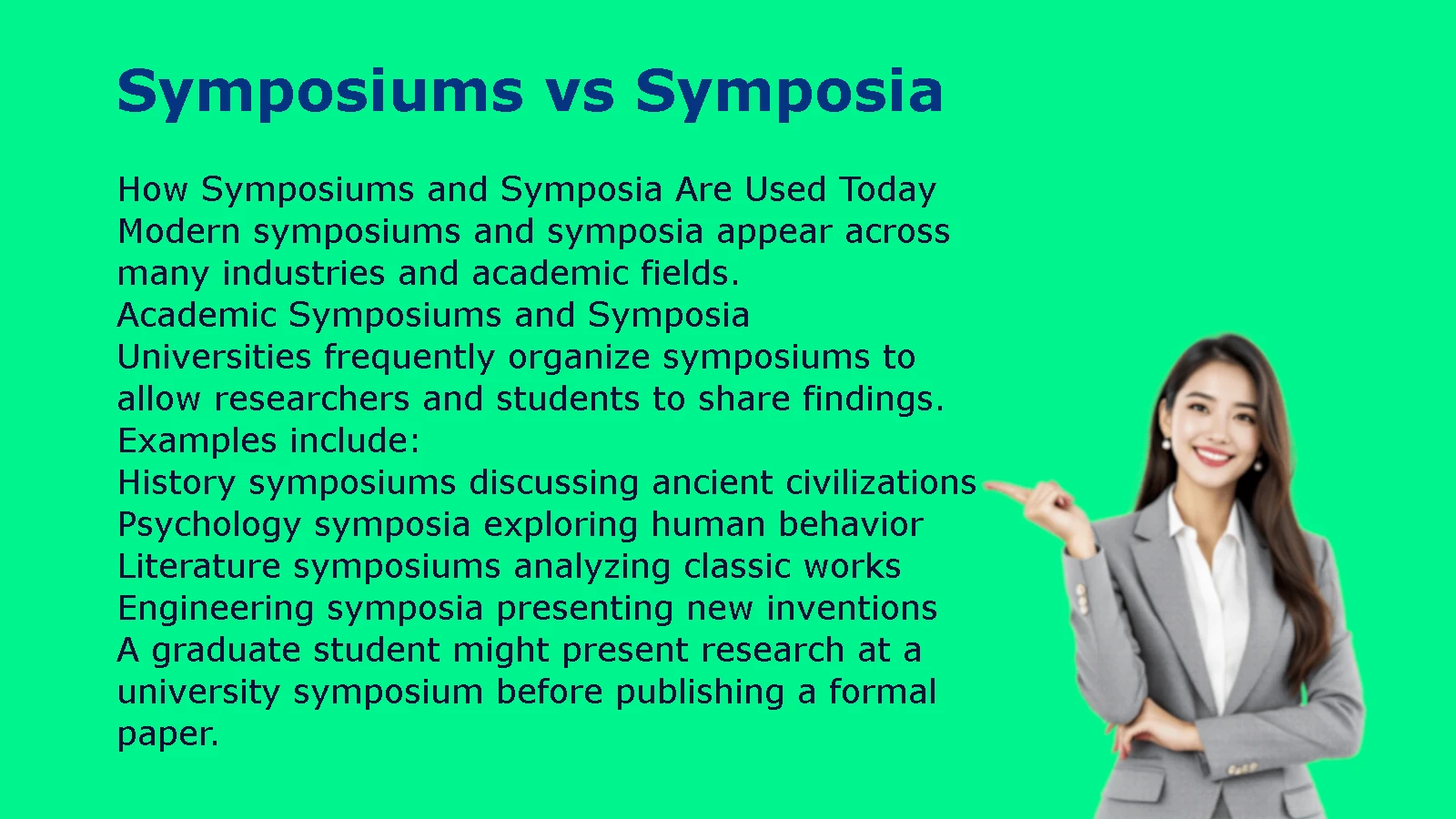
How Symposiums and Symposia Are Used Today
Modern symposiums and symposia appear across many industries and academic fields.
Academic Symposiums and Symposia
Universities frequently organize symposiums to allow researchers and students to share findings.
Examples include:
- History symposiums discussing ancient civilizations
- Psychology symposia exploring human behavior
- Literature symposiums analyzing classic works
- Engineering symposia presenting new inventions
A graduate student might present research at a university symposium before publishing a formal paper.
Medical Symposiums and Symposia
Healthcare organizations often hold symposiums to discuss medical discoveries.
Common topics include:
- Cancer research
- New medications
- Public health challenges
- Surgical techniques
- Disease prevention
Medical professionals often use the word symposia because academic and scientific communities traditionally preserve Greek and Latin plural forms.
For example:
“The researchers presented their findings at international medical symposia.”
This sounds natural in a scholarly environment.
Business Symposiums
Companies and professional organizations also host symposiums.
Business symposium topics may include:
- Leadership strategies
- Market trends
- Workplace innovation
- Financial planning
- Technology development
In business writing, symposiums is often more common because it sounds familiar to a general audience.
Example:
“The company organizes leadership symposiums for emerging executives.”
Symposiums vs Symposia: The Main Difference
The main difference between symposiums and symposia is their plural formation.
| Word | Meaning | Origin | Common Use |
| Symposium | One formal gathering or discussion event | Greek origin | Singular form |
| Symposiums | More than one symposium | English plural form | General and professional writing |
| Symposia | More than one symposium | Traditional Greek plural form | Academic and scientific writing |
Both words describe multiple symposium events.
The difference comes from language history.
Symposiums follows normal English grammar rules:
symposium + s = symposiums
Symposia follows the original Greek plural pattern:
symposium → symposia
English speakers often choose between these forms depending on context.
Is Symposiums Correct?
Yes, symposiums is correct.
Many people assume that because symposia comes from Greek, it must be the only correct plural. That idea is outdated. English constantly changes, and many borrowed words become regular English words over time.
When a foreign word becomes common, English speakers often add standard plural endings.
For example:
| Traditional Form | English Form |
| Forum → fora | Forum → forums |
| Stadium → stadia | Stadium → stadiums |
| Memorandum → memoranda | Memorandum → memorandums |
| Symposium → symposia | Symposium → symposiums |
Both forms can exist at the same time.
Why English Accepts Symposiums
Languages evolve based on how people actually use words. Over time, English speakers began treating symposium like other English nouns.
Instead of remembering the Greek plural rule, many speakers naturally use:
- One symposium
- Two symposiums
- Several symposiums
This pattern is especially common outside academic circles.
For example:
“The organization hosted three technology symposiums this year.”
This sentence sounds completely natural in everyday English.
When to Use Symposiums
Use symposiums when writing for a broad audience or when clarity matters more than tradition.
It works well in:
- Blog posts
- News articles
- Business documents
- General communication
- Educational websites
Examples:
Business Context
“The company sponsors industry symposiums to connect professionals from different fields.”
General Writing
“Many environmental symposiums focus on protecting natural resources.”
Public Communication
“The museum hosts art symposiums throughout the year.”
In these examples, symposiums feels approachable and easy to understand.
For most general readers, it is often the better choice because it follows familiar English patterns.
Is Symposia Correct?
Yes, symposia is correct. It is the traditional plural form of symposium and comes directly from the original Greek language pattern.
While symposiums follows modern English rules, symposia keeps the historical Greek ending. Many academic, scientific, and professional communities continue to use it because it carries a more formal and scholarly tone.
For example:
“The university hosted several international symposia on renewable energy.”
This sentence sounds natural in an academic setting because universities and research organizations often maintain traditional terminology.
However, using symposia doesn’t automatically make writing better. The best word depends on your audience. A research journal may prefer symposia, while a general audience may find symposiums clearer.
Why Academic Fields Often Use Symposia
Academic communities frequently preserve classical plural forms because many scholarly terms come from Greek and Latin.
Fields like medicine, science, law, and philosophy have a long tradition of using these forms.
Examples include:
- Alumnus → alumni
- Criterion → criteria
- Phenomenon → phenomena
- Symposium → symposia
These words often remain popular in academic environments because they connect modern research with centuries of scholarly tradition.
For example, a scientific journal might write:
“The findings were presented at several international symposia.”
A university announcement may say:
“The department will host two research symposia this semester.”
In these contexts, symposia feels appropriate because the audience expects formal academic language.
When to Use Symposia
Use symposia when writing in settings where a formal or scholarly tone fits.
Common examples include:
- Academic papers
- Research publications
- University announcements
- Scientific reports
- Professional journals
- Institutional documents
Examples of Symposia in Sentences
Academic Example
“The history department organized three symposia examining ancient civilizations.”
Scientific Example
“Researchers shared their discoveries at global environmental symposia.”
Medical Example
“Doctors attended specialized symposia focused on advances in cancer treatment.”
Professional Example
“The association sponsors annual leadership symposia for industry experts.”
The word does not change the meaning. It simply creates a different tone.
Symposiums vs Symposia: Which One Should You Use?
Choosing between symposiums and symposia depends on three main factors:
- Your audience
- Your writing style
- Your purpose
There is no universal rule that says one form is always better.
Use Symposiums When:
Choose symposiums if you want your writing to feel natural and accessible.
It works best for:
- General readers
- Online content
- Marketing materials
- News articles
- Everyday conversations
Examples:
“The city hosts several educational symposiums each year.”
“Technology symposiums help businesses discover new trends.”
These sentences sound clear and familiar.
Use Symposia When:
Choose symposia if you want to match a formal academic environment.
It works best for:
- Research papers
- Scientific writing
- University publications
- Scholarly discussions
Examples:
“The researchers presented their studies at international symposia.”
“The conference included multiple symposia covering different areas of neuroscience.”
Here, symposia matches the professional setting.
Symposiums vs Symposia: Quick Decision Guide
| Situation | Better Choice | Reason |
| Blog article for general readers | Symposiums | Easier and more familiar |
| University research paper | Symposia | Matches academic style |
| Business website | Symposiums | Sounds natural |
| Scientific journal | Symposia | Traditional scholarly usage |
| Casual conversation | Symposiums | Common English form |
| Formal academic announcement | Symposia | Fits institutional tone |
A simple rule:
When speaking to everyday readers, use symposiums. When writing for scholars, symposia may fit better.
Are Symposiums and Symposia Equally Common?
Both words appear in modern English, but their popularity varies by field.
Symposiums has become increasingly common because English speakers often prefer regular plural forms.
Symposia remains especially common in:
- Scientific research
- Medicine
- Higher education
- Academic organizations
The difference is similar to other pairs where English accepts both traditional and modern forms.
Examples:
| Traditional Plural | Modern English Plural |
| Cacti | Cactuses |
| Octopi | Octopuses |
| Formulae | Formulas |
| Symposia | Symposiums |
English does not always replace older forms. Instead, it often keeps both and assigns them slightly different uses.
Symposiums vs Symposia Examples in Real Sentences
Seeing both words in context makes the difference easier to understand.
Examples Using Symposiums
“The organization hosts several technology symposiums every year.”
This sounds natural because the sentence targets a general audience.
“Local artists participated in creative symposiums focused on modern design.”
The regular plural makes the sentence easy to read.
“The company attended business symposiums to learn about industry changes.”
This fits professional communication.
Examples Using Symposia
“The university conducted several research symposia during the academic year.”
The formal setting supports the traditional plural.
“Scientists gathered at international symposia to discuss climate solutions.”
The scientific context makes symposia a natural choice.
“The medical association organized specialized symposia for healthcare professionals.”
The word fits because the audience is highly specialized.
Symposium vs Conference: Are They the Same?
People sometimes use symposium and conference interchangeably, but they are not exactly the same.
Both involve groups of people meeting to share information. However, they usually have different structures.
| Feature | Symposium | Conference |
| Main purpose | Focused discussion on one topic | Broader exchange of ideas |
| Size | Usually smaller | Often larger |
| Topics | Narrow and specialized | Multiple topics or fields |
| Presentations | Expert focused | Many sessions and speakers |
| Audience | Specialists and researchers | Professionals, students, and general participants |
For example:
A university may organize a technology conference covering software, hardware, cybersecurity, and business.
A technology symposium might focus only on artificial intelligence ethics.
Symposium vs Seminar vs Workshop
These terms often overlap, but they describe different types of events.
| Event | Main Purpose | Typical Activity |
| Symposium | Share expert knowledge | Presentations and discussions |
| Seminar | Teach or explain a topic | Lectures and learning sessions |
| Workshop | Develop practical skills | Hands on activities |
| Conference | Bring people together around broad themes | Multiple sessions and networking |
A workshop usually asks participants to actively practice something.
A symposium usually focuses more on discussion and expert presentations.
For example:
- A writing symposium may include authors discussing storytelling techniques.
- A writing workshop may require participants to create and edit their own stories.
Common Mistakes When Using Symposiums and Symposia
Even though both forms are correct, writers often make mistakes when using them.
Mistake: Assuming Symposiums Is Wrong
Some people believe that only symposia is acceptable because the word has Greek origins.
That is incorrect.
Modern English accepts symposiums as a standard plural form.
Example:
✅ “The university hosted several symposiums.”
This sentence is grammatically correct.
Mistake: Using Symposia to Sound More Intelligent
A common writing mistake is choosing complicated words simply because they appear more formal.
Using symposia in a casual article can sometimes make the writing feel unnecessarily academic.
For example:
“Our company attended several business symposia.”
This is correct, but:
“Our company attended several business symposiums.”
may sound more natural for customers and general readers.
Clear communication matters more than using traditional forms.
Mistake: Mixing Singular and Plural Forms
The singular and plural forms must match.
Incorrect:
“Several symposium was held last year.”
Correct:
“Several symposiums were held last year.”
Correct:
“Several symposia were held last year.”
The noun must agree with the number being discussed.
Understanding Symposium, Symposiums, Symposia, and Possessive Forms
Understanding the different forms of symposiums vs symposia becomes easier when you know how each word functions in a sentence.
Many mistakes happen because writers focus only on the plural forms and forget about possessive forms or sentence structure.
Here is a complete breakdown:
| Form | Meaning | Example |
| Symposium | One event | “The symposium begins on Monday.” |
| Symposiums | More than one event (regular English plural) | “Several symposiums were held this year.” |
| Symposia | More than one event (traditional Greek plural) | “Several symposia attracted international researchers.” |
| Symposium’s | Something belonging to one symposium | “The symposium’s theme focused on climate change.” |
| Symposiums’ | Something belonging to multiple symposiums | “The symposiums’ schedules were released online.” |
These forms follow normal English grammar rules.
How to Remember the Difference Between Symposiums and Symposia
Learning the difference between symposiums and symposia does not need to feel complicated.
A simple memory trick can help:
- Symposiums = standard English plural
- Symposia = traditional Greek plural
Think of symposiums as the everyday version and symposia as the academic version.
Another way to remember it:
If the audience is your neighbor, “symposiums” probably sounds better. If the audience is a researcher, “symposia” may fit better.
This is not a strict rule. It is simply a useful guide for choosing the most natural word.
Why English Has Multiple Plural Forms
The confusion around symposiums vs symposia comes from a larger pattern in the English language.
English is a mixture of many languages, including:
- Greek
- Latin
- French
- German
- Old Norse
Because of this, English has inherited different ways to create plurals.
Some words keep their original endings:
- Analysis → analyses
- Thesis → theses
- Criterion → criteria
Others become regular English words:
- Idea → ideas
- Computer → computers
- Symposium → symposiums
Over time, many borrowed words develop two accepted forms.
This happens because language follows usage. When millions of speakers use a word in a certain way, that usage often becomes accepted.
Case Study: Academic Writing vs General Communication
The choice between symposiums and symposia often depends on the type of reader.
Imagine two different situations.
Case Study One: A University Research Journal
A university publishes an article about international scientific gatherings.
The sentence reads:
“Researchers shared their findings at several international symposia.”
This works well because the audience includes academics, scientists, and researchers.
The formal tone matches the subject.
Case Study Two: A Business Website
A company writes a blog post about professional events.
The sentence reads:
“Our team participates in industry symposiums to discover new trends.”
This feels more natural because the article targets business readers.
Using symposiums improves accessibility without changing the meaning.
Frequently Asked Questions About Symposiums vs Symposia
Is Symposia the Correct Plural of Symposium?
Yes. Symposia is the traditional Greek plural form of symposium.
However, it is not the only correct option.
Symposiums is also accepted in modern English.
Is Symposiums Grammatically Correct?
Yes. Symposiums is a correct English plural.
English commonly adds s to borrowed words, especially when those words become common in everyday use.
Example:
“The organization hosts several symposiums each year.”
This sentence is completely acceptable.
Which Is Better: Symposiums or Symposia?
Neither word is always better.
The best choice depends on context.
Use:
- Symposiums for general readers and everyday writing.
- Symposia for academic and scientific writing.
The goal is not to sound more formal. The goal is to communicate clearly.
Do Scientists Prefer Symposia?
Many scientists and academics use symposia because scientific communities often preserve traditional terminology.
For example:
“The researchers presented their work at medical symposia.”
However, scientists may also use symposiums, especially in less formal communication.
Can I Use Symposiums in Formal Writing?
Yes.
Formal writing does not require traditional plurals in every situation.
A business report, government document, or professional article can use symposiums without any grammatical issue.
The important thing is consistency.
Common Examples of Symposiums and Symposia in Different Fields
The plural form often changes depending on the industry.
Medicine
Preferred style:
“Doctors attended international medical symposia.”
Reason:
Medical writing often follows traditional academic conventions.
Technology
Common style:
“The company hosts technology symposiums every year.”
Reason:
Technology audiences often prefer straightforward modern English.
Education
Both forms appear:
“Students participated in academic symposiums.”
or:
“Students presented research at academic symposia.”
Both are correct.
Arts and Humanities
Both forms are used:
“The museum organized several art symposiums.”
or:
“The department hosted literary symposia.”
The choice depends on the organization’s style.
A Simple Rule for Writers
When deciding between symposiums vs symposia, ask:
Who will read this?
If your audience includes:
- Customers
- General readers
- Website visitors
- Business professionals
Choose:
✅ Symposiums
If your audience includes:
- Researchers
- Academics
- Scientists
- Scholars
Choose:
✅ Symposia
The difference is mostly about tone, not correctness.
Final Thoughts on Symposiums vs Symposia
The debate between symposiums vs symposia is not really about right versus wrong. It is about understanding how English changes and adapts over time.
Symposia preserves the traditional Greek plural form and remains popular in academic, scientific, and scholarly environments. It carries a formal tone and connects modern writing with the historical roots of the word.
Symposiums, on the other hand, follows normal English grammar rules. It is widely accepted and often feels more natural in everyday communication, business writing, and general content.
Both forms have a place in modern English.
A quick summary:
| Use | Best Choice |
| Everyday writing | Symposiums |
| Blog content | Symposiums |
| Business communication | Symposiums |
| Academic papers | Symposia |
| Scientific publications | Symposia |
| Formal research settings | Symposia |