Have you ever wondered whether you should write “desert” or “dessert”? These two words look almost identical, but they have completely different meanings. If you’ve ever paused while writing a sentence and thought twice about which one to use, you’re not alone.
Desert and dessert are different words with different meanings and pronunciations. Desert can refer to a dry, sandy region with little rainfall, while dessert means a sweet food served after a meal.
Examples:
- The Sahara is the world’s largest hot desert.
- We had chocolate cake for dessert.
The confusion is understandable. People often search for desert or dessert, desert vs dessert, dessert vs desert, or how to remember the difference between desert and dessert because the extra s changes both the spelling and meaning. And here’s the kicker: one simple letter can be the difference between talking about a sandy landscape and ordering something sweet after dinner.
In this guide, you’ll learn the complete difference between desert and dessert, including their meanings, definitions, pronunciations, spelling, correct usage, and examples in sentences. You’ll also discover an easy trick to remember desert vs dessert and avoid confusing these two commonly mixed up words.
Desert vs Dessert at a Glance
The quickest way to understand Desert vs Dessert is to compare their meanings and grammatical uses.
| Word | Part of speech | Meaning | Pronunciation in American English | Example |
| desert | Noun | A dry region with little rainfall | /ˈdez.ɚt/ | The hikers crossed the desert. |
| desert | Verb | To leave or abandon | /dɪˈzɝːt/ | He would never desert his family. |
| desert | Noun | Something deserved, especially a punishment or reward | /dɪˈzɝːt/ | She received her just deserts. |
| dessert | Noun | Sweet food served after a meal | /dɪˈzɝːt/ | We ordered dessert after dinner. |
The most common distinction is simple:
Desert is dry land. Dessert is something sweet.
However, stopping there leaves out two important uses of desert. The word can also function as a verb, and the less familiar noun appears in the expression just deserts.
What Does Desert Mean?
Desert has several meanings, so context matters. The most familiar meaning describes a type of landscape.
Desert as a Dry Region
A desert is an area that receives very little precipitation and supports relatively little vegetation. Sand is common in many deserts, but sand isn’t what makes a place a desert.
That distinction matters.
A desert can contain sand dunes, rocks, gravel, mountains, shrubs, or other terrain. Some deserts are also cold rather than hot. So the mental picture of endless hot sand is useful for remembering the word, but it isn’t a complete definition.
Cambridge defines a desert as an area, often covered with sand or rocks, where there is very little rain and not many plants.
For example:
- The explorers traveled across the desert.
- The desert receives very little rainfall.
- Many animals have adapted to life in the desert.
- The road disappeared into the desert.
- Water is especially valuable in a dry desert environment.
The word can also describe something figuratively barren or lacking a particular quality. For example, cultural desert can describe a place considered to lack cultural activity or interest.
Desert as a Verb
Desert can also be a verb. In this use, it means to leave someone or something, especially when you should remain, or to abandon a responsibility or position.
For example:
- He refused to desert his family.
- The soldiers were accused of deserting their posts.
- She felt that her friends had deserted her.
- The residents deserted the town after the evacuation order.
- His courage deserted him during the difficult moment.
The word often carries a stronger meaning than simply leave. If someone leaves a place after work, you wouldn’t normally say that they deserted it. The verb often suggests abandonment, disloyalty, or leaving someone in a difficult situation.
Cambridge specifically includes leaving the armed forces without permission as one meaning of desert, while also defining it more broadly as leaving someone without help or leaving them in a difficult situation.
Desert as a Verb in Military Contexts
One especially established use involves military service.
To desert the armed forces means to leave without permission and with no intention of returning. The related noun is desertion, and a person who does this is a deserter.
For example:
The soldier was accused of deserting his post.
Here, deserting has nothing to do with sand or sweets. It describes abandoning a military duty.
Deserted: A Related Form
The adjective deserted means abandoned, empty, or lacking people.
For example:
- We walked along a deserted street.
- The building stood deserted for years.
- The beach was almost deserted after the storm.
- The town looked deserted at night.
Notice how the meaning connects to the verb desert. If people desert a place, that place can become deserted.
What Does Dessert Mean?
Dessert is a noun for sweet food eaten at the end of a meal.
Cake, pie, ice cream, pudding, pastries, and many fruit based dishes can all be called dessert. The exact food varies by cuisine and culture, but the basic word refers to the sweet course or dish.
For example:
- We had chocolate cake for dessert.
- Would you like dessert?
- The restaurant has a long dessert menu.
- She made a fruit pie for dessert.
- They decided to skip dessert.
- Save room for dessert.
Dessert Is a Noun
Unlike desert, which can function as both a noun and a verb, dessert is normally used as a noun in this meaning.
Common expressions include:
- have dessert
- order dessert
- serve dessert
- eat dessert
- skip dessert
- make dessert
- save room for dessert
- dessert menu
- dessert course
These combinations make the word easy to recognize in everyday writing.
If you see a sentence such as “What are we having for dessert?”, the meaning is straightforward: the speaker wants to know what sweet food will be served after the meal.
Dessert Doesn’t Mean Only Cake
Another common misconception is that dessert means cake or ice cream specifically.
It doesn’t.
Dessert is a category rather than one particular food. Depending on the meal, it might be pie, fruit, pudding, ice cream, pastries, or another sweet dish. Cambridge lists examples such as apple pie, peaches and cream, and layered chocolate desserts.
So these are all natural:
- We had fruit for dessert.
- Ice cream was served for dessert.
- She prepared a chocolate dessert.
- The restaurant offers several desserts.
Why Are Desert and Dessert So Easy to Confuse?
The problem isn’t the meanings. The meanings are usually easy to distinguish.
The real trouble comes from spelling and pronunciation.
Both words contain the letters d-e-s-e-r-t, with dessert adding one extra s. That small difference creates two separate words with unrelated everyday meanings.
The pronunciation makes things even trickier.
The Pronunciation Difference
In American English, desert meaning dry land is pronounced with stress on the first syllable:
/ˈdez.ɚt/
The verb desert is pronounced with stress on the second syllable:
/dɪˈzɝːt/
Dessert also has second syllable stress:
/dɪˈzɝːt/
Cambridge gives these American pronunciations for the two words.
That means desert has two common pronunciations depending on its meaning, while dessert shares its pronunciation with the verb desert.
| Meaning | Word | Stress |
| Dry region | desert | First syllable |
| Abandon | desert | Second syllable |
| Sweet food | dessert | Second syllable |
This is why context matters so much when you’re listening rather than reading.
If someone says a sentence about crossing a huge dry region, you can identify desert from context. If someone says they might desert their responsibilities, the context points to the verb.
How to Remember Desert vs. Dessert
The best way to remember Desert vs Dessert is to connect the spelling with the meaning.
Remember: Dessert Has Two S’s
A popular memory trick is:
Dessert has two S’s because you might want seconds.
It’s not a grammatical rule. It’s simply a mnemonic.
Imagine finishing a meal and enjoying a slice of cake. Then someone asks whether you’d like another slice.
You might say yes.
That’s your second serving of dessert.
So:
dessert → two S’s → seconds
This is one of the easiest ways to lock in the spelling.
Remember: Desert Has One S
For the dry landscape, use the shorter spelling:
desert → one S
Picture a dry landscape with little rainfall and sparse vegetation. You don’t need an elaborate trick. The meaning itself can become the memory cue.
Use the Meaning Test
When you’re unsure, ask yourself one question:
What am I talking about?
If the answer is:
- Dry land → desert
- Abandoning someone or something → desert
- Sweet food → dessert
- Something someone deserves → desert, as in just deserts
This works better than trying to remember the spelling in isolation.
Desert vs Dessert Examples
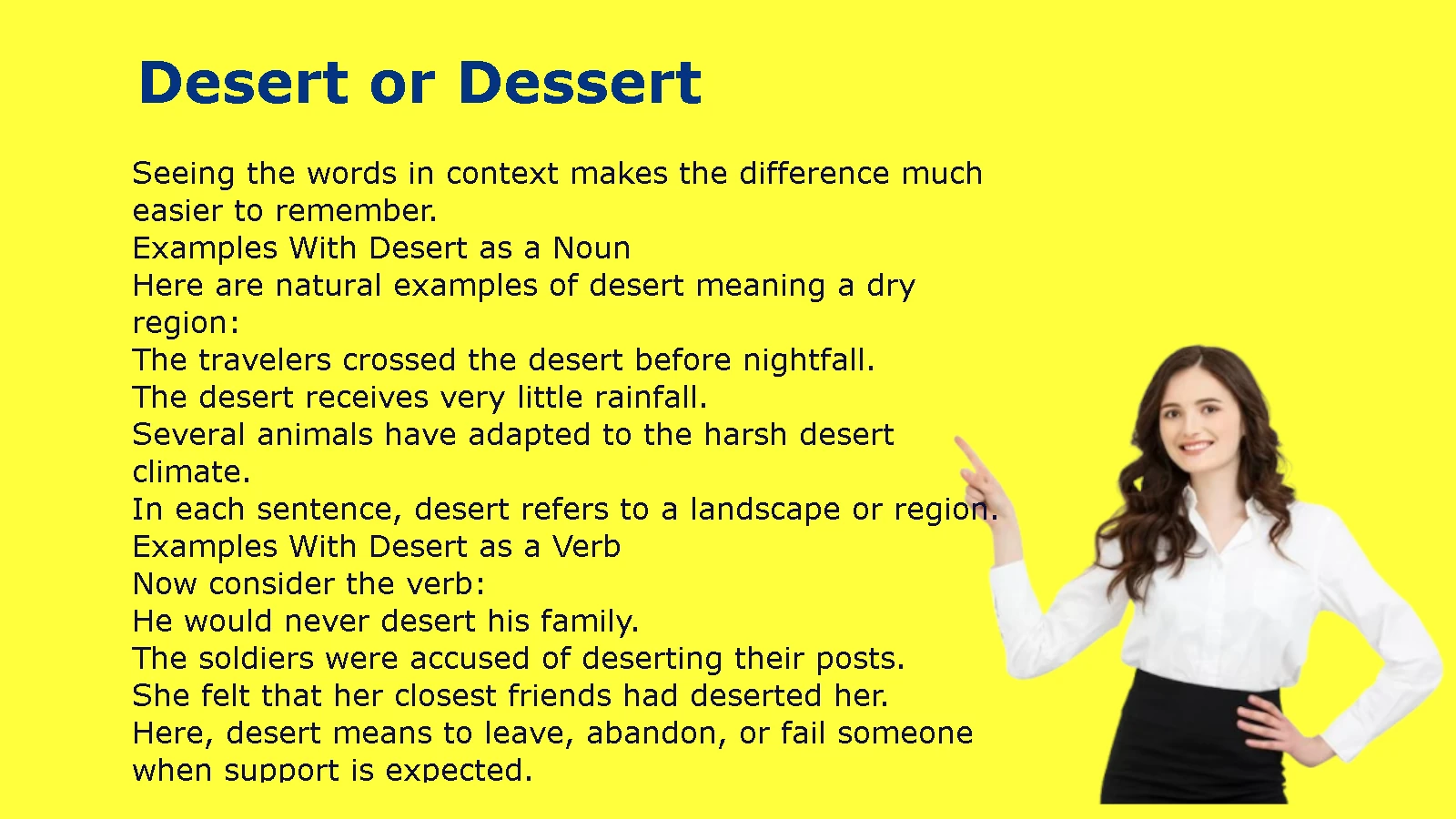
Seeing the words in context makes the difference much easier to remember.
Examples With Desert as a Noun
Here are natural examples of desert meaning a dry region:
- The travelers crossed the desert before nightfall.
- The desert receives very little rainfall.
- Several animals have adapted to the harsh desert climate.
In each sentence, desert refers to a landscape or region.
Examples With Desert as a Verb
Now consider the verb:
- He would never desert his family.
- The soldiers were accused of deserting their posts.
- She felt that her closest friends had deserted her.
Here, desert means to leave, abandon, or fail someone when support is expected.
Examples With Dessert
Now add the second s:
- We had ice cream for dessert.
- The restaurant serves three different desserts.
- She ordered chocolate cake for dessert.
- Would you like dessert?
- They skipped dessert because they were already full.
- The chef created a new dessert for the menu.
- Fruit and cream made a simple dessert.
The extra s signals the sweet food meaning.
Desert and Dessert Side by Side
A side by side comparison can make the distinction almost automatic.
| Sentence | Correct word | Why? |
| The camel crossed the desert. | desert | It refers to dry land. |
| We had cake for dessert. | dessert | It refers to sweet food. |
| He refused to desert his friends. | desert | It means abandon. |
| The soldiers were accused of deserting their posts. | desert | It means leaving without permission. |
| The restaurant serves several desserts. | dessert | It refers to sweet foods. |
| They traveled through the desert. | desert | It refers to a dry region. |
| She ordered pie for dessert. | dessert | It refers to a sweet course. |
| His courage deserted him. | desert | It means his courage suddenly left him. |
The pattern is clear once you stop looking at the words as isolated spellings and start looking at their meanings.
“Just Deserts” or “Just Desserts”?
This is where the desert or dessert question gets genuinely interesting.
The standard expression is just deserts, not just desserts.
At first glance, that seems strange. After all, the phrase sounds like desserts.
But just deserts has nothing to do with cake, pie, or ice cream.
What Does “Just Deserts” Mean?
Just deserts means the reward or punishment that someone deserves. In modern usage, it most often refers to a punishment or negative consequence that a person deserves because of their actions.
For example:
The dishonest businessman finally got his just deserts.
The sentence doesn’t mean he received a plate of sweets.
It means he received the consequences he deserved.
Another example:
After years of mistreating his employees, he finally got his just deserts.
Here, deserts is a special noun related to the idea of what someone deserves.
Why Is “Just Deserts” Spelled With One S?
This isn’t a typo.
Merriam Webster explains that the expression uses an older noun desert meaning a deserved reward or punishment. The word is spelled like the dry land desert, but it is pronounced like dessert.
That gives English an unusual three way distinction:
- desert = dry land
- desert = deserved reward or punishment
- dessert = sweet food
The second desert is much less common outside expressions such as just deserts.
A Quick Way to Remember “Just Deserts”
Think of the word deserve.
Just deserts → what someone deserves.
That connection is more useful than trying to associate the phrase with food.
Merriam Webster describes just deserts as the proper spelling for the phrase meaning the punishment someone deserves.
Common Desert vs Dessert Mistakes
These errors are common because the words look almost identical.
Mistake: “We had cake for desert.”
Incorrect:
We had cake for desert.
Correct:
We had cake for dessert.
Cake is sweet food served after a meal, so you need dessert with two S’s.
Mistake: “The camel crossed the dessert.”
Incorrect:
The camel crossed the dessert.
Correct:
The camel crossed the desert.
A camel can certainly appear in a dessert themed joke, but in an ordinary sentence about geography, the correct word is desert.
Mistake: “He would never dessert his family.”
Incorrect:
He would never dessert his family.
Correct:
He would never desert his family.
Here, desert is a verb meaning to abandon.
Mistake: “He got his just desserts.”
Incorrect in the standard expression:
He got his just desserts.
Correct:
He got his just deserts.
The expression uses the less familiar noun deserts, not the word for sweet food.
Desert vs Dessert Grammar
Understanding the grammar makes these words easier to use correctly.
| Word | Grammar | Example |
| desert | Noun | The desert is vast. |
| desert | Verb | Don’t desert your friends. |
| deserted | Verb/adjective | They deserted the town. / The street was deserted. |
| desertion | Noun | Desertion from the military can have serious consequences. |
| dessert | Noun | We ordered dessert. |
| desserts | Plural noun | The menu lists several desserts. |
Desert Can Be a Noun or Verb
This is one of the most important details to remember.
When desert refers to a landscape, it is a noun:
The desert was extremely dry.
When desert means abandon, it is a verb:
He would never desert his friends.
The pronunciation changes along with the meaning.
Dessert Is a Noun
Dessert normally functions as a noun:
The dessert was delicious.
You can make it plural:
The restaurant offers several desserts.
The plural form is especially easy to recognize because the word already contains two S’s before the ending.
A Practical Case Study: Three Sentences, Three Meanings
Consider these three sentences:
The hikers crossed the desert.
The hikers ate dessert afterward.
The guide refused to desert them.
This tiny set of examples captures the entire problem. The spelling isn’t random. Each word performs a different job.
Why the Extra S Matters
The difference between one S and two S’s may look minor, but spelling often carries meaning.
Compare:
desert → dry land
dessert → sweet food
If you write “We crossed the dessert,” the reader may briefly picture a chocolate landscape instead of a geographical one.
Likewise, “We had cake for desert” removes the spelling cue that tells the reader you’re talking about food.
In everyday writing, context often saves you. In formal writing, however, correct spelling keeps the meaning precise.
That matters in:
- school assignments
- business writing
- articles
- menus
- travel writing
- emails
- professional documents
- creative writing
A one letter difference can change the entire image a sentence creates.
A Simple Decision Guide for Desert or Dessert
When you need to choose between desert and dessert, use this quick test.
Use desert when you mean:
- A dry geographical region
- A barren or sparsely vegetated area
- To abandon someone
- To leave a position without permission
- A deserved reward or punishment in just deserts
Use dessert when you mean:
- Cake
- Pie
- Ice cream
- Pudding
- Pastries
- Fruit served as a sweet course
- Any other sweet food served at the end of a meal
Here’s the shortcut:
Dry land = desert. Sweet food = dessert. Abandon = desert. What someone deserves = just deserts.
Desert or Dessert Practice Quiz
Test yourself before moving on.
Choose desert, deserted, dessert, or the appropriate form of desert for each sentence.
- The explorers traveled across the ___.
- We ordered ice cream for ___.
- He would never ___ his family.
- The soldiers were accused of ___ their posts.
- The restaurant has an impressive ___ menu.
- The empty town looked completely ___.
- The travelers watched the sunset over the ___.
- She made apple pie for ___.
- His courage ___ him during the difficult moment.
- After years of dishonest behavior, he finally got his just ___.
Answer Key
- desert
- dessert
- desert
- deserting
- dessert
- deserted
- desert
- dessert
- deserted
- deserts
The last answer is the trickiest. Just deserts uses the less common noun meaning something deserved, not the word referring to sweet food.
Frequently Asked Questions About Desert or Dessert
Is it desert or dessert?
Both words are correct, but they have different meanings. Desert usually means a dry region or, as a verb, to abandon someone or something. Dessert means sweet food served at the end of a meal.
Is dessert spelled with one S or two?
Dessert is spelled with two S’s.
A useful memory trick is to associate the two S’s with seconds. You might want seconds of dessert.
What is the difference between desert and dessert?
Desert refers to dry land or can mean to abandon. Dessert refers to sweet food eaten after a meal.
How do you remember desert vs. dessert?
Remember:
Dessert has two S’s because you may want seconds.
Then keep desert with one S for the dry landscape.
For the verb desert, remember that it means to leave or abandon.
Are desert and dessert pronounced the same?
Not always.
The noun desert, meaning a dry region, has first syllable stress. The verb desert and the noun dessert have second syllable stress in American English.
Is “just deserts” or “just desserts” correct?
The standard expression is just deserts, with one S in deserts.
It means the consequences, reward, or punishment someone deserves. Modern usage usually involves a deserved punishment or negative consequence.
Is desert a noun or a verb?
It can be either.
As a noun, desert can mean a dry region.
As a verb, desert means to leave or abandon someone or something.
There is also a less common noun desert in the expression just deserts, where it refers to something deserved.
Is dessert always cake?
No. Dessert is a broad term for sweet food served at the end of a meal. It can include cake, pie, ice cream, pudding, pastries, fruit based dishes, and many other foods.
Does every desert have sand?
No. Sand isn’t required for an area to be a desert. The defining idea is very low precipitation and limited vegetation, not simply a landscape covered in sand. Cambridge describes deserts as areas often covered with sand or rocks where there is very little rain and not many plants.
Why does “just deserts” sound like “desserts”?
Because the noun desert used in just deserts has a pronunciation like dessert even though it is spelled like the dry land word. It comes from an older sense related to what someone deserves.
Final Takeaway: Desert or Dessert?
The difference between desert and dessert becomes easy once you connect each spelling to its meaning.
| If you mean… | Use… |
| A dry region | desert |
| To abandon someone or something | desert |
| Something deserved | desert, as in just deserts |
| Sweet food after a meal | dessert |
The most useful memory trick is simple:
Desert = dry land.
Dessert = sweet food.
Dessert has two S’s because you may want seconds.
Just deserts = what someone deserves.
So if you’re writing about a meal, choose dessert. If you’re writing about a dry landscape, choose desert. If you’re describing someone abandoning a person, duty, or position, use desert as a verb.
And when someone finally gets what they deserve, remember the odd one out: just deserts.