Have you ever dealt with someone who refuses to cooperate, even when you give them a good reason to? That stubborn behavior may be described as recalcitrance. While Recalcitrance Meaning can seem complicated at first, the word simply describes a strong refusal to obey, cooperate, or follow rules.
Recalcitrance is a noun that means stubborn resistance to authority, control, or guidance. It often describes someone who refuses to do what they are asked or continues to resist despite pressure to comply.
Examples:
- His recalcitrance made it difficult for the team to finish the project.
- The teacher struggled with the student’s recalcitrance.
The confusion is understandable. People often search for what does recalcitrance mean, recalcitrance definition, recalcitrance meaning in English, or recalcitrance synonym because the word is formal and isn’t common in everyday conversation. And here’s the kicker: recalcitrance usually suggests more than ordinary stubbornness. It often involves active resistance to authority, rules, or instructions.
In this guide, you’ll learn the complete Recalcitrance Meaning, its definition, pronunciation, origin, synonyms, antonyms, and correct usage. You’ll also discover how to use recalcitrance in a sentence, what it means in different contexts, and how it differs from similar words such as stubbornness, defiance, and disobedience.
What Does Recalcitrance Mean?
Recalcitrance means determined resistance to authority, instructions, rules, expectations, or control.
Cambridge Dictionary classifies recalcitrance as a formal noun and defines it as the quality of being determined not to do what other people, especially people in authority, want or expect.
The key idea is resistance.
Someone who shows recalcitrance doesn’t merely misunderstand an instruction or forget to follow it. The person actively or persistently resists what is expected.
Consider these two situations:
- An employee forgets to submit a report because they were busy.
- An employee refuses to submit the report despite repeated reasonable requests.
The first situation may involve forgetfulness or poor organization. The second could involve recalcitrance.
Recalcitrance in Simple Words
In everyday English, you can think of recalcitrance as:
- Stubborn resistance
- Refusal to cooperate
- Resistance to authority
- Unwillingness to obey
- Persistent noncompliance
- Defiance of instructions
- Resistance to being controlled
The word usually describes more than a single disagreement. It suggests a persistent unwillingness to comply.
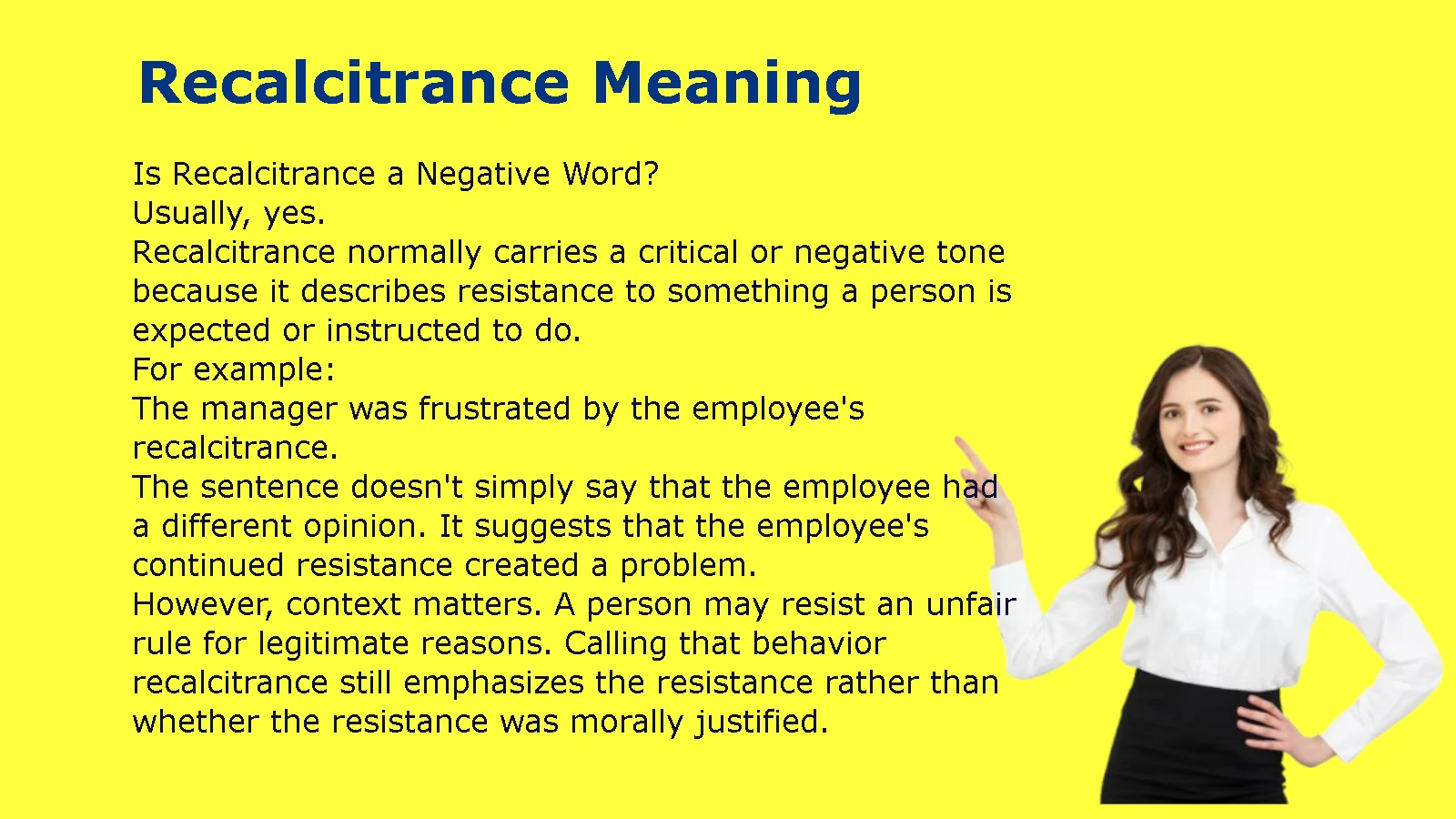
Is Recalcitrance a Negative Word?
Usually, yes.
Recalcitrance normally carries a critical or negative tone because it describes resistance to something a person is expected or instructed to do.
For example:
The manager was frustrated by the employee’s recalcitrance.
The sentence doesn’t simply say that the employee had a different opinion. It suggests that the employee’s continued resistance created a problem.
However, context matters. A person may resist an unfair rule for legitimate reasons. Calling that behavior recalcitrance still emphasizes the resistance rather than whether the resistance was morally justified.
Recalcitrance Definition at a Glance
| Feature | Details |
| Word | Recalcitrance |
| Part of speech | Noun |
| Meaning | Persistent resistance to authority, control, rules, or instructions |
| Tone | Usually negative or critical |
| Register | Formal |
| Adjective | Recalcitrant |
| Common synonyms | Defiance, stubbornness, disobedience, resistance, intractability |
| Common antonyms | Compliance, obedience, cooperation |
| Pronunciation | /rɪˈkæl.sɪ.trəns/ |
| Origin | French and Late Latin |
| Earliest recorded English use | 1845 |
Cambridge identifies recalcitrance as a formal, uncountable noun. Etymonline dates the English noun to 1845.
Recalcitrance Part of Speech
Recalcitrance is a noun.
More specifically, dictionaries commonly treat it as an uncountable noun, meaning you generally don’t use it as a recalcitrance when referring to the quality itself.
Examples of Recalcitrance as a Noun
- His recalcitrance frustrated the supervisor.
- The committee struggled with the group’s recalcitrance.
- Her recalcitrance toward authority created tension.
- The negotiations stalled because of continued recalcitrance.
- The teacher was surprised by the student’s recalcitrance.
The related adjective is recalcitrant.
Compare these two sentences:
His recalcitrance caused problems.
He was recalcitrant.
The first sentence names the quality or behavior. The second describes the person displaying that behavior.
How to Pronounce Recalcitrance
The US pronunciation is:
/rɪˈkæl.sɪ.trəns/
The main stress falls on the second syllable.
recalcitrance
/rɪˈkæl.sɪ.trəns/
Give feedback
The pronunciation can sound intimidating at first because the word contains several syllables. Breaking it into parts makes it easier to recognize when you hear it.
Cambridge gives the same core US pronunciation pattern.
Recalcitrance Definition With Examples
The best way to understand recalcitrance is to see how the word works in different situations.
Example of Recalcitrance at Work
The manager became frustrated by the employee’s recalcitrance after several reasonable requests were ignored.
Here, recalcitrance describes the employee’s persistent resistance to instructions.
Example of Recalcitrance at School
The teacher struggled with the student’s recalcitrance when he repeatedly refused to follow classroom rules.
The student isn’t simply making one mistake. The behavior involves continued resistance.
Example of Recalcitrance in Government
The government’s recalcitrance delayed the proposed reforms.
Here, the word describes institutional resistance rather than the behavior of one individual.
Example in a Family Setting
Her parents were exhausted by her recalcitrance whenever they asked her to complete her chores.
This example shows why recalcitrance can describe resistance in ordinary personal situations, although stubbornness would usually sound more natural in casual conversation.
Example in Negotiations
The negotiations collapsed because neither side could overcome its recalcitrance.
This use highlights an important feature of the word: recalcitrance doesn’t always involve direct disobedience. It can also describe an unwillingness to compromise, cooperate, or accept a proposed change.
Recalcitrance Examples in Everyday Situations
Although recalcitrance sounds formal, the behavior it describes is easy to recognize.
At School
A student refuses to follow a teacher’s reasonable instructions again and again.
That behavior may be described as recalcitrance.
At Work
An employee repeatedly refuses to follow established procedures even after receiving clear instructions.
That persistent resistance may amount to recalcitrance.
In a Family
A teenager refuses every reasonable request from a parent and deliberately resists household rules.
A formal writer might call this recalcitrance, while everyday speakers would probably say stubbornness or defiance.
In an Organization
A department refuses to adopt a required procedure despite repeated explanations and deadlines.
Here, organizational recalcitrance can describe the department’s resistance.
During Negotiations
One side refuses to compromise or engage with proposed solutions.
In a formal report, that behavior could be described as recalcitrance.
In Politics and Public Policy
A group or institution resists a proposed reform or refuses to cooperate with an authority.
The term can describe this kind of institutional resistance as well. Cambridge’s corpus examples show recalcitrance appearing in contexts involving political settlements, organizations, and even technical subjects.
Recalcitrance Synonyms
Several words overlap with recalcitrance, but they aren’t perfect substitutes.
| Synonym | Main idea | Difference from recalcitrance |
| Defiance | Open resistance | Often sounds more deliberate and confrontational |
| Stubbornness | Refusal to change | More common in everyday English |
| Disobedience | Failure or refusal to obey | More directly connected to breaking commands |
| Insubordination | Refusal to obey authority | Especially common in workplaces or hierarchical systems |
| Obstinacy | Persistent unwillingness to change | Emphasizes stubborn persistence |
| Willfulness | Insisting on one’s own wishes | Can suggest deliberate self determination |
| Intractability | Difficult to control or resolve | Can describe people, problems, or situations |
| Noncooperation | Refusal to cooperate | More neutral and straightforward |
| Resistance | Opposition to something | Much broader and often less negative |
| Rebelliousness | Tendency to oppose authority | Often stronger and more openly oppositional |
Recalcitrance vs Recalcitrant
The difference is simple once you know the parts of speech.
Recalcitrance is a noun.
Recalcitrant is an adjective.
| Word | Part of speech | Meaning | Example |
| Recalcitrance | Noun | Persistent resistance | His recalcitrance caused delays. |
| Recalcitrant | Adjective | Resistant or unwilling to obey | The recalcitrant employee refused the request. |
Think of it this way:
Recalcitrance = the behavior or quality
Recalcitrant = the person, animal, thing, or situation showing that quality
Cambridge defines recalcitrant as formal and uses it for people who are unwilling to obey orders or do what should be done. It can also describe an animal that refuses to be controlled.
Incorrect and Correct Usage
Incorrect:
He is recalcitrance.
Correct:
He is recalcitrant.
Or:
His behavior shows recalcitrance.
Another common mistake is treating recalcitrance as an adjective.
Incorrect:
She was recalcitrance toward her supervisor.
Correct:
She was recalcitrant toward her supervisor.
Recalcitrance vs. Stubbornness
Recalcitrance and stubbornness overlap, but they aren’t identical.
Stubbornness is the broader and much more common word. A stubborn person may refuse to change an opinion, accept advice, admit a mistake, or try a different approach.
Recalcitrance places more emphasis on resistance to authority, expectations, control, or instructions.
Compare:
Mark was stubborn about changing his opinion.
This tells you Mark refused to change his mind.
Now consider:
Mark’s recalcitrance frustrated the committee.
This suggests that Mark resisted what the committee expected or requested.
Quick Comparison
| Stubbornness | Recalcitrance |
| Common in everyday speech | Formal |
| Can involve opinions or decisions | Often involves authority or expectations |
| Broad meaning | More specific sense of resistance |
| Usually describes a person’s attitude | Can describe individual or institutional resistance |
| Neutral to negative depending on context | Usually critical |
So, if a friend refuses to try a new restaurant, stubbornness sounds natural.
If a government agency repeatedly refuses to comply with an official requirement, recalcitrance sounds much more appropriate in formal writing.
Recalcitrance vs. Defiance
Defiance usually sounds more openly confrontational.
A defiant person may deliberately challenge authority. They aren’t merely refusing to comply. They may make their opposition obvious.
Recalcitrance, by contrast, emphasizes persistent resistance.
For example:
The child showed defiance by openly challenging the teacher.
This suggests direct opposition.
The child’s recalcitrance made it difficult for the teacher to maintain order.
This emphasizes persistent resistance and unwillingness to cooperate.
The distinction is subtle, but useful.
A Simple Rule
Use defiance when the person appears to be challenging authority.
Use recalcitrance when the main idea is persistent resistance or noncompliance.
The two words can overlap. In fact, formal writing sometimes uses them together when the writer wants to emphasize both resistance and open opposition.
Recalcitrance vs. Insubordination
Insubordination has a narrower meaning.
It generally refers to refusing to obey someone who has authority, especially in a workplace, military, school, or other hierarchy.
For example:
The employee was disciplined for insubordination after refusing a direct order from her supervisor.
That sentence clearly involves a hierarchy.
Recalcitrance has a wider range.
It can describe resistance to:
- Authority
- Rules
- Reform
- Expectations
- Instructions
- Correction
- Negotiation
- Change
- Control
Therefore, insubordination is a type of resistance that can overlap with recalcitrance, but the terms aren’t interchangeable in every context.
Origin and Etymology of Recalcitrance
The history of recalcitrance is one of the most memorable parts of the word.
Etymonline dates recalcitrance to 1845 and connects it to French récalcitrance or to the English formation recalcitrant + -ance.
The deeper root comes from Late Latin recalcitrare, meaning “to kick back.”
The original image involved a horse that kicked backward when someone attempted to control it. Over time, that physical idea developed into a figurative meaning: a person who kicks back against authority or refuses to submit.
That makes the word easier to remember.
Imagine someone trying to lead a stubborn horse.
The horse digs in its hooves.
It refuses to move.
Then it kicks backward.
That is the basic metaphor behind recalcitrance.
Word Family
The related forms include:
- Recalcitrance — noun
- Recalcitrant — adjective
- Recalcitrate — verb
- Recalcitration — noun, referring to the act or process of resisting
Etymonline traces recalcitrate to the 1620s, with the sense of resisting obstinately appearing later.
Common Collocations With Recalcitrance
Learning common word combinations can help you use recalcitrance naturally.
Some useful combinations include:
- persistent recalcitrance
- continued recalcitrance
- political recalcitrance
- institutional recalcitrance
- bureaucratic recalcitrance
- recalcitrance toward authority
- recalcitrance to change
- recalcitrance in negotiations
- recalcitrance of the group
- recalcitrance in the face of pressure
Recalcitrance Toward Authority
This phrase emphasizes resistance to people or institutions that hold power.
The student’s recalcitrance toward authority concerned the school administration.
Recalcitrance to Change
This phrase focuses on unwillingness to accept something new.
The company’s recalcitrance to change slowed its response to new market conditions.
Persistent Recalcitrance
This combination emphasizes that resistance has continued over time.
Persistent recalcitrance prevented the two sides from reaching an agreement.
How to Use Recalcitrance in a Sentence
The word works best in formal sentences where you need to describe persistent resistance precisely.
With a Possessive
His recalcitrance frustrated the entire team.
This structure identifies the person showing the resistant behavior.
With “of”
The recalcitrance of the committee delayed the vote.
This construction works well in formal writing.
With “toward”
Her recalcitrance toward authority became increasingly obvious.
This identifies the target of the resistance.
With “to”
Their recalcitrance to change created unnecessary delays.
This focuses on what they resisted.
With “continued”
The manager grew tired of their continued recalcitrance.
This emphasizes persistence.
Is Recalcitrance a Formal Word?
Yes.
Cambridge explicitly labels recalcitrance as formal.
That doesn’t mean the word is unsuitable for ordinary communication. It simply means that other words may sound more natural in casual conversation.
For example, a friend might say:
He’s really stubborn.
A formal report might say:
His recalcitrance has complicated the negotiations.
Both sentences communicate resistance. The second simply has a more formal register.
Where Recalcitrance Works Well
Use it naturally in:
- Academic writing
- Formal essays
- Research
- Professional reports
- Journalism
- Legal or policy discussions
- Historical writing
- Political analysis
- Formal correspondence
Where Simpler Words May Work Better
In casual situations, consider:
- stubbornness
- refusal
- resistance
- disobedience
- defiance
- unwillingness
The goal isn’t to use the most sophisticated word available. The goal is to use the most precise word for the situation.
Can Recalcitrance Describe a Person?
Yes, but with an important grammatical distinction.
You don’t normally call someone “a recalcitrance person.”
Instead, use recalcitrant to describe the person.
The employee was recalcitrant.
Then use recalcitrance to describe the person’s behavior or quality:
The employee’s recalcitrance caused repeated delays.
This distinction is similar to many noun adjective pairs:
| Noun | Adjective |
| Resistance | Resistant |
| Defiance | Defiant |
| Obedience | Obedient |
| Recalcitrance | Recalcitrant |
Cambridge’s definition of recalcitrant also extends beyond people to animals that refuse to be controlled.
Can Recalcitrance Describe Things Other Than People?
Yes.
Although the word often describes human behavior, its use can extend to groups, institutions, systems, problems, and technical subjects.
Cambridge corpus examples include uses involving political groups, organizations, biological materials, and scientific contexts.
For example:
The institution’s recalcitrance delayed the reform.
Here, the institution acts as the source of resistance.
There is also a specialized scientific use of recalcitrant and recalcitrance. For example, Cambridge’s corpus includes references to seed recalcitrance and the recalcitrance of biofilms.
In these technical contexts, the meaning shifts slightly from simple human disobedience toward resistance to treatment, change, removal, or expected processes.
That broader use is important because it shows that recalcitrance isn’t limited to a stubborn person refusing an order.
Antonyms of Recalcitrance
The opposite of recalcitrance is generally some form of willing compliance or cooperation.
| Antonym | Meaning |
| Compliance | Willingness to follow a rule or request |
| Obedience | Following an order or authority |
| Cooperation | Working willingly with others |
| Agreeableness | Readiness to accept or cooperate |
| Submission | Yielding to authority or control |
| Conformity | Following established rules or expectations |
The best antonym depends on context.
If two groups work together instead of resisting one another, cooperation is the better opposite.
Recalcitrance in Formal Writing
The word can add precision when you need to describe resistance without repeating stubborn or defiant.
Consider this sentence:
The committee was stubborn and refused to change its position.
It’s clear, but somewhat repetitive.
A formal version could be:
The committee’s recalcitrance prevented meaningful progress.
The second sentence is more compact. It turns the entire idea of persistent resistance into one noun.
However, precision still matters. Don’t use recalcitrance simply because it sounds sophisticated. If the situation involves a simple disagreement, resistance or disagreement may be more accurate.
A Practical Case Study: Recalcitrance in a Workplace
Imagine a company introduces a new reporting system.
The manager explains the process. Employees receive training. The deadline is reasonable. Most workers adapt.
One employee refuses.
At first, the employee says the old system worked better. That’s disagreement.
Then the employee ignores the new procedure. That’s noncompliance.
The manager explains the requirement again. The employee still refuses.
The employee continues resisting even after receiving clear instructions and support.
At that point, a formal report might describe the behavior as recalcitrance.
The progression matters:
Disagreement → resistance → persistent noncompliance → recalcitrance
Not every disagreement qualifies as recalcitrance. The word becomes more appropriate when resistance becomes deliberate, persistent, and difficult to overcome.
Common Mistakes When Using Recalcitrance
Mistake: Using It as an Adjective
Incorrect:
She is recalcitrance.
Correct:
She is recalcitrant.
Or:
Her behavior shows recalcitrance.
Mistake: Treating Every Disagreement as Recalcitrance
A person can disagree with an instruction without being recalcitrant.
The word usually implies something stronger: determined resistance.
Mistake: Using It in Every Casual Conversation
You can use the word casually, but it has a formal tone.
Instead of:
My brother’s recalcitrance is annoying.
A natural everyday sentence might be:
My brother’s stubbornness is annoying.
Mistake: Assuming It Always Means Rebellion
Recalcitrance can involve defiance, but it doesn’t necessarily mean open rebellion.
A person may simply refuse to cooperate or comply.
Recalcitrance vs. Resistance: Are They the Same?
Not quite.
Resistance is much broader.
You can resist:
- Pressure
- Change
- Disease
- Heat
- Treatment
- Authority
- Persuasion
- Physical force
Recalcitrance usually adds the idea of persistent unwillingness to comply or submit.
Compare:
The material has resistance to heat.
That is a technical physical property.
You wouldn’t normally replace resistance with recalcitrance here.
But:
The organization showed resistance to the proposed reform.
This could potentially become:
The organization showed recalcitrance toward the proposed reform.
The second version makes the resistance sound more stubborn and difficult to overcome.
Recalcitrance vs. Obstinacy
Obstinacy and recalcitrance are close, but their focus differs.
Obstinacy emphasizes a person’s unwillingness to change their mind or behavior.
Recalcitrance emphasizes resistance to authority, expectations, control, or compliance.
For example:
Her obstinacy prevented her from admitting that she was wrong.
The focus is her refusal to change her position.
Her recalcitrance prevented the team from carrying out the supervisor’s instructions.
The focus is her resistance to an external instruction.
Both words suggest stubbornness. The surrounding context determines which one fits better.
Recalcitrance and the Idea of “Kicking Back”
The etymology gives the word a memorable mental picture.
The Latin root recalcitrare meant “to kick back,” especially in reference to a horse. Etymonline traces the word through Late Latin and French before its development in English.
That image captures the modern meaning surprisingly well.
Someone gives an instruction.
Instead of moving forward, the person pushes back.
The stronger the resistance, the more appropriate the metaphor becomes.
This is why recalcitrance feels stronger than a simple word such as disagreement. It suggests that someone is digging in their heels.
Quick Comparison of Related Words
| Word | Core meaning | Formality | Main emphasis |
| Recalcitrance | Persistent resistance | High | Resistance to control or expectations |
| Stubbornness | Refusal to change | Low | Inflexibility |
| Defiance | Open resistance | Medium | Challenging authority |
| Disobedience | Refusal to obey | Medium | Breaking or ignoring commands |
| Insubordination | Refusal to obey authority | High | Hierarchical authority |
| Obstinacy | Persistent stubbornness | Medium | Refusing to change |
| Resistance | Opposition | Low | Broad opposition |
| Intractability | Difficulty being controlled or resolved | High | Unyielding nature |
Frequently Asked Questions About Recalcitrance
What does recalcitrance mean in simple words?
Recalcitrance means stubborn resistance or refusal to cooperate, obey, or accept control. It often describes someone who persistently resists authority or instructions.
Is recalcitrance a noun?
Yes. Recalcitrance is a noun, and dictionaries generally treat it as an uncountable noun.
What is an example of recalcitrance?
The employee’s recalcitrance made it difficult for the manager to implement the new policy.
The sentence describes persistent resistance to an expected change.
What is the adjective form of recalcitrance?
The adjective is recalcitrant.
The recalcitrant employee refused to follow the instructions.
Is recalcitrance positive or negative?
It is usually negative or critical because it describes persistent resistance, noncompliance, or unwillingness to cooperate.
What is a synonym for recalcitrance?
Depending on the context, useful synonyms include stubbornness, defiance, disobedience, obstinacy, resistance, intractability, and insubordination.
What is the opposite of recalcitrance?
Common antonyms include compliance, obedience, cooperation, agreeableness, and submission.
Is recalcitrance a formal word?
Yes. Cambridge labels it formal.
What is the difference between recalcitrance and recalcitrant?
Recalcitrance is the noun describing the quality or behavior.
Recalcitrant is the adjective describing someone or something that resists control, instructions, or expectations.
Can you use recalcitrance for an organization?
Yes. Formal writing can use recalcitrance to describe resistance from groups, institutions, or other entities. Cambridge’s corpus includes examples beyond individual human behavior.
Does recalcitrance always mean disobedience?
No. It can involve resistance to authority, expectations, change, correction, negotiation, or control. Disobedience is one possible form of recalcitrance, but it isn’t the whole meaning.
Recalcitrance Meaning: Quick Summary
Recalcitrance means persistent and determined resistance to authority, instructions, control, rules, or expectations.
It is a formal noun. The related adjective is recalcitrant. The word usually carries a negative or critical tone because it describes unwillingness to comply or cooperate.
| Question | Answer |
| What does recalcitrance mean? | Stubborn or persistent resistance to authority, control, instructions, or expectations |
| Part of speech | Noun |
| Adjective form | Recalcitrant |
| Pronunciation | /rɪˈkæl.sɪ.trəns/ |
| Tone | Usually negative and formal |
| Closest everyday synonym | Stubbornness |
| Other synonyms | Defiance, disobedience, obstinacy, intractability |
| Common opposites | Compliance, obedience, cooperation |
| Typical contexts | Authority, rules, negotiations, organizations, reform, correction |
| English noun recorded | 1845 |
| Deeper origin | Late Latin recalcitrare, “to kick back” |
The easiest way to remember the recalcitrance meaning is to picture someone digging in their heels and kicking back against an instruction. The word describes more than ordinary stubbornness. It captures the determined resistance that makes cooperation, correction, or control difficult.