Freaked out means feeling very scared, shocked, nervous, or upset about something. It is an informal expression often used when a situation causes a strong emotional reaction.
If you’re searching for “freaked out meaning,” “what does freaked out mean,” or “freaked out definition,” you’re likely looking for its simple meaning and how to use it in everyday conversation. The phrase can describe anything from sudden fear to intense worry or shock. Its exact meaning depends on the situation and the emotion being described.
| Question | Answer |
| What does freaked out mean? | Feeling very scared, shocked, nervous, or upset. |
| What is the meaning of freaked out? | It means having a strong emotional reaction to something. |
| Is freaked out a slang phrase? | Yes. It is an informal expression commonly used in everyday English. |
| What is a synonym for freaked out? | Scared, frightened, nervous, shocked, panicked, or upset. |
Freaked Out Meaning
The simplest freaked out meaning is extremely upset, frightened, shocked, nervous, or emotionally overwhelmed.
The expression comes from the phrasal verb freak out. When you use it without an object, it describes the person’s reaction:
I freaked out when the alarm went off.
Here, I experienced the emotional reaction.
When you use an object, the structure changes:
The alarm freaked me out.
Now the alarm caused the reaction.
That small grammatical difference makes a big difference in meaning.
| Expression | Meaning |
| I freaked out. | I had a very strong emotional reaction. |
| It freaked me out. | It caused me to feel very scared, shocked, upset, or disturbed. |
| She is freaking out. | She is currently reacting very strongly. |
| Don’t freak out. | Don’t panic or become overly upset. |
| That really freaked him out. | That caused him to become very upset, scared, or shocked. |
Importantly, freaked out doesn’t always mean scared. Fear is one common meaning, but context can change the emotion.
Someone might freak out with excitement after getting concert tickets. Another person might freak out with worry before an important exam. Someone else might freak out in shock after receiving unexpected news.
Cambridge specifically notes that the expression can describe becoming extremely emotional. Dictionary.com likewise describes freak out as entering a heightened emotional state involving emotions such as fear, anger, or excitement.
Quick Definition
Freaked out means having an intense emotional reaction, especially because of fear, anxiety, surprise, shock, excitement, or distress.
The phrase is informal, so it works naturally in conversation and casual writing. It usually sounds too casual for highly formal writing.
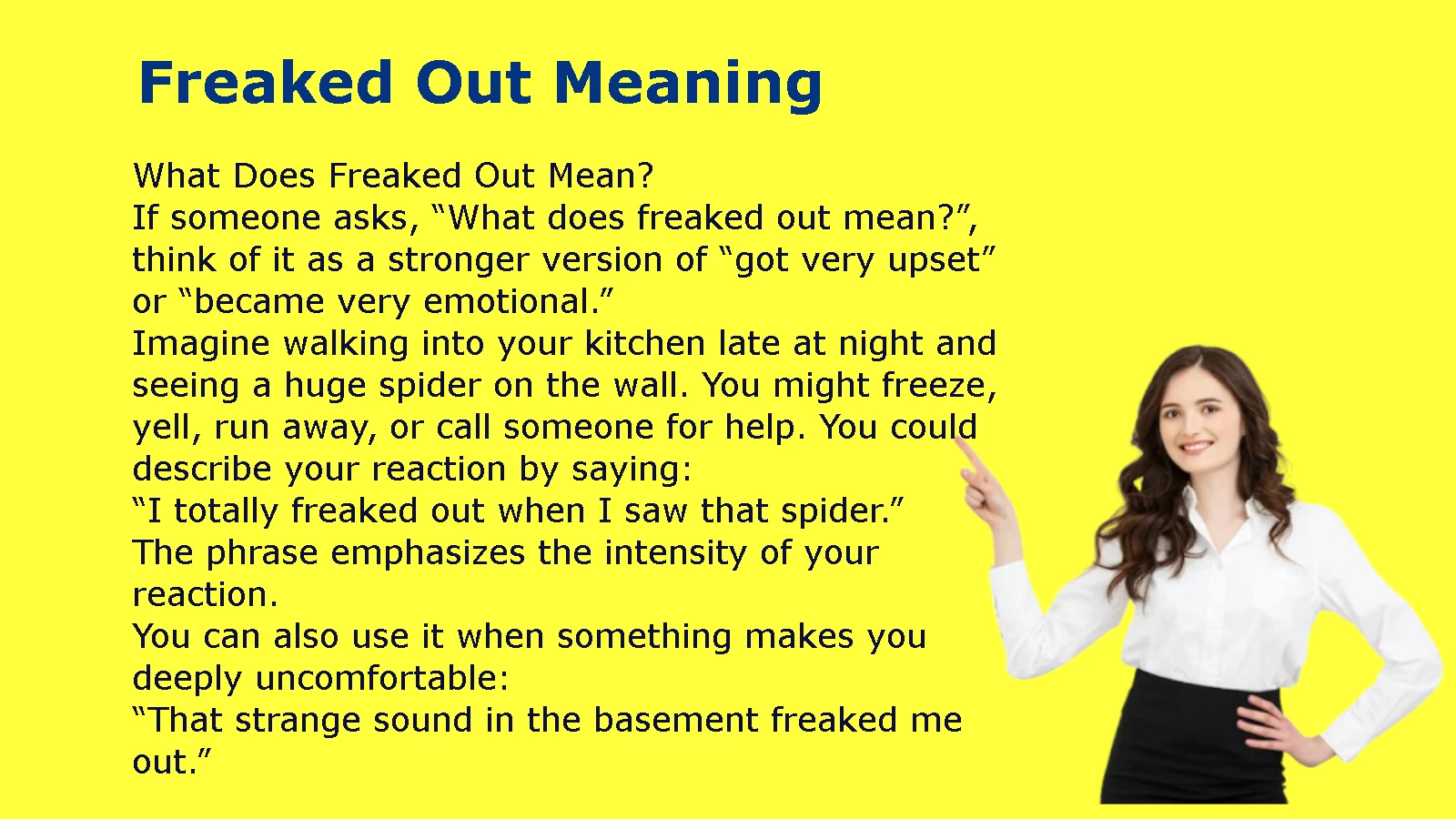
What Does Freaked Out Mean?
If someone asks, “What does freaked out mean?”, think of it as a stronger version of “got very upset” or “became very emotional.”
Imagine walking into your kitchen late at night and seeing a huge spider on the wall. You might freeze, yell, run away, or call someone for help. You could describe your reaction by saying:
“I totally freaked out when I saw that spider.”
The phrase emphasizes the intensity of your reaction.
You can also use it when something makes you deeply uncomfortable:
“That strange sound in the basement freaked me out.”
Here, the sound caused the emotional response.
The expression also works for positive situations:
“She freaked out when her favorite singer surprised her.”
In this sentence, freaked out doesn’t mean she became frightened. Instead, she became extremely excited or emotional.
That flexibility explains why context matters so much.
Everyday Examples of Freaked Out
Here are several natural examples:
- I freaked out when I couldn’t find my phone.
- He freaked out after hearing the crash.
- My little brother freaked out when the lights went off.
- She freaked out when she saw the final score.
- They freaked out when their favorite team showed up.
- I was completely freaked out by the strange noise.
- Don’t freak out. We’ll figure this out.
- The unexpected message really freaked her out.
Notice how the phrase changes slightly with each situation. The emotional reaction might involve fear, panic, excitement, worry, or shock.
Freaked Out Meaning in Slang
Freaked out is an informal expression and is often treated as slang because people use it heavily in casual speech and informal online communication.
In slangy everyday English, the phrase can describe an intense reaction that feels difficult to control. Dictionary.com traces the slang use of freak out to the 1960s and describes it as losing emotional control because of emotions such as excitement, shock, fear, or joy.
For example:
“I freaked out when I saw the price.”
Depending on context, that could mean the speaker became angry, shocked, worried, or simply overwhelmed.
Another example:
“Everyone freaked out when the celebrity walked in.”
Here, the phrase could mean everyone became extremely excited.
Is “Freaked Out” Always Negative?
No. That’s one of the most important points to remember.
Although freaked out often suggests fear or anxiety, it can describe a positive emotional reaction too.
Compare these examples:
- The horror movie freaked me out. → Negative or frightening.
- I freaked out when I got the tickets. → Excited and happy.
- She freaked out over the unexpected bill. → Worried or upset.
- He freaked out when he heard the news. → Strong reaction; the exact emotion depends on the news.
The surrounding words usually reveal the intended feeling.
What Does Freaked Out Mean on TikTok?
On TikTok, freaked out generally keeps its ordinary meaning: someone experienced an unusually strong emotional reaction.
There isn’t a separate standard dictionary definition that applies only to TikTok. Instead, social media often stretches familiar expressions into dramatic, humorous, or exaggerated reactions.
For example, a TikTok caption might say:
“I freaked out when I saw this ending.”
The person could mean they were genuinely shocked. They could also be exaggerating for humor.
Similarly:
“Everyone in the comments is freaking out.”
This usually means many people are reacting strongly to the video.
The important clue is what caused the reaction.
A scary video might make someone feel frightened. A surprise reveal could cause shock. A cute celebrity appearance could produce excitement. A ridiculous video might trigger laughter and exaggerated disbelief.
So, when you see freaked out on TikTok, don’t automatically translate it as scared. Look at the surrounding conversation.
TikTok Examples
| TikTok-style expression | Likely meaning |
| “I freaked out when I saw that.” | I was extremely surprised, shocked, or scared. |
| “I’m freaking out right now.” | I’m extremely excited, worried, or overwhelmed. |
| “That video freaked me out.” | The video disturbed, scared, or shocked me. |
| “Everyone freaked out in the comments.” | Everyone reacted strongly. |
| “Don’t freak out!” | Don’t panic or overreact. |
Online language often depends heavily on tone. A laughing emoji, exaggerated punctuation, or the surrounding caption can completely change how the phrase feels.
Freaked Out Meaning in Gen Z Slang
The freaked out meaning in Gen Z slang usually isn’t a completely new definition. Younger internet users commonly use the established phrase in casual, exaggerated, and highly expressive ways.
For instance:
“I’m literally freaking out right now.”
This might mean the person is anxious about an exam. It could also mean they’re thrilled about seeing their favorite performer.
Another example:
“I freaked out when I saw the surprise.”
The speaker might have screamed, laughed, cried, or simply reacted with intense excitement.
That’s a useful distinction. Freaked out describes the strength of the reaction more than one specific emotion.
Common Online Uses
You may see the expression used to describe:
- Sudden fear
- Extreme excitement
- Anxiety
- Shock
- Embarrassment
- Disbelief
- Overwhelming happiness
- Disturbing or creepy situations
- Unexpected news
- Dramatic reactions to videos or posts
Online conversations also use freaking out as an exaggeration.
For example:
“I’m freaking out because my package finally arrived.”
The speaker probably isn’t experiencing serious distress. They may simply be extremely excited.
That’s why literal translation can sometimes miss the intended tone.
What Does “Freaked Me Out” Mean?
Freaked me out means caused me to feel very scared, shocked, upset, uncomfortable, or emotionally overwhelmed.
The key difference is grammatical.
“I Freaked Out”
When you say:
“I freaked out.”
You experienced the reaction.
The sentence focuses on your response.
For example:
“I freaked out when I couldn’t find my passport.”
You became extremely worried.
“It Freaked Me Out”
When you say:
“It freaked me out.”
Something else caused your reaction.
The word it refers to the thing that created the emotional response.
For example:
“That noise freaked me out.”
The noise caused you to feel frightened or disturbed.
More Examples
| Sentence | Meaning |
| I freaked out when I saw the spider. | I became very scared. |
| The spider freaked me out. | The spider scared me. |
| She freaked out about the exam. | She became extremely worried. |
| The exam freaked her out. | The exam made her very anxious. |
| He freaked out when he won. | He reacted with extreme excitement. |
| The surprise freaked him out. | The surprise caused a strong reaction. |
This pattern is useful because it helps you understand similar expressions such as scared me, shocked me, upset me, and surprised me.
Freaked vs. Freaked Out
Freaked and freaked out aren’t always interchangeable.
The expression freaked out works as the common phrasal verb for describing an intense emotional reaction:
She freaked out when she saw the damage.
The standalone form freaked can appear in other grammatical structures, especially when freak means something different or when a writer uses it as part of another expression. However, for the everyday meaning of became extremely emotional, freaked out is the natural choice.
Compare:
- I freaked out when I heard the news. ✓
- I freaked when I heard the news. ✓ Informal, but less common in many contexts.
- The news freaked me out. ✓
- The news freaked me. ✗ Usually unnatural for this meaning.
The particle out is an important part of the familiar phrasal verb.
Why “Out” Matters
English uses out in many phrasal verbs to suggest movement, completion, intensity, or a change of state.
In freak out, the phrase conveys a strong departure from a calm emotional state.
You can think of it as:
calm → trigger → intense reaction
That doesn’t mean the phrase always describes literal loss of control. People often use it loosely to describe a very strong reaction.
Freak Out Meaning
Freak out is the base form of the phrase. It means to become extremely emotional or to cause someone to become extremely emotional.
Cambridge classifies freak out as an informal phrasal verb. Its American English definition includes being very excited or emotional or causing someone else to become that way.
The form changes depending on the tense.
| Form | Example | Meaning |
| Freak out | Don’t freak out. | Don’t become overly upset or panicked. |
| Freaks out | She freaks out easily. | She often reacts very strongly. |
| Freaked out | He freaked out yesterday. | He had a strong reaction in the past. |
| Freaking out | I’m freaking out right now. | I’m having a strong reaction now. |
Freak Out
Use freak out for the base form or after modal and auxiliary verbs:
Don’t freak out.
I might freak out if they cancel the trip.
Freaked Out
Use freaked out for a completed past reaction:
I freaked out when I saw the damage.
Freaking Out
Use freaking out for an action or emotional reaction happening now:
She’s freaking out about tomorrow’s interview.
The meaning stays closely related. The grammar changes.
Freaked Out Meaning in Different Contexts
Context gives freaked out its emotional color. The same phrase can describe fear in one sentence and excitement in another.
| Phrase | Meaning |
| I freaked out when I saw it. | I became very frightened or upset. |
| That movie freaked me out. | That movie made me feel scared or disturbed. |
| She freaked out over the news. | She reacted very strongly to the news. |
| He’s freaking out about the test. | He’s extremely worried about the test. |
| I freaked out when they surprised me. | I reacted with strong surprise. |
| She freaked out when she got backstage passes. | She became extremely excited. |
| He freaked out after losing his wallet. | He became very worried or upset. |
| That creepy sound freaked everyone out. | The sound frightened or disturbed everyone. |
Freaked Out From Fear
Fear is perhaps the most obvious use.
“I freaked out when the dog suddenly ran toward me.”
The speaker experienced a sudden, intense fear response.
Freaked Out From Worry
The phrase can also describe anxiety.
“She freaked out because she thought she’d missed the deadline.”
Here, the person isn’t necessarily terrified. She is extremely worried.
Freaked Out From Shock
Unexpected information can trigger another kind of reaction:
“He freaked out when he heard the news.”
The sentence doesn’t tell you exactly how he reacted. He could have shouted, cried, frozen, or simply become highly emotional.
Freaked Out From Excitement
Positive events can trigger the phrase too:
“I freaked out when I found out my favorite band was coming to town.”
In this context, freaked out means became extremely excited.
Freaked Out Meaning in a Sentence
Seeing the phrase in complete sentences makes its meaning much easier to understand.
Fear
I freaked out when I heard someone knocking on the window at midnight.
Here, freaked out means became very frightened.
Surprise
She freaked out when her friends surprised her at the restaurant.
The phrase means she had an intense emotional reaction to the unexpected event.
Worry
He freaked out after realizing he’d left his wallet at the airport.
The meaning is closer to panicked or became extremely worried.
Excitement
The kids freaked out when they saw the presents under the tree.
Here, the phrase describes excitement rather than fear.
Shock
I freaked out when I opened the email and saw the unexpected news.
The reaction could involve disbelief, worry, excitement, or another strong emotion.
Distress
She freaked out when her computer suddenly stopped working before the presentation.
In this case, the phrase suggests intense frustration, worry, or panic.
Humor and Exaggeration
I almost freaked out when I realized I had been wearing my shirt backward all day.
People often use freak out casually to exaggerate a reaction. The speaker may not have experienced a serious emotional crisis. They may simply have felt embarrassed or surprised.
That distinction matters when interpreting casual conversation.
Freaked Out Synonyms
There isn’t one perfect synonym for freaked out because the phrase covers several emotional states.
The best replacement depends on the situation.
| Synonym | Best used when “freaked out” means… |
| Panicked | Someone became extremely worried or frightened. |
| Scared | Someone felt fear. |
| Frightened | Someone experienced strong fear. |
| Startled | Something caused a sudden brief reaction. |
| Shocked | Something unexpected caused disbelief or surprise. |
| Upset | Someone became emotionally distressed. |
| Overwhelmed | Someone couldn’t easily handle the situation emotionally. |
| Alarmed | Someone became concerned about possible danger. |
| Distressed | Someone experienced significant emotional discomfort. |
| Agitated | Someone became restless, angry, or emotionally unsettled. |
Freaked Out vs. Panicked
Panicked usually suggests fear or anxiety.
She panicked when she couldn’t find her child.
Freaked out is broader:
She freaked out when she couldn’t find her child.
The second sentence could describe panic, anger, fear, or extreme worry.
Freaked Out vs. Startled
Startled usually describes a sudden reaction to something unexpected.
The loud noise startled me.
Freaked me out suggests a stronger or more disturbing emotional response.
The strange noise in the empty house freaked me out.
Freaked Out vs. Shocked
Shocked focuses on surprise or disbelief.
I was shocked by the announcement.
Freaked out emphasizes the intensity of the emotional response.
I freaked out when I heard the announcement.
The speaker may have reacted with fear, excitement, anger, or disbelief.
Freaked Out Meaning in a Song
The freaked out meaning in a song depends heavily on the lyrics and the situation described in the song.
Songwriters often use everyday phrases creatively. A lyric containing freaked out might describe fear, romantic intensity, excitement, confusion, anxiety, or emotional overload.
For example, if the surrounding lyrics describe a frightening situation, freaked out probably means scared or disturbed. If the song describes falling in love or receiving exciting news, the phrase may suggest intense excitement or emotional overwhelm.
Therefore, the phrase shouldn’t automatically receive one fixed interpretation just because it appears in a song.
The same principle applies to social media. Context beats the dictionary when you’re interpreting a specific line.
Freaked Out Meaning in Chinese
The best Chinese translation for freaked out depends on the emotion behind the phrase.
Cambridge’s English-Chinese dictionary translates freak someone out as 使……极度激动, which conveys the idea of making someone extremely emotional.
However, everyday Chinese can use different expressions when the intended emotion changes.
| English meaning | Possible Chinese expression | Context |
| Scared badly | 吓坏了 | Strong fear |
| Panicked | 惊慌失措 | Panic or confusion |
| Went crazy with excitement | 欣喜若狂 | Extreme happiness |
| Became extremely emotional | 极度激动 | Strong emotional reaction |
| Lost control emotionally | 抓狂 | Frustration, anger, or agitation |
For example:
I freaked out when I saw the snake.
A natural translation would focus on fear, so 吓坏了 can fit the context.
On the other hand:
I freaked out when I got the concert tickets!
That sentence expresses excitement. A translation such as 欣喜若狂 may better capture the emotion.
This is why translating freaked out word-for-word doesn’t always work. You need to identify the emotion first.
How to Use “Freaked Out” Naturally
Because freaked out is informal, it works especially well in conversations, texts, social media posts, casual emails, and dialogue.
It can sound natural after words such as:
- totally
- really
- completely
- literally
- almost
- kind of
- so
For example:
I totally freaked out when I saw the bill.
She really freaked out after hearing the noise.
I almost freaked out when I couldn’t find my keys.
However, avoid treating literally as a requirement. People often use it casually for emphasis even when they aren’t describing a literal extreme event.
When Not to Use “Freaked Out”
The phrase may sound too casual in formal writing.
For example, a formal report might say:
The employees expressed significant concern about the sudden change.
A casual conversation might say:
Everyone freaked out about the sudden change.
Both communicate a strong reaction. The register differs.
For academic, legal, professional, or highly formal writing, alternatives such as became concerned, reacted strongly, expressed alarm, or became distressed may fit better.
“Freaked Out” vs. “Freaking Out”
These expressions describe related ideas but occur at different points in time.
Freaked out usually describes a completed or past reaction:
I freaked out when I saw the results.
Freaking out describes an ongoing reaction:
I’m freaking out about the results.
The distinction becomes especially clear with time expressions.
| Phrase | Time |
| I freaked out yesterday. | Past |
| I’m freaking out right now. | Happening now |
| I might freak out tomorrow. | Possible future |
| She freaks out whenever that happens. | Repeated reaction |
Once you understand the base form freak out, these variations become easy to recognize.
Why Context Matters So Much
The unusual thing about freaked out is its emotional range.
Some expressions point toward one main emotion. Terrified clearly indicates fear. Delighted points toward happiness. Furious suggests anger.
Freaked out doesn’t work that way.
Instead, it signals intensity.
Think of the phrase as an emotional volume knob. The surrounding context tells you which emotion is playing.
For example:
I freaked out when I saw the spider.
The context suggests fear.
I freaked out when I got accepted into college.
The context suggests excitement.
I freaked out when I saw the repair bill.
The context suggests worry or distress.
I freaked out when they told me the surprise party was for me.
The context suggests shock and excitement.
The words surrounding the phrase do much of the interpretive work.
Common Mistakes With “Freaked Out”
A few mistakes can make the phrase sound unnatural.
Mistake: Assuming It Always Means “Scared”
Not every use describes fear.
She freaked out when she won the competition.
This likely means she became extremely excited.
Mistake: Confusing “Freaked Out” With “Freaked Me Out”
These structures have different subjects.
I freaked out.
You reacted strongly.
The movie freaked me out.
The movie caused your reaction.
Mistake: Using It in Every Formal Situation
The phrase is informal. It fits casual communication much better than formal reports or academic essays.
Mistake: Ignoring Context
Don’t translate the phrase automatically as afraid.
Ask a simple question:
What emotion is the speaker actually describing?
That answer will usually reveal the intended meaning.
Frequently Asked Questions About Freaked Out
What does freaked out mean in slang?
Freaked out is an informal expression meaning became extremely emotional, frightened, worried, shocked, upset, or excited. The exact meaning depends on the context.
What does freaked out mean on TikTok?
On TikTok, freaked out generally has the same basic meaning as in everyday English. Users often apply it dramatically or humorously to describe an intense reaction to a video, message, surprise, or situation.
What does freaked out mean in Gen Z slang?
In Gen Z and online conversation, freaked out commonly describes a very strong reaction. It can refer to fear, excitement, anxiety, shock, embarrassment, or another intense emotion. It isn’t limited to one new Gen Z definition.
What does freaked me out mean?
Freaked me out means caused me to feel very scared, shocked, uncomfortable, upset, or emotionally overwhelmed.
For example:
That horror movie freaked me out.
The movie caused the emotional reaction.
What does freak out mean?
Freak out means to become extremely emotional or to cause someone else to become extremely emotional. It can involve fear, anxiety, excitement, shock, anger, or another strong reaction. Cambridge classifies the expression as an informal phrasal verb.
Is freaked out a slang term?
Freaked out is an informal expression and is commonly described as slang. It appears widely in casual conversation and online communication. Dictionary.com traces the slang use of freak out to the 1960s.
What is another word for freaked out?
Depending on the context, alternatives include panicked, scared, frightened, startled, shocked, upset, overwhelmed, alarmed, and distressed.
The best synonym depends on the emotion. For example, panicked fits worry or fear, while shocked fits surprise and excited may fit a positive reaction.
Is “freaked out” positive or negative?
It can be either.
That creepy noise freaked me out. → Negative.
I freaked out when I got backstage passes. → Positive.
The surrounding context tells you which emotion the speaker means.
Can “freaked out” mean excited?
Yes. Freaked out can describe extreme excitement.
For example:
She freaked out when she learned that her favorite actor would be at the event.
Here, the phrase means she became extremely excited or emotional.
What is the difference between “I freaked out” and “it freaked me out”?
I freaked out means I had the strong emotional reaction.
It freaked me out means it caused me to have the strong emotional reaction.
Compare:
I freaked out when I saw the snake.
The snake freaked me out.
The first sentence focuses on the person’s reaction. The second focuses on what caused it.
Final Takeaway
The simplest freaked out meaning is having an intense emotional reaction. Most often, that reaction involves fear, worry, shock, surprise, or excitement.
The phrase is informal and flexible. You might freak out when you see something frightening, freak out over stressful news, or freak out with excitement after receiving something you’ve wanted for years.
The key is context.
If you remember one rule, make it this:
“Freaked out” tells you that the reaction was intense. The context tells you what emotion caused it.
Once you understand that distinction, expressions such as freak out, freaked out, freaking out, and freaked me out become much easier to understand and use naturally.