When writing about reducing something to the lowest possible level, you may wonder whether to use minimize or minimise. The difference between Minimize vs Minimise is not about meaning but about spelling conventions. Your choice usually depends on the type of English you are using and the country or audience you are writing for.
Minimize and minimise have the same meaning. Both mean to reduce something to the smallest possible amount, degree, or level. Minimize is the standard spelling in American English, while minimise is traditionally preferred in British English and many other varieties influenced by British spelling.
Examples:
- The company wants to minimize its operating costs.
- The company wants to minimise its operating costs.
The confusion is understandable. People often search for minimize vs minimise, minimize or minimise, which spelling is correct, or minimise meaning in English because both spellings are accepted, yet they follow different spelling conventions. And here’s the kicker: neither spelling changes the word’s meaning or pronunciation.
In this guide, you’ll learn the complete difference between Minimize vs Minimise, including their meaning, pronunciation, origin, correct spelling, and usage. You’ll also discover which spelling to use in American English vs British English, along with clear examples to help you choose the right form.
Boondoggle Meaning
Boondoggle is a US informal noun that generally means an unnecessary or expensive project, activity, or piece of work that wastes time, money, or other resources.
Cambridge defines it as an unnecessary and expensive piece of work, particularly one paid for with public money. Its American Dictionary definition similarly describes an expensive program that wastes money.
In simpler terms:
A boondoggle is a project or activity that seems wasteful, pointless, or unnecessarily expensive.
For example:
The company spent two years developing a system that nobody uses. Employees started calling it a boondoggle.
The system might technically exist and might even have some benefits. The word boondoggle tells you that someone considers those benefits too small to justify the time, money, or effort involved.
Boondoggle Definition in Simple English
Here’s the easiest way to remember the meaning:
Boondoggle = a wasteful or pointless project or activity.
The word commonly involves one or more of these ideas:
- Unnecessary work
- Excessive spending
- Wasted time
- Poor practical value
- Inefficient use of resources
- A project that looks productive but accomplishes little
A boondoggle doesn’t necessarily have to fail completely. A project can produce something useful and still be called a boondoggle if critics believe its cost or effort greatly outweighs its value.
Boondoggle as a Noun
The noun is by far the most common form.
You can use boondoggle to describe a project, program, activity, expenditure, or undertaking.
Examples:
- “The renovation became an expensive boondoggle.”
- “Critics called the proposal a government boondoggle.”
- “The software project turned into a corporate boondoggle.”
- “Nobody wanted another six-month boondoggle.”
- “The committee spent millions on what critics considered a boondoggle.”
The plural is boondoggles.
“The report identified several expensive boondoggles.”
Boondoggle as a Verb
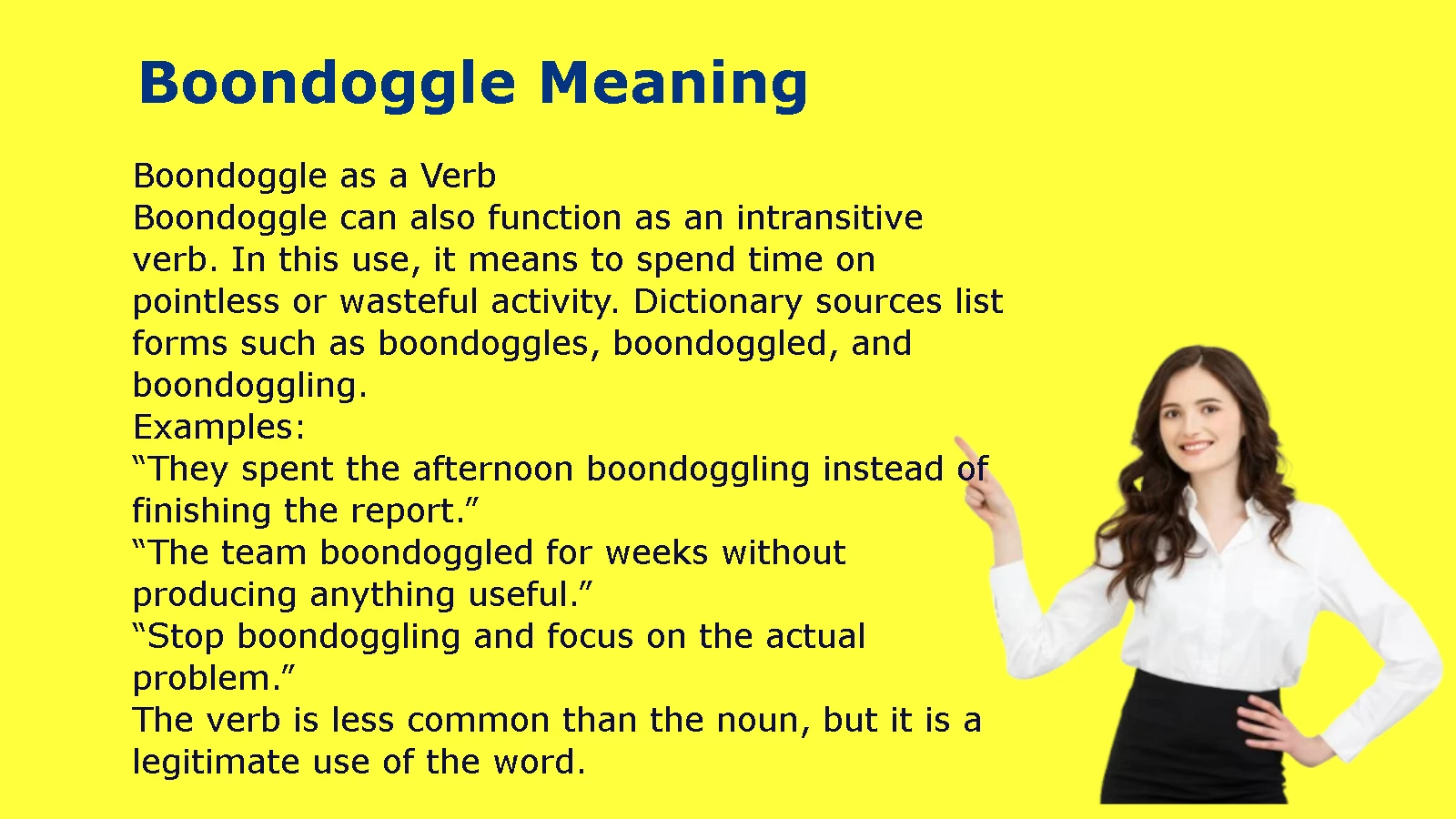
Boondoggle can also function as an intransitive verb. In this use, it means to spend time on pointless or wasteful activity. Dictionary sources list forms such as boondoggles, boondoggled, and boondoggling.
Examples:
- “They spent the afternoon boondoggling instead of finishing the report.”
- “The team boondoggled for weeks without producing anything useful.”
- “Stop boondoggling and focus on the actual problem.”
The verb is less common than the noun, but it is a legitimate use of the word.
What Does Boondoggle Mean in Simple Terms?
Imagine that your office needs a simple spreadsheet.
Instead of making one, the company spends six months designing an elaborate software platform. It hires consultants, holds dozens of meetings, creates hundreds of pages of documentation, and spends thousands of dollars.
In the end, employees still use the original spreadsheet.
Someone might call the entire project a boondoggle.
The important idea isn’t simply that the project took a long time. It is that the project appears to have poor value compared with the resources invested in it.
| Situation | Is “boondoggle” a possible description? | Why? |
| A useful project finishes over budget | Possibly | The spending may be viewed as excessive |
| An unnecessary project consumes large resources | Yes | It fits the core meaning |
| A pointless office task takes all day | Yes | It can describe wasteful work |
| A difficult project succeeds after years of work | Not necessarily | Difficulty alone doesn’t make something a boondoggle |
| A project fails despite reasonable costs | Not necessarily | Failure alone isn’t enough |
| An expensive project provides little practical value | Yes | This strongly fits the word |
That distinction matters. Boondoggle does not simply mean “anything expensive” or “anything that fails.” The word focuses on perceived waste, unnecessary effort, or poor value.
Boondoggle Examples
The best way to understand this unusual word is to see it in different contexts.
Boondoggle in a Sentence
Here are natural examples:
- “The new office initiative became a costly boondoggle.”
- “Employees complained that the training program was a complete boondoggle.”
- “The committee spent months on a procedural boondoggle.”
- “Critics described the project as an expensive boondoggle.”
- “The company canceled the software boondoggle after realizing nobody needed it.”
- “They spent the entire afternoon boondoggling instead of solving the problem.”
- “The proposed expansion could become another corporate boondoggle.”
- “The project wasn’t a failure, but its critics considered it a boondoggle.”
Notice how the word works especially well when you want to emphasize wasted resources rather than simple failure.
Workplace Boondoggle Examples
A workplace boondoggle might involve an unnecessary internal project.
For example, imagine a company that already has a perfectly functional employee scheduling system. Management decides to replace it with a custom platform. The project takes a year, requires outside consultants, and creates more administrative work than the original system.
Employees might describe the initiative as a boondoggle.
Other possible workplace examples include:
- Creating reports that nobody reads
- Launching unnecessary internal programs
- Building an expensive tool that solves a minor problem
- Holding endless meetings without decisions
- Spending excessive resources on a project with little practical benefit
- Continuing a project simply because the company has already invested heavily in it
Of course, whether something actually qualifies as a boondoggle depends on the evidence and the speaker’s judgment. The word itself is evaluative, not a neutral technical classification.
Government Boondoggle Examples
The word has a particularly strong association with public spending.
Cambridge specifically notes the use of boondoggle for unnecessary and expensive work paid for by the public.
That makes phrases such as these common:
- government boondoggle
- taxpayer boondoggle
- public-works boondoggle
- expensive boondoggle
- wasteful government project
However, there’s an important language point here.
Calling a government project a boondoggle is usually a criticism of the project. It doesn’t establish as a factual matter that the project has no value. A person can point to its cost, delays, or results as evidence and still have another person disagree about whether the spending was justified.
So compare these statements:
“The project cost $500 million.”
That is a factual claim that can be checked.
“The project was a $500 million boondoggle.”
The second statement combines a factual figure with an evaluation of the project’s value.
That distinction is essential when using the word accurately.
Corporate Boondoggle Meaning
A corporate boondoggle is an expensive, unnecessary, or unproductive business project or activity that consumes company resources without delivering enough practical value.
The phrase appears in business contexts because companies can create their own versions of wasteful projects.
For example:
A corporation spends millions developing an internal platform that employees don’t need. Critics inside the company might call it a corporate boondoggle.
Corporate boondoggles can involve:
- Unnecessary software systems
- Overly elaborate office renovations
- Redundant internal programs
- Projects with unclear business objectives
- Expensive initiatives with little measurable benefit
- Excessive consulting expenses
- Long-running projects that produce little useful output
The word can also describe corporate travel or events when someone views them as unnecessary.
That’s where you’ll sometimes encounter boondoggle trip.
Boondoggle Trip Meaning
A boondoggle trip is a trip that someone considers unnecessary, wasteful, extravagant, or insufficiently connected to legitimate work.
The idea usually appears in business or organizational contexts.
For example:
The executives’ expensive conference trip was criticized as a boondoggle.
The word doesn’t automatically mean that every business trip is wasteful. Instead, the speaker is suggesting that the trip provided little value compared with its cost or purpose.
A trip might be called a boondoggle because of:
- Excessive spending
- A weak business purpose
- Lavish accommodations or activities
- Too many participants
- Poorly defined objectives
- Little measurable benefit from attending
Again, boondoggle expresses an assessment. The trip’s actual value has to be considered separately.
Boondoggle Synonyms
Several words overlap with boondoggle, but they don’t all mean exactly the same thing.
| Synonym | Meaning | Main Difference |
| Waste | Unnecessary use of resources | Broader and more neutral |
| Busywork | Work that keeps someone occupied without much useful output | Focuses on keeping busy |
| Make-work | Work created mainly to give people something to do | Often focuses on artificial employment |
| Time-waster | Something that consumes time unnecessarily | Focuses mainly on time |
| Pointless project | A project with little meaningful purpose | More direct and less idiomatic |
| Wasteful project | A project that uses resources inefficiently | More neutral and descriptive |
| White elephant | A costly or burdensome possession or undertaking | Often emphasizes maintenance or financial burden |
| Futile undertaking | An activity unlikely to achieve its purpose | Focuses on futility rather than expense |
What Is the Closest Synonym for Boondoggle?
There isn’t one perfect synonym for every situation.
Wasteful project comes close when you’re describing an expensive or inefficient undertaking.
Busywork works better when someone spends time doing tasks that don’t accomplish much.
Make-work fits when someone creates work primarily to keep people occupied.
White elephant is useful when something is expensive to maintain or difficult to justify financially.
The choice depends on what you want to emphasize.
Boondoggle: “This project wastes resources.”
Busywork: “This task keeps people busy without accomplishing much.”
White elephant: “This expensive thing has become a burden.”
That distinction makes your writing more precise.
Is Boondoggle Slang?
Boondoggle is generally classified as a US informal word rather than slang in the narrowest sense. Cambridge labels it “US informal.”
It’s an established English word that has appeared in dictionaries and formal writing for decades. However, it still has a conversational flavor.
You might see it in:
- News articles
- Opinion writing
- Business discussions
- Political commentary
- Everyday conversation
- Reports discussing questionable spending
It’s not a swear word, and it isn’t offensive language by itself.
Its unusual sound can make it feel playful or humorous. The meaning, however, can be quite serious.
Calling a multimillion-dollar project a boondoggle can be a sharp criticism.
Boondoggle Origin and Etymology
The origin of boondoggle is one of the most interesting parts of the word’s history.
The word first appeared in American English in a different sense from the one people usually recognize today. It referred to a braided leather lanyard or decorative cord associated with Boy Scouts. Etymonline dates this sense to around 1930 and reports contemporary accounts connecting the word and object with the Order of the Arrow in Rochester, New York, around 1928.
The word later acquired its modern negative sense during the 1930s.
Where Did the Word Boondoggle Come From?
The exact origin of the unusual name isn’t completely certain.
Etymonline notes that the name may have been arbitrary. It also says that newspapers later claimed it had once been a pioneer term for a “gadget,” but that evidence for this explanation is lacking.
Some dictionary sources attribute the coinage to Robert H. Link, an American Scout leader. Collins likewise identifies Link in its word-origin information.
So it’s better to avoid confidently repeating elaborate folk etymologies. The strongest historical evidence connects the early word with Scouting and a braided decorative object, while the precise reason for choosing the name remains uncertain.
How Did Boondoggle Get Its Modern Meaning?
The major semantic change occurred in 1935.
At the time, controversy surrounded certain New Deal relief-work activities in New York City. One program involved unemployed people making the braided objects known as boondoggles. Newspapers picked up the unusual word during the controversy and began using it in connection with supposedly wasteful relief work.
Etymonline dates the modern sense of “wasteful expenditure” to April 1935. It also records the word’s rapid spread as a contemptuous term for make-work projects.
The timeline looks roughly like this:
| Period | Meaning or development |
| Late 1920s | The term is associated with a braided Scout item |
| 1930 | The physical-object sense is documented |
| 1929 | A Scout-made boondoggle attracted public attention when presented to the Prince of Wales |
| April 1935 | The word became associated with criticism of allegedly wasteful relief work |
| 1935 onward | Boondoggle developed its familiar figurative meaning of wasteful or pointless work |
The transformation is a classic example of semantic change. A word that originally named an object became a metaphor for an activity considered similarly unproductive.
Historical Case Study: The 1935 Boondoggle Controversy
The word’s modern meaning didn’t emerge randomly.
In 1935, New York City faced criticism over aspects of its relief programs. Newspaper coverage focused on work that critics considered unproductive, including the production of braided Scout-style items. The unusual name quickly became useful shorthand for the broader criticism.
A contemporary newspaper column even remarked on the sudden spread of the term, describing it as a word that had “swept the country.”
This episode explains why boondoggle became strongly associated with government waste.
The word’s history also explains something important about its modern meaning: it isn’t merely another synonym for project. From its earliest figurative use, it carried an accusation that the work looked productive while providing little real value.
Boondoggle as a Literal Object
The older literal meaning hasn’t completely disappeared from dictionaries.
A boondoggle can refer to a braided or woven decorative item, particularly one associated historically with Scouts. Dictionary sources describe it as a braided ring or cord used with a neckerchief and as a handicraft made from materials such as leather or other strips.
That older meaning is much less common today than the figurative sense.
Still, it matters when studying the word’s history because the two meanings are connected through the word’s documented development.
Literal meaning:
A braided or woven decorative object.
Modern figurative meaning:
A wasteful, unnecessary, or pointless project or activity.
The shift from an object to an activity is what gives boondoggle its unusual linguistic story.
Boondoggle vs. Busywork
Boondoggle and busywork overlap, but they aren’t identical.
Busywork means work that occupies someone’s time without producing much useful output.
A worker might spend three hours filling out unnecessary forms. That’s busywork.
A company might spend two years and millions of dollars developing an unnecessary system. That could be a boondoggle.
The scale and focus often differ:
| Word | Main focus |
| Busywork | Keeping someone occupied |
| Boondoggle | Wasteful or unnecessary project/activity |
| Make-work | Work created mainly to keep people employed or busy |
A boondoggle can contain plenty of busywork, but the terms aren’t interchangeable in every sentence.
Boondoggle vs. White Elephant
A white elephant usually refers to something that is costly, burdensome, or difficult to maintain despite its supposed value.
A boondoggle emphasizes waste or unnecessary expenditure.
For example:
“The unused stadium became a white elephant.”
This suggests the stadium is now a costly burden.
“The stadium project was a boondoggle.”
This suggests the project itself was viewed as an unnecessary or wasteful undertaking.
The same thing could potentially be described with either expression, but the emphasis changes.
Boondoggle vs. Fool’s Errand
A fool’s errand involves sending someone after something pointless, impossible, or nonexistent.
A boondoggle doesn’t necessarily involve an impossible goal.
A project can be technically achievable and still be called a boondoggle if someone believes it isn’t worth the resources required.
That’s a useful distinction:
- Fool’s errand: futile pursuit
- Boondoggle: wasteful or unnecessary undertaking
Boondoggle vs. Make-Work
Make-work is work created mainly to keep someone busy.
The historical development of boondoggle makes this comparison especially interesting because the modern meaning became associated with criticism of relief work that opponents characterized as make-work.
Today, the words can overlap:
“The department created make-work tasks.”
“The department created a bureaucratic boondoggle.”
The first sentence focuses on artificial work. The second emphasizes the broader wastefulness of the project or activity.
Is Boondoggle Always Negative?
In modern usage, boondoggle normally carries a negative or disapproving meaning.
Calling something a boondoggle suggests that it wastes resources or doesn’t justify its cost.
However, the word itself doesn’t prove that the criticism is correct.
For example:
“Critics called the project a boondoggle.”
This wording is more precise than:
“The project was a boondoggle.”
The first sentence clearly attributes the evaluation to critics. The second presents the judgment more directly.
That distinction becomes especially important in journalism, business writing, and discussions of public spending.
How to Use Boondoggle Correctly
The word works best when the context involves waste, unnecessary effort, excessive expense, or questionable value.
Common grammatical patterns
| Form | Example |
| a boondoggle | “The project became a boondoggle.” |
| the boondoggle | “The boondoggle consumed the entire budget.” |
| boondoggles | “The report listed several boondoggles.” |
| boondoggle as a verb | “They continued to boondoggle.” |
| boondoggled | “The team boondoggled for months.” |
| boondoggling | “They were accused of boondoggling.” |
Useful collocations
You’ll often see boondoggle paired with words such as:
- expensive boondoggle
- government boondoggle
- corporate boondoggle
- taxpayer boondoggle
- costly boondoggle
- wasteful boondoggle
- political boondoggle
- bureaucratic boondoggle
These combinations reinforce the idea of an undertaking that consumes resources without enough practical benefit.
Boondoggle Pronunciation
In American English, boondoggle is pronounced approximately:
BOON-dah-guhl
Cambridge gives the US pronunciation as /ˈbuːnˌdɑː.ɡəl/. The stress falls primarily on the first syllable.
boondoggle
/ˈbuːnˌdɑː.ɡəl/
Give feedback
The spelling can look intimidating at first, but the pronunciation is fairly straightforward once you divide it into syllables.
Boondoggle Plural and Verb Forms
The plural noun is boondoggles.
Examples:
- “The agency faced criticism over several boondoggles.”
- “The report identified multiple boondoggles.”
The verb has these common forms:
- boondoggle
- boondoggles
- boondoggled
- boondoggling
For example:
“They boondoggled instead of addressing the underlying issue.”
The verb is less frequent in everyday conversation than the noun, but dictionaries recognize it as an established usage.
Is Boondoggle Formal or Informal?
Boondoggle is informal US English. Cambridge explicitly labels the noun as US informal.
That doesn’t mean you can’t find it in serious writing. In fact, the word has a long history in journalism, public-policy discussions, business writing, and political commentary.
Still, if you need completely neutral wording, alternatives such as these may work better:
- unnecessary project
- inefficient expenditure
- wasteful activity
- unproductive undertaking
- poorly justified expense
The advantage of boondoggle is its punch. It communicates criticism in a single memorable word.
Boondoggle in Business and Corporate Culture
Corporate use has expanded the word beyond its historical connection with public spending.
A company doesn’t need taxpayer money for something to be called a boondoggle. The term can describe any corporate undertaking that employees or observers believe wastes resources.
For example, consider a fictional but realistic scenario:
Case Study: The Unused Corporate Platform
A large company already has an effective customer-support system. Executives decide to build a custom replacement.
The project involves:
- A large development team
- Outside consultants
- Extensive meetings
- A long testing period
- Significant licensing and infrastructure costs
After launch, most employees continue using the old system because the new platform is slower and harder to navigate.
If employees describe the initiative as a corporate boondoggle, they’re emphasizing the gap between the resources consumed and the practical value delivered.
The term doesn’t tell us whether the criticism is objectively correct. It tells us how the project is being characterized.
That’s exactly how boondoggle works in real-world language.
Boondoggle and Public Spending
The public-spending connection remains one of the word’s strongest modern associations.
Dictionary definitions frequently mention expensive work funded by the public.
You may therefore encounter expressions such as:
taxpayer-funded boondoggle
government boondoggle
public-works boondoggle
multimillion-dollar boondoggle
These phrases usually appear when someone argues that a project doesn’t provide enough value to justify its cost.
When evaluating such a claim, it’s useful to separate several questions:
- How much did the project cost?
- What was the project designed to accomplish?
- What benefits were expected?
- What benefits actually occurred?
- Were there cost overruns?
- Were there delays?
- Did the project serve its intended users?
- What alternatives were available?
- Who is calling it a boondoggle, and why?
The word boondoggle summarizes a criticism. The underlying facts determine whether that criticism is persuasive.
Frequently Asked Questions About Boondoggle
What does boondoggle mean?
Boondoggle means an unnecessary, wasteful, or unproductive project or activity. It often refers to something that consumes considerable time or money without providing enough practical value.
What is a synonym for boondoggle?
Common synonyms include wasteful project, pointless activity, busywork, make-work, time-waster, and futile undertaking. The best synonym depends on the context.
Is boondoggle slang?
Boondoggle is US informal English. It’s an established dictionary word rather than internet slang or profanity.
Is boondoggle a negative word?
Yes. Boondoggle normally has a negative or disapproving connotation. Calling something a boondoggle suggests that the speaker considers it wasteful, unnecessary, or poor value.
What does boondoggle mean as a verb?
As a verb, boondoggle means to spend time on pointless or wasteful activity. The forms include boondoggled and boondoggling.
What does boondoggle trip mean?
A boondoggle trip refers to a trip that someone considers unnecessary, extravagant, or wasteful, particularly when the trip is presented as business or organizational travel.
What does corporate boondoggle mean?
A corporate boondoggle is a business project or activity viewed as unnecessarily expensive, inefficient, or unproductive.
Where did the word boondoggle come from?
The word is documented in the early 20th century as the name for a braided decorative cord associated with Scouts. Its modern meaning of wasteful work became prominent in 1935 during controversy over New York relief programs.
How do you pronounce boondoggle?
In US English, boondoggle is pronounced /ˈbuːnˌdɑː.ɡəl/, with the main stress on the first syllable.
What is an example of a boondoggle?
An expensive project that consumes substantial time and money but provides little practical benefit could be described as a boondoggle.
What is the opposite of a boondoggle?
There isn’t one exact opposite. Depending on the context, possible opposites include productive project, worthwhile undertaking, useful activity, and efficient investment.
Can boondoggle describe something other than a government project?
Yes. Although the word has a strong association with public spending, it can describe corporate projects, workplace activities, personal undertakings, and other forms of wasteful or pointless work.
Key Takeaway: Boondoggle Meaning
The simplest way to remember the boondoggle meaning is a wasteful, unnecessary, or pointless project or activity.
The word usually carries a negative judgment about how resources are being used. That’s why you’ll often see it in phrases such as government boondoggle, corporate boondoggle, and taxpayer boondoggle.
Its history makes the word even more interesting. Boondoggle originally referred to a braided decorative item associated with Scouts before becoming a term for allegedly wasteful work during the public-relief controversies of the 1930s.
Today, you can use it as both a noun and a verb:
- Noun: “The project was an expensive boondoggle.”
- Verb: “They spent the afternoon boondoggling.”
So when someone calls a project a boondoggle, they’re saying more than “it didn’t work.” They’re suggesting that the time, money, effort, or resources involved weren’t justified by what the project produced.