Have you ever come across the word hereditary and wondered what it really means? Hereditary describes something that is passed from parents to their children, usually through genes or family inheritance. It can refer to physical traits, medical conditions, titles, or characteristics that continue from one generation to the next.
For example, hereditary can describe a trait you inherit from your parents, such as eye color or certain genetic characteristics. It can also describe something passed down through a family, such as a hereditary title or position. The exact meaning depends on how the word is used in a sentence.
Examples:
- The doctor asked if the condition was hereditary.
- The family held a hereditary title for several generations.
People often search for hereditary meaning, what does hereditary mean, hereditary meaning in English, or hereditary meaning in a sentence because the word can sound more complicated than it really is. And here’s the kicker: hereditary simply refers to something that is inherited or passed down through a family, although it does not always mean that something will definitely appear in every descendant.
In this guide, you’ll learn the complete hereditary meaning, including its definition, pronunciation, origin, synonyms, examples, and usage. You’ll also see how to use hereditary correctly in everyday sentences and understand the difference between hereditary, inherited, and genetic.
Hereditary Meaning
Hereditary is an adjective that describes something passed from parents or ancestors to later generations through heredity or inheritance.
In modern English, the word has two especially common uses:
- Biological or genetic: A characteristic or condition can pass from parents to children through genes.
- Family, historical, or legal: A title, position, right, or property can pass from one generation to another through a family line.
Cambridge defines hereditary in relation to characteristics or diseases as something passed from parent to child through genes. It also uses the word for titles and social positions that pass from parent to child as a right.
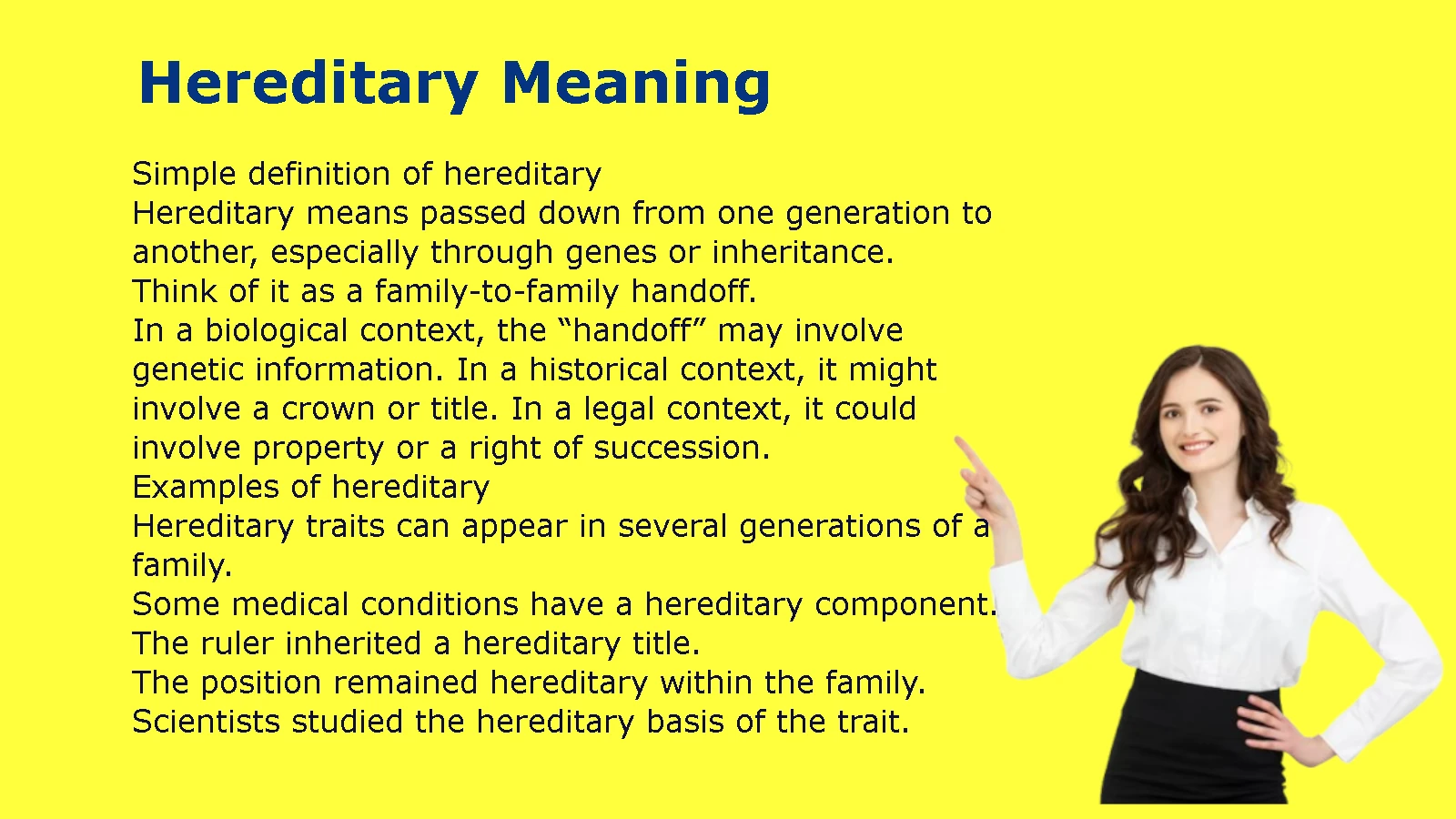
Simple definition of hereditary
Hereditary means passed down from one generation to another, especially through genes or inheritance.
Think of it as a family-to-family handoff.
In a biological context, the “handoff” may involve genetic information. In a historical context, it might involve a crown or title. In a legal context, it could involve property or a right of succession.
Examples of hereditary
- Hereditary traits can appear in several generations of a family.
- Some medical conditions have a hereditary component.
- The ruler inherited a hereditary title.
- The position remained hereditary within the family.
- Scientists studied the hereditary basis of the trait.
The word doesn’t automatically mean that every family member will have the same characteristic. It describes a form of transmission or inheritance. The actual pattern can be much more complicated.
What Does Hereditary Mean?
In plain English, hereditary means something comes down to you from an earlier generation of your family.
The idea becomes easier when you picture a family tree.
Grandparents → Parents → Children → Grandchildren
Something hereditary can move along that family line. In genetics, genes carry biological information from parents to children. In other settings, families can pass down titles, property, traditions, or rights.
For example, suppose several members of a family have a particular genetic condition. Researchers may investigate whether the condition results from genetic variants passed from parents to children. The National Human Genome Research Institute defines an inherited trait or variant as one encoded in DNA and passed from parent to offspring during reproduction.
However, not everything common in a family is hereditary.
A family might eat the same foods, live in the same environment, speak the same language, or share the same habits. Those similarities can come from shared experiences rather than inherited genes.
Hereditary does not simply mean “common in a family”
Consider these examples:
| Example | Hereditary? | Why? |
| A genetic variant passed from parent to child | Yes | The genetic information travels through inheritance |
| A family member has the same eye color as a parent | Potentially | Genes influence eye color |
| Everyone in a family enjoys spicy food | Not necessarily | Shared habits can explain the similarity |
| A child learns a parent’s language | No | Language is learned rather than genetically inherited |
| A royal title passes to an heir | Yes, in the succession sense | The title follows a family line |
| A family recipe is taught to children | Not genetically | It is culturally transmitted |
That distinction matters. Hereditary has a stronger connection to biological heredity or formal inheritance than simply sharing something with your relatives.
Hereditary Meaning in Biology
In biology, hereditary relates to characteristics that pass from parents to offspring through heredity.
Heredity is one of the basic ideas behind genetics. Parents transmit genetic information to their children through reproductive cells. Genes form an important part of that process. The National Human Genome Research Institute describes a gene as a basic unit of inheritance and notes that genes are passed from parents to offspring.
A hereditary trait can involve a physical characteristic, a biological feature, or a predisposition influenced by genetic variation.
Examples of hereditary traits
Common examples discussed in genetics include:
- Certain aspects of eye color
- Some blood-group characteristics
- Certain inherited disorders
- Some forms of hair characteristics
- Certain inherited metabolic conditions
- Some genetic predispositions
Still, biology rarely works like a simple photocopier.
Many traits result from multiple genes interacting with one another and with environmental factors. The National Human Genome Research Institute notes that traits can be influenced by genes, environmental factors, or a combination of both.
That means saying a trait is “hereditary” doesn’t necessarily mean that one specific gene controls it.
Hereditary traits and generations
Imagine a characteristic appearing in a parent, child, and grandchild. That pattern may suggest inheritance, but scientists need more evidence before concluding that a specific genetic mechanism causes it.
Geneticists can use a pedigree, which is a family chart showing how a trait or condition appears across generations. Pedigrees help researchers examine family relationships and possible inheritance patterns.
This is where the everyday meaning of hereditary meets the more precise language of biology.
Hereditary Meaning in Genetics
In genetics, hereditary describes something that passes through generations because of genetic inheritance.
DNA carries biological information. During reproduction, offspring receive genetic material from their parents. Those inherited variants can influence characteristics and, in some cases, contribute to a disease or condition.
How hereditary traits work
For many genes, a person receives one version, called an allele, from each parent. Different patterns of inheritance can affect how a characteristic appears.
For example, a dominant inheritance pattern can produce a trait when only one relevant dominant allele is present. A recessive pattern generally requires two copies of the relevant recessive allele for the associated trait to appear.
A simplified model looks like this:
Parent 1
│
├── Genetic variant ──┐
│ │
│ Child
│ │
└── Other variant ────┘
│
Possible trait
Real inheritance can be considerably more complicated.
Gregor Mendel’s experiments with pea plants helped establish basic ideas about dominant and recessive inheritance. Modern genetics has since shown that many traits involve multiple genes, gene interactions, and environmental influences.
Hereditary vs. acquired characteristics
This distinction is particularly important.
A hereditary characteristic comes through genetic inheritance. An acquired characteristic develops during a person’s lifetime because of experiences, behavior, environment, injury, training, or other factors.
For example:
- A genetic variant inherited from a parent can be hereditary.
- A scar from an accident is acquired.
- Increased muscle strength from exercise is acquired.
- A genetic predisposition can be hereditary.
- Knowledge of a language learned during childhood is acquired.
The line isn’t always completely black and white because genes and environments interact. Genetics itself studies the relationship among genes, DNA variation, and environmental factors.
Hereditary Meaning in Family
When people use hereditary in a family context, they usually mean something passed down from earlier generations.
You might hear phrases such as:
- hereditary condition
- hereditary trait
- hereditary disease
- hereditary tendency
- hereditary characteristic
- hereditary family history
Suppose a particular genetic condition appears in several generations. A doctor or researcher may describe the condition as hereditary when genetic inheritance explains its transmission.
The term can also describe characteristics rather than diseases.
For example:
“Several members of the family have a hereditary tendency toward the condition.”
That statement doesn’t necessarily mean every relative will develop it. Genetic inheritance can involve different patterns, and many traits depend on more than genes alone.
Family resemblance isn’t always hereditary
Here’s an easy trap.
A child might resemble a parent because of inherited genes. Yet a child might also resemble a parent because they share the same hairstyle, diet, mannerisms, accent, or lifestyle.
Family resemblance and hereditary resemblance aren’t always the same thing.
That distinction becomes especially important when discussing health. A condition that appears repeatedly in a family may have genetic, environmental, behavioral, or mixed causes.
Hereditary Meaning in History
In history, hereditary often describes a title, position, rank, or form of authority that passes through a family.
A hereditary ruler, for example, receives the right to rule through a recognized family succession rather than through an ordinary election or appointment.
Similarly, a hereditary title passes according to established rules of descent.
Oxford describes a hereditary title or monarchy as something legally given to a person’s child after the parent dies.
Examples of hereditary positions
Historical examples include:
- Monarchs
- Kings and queens
- Princes and princesses
- Hereditary nobles
- Hereditary peers
- Family-based offices or ranks in certain historical systems
The exact rules varied enormously across societies. Some systems favored the eldest child. Others used different succession rules based on gender, lineage, legitimacy, or other requirements.
So when you see hereditary monarchy, the word tells you something important about succession: the position follows a family line.
Hereditary does not mean “genetic” here
This is a useful distinction.
A royal title isn’t passed through DNA. It passes through legal, social, or traditional rules of succession.
That’s why the word hereditary has a broader meaning than simply “genetic.”
Hereditary Meaning in Law
In legal contexts, hereditary generally relates to something that passes by inheritance or follows a line of descent.
It can describe things such as:
- Property
- Rights
- Titles
- Estates
- Positions
- Succession
- Claims based on descent
For example:
“The title was hereditary and passed to the next eligible heir.”
Here, hereditary describes the legal or customary mechanism by which the title moves from one generation to another.
The broader dictionary sense includes things that descend to later generations through inheritance or according to established rules of descent.
Hereditary does not always mean genetic in law
This is one of the most important distinctions in the entire word.
If someone inherits a house, the house isn’t genetically transferred to that person. Instead, ownership passes through an inheritance process.
Likewise, a hereditary title doesn’t enter someone’s DNA. The person receives it because the relevant succession rules recognize their place in the family line.
Biology uses hereditary mainly to discuss transmission through heredity. Law and history can use hereditary to describe transmission through inheritance or descent.
Because inheritance laws differ between jurisdictions, the precise legal meaning can depend on the legal system involved.
Hereditary vs. Inherited
Hereditary and inherited overlap heavily, but they aren’t identical in every situation.
Inherited is usually broader. You can inherit a genetic characteristic, but you can also inherit money, property, a title, or even a family tradition in a less technical sense.
Hereditary more strongly emphasizes something that passes through generations or a line of descent.
| Hereditary | Inherited |
| Often emphasizes transmission through generations | Emphasizes receiving something from an earlier person or generation |
| Common in genetics and biology | Common in genetics and everyday language |
| Can describe titles and positions | Can describe property, money, traits, titles, and more |
| Often has a family-line meaning | Has a broader range of uses |
| “A hereditary disease” | “An inherited genetic variant” |
| “A hereditary title” | “She inherited the estate” |
Example
Consider these two sentences:
The condition is hereditary.
This emphasizes that the condition can be transmitted through genetic inheritance.
She inherited the property from her father.
This emphasizes that she received property after her father’s death.
Both words connect to the idea of inheritance. However, their focus differs.
A useful shortcut is:
Hereditary = passed down
Inherited = received from someone before you
The shortcut isn’t perfect, but it works well for everyday understanding.
Hereditary vs. Genetic
Hereditary and genetic are closely related, yet they shouldn’t always be treated as exact synonyms.
Genetic refers specifically to genes, DNA, or genetic processes. Hereditary emphasizes transmission from one generation to another.
The distinction becomes clearer with a simple example.
A genetic change can occur in a person’s cells without necessarily being inherited from a parent. By contrast, something described as hereditary specifically points toward transmission across generations.
The National Human Genome Research Institute defines genetics as the study of inheritance and explains that genetics involves genes, DNA variation, and interactions with environmental factors.
Hereditary vs. genetic comparison
| Term | Main focus | Example |
| Hereditary | Passed from earlier generations | A hereditary condition |
| Genetic | Related to genes or DNA | A genetic variant |
| Hereditary trait | A trait transmitted through inheritance | An inherited characteristic |
| Genetic trait | A trait influenced by genetic factors | A characteristic affected by several genes |
Here’s another way to remember it:
Genetic tells you about genes. Hereditary tells you about transmission across generations.
Sometimes both words fit. In other cases, one is more precise.
Hereditary Meaning in Different Contexts
The meaning of hereditary changes slightly depending on where you encounter it.
| Context | Hereditary Meaning |
| Biology | Passed from parents to offspring through heredity |
| Genetics | Related to traits or variants transmitted through genes |
| Family | Passed down through generations of a family |
| History | Passed through a family line, such as a title or position |
| Law | Connected with inheritance, descent, or succession |
| Medicine | Describes genetic information or conditions passed from parent to child |
| Everyday English | Something handed down from previous generations |
Medicine provides a particularly common example. The National Cancer Institute defines hereditary in medicine as the passing of genetic information from parent to child through genes in sperm and egg cells.
A quick context test
When you encounter hereditary, ask:
“What is being passed down?”
If the answer is:
- Genes or traits → the meaning is biological or genetic.
- A disease or predisposition → the meaning is often medical or genetic.
- A title or position → the meaning is historical or social.
- Property or rights → the meaning is legal or inheritance-related.
- A family tradition → the meaning may be broader and cultural rather than genetic.
That one question can make the word much easier to understand.
Hereditary Meaning in English
The hereditary meaning in English is:
Passed from parents or ancestors to later generations through heredity or inheritance.
Part of speech: Adjective
US pronunciation: /həˈred.ə.ter.i/
Basic meaning: Passed down from one generation to another, especially through genes or a family inheritance.
Example
The doctor wanted to know whether the condition was hereditary.
Here, hereditary means the condition may be passed from parents to children through genetic inheritance.
Another example shows the historical sense:
The family held a hereditary title.
In that sentence, the title passes through a family line rather than through DNA.
The word comes from the Latin hērēditārius, meaning “relating to inheritance.”
Hereditary Meaning in French
The French equivalent of hereditary is héréditaire.
The French word has closely related uses. Larousse defines héréditaire as something transmitted according to the laws of genetic heredity. It can also describe a disposition inherited from parents or ancestors and something transmitted through succession.
Examples
English: hereditary disease
French: maladie héréditaire
English: hereditary title
French: titre héréditaire
The French noun hérédité refers to heredity, including the transmission of genetic characteristics from parents to descendants.
So the connection is straightforward:
hereditary → héréditaire
heredity → hérédité
Hereditary Meaning in Farsi
In Farsi, hereditary can be translated as ارثی (ersi) or موروثی (mowruthi) depending on context. وراثتی (varāsati) can also appear in contexts involving inheritance or heredity. Persian-English dictionaries list موروثی and ارثی among translations for “hereditary.”
Common distinctions
- ارثی often works well for something inherited or hereditary, particularly in biological or medical contexts.
- موروثی can emphasize something passed down through a family or inherited from ancestors.
- وراثتی relates broadly to inheritance and heredity.
For example, a hereditary disease may be described using terminology related to بیماری ارثی or بیماری وراثتی.
The exact choice depends on the sentence and the kind of inheritance being discussed.
Hereditary Meaning in a Sentence
Seeing the word in different sentences makes its range much easier to understand.
Everyday example
Her musical talent seems to run in the family, although talent itself isn’t necessarily a simple hereditary trait.
This example also shows why context matters. Family patterns don’t automatically prove genetic inheritance.
Biology example
Some characteristics are hereditary and can pass from parents to offspring through genetic inheritance.
Genetics example
Researchers studied how the hereditary trait appeared across several generations.
Medical example
The doctor asked about hereditary conditions in the patient’s family.
Historical example
The crown followed a hereditary system of succession.
Legal example
The hereditary right passed to the next eligible heir under the applicable succession rules.
Family example
Several generations shared a hereditary characteristic.
Cultural example
The family passed its traditional craft from one generation to another.
Notice something important: the last example describes transmission across generations, but it doesn’t necessarily describe genetic heredity. That’s exactly why context matters when interpreting hereditary.
Synonyms for Hereditary
The best synonym depends on the sentence.
Common synonyms
- Inherited
- Genetic
- Familial
- Heritable
- Ancestral
- Passed down
- Inherited by descent
- Traditional in some broader contexts
However, these words aren’t interchangeable in every situation.
Hereditary vs. inherited
Inherited is usually the closest everyday alternative.
hereditary condition
inherited condition
Both can work in many medical or genetic contexts.
Hereditary vs. genetic
Genetic is more specifically connected to genes and DNA.
hereditary disease
genetic disease
These can overlap, but the terms emphasize different aspects of the condition.
Hereditary vs. familial
Familial means associated with a family. It doesn’t always establish a genetic cause.
For instance, a condition can appear frequently within a family because relatives share environmental factors, habits, or exposures.
Hereditary vs. ancestral
Ancestral means relating to ancestors. It doesn’t necessarily mean something was genetically transmitted.
You might describe an old family tradition as ancestral, but calling it hereditary would suggest a different kind of transmission depending on the context.
Frequently Asked Questions About Hereditary
What does hereditary mean?
Hereditary means passed from parents or ancestors to later generations, especially through genes or inheritance. The word can describe biological traits, medical conditions, titles, positions, property, or rights depending on the context.
What does hereditary mean in biology?
In biology, hereditary describes characteristics transmitted from parents to offspring through heredity. Genetic information plays a central role in this process.
What does hereditary mean in genetics?
In genetics, hereditary refers to something passed from parent to offspring through genetic inheritance. An inherited variant is encoded in DNA and transmitted during reproduction.
What does hereditary mean in history?
In history, hereditary often means that a title, position, rank, or authority passes through a family line. Hereditary monarchies are a familiar example.
What does hereditary mean in law?
In law, hereditary generally relates to inheritance, descent, or succession. It can describe property, rights, titles, or positions that pass according to inheritance rules. The exact legal meaning depends on the applicable legal system.
What does hereditary mean in a family?
In a family context, hereditary usually means something passed down through generations. When people discuss hereditary characteristics or conditions, they often mean characteristics influenced by genetic information inherited from parents.
Is hereditary the same as genetic?
Not exactly. The terms overlap, but genetic focuses on genes and DNA while hereditary focuses more strongly on transmission from one generation to another. A genetic change isn’t necessarily inherited from a parent.
Is hereditary the same as inherited?
They’re closely related, but inherited is broader. You can inherit genes, traits, property, money, or other things. Hereditary more strongly emphasizes transmission through generations or a family line.
Final Takeaway: What Does Hereditary Mean?
The simplest way to understand hereditary is to remember the idea of something being passed down.
In biology and genetics, it usually refers to traits, variants, or conditions transmitted from parents to offspring through genetic inheritance. In history and law, the word can describe titles, positions, property, rights, or succession that move through a family line.
So when you encounter the word, look at what comes after it:
- Hereditary trait → a trait passed through genetic inheritance
- Hereditary disease → a condition associated with inherited genetic information
- Hereditary title → a title passed through a family line
- Hereditary position → a role transmitted through established succession
- Hereditary right → a right connected with inheritance or descent
The key idea remains the same: hereditary describes something that reaches one generation from an earlier generation through heredity or inheritance.