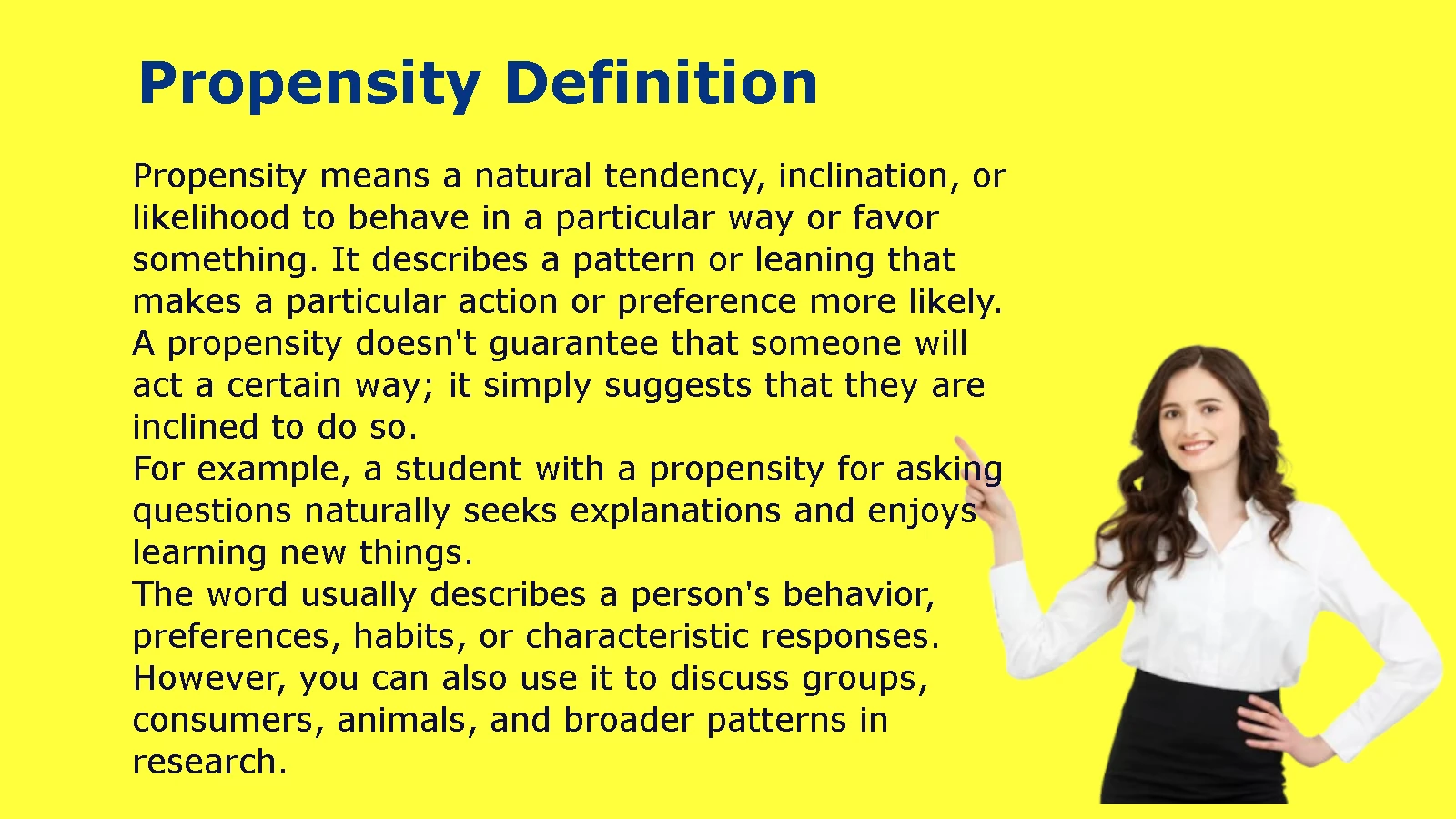
The propensity definition refers to a person’s natural or usual tendency to think, feel, or act in a particular way. For example, someone with a propensity for kindness often treats others with compassion, while a person with a propensity for taking risks may be more willing to try uncertain opportunities. Terms such as tendency, inclination, predisposition, disposition, and leaning are related synonyms, but each can carry a slightly different meaning depending on the context.
A propensity is a natural tendency, inclination, or likelihood to behave in a particular way or develop a certain habit. If you’ve come across the word “propensity” and wondered what it means, how it is used, or how it describes someone’s behavior, the term is closely connected to tendencies, habits, inclinations, preferences, behavioral patterns, and natural dispositions.
In this guide, you’ll learn what “propensity” means, how to use it in sentences, where the word comes from, and how “propensity” differs from related expressions such as “tendency” and “inclination.” You’ll also see clear examples to make the meaning easy to understand.
By the end, you’ll know exactly what propensity means and how to use this word naturally and correctly.
What Is the Definition of Propensity?
Propensity means a natural tendency, inclination, or likelihood to behave in a particular way or favor something. It describes a pattern or leaning that makes a particular action or preference more likely. A propensity doesn’t guarantee that someone will act a certain way; it simply suggests that they are inclined to do so.
For example, a student with a propensity for asking questions naturally seeks explanations and enjoys learning new things.
The word usually describes a person’s behavior, preferences, habits, or characteristic responses. However, you can also use it to discuss groups, consumers, animals, and broader patterns in research.
Consider these examples:
- A child has a propensity to ask questions.
- My friend has a propensity for collecting old books.
- The company noticed a propensity among customers to buy discounted products.
- He has a propensity to remain calm during stressful situations.
Each sentence describes something that tends to happen rather than something that must happen.
Propensity Definition in Simple Words
In simple words, propensity is a natural leaning toward doing or liking something.
Think of it as a direction in which someone’s behavior tends to move. If your friend always volunteers to organize group activities, you might say they have a propensity for leadership. If another friend frequently puts off difficult tasks, they may have a propensity to procrastinate.
Here are a few everyday examples:
- Propensity for kindness: You naturally enjoy helping others.
- Propensity to worry: You often become concerned about possible problems.
- Propensity for adventure: You enjoy exploring unfamiliar places.
- Propensity to save money: You tend to set money aside rather than spend it immediately.
A propensity can develop through personality, experience, repeated habits, environmental influences, or a combination of factors. The word itself doesn’t explain why a tendency exists. It simply identifies the tendency.
Easy way to remember it: If someone tends to do something repeatedly or naturally leans toward a particular preference, they may have a propensity for it.
Is Propensity a Noun?
Yes. Propensity is a noun because it names a tendency or inclination rather than describing an action directly.
You can use it as the main noun in a sentence or place it after a possessive word to identify someone’s particular tendency.
Examples:
- Her propensity for organization makes her an excellent project manager.
- His propensity to interrupt sometimes frustrates his coworkers.
- The research examined the propensity of consumers to switch brands.
- Their different propensities influenced how they approached the challenge.
The plural form is propensities.
For example:
- Children develop different propensities as they grow.
- The report identified several propensities among frequent buyers.
- People have different propensities toward risk-taking.
The word also appears in formal expressions such as propensity for risk, propensity to spend, and propensity toward violence.
Although the word can sound academic, it works in ordinary sentences whenever you want to describe a recognizable inclination.
What Does Propensity Mean in Different Contexts?
The meaning of propensity stays largely the same across different situations, but the type of tendency changes with the context. It might describe a personality trait, a personal preference, a recurring habit, or a measurable pattern in consumer behavior.
Understanding these differences helps you interpret the word more accurately.
Positive Propensity
A positive propensity describes an inclination toward behavior that people generally consider helpful, constructive, or desirable.
For example, someone might have a propensity for generosity, curiosity, patience, or cooperation. These tendencies can influence how that person responds to everyday situations.
Consider the following examples:
- Propensity for generosity: Maria often shares her resources with people who need help.
- Propensity to learn: Daniel enjoys learning new skills, even when they require extra effort.
- Propensity for leadership: Aisha naturally steps forward when a group needs direction.
- Propensity toward cooperation: The employee prefers solving problems through teamwork.
- Propensity for creativity: The designer regularly comes up with original approaches to familiar problems.
These examples describe patterns rather than isolated actions.
Someone who helps a stranger once has performed a kind act. Someone who consistently looks for opportunities to help others may demonstrate a propensity for kindness.
Still, a positive propensity doesn’t guarantee a positive outcome every time. A person who naturally takes charge, for instance, might occasionally overlook other people’s opinions.
Negative Propensity
A negative propensity describes a tendency toward behavior that may cause problems, create risks, or produce undesirable consequences.
The word frequently appears in discussions about personal habits, decision-making, and behavioral patterns.
Examples include:
- Propensity to procrastinate: Someone regularly delays important tasks.
- Propensity to overspend: A person often purchases unnecessary items.
- Propensity for exaggeration: Someone tends to make stories sound more dramatic than they were.
- Propensity toward conflict: A person frequently responds to disagreements with hostility.
- Propensity to take risks: Someone often chooses uncertain options without carefully considering the consequences.
Imagine an employee who repeatedly misses deadlines because they postpone difficult assignments. A manager might describe the employee as having a propensity to procrastinate.
That description identifies a recurring pattern. It doesn’t mean the employee can never improve or that every future assignment will be late.
This distinction matters because propensity describes a tendency, not a permanent character judgment.
A person can recognize an unhelpful tendency, change their environment, develop new habits, and gradually behave differently.
Propensity in Academic and Professional Writing
In academic and professional contexts, propensity often describes behavior that researchers or organizations want to understand, compare, or predict.
The word is especially useful when discussing patterns that occur more frequently under certain circumstances.
In psychology, researchers might examine a person’s propensity to avoid stressful situations or seek social interaction.
In education, a researcher might investigate students’ propensity to participate in classroom discussions.
For example:
The marketing team studied customers’ propensity to renew their subscriptions after a free trial.
This sentence suggests that the team examined how likely customers were to renew their subscriptions.
Another example:
The researchers investigated whether financial stress was associated with a greater propensity to delay major purchases.
Here, propensity describes a tendency that researchers can examine using data.
In technical writing, the term can have a more precise meaning than it does in everyday conversation. A propensity score, for instance, is a statistical estimate of the probability that an individual receives a particular treatment or exposure, given observed characteristics.
This technical use is related to the general definition, but it has a specific role in statistical analysis.
Propensity Examples in Sentences
The easiest way to understand propensity is to see how it works in different sentences. The word often appears in discussions about habits, personality, preferences, professional behavior, and decision-making.
The following examples show how to use it naturally.
Everyday Examples of Propensity
Here are original sentences that demonstrate the word in familiar situations.
- My younger brother has a propensity to ask questions whenever he encounters something unfamiliar.
- Lena has a propensity for remembering small details about people’s lives.
- Our dog has a propensity to bark whenever the delivery driver arrives.
- Marcus has a propensity for turning ordinary meals into elaborate cooking experiments.
- She has a propensity to arrive early because she dislikes feeling rushed.
- My neighbor has a propensity for collecting vintage postcards.
- The little boy showed a propensity for solving puzzles without asking for help.
- His propensity to joke during serious conversations sometimes causes misunderstandings.
- Elena has a propensity for choosing challenging books over light reading.
- The team captain has a propensity to encourage quieter players to participate.
Notice how each sentence identifies a tendency that helps explain someone’s behavior.
The word also works when describing a tendency that appears only in a particular situation.
For example:
Although Nina usually avoids public attention, she has a propensity to speak up when someone is treated unfairly.
This sentence shows that a person’s general personality doesn’t determine every action. Someone may have a particular propensity that emerges under specific circumstances.
Propensity Examples in Academic and Formal Writing
Formal writing often uses propensity to describe patterns without making absolute claims.
Here are several examples:
- The study examined participants’ propensity to make impulsive financial decisions.
- Her propensity for detailed analysis helped the research team identify inconsistencies.
- Rising interest rates may influence consumers’ propensity to borrow money.
- The survey measured employees’ propensity to seek feedback from their managers.
- Researchers investigated the relationship between sleep quality and the propensity to make mistakes.
- The company analyzed customers’ propensity to cancel their subscriptions after a price increase.
- Students with a propensity for independent learning often seek additional reading materials.
- The report explored the propensity of households to increase savings during periods of uncertainty.
These examples demonstrate why the word appears frequently in research papers, reports, and business documents.
It allows writers to describe likelihood or inclination without suggesting that a particular outcome is inevitable.
For example, saying that customers have a propensity to cancel a subscription doesn’t mean every customer will cancel. It means that the observed pattern or estimated likelihood points in that direction.
How to Use Propensity in a Sentence
The two most common grammatical patterns are propensity to + verb and propensity for + noun or gerund.
A third pattern, propensity toward/towards, also appears in English.
| Sentence pattern | Example | What it expresses |
| Propensity to + verb | She has a propensity to overthink decisions. | A tendency to perform an action |
| Propensity for + noun | He has a propensity for adventure. | An inclination toward an activity or preference |
| Propensity for + gerund | They have a propensity for taking unnecessary risks. | A tendency to engage in an activity |
| Propensity toward/towards + noun | The policy showed a propensity toward centralization. | A leaning in a particular direction |
Let’s examine the patterns more closely.
Propensity to + verb
Use this construction when you want to describe an action someone tends to perform.
Examples:
- He has a propensity to interrupt.
- The child has a propensity to explore.
- She has a propensity to avoid confrontation.
Propensity for + noun
Use this construction when you want to describe a preference, characteristic, or area of interest.
Examples:
- He has a propensity for music.
- She has a propensity for careful planning.
- They have a propensity for adventure.
Propensity for + gerund
A gerund is a verb ending in -ing that functions as a noun.
Examples:
- She has a propensity for spending impulsively.
- He has a propensity for helping people in need.
- The team has a propensity for overlooking small details.
A useful editing tip is to read your sentence aloud. If the construction sounds awkward, consider whether tendency, habit, or inclination would express your meaning more naturally.
Synonyms and Antonyms of Propensity
Several English words share the meaning of propensity, but each carries a slightly different emphasis. Choosing the right synonym can make your writing more precise and prevent repetitive wording.
Common Synonyms for Propensity
The most useful synonyms include tendency, inclination, proclivity, predisposition, penchant, and predilection.
| Synonym | Meaning or nuance | Example |
| Tendency | A general pattern or recurring behavior | He has a tendency to interrupt. |
| Inclination | A preference or willingness to do something | She has an inclination to help others. |
| Proclivity | A natural leaning toward a particular behavior | He has a proclivity for debate. |
| Predisposition | An existing susceptibility or underlying inclination | She has a predisposition to motion sickness. |
| Penchant | A strong liking or preference | He has a penchant for classic novels. |
| Predilection | A particular preference or taste | She has a predilection for historical fiction. |
| Leaning | A preference or direction of interest | He has a leaning toward practical solutions. |
| Bent | A natural aptitude or inclination | She has a mathematical bent. |
| Disposition | A person’s characteristic temperament or usual attitude | He has a cheerful disposition. |
Although these words overlap, they aren’t interchangeable in every sentence.
For example, penchant usually emphasizes a strong liking. You might have a penchant for spicy food, but it would sound less natural to describe a person’s tendency to make repeated accounting errors as a penchant.
Similarly, predisposition often suggests an underlying susceptibility or pre-existing tendency. It can appear in discussions of health, behavior, and risk, where penchant would be inappropriate.
Best everyday synonym: Tendency is often the safest replacement because it’s widely understood and works in many contexts.
Best formal alternatives: Proclivity and predisposition may fit when you need to emphasize a natural leaning or an underlying susceptibility.
Antonyms of Propensity
An antonym expresses the opposite or a contrasting idea.
Because propensity can describe tendencies, preferences, or inclinations, its best antonym depends on the sentence.
| Antonym | Meaning | Example |
| Aversion | A strong dislike or opposition | She has an aversion to unnecessary risks. |
| Disinclination | A lack of desire or willingness | He showed a disinclination to participate. |
| Reluctance | Hesitation or unwillingness | Her reluctance to speak surprised the group. |
| Resistance | Opposition to an action or change | The team showed resistance to adopting new procedures. |
| Unlikelihood | A low probability of something happening | The unlikelihood of failure reassured the team. |
These words don’t all function as direct opposites in every context.
For example, aversion contrasts with a propensity that describes a strong preference. Reluctance contrasts with a propensity to act willingly. Unlikelihood may provide a useful contrast when propensity refers to probability.
Consider these sentences:
- He has a propensity for public speaking, while his colleague has an aversion to it.
- She has a propensity to experiment, but her manager shows a disinclination to change established procedures.
- The customer demonstrated a propensity to purchase premium products, whereas another customer showed reluctance to spend more.
The right antonym helps establish the precise contrast you want to communicate.
Propensity vs. Similar Words
Propensity often appears alongside words such as tendency, proclivity, predisposition, and inclination. These terms share a general meaning, but their differences matter when you want to write clearly.
Propensity vs. Tendency
Propensity and tendency both describe a likelihood or inclination toward a particular behavior. The main difference is that tendency is more common in everyday English, while propensity often sounds more formal or analytical.
Compare these examples:
- Everyday: He has a tendency to arrive late.
- More formal: He has a propensity to arrive late.
Both sentences communicate the same general idea. The second may sound more suited to a report, evaluation, or formal discussion.
Tendency can also describe patterns that aren’t directly related to a person’s behavior.
For example:
- Temperatures show a tendency to rise during the summer.
- The market has a tendency to react quickly to unexpected news.
Propensity is especially natural when describing a person’s, group’s, or system’s inclination toward a particular behavior or outcome.
Which word should you choose?
Use tendency for general explanations and casual conversation. Choose propensity when the context calls for a more formal description of behavioral likelihood or inclination.
Propensity vs. Proclivity
Propensity and proclivity are close synonyms. Both describe a natural leaning toward a particular activity, behavior, or preference.
However, proclivity often emphasizes a person’s particular inclination toward a specific kind of behavior, while propensity has a broader range of uses.
Examples:
- He has a propensity to take financial risks.
- He has a proclivity for risky investments.
Both sentences suggest a leaning toward risk-taking.
Now consider a different example:
Her propensity to remain calm during emergencies made her a reliable team leader.
You could replace propensity with proclivity, but the original may sound more natural to many readers because it describes a general behavioral tendency.
Neither word automatically implies that the tendency is negative. Context determines whether the behavior is desirable or undesirable.
Use proclivity when you want a more formal alternative that highlights a particular leaning. Use propensity when you want to emphasize a general tendency or likelihood.
Propensity vs. Predisposition
Propensity and predisposition both describe inclinations, but predisposition often suggests an existing susceptibility or underlying condition that makes something more likely.
For example:
- He has a propensity to take risks.
- He has a predisposition to motion sickness.
The first sentence describes a tendency in behavior. The second describes a susceptibility that may influence how someone responds to certain situations.
The distinction becomes particularly important in health-related writing.
A predisposition to a condition doesn’t mean that the condition will inevitably develop. It means that certain underlying factors may increase the likelihood of its occurrence.
Similarly, a propensity toward a behavior doesn’t establish that the behavior is unavoidable.
In research, these terms can also carry more specialized meanings. Their exact use depends on the field, the variables being studied, and the evidence available.
Choose propensity when discussing a general inclination or behavioral pattern. Choose predisposition when you want to emphasize an existing susceptibility or underlying tendency.
Propensity vs. Inclination
Inclination and propensity overlap considerably, but they often emphasize different aspects of behavior.
Inclination frequently highlights preference or willingness, whereas propensity often emphasizes a tendency or likelihood of acting in a certain way.
Compare the following sentences:
- She has an inclination to work independently.
- She has a propensity to work independently.
The first sentence may emphasize her preference for working alone. The second more strongly suggests a recurring behavioral tendency.
Consider another pair:
- He has an inclination to accept the offer.
- He has a propensity to accept similar offers.
The first describes a present preference or willingness. The second suggests a broader pattern across multiple situations.
These distinctions aren’t absolute. English speakers often use both words in overlapping ways.
However, the comparison provides a practical rule:
- Use inclination when preference or willingness matters most.
- Use propensity when you’re describing a broader tendency or recurring pattern.
Is Propensity Positive, Negative, or Neutral?
Propensity is a neutral word. It doesn’t automatically suggest good or bad behavior. The words surrounding it determine whether the tendency sounds positive, negative, or simply descriptive.
For instance, a propensity for kindness describes a favorable tendency, while a propensity to overspend describes a potentially harmful one.
The word itself remains neutral in both expressions.
Positive and Neutral Examples
A propensity can describe a useful quality, an ordinary preference, or a characteristic that has no clear moral value.
Examples include:
- A propensity for kindness.
- A propensity to learn new skills.
- A propensity for careful planning.
- A propensity to explore unfamiliar places.
- A propensity to ask detailed questions.
- A propensity for independent thinking.
Some tendencies can be positive in one situation and less helpful in another.
A person with a propensity to question assumptions may help a team identify mistakes. However, if that person challenges every minor decision, coworkers may find collaboration difficult.
Likewise, someone with a propensity for caution may avoid unnecessary danger but also miss opportunities that require reasonable risk-taking.
The context determines how the tendency affects the situation.
Negative Examples
A negative propensity describes a tendency that may lead to undesirable outcomes.
Examples include:
- A propensity to procrastinate.
- A propensity for reckless spending.
- A propensity to exaggerate achievements.
- A propensity toward aggressive behavior.
- A propensity to ignore warning signs.
Suppose an employee regularly postpones important tasks until the last minute. A manager might identify a propensity to procrastinate as a problem affecting the employee’s performance.
The description becomes more useful when paired with specific evidence.
Instead of saying, “He has a bad propensity,” a clearer statement would be:
He has a propensity to postpone complex assignments, which often leaves too little time for review.
This version identifies the behavior and its practical consequence without making a vague judgment about the person’s character.
When writing about people, focus on observable patterns rather than treating a propensity as an unchangeable identity.
Origin and History of the Word Propensity
The word propensity entered English in the late 16th century. It developed from propense, meaning inclined or disposed toward something, and ultimately traces to the Latin propensus, associated with leaning or inclining.
Its historical roots help explain the modern meaning: a propensity is a leaning in a particular direction.
Over time, the word became established in formal English, particularly in writing about character, behavior, preferences, and likelihood.
For example, a writer might describe a person’s propensity for generosity or a community’s propensity to adopt new practices.
Today, the word appears in several fields:
- Psychology: Describing tendencies in behavior.
- Economics: Discussing patterns of consumption, saving, and spending.
- Business: Examining customer behavior and purchasing likelihood.
- Education: Describing students’ inclination to participate or pursue particular activities.
- Statistics: Referring to specialized concepts such as propensity scores.
Although the word has a formal tone, its underlying meaning remains straightforward. It describes an inclination toward something rather than a guaranteed result.
Common Mistakes When Using Propensity
Propensity is easy to understand, but a few common mistakes can make your writing less precise. Paying attention to certainty, grammar, and tone will help you use the word naturally.
Confusing Propensity With Certainty
The most important distinction is that a propensity indicates a tendency, not a guarantee.
For example:
Incorrect interpretation: She has a propensity to make mistakes, so she will fail the exam.
More accurate interpretation: She has a propensity to overlook small details, so reviewing her work carefully may help her avoid mistakes.
The second statement recognizes a pattern without assuming that the outcome is inevitable.
A propensity can influence behavior, but other factors also matter. Preparation, circumstances, experience, motivation, and deliberate choices can all affect what someone does.
This distinction is particularly important in professional reports and research writing. A statistical association or estimated likelihood doesn’t automatically establish a certain outcome.
Using the Wrong Preposition
The most common constructions are propensity to, propensity for, and propensity toward/towards.
Each construction serves a slightly different purpose.
Use propensity to before a verb:
- A propensity to complain.
- A propensity to take risks.
- A propensity to avoid conflict.
propensity for before a noun or gerund:
- A propensity for adventure.
- A propensity for criticism.
- A propensity for taking risks.
Use propensity toward or towards to express a leaning in a particular direction:
- A propensity toward caution.
- A propensity toward aggressive negotiation.
- A propensity towards independent decision-making.
Both toward and towards are standard English forms. Toward is especially common in American English.
A useful editing exercise is to check the word immediately following propensity. If you intend to describe an action, the to + verb construction is often the clearest choice.
Using Propensity in Casual Conversation
Although propensity is a valid word in everyday English, it can sound unnecessarily formal in casual conversation.
Imagine telling a friend:
“I have a propensity to forget where I put my keys.”
The sentence is grammatically correct, but most people would probably say:
“I tend to forget where I put my keys.”
The simpler version sounds more natural in an informal conversation.
Here are several practical alternatives:
| Formal expression | More conversational alternative |
| A propensity to worry | A tendency to worry |
| A propensity for sweets | A liking for sweets |
| A propensity to procrastinate | A habit of putting things off |
| A propensity toward caution | A tendency to be cautious |
| A propensity for adventure | A love of adventure |
The best choice depends on your audience and purpose.
In an academic paper, business report, or formal analysis, propensity may be appropriate. In a text message, casual conversation, or simple explanation, tendency or habit may communicate the idea more directly.
Good writing isn’t about choosing the most complicated word. It’s about choosing the word that conveys your meaning clearly.
Frequently Asked Questions About Propensity
What Is the Simple Definition of Propensity?
Propensity means a natural tendency or inclination to behave in a certain way or prefer something. For example, a person with a propensity for reading regularly chooses books as a source of entertainment or learning.
What Is an Example of Propensity?
An example is: “Jordan has a propensity to arrive early for meetings.” The sentence means that Jordan tends to arrive before the scheduled time. It describes a recurring pattern, not a guarantee that Jordan will always be early.
Is Propensity a Positive or Negative Word?
Propensity is neutral. It can describe a positive tendency, such as a propensity for kindness, or a negative one, such as a propensity to overspend. The surrounding words establish the meaning’s positive or negative tone.
What Is a Synonym for Propensity?
Tendency is one of the most common synonyms for propensity. Other alternatives include inclination, proclivity, predisposition, penchant, and predilection. The best choice depends on whether you’re describing a general pattern, a natural leaning, an underlying susceptibility, or a strong preference.
What Is the Difference Between Propensity and Tendency?
Both words describe a likelihood or inclination toward something. However, tendency is more common in everyday conversation, while propensity often sounds more formal and appears frequently in academic, professional, and analytical writing.
How Do You Use Propensity in a Sentence?
Use propensity to + verb to describe an action or propensity for + noun or gerund to describe an inclination or activity. For example, “She has a propensity to overthink decisions” and “He has a propensity for collecting rare books.”
Conclusion: Understanding the Meaning of Propensity
The propensity definition comes down to one central idea: a natural tendency or inclination toward a particular behavior, action, or preference.
You can use the word to describe almost any recurring pattern, from a person’s propensity for kindness to a customer’s propensity to purchase a product. Its meaning remains neutral, so the context determines whether the tendency is positive, negative, or simply descriptive.
Remember these key points:
- Definition: A natural tendency or inclination.
- Part of speech: Noun.
- Plural form: Propensities.
- Common synonyms: Tendency, inclination, proclivity, and predisposition.
- Common patterns: Propensity to do something and propensity for something.
- Important distinction: A propensity suggests likelihood, not certainty.
When choosing between propensity and a similar word, consider what you want to emphasize. Use tendency for a straightforward explanation, inclination for preference or willingness, and predisposition when an underlying susceptibility matters.
Ready to use the word confidently? Try writing three original sentences about everyday habits, personal preferences, or workplace behavior. That simple exercise will help you understand not only what propensity means but also how to use it naturally.
Meta Title: Propensity Definition: Meaning, Synonyms & Examples
Meta Description: Learn the propensity definition, discover synonyms and antonyms, explore original sentence examples, and understand how to use the word correctly.













