The word frescade may look unfamiliar, especially if you’ve come across it online, in a book, or in a conversation and wondered what it means. If you’re searching for the frescade meaning, you likely want to know what the word refers to, how it is used, and whether it has a recognized definition. Understanding the term starts with looking at its spelling, possible origins, and the context in which it appears.
The meaning of frescade can be difficult to establish without context because it is an uncommon term. If you’re wondering what does frescade mean, it’s important to distinguish it from similar-looking words and possible spelling variations. The phrase “what is the meaning of frescade” reflects the same question: identifying the word’s definition, usage, and any related terms that might help explain it.
In this guide, you’ll explore what frescade means, its possible origin, how to use it in a sentence, and whether it has recognized synonyms or related words. You’ll also find clear explanations and examples to help you understand the term without confusing it with other words.
By the end, you’ll have a clearer understanding of frescade meaning, including what the word may refer to and how to interpret it when you encounter it in context.
What Does Frescade Mean?
Frescade is a rare English noun that refers to a cool walk or a shady place. The word evokes an outdoor setting where trees, vegetation, or shelter provide relief from direct sunlight. Depending on the context, it can describe a refreshing stroll or the cool, shaded area where someone walks.
Think of a tree-lined garden path on a hot summer afternoon. The trees block the harsh sunlight, a gentle breeze moves through the leaves, and the air feels noticeably cooler beneath the branches. That setting captures the central idea behind frescade.
The word is unusual today, so most people would describe the same scene with familiar expressions such as shady path, cool walkway, or pleasant stroll.
Frescade Meaning in Simple English
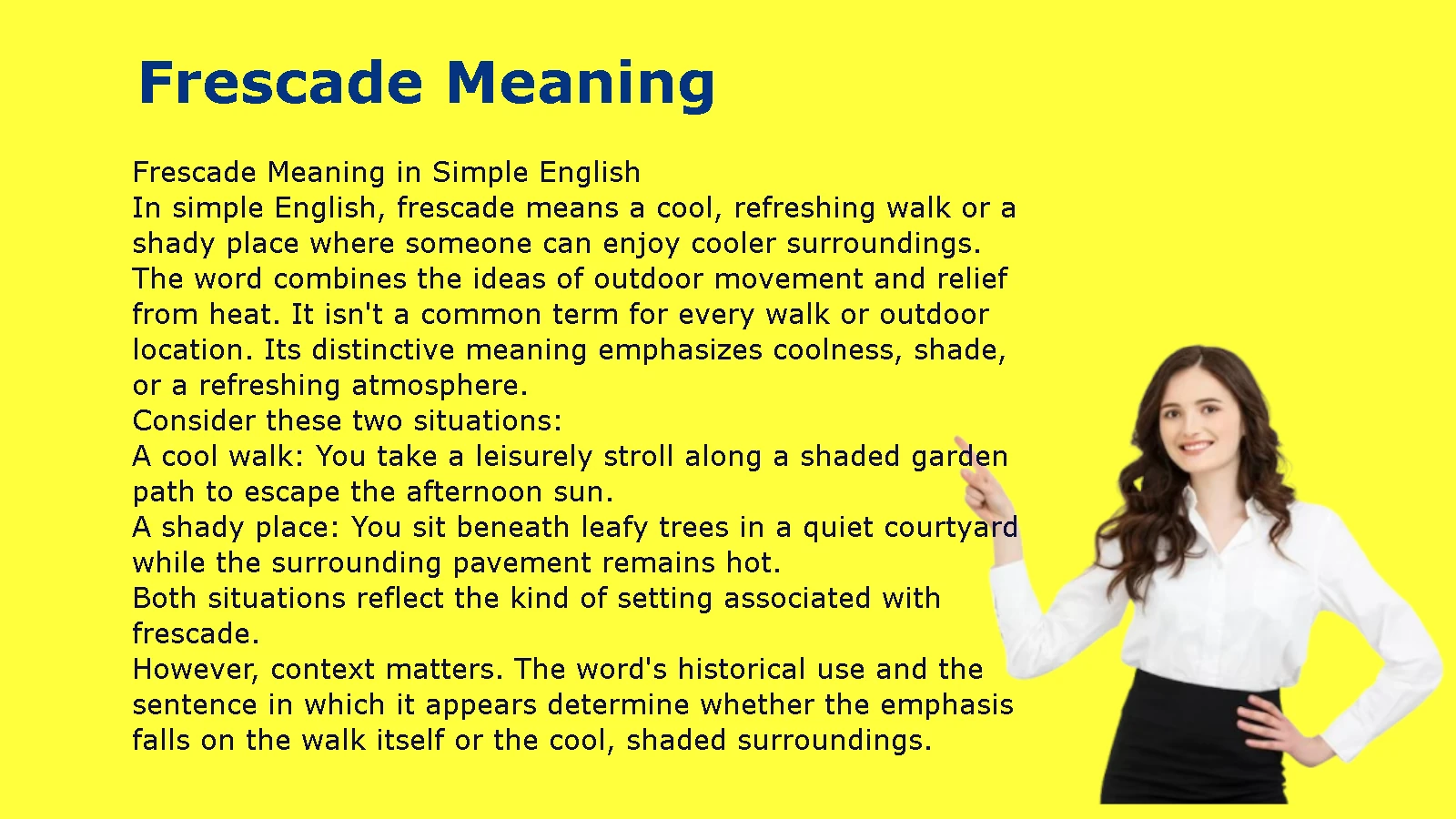
In simple English, frescade means a cool, refreshing walk or a shady place where someone can enjoy cooler surroundings.
The word combines the ideas of outdoor movement and relief from heat. It isn’t a common term for every walk or outdoor location. Its distinctive meaning emphasizes coolness, shade, or a refreshing atmosphere.
Consider these two situations:
- A cool walk: You take a leisurely stroll along a shaded garden path to escape the afternoon sun.
- A shady place: You sit beneath leafy trees in a quiet courtyard while the surrounding pavement remains hot.
Both situations reflect the kind of setting associated with frescade.
However, context matters. The word’s historical use and the sentence in which it appears determine whether the emphasis falls on the walk itself or the cool, shaded surroundings.
Frescade Definition and Part of Speech
The word frescade functions as a noun. It names a walk or place associated with coolness and shade rather than describing an object with an adjective.
Here is a quick breakdown of its meaning and grammatical role.
| Feature | Explanation |
| Word | Frescade |
| Part of speech | Noun |
| Core meaning | A cool walk or shady place |
| Main association | Shade, coolness, and relief from heat |
| Commonness | Rare in modern English |
| Typical context | Descriptive, literary, or historical writing |
| Everyday alternatives | Shady path, cool stroll, shaded walkway |
Because frescade is a noun, it can appear as the subject or object of a sentence.
For example:
- The frescade offered a peaceful escape from the afternoon heat.
- They enjoyed a frescade through the shaded garden.
- The old estate featured a quiet frescade beneath its trees.
These are original illustrative sentences, not quotations from historical texts.
Notice that the word can refer to either a setting or an experience. The surrounding words help readers understand which sense the writer intends.
What Does Frescade Mean in Everyday Language?
In everyday language, you can understand frescade as a shaded place or refreshing walk that provides relief from hot weather.
Although the word has a specific historical meaning, you don’t need complicated language to understand the idea behind it.
Imagine walking through a city on a hot day. The sidewalks radiate heat, traffic fills the streets, and you begin looking for somewhere cooler. You spot a narrow path beneath tall trees and decide to walk through it instead of continuing along the sunny pavement.
You could describe that experience as a walk through a shaded garden or, using the rare word, a frescade.
Here are several everyday expressions that communicate a similar idea:
- Shady path: A route protected from direct sunlight.
- Cool stroll: A relaxed walk in comfortable surroundings.
- Shaded retreat: A place where you can escape the sun and heat.
- Tree-lined walkway: A pedestrian route bordered by trees.
- Refreshing walk: A stroll that helps you feel cooler or more comfortable.
These alternatives usually communicate the idea more clearly to modern readers. Still, frescade can add a literary or historical quality when used deliberately.
Frescade Pronunciation
Pronunciation can be less straightforward with rare words because many English speakers have never encountered them. If you want to use frescade in conversation, focus on a reliable dictionary pronunciation rather than guessing from its spelling alone.
The word has two syllables, and its final letters may remind readers of other words with different pronunciation patterns. A pronunciation guide can help you avoid confusing it with a similar-looking term.
How to Pronounce Frescade
A practical starting point is to divide the word into two syllables:
fres-cade
Say the two parts smoothly as one word rather than pausing between them. For a precise pronunciation, use a dictionary audio entry or phonetic transcription that specifically covers frescade.
Don’t assume that every word ending in -cade follows the same pronunciation pattern. English contains words borrowed from different languages, and their spellings don’t always reveal their original sounds.
If you’re learning English, these steps can help:
- Read the word aloud: Practice saying it as a single word.
- Check a dictionary recording: Listen to a pronunciation source that includes this specific entry.
- Repeat it in context: Use a short sentence to practice the word’s rhythm.
- Avoid relying only on spelling: Uncommon words sometimes preserve patterns from their linguistic origins.
For example, practice this sentence: The frescade beneath the old trees offered a welcome escape from the heat.
The goal is to make the word sound natural without forcing an exaggerated or overly formal pronunciation.
How to Use Frescade in Spoken English
You can use frescade in spoken English when discussing rare vocabulary, literature, historical gardens, or descriptive writing. However, it’s worth considering whether your listener will understand the term.
Imagine telling a friend, “Let’s take a frescade through the garden.” If your friend has never heard the word, you may need to explain what you mean.
A more natural everyday alternative would be:
“Let’s take a walk along the shady garden path.”
The second sentence communicates the idea immediately. The first can work when you’re intentionally choosing an unusual word or discussing vocabulary.
Use frescade when its literary character serves a purpose. Choose simpler wording when clarity matters more than style.
Frescade Examples in Sentences
Examples make rare words easier to understand because they show how a definition works in context. Since frescade is uncommon, the following sentences are original examples designed to illustrate its meaning rather than quotations from published works.
Simple Sentences Using Frescade
Here are several examples showing how frescade might appear in descriptive writing.
- “The frescade beneath the old oak trees offered relief from the summer heat.”
The word describes a cool, shaded setting. - “After lunch, the visitors enjoyed a quiet frescade through the estate’s gardens.”
Here, the emphasis falls on a leisurely walk through a pleasant outdoor environment. - “She found a peaceful frescade beside the stone wall, where the afternoon sun could not reach her.”
This sentence emphasizes shade and shelter. - “The garden’s frescade became a favorite retreat during the hottest months of the year.”
The word evokes a refreshing place that people return to for comfort. - “They left the busy street and followed a frescade through the leafy grounds.”
The sentence contrasts a hot, crowded street with a cooler walking environment. - “A gentle breeze moved through the trees along the frescade.”
This example highlights the cool atmosphere associated with the setting. - “The elderly couple preferred the frescade to the sunlit path across the lawn.”
The sentence contrasts a shaded route with an exposed one.
These examples share a common theme: a pleasant outdoor environment that offers some escape from heat or direct sunlight.
Keep in mind that these are illustrative uses. They show how a writer might apply the word based on its established sense, but they don’t demonstrate how frequently modern speakers actually use it.
Frescade in Literary and Descriptive Writing
Rare words can be useful in literature because they sometimes express an idea with a distinctive historical or emotional tone. Frescade may suit a description of an old garden, an estate, a shaded courtyard, or a peaceful outdoor walk.
Imagine a novelist describing a country house on a summer afternoon.
A straightforward version might read:
The visitors walked along a shady path while the heat settled over the fields.
A more literary version might read:
The visitors followed the frescade beneath the old trees, leaving the sunlit fields behind.
Both sentences communicate a similar scene. The second uses an unusual noun to give the description a more specialized feel.
The choice depends on the audience and the surrounding prose. A historical novel may benefit from uncommon vocabulary, while a contemporary travel article will often work better with familiar terms.
A useful descriptive technique is to combine the word with sensory details:
- Temperature: The air beneath the trees feels cooler.
- Light: Sunlight filters through the leaves.
- Sound: Birds call from the branches.
- Movement: A narrow path winds through the garden.
- Atmosphere: The setting feels peaceful and sheltered.
For example:
Sunlight shimmered across the lawn, but the frescade remained cool beneath the dense canopy. Birds called from the branches as the narrow path curved toward a quiet courtyard.
The surrounding details help readers understand the setting without requiring them to know the word beforehand.
How to Use Frescade Correctly
The safest way to use frescade is to treat it as a noun referring to a cool walk or shaded place. Don’t assume that it can replace every word associated with freshness, coolness, or walking.
Compare these examples:
| Sentence | Assessment | Why |
| The frescade offered a welcome escape from the heat. | Appropriate illustrative use | The word refers to a cool, shaded setting. |
| They enjoyed a frescade through the garden. | Appropriate illustrative use | The context emphasizes a refreshing walk. |
| The air was frescade. | Incorrect for the intended noun sense | The sentence uses the noun as though it were an adjective. |
| She wore a frescade dress. | Unsupported usage | The word doesn’t ordinarily mean a type of clothing. |
| The frescade was lined with trees. | Appropriate illustrative use | The sentence treats it as a place or route. |
The distinction matters because a word’s associations don’t automatically become part of its definition.
For instance, frescade has a connection to coolness, but that doesn’t mean you can use it as a synonym for fresh, cold, chilly, or refreshing in every sentence.
When in doubt, rewrite the sentence using familiar language. If the intended meaning is a shaded walking route, shady path may communicate the idea more accurately to a general audience.
What Is the Origin of Frescade?
The history of frescade helps explain why its meaning centers on coolness and shade. Like many uncommon English words, it reflects the influence of other European languages and older vocabulary that has gradually fallen out of everyday use.
Understanding its origin also helps distinguish its actual meaning from guesses based on its spelling.
Frescade Etymology
Frescade is associated with French frescade and Italian frescata, words connected to fresco, meaning “cool” or “fresh.”
This linguistic connection makes sense when you consider the word’s central idea. A shaded walk or sheltered place offers relief from heat, creating a connection between cool surroundings and the experience of walking outdoors.
However, etymology requires care. Similar spellings don’t automatically prove that two words share precisely the same history. The relationship between related forms should be distinguished from assumptions based solely on appearance.
Here is a simple breakdown:
| Word | General meaning | Connection |
| Frescade | A cool walk or shady place | The word being explored |
| Fresco | Cool or fresh in some Romance-language contexts; also a painting technique in English | Shares a related linguistic form |
| Fresh | Recently made, clean, new, or pleasantly cool, depending on context | Expresses some related ideas in modern English |
| Refreshing | Making someone feel cooler, more comfortable, or revitalized | Describes an effect associated with cool surroundings |
These words aren’t interchangeable. Their similarities help explain the general association with freshness and coolness, but each has its own meaning and grammatical role.
The Connection Between Frescade and Freshness
The relationship between frescade and the idea of freshness becomes easier to understand when you picture a hot afternoon.
You have been walking along a sunny road for twenty minutes. The pavement radiates heat, and the air feels heavy. Then you enter a garden where mature trees shade the path. The temperature feels more comfortable, and the breeze makes the walk pleasant again.
That change captures the experience associated with frescade.
The important distinction is that the word doesn’t simply mean anything fresh. Its meaning is more specific to a cool walk or shady place.
For example:
- A freshly baked loaf of bread is fresh, but it isn’t a frescade.
- A cool breeze can feel refreshing, but the breeze itself isn’t necessarily a frescade.
- A shaded garden path may fit the meaning of frescade because it combines an outdoor route with a sense of coolness.
Thinking about the setting rather than the spelling will help you remember the word more accurately.
Is Frescade an Old or Obsolete Word?
Frescade is a rare word that you’ll encounter far less often than everyday terms such as walk, path, shade, or stroll. Its limited presence in ordinary conversation gives it an old-fashioned or literary quality.
That doesn’t automatically mean the word is completely obsolete. A rare word can remain part of the English vocabulary even when few people use it regularly.
Consider the difference between these categories:
- Common words: People use them frequently in conversation and writing.
- Rare words: People may recognize them through dictionaries, literature, or specialized vocabulary.
- Obsolete words: These have generally fallen out of use, although readers may still encounter them in historical texts.
It’s best to describe frescade as uncommon rather than confidently labeling it obsolete without evidence of its historical usage.
If you encounter the word in an older book, the surrounding passage may help you understand why the writer chose it. The author might be describing a garden, an estate, or a leisurely walk in a shaded setting.
Is Frescade a Real English Word?
Yes. Frescade is a documented English word, although it is uncommon in modern usage. Its rarity can make it seem unfamiliar or invented, particularly to readers who primarily encounter contemporary English.
The distinction between a rare word and a nonexistent one matters. English contains many legitimate words that most speakers rarely use. Some survive mainly in literary contexts, historical writing, or specialist vocabulary.
What Dictionaries Say About Frescade
The key point is that frescade has an established lexical meaning: a cool walk or shady place.
When researching an unfamiliar word, it’s useful to separate three questions:
- Does the word exist? A recognized dictionary entry can establish that it is part of the recorded vocabulary.
- What does it mean? The definition explains the concept the word expresses.
- How commonly do people use it? Frequency is a separate issue from legitimacy.
A word can have a clear definition and still be rare.
This distinction also helps when evaluating unfamiliar vocabulary encountered online. A search result might repeat a definition without explaining the word’s grammatical function, historical background, or present-day relevance.
For frescade, the practical takeaway is straightforward: the word is legitimate, but most readers will understand shady path or cool walk more quickly.
Is Frescade Used in Modern English?
You can understand frescade today, but it isn’t a typical choice in casual conversation. Most speakers would choose a more familiar expression to describe a pleasant walk through a shaded area.
For example, compare these sentences:
Uncommon wording: “We spent the afternoon enjoying a frescade through the gardens.”
Everyday wording: “We spent the afternoon walking along the shady garden paths.”
The second sentence is easier for a general audience to process. It communicates the same broad idea without requiring readers to know an unusual word.
Still, the first version might suit a writer who wants a more distinctive literary style.
Use frescade when the word adds something to the passage. Avoid using it simply to make a sentence sound sophisticated. Unfamiliar vocabulary works best when it contributes precision, atmosphere, or historical character.
Frescade Synonyms and Related Words
Finding a synonym for frescade requires attention to context because its meaning combines ideas that familiar English words often express separately.
One alternative may describe the location, another the act of walking, and another the cool atmosphere. Choosing the right substitute depends on which part of the meaning matters most.
Words Similar to Frescade
The following words and phrases can help communicate the idea of frescade in modern English.
| Synonym or related term | Meaning | Best use |
| Shady path | A route protected from direct sunlight | Describing a garden or outdoor route |
| Shaded walkway | A pedestrian route sheltered from the sun | Practical descriptions and travel writing |
| Cool stroll | A relaxed walk in comfortable conditions | Emphasizing the walking experience |
| Promenade | A place or route for leisurely walking | Describing recreational walking areas |
| Shady spot | A location protected from sunlight | Referring to a place to sit or rest |
| Tree-lined path | A route bordered by trees | Creating a visual description |
| Shaded retreat | A sheltered place that offers comfort | Describing a peaceful outdoor escape |
| Garden walk | A walk through a garden or a path designed for walking | General descriptions of landscaped areas |
The closest substitute is usually “shady path” when the word refers to a place, or “cool stroll” when it refers to the experience of walking.
Neither phrase matches every possible nuance. A promenade, for instance, doesn’t necessarily provide shade, while a shady spot doesn’t necessarily involve walking.
Choose a substitute that preserves the meaning of the original sentence instead of automatically selecting the first word that looks similar.
Frescade vs. Promenade
Both frescade and promenade can relate to leisurely walking, but they emphasize different things.
A promenade generally refers to a leisurely walk or a public place designed for walking. Promenades can appear along beaches, waterfronts, parks, and city streets. They don’t need to be shaded or cool.
A frescade, by contrast, carries a more specific association with a cool walk or shady place.
| Feature | Frescade | Promenade |
| Main idea | A cool walk or shady place | Leisurely walking or a walking area |
| Emphasis | Coolness and shade | Recreation and strolling |
| Modern familiarity | Rare | Commonly recognized |
| Typical example | A shaded garden route | A waterfront walking area |
| Best everyday substitute | Shady path or cool stroll | Leisurely walk or walkway |
Imagine walking beside the ocean on a sunny afternoon. The route might be a promenade even if the sun beats down on the pavement.
Now picture a narrow path beneath dense trees, where the shade makes walking comfortable on a hot day. That setting better reflects the idea of a frescade.
The distinction is useful when selecting precise vocabulary for descriptions of gardens, estates, parks, and outdoor spaces.
Frescade vs. Fresco
The words frescade and fresco look similar, but their meanings differ.
In English, a fresco is a painting technique in which artists apply pigments to fresh, wet plaster. The term also refers to a painting produced using that technique.
A frescade refers to a cool walk or shady place.
Their similar spelling doesn’t make them synonyms.
For example:
- “The chapel contained a beautiful fresco.” This sentence refers to a painting.
- “The shaded path offered a peaceful frescade.” This sentence uses frescade in its illustrative sense of a cool walk or place.
The distinction is particularly useful for English learners, who may assume that words with similar beginnings must share a definition.
When you encounter an unfamiliar term, examine its complete spelling and grammatical role rather than relying on visual resemblance.
Which Word Should You Use Instead of Frescade?
The best alternative depends on what you want to communicate.
Choose shady path when you mean a route protected from sunlight. Use cool stroll when the focus is on walking in comfortable weather. Choose shaded retreat when you want to emphasize a peaceful place to escape the heat.
For example:
- Everyday conversation: “Let’s take a walk under the trees.”
- Travel writing: “The park has several shaded walking paths.”
- Descriptive prose: “A cool, leafy path offered relief from the afternoon sun.”
- Historical or literary discussion: “The rare word frescade describes a cool walk or shady place.”
These options allow you to adjust your vocabulary to your audience.
If you write for a general readership, familiar wording usually improves clarity. If you’re discussing historical vocabulary, the unusual word itself may be the focus, making frescade the better choice.
How to Remember the Meaning of Frescade
A simple memory technique can make an unfamiliar word easier to recall. The trick is to connect the word with a clear mental image rather than memorize an isolated definition.
An Easy Memory Trick
Picture a shaded path running through a garden on a hot summer day.
The sun shines on the open lawn, but the path beneath the trees remains cool. You follow it slowly, enjoying the shade and fresh air.
Associate that image with frescade.
You can remember the word through three connected ideas:
- Coolness: The surroundings offer relief from heat.
- Shade: Trees or another form of shelter block the sun.
- Walking: The setting may involve a leisurely outdoor stroll.
This memory aid reflects the word’s meaning without pretending to explain its complete historical origin.
Try creating your own sentence:
“The frescade through the garden was the perfect escape from the afternoon sun.”
Repeat the sentence once or twice, then try explaining the meaning without looking at the definition. If you can recall the image of a cool, shaded walk, you’ve captured the central idea.
When to Use Frescade in Your Writing
Although frescade is a legitimate word, you don’t need to use it whenever you describe a shaded outdoor setting.
Think about your audience and the purpose of the sentence before choosing it.
Use frescade when:
- You’re discussing rare English vocabulary.
- You’re writing descriptive or historical prose.
- You’re exploring unusual words and their meanings.
- The word contributes a specific literary tone.
Choose a simpler alternative when:
- You’re writing instructions or practical information.
- Your audience may not recognize the word.
- You want a sentence that readers can understand immediately.
- A phrase such as shaded walkway expresses your meaning more precisely.
For example, a travel guide might say, “Follow the shaded path to reach the garden pavilion.” That sentence gives visitors a clear instruction.
A literary passage might use frescade to create a more unusual tone. Both choices can work, but they serve different purposes.
The best vocabulary isn’t necessarily the rarest vocabulary. It’s the wording that conveys your intended meaning accurately and naturally.
Frequently Asked Questions About Frescade Meaning
What Is the Meaning of Frescade?
Frescade means a cool walk or a shady place. It describes an outdoor setting or walking experience associated with relief from heat and direct sunlight. The word is rare in modern English, so expressions such as shady path or cool stroll are often easier for everyday readers to understand.
Is Frescade a Real Word?
Yes, frescade is a documented English noun. Its rarity doesn’t make it incorrect or invented. However, it isn’t commonly used in everyday conversation, and most people would choose a more familiar expression to describe a cool walk or shaded location.
How Do You Pronounce Frescade?
You can begin by dividing the word into two syllables: fres-cade. For an exact pronunciation, check a dictionary entry with phonetic notation or audio. Avoid assuming that the spelling alone establishes every sound or stress pattern.
What Is the Origin of the Word Frescade?
Frescade is associated with French frescade and Italian frescata, forms connected to fresco, meaning cool or fresh. This relationship helps explain the word’s association with coolness and shade. Similar-looking words should not automatically be treated as interchangeable, however.
What Is a Synonym for Frescade?
The best synonym depends on the context. Shady path works when you mean a sheltered route, while cool stroll emphasizes the walking experience. Other related expressions include shaded walkway, shady spot, and shaded retreat.
Is Frescade Still Used Today?
Frescade remains a useful term to recognize when studying rare English vocabulary, but it isn’t common in modern conversation. You may encounter it in dictionary research, historical discussions, or descriptive writing. In most everyday situations, familiar expressions communicate its meaning more clearly.
Conclusion: What Frescade Means and How to Use It
The word frescade refers to a cool walk or shady place. Its meaning evokes a sheltered outdoor setting where shade and cooler surroundings offer relief from the heat.
Although the word is rare in modern English, understanding it can expand your vocabulary and help you interpret unfamiliar words in historical or descriptive writing.
Remember these key points:
- Meaning: A cool walk or shady place.
- Part of speech: Noun.
- Main association: Shade, coolness, and outdoor relaxation.
- Related words: Shady path, cool stroll, shaded walkway, and promenade.
- Best use: Literary descriptions, historical vocabulary, and discussions of unusual English words.
If you want to use frescade in a sentence, start with a clear picture of a cool, shaded walking route. Then make sure the surrounding words communicate the intended meaning.
Want to expand your vocabulary further? Explore more rare English words, learn their definitions, and practice using them in original sentences. The more carefully you connect unfamiliar words with real situations, the easier they become to remember and use correctly.













