Simp meaning refers to showing excessive attention, affection, or devotion to someone you like, especially when that person does not return the same level of interest. People commonly use the slang word simp on TikTok, Twitch, Instagram, and in text messages to tease someone who seems overly eager to impress a crush, celebrity, or online creator.
The term has become a familiar part of internet culture, but its meaning depends on context. Sometimes, friends use it as a harmless joke about a crush. In other situations, it criticizes someone for ignoring personal boundaries or spending too much time, money, or energy trying to win another person’s attention. Understanding what simp means in texting, where the word originated, and how it differs from genuine kindness helps you recognize its meaning without confusing affection with weakness.
What Does “Simp” Mean in Texting and Social Media?
A simp is someone who shows what others perceive as excessive admiration, affection, or devotion toward another person, often without receiving equal attention in return. In texting and social media, the word usually describes someone who goes out of their way to impress a crush, defend an influencer, or gain the attention of someone they admire.
The term does not have a strict, measurable definition. What one person calls simping, another might consider ordinary romantic interest or generosity. Tone, behavior, and the relationship between the people involved all matter.
The Modern Definition of Simp
In modern internet slang, a simp often puts another person on a pedestal. They may prioritize that person’s needs, overlook their flaws, or continue pursuing them despite receiving little interest in return.
For example, imagine that Daniel sends a friend dozens of messages every day. The friend rarely replies, yet Daniel keeps buying gifts and canceling his plans whenever the friend asks for help. His friends might call him a simp because he appears to invest far more in the relationship than the other person does.
However, showing affection does not automatically make someone a simp. Buying your partner flowers, complimenting someone you admire, or supporting a friend’s livestream can be perfectly normal. The label usually appears when people perceive the behavior as excessive, one-sided, or motivated by a desperate need for approval.
Common behaviors associated with simping include:
- Constantly complimenting someone in hopes of receiving romantic attention.
- Spending money on gifts that exceed your budget to impress a crush.
- Ignoring repeated signs that someone is not interested.
- Defending a favorite influencer even when that person clearly makes a mistake.
- Abandoning personal interests or friendships to remain available to someone else.
- Expecting romantic or sexual attention in exchange for kindness, gifts, or favors.
These examples describe common stereotypes associated with the term, not a psychological diagnosis or a reliable way to judge someone’s character.
Is “Simp” an Acronym?
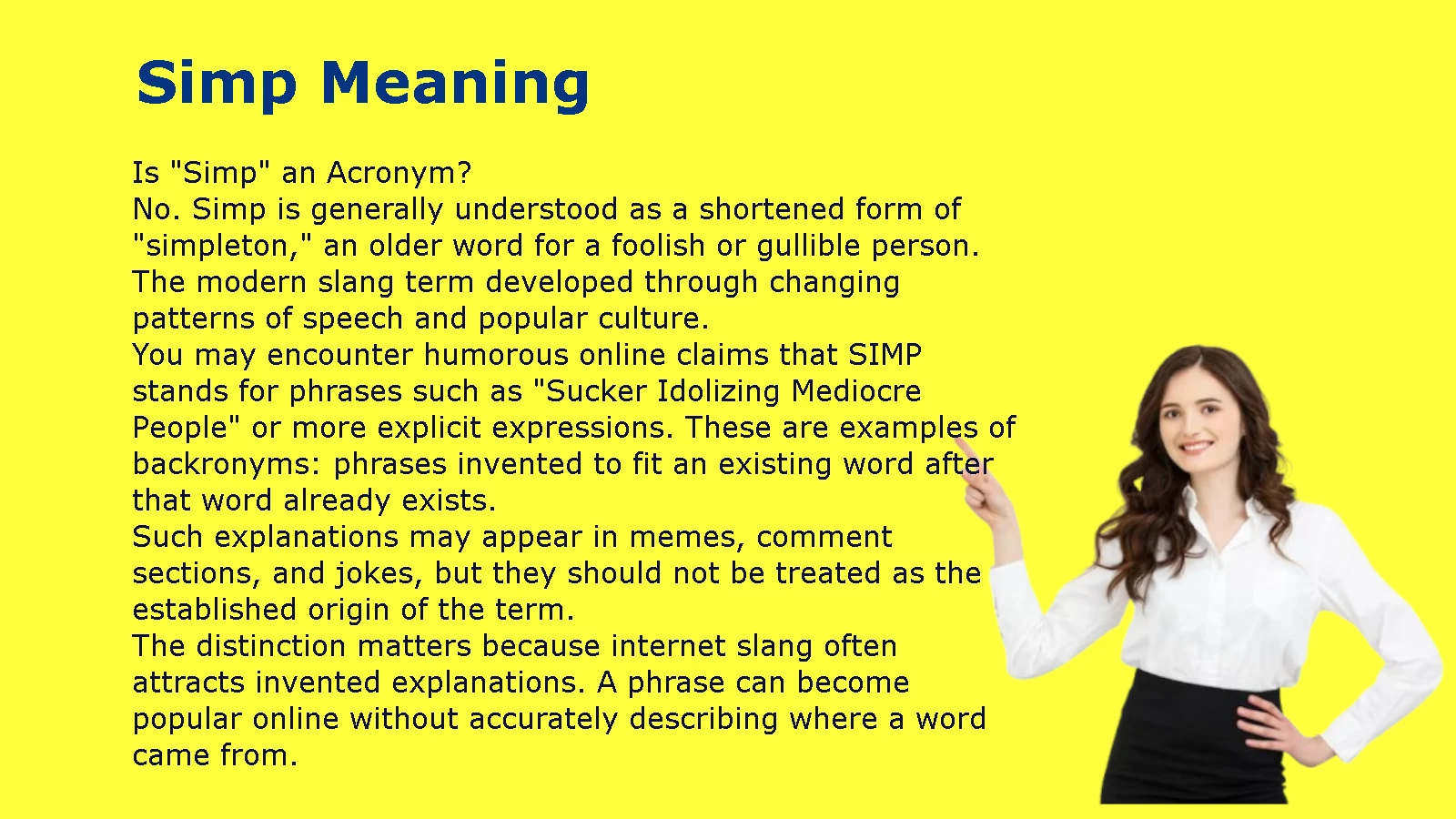
No. Simp is generally understood as a shortened form of “simpleton,” an older word for a foolish or gullible person. The modern slang term developed through changing patterns of speech and popular culture.
You may encounter humorous online claims that SIMP stands for phrases such as “Sucker Idolizing Mediocre People” or more explicit expressions. These are examples of backronyms: phrases invented to fit an existing word after that word already exists.
Such explanations may appear in memes, comment sections, and jokes, but they should not be treated as the established origin of the term.
The distinction matters because internet slang often attracts invented explanations. A phrase can become popular online without accurately describing where a word came from.
How to Use “Simp” as a Noun and a Verb
People use simp in several grammatical forms. Understanding these forms makes the word easier to recognize in everyday conversations.
| Form | Meaning | Example |
| Simp (noun) | A person perceived as excessively devoted to someone | “He’s a simp for his favorite singer.” |
| Simp (verb) | To show excessive admiration or devotion | “He continues to simp for her.” |
| Simping (present participle) | The act of showing that devotion | “Everyone jokes about his simping.” |
| Simped (past tense) | Showed excessive admiration or devotion | “He simped over his crush all summer.” |
| Simps (plural noun) | More than one person described as a simp | “The comments were full of simps.” |
Here are a few natural examples of simp meaning in texting:
- “Bro, you’re such a simp.” — A friend teases someone for doing too much for a crush.
- “I’m simping for that actor.” — Someone humorously admits to admiring a celebrity.
- “Stop simping in the comments.” — A person criticizes excessive praise or attention online.
- “She’s a simp for her boyfriend.” — Someone describes a woman’s strong affection for her partner, perhaps jokingly.
The same word can communicate affection, embarrassment, admiration, or contempt. A laughing emoji or friendly conversation may signal playful teasing, while an aggressive comment may be intended as an insult.
Where Did the Word “Simp” Come From?
The origin of the word simp connects older English slang with hip-hop culture and the rise of social media. The term existed long before TikTok became popular. Over time, its associations shifted from foolishness and perceived weakness to exaggerated romantic devotion and online admiration.
Early Roots in the Word “Simpleton”
The word simpleton describes someone considered foolish, naive, or lacking good judgment. Simp developed as a shortened form of that word and appeared in slang well before its recent popularity on social media.
In earlier usage, calling someone a simp suggested that the person was gullible or easy to take advantage of. The label was not limited to today’s familiar image of someone pursuing a crush.
The modern term retains part of that implication. When someone calls another person a simp, they often suggest that the person has abandoned good judgment because of attraction, admiration, or a desire for approval.
Consider the difference between these statements:
- “He trusts everyone too easily.” — This describes general gullibility.
- “He keeps paying for everything because he hopes she’ll date him.” — This describes behavior that people might call simping.
The second example reflects the romantic and social associations that became more prominent in contemporary slang.
The Hip-Hop Connection
Hip-hop helped popularize simp as a term for a man perceived as weak, submissive, or overly accommodating in romantic and sexual relationships.
The word appeared in discussions of relationships, status, money, and masculinity. Some uses criticized men who spent money or gave up their independence to gain a woman’s favor. The term also carried broader judgments about a man’s social standing and perceived self-respect.
West Coast rapper Too $hort is frequently associated with the word’s use in hip-hop culture during the late 1980s and 1990s. This period helped connect the term with relationship dynamics and the idea that someone could be manipulated through romantic interest.
However, the history is broader than any one artist or song. Slang develops through repeated use in communities, music, conversations, and media. No single moment explains every stage of the word’s evolution.
This cultural background also helps explain why the term sometimes carries a gendered meaning. Although people now apply it to anyone, older uses often focused on men and their behavior toward women.
How TikTok, Twitch, and Memes Popularized “Simp”
The word gained widespread mainstream attention around 2019–2020 as TikTok videos, gaming communities, livestreams, and internet memes brought it to larger audiences.
Several online behaviors helped drive its popularity:
- Livestream donations: Viewers sometimes sent money to creators they admired, leading other users to joke about simping.
- Comment-section humor: Users called themselves simps for celebrities, fictional characters, musicians, and attractive influencers.
- Viral challenges: Memes turned the label into a recognizable joke about crushes and exaggerated affection.
- Gaming communities: Players used the term to tease friends who seemed overly attentive to someone they liked.
- Short-form video: Repeated jokes and reaction videos helped the word spread beyond its earlier cultural settings.
The meaning also became more flexible. Someone might say, “I’m a simp for this character,” simply to express strong admiration for a fictional hero. In that context, the person may not be describing a real relationship or unhealthy behavior at all.
This shift illustrates how social media can soften an insult through humor while preserving its original negative associations in other situations.
What Are Examples of a Simp?
People often use the word simp when someone appears to invest too much effort in gaining another person’s attention. The behavior might involve constant compliments, expensive gifts, unquestioning loyalty, or neglecting personal priorities. However, the behavior alone does not prove someone is simping. You need to consider the person’s intentions, the other person’s response, and whether the relationship has healthy boundaries.
Excessive Attention and Compliments
Compliments can show appreciation and build connections. The problem arises when someone uses constant praise to seek approval from a person who has shown little interest.
For example, Marcus comments on every photo his crush posts. He sends flattering messages throughout the day and becomes upset whenever she doesn’t respond. Instead of accepting her communication style or lack of interest, he increases his efforts.
His friends might call this simping because he seems to depend on her attention for validation.
Compare these two situations:
- Healthy interest: You compliment someone, start a conversation, and give them space to respond.
- Behavior people might call simping: You repeatedly message someone who ignores you and keep increasing your efforts to get a reaction.
The difference isn’t the number of compliments alone. It involves respect, expectations, and the willingness to accept another person’s response.
Going Overboard to Impress a Crush
Another common example involves sacrificing your own time, money, or commitments to please someone.
Imagine that Olivia regularly cancels plans with her friends whenever her crush wants company. She completes his assignments, pays for his meals, and rearranges her schedule around him. He rarely offers the same consideration.
Her friends might describe her behavior as simping because she consistently puts his preferences ahead of her own.
Signs that romantic interest may be becoming unhealthy include:
- Frequently canceling important plans to remain available.
- Spending money you cannot comfortably afford.
- Ignoring your own needs because you fear disappointing someone.
- Saying yes to every request, even when it creates stress.
- Continuing to pursue a person who has clearly declined a relationship.
Being generous isn’t the problem. Losing your ability to make independent choices is. You can care about someone deeply without treating their every preference as a command.
Defending Someone Without Question
The term simp also appears in arguments about celebrities, streamers, and social media personalities.
Suppose a popular creator makes a misleading claim. One fan immediately attacks anyone who criticizes the creator, even when the criticism includes clear evidence. The fan refuses to reconsider the situation because they admire the person.
Other users might call the fan a simp.
This example is slightly different from pursuing a romantic interest. It centers on excessive loyalty and the desire to gain recognition from someone admired.
However, defending a person does not automatically qualify as simping. You can disagree with unfair criticism, correct false information, or support a creator’s work without blindly accepting everything they do.
The key distinction is support versus unquestioning devotion. Healthy admiration allows you to recognize another person’s mistakes.
Spending Excessively on an Online Crush
Financial simping is a common theme in discussions about livestreaming and online creators.
Imagine that a viewer donates $300 to a streamer in one evening, even though the viewer struggles to pay monthly bills. The viewer hopes the streamer will read their name aloud, remember them, or develop a personal connection.
Other viewers may describe this as simping because the donation appears tied to a desire for individual attention.
Consider three different situations:
| Situation | Is it necessarily simping? | Why? |
| Donating $10 to support a creator whose work you enjoy | No | The donation may reflect ordinary appreciation. |
| Buying a gift for a partner on a special occasion | No | Thoughtful gifts are normal in healthy relationships. |
| Spending rent money on donations to win a streamer’s affection | It may be described as simping | The spending threatens financial stability and may reflect unrealistic expectations. |
A large donation alone doesn’t establish someone’s motives. Some viewers can comfortably afford substantial contributions and give them without expecting personal attention.
The more useful questions are whether the spending is affordable, whether the person understands the relationship, and whether they expect something in return.
Simp vs. Gentleman: What’s the Difference?
A simp vs. gentleman comparison helps separate genuine kindness from behavior that people perceive as excessive or one-sided. A gentleman can be thoughtful, generous, and romantic while maintaining his independence. Someone described as a simp is usually portrayed as prioritizing another person’s approval at the expense of their own needs.
The distinction isn’t about whether someone buys gifts, pays for dinner, or expresses affection. It concerns mutual respect, personal boundaries, and expectations.
Simp vs. Genuine Kindness: A Side-by-Side Comparison
| Behavior | Genuine kindness | Behavior often called simping |
| Attention | Shows interest while respecting the other person’s space | Continues pursuing someone who has shown disinterest |
| Effort | Makes thoughtful gestures without neglecting personal needs | Repeatedly sacrifices important commitments to gain approval |
| Boundaries | Can say no when necessary | Agrees to everything out of fear of rejection |
| Motivation | Gives because they genuinely care | Gives primarily to earn attention or affection |
| Reciprocity | Values mutual respect and balanced effort | Accepts a consistently one-sided dynamic |
| Independence | Maintains friendships, interests, and personal goals | Abandons personal priorities to please someone |
| Response to rejection | Accepts the answer and moves forward | Keeps trying to change the other person’s mind |
These categories describe general patterns, not fixed personality types. A person may behave generously in one situation and make poor decisions in another.
For example, paying for a date doesn’t make someone a simp. Neither does helping a partner through a difficult period. Those actions can reflect genuine care.
The concern emerges when someone treats kindness as a transaction: If I do enough for this person, they will eventually owe me affection.
Romantic interest doesn’t work that way. No amount of money, attention, or effort entitles someone to another person’s feelings.
Can Someone Be Romantic Without Being a Simp?
Absolutely. Romance and self-respect can coexist.
A person can plan thoughtful dates, send affectionate messages, buy meaningful gifts, and make sacrifices for a partner without displaying the behavior commonly associated with simping.
Consider this example:
Situation A: Alex buys his partner concert tickets because he knows they love the band. He enjoys sharing the experience and doesn’t expect a reward.
Situation B: Alex buys expensive tickets for someone who has repeatedly rejected him. He believes the purchase will eventually convince that person to date him.
Both situations involve spending money. Yet the intentions and relationship dynamics differ considerably.
A useful way to evaluate your own behavior is to ask yourself:
- Would I still make this gesture if I knew I wouldn’t receive romantic attention in return?
- Am I comfortable saying no when a request conflicts with my needs?
- Does this person respect my time and feelings?
- Have they expressed interest, or am I interpreting ordinary politeness as attraction?
- Am I neglecting friendships, finances, or responsibilities to impress them?
Your answers can help you distinguish healthy affection from behavior driven by insecurity or unrealistic expectations.
Remember that rejection doesn’t make someone a simp. Expressing interest and hearing no is a normal part of dating. Respecting that answer shows emotional maturity, even when the experience feels disappointing.
What Are Similar Slang Words to “Simp”?
Several internet slang terms overlap with simp, but each carries a slightly different meaning. Understanding these differences helps you choose the right word when discussing online behavior, celebrity fandom, or romantic relationships.
Simp vs. Stan
A stan is an extremely devoted fan of a celebrity, artist, fictional character, or other public figure. The term can function as both a noun and a verb.
For example:
- “I’m a stan of this singer.” — The speaker is a dedicated fan.
- “I stan this actor.” — The speaker strongly supports or admires the actor.
- “He’s simping for that streamer.” — The speaker suggests that his admiration or attention is excessive, often with a romantic or approval-seeking element.
The main difference is the target of the behavior. Stan usually emphasizes intense fandom, while simp often emphasizes excessive devotion to a person someone desires or wants to impress.
The meanings can overlap. A person might be both a devoted fan and someone other users jokingly call a simp.
Simp vs. White Knight
A white knight is someone who defends another person, often a woman, in a way that others perceive as excessive or motivated by a desire for approval.
For example, someone might enter an online argument to defend a stranger from every criticism, even when the stranger has behaved unfairly. Other users could call that person a white knight.
The term often focuses on public defense or the appearance of moral superiority. Simp has a broader range of uses, including romantic attention, gifts, financial support, and excessive admiration.
Neither label necessarily describes someone’s real motivation. A person may defend someone because the criticism is genuinely unfair, not because they want attention or a relationship.
Simp vs. Pick-Me
A pick-me is someone who seeks approval by presenting themselves as more desirable, agreeable, or different from others. The term often appears when a person puts down members of their own social group to gain attention or acceptance.
For example, someone might say, “I’m not like other girls. I never cause drama, and I only get along with guys.”
Others may call this pick-me behavior if the person uses the comparison to gain approval by criticizing other women.
The distinction is straightforward:
- Simp: Shows excessive devotion or attention toward someone they admire.
- White knight: Defends someone in a way others perceive as excessive or approval-seeking.
- Pick-me: Seeks validation by emphasizing their supposed superiority or difference from others.
- Stan: Displays intense devotion to a public figure, artist, or other subject of fandom.
These labels belong to informal internet slang. Their meanings can overlap, and people sometimes use them loosely or unfairly.
Frequently Asked Questions About Simp Meaning
Is “Simp” an Insult?
Yes, simp can be an insult, but its tone depends on context. Friends might use it playfully to tease someone about a crush, while strangers might use it to shame someone for showing affection or generosity. The word generally carries a negative suggestion of excessive or one-sided devotion, although people also use it jokingly about themselves.
Can a Girl Be a Simp?
Yes. Anyone can be called a simp, regardless of gender. Although older uses often focused on men pursuing women, modern internet slang applies the term to people of any gender who show what others perceive as excessive admiration, affection, or devotion. For example, someone might jokingly say, “I’m a simp for my girlfriend,” to express strong affection.
What Is the Opposite of a Simp?
There is no universally accepted opposite of simp. Online communities sometimes use Gigachad to represent confidence, independence, and self-assurance. However, that term belongs to its own meme culture and doesn’t provide a precise antonym. In ordinary language, someone who maintains healthy boundaries and self-respect might be described as confident, independent, or emotionally mature.
What Does “Simping” Mean on TikTok?
On TikTok, simping usually means openly admiring, praising, or expressing strong attraction toward someone. Users might describe themselves as simping for a celebrity, fictional character, or influencer. The term often appears in humorous videos and comments, so it doesn’t always imply unhealthy behavior or a genuine attempt to start a relationship.
Is Being a Simp the Same as Being Nice?
No. Being nice means treating people with consideration and respect. Simping, in its usual slang sense, suggests excessive or one-sided devotion, especially when someone ignores boundaries or expects affection in return for favors. Compliments, gifts, and romantic gestures aren’t enough to make someone a simp. The surrounding behavior and expectations matter more than any single action.
What Does “Simp for Someone” Mean?
To simp for someone means to show unusually strong admiration, affection, or devotion toward that person. For example, “I simp for that actress” might mean the speaker finds her extremely attractive or admires her work. Depending on the context, the phrase can express genuine enthusiasm, playful exaggeration, or criticism of someone’s excessive attention.
Conclusion: Understanding the Meaning of Simp
The meaning of simp has evolved from an older slang term associated with foolishness into a widely recognized expression for excessive admiration, affection, or devotion. Today, people use it in text messages, gaming chats, TikTok videos, livestreams, and everyday conversations.
Sometimes, the word is simply a joke between friends. Other times, it criticizes someone for pursuing a person who shows little interest, spending beyond their means, or sacrificing their own needs to gain approval.
The important distinction is that kindness isn’t weakness, and affection isn’t automatically simping. You can express interest, support a partner, give thoughtful gifts, and show generosity while maintaining healthy boundaries.
If you’re unsure whether a behavior deserves the label, look beyond the gesture itself. Consider the person’s intentions, the level of mutual interest, and whether both people respect each other’s needs.













