Irreplaceable vs Irreplacable is a common spelling question, but only one form is correct in standard English: irreplaceable. The word describes a person, object, memory, or resource that cannot be replaced or is too valuable to lose. The spelling irreplacable is a misspelling because it leaves out an important letter “e” from the word replace.
Understanding the difference helps you avoid spelling mistakes in emails, school assignments, professional documents, and everyday writing. It also helps you use irreplaceable meaning, irreplaceable synonyms, and related expressions more accurately. In this guide, you’ll learn why the correct spelling retains the “e,” how to use the word in original sentences, and how to remember its spelling without relying on guesswork.
The Difference Between Irreplaceable and Irreplacable
The main difference between irreplaceable and irreplacable is spelling. Irreplaceable is the correct English adjective, while irreplacable is a common spelling error. Both forms may appear in online searches, messages, or informal writing, but only irreplaceable should be used in standard written English.
| Word | Correct or incorrect? | Meaning | Example |
| Irreplaceable | Correct | Impossible or extremely difficult to replace | Her experience makes her irreplaceable. |
| Irreplacable | Incorrect | Intended to mean irreplaceable | The correct sentence uses “irreplaceable.” |
The mistake often occurs because writers remember the sound of the word but forget its original spelling. Since replaceable contains the sequence “place,” some people remove the second “e” when adding the prefix ir-.
However, spelling follows the established structure of the word rather than the way a writer informally breaks it into sounds.
Irreplaceable: The Correct Spelling
Irreplaceable is an adjective that describes someone or something that cannot be replaced, either because no suitable substitute exists or because the person or thing has exceptional value.
For example:
- My mother’s handwritten recipes are irreplaceable.
- The engineer’s specialized knowledge proved irreplaceable during the project.
- The museum protects irreplaceable historical artifacts.
- Her kindness made her an irreplaceable friend.
The word can describe emotional connections, professional contributions, rare objects, and resources that people cannot easily reproduce.
Its pronunciation is commonly represented as /ˌɪrɪˈpleɪsəbəl/. The main stress falls on the “place” syllable. Although pronunciation can help you recognize the word, remembering its connection to replace provides a more reliable spelling strategy.
Irreplacable: The Common Misspelling
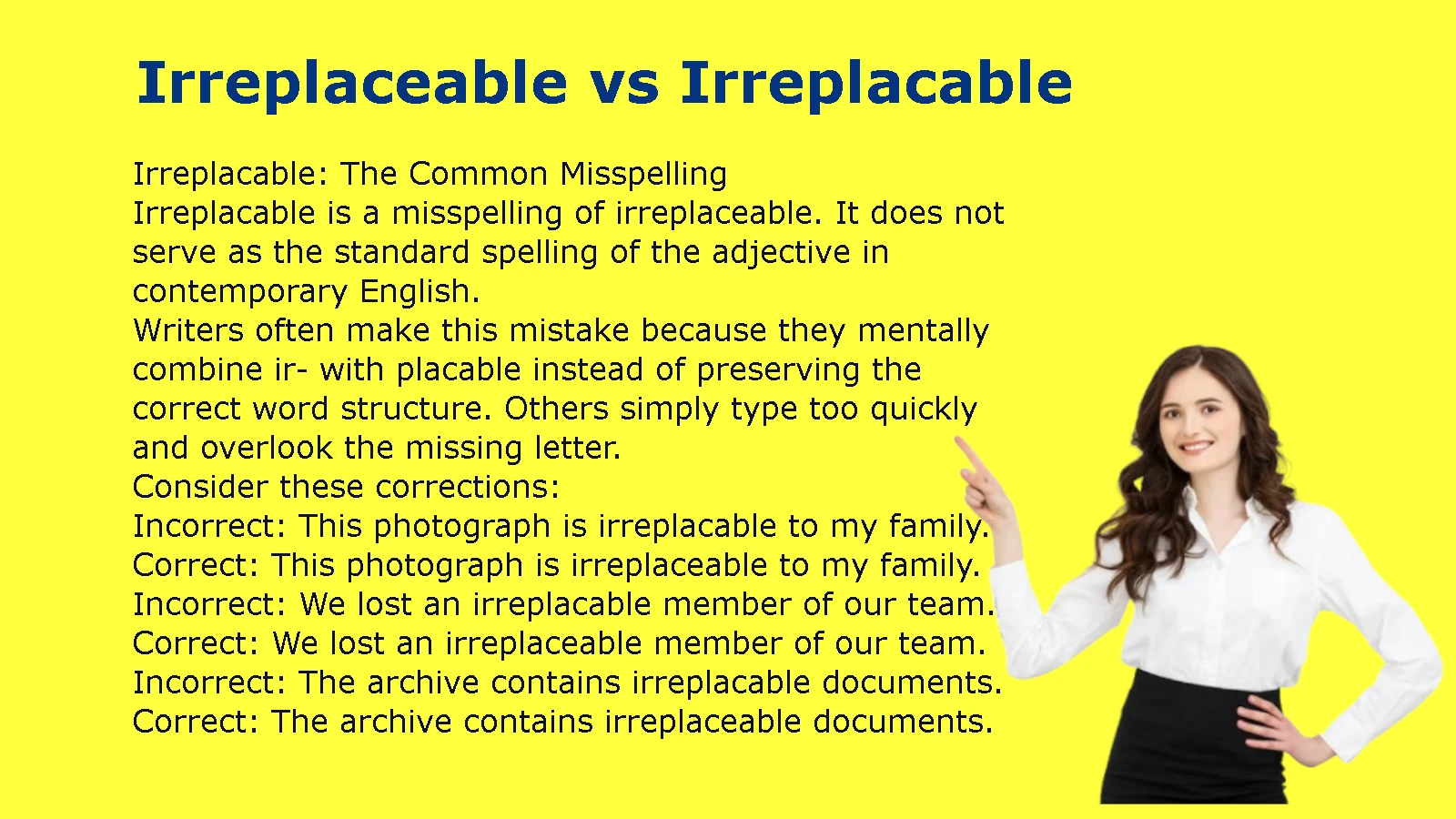
Irreplacable is a misspelling of irreplaceable. It does not serve as the standard spelling of the adjective in contemporary English.
Writers often make this mistake because they mentally combine ir- with placable instead of preserving the correct word structure. Others simply type too quickly and overlook the missing letter.
Consider these corrections:
- Incorrect: This photograph is irreplacable to my family.
- Correct: This photograph is irreplaceable to my family.
- Incorrect: We lost an irreplacable member of our team.
- Correct: We lost an irreplaceable member of our team.
- Incorrect: The archive contains irreplacable documents.
- Correct: The archive contains irreplaceable documents.
If you encounter irreplacable while proofreading, replace it with irreplaceable. A spell-checker can catch many instances, but knowing the correct spelling helps you identify the error even when automated tools miss it.
Why Is Irreplaceable Spelled With an E?
Irreplaceable retains the “e” because its spelling preserves the established word replace when the prefix ir- and the suffix -able form the adjective. The letter “e” also helps maintain the soft “c” spelling pattern found in replace. Remembering the complete root word is the simplest way to avoid writing irreplacable.
The Root Word Is Replace
The easiest way to understand the spelling is to begin with the verb replace.
Replace means to put something in the position of something else, use a substitute, or provide a new item in place of an old one.
For example:
- Please replace the broken screen.
- We need to replace the missing document.
- No employee can completely replace the experience she brought to the company.
The adjective replaceable describes something that can be replaced. Adding the negative prefix ir- creates irreplaceable, which expresses the opposite idea.
The word structure is:
ir- + replace + -able = irreplaceable
Here is how each part contributes:
| Word part | Function | Example or explanation |
| ir- | Negative prefix | Reverses the meaning in this word |
| replace | Root word | Means to substitute one thing for another |
| -able | Adjective-forming suffix | Expresses the idea of being capable of an action |
| irreplaceable | Complete adjective | Not replaceable; exceptionally difficult or impossible to substitute |
The negative prefix ir- is a variant of in- used before certain word beginnings. You can see the same spelling pattern in words such as irregular and irrelevant.
The key point is that you should preserve the spelling of replace when forming irreplaceable. Do not remove the “e” simply because another form seems easier to type.
How the Soft C Rule Helps
The soft C rule is another useful spelling clue. In many English words, the letter “c” represents an /s/ sound when it appears before “e,” “i,” or “y.” In other common positions, it can represent a /k/ sound.
Compare these examples:
| Soft C: /s/ sound | Hard C: /k/ sound |
| Replace | Cat |
| Center | Cold |
| City | Class |
| Cycle | Cup |
In replace, the “c” comes before “e,” so it represents the /s/ sound. The correct spelling preserves that pattern in irreplaceable.
Removing the “e” from the familiar sequence changes the written structure and creates the incorrect form irreplacable. However, the soft C rule is a supporting clue, not the entire explanation. The strongest method is to remember that irreplaceable comes from replace and replaceable.
A practical proofreading question is: Can I identify the complete word “replace” inside irreplaceable? If you can, you’re much less likely to omit the “e.”
What Does Irreplaceable Mean?
Irreplaceable means impossible or extremely difficult to replace with an equivalent person, object, resource, or experience. It often describes something that has unique qualities, exceptional usefulness, deep emotional significance, or historical value. The word does not always mean that no substitute could ever exist; sometimes it emphasizes how much a particular person or thing matters.
The meaning depends on the context. A family photograph may be irreplaceable because it preserves a memory. A specialist may be considered irreplaceable because of years of experience. A historical document may be irreplaceable because nobody can recreate the original.
Irreplaceable Meaning in Everyday English
In everyday language, people use irreplaceable to express the importance of someone or something they would struggle to lose.
For example, a favorite jacket may be replaceable if you can purchase an identical one. However, a jacket inherited from a loved one may be irreplaceable because its emotional value comes from its history.
Similarly, a business may purchase another computer, but it cannot necessarily recover the unique files stored on a damaged device if no backup exists.
The word can express several related ideas:
- Uniqueness: Nothing else is exactly the same.
- Emotional value: A person or object holds special meaning.
- Practical importance: A person, tool, or resource performs a role that is difficult to fill.
- Historical significance: An original object or record cannot be recreated authentically.
- Exceptional usefulness: Someone contributes knowledge or skills that are difficult to duplicate.
These meanings overlap, but they are not identical. A rare object may be unique without being valuable, while an ordinary object may become irreplaceable to someone because of its personal history.
Emotional vs. Practical Irreplaceability
The word can describe both emotional connections and practical value. Understanding the difference helps you select the right example and communicate your intended meaning.
| Context | What irreplaceable means | Example |
| Family | Deep personal or sentimental value | Her father’s letters are irreplaceable. |
| Friendship | A relationship that cannot be duplicated | His support made him an irreplaceable friend. |
| Workplace | Skills, knowledge, or contributions that are hard to replace | Her experience made her an irreplaceable member of the team. |
| History | An original record or artifact that cannot be authentically recreated | The archive preserves irreplaceable historical documents. |
| Environment | An ecosystem or species with distinctive ecological value | The wetland provides irreplaceable habitat for native wildlife. |
| Art | Original work with artistic or cultural significance | The gallery safeguards irreplaceable paintings. |
Consider a small business that loses its most experienced technician. The owner might describe that employee as irreplaceable because the technician understands equipment that nobody else on the team knows how to repair.
That description expresses the current difficulty of replacing the employee’s expertise. It does not mean the company could never train another technician. The business might eventually develop the same capabilities, but doing so would require time, training, and investment.
This distinction matters because irreplaceable can be an emotional judgment rather than an absolute statement. The context tells readers whether you mean literally unique, practically essential, or personally meaningful.
How to Use Irreplaceable in a Sentence
Use irreplaceable before a noun or after a linking verb to describe a person, object, skill, memory, or resource that cannot easily be substituted. The adjective works in casual conversation, academic writing, workplace communication, and formal descriptions. Choose examples that make the reason for the item’s value clear.
Personal and Emotional Examples
People frequently use irreplaceable when discussing relationships, family history, and meaningful possessions.
- My grandmother’s wedding ring is irreplaceable to our family.
- The photographs from our childhood are irreplaceable memories of the time we spent together.
- Her friendship became irreplaceable during the most difficult period of my life.
- That old notebook contains irreplaceable memories from my first year at university.
- His encouragement played an irreplaceable role in helping me regain confidence.
- The handwritten letter is irreplaceable because it is the only message I have from my grandfather.
These examples show that irreplaceable often carries a strong emotional meaning. The object itself may not be expensive, but its personal history gives it exceptional value.
Compare a mass-produced watch with a watch inherited from a parent. Both may tell time equally well, but the inherited watch may be irreplaceable because its sentimental significance cannot be purchased again.
Professional and Academic Examples
In professional writing, irreplaceable usually emphasizes specialized knowledge, important contributions, or a role that would be difficult to fill.
- Her knowledge of the company’s original software made her an irreplaceable asset during the system migration.
- The research team relied on his irreplaceable expertise in historical data analysis.
- A reliable backup system protects irreplaceable business records.
- His detailed understanding of the manufacturing process made him an irreplaceable member of the engineering team.
- The professor’s mentorship had an irreplaceable influence on her academic development.
- The organization depends on volunteers who provide irreplaceable community support.
Notice the expressions irreplaceable asset, irreplaceable expertise, and irreplaceable member. These combinations work well when you want to describe a person’s contribution without claiming that the individual is objectively better than everyone else.
In a formal report, you can also explain why something is irreplaceable rather than using the adjective alone.
For example:
“The technician’s twenty years of experience with the original equipment made his knowledge difficult to reproduce.”
This sentence provides a specific reason for the claim. It may be more informative than simply stating that the technician is irreplaceable.
Historical and Environmental Examples
Irreplaceable also works when describing things that cannot be recreated once lost.
- The flood damaged irreplaceable historical manuscripts stored in the archive.
- The museum uses special lighting to protect its irreplaceable paintings.
- The ancient site contains irreplaceable evidence of early human settlement.
- The destruction of the coral reef harmed an irreplaceable marine habitat.
- Scientists are working to preserve irreplaceable genetic diversity among endangered species.
- The original recording is an irreplaceable part of the musician’s history.
These examples often involve permanent loss. A digital copy may preserve the text of a manuscript, for instance, but it cannot fully replace the physical original, including its materials, markings, and historical evidence.
When writing about environmental resources, be precise about what makes them irreplaceable. A habitat may support a rare species, protect a coastline, or provide ecological functions that a nearby location cannot immediately reproduce.
Common Grammar Patterns With Irreplaceable
You can use the adjective in several sentence structures.
| Pattern | Example |
| Irreplaceable + noun | She has irreplaceable experience. |
| Linking verb + irreplaceable | These records are irreplaceable. |
| An irreplaceable part of + noun | He became an irreplaceable part of the team. |
| Irreplaceable to + person or group | The keepsake is irreplaceable to me. |
| Irreplaceable for + purpose | This dataset is irreplaceable for the study. |
| Make someone or something irreplaceable | Her contributions made her irreplaceable. |
The adjective does not change to agree with a singular or plural noun.
For example:
- Singular: This document is irreplaceable.
- Plural: These documents are irreplaceable.
You do not write irreplaceables when you simply want the plural form of the adjective. Instead, change the noun or restructure the sentence: “These irreplaceable objects belong to the museum.”
How to Remember the Correct Spelling
The simplest way to remember irreplaceable is to keep the complete root word replace intact. Start with replace, add the suffix -able to form replaceable, and then add the negative prefix ir-. This method connects the spelling to the word’s structure, making it easier to recall than memorizing an isolated string of letters.
Use the “Keep Replace Intact” Trick
Follow these steps whenever you are unsure how to spell the word:
Step one: Write the root word.
Start with replace. Check that it contains the sequence “place” with an “e” at the end.
Step two: Add the suffix.
Combine replace with -able to form replaceable.
Step three: Add the negative prefix.
Place ir- before replaceable to create irreplaceable.
The complete structure is:
ir- + replace + -able = irreplaceable
The most important part is remembering that replace remains intact. Do not remove the “e” when adding the other word parts.
Use a Quick Visual Memory Trick
If you often confuse the two spellings, focus on the middle of the word:
- Correct: ir-re-place-able
- Incorrect: ir-re-plac-able
The correct version contains the full root word replace. You can also connect the spelling to its meaning: if something is irreplaceable, you cannot simply replace it with an equivalent.
This memory trick is particularly useful when proofreading essays, resumes, website content, business reports, and personal messages.
Build a Reliable Proofreading Habit
A short review process can prevent the same spelling mistake from appearing repeatedly.
- Read the word slowly: Look for the full sequence “replace.”
- Check the root: Confirm that the original verb has not lost a letter.
- Use spell-check: Treat automated suggestions as a second layer of review.
- Read the complete sentence: Confirm that irreplaceable expresses the meaning you intend.
- Save a personal spelling list: Include words you frequently mistype, such as irreplaceable, definitely, and separate.
For website owners and professional writers, this habit is especially useful. A misspelling in a headline or important landing page can undermine the impression of care and accuracy that the rest of the content creates.
Irreplaceable Synonyms and Antonyms
The best synonym for irreplaceable depends on what you want to emphasize. Invaluable highlights exceptional usefulness or worth, priceless emphasizes value beyond money, and indispensable means essential. Meanwhile, replaceable expresses the opposite idea. Choosing the right alternative helps you avoid repetition and communicate the exact meaning.
Common Synonyms for Irreplaceable
| Synonym | Meaning or nuance | Best used for |
| Invaluable | Extremely useful or valuable | Advice, expertise, contributions |
| Priceless | Beyond monetary measurement | Family heirlooms, memories, artwork |
| Indispensable | Essential or necessary | Tools, team members, resources |
| Unique | Different from everything else or the only one of its kind | Original ideas, rare objects |
| One-of-a-kind | Having no exact duplicate | Personal gifts, custom creations |
| Unmatched | Not equaled by another | Skill, performance, achievement |
| Essential | Necessary for a particular purpose | Equipment, information, processes |
These words are related, but they are not always interchangeable.
For example, a colleague may be indispensable to a project because the team cannot complete the work without that person’s contribution. A family photograph may be priceless because of its sentimental meaning. An original painting may be unique because no identical original exists.
Use irreplaceable when you want to emphasize the difficulty or impossibility of finding an equivalent substitute.
Antonyms of Irreplaceable
An antonym expresses an opposite or contrasting meaning.
| Antonym | Meaning | Example |
| Replaceable | Able to be replaced | The damaged part is replaceable. |
| Interchangeable | Capable of being substituted for another | These components are interchangeable. |
| Substitutable | Able to be replaced by an alternative | The ingredient is easily substitutable. |
| Common | Frequently found rather than rare | The museum displays common household objects. |
| Ordinary | Not especially unusual or distinctive | The shop sells ordinary, mass-produced items. |
Replaceable is the clearest direct antonym. However, common and ordinary do not always mean the opposite of irreplaceable. An ordinary object can become irreplaceable because of its personal history, even if thousands of identical objects exist.
For example, a plain coffee mug may be ordinary in design but irreplaceable to someone who received it from a loved one. Context determines which word best communicates the intended meaning.
Frequently Asked Questions
Is irreplacable a word?
No. Irreplacable is a common misspelling of irreplaceable, which is the standard English adjective. Use irreplaceable in formal writing, school assignments, emails, and published content.
How do you spell irreplaceable correctly?
The correct spelling is irreplaceable. Remember the structure ir- + replace + -able and keep the complete root word replace intact when adding the prefix and suffix.
What is the meaning of irreplaceable?
Irreplaceable describes someone or something that cannot be replaced or is exceptionally difficult to substitute. It can refer to a loved one, a rare artifact, specialized expertise, or an object with deep personal meaning.
Is it irreplaceable or unreplaceable?
Irreplaceable is the established and generally preferred form in standard English. You may encounter unreplaceable, but irreplaceable is the safer choice for formal writing and everyday use.
What is the opposite of irreplaceable?
The clearest opposite is replaceable, meaning capable of being replaced. Interchangeable can also work when two items or people can substitute for one another in a particular context.
What are some synonyms for irreplaceable?
Common synonyms include invaluable, priceless, indispensable, unique, and one-of-a-kind. Choose invaluable for usefulness, priceless for exceptional worth, and indispensable for something essential.
Final Thoughts on Irreplaceable vs Irreplacable
The spelling difference between irreplaceable and irreplacable comes down to one important letter. Irreplaceable is correct, while irreplacable is a misspelling. The easiest way to remember the correct form is to preserve the root word replace when adding the prefix ir- and the suffix -able.
Use irreplaceable when describing something that cannot be easily substituted because of its uniqueness, practical importance, or emotional value. Choose related words such as invaluable, priceless, and indispensable when they communicate your meaning more precisely.
Before publishing your next email, article, assignment, or business document, check that you have written irreplaceable with the complete “replace” sequence. Make this small spelling check part of your proofreading routine, and you’ll avoid a mistake that is easy to make but just as easy to correct.













