Explicit vs Implicit can be confusing because both words describe how information is communicated, but they work in opposite ways. Explicit means something is stated clearly and directly, while implicit means it’s suggested or understood without being directly stated. Knowing the difference helps you use these words correctly when talking about instructions, meanings, ideas, or communication.
| Question | Answer |
|---|---|
| What does explicit mean? | Clearly stated or expressed directly. |
| What does implicit mean? | Suggested or understood without being directly stated. |
| What is the difference between explicit and implicit? | Explicit information is direct and clear; implicit information is indirect or implied. |
Explicit vs Implicit: Quick Difference
The fastest way to understand Explicit vs Implicit is to compare how information reaches the reader or listener.
| Explicit | Implicit |
| Clearly stated | Suggested or implied |
| Direct | Indirect |
| Usually leaves little room for interpretation | Requires interpretation or context |
| The information appears directly in the words | The information is inferred from clues |
| “Do not enter this room.” | “This area is restricted.” |
| “I disagree with your proposal.” | “I’m not sure that approach will work.” |
| “The meeting starts at 10 a.m.” | “Let’s meet midmorning.” |
A useful memory trick is:
Explicit = expressed.
Implicit = implied.
Merriam Webster uses a similar distinction: explicit things are explained, while implicit things are implied. The two words share a Latin root related to the idea of folding, but their prefixes point in different directions.
However, don’t assume that explicit and implicit are always exact opposites. They often work as opposites when you’re discussing whether something was directly stated. Yet both words have other established meanings.
What Does Explicit Mean?
Explicit means clearly and directly expressed. If a statement is explicit, the speaker or writer doesn’t expect you to figure out the main point through hints.
Merriam Webster defines explicit as something “fully revealed or expressed” without vagueness, implication, or ambiguity. Cambridge similarly defines it as something communicated directly in a clear and exact way.
In plain English, an explicit message puts the information on the table.
Explicit Meaning in Simple Terms
Consider these statements:
- “The store closes at 9 p.m.”
- “Please send the invoice today.”
- “Do not park in this space.”
- “She said she didn’t want to participate.”
- “The contract requires written approval.”
Each statement communicates a fairly definite idea. The reader doesn’t need to guess what the speaker means.
That doesn’t mean explicit language can never be misunderstood. People can still misread words or ignore context. The key point is that the information itself has been directly expressed.
Examples of Explicit Statements
Here are several everyday examples:
Example 1:
“Please call me after 6 p.m.”
The request and time are explicit.
Example 2:
“Employees must wear identification badges.”
The rule is explicit.
Example 3:
“She explicitly told him not to share the information.”
The verb explicitly emphasizes that she communicated the instruction directly.
Example 4:
“The teacher gave explicit instructions for completing the assignment.”
The students received clear directions rather than having to infer what to do.
Common Uses of Explicit
You’ll often see explicit used with words such as:
- explicit instructions
- explicit permission
- explicit consent
- explicit agreement
- explicit warning
- explicit request
- explicit statement
- explicit rule
- explicit explanation
- explicit details
- explicit instructions
- explicit terms
For example:
“The landlord gave explicit permission to repaint the kitchen.”
The permission isn’t merely assumed. It was clearly given.
Explicitly vs. Explicit
Explicit is an adjective.
Explicitly is an adverb.
Compare:
- “The instructions were explicit.”
- “The manager explicitly explained the procedure.”
In the first sentence, explicit describes the instructions. In the second, explicitly describes how the manager explained the procedure.
What Does Implicit Mean?
Implicit usually describes something that is suggested, understood, or contained without being directly stated.
Merriam Webster defines the central sense as something understood from something else even though it isn’t clearly or directly expressed. Cambridge gives a similar definition: something suggested rather than communicated directly.
Think of implicit meaning as information that sits between the lines.
Implicit Meaning in Simple Terms
Imagine someone says:
“It’s getting pretty cold in here.”
That sentence doesn’t explicitly say, “Please close the window.”
Yet depending on the situation, the listener might understand that request.
The speaker has communicated indirectly. The listener uses context to interpret the message.
That interpretation is implicit.
Examples of Implicit Statements
Example 1:
“It looks like everyone is leaving.”
Depending on the context, this could implicitly suggest that you should leave too.
Example 2:
“Your presentation has been going on for nearly an hour.”
The speaker hasn’t explicitly said, “You need to finish.” However, the statement may imply that the presentation is taking too long.
Example 3:
“She looked at the clock three times during the meeting.”
Her behavior might implicitly communicate that she wants the meeting to end.
Example 4:
“He didn’t respond when asked whether he wanted to join us.”
His silence might be interpreted as an implicit refusal, although the silence doesn’t prove that interpretation.
That last example matters. Implicit meaning depends on context. An inference can be reasonable without being certain.
Explicit vs Implicit Meaning
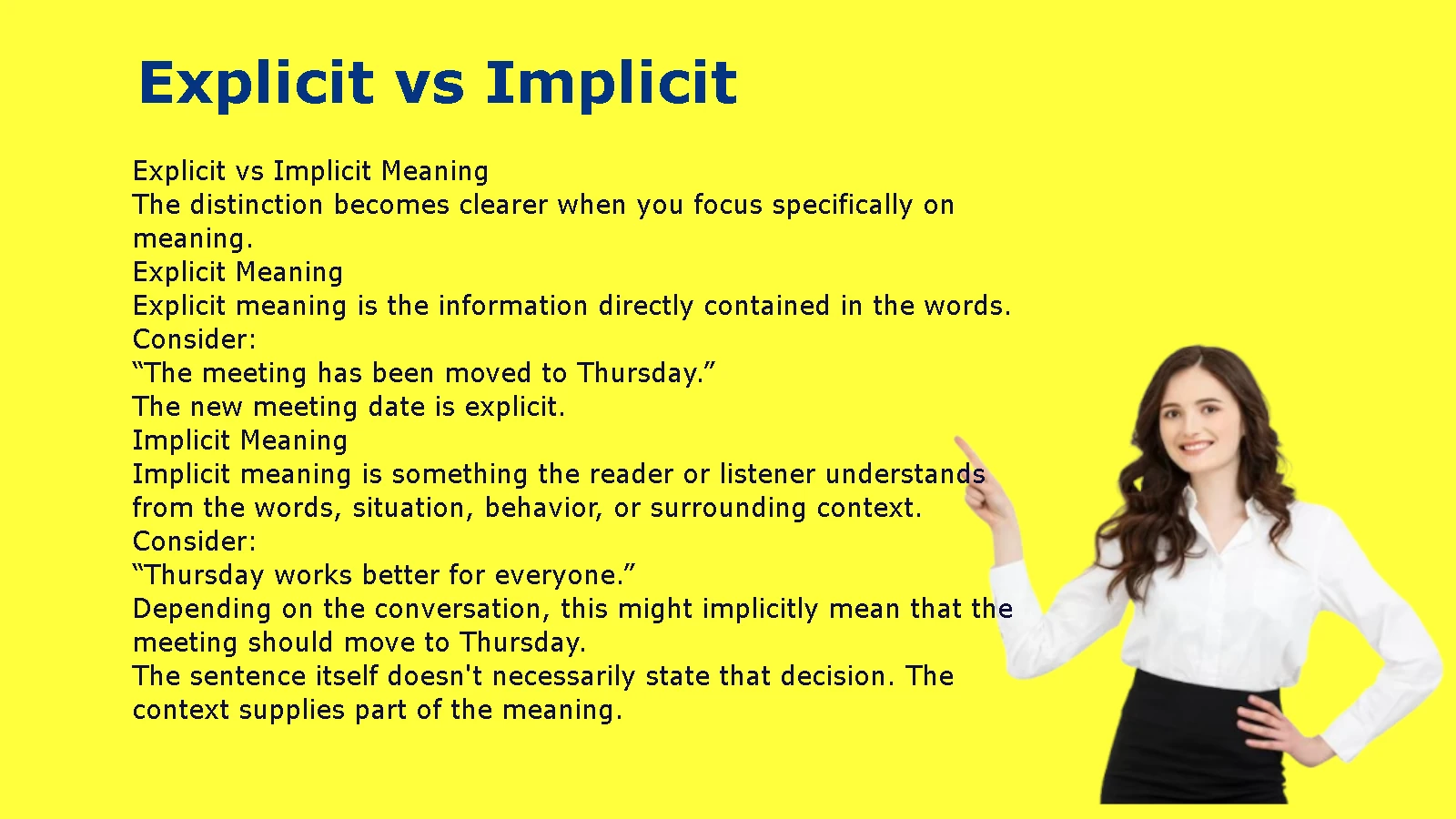
The distinction becomes clearer when you focus specifically on meaning.
Explicit Meaning
Explicit meaning is the information directly contained in the words.
Consider:
“The meeting has been moved to Thursday.”
The new meeting date is explicit.
Implicit Meaning
Implicit meaning is something the reader or listener understands from the words, situation, behavior, or surrounding context.
Consider:
“Thursday works better for everyone.”
Depending on the conversation, this might implicitly mean that the meeting should move to Thursday.
The sentence itself doesn’t necessarily state that decision. The context supplies part of the meaning.
How to Identify Explicit and Implicit Meaning
Ask yourself one simple question:
“Did the person actually say or write this?”
- If yes, the information may be explicit.
- If no, but the context strongly suggests it, the information may be implicit.
For example:
“Don’t touch that pan. It’s extremely hot.”
The warning is explicit.
Now consider:
“That pan just came out of the oven.”
The speaker hasn’t directly said “Don’t touch it,” but the danger may be implicit.
This distinction becomes especially useful when analyzing conversations, books, advertisements, speeches, and workplace communication.
Explicit vs Implicit Communication
Communication doesn’t always work like a straightforward instruction manual. People constantly use hints, tone, facial expressions, timing, and context to convey meaning.
What Is Explicit Communication?
Explicit communication states the intended message directly.
For example:
“Please send me the final version by 3 p.m.”
The recipient knows:
- what to send
- when to send it
- that the request is direct
There’s little need to decode the message.
What Is Implicit Communication?
Implicit communication conveys meaning without stating everything directly.
For example:
“I’ll need the final version before the client call.”
The speaker hasn’t necessarily given a precise deadline. However, if the client call begins at 3 p.m., the listener can infer that the document needs to arrive before then.
The message relies on shared context.
When Explicit Communication Works Better
Explicit language is especially useful when misunderstanding could create real problems.
Use it for:
- safety instructions
- deadlines
- workplace responsibilities
- contracts
- policies
- technical directions
- financial arrangements
- important expectations
- formal requests
- procedures
If someone is standing beside a dangerous machine, “Be careful around that” may not be enough. “Do not touch the machine while it is running” is much clearer.
When the stakes are high, don’t make people play detective.
When Implicit Communication Works Better
Implicit language can be useful when subtlety matters.
It often appears in:
- casual conversations
- humor
- storytelling
- fiction
- satire
- social interactions
- diplomatic language
- character dialogue
For example, a novelist may write:
“He glanced at the packed suitcase beside the door.”
The author doesn’t need to say, “He was planning to leave.” The suitcase provides the clue.
That kind of indirect communication gives readers something to discover.
Explicit vs Implicit Examples in Everyday Communication
The difference becomes easier to remember when you see the same basic message expressed in both ways.
| Situation | Explicit | Implicit |
| Asking someone to leave | “Please leave now.” | “It’s getting late.” |
| Asking someone to clean | “Please clean the kitchen.” | “The kitchen is a mess.” |
| Showing disagreement | “I disagree.” | “I’m not sure that’s the best approach.” |
| Asking for help | “Can you help me carry these boxes?” | “These boxes are heavier than I expected.” |
| Giving a warning | “Don’t touch that.” | “That surface is extremely hot.” |
| Requesting a call | “Please call me tonight.” | “I’ll be waiting to hear from you.” |
| Showing disappointment | “I’m disappointed.” | Silence after receiving the result |
| Showing interest | “I’d like to see you again.” | “We should do this again sometime.” |
Notice something important: the implicit examples aren’t automatically equivalent to the explicit ones.
Context determines what an implicit statement means.
Someone saying “It’s getting late” might genuinely be commenting on the time. They might also be hinting that they want to leave. Without context, you can’t know for certain.
Explicit vs Implicit in Writing
Writers make deliberate choices about how much information to state and how much to leave for the reader.
Explicit Writing
Explicit writing states the main point clearly.
For example:
“The company will close its downtown office on December 31.”
There’s no need to infer the closure date.
This approach works particularly well for:
- instructions
- academic explanations
- policies
- technical documentation
- business communication
- educational material
- legal documents
When readers need precise information, explicit wording saves time.
Implicit Writing
Implicit writing allows readers to infer meaning.
Consider this fictional example:
“Maya placed the resignation letter on her manager’s desk and cleared out the last drawer.”
The passage never says, “Maya resigned.” Yet the evidence strongly suggests it.
This approach can make writing more engaging because the reader participates in constructing the meaning.
Why Writers Use Implicit Meaning
Writers may use implicit meaning to:
- create suspense
- develop characters
- add subtlety
- create humor
- avoid repetitive explanation
- encourage interpretation
- make dialogue sound natural
- allow readers to discover information
A mystery novel would lose much of its appeal if every clue came with a flashing sign saying, “THIS IS THE IMPORTANT CLUE.”
Why Writers Use Explicit Meaning
Explicit wording has its own strengths.
It can:
- reduce ambiguity
- make instructions easier to follow
- improve accessibility
- clarify complicated concepts
- establish expectations
- prevent avoidable misunderstandings
Strong writing doesn’t always choose one side. It knows when to be direct and when to let context do some of the work.
Explicit vs Implicit Agreement
The phrase explicit agreement is straightforward. Someone clearly communicates their agreement.
For example:
“Yes, I agree to these terms.”
That’s explicit.
An implicit agreement, by contrast, is understood from circumstances, behavior, or an existing understanding.
For example, two coworkers might follow a long established routine without repeatedly stating that they’ll continue doing it. Their conduct can suggest an implicit understanding.
Merriam Webster lists implicit agreement as a standard use of the word.
However, don’t treat an implicit agreement as automatically legally binding. Whether conduct creates a legal agreement depends on the circumstances and applicable law. The linguistic meaning of implicit shouldn’t be confused with a legal conclusion.
Explicit vs Implicit Warning
Warnings provide another useful comparison.
An explicit warning says exactly what the danger is:
“Do not enter. The floor is unstable.”
An implicit warning might look like:
“The floor has already collapsed twice today.”
The second statement strongly suggests danger. Yet it doesn’t directly command the listener to stay away.
In everyday speech, people often rely on this kind of indirect warning because the context does some of the work.
Still, when safety matters, explicit warnings are usually clearer.
Explicit vs Implicit Assumptions
An explicit assumption is one that someone openly states.
For example:
“For this calculation, we assume the temperature remains constant.”
The assumption is visible and easy to identify.
An implicit assumption is built into an argument without being directly stated.
Suppose someone says:
“The restaurant should stay open later because more people will come after 10 p.m.”
The argument may contain an implicit assumption that enough customers will actually arrive after 10 p.m. for the extra operating costs to make sense.
Identifying implicit assumptions is an important reading and reasoning skill. Arguments can look convincing until you uncover the unstated idea supporting them.
Explicit vs Implicit in Literature
Literature often depends heavily on the difference between what characters say and what they mean.
Imagine this exchange:
“You finally made it.”
The explicit information is that the person arrived.
The implicit meaning could be irritation, relief, sarcasm, or affection. Tone and context determine the interpretation.
This is why dialogue can carry several layers of meaning at once.
A character might say:
“That’s interesting.”
Explicitly, the character calls something interesting.
Implicitly, the character could mean:
- “I like it.”
- “I don’t believe you.”
- “That’s strange.”
- “I disagree.”
- “I don’t know what to say.”
The words alone don’t settle the issue.
Explicit vs Implicit: Other Meanings of Explicit
The everyday communication meaning isn’t the only meaning of explicit.
Explicit Meaning “Graphic or Detailed”
Explicit can describe material that openly depicts or discusses sexual content, violence, or other graphic material.
Examples include:
- sexually explicit content
- explicit lyrics
- explicit scenes
- explicit violence
- explicit descriptions
Cambridge and Merriam Webster both recognize this established sense.
Here, explicit doesn’t simply mean “clear instructions.” It means that the material presents details openly rather than leaving them to implication.
Explicit Meaning “Fully Developed”
The word can also describe something that has been clearly formulated or developed.
For example:
“The team created an explicit plan for the next stage of the project.”
The plan contains clearly defined details rather than existing only as a vague idea.
Merriam Webster recognizes this sense as well.
Explicit in Mathematics
Mathematics gives explicit a technical meaning.
An explicit function defines the dependent variable directly in terms of independent variables.
For example:
y = 2x + 5
Here, y is directly expressed in terms of x.
This differs from an implicit equation, where the variables remain connected within the same expression.
Explicit vs Implicit in Mathematics
The mathematical distinction is related to the general idea of direct versus contained information, but it has a precise technical meaning.
| Type | Example | Basic idea |
| Explicit | y = 2x + 5 | The dependent variable is isolated |
| Implicit | x² + y² = 25 | The variables remain together in an equation |
Explicit Function
Consider:
y = x² + 3
The equation directly tells you how to calculate y from x.
If x = 2:
y = 2² + 3 = 7
The dependent variable appears explicitly.
Implicit Function
Now consider:
x² + y² = 25
The equation describes a relationship between x and y without isolating y.
You can rearrange it to:
y = ±√(25 − x²)
Once rearranged, you have explicit expressions for the two branches. But the original equation itself is implicit.
Merriam Webster defines an implicit mathematical function as one in which the dependent and independent variables aren’t separated onto opposite sides of the equation.
This technical use is worth remembering because someone searching for Explicit vs Implicit may be asking about mathematics rather than everyday language.
Explicit vs Implicit: Another Meaning of Implicit
Here’s where the comparison gets interesting.
Implicit doesn’t always mean indirect.
Merriam Webster and Cambridge both recognize another established sense in which implicit means complete, absolute, or without doubt.
That’s why you can see phrases such as:
- implicit trust
- implicit faith
- implicit confidence
- implicit obedience
Consider:
“They have implicit trust in one another.”
Here, implicit doesn’t mean that the trust is merely suggested. It means the trust is complete or unquestioning.
That’s an important distinction. If you replace every occurrence of implicit with “indirect,” you’ll misunderstand some perfectly normal expressions.
Implicit in the Sense of “Inherent”
Implicit can also describe something that exists within the nature or essence of something else, even though it hasn’t been fully expressed.
For example:
“The risks are implicit in the design.”
The sentence means that the risks are inherent in the design. They’re part of what the design involves, even if nobody has explicitly listed every one of them.
This sense appears in discussions about:
- technology
- arguments
- systems
- ideas
- plans
- consequences
- potential risks
Merriam Webster recognizes this sense as something involved in the nature or essence of another thing.
Implicit vs. Explicit Bias
The two words also appear in discussions of implicit bias and related concepts.
An implicit attitude can influence someone without that person consciously recognizing it. Cambridge includes this use in its definition of implicit, while Merriam Webster similarly describes implicit attitudes as present without conscious awareness.
This differs from an explicit attitude, which a person consciously states or openly expresses.
The distinction is useful because a person’s stated beliefs and automatic reactions aren’t necessarily identical. Understanding that difference requires more than simply labeling something “hidden.” The term implicit here describes a process or attitude that may operate outside conscious awareness.
Common Mistakes With Explicit and Implicit
The words look similar, which makes several mistakes common.
Mistake: Treating Explicit and Implicit as Synonyms
They’re not.
If information is directly stated, explicit is generally the better choice.
If the information is suggested rather than directly stated, implicit is generally the better choice.
Mistake: Assuming Implicit Always Means Hidden
Something can be implicit without being secret.
For example:
“The dark clouds were an implicit warning of a storm.”
The warning isn’t hidden. The clouds simply don’t literally say, “A storm is coming.”
Mistake: Assuming Explicit Always Means Detailed
An explicit statement can be extremely short.
“Stop.”
That’s explicit because the instruction is direct.
It doesn’t need to contain five paragraphs of explanation.
Mistake: Assuming an Implicit Meaning Is Certain
This is perhaps the most important mistake.
If someone says:
“It’s getting late.”
You might infer that they want to leave.
But you shouldn’t automatically claim that they explicitly asked to leave. They didn’t.
Implicit meaning involves interpretation.
Mistake: Forgetting the “Complete” Meaning of Implicit
Phrases such as implicit trust and implicit faith don’t mean indirect trust or indirect faith.
In these expressions, implicit can mean complete or unquestioning.
Explicit vs Implicit Grammar and Word Forms
Both words are adjectives.
Their common adverb forms are explicitly and implicitly.
| Adjective | Adverb | Example |
| explicit | explicitly | She explicitly stated her position. |
| implicit | implicitly | His response implicitly suggested agreement. |
How to Use Explicit Correctly
Use explicit when it describes something clear or directly expressed.
- “The instructions were explicit.”
- “We need explicit permission.”
- “She gave an explicit warning.”
Use explicitly when describing an action performed in a direct or clearly stated way.
- “He explicitly rejected the proposal.”
- “The contract explicitly prohibits the practice.”
How to Use Implicit Correctly
Use implicit when something is understood, suggested, inherent, or, in certain expressions, complete.
- “There was an implicit warning.”
- “The argument contains an implicit assumption.”
- “They have implicit trust in one another.”
Use implicitly to describe something communicated or understood indirectly.
- “The comment implicitly criticized the policy.”
- “The decision implicitly acknowledged the problem.”
Merriam Webster notes that implicit is especially often followed by in, as in “implicit in the argument” or “implicit in the statement.”
Explicit vs Implicit: Side-by-Side Case Study
Consider a workplace situation.
A manager tells an employee:
“Please send the revised report to the client by 2 p.m.”
That’s explicit communication. The employee has a clear task and deadline.
Now imagine the manager says:
“The client call is at 3 p.m., and they still haven’t seen the revised report.”
The manager may be implicitly communicating that the report needs to be sent before the call.
The second version relies on the employee to connect the dots.
What Changes Between the Two?
| Factor | Explicit version | Implicit version |
| Task | Directly stated | Inferred |
| Deadline | Directly stated | Inferred from context |
| Interpretation | Limited | Greater |
| Risk of misunderstanding | Lower | Higher |
| Conversational subtlety | Lower | Higher |
| Best for formal instructions | Usually better | Often less suitable |
The lesson isn’t that explicit communication is always superior. It’s that clarity and subtlety serve different purposes.
If the employee must meet a specific deadline, explicit language is safer.
If the manager is casually discussing the situation, implicit communication may feel more natural.
Explicit vs Implicit: How to Choose the Right Word
Choosing between these words becomes much easier when you focus on what you want to communicate.
Use Explicit When:
- You want to remove ambiguity.
- You are giving instructions.
- You are stating a deadline.
- You are defining a rule.
- You are documenting an agreement.
- You are explaining a technical process.
- You need the reader to understand a specific requirement.
- Misinterpretation could cause problems.
Use Implicit When:
- The meaning comes from context.
- You want to suggest rather than state.
- You’re analyzing an unstated assumption.
- You’re discussing subtle communication.
- You’re writing fiction or dialogue.
- You’re describing something inherent in a situation.
- You’re referring to unquestioning trust or faith.
A useful rule is:
If misunderstanding has a cost, be explicit. If subtlety adds value, implicit meaning may work better.
Explicit vs Implicit: How to Remember the Difference
The simplest memory trick is to connect each word with its everyday function:
Explicit → expressed.
Implicit → implied.
There’s also a useful etymological clue. Both words are connected to the Latin root plicare, meaning “to fold.” Merriam Webster explains the prefixes as part of the distinction: ex- relates to “out,” while im- relates to “in” or “within.”
You can picture the difference like this:
Explicit: unfold the information and lay it out.
Implicit: fold the meaning into the message and let the reader uncover it.
That isn’t a complete dictionary definition, but it’s an excellent memory aid.
Explicit vs Implicit Examples: A Complete Reference
Here are more examples to make the distinction second nature.
| Context | Explicit | Implicit |
| Instructions | “Turn off the computer before leaving.” | “The computers shouldn’t be left running overnight.” |
| Request | “Please close the window.” | “It’s getting cold in here.” |
| Disagreement | “I don’t agree.” | “I’m not convinced.” |
| Warning | “Don’t walk on the wet floor.” | “The floor was just cleaned.” |
| Deadline | “Submit it by Friday.” | “We need it before the weekend.” |
| Invitation | “Would you like to come to dinner?” | “We’re having dinner at our place tonight.” |
| Disappointment | “I’m disappointed.” | “I expected something different.” |
| Approval | “I approve the plan.” | “That plan should work well.” |
| Refusal | “No, I won’t participate.” | “I don’t think that’s for me.” |
| Interest | “I’d like to meet again.” | “We should do this again sometime.” |
The implicit versions require more interpretation. In some cases, several interpretations are possible.
That uncertainty is exactly why context matters.
Why the Difference Between Explicit and Implicit Matters
The distinction isn’t just a vocabulary exercise.
It affects how people understand instructions, interpret arguments, analyze stories, write professionally, and navigate everyday conversations.
A vague workplace message can create confusion about responsibilities. An overly explicit line in a novel can ruin a subtle scene. An unstated assumption can weaken an argument. A direct safety warning can prevent someone from making a dangerous mistake.
In other words, the choice between explicit and implicit language can change how successfully a message works.
Good communication isn’t about making every sentence explicit. Nor is it about making everything subtle.
It’s about knowing what your audience needs.
Frequently Asked Questions About Explicit vs Implicit
What is the difference between explicit and implicit?
Explicit means directly and clearly stated. Implicit usually means suggested or understood without being directly stated.
Is implicit the opposite of explicit?
Often, yes. When discussing communication or meaning, explicit information is directly expressed while implicit information is understood from context or implication. However, the words have additional meanings that aren’t simple opposites.
Does explicit mean clear?
Yes. Explicit commonly describes something communicated in a clear, exact, and unambiguous way.
Does implicit mean indirect?
In its main communication sense, yes. Something implicit is suggested rather than directly communicated. However, implicit can also mean complete or unquestioning in expressions such as “implicit trust.”
What is an example of explicit communication?
“Please send the report by 5 p.m.” is explicit because the request and deadline are directly stated.
What is an example of implicit communication?
“The client meeting starts at 5 p.m., and we still don’t have the report” may implicitly communicate that the report needs to be finished before the meeting.
What is an implicit message?
An implicit message is meaning that a person understands from context, behavior, tone, or wording rather than from a direct statement.
What is an explicit message?
An explicit message states the intended information directly, leaving less room for the recipient to infer the main point.
What is the difference between explicit and implicit communication?
Explicit communication tells the recipient the message directly. Implicit communication expects the recipient to infer at least part of the message.
What does explicit mean in mathematics?
In mathematics, an explicit function expresses the dependent variable directly in terms of the independent variable, such as y = 2x + 1.
What does implicit mean in mathematics?
An implicit function describes a relationship in which the dependent and independent variables aren’t separated, such as x² + y² = 25.
What does “implicit trust” mean?
Implicit trust means complete or unquestioning trust. Here, implicit doesn’t mean “indirect.”
Can something be both explicit and implicit?
Different parts of the same message can be explicit and implicit at the same time. A speaker may state one fact directly while leaving another idea for the listener to infer.
For example:
“The meeting ends at 6, and you haven’t eaten all day.”
The ending time is explicit. The suggestion that you should eat something is implicit.
Final Thoughts on Explicit vs Implicit
The difference between Explicit vs Implicit comes down to how meaning is communicated.
Explicit information is directly expressed. You don’t need to dig for the main point.
Implicit information is generally suggested, inferred, or contained within something else. You use context to understand it.
Remember the simplest distinction:
Explicit = expressed.
Implicit = implied.
Still, don’t stop there. Implicit can also mean complete or unquestioning in phrases such as “implicit trust,” and it can describe something inherent in another thing. Explicit can describe clear instructions, fully developed ideas, graphic material, and certain mathematical functions.
When you’re writing, choose the word that matches your meaning. If clarity matters most, say exactly what you mean. If context and subtlety carry the message, let the meaning unfold naturally.
That’s the real difference between explicit and implicit language: one puts the meaning in plain sight, while the other asks you to connect the dots.