Have you ever come across the phrase clawing back and wondered what it means? If you’re searching for clawing back meaning, what does clawing back mean, or clawing back definition, you’re likely trying to understand a phrase that describes the act of recovering something that was lost, giving back ground, or gradually regaining a previous position or advantage.
Clawing back means slowly recovering something that has been lost or getting closer to a previous position after falling behind. It often suggests that the recovery takes considerable effort, determination, or persistence, especially when someone is trying to overcome a disadvantage.
Examples:
- The team is clawing back after falling behind by three goals.
- The company is clawing back market share after a difficult year.
The confusion is understandable. People often search for clawing back meaning in English, what is the meaning of clawing back, clawing back synonym, or how to use clawing back in a sentence because the phrase can have slightly different meanings depending on the context. In sports, business, politics, or everyday situations, it usually conveys the idea of making a determined recovery after losing ground.
In this guide, you’ll learn the complete clawing back meaning, including its definition, origin, synonyms, usage, and meaning in different contexts. You’ll also see clear examples of clawing back in a sentence and learn how to use this phrase naturally and correctly.
Quick Answer: What Does “Clawing Back” Mean?
Clawing back means recovering, regaining, or taking back something that was previously lost, given, paid, or surrendered, usually with considerable effort.
The phrase comes from the image of using claws to pull something back toward yourself. In modern English, however, clawing back is usually figurative. It can describe recovering money, reducing financial losses, regaining market share, recovering lost ground, or taking back benefits or payments.
For example:
The company is clawing back some of the money it overpaid.
Another common use appears in financial reporting:
The stock fell sharply but is now clawing back some of its earlier losses.
The phrase is closely related to claw back and the noun clawback, but they do not function in exactly the same way.
What Does “Clawing Back” Mean?
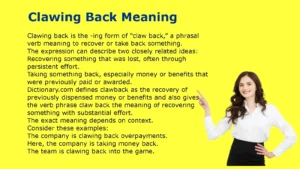
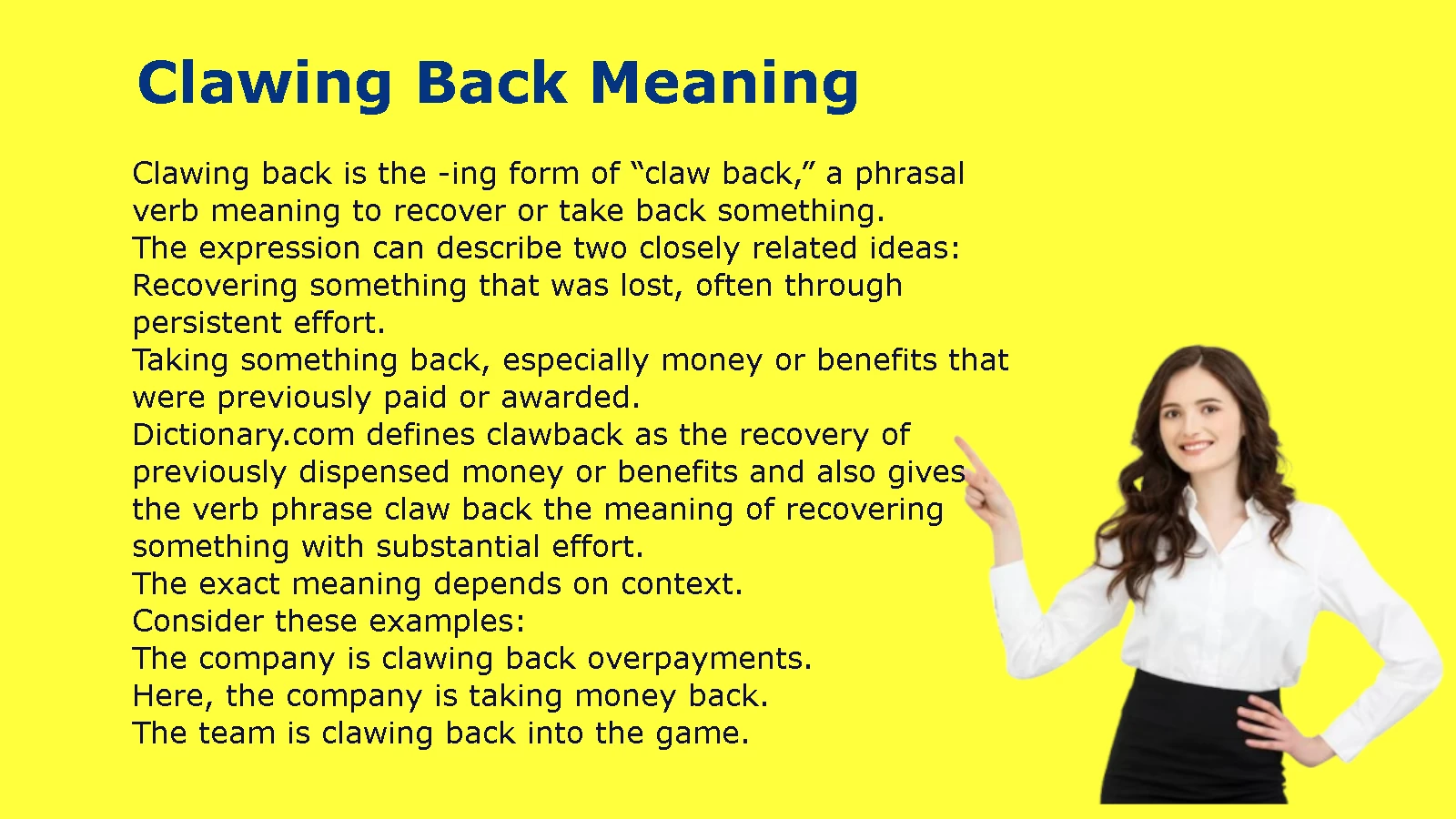
Clawing back is the -ing form of “claw back,” a phrasal verb meaning to recover or take back something.
The expression can describe two closely related ideas:
- Recovering something that was lost, often through persistent effort.
- Taking something back, especially money or benefits that were previously paid or awarded.
Dictionary.com defines clawback as the recovery of previously dispensed money or benefits and also gives the verb phrase claw back the meaning of recovering something with substantial effort.
The exact meaning depends on context.
Consider these examples:
- The company is clawing back overpayments.
Here, the company is taking money back. - The team is clawing back into the game.
Here, the team is recovering from a disadvantage. - The stock is clawing back some of its losses.
Here, the stock is recovering part of an earlier decline.
So, clawing back does not always involve money. It can describe the recovery of a position, advantage, amount, or progress.
Why Does “Clawing Back” Mean Recovering Something?
The expression uses claw metaphorically.
Imagine an animal using its claws to pull something toward itself. The movement suggests effort, resistance, and persistence. English developed the figurative expression claw back to describe a similarly difficult recovery.
That imagery explains an important nuance.
Recovering can sound neutral:
The company recovered its losses.
Clawing back often suggests that the recovery took effort:
The company clawed back some of its losses.
The second sentence creates a stronger sense of struggle. The company did not simply return to its previous position. It worked its way back after losing ground.
That is why the phrase is particularly common in journalism, financial reporting, sports coverage, business writing, and discussions of competition.
Clawing Back Meaning in Different Contexts
The phrase becomes easier to understand when you see how it works in different situations.
Clawing Back Money or Payments
When someone claws back money, they recover money that has already been paid, distributed, or received.
For example:
The agency is clawing back payments that were made in error.
A company might also claw back an overpayment from an employee, customer, contractor, or other recipient if a contract or applicable rule allows it.
This use is especially close to the financial meaning of clawback.
Cambridge Dictionary defines clawback in finance as a situation in which a government or company takes back money it has already paid.
Clawing Back Financial Losses
The phrase also appears when a person, company, investor, or financial market recovers part of a previous loss.
For example:
The shares fell 10% in the morning but clawed back 4% by the afternoon.
Here, the shares did not necessarily recover the entire 10% decline. They simply recovered part of the lost value.
That distinction matters.
If an asset falls from $100 to $90, it has lost $10. If it later rises from $90 to $94, it has clawed back $4 of its earlier loss.
It has not returned to $100.
Clawing Back Benefits or Compensation
Organizations can also claw back compensation or benefits under certain conditions.
For example:
The company may claw back the bonus if the contractual performance conditions are not met.
In executive compensation, a clawback policy can require certain incentive-based compensation to be returned under specified circumstances.
For U.S. public companies subject to the applicable SEC and exchange rules, modern clawback policies can require recovery of certain erroneously awarded incentive compensation following an accounting restatement. SEC-filed policies commonly cover a recovery period involving the three completed fiscal years preceding the relevant restatement date.
The precise rules depend on the company, compensation arrangement, securities-listing requirements, and applicable law.
Clawing Back Market Share
The phrase is not limited to money.
A business can claw back market share after competitors take some of its customers.
For example:
The retailer is clawing back market share after losing customers to online competitors.
Here, clawing back means regaining something that was previously held.
The phrase emphasizes competition and effort.
Clawing Back Time or Progress
The expression can also work in broader figurative situations.
For example:
We are trying to claw back the time we lost during the delay.
Or:
The project team clawed back several weeks after falling behind schedule.
In these sentences, the subject is not literally taking something back. Instead, it is recovering lost progress or compensating for lost time.
What Does “Claw Back” Mean in Finance?
In finance and business, claw back commonly refers to recovering money or compensation that has already been paid.
The related noun clawback is particularly important in this context.
A clawback can appear in:
- Executive compensation
- Bonuses
- Tax credits
- Government payments
- Grants
- Incentive compensation
- Contracts
- Insurance arrangements
- Financial agreements
Cambridge gives both a financial meaning involving the recovery of previously paid money and a stock-market meaning involving a gradual recovery after a decline.
These two uses are easy to confuse because they involve the same word but describe different mechanisms.
Financial Clawback Example
Suppose an executive receives a $500,000 performance bonus based partly on reported financial results.
Later, the company restates its financial statements and determines that the corrected figures would have produced a $350,000 bonus.
A clawback policy may require recovery of the $150,000 excess, subject to the applicable policy and rules.
That is different from saying the executive simply lost $150,000. A clawback is a mechanism for recovering compensation that was previously awarded or paid.
SEC-filed policies describe this concept as recovering the amount of incentive-based compensation that exceeded what would have been received using the restated financial results.
What Is a Clawback?
A clawback is the recovery or return of money, benefits, or compensation that has already been given or paid.
It is usually a noun.
Compare:
The company will claw back the payment.
Here, claw back is a verb phrase.
The company has a clawback provision.
Here, clawback is a noun.
This distinction is important when writing about contracts, compensation, or financial policies.
Clawback Provisions
A clawback provision is a contractual or policy provision that establishes circumstances under which money or benefits may have to be returned.
For example, an agreement might specify that an incentive payment can be recovered if certain conditions occur.
However, the existence of a clawback provision does not automatically mean that every payment can be recovered in every situation. The actual terms matter.
In U.S. public-company executive compensation, SEC Rule 10D-1 and related exchange listing standards provide a regulatory framework for certain compensation clawbacks. Companies have adopted policies implementing those requirements.
Claw Back vs. Clawing Back
These expressions are related but have different grammatical roles.
| Form | Function | Example |
| claw back | Base verb phrase | The company may claw back the bonus. |
| clawed back | Past tense/past participle | The company clawed back the payment. |
| clawing back | Present participle/gerund | The company is clawing back the payment. |
| clawback | Noun | The contract contains a clawback provision. |
“Claw Back” as a Verb
Use claw back when describing an action.
The company plans to claw back the overpayment.
“Clawed Back” as the Past Form
Use clawed back when the recovery already happened.
The company clawed back the disputed payment.
“Clawing Back” as the -ing Form
Use clawing back for an action that is ongoing or as a gerund.
The company is clawing back some of the previously awarded compensation.
“Clawback” as a Noun
Use clawback when naming the recovery mechanism or event.
The agreement contains a clawback clause.
This is one of the most important grammar points for anyone searching for clawing back meaning.
Clawing Back vs. Recovering
Clawing back and recovering can be synonyms, but they are not always interchangeable in tone.
| Expression | Main idea | Nuance |
| Recovering | Getting something back | Neutral |
| Clawing back | Getting something back with effort | Suggests difficulty or struggle |
| Regaining | Getting back a former position | Often used for status, control, or advantage |
| Reclaiming | Taking something back | Can emphasize ownership |
| Recouping | Recovering money or losses | Especially common in financial contexts |
| Retaking | Taking back a position or place | Often implies competition |
| Winning back | Regaining someone’s support or business | Often used with customers or public support |
Consider the difference:
The company recovered some of its lost market share.
This is straightforward.
The company clawed back some of its lost market share.
This suggests that regaining the market share was difficult and required sustained effort.
That extra sense of struggle is one of the defining characteristics of clawing back.
Clawing Back Meaning in a Sentence
Here are realistic examples showing the phrase in different contexts.
Money
The company is clawing back payments that were made in error.
Financial losses
The investment recovered slightly, clawing back some of its earlier losses.
Business
The retailer is clawing back market share after a difficult year.
Compensation
The employer’s policy allows it to claw back certain incentive payments.
Time
The team worked late to claw back some of the time lost during the delay.
Sports
The team clawed back from a three-goal deficit in the second half.
Competition
The smaller company is clawing back customers from its larger competitor.
Public support
The campaign is trying to claw back support it lost during the controversy.
Project progress
The developers clawed back several weeks after reorganizing the schedule.
Stock market
The share price fell sharply before clawing back part of the decline.
Notice that not every example involves taking money back. In several cases, clawing back simply means regaining something after losing it.
A Simple Case Study: Understanding “Clawing Back” Through Numbers
Imagine that a company’s stock trades at $80 per share.
A disappointing earnings report causes it to fall to $68.
The decline is:
$80 − $68 = $12
The stock then rises to $73.
It has recovered:
$73 − $68 = $5
So a financial article might say:
The stock clawed back $5 of its earlier $12 decline.
The phrase works because the stock is recovering part of what it lost, rather than simply rising from an arbitrary starting point.
The same idea can apply to business performance.
Suppose a retailer previously held 30% of a market, then dropped to 24%. Later, it increases its share to 27%.
The retailer has regained part of the market share it lost. A journalist could describe this as the retailer clawing back market share.
The important idea is partial recovery after a setback.
Clawing Back in Executive Compensation
One of the most significant modern uses of clawback appears in executive compensation.
A company’s compensation system may tie bonuses or other incentive payments to financial measures. If previously reported results later require an accounting restatement, the amount of compensation that should have been awarded can change.
Under the SEC’s clawback framework for listed companies, certain incentive-based compensation can be subject to recovery following a qualifying accounting restatement. The rules are not limited to cases where an executive personally committed misconduct.
That point is important because people sometimes assume:
Clawback = punishment for wrongdoing
That is not always correct.
A clawback policy can operate as a compensation recovery mechanism under defined circumstances.
Individual company policies can also contain additional provisions. For example, SEC-filed policies may address misconduct separately from mandatory recovery connected with an accounting restatement.
Why the Distinction Matters
Imagine an executive received a bonus based on reported revenue.
Later, accounting errors require the company to restate its financial statements.
The corrected figures result in a lower bonus.
A clawback mechanism can address the difference between:
- The incentive compensation actually received
- The incentive compensation that would have been received using the corrected figures
This is why clawback has become an important term in corporate governance and executive compensation.
Clawing Back in Stock-Market Language
Financial journalism often uses claw back differently from the contractual meaning of clawback.
For example:
The stock clawed back some of its losses.
Here, nobody is demanding that money be returned.
Instead, the stock price is recovering after falling.
Cambridge specifically recognizes a stock-market use of clawback for a gradual increase in a share price after it has declined.
This gives the phrase two useful financial meanings:
| Context | Meaning |
| Compensation | Recover money already paid |
| Government payments | Recover money already distributed |
| Contracts | Require repayment under specified conditions |
| Stock market | Recover part of a previous decline |
| Business | Regain lost market share or position |
| General use | Recover something lost through effort |
Is “Clawing Back” Grammatically Correct?
Yes. Clawing back is grammatically correct.
It is the present participle of the phrasal verb claw back.
You can use it after forms of be:
The company is clawing back the payment.
You can also use it as a gerund:
Clawing back the money may take several months.
Or after another verb:
The company started clawing back the overpayments.
The grammatical structure is similar to other phrasal verbs:
- give back → giving back
- take back → taking back
- pay back → paying back
- win back → winning back
- claw back → clawing back
The word back remains part of the phrasal verb.
Is “Clawing Back” Formal or Informal?
Clawing back is standard English, but its suitability depends on context.
It is especially natural in:
- Financial journalism
- Business reporting
- Economics
- Sports reporting
- Corporate communication
- Market commentary
For highly formal legal drafting, the more precise term may be recover, recoup, or require repayment, depending on the intended meaning.
For example:
The company may claw back the bonus.
This sounds natural in business communication.
A contract might instead say:
The company may require repayment of the incentive compensation.
The second version is more explicit and legally precise.
Casual Use
We’re clawing back some of the time we lost.
This is understandable and conversational.
Business Use
The retailer is clawing back market share.
This is common business language.
Financial Use
The stock clawed back part of its earlier decline.
This is natural financial reporting language.
Formal Contractual Use
The company may recover the compensation under the applicable clawback provision.
Here, recover and clawback provision provide more precise terminology.
Common Mistakes With “Clawing Back”
Assuming It Always Means Taking Money Back
This is probably the most important mistake.
Clawing back can mean recovering money, but it can also mean regaining:
- Losses
- Market share
- Time
- Progress
- Support
- A competitive position
- Ground lost to a rival
Confusing “Claw Back” With “Clawback”
The forms have different grammatical roles.
Claw back is generally a verb phrase:
The company will claw back the payment.
Clawback is a noun:
The contract contains a clawback provision.
Assuming a Clawback Always Involves Misconduct
A clawback can result from different contractual, regulatory, or policy conditions.
For example, SEC-related executive compensation rules can require recovery following certain accounting restatements even when the applicable policy does not depend on misconduct by the executive.
Treating “Recovering” and “Clawing Back” as Completely Identical
They overlap, but clawing back often adds a sense of effort or difficulty.
The company recovered its market share.
is more neutral than:
The company clawed back its market share.
The second sentence emphasizes the struggle involved in the recovery.
Using “Clawing Back” When There Is Nothing to Recover
The phrase normally implies some form of loss, reduction, surrender, or previous transfer.
For example:
The company increased its sales.
This does not necessarily mean the company clawed back sales.
But:
The company clawed back sales after losing customers to a competitor.
makes sense because there was a prior loss to recover.
Clawing Back vs. Regaining
Regaining is broader and more neutral.
The company regained its position in the market.
Clawing back adds a stronger sense of difficulty:
The company clawed back its position in the market.
Use regaining when you simply want to describe getting something back.
Use clawing back when you want to emphasize the effort, competition, or gradual recovery involved.
Clawing Back vs. Recouping
These words overlap in financial contexts but are not identical.
Recoup usually means recovering money, costs, or losses.
The company hopes to recoup its investment.
Claw back can describe the recovery of money, but it also has a broader figurative use.
The company is clawing back market share.
You would not normally say:
The company is recouping market share.
So recoup is more financially specific, while claw back is more flexible.
Clawing Back vs. Reclaiming
Reclaiming often focuses on getting something back because it belongs to you or because you previously possessed it.
The company is reclaiming its position as an industry leader.
Clawing back emphasizes the struggle involved in the recovery.
The company is clawing back its position after several difficult years.
Both can be correct, but they create slightly different impressions.
Related Terms: Clawback, Claw-Back, and Claw Back
You may encounter several written forms.
Claw back
This is the standard verb phrase.
The company may claw back the payment.
Clawback
This is commonly used as the noun.
The contract includes a clawback.
Claw-back
A hyphenated form may appear in some editorial or historical usage, but clawback is widely used as the noun in modern financial terminology.
For a website explaining the term, keeping the grammatical distinction clear is more useful than treating every spelling variation as a separate word.
Clawing Back Synonyms
The best synonym depends on the context.
For money
- recovering
- recouping
- reclaiming
- taking back
- retrieving
losses
- recovering
- making up
- offsetting
- recouping
For market share
- regaining
- reclaiming
- winning back
- retaking
time or progress
- making up
- recovering
- regaining
- making up lost ground
For support or customers
- winning back
- regaining
- reclaiming
The closest general synonym is usually recovering, but it does not always preserve the sense of effort found in clawing back.
Facts to Remember About the Clawing Back Meaning
Here are the key points to remember:
- Clawing back means recovering or taking back something.
- It can refer to money, but it is not limited to money.
- The expression often suggests difficulty, persistence, or gradual recovery.
- Claw back is the verb phrase.
- Clawed back is the past form.
- Clawing back is the -ing form.
- Clawback is the noun.
- In finance, a clawback can involve recovering previously paid money or compensation.
- In stock-market language, clawing back losses means recovering part of a previous decline.
- A clawback does not necessarily imply personal misconduct.
- The exact legal effect of a clawback depends on the relevant contract, policy, regulation, or law.
Frequently Asked Questions About Clawing Back
What does clawing back mean?
Clawing back means recovering, regaining, or taking back something that was previously lost, given, paid, or surrendered. It often suggests that the recovery requires effort.
What does “claw back” mean in finance?
In finance, claw back can mean recovering money or compensation that has already been paid. It can also describe an asset or share price recovering part of a previous decline.
What is a clawback?
A clawback is the recovery or return of money, benefits, or compensation that has already been paid or awarded, usually under specified contractual, regulatory, or policy conditions.
What does clawing back money mean?
Clawing back money means recovering money that has already been paid, distributed, or received.
For example:
The company is clawing back the overpayment.
What does clawing back losses mean?
Clawing back losses means recovering some of the value that was previously lost.
For example:
The stock clawed back some of its earlier losses.
It does not necessarily mean that the entire loss has been recovered.
Is clawing back the same as recovering?
Not exactly. Both can mean getting something back, but clawing back often suggests that the recovery is difficult or requires persistent effort.
Is clawing back one word?
No. Clawing back consists of the word clawing followed by the particle back. The related noun is commonly written as clawback.
What is the past tense of claw back?
The past tense is clawed back.
The company clawed back the payment.
Can you use clawing back for non-financial situations?
Yes. You can use it for market share, time, progress, competitive advantage, support, or other things that were lost and later recovered.
Is “clawback” a noun or a verb?
Clawback is normally used as a noun.
The agreement contains a clawback provision.
The verb is written claw back.
Final Meaning of “Clawing Back”
Clawing back means recovering or regaining something after it has been lost, reduced, given away, or paid out, often through considerable effort.
The simplest way to remember the phrase is:
Clawing back = working to get something back after losing it.
The related forms are equally important:
- claw back = verb
- clawed back = past tense
- clawing back = -ing form
- clawback = noun
Understanding that distinction makes it much easier to recognize and use clawing back correctly in financial articles, business writing, contracts, news reports, and everyday English.
Suggested Internal Links
For a word-meaning website, relevant internal links could naturally point to:
- Clawback Meaning
- Claw Back Meaning in Finance
- Clawed Back Meaning
- Recoup Meaning
- Reclaim Meaning
Suggested Image Alt Text
- clawing back meaning explained with examples
- claw back meaning in finance
- clawback meaning and claw back grammar
- clawing back financial losses example
- clawback provision explained
Authoritative Sources
The Cambridge Dictionary provides financial and stock-market definitions for clawback, while Dictionary.com covers both the noun and verb-phrase meanings.
For the regulatory side of executive compensation, SEC-filed clawback policies provide concrete examples of how recovery provisions operate under the applicable U.S. securities framework.