Have you ever come across “clamor” in one article and “clamour” in another and wondered which spelling is correct? The confusion is understandable because Clamor vs Clamour is not really a difference in meaning. Both words refer to a loud, confused noise, a strong public demand, or a loud expression of protest or excitement.
Clamor is the standard spelling in American English, while clamour is the preferred spelling in British English and other varieties that follow British spelling conventions.
Examples:
- The clamor of the crowd grew louder.
- The clamour of the crowd could be heard from miles away.
So, which one should you use? That depends mainly on the type of English you’re writing. If you’re following US English, clamor is the usual choice. If you’re writing in UK English, clamour is more common. Both spellings have the same pronunciation, definition, and grammatical function.
In this guide, you’ll learn the complete difference between Clamor vs Clamour, including their meaning, pronunciation, spelling, origin, usage, and examples in sentences. You’ll also discover whether clamor or clamour is correct in American and British English, plus simple tips to remember which spelling to use.
What Does Clamor Mean?
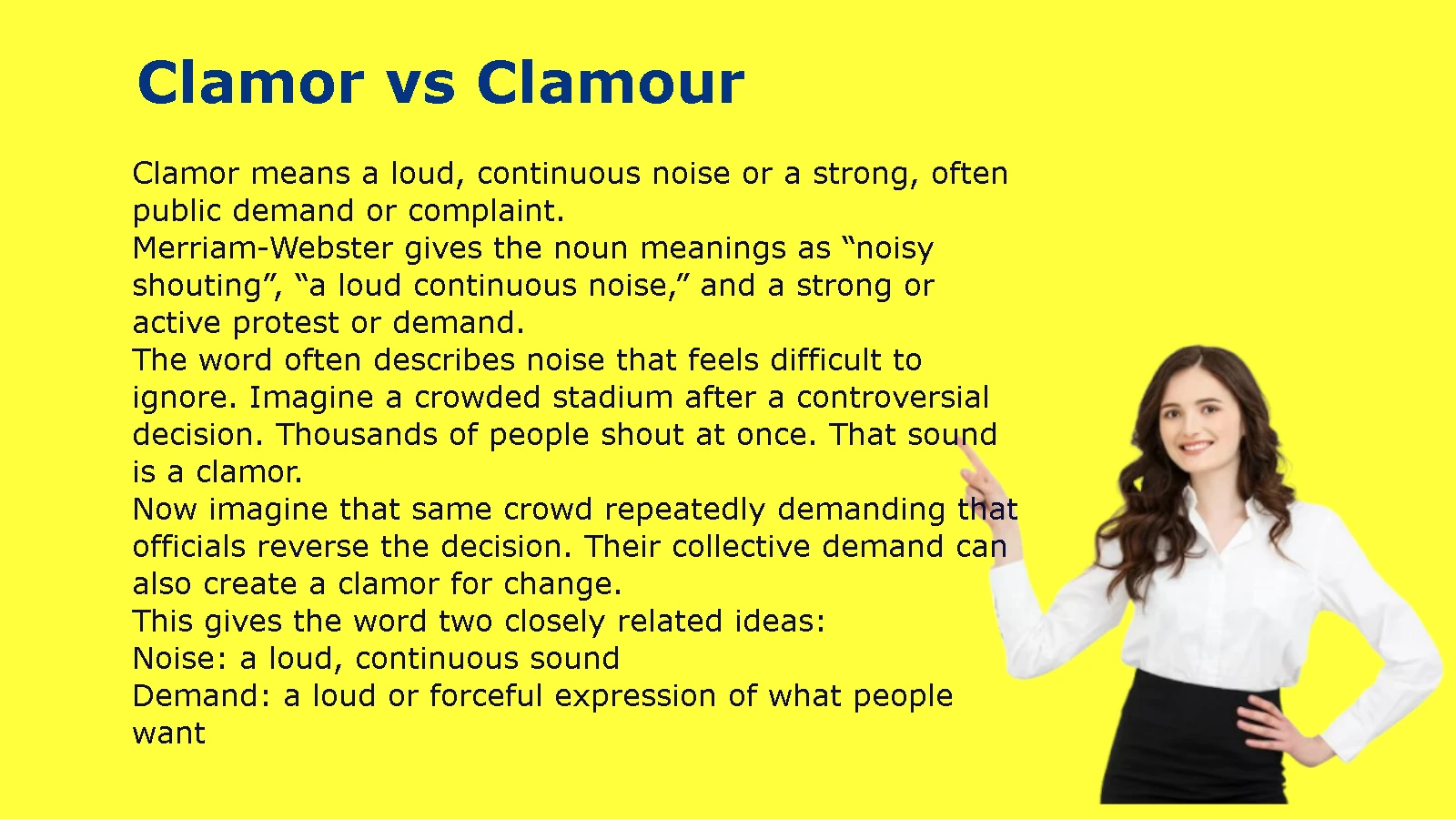
Clamor means a loud, continuous noise or a strong, often public demand or complaint.
Merriam-Webster gives the noun meanings as “noisy shouting”, “a loud continuous noise,” and a strong or active protest or demand.
The word often describes noise that feels difficult to ignore. Imagine a crowded stadium after a controversial decision. Thousands of people shout at once. That sound is a clamor.
Now imagine that same crowd repeatedly demanding that officials reverse the decision. Their collective demand can also create a clamor for change.
This gives the word two closely related ideas:
- Noise: a loud, continuous sound
- Demand: a loud or forceful expression of what people want
Clamor as a Noun
As a noun, clamor can describe a physical sound:
The clamor of the marketplace filled the narrow street.
Here, clamor refers to the combined noise of many voices and activities.
It can also describe a collective demand:
The clamor for reform became impossible for lawmakers to ignore.
In this sentence, the word doesn’t simply mean that people are making noise. It suggests that many people are strongly and publicly demanding something.
Oxford gives similar uses, including a loud noise made by many people or animals and a demand made by a large group.
Clamor as a Verb
As a verb, clamor means to demand something loudly or to shout loudly, often as part of a group.
For example:
- Fans clamored for an encore.
- Workers clamored for better conditions.
- Reporters clamored to know what had happened.
- Children clamored for their parents’ attention.
- Protesters clamored for immediate action.
The verb often appears in the structures clamor for something and clamor to do something. Oxford specifically records both patterns.
The word also works when a group makes a confused or noisy outcry:
A crowd of reporters clamored around the car.
That sentence focuses more on the noisy behavior of the reporters than on a particular demand.
What Does Clamour Mean?
Clamour has the same core meaning as clamor. The spelling is simply associated with British English and some other varieties that retain the -our form.
Cambridge defines clamour as the UK spelling of clamor. It uses the word for a loud complaint or demand and for loud noise, particularly noise made by people’s voices.
For example:
The crowd’s clamour grew louder as the announcement was delayed.
The sentence means exactly what its American English counterpart means:
The crowd’s clamor grew louder as the announcement was delayed.
Clamour as a Noun
As a noun, clamour can refer to a loud sound:
- the clamour of voices
- the clamour of the city
- the clamour of the marketplace
- the clamour of the crowd
It can also describe a collective demand:
- a public clamour for change
- a growing clamour for answers
- a clamour for justice
- a clamour for reform
Oxford lists examples such as “the clamour of the market” and “the clamour for her resignation.”
Clamour as a Verb
As a verb, clamour can mean to demand something loudly or to shout in a noisy, confused way.
For example:
The fans clamoured for another performance.
Or:
Everyone was clamouring to know the result.
Oxford records the structures clamour for something and clamour to do something, as well as the use of clamour for a crowd shouting loudly.
Clamor vs Clamour: What Is the Difference?
The central difference is spelling convention rather than meaning.
| Feature | Clamor | Clamour |
| American English | Standard | Less usual |
| British English | Less usual | Standard |
| Meaning | Same | Same |
| Noun | Yes | Yes |
| Verb | Yes | Yes |
| Pronunciation | Same basic word | Same basic word |
| Past tense | clamored | clamoured |
| Present participle | clamoring | clamouring |
| Related adjective | clamorous | clamorous |
This distinction matters because English spelling often reflects regional conventions.
The difference between color and colour, favor and favour, and labor and labour follows a similar broad pattern. However, you shouldn’t assume every English word ending in -or has a standard -our counterpart. English spelling contains plenty of exceptions.
For clamor specifically, the dictionaries are clear: clamor is the US form and clamour is the UK form.
Why Does Clamor Have Two Spellings?
The spelling difference has a long history.
The word entered English through forms related to Anglo-French and Latin. Merriam-Webster traces the noun and one verb sense to Middle English, Anglo-French clamour, and Latin clamor, from clamare, meaning “to cry out.”
The word therefore predates modern American and British spelling standards by centuries.
The -our spelling reflects French influence and became established in British English. American spelling later developed a strong preference for -or in many words of this type.
Etymonline notes that the -our form was historically widespread and that American usage eventually favored -or in many such words.
That history explains why neither spelling represents a modern invention. Both forms have deep roots in English.
A Brief Word History
The development can be simplified like this:
Latin clamor
↓
Old French / Anglo-French forms
↓
Middle English forms such as clamour
↓
Modern English: clamor / clamour
The original idea remained remarkably stable: a cry, shout, outcry, or loud demand.
Merriam-Webster dates the first known English use of clamor to the 14th century.
That’s a useful reminder that this isn’t merely a modern spelling preference. The word has been part of English vocabulary for hundreds of years.
Clamor vs Clamour in American and British English
Regional spelling becomes especially important when you’re writing for a specific audience.
If you write an article for readers in the United States, clamor will usually look more natural:
The campaign sparked a clamor for greater transparency.
For a British audience, clamour fits the expected spelling:
The campaign sparked a clamour for greater transparency.
Neither sentence is more correct in meaning.
The important point is consistency. If a document follows American spelling, using clamour in one paragraph and clamor in the next can look like an editing mistake.
The same principle applies across an entire piece of writing.
American English
Use:
- clamor
- clamored
- clamoring
Example:
Customers began clamoring for an explanation.
British English
Use:
- clamour
- clamoured
- clamouring
Example:
Customers began clamouring for an explanation.
Oxford explicitly lists these corresponding forms, including clamored/clamoured and clamoring/clamouring.
Clamor vs Clamour Examples
Seeing the two forms side by side makes the difference easy to understand.
| American English | British English |
| The clamor grew louder. | The clamour grew louder. |
| Fans clamored for an encore. | Fans clamoured for an encore. |
| Workers clamored for better pay. | Workers clamoured for better pay. |
| The clamor of voices filled the hall. | The clamour of voices filled the hall. |
| Reporters were clamoring to know the truth. | Reporters were clamouring to know the truth. |
| A public clamor for reform followed the decision. | A public clamour for reform followed the decision. |
Notice what doesn’t change: the grammar, meaning, and sentence structure remain essentially the same.
Only the spelling changes.
Example: Noise
American:
The clamor from the stadium could be heard several blocks away.
British:
The clamour from the stadium could be heard several blocks away.
Here, the word refers to a loud collective sound.
Example: Public Demand
American:
There was a growing clamor for an independent investigation.
British:
There was a growing clamour for an independent investigation.
Here, the word describes a strong public demand.
Example: Loud Requests
American:
The children clamored for another story.
British:
The children clamoured for another story.
The verb describes repeated, energetic requests.
Clamor vs Clamour: How the Meaning Changes With Context
One interesting feature of this word is that context determines whether it emphasizes sound or demand.
Consider:
The clamor outside woke me.
This sentence focuses on noise.
Now compare it with:
There was a clamor for lower prices.
This sentence focuses on demand.
The word connects these meanings because a demand often becomes loud and collective. A group doesn’t merely want something. It makes its desire heard.
That’s why clamor often appears in discussions of:
- protests
- politics
- public opinion
- campaigns
- sports crowds
- media pressure
- social movements
- consumer demands
- noisy gatherings
The word works particularly well when many voices combine into one noticeable outcry.
Clamor for and Clamour for
One of the most useful patterns to learn is clamor for something or clamour for something.
This construction means to demand something loudly, strongly, or persistently.
Examples include:
- clamor for justice
- clamor for change
- clamor for answers
- clamor for reform
- clamor for attention
- clamor for action
- clamor for freedom
- clamor for better conditions
British spelling simply changes the word itself:
- clamour for justice
- clamour for change
- clamour for answers
- clamour for reform
Cambridge and Oxford both document this construction.
Why “Clamor for” Is So Common
The phrase works because clamor often involves collective pressure.
Compare these sentences:
People wanted answers.
This is neutral.
People demanded answers.
This is stronger.
People clamored for answers.
This suggests a loud, urgent, persistent, or highly public demand.
The word therefore adds emotional and social force without requiring a long explanation.
Clamor to Do Something
Another useful construction is clamor to do something.
For example:
Fans clamored to meet the singer.
Reporters clamored to hear the announcement.
Everyone clamored to know what had happened.
British English uses the same structure:
Fans clamoured to meet the singer.
Reporters clamoured to hear the announcement.
Everyone clamoured to know what had happened.
Oxford specifically records clamor to do something and its British counterpart clamour to do something.
This structure usually emphasizes eagerness expressed in a noisy or insistent way.
Clamored vs Clamoured
The past tense follows the same regional spelling distinction.
| American English | British English |
| clamored | clamoured |
| The fans clamored for tickets. | The fans clamoured for tickets. |
If your writing uses American spelling, choose clamored.
If your writing uses British spelling, choose clamoured.
The pronunciation remains essentially the same. Cambridge provides US and UK pronunciation entries for the two forms.
Clamoring vs Clamouring
The present participle also follows the same pattern.
American English
clamoring
Customers were clamoring for refunds.
British English
clamouring
Customers were clamouring for refunds.
The extra u doesn’t create a new word or a different meaning. It reflects the spelling convention used by the variety of English you’re writing in.
Oxford lists clamoring as the American form and clamouring as the Canadian/British form.
Clamor vs Clamour Pronunciation
Despite their different spellings, clamor and clamour represent the same underlying word.
Cambridge gives US pronunciation as approximately /ˈklæm.ɚ/ and UK pronunciation as approximately /ˈklæm.ər/.
The main audible difference comes from the normal pronunciation patterns of American and British English, not from the spelling itself.
So don’t pronounce the u in clamour as though it creates an extra syllable. It doesn’t.
A practical approximation is:
CLAM-er
The exact vowel and final sound can vary by accent.
Clamor vs Clamour: Common Phrases
Both spellings appear in several useful expressions.
| American English | British English |
| clamor for change | clamour for change |
| clamor for justice | clamour for justice |
| clamor for answers | clamour for answers |
| clamor for attention | clamour for attention |
| a clamor of voices | a clamour of voices |
| the clamor of the city | the clamour of the city |
| above the clamor | above the clamour |
| amid the clamor | amid the clamour |
Oxford records patterns such as above the clamour, amid the clamour, and clamour for.
These phrases work particularly well in formal writing because clamor can capture both sound and social pressure.
Clangor suggests a loud, ringing, often metallic sound.
Compare:
The clamor of the crowd filled the stadium.
The noise comes from people.
Now:
The clangor of metal echoed through the workshop.
The sound has a ringing, metallic quality.
This distinction matters because choosing clangor instead of clamor can change the image in the reader’s mind.
Clamor vs Clamour vs Uproar
Uproar also overlaps with clamor, but it carries a slightly different emphasis.
An uproar usually refers to noisy confusion, excitement, protest, or disturbance.
A clamor can describe the noise itself or a strong demand expressed by many people.
Compare:
The announcement caused an uproar.
This suggests a sudden and highly emotional reaction.
The announcement created a clamor for answers.
This specifically highlights the public demand for answers.
In other words, uproar focuses more on the disturbance or reaction, while clamor can focus on the noise or the demand behind it.
Clamor vs Clamour vs Outcry
Outcry is another close synonym, especially when people strongly object to something.
For example:
The decision triggered a public outcry.
You could also say:
The decision triggered a public clamor for reform.
The two expressions overlap, but outcry often emphasizes strong public protest, while clamor can emphasize the loudness, persistence, or collective nature of the demand.
The best choice depends on the image you want to create.
Clamorous: The Related Adjective
The adjective clamorous comes from the same word family.
It means very noisy or noisily insistent.
Merriam-Webster defines clamorous as something marked by confused noise or outcry and also uses it for demands that insistently call for attention.
Examples:
- a clamorous crowd
- clamorous demands
- a clamorous marketplace
- clamorous protests
- the clamorous streets of a busy city
One important spelling point deserves attention:
The standard adjective is “clamorous,” not “clamourous.”
So even writers who use British spelling should normally write:
The protesters made clamorous demands.
Not:
The protesters made clamourous demands.
The noun changes between clamor and clamour, but the adjective remains clamorous in standard usage. Merriam-Webster lists clamorous as the adjective related to clamor.
A Practical Case Study: Choosing the Right Spelling
Imagine two editors are preparing the same article for different audiences.
Editor A: American publication
The publication follows American English. Its article says:
The clamor for affordable housing has grown louder.
Later, it says:
Residents clamored for immediate action.
And:
Protesters were clamoring outside city hall.
This spelling pattern is consistent.
Editor B: British publication
The British edition uses:
The clamour for affordable housing has grown louder.
Then:
Residents clamoured for immediate action.
And:
Protesters were clamouring outside city hall.
Again, the spelling remains consistent.
What the case study shows
Neither editor has changed the meaning.
The only thing that changes is the regional spelling system.
That makes this a style decision rather than a vocabulary decision.
Which Spelling Should You Use?
The answer depends on your audience.
Use “clamor” when writing for an American audience
Choose clamor for:
- US websites
- American schools
- American newspapers
- US business writing
- American academic writing
- content written primarily for US readers
Example:
The public clamor for answers continued throughout the investigation.
Use “clamour” when writing for a British audience
Choose clamour for:
- UK publications
- British schools
- British newspapers
- UK business writing
- content following British spelling conventions
Example:
The public clamour for answers continued throughout the investigation.
What about Canadian English?
Canadian English can use clamour as well as clamor. Oxford specifically notes clamour as a Canadian form alongside the American clamor.
That means Canadian usage doesn’t always fit neatly into a simple US-versus-UK split.
When a particular publication or institution has its own style guide, follow that guide.
Common Mistakes With Clamor and Clamour
The spelling itself is easy once you understand the regional distinction. The bigger problems usually come from inconsistent usage.
Treating one spelling as universally correct
Neither spelling is universally “more correct.”
Clamor is standard American English.
Clamour is standard British English.
Calling the British spelling wrong simply because American English uses clamor misses the regional nature of English spelling.
Mixing forms in the same article
Avoid writing:
The public clamor for reform grew louder. Later, protesters clamoured for answers.
Unless you’re deliberately discussing different varieties of English, the mixed spelling looks inconsistent.
Choose one variety and stick with it.
Writing “clamour” in American English without a reason
If an article follows American spelling, clamor will normally be the better choice.
Writing “clamor” in British English without checking the style
If a British publication expects traditional British spelling, clamour is the natural choice.
Adding “u” to clamorous
Don’t automatically turn clamorous into clamourous just because you write clamour.
The standard adjective is clamorous.
Clamor vs Clamour: Synonyms and Related Words
Depending on the context, several words can replace clamor or clamour.
| Word | Typical meaning |
| uproar | Loud confusion, excitement, or disturbance |
| outcry | Strong public protest or objection |
| hubbub | A mixture of loud, confused sounds |
| din | A loud, unpleasant, continuous noise |
| commotion | Noisy confusion or disturbance |
| racket | Loud, unpleasant noise |
| protest | Public expression of objection |
| demand | A firm request for something |
| outcry | Strong expression of anger or concern |
The best synonym depends on whether the sentence focuses on noise, protest, demand, or confusion.
For example, din works well for physical noise:
The din of traffic made conversation difficult.
Outcry works better for public objection:
The decision caused a public outcry.
Clamor can bridge both ideas:
The decision sparked a clamor for reform.
Frequently Asked Questions About Clamor vs Clamour
Is clamor or clamour correct?
Both are correct. Clamor is the standard American spelling, while clamour is the standard British spelling.
Is clamour British or American?
Clamour is primarily the British spelling. American English generally uses clamor. Merriam-Webster describes clamour as the chiefly British spelling.
Does clamor mean the same as clamour?
Yes. Clamor and clamour have the same basic meanings. Both can refer to loud noise, a loud complaint, or a strong demand.
Which spelling should I use in the US?
Use clamor in American English.
For example:
There was a growing clamor for change.
Which spelling should I use in the UK?
Use clamour in British English.
For example:
There was a growing clamour for change.
Is clamoring or clamouring correct?
Both are correct regional forms.
- American English: clamoring
- British English: clamouring
Oxford records both forms.
Is clamored or clamoured correct?
Again, both forms are correct.
- American English: clamored
- British English: clamoured
Is clamorous spelled with “our”?
No. The standard adjective is clamorous.
For example:
The city became clamorous after the announcement.
Merriam-Webster lists clamorous as the adjective related to clamor.
How do you pronounce clamor and clamour?
The words have essentially the same pronunciation. American and British accents can produce slightly different vowel and final sounds, but the spelling difference doesn’t create a separate word or an extra syllable. Cambridge provides both US and UK pronunciations.
Is clamor a noun or a verb?
It can be both.
As a noun:
The clamor of the crowd filled the arena.
As a verb:
Fans clamored for another song.
What does “clamor for” mean?
Clamor for means to demand something loudly, strongly, or persistently.
For example:
Citizens clamored for answers after the announcement.
The British spelling is:
Citizens clamoured for answers after the announcement.
What does “clamor to do something” mean?
It means to demand or eagerly seek the chance to do something in a loud or insistent way.
For example:
The fans clamored to meet the players.
Oxford records this verb pattern alongside clamor for something.
Clamor vs Clamour: Final Verdict
The clamor vs clamour question has a straightforward answer.
Clamor is the standard American English spelling.
Clamour is the standard British English spelling.
Both words can function as nouns and verbs. Both can describe loud noise, strong public demands, or noisy complaints. Their related forms also follow the regional pattern:
| American English | British English |
| clamor | clamour |
| clamored | clamoured |
| clamoring | clamouring |
| clamorous | clamorous |
The word itself has a long history, reaching English through Anglo-French from Latin clamor, meaning a shout or loud cry.
So when you’re deciding between clamor and clamour, don’t ask which spelling is “right” in every situation. Ask a better question:
Which variety of English are you writing for?
If your audience uses American English, choose clamor. If you’re following British English conventions, choose clamour. Most importantly, keep the spelling consistent throughout your writing.