Anyways is an informal word commonly used in everyday conversation to mean “anyway” or to move a conversation back to the main point. If you’ve come across the word “anyways” and wondered what it means, whether it is grammatically correct, or how it differs from “anyway,” its meaning and usage depend heavily on context, tone, and the type of English being used.
The anyways meaning is generally the same as “anyway,” but anyways is more informal and is often heard in casual speech and conversational writing. It can be used to mean “in any case,” “regardless,” “at any rate,” or to return to a previous topic after a brief interruption or digression. Related expressions such as anyway, in any case, regardless, at any rate, and anyhow can have similar meanings, although they are not always interchangeable in every context.
In this guide, you’ll learn what “anyways” means, how it is used in sentences, whether “anyways” is a correct word, and the difference between “anyways” and “anyway.” You’ll also see clear examples that show how the word works in casual conversation, informal writing, and different sentence contexts.
By the end, you’ll know exactly what anyways means, when to use it, and why “anyway” is generally preferred in formal and standard English.
Anyways Meaning: Quick Answer
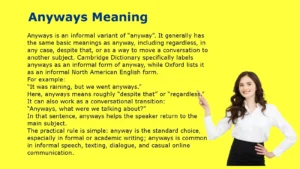
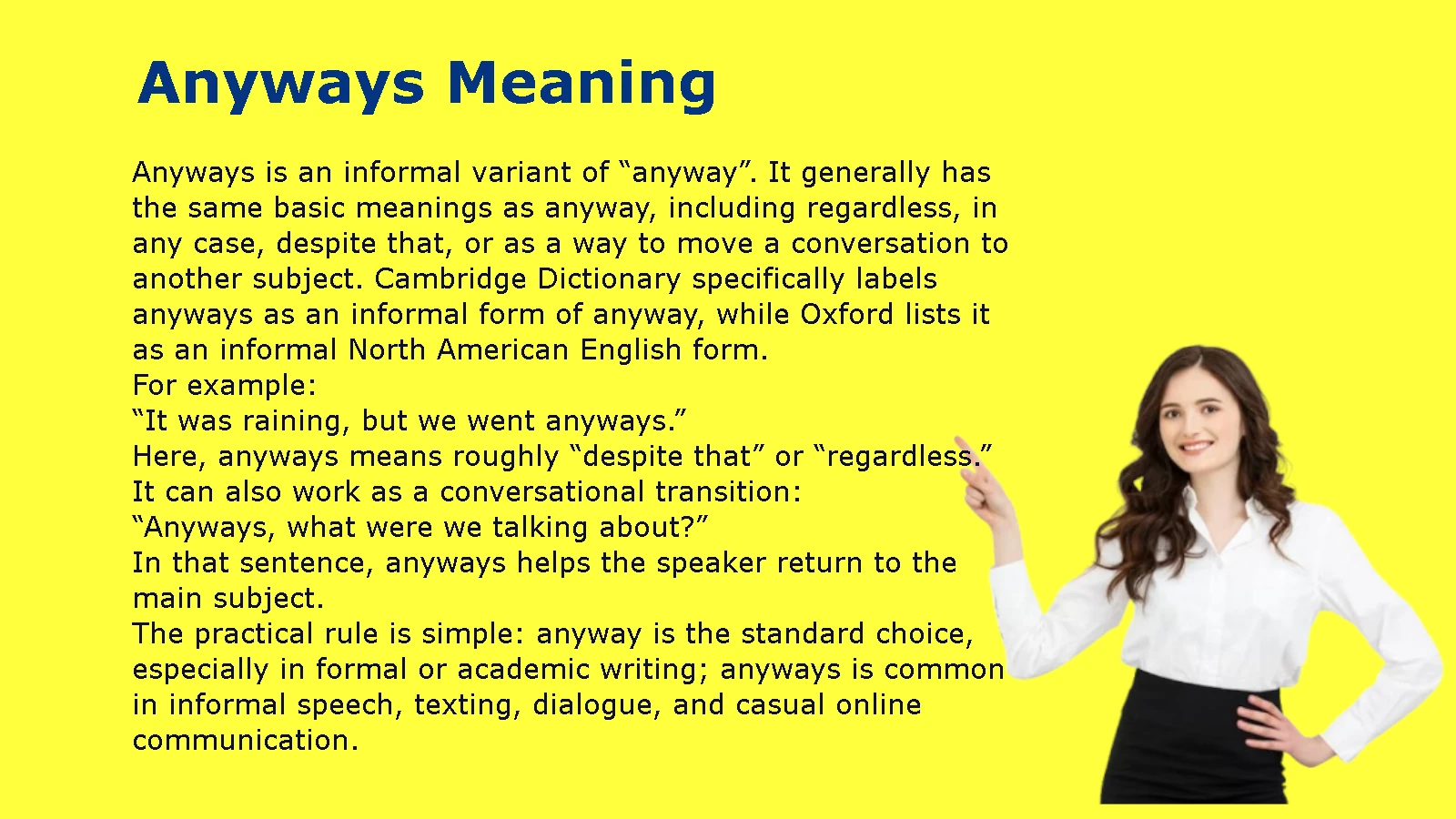
Anyways is an informal variant of “anyway”. It generally has the same basic meanings as anyway, including regardless, in any case, despite that, or as a way to move a conversation to another subject. Cambridge Dictionary specifically labels anyways as an informal form of anyway, while Oxford lists it as an informal North American English form.
For example:
“It was raining, but we went anyways.”
Here, anyways means roughly “despite that” or “regardless.”
It can also work as a conversational transition:
“Anyways, what were we talking about?”
In that sentence, anyways helps the speaker return to the main subject.
The practical rule is simple: anyway is the standard choice, especially in formal or academic writing; anyways is common in informal speech, texting, dialogue, and casual online communication.
What Does “Anyways” Mean?
The word anyways generally means the same thing as anyway. The difference is primarily one of register and usage, rather than a completely different definition.
Cambridge Dictionary defines anyways as an informal form of anyway. Oxford similarly identifies anyways as an informal North American English variant.
Depending on the sentence, anyways can communicate several related ideas:
- Regardless
- In any case
- Despite that
- Even so
- Moving on
- Returning to the main point
- Ending or redirecting a conversation
Consider these examples:
- “I was tired, but I went anyways.”
= I went despite being tired. - “Anyways, let’s get back to work.”
= Moving on, let’s get back to work. - “I don’t think he’ll come, but we’ll go anyways.”
= We’ll go regardless. - “Anyways, where were we?”
= Let’s return to the previous subject.
So, the exact anyways meaning depends on its position and function in the sentence.
Is “Anyways” a Real Word?
Yes. Anyways is an established English word, and major dictionaries document it.
Cambridge Dictionary has a separate entry for anyways and labels it informal, defining it as informal anyway.
Oxford Advanced Learner’s Dictionary also lists anyways under anyway, identifying it as North American English, informal.
However, dictionary recognition does not mean that anyways and anyway have exactly the same status in every type of writing.
Dictionary.com describes anyways as a variation of anyway and labels it nonstandard.
That difference in labeling is important. Dictionaries can describe a word’s actual use without recommending it for every context.
Why Do Some People Say “Anyways” Is Wrong?
The objection usually comes from traditional standard-English usage.
For many speakers, anyway is the established standard form, while anyways sounds conversational or regional. That is why a teacher, editor, or professional writer may prefer:
“We decided to go anyway.”
instead of:
“We decided to go anyways.”
That doesn’t mean the second sentence is meaningless or that anyways does not exist. It means that anyway is the safer and more widely accepted choice when formal standard English matters.
Anyway vs. Anyways: What Is the Difference?
The basic semantic difference is very small.
| Feature | Anyway | Anyways |
| Basic meaning | In any case, regardless, despite that | Generally the same |
| Dictionary status | Standard entry | Documented informal variant |
| Formal writing | Appropriate | Usually avoided |
| Casual conversation | Common | Common in some varieties |
| Texting | Common | Common |
| Social media | Common | Common |
| Academic writing | Preferred | Usually avoid |
| Professional communication | Preferred | Safer to use anyway |
| Conversational transition | Yes | Yes |
The biggest difference is tone and formality, not meaning.
Anyway Is the Standard Choice
Anyway works naturally in both casual and formal English.
For example:
“The evidence was incomplete, but the researchers continued anyway.”
It can also introduce a transition:
“Anyway, let’s return to the original question.”
Cambridge describes anyway as an adverb that can express contrast, support a statement, change the subject, return to an earlier subject, or mark a conversational ending.
Anyways Is More Informal
Anyways performs many of the same functions but has a more casual feel.
For example:
“Anyways, I’ll call you tomorrow.”
This sounds natural in an informal conversation or text message. In a formal report, however, “Anyway” would normally be the better choice.
What Does “Anyways” Mean in Texting?
In texting, anyways often acts as a conversational transition.
People may use it to:
- Change the subject
- Return to something they were discussing
- Move past an awkward point
- Dismiss a minor issue
- Bring a story back on track
- End a discussion
- Signal that something previously mentioned is no longer important
For example:
“I was going to tell you about the concert, but I got distracted. Anyways, it was amazing.”
Here, anyways means something like “moving on” or “in any case.”
Another example:
“I don’t think she’ll be there anyways.”
Here, it means “regardless” or “in any case.”
The same spelling can therefore perform different conversational jobs.
Why Is “Anyways” Common in Text Messages?
Texting is usually less formal than academic or professional writing. People often reproduce the way they speak.
Words such as anyways, gonna, wanna, yeah, and other conversational forms can appear naturally in messages because texting often functions as written conversation.
That doesn’t automatically make every informal form suitable for formal writing.
“Anyways” in a Sentence: Examples
The easiest way to understand the anyways meaning is to see how it works in different contexts.
Anyways Meaning “Regardless”
“I wasn’t sure about going, but I went anyways.”
Meaning: I went regardless of my uncertainty.
Anyways Meaning “Despite That”
“The instructions were confusing, but she finished the project anyways.”
Meaning: She finished the project despite the confusing instructions.
Anyways as a Conversation Transition
“Anyways, let’s talk about something else.”
Meaning: Moving on, let’s discuss another subject.
Anyways as a Return to a Previous Topic
“We got distracted talking about the movie. Anyways, you were telling me about your new job.”
Here, anyways brings the conversation back to the earlier subject.
Anyways for Ending a Conversation
“Anyways, I should probably get going.”
The word helps signal that the speaker is wrapping up the conversation.
Anyways for Dismissing a Minor Issue
“He didn’t agree with me, but anyways, it wasn’t important.”
The speaker is deliberately moving past the disagreement.
What Does “But Anyways” Mean?
“But anyways” is an informal conversational phrase that generally means “but regardless,” “in any case,” or “moving on.”
For example:
“I don’t think that’s what happened, but anyways, let’s move on.”
Here, but anyways signals that the speaker doesn’t want to continue debating the previous point.
Another example:
“I was going to explain the whole story, but anyways, you get the idea.”
In this case, the phrase helps the speaker stop elaborating and move forward.
Is “But Anyways” Correct?
It is understandable and common in informal speech, but “but anyways” is not the preferred construction for formal writing.
For a professional or academic context, you could use:
- Nevertheless
- In any case
- Regardless
- Even so
- Anyway
For example:
Informal:
“But anyways, let’s continue.”
More neutral:
“Anyway, let’s continue.”
More formal:
“In any case, let’s continue.”
The appropriate choice depends on the audience and purpose.
What Does “I Do It Anyways” Mean?
“I do it anyways” generally means “I do it regardless” or “I do it despite what was mentioned.”
For example:
“People tell me not to worry, but I do it anyways.”
The meaning is:
I worry regardless of what people tell me.
Another example:
“I know it’s difficult, but I do it anyways.”
Here, anyways means despite the difficulty.
“I Do It Anyway” vs. “I Do It Anyways”
Both communicate essentially the same idea:
“I do it anyway.”
“I do it anyways.”
The first is the standard form and works in virtually any context. The second is more informal.
If you are writing an essay, business email, application, report, or other formal document, “I do it anyway” is the better choice.
What Is the Difference Between “Anyway” and “Any Way”?
This is a different distinction from anyway vs. anyways.
Anyway is one word and is an adverb.
Any way is two words and normally refers to any method, manner, route, or possible means.
Compare:
“I don’t want to go, but I’ll go anyway.”
Here, anyway means regardless.
Now compare:
“I’ll help you in any way I can.”
Here, any way refers to any manner or method.
A useful test is whether you can replace any way with “in any manner” or “by any means.” Dictionary.com gives this distinction between anyway and any way.
Compare the Three Forms
| Form | Meaning | Example |
| Anyway | Regardless; in any case | “I’ll do it anyway.” |
| Anyways | Informal variant of anyway | “I’ll do it anyways.” |
| Any way | Any method or manner | “Help me in any way you can.” |
This distinction matters because anyways is not simply another spelling of “any way.”
What Is “Anyways” Grammatically?
Anyways functions as an adverb, like anyway.
Cambridge identifies anyway as an adverb and describes several functions, including expressing contrast and acting as a discourse marker.
In a sentence such as:
“We went anyways.”
Anyways modifies the situation by indicating that the action happened regardless of the circumstances already mentioned.
In:
“Anyways, let’s start.”
it functions as a discourse marker.
A discourse marker helps organize conversation. It can show that a speaker is changing direction, returning to a topic, starting a new point, or bringing a conversation toward an end.
That is why anyways can feel difficult to define with one single synonym. Its function depends heavily on context.
Is “Anyways” Grammatically Correct?
There isn’t a useful one-word answer that applies to every context.
Anyways is documented in major dictionaries, but it is marked as informal or nonstandard depending on the reference. Cambridge calls it informal; Oxford identifies it as informal North American English; Dictionary.com labels it a nonstandard variant.
So the practical distinction is:
- Casual conversation: acceptable and commonly encountered
- Texting: natural in informal communication
- Social media: acceptable when a casual voice is intended
- Professional writing: anyway is safer
- Academic writing: anyway is preferred
- Formal documents: use anyway
This is a matter of register and convention, not simply a question of whether the word has meaning.
Is “Anyways” Formal or Informal?
Anyways is generally informal.
Cambridge explicitly labels it informal, while Oxford identifies it as an informal North American English form.
Casual Conversation
You might naturally hear:
“Anyways, what are you doing later?”
This sounds conversational and relaxed.
Texting and Social Media
A message such as:
“Anyways, I’ll see you tomorrow.”
is perfectly understandable in casual communication.
Professional Communication
A professional email would generally be better with:
“Anyway, I’ll follow up tomorrow.”
rather than:
“Anyways, I’ll follow up tomorrow.”
Academic Writing
In an essay or research paper, anyway is the safer choice.
For example:
“The results were inconclusive, but the experiment was useful anyway.”
There is no need to use the informal variant.
Grammarly likewise notes that anyway is acceptable in formal writing, while anyways is associated with informal usage.
When Should You Use “Anyways”?
Use anyways when the context is deliberately informal and the conversational tone sounds natural with it.
Suitable contexts include:
- Text messages
- Casual emails to friends
- Informal social media posts
- Dialogue in fiction
- Casual conversation
- Personal notes
- Informal online discussions
For example:
“Anyways, I’ll send you the photos tonight.”
The word fits the relaxed tone.
When Should You Use “Anyway”?
Choose anyway when you want the standard form.
It is appropriate for:
- Academic writing
- Business emails
- Reports
- Formal correspondence
- Applications
- Professional websites
- News-style writing
- Most edited prose
The advantage of anyway is that you don’t have to worry about whether your reader considers anyways too informal.
Anyways Synonyms and Similar Expressions
There is no single synonym that works in every use of anyways. The best replacement depends on what the word means in the sentence.
| Anyways meaning | Possible alternative |
| Regardless | Regardless |
| In any case | In any case |
| Despite that | Despite that |
| Even so | Even so |
| Moving on | Moving on |
| Returning to the point | In any event |
| At least | At least |
Example: “I Went Anyways”
You could write:
“I went regardless.”
or:
“I went anyway.”
Example: “Anyways, Let’s Continue”
You could write:
“Anyway, let’s continue.”
or:
“In any case, let’s continue.”
The alternatives should be chosen according to meaning and tone, not simply substituted mechanically.
Common Expressions With “Anyways”
Several expressions occur naturally in informal communication.
“Anyways, Moving On”
“Anyways, moving on, we need to discuss tomorrow’s schedule.”
This explicitly signals a change in subject.
“Anyways, As I Was Saying”
“Anyways, as I was saying, the meeting starts at nine.”
This means the speaker is returning to a previous point.
“Anyways, It Doesn’t Matter”
“Anyways, it doesn’t matter anymore.”
The speaker is dismissing the importance of the preceding issue.
“Anyways, Where Was I?”
“Anyways, where was I?”
This commonly appears when someone has been interrupted or distracted.
“I’ll Do It Anyways”
“I know you think it’s unnecessary, but I’ll do it anyways.”
Here, anyways means regardless.
Common Mistakes With “Anyways”
Assuming “Anyways” and “Anyway” Have Completely Different Meanings
They generally do not.
Anyways is primarily an informal variant of anyway.
Assuming “Anyways” Is Never Used by Native Speakers
That is also inaccurate.
Major dictionaries document its actual usage, and Cambridge provides corpus examples of anyways in contemporary English.
Assuming “Anyways” Is Always Appropriate
Dictionary recognition doesn’t make it suitable for every register.
A formal report should generally use anyway.
Confusing “Anyways” With “Any Way”
These forms have different grammatical structures.
“I’ll do it anyway.”
= I’ll do it regardless.
“I’ll do it any way you want.”
= I’ll do it using whatever method you prefer.
Treating Informal Usage as a Spelling Error
Calling anyways simply a typo misses an important distinction.
The form is documented, but its register is different from standard formal usage.
Case Study: How Context Changes the Choice
Consider the same basic idea in three settings.
Text Message
“I know it’s late, but I’ll finish it anyways.”
This sounds conversational.
Workplace Email
“I know it’s late, but I’ll finish it anyway.”
The standard form fits professional communication better.
Academic Paper
“Although the initial results were inconclusive, the researchers continued the experiment anyway.”
Here, anyway fits formal edited prose.
The meaning remains essentially unchanged. What changes is the level of formality.
This is one of the most useful lessons about anyways: word choice isn’t only about dictionary meaning; it is also about audience, context, and register.
What Does “Anyways” Mean in Different Contexts?
In Everyday Conversation
It can mean regardless:
“I’m tired, but I’m going anyways.”
In Storytelling
It can move the story forward:
“Anyways, after we left the restaurant, we went home.”
After an Interruption
It can return the speaker to the original topic:
“Anyways, as I was saying, the project needs more time.”
During an Argument
It can dismiss a point:
“Maybe you’re right. Anyways, there’s nothing we can do now.”
At the End of a Conversation
It can introduce a closing:
“Anyways, I should let you get back to work.”
The same word can therefore have different pragmatic functions even when its dictionary meaning remains closely related to anyway.
Is “Anyways” in the Oxford Dictionary?
Yes, Oxford dictionaries document “anyways,” but they identify it as an informal form of “anyway.”
The Oxford Advanced Learner’s Dictionary lists anyways under its entry for anyway and labels it North American English, informal.
That distinction is worth remembering.
Being included in a dictionary means the form is recognized and described. It does not necessarily mean it is the preferred form for every formal writing situation.
Cambridge takes a similar approach, giving anyways its own entry and labeling it informal for anyway.
What Does “Anyways” Mean in Spanish?
There is no single Spanish translation that fits every use of anyways.
Depending on context, possible translations include:
- De todos modos
- De todas maneras
- En cualquier caso
- Como sea
- En fin
For example:
“I’ll do it anyways.”
can be translated as:
“Lo haré de todos modos.”
But:
“Anyways, let’s continue.”
could be more naturally rendered as:
“En fin, continuemos.”
or:
“De todos modos, continuemos.”
Cambridge provides “de todas maneras” as a Spanish translation for anyways.
The best translation therefore depends on whether anyways expresses regardless, transition, dismissal, or another conversational function.
Anyways Meaning vs. “Anyhow”
Anyhow is another word closely related to anyway and anyways.
Oxford lists anyhow alongside anyway and informal anyways for several of the same functions.
Compare:
“I’ll finish it anyway.”
“I’ll finish it anyhow.”
“I’ll finish it anyways.”
All three can communicate the basic idea of doing something regardless, although their tone and regional frequency can differ.
In formal writing, anyway is generally the straightforward choice.
How “Anyways” Works as a Discourse Marker
One of the most interesting aspects of anyways meaning is its use as a discourse marker.
A discourse marker helps organize conversation rather than adding a major piece of factual information.
For example:
“Anyways, let’s get back to the meeting.”
The word doesn’t describe the meeting. Instead, it tells the listener how to interpret the direction of the conversation.
Cambridge explains that anyway can function as a discourse marker when speakers change subjects, return to earlier topics, or bring conversations toward an ending.
That explains why words such as anyway and anyways appear so frequently in natural conversation.
They help speakers manage the flow of ideas.
Common Discourse Functions
Anyways can signal:
- Topic change: “Anyways, let’s talk about something else.”
- Topic return: “Anyways, back to the original problem.”
- Story progression: “Anyways, we eventually reached the station.”
- Conversation closure: “Anyways, I should go.”
- Dismissal: “Anyways, it doesn’t matter.”
- Continuation despite an obstacle: “I was tired, but I went anyways.”
This is why a simple dictionary synonym cannot capture every use.
Can You Start a Sentence With “Anyways”?
Yes, anyways can appear at the beginning of an informal sentence, especially when it is functioning as a conversational transition.
For example:
“Anyways, let’s get started.”
“Anyways, what happened next?”
“Anyways, I’ll call you later.”
However, in formal writing, anyway is the safer choice:
“Anyway, let’s begin.”
When anyway is used as a discourse marker at the beginning of a sentence, Cambridge recommends a comma after it in writing.
The same punctuation convention can be applied to informal anyways when it begins a sentence:
“Anyways, let’s move on.”
Is “Anyways” American English?
Anyways is particularly associated with informal North American English, although it is not restricted to one country or variety.
Oxford specifically labels it North American English, informal, while Cambridge labels it simply as an informal form of anyway.
Dictionary.com also provides American and British entries for the word.
So it is better to describe anyways as an informal English variant with strong North American associations, rather than claiming that it belongs exclusively to American English.
When “Anyways” Sounds Natural
The word often sounds natural when the speaker is talking casually and the sentence resembles spontaneous conversation.
For example:
“Anyways, what are we having for dinner?”
“I don’t really want to go, but I’ll come anyways.”
“Anyways, forget about it.”
These examples have a relaxed, conversational quality.
If you changed the context to a formal report, the standard anyway would usually be more appropriate.
When “Anyways” Sounds Out of Place
Imagine a university research paper saying:
“The sample size was small, but the researchers continued anyways.”
The meaning is understandable, but the word may sound unnecessarily informal for the genre.
A more appropriate version would be:
“The sample size was small, but the researchers continued anyway.”
Likewise, a formal business email would normally use:
“We will proceed anyway.”
rather than:
“We will proceed anyways.”
The difference is subtle, but formal writing rewards consistency of register.
Facts to Remember About the Anyways Meaning
Here are the key points to remember:
- Anyways is a real, documented English word.
- It generally means the same thing as anyway.
- Major dictionaries identify it as informal or nonstandard depending on the reference.
- It can mean regardless, in any case, or despite that.
- It can also function as a conversational transition.
- Anyways is common in informal speech and writing.
- Anyway is the safer form for formal and academic writing.
- Anyways and any way are not interchangeable.
- “I do it anyways” means essentially “I do it regardless.”
- “But anyways” usually signals a transition or move away from a previous point.
- The appropriate choice depends on audience, purpose, and tone.
FAQs About Anyways Meaning
What does anyways mean?
Anyways generally means anyway, regardless, in any case, or despite that. It can also be used informally to change a subject, return to an earlier topic, or move a conversation toward an ending.
Is anyways a real word?
Yes. Major dictionaries document anyways, although they identify it as an informal form or variant of anyway.
Is anyways grammatically correct?
It is documented and used in English, particularly in informal contexts. However, anyway is the safer standard choice for formal, academic, and professional writing.
Is anyway or anyways correct?
Both forms are used, but anyway is the standard choice. Anyways is generally more informal.
Is anyways formal or informal?
Anyways is informal. Cambridge explicitly labels it as an informal form of anyway, and Oxford describes it as informal North American English.
What does anyways mean in texting?
In texting, anyways can mean regardless, in any case, or moving on. Its meaning depends on the sentence.
What does “but anyways” mean?
“But anyways” is an informal transition that can mean “but regardless,” “in any case,” or “moving on.”
What does “I do it anyways” mean?
It means “I do it regardless” or “I do it despite what was just mentioned.”
Can I use anyways in formal writing?
You generally should choose anyway in formal writing. Anyways is documented, but its informal labeling makes it less suitable for academic and professional contexts.
What is a synonym for anyways?
Depending on context, alternatives include anyway, regardless, in any case, even so, anyhow, and in any event.
What does anyways mean in Spanish?
Depending on context, it can correspond to de todos modos, de todas maneras, en cualquier caso, or en fin. Cambridge gives de todas maneras as a Spanish translation.
Is “anyways” in the Oxford Dictionary?
Yes. Oxford documents anyways as an informal North American English form of anyway.
Is “anyways” the same as “anyway”?
For most modern uses, yes, the basic meaning is the same. The main difference is that anyways is more informal.
Is “anyways” a slang word?
It is better described as an informal variant of anyway rather than simply calling it slang. Cambridge uses the label “informal,” while Oxford similarly identifies it as informal North American English.
Conclusion: Anyways Meaning Explained
The anyways meaning is closely connected to anyway. It can express regardless, in any case, despite that, or even so, and it can also help speakers move between topics, return to an earlier point, or close a conversation.
The most important distinction is formality.
Anyway is the standard form and works well in formal, academic, professional, and casual English. Anyways is an informal variant that is widely encountered in conversation, texting, social media, and casual writing. Cambridge and Oxford both document the form while identifying its informal status.
So if you’re wondering which one to use, the practical rule is straightforward:
Use “anyway” when you want the standard form. Use “anyways” when the informal conversational tone is intentional.
That distinction lets you understand both forms without treating ordinary informal English as simply a spelling mistake.