A flatpacked item is something designed to be sold, stored, or transported in a compact form, with its parts packed flat and usually assembled after purchase. The term is commonly associated with flat-pack furniture, ready-to-assemble products, boxes, panels, shelves, and home furnishings that are easier to transport because they take up less space. If you’ve come across the word “flatpacked” and wondered what it means, how it is used, or why products are described this way, the term is closely connected to assembly, furniture, packaging, transportation, storage, and self-assembly.
The flatpacked meaning refers to an object, especially furniture, that has been disassembled and packaged in a flat, compact form for transportation or storage. The word is formed from flat pack, which describes a type of packaging in which the components of a product are packed flat rather than being fully assembled. You may also see related forms such as flat-pack, flat packed, ready-to-assemble, self-assembly, knock-down, and prefabricated, although these terms can have slightly different uses.
In this guide, you’ll learn what “flatpacked” means, how the word is used in sentences, what flat-packed products are, why furniture is flatpacked, and how “flatpacked” differs from related expressions such as “flat-pack” and “ready-to-assemble.” You’ll also see clear examples to make the meaning easy to understand.
By the end, you’ll know exactly what flatpacked means and how to use this practical term naturally and correctly.
Quick Answer: What Does Flatpacked Mean?
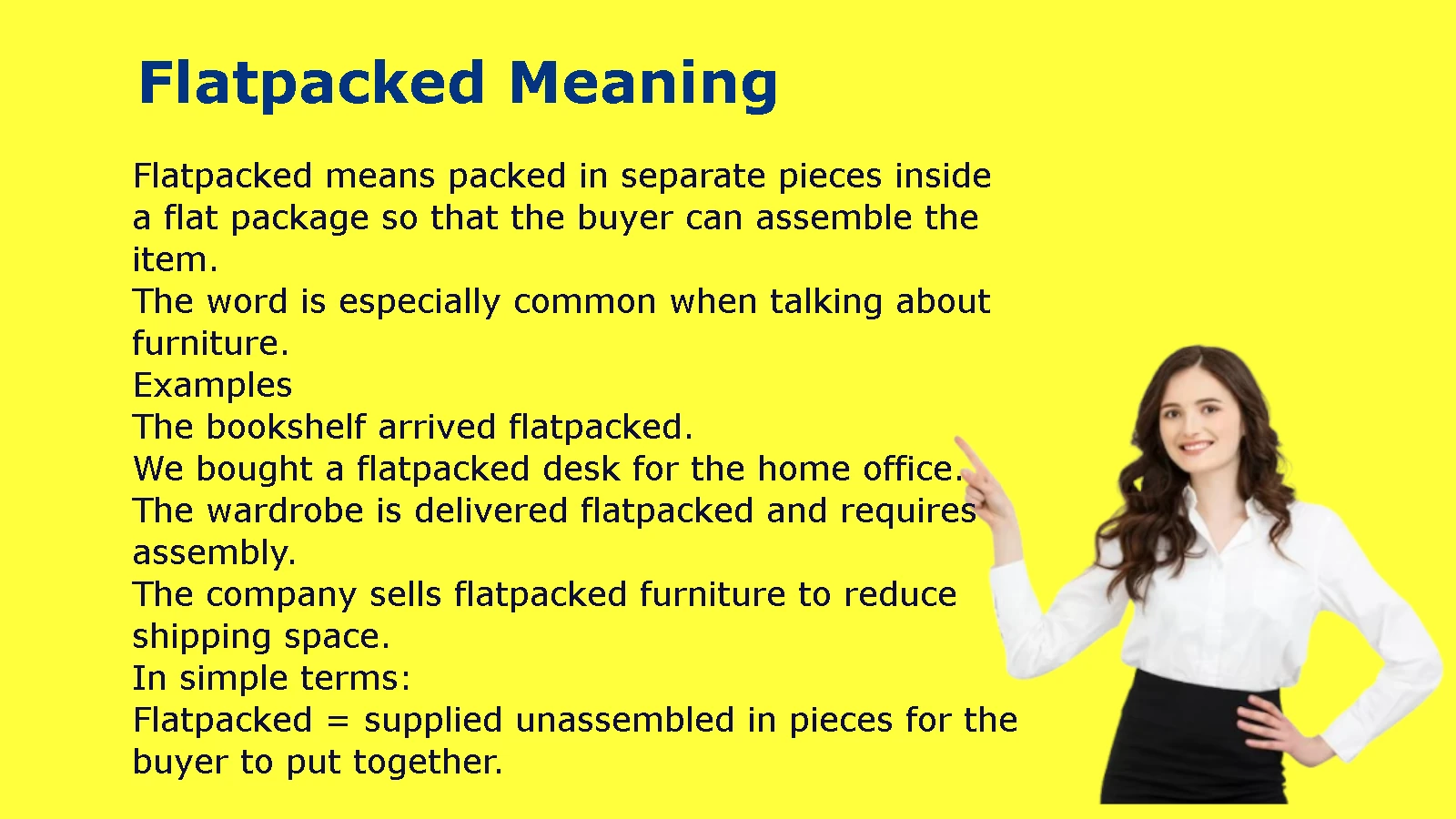
Flatpacked means packed in separate pieces inside a flat package so that the buyer can assemble the item.
The word is especially common when talking about furniture.
Examples
- The bookshelf arrived flatpacked.
- We bought a flatpacked desk for the home office.
- The wardrobe is delivered flatpacked and requires assembly.
- The company sells flatpacked furniture to reduce shipping space.
In simple terms:
Flatpacked = supplied unassembled in pieces for the buyer to put together.
The underlying noun flat pack refers to an item, particularly furniture, sold as separate pieces in a flat box for the customer to assemble. Cambridge gives this meaning for flatpack, while Oxford describes a flat-pack as furniture sold in pieces in a flat box that you have to build yourself.
What Does Flatpacked Mean?
Flatpacked is an adjective that describes something supplied in pieces rather than already assembled.
The individual components are generally arranged and packaged together in a flat or relatively compact box. The customer then follows assembly instructions to turn those separate components into the finished product.
This arrangement is particularly common in furniture retail.
A flatpacked desk, for example, may arrive with:
- A desktop
- Legs or supports
- Screws and other fasteners
- Connecting pieces
- Assembly hardware
- Instructions
The finished desk exists as a complete product in design, but it is not physically assembled when delivered.
Collins specifically defines flat-packed as an adjective for furniture, equipment, or other construction supplied in pieces packed into a flat box for assembly by the buyer.
Simple definition
| Term | Meaning |
| Flatpacked | Supplied in pieces for the buyer to assemble |
| Flat-packed | Same basic meaning; hyphenated adjective |
| Flat pack | A package or product supplied in pieces for assembly |
| Flat-pack | Often used as an adjective before a noun |
| Assembled | Already put together |
| Ready-to-assemble | Designed to be assembled by the customer |
The important idea is self-assembly.
If something is described as flatpacked, you should generally expect to receive its components rather than a fully built item.
Is Flatpacked a Real Word?
Yes. Flatpacked is an established English form, although flat-packed is also widely used, particularly in British English.
Collins lists flat-packed as an adjective and defines it in relation to furniture, equipment, and other constructions supplied in pieces for assembly by the buyer.
The base expression flat pack is also established in major dictionaries. Cambridge defines flatpack as furniture sold in pieces inside a flat box and ready for the buyer to put together.
That means flatpacked is not simply a random combination of the words flat and packed. It belongs to a recognized group of terms associated with products designed for transportation and customer assembly.
Is flatpacked the same as flat-packed?
For most ordinary uses, yes.
The main difference is spelling rather than meaning.
You may see:
- flatpacked furniture
- flat-packed furniture
- flat-pack furniture
- flat pack furniture
However, these forms do not all perform exactly the same grammatical job.
Flatpacked vs. Flat-Packed vs. Flat Pack
The spelling becomes easier to understand when you separate the adjective from the noun.
Flatpacked
Flatpacked functions as an adjective.
It describes something that has been supplied in separate pieces for assembly.
Example:
The cabinet arrived flatpacked.
Here, flatpacked tells us the condition or form in which the cabinet arrived.
Flat-packed
Flat-packed has essentially the same meaning as flatpacked when used as an adjective.
Example:
We ordered a flat-packed wardrobe.
The hyphen connects the two parts of the compound adjective.
Collins specifically lists flat-packed as an adjective meaning supplied in pieces packed into a flat box for assembly by the buyer.
Flat pack
Flat pack is commonly used as a noun.
It can refer to the package or the furniture supplied in that form.
Example:
The bookcase arrived as a flat pack.
Cambridge defines flatpack as a piece of furniture sold in pieces inside a flat box and ready for the buyer to assemble.
Collins similarly defines flat pack as furniture or another construction supplied in pieces and assembled by the buyer.
Flat-pack
Flat-pack is commonly used as an adjective before another noun.
Example:
We bought a flat-pack bookcase.
Oxford lists flat-pack as a noun and gives examples such as flat-pack bookcase and furniture sold for self-assembly.
Comparison table
| Form | Typical role | Example |
| flatpacked | Adjective | The table arrived flatpacked. |
| flat-packed | Adjective | The table arrived flat-packed. |
| flat pack | Noun | The table came as a flat pack. |
| flatpack | Noun/adjective in some dictionaries | The flatpack arrived today. |
| flat-pack | Adjective or noun | We bought a flat-pack table. |
The exact preferred spelling can vary by dictionary, style guide, publisher, and variety of English. The meaning remains essentially the same when the term describes an item supplied in pieces for assembly.
What Does Flatpacked Mean in Furniture?
In furniture, flatpacked means the furniture is delivered as separate components that the customer assembles.
This approach is common with products that can be efficiently broken down into boards, panels, frames, legs, shelves, and hardware.
For example, a flatpacked wardrobe may contain:
- Side panels
- A back panel
- Doors
- Shelves
- Hinges
- Screws
- Dowels
- Handles
- Assembly instructions
The customer assembles those pieces to create the finished wardrobe.
Flatpacked Furniture
Flatpacked furniture is often designed specifically around the requirements of shipping and assembly.
Manufacturers can produce panels and components that fit into a compact package. Retailers can then store and transport the product without having to handle a fully assembled piece of furniture.
This is why the term appears frequently in descriptions of:
- Bookcases
- Desks
- Dining tables
- Wardrobes
- Cabinets
- Shelving units
- Bed frames
- TV stands
- Storage units
- Office furniture
A Cambridge dictionary entry uses furniture as the central example of the flatpack concept, describing furniture sold in pieces inside a flat box for the buyer to put together.
Flatpacked Desks and Tables
A flatpacked desk is delivered in pieces rather than as a completed desk.
The package might contain the desktop, legs, brackets, screws, and other components. Assembly is required before the desk can be used normally.
For example:
I ordered a flatpacked desk for my new office.
This sentence tells the reader that the desk will need to be assembled.
Flatpacked Cabinets and Shelves
Cabinets and shelving units are particularly suitable for flat-pack construction because many of their components consist of relatively flat boards or panels.
A product description might say:
This flatpacked cabinet includes all hardware and assembly instructions.
Here, flatpacked describes how the cabinet is supplied rather than describing its final appearance.
Flatpacked Beds and Other Furniture
Bed frames, wardrobes, tables, chairs, and storage furniture can also be supplied in flat-packed form.
The key feature is not the type of furniture. It is the way the product is packaged and delivered.
A flatpacked bed is not necessarily a different kind of bed once assembled. The term describes its delivery and assembly format.
How Is Flatpacked Used in a Sentence?
The word usually appears after a linking verb such as arrive, come, or be, or before a noun as a descriptive adjective.
Flatpacked after a verb
The desk arrived flatpacked.
The wardrobe came flatpacked.
The shelves were delivered flatpacked.
In these sentences, flatpacked describes the state or form in which the products were delivered.
Flatpacked before a noun
We bought a flatpacked desk.
She ordered a flatpacked wardrobe.
They installed a flatpacked kitchen unit.
This construction uses flatpacked as a modifier.
More examples of flatpacked in everyday English
- The table was delivered flatpacked.
- Our new bookcase came flatpacked.
- The company specializes in flatpacked office furniture.
- The cabinet is supplied flatpacked for easy transportation.
- I didn’t realize the wardrobe would arrive flatpacked.
- The retailer sells most of its furniture flatpacked.
- The bed frame was delivered flatpacked in one large box.
- We assembled the flatpacked shelves in the afternoon.
Flatpacked Meaning in Different Contexts
Although furniture is the most familiar context, the word can describe other products or structures that are supplied in pieces for assembly.
Furniture and Home Assembly
This is the most straightforward use.
The dining table is delivered flatpacked.
The buyer receives the components and assembles the table.
Packaging and Transportation
The word can also emphasize the packaging method.
The product is designed to be transported flatpacked.
In this case, the focus is not just on assembly. The sentence highlights the fact that the product can be packaged compactly before being transported.
Product Manufacturing and Retail
Retailers may use the term when describing how a product reaches customers.
For example:
The shelving system is supplied flatpacked with full assembly instructions.
This tells potential buyers that the product is not delivered ready to use.
Construction and Other Structures
The Collins definition is broader than furniture. It includes equipment and other construction supplied in pieces for assembly.
That means flat-packed can sometimes describe larger constructed items when they are designed to be manufactured as components, transported in packages, and assembled at another location.
The central idea remains the same:
components are packaged compactly and assembled later.
What Is Flat-Pack Furniture?
Flat-pack furniture is furniture sold or delivered as separate components that the buyer assembles.
The term is closely related to self-assembly furniture and ready-to-assemble furniture.
Oxford defines a flat-pack as furniture sold in pieces in a flat box that the buyer has to build themselves.
How Flat-Pack Furniture Is Sold
A typical flat-pack product may be sold as one or several boxes containing:
- Main panels
- Smaller components
- Hardware
- Fasteners
- Connectors
- Assembly instructions
The packaging is designed to keep these parts together while making transportation and storage practical.
How Flat-Pack Furniture Is Assembled
The exact process varies by product, but assembly commonly involves:
- Identifying each component
- Checking the hardware
- Following the instruction sequence
- Connecting panels or frames
- Tightening fasteners
- Installing doors, shelves, or legs
- Checking that the finished item is stable
Not every flatpacked item requires the same level of effort. A small shelf may require only a few assembly steps, while a large wardrobe can involve many components.
Why Furniture Is Flat-Packed
There are practical reasons manufacturers and retailers use this format.
Transportation: Separate components can often be packaged more compactly than a fully assembled product.
Storage: Flat boxes can be easier to stack and organize in warehouses and retail environments.
Handling: A customer may find a boxed collection of components easier to move through a doorway than a fully assembled wardrobe.
Retail distribution: Products can be sold in standardized packages rather than requiring every item to remain assembled.
These are practical characteristics of the flat-pack model, not part of the dictionary definition itself.
Flatpacked vs. Ready-to-Assemble
Both are closely related, but they emphasize slightly different things.
Flatpacked focuses on the packaging and delivery format.
Ready-to-assemble focuses on the fact that the product is supplied for customer assembly.
For example:
The bookcase is flatpacked.
This emphasizes that it is supplied in pieces in a compact package.
The bookcase is ready-to-assemble.
This emphasizes that the customer is expected to put it together.
A product can reasonably be described using both expressions:
The company sells flatpacked, ready-to-assemble furniture.
Flatpacked vs. Assembled
These terms describe opposite stages of a product’s delivery or setup.
| Flatpacked | Assembled |
| Supplied in separate pieces | Already put together |
| Requires assembly | Usually ready to use |
| Components are packaged together | Components have been joined |
| Often shipped in a compact box | Usually takes up its full size |
| Customer may assemble it | Seller or manufacturer may have assembled it |
Consider a desk.
If the box contains a desktop, legs, screws, and instructions, the desk is flatpacked.
Once those components have been connected and the desk is ready for use, it is assembled.
Is Flatpacked One Word or Two?
Flatpacked is written as one word when it is used in that form, but flat-packed is also an established spelling.
This is one reason people encounter several versions of the expression.
You may see:
- flatpacked
- flat-packed
- flat pack
- flat-pack
- flatpack
The correct choice depends partly on the grammatical function.
For example:
The furniture is flat-packed.
Here, the expression functions as an adjective.
The furniture arrived as a flat pack.
Here, flat pack functions as a noun.
We bought flat-pack furniture.
Here, flat-pack modifies furniture.
Cambridge uses flatpack as a noun and also records flatpack as an adjective in its Learner’s Dictionary.
Collins, meanwhile, records flat pack, flat-pack, and flat-packed in related grammatical uses.
Is flatpacked or flat-packed correct?
Both forms can be found, but flat-packed is an especially well-established dictionary form.
If you are writing for a particular publication, follow its style guide consistently.
For general English, flat-packed is a safe choice when you want a clearly recognizable compound adjective.
For example:
The shelves were delivered flat-packed.
You can also encounter:
The shelves were delivered flatpacked.
The meaning is the same.
Is Flatpacked British or American English?
The vocabulary surrounding flat pack is particularly strongly associated with British English.
Cambridge labels flatpack as a UK noun, and Oxford identifies flat-pack as British English.
Collins also labels its definition of flat-packed as British English.
That does not mean American English speakers cannot understand or use the expression. Flat-pack furniture is widely understandable in English, but American product descriptions may more often use terms such as ready-to-assemble furniture.
This creates a useful distinction:
| Expression | Common association |
| Flatpacked / flat-packed | Especially British English |
| Flat pack | Especially British English |
| Flat-pack furniture | Widely understood |
| Ready-to-assemble furniture | Common alternative, especially in American contexts |
| Self-assembly furniture | Common British-style expression |
Common Mistakes With Flatpacked
The word is simple once its grammatical role is clear, but several mistakes are possible.
Confusing Flatpacked With Flat Pack
These forms are related but do different jobs.
Correct:
The wardrobe is flatpacked.
Correct:
The wardrobe arrived as a flat pack.
The first describes the wardrobe’s supplied condition. The second identifies the package or product format.
Using Flatpacked as a Noun
Because flat pack is used as a noun, it can be tempting to use flatpacked the same way.
For standard usage, prefer:
The product arrived as a flat pack.
rather than treating flatpacked as the name of the package.
Confusing Flatpacked With Flat-Pack Furniture
These expressions overlap, but the grammatical structure differs.
The furniture is flatpacked.
Here, flatpacked describes the furniture.
The furniture is flat-pack furniture.
Here, flat-pack modifies furniture.
Both communicate the same general concept, but they are constructed differently.
Assuming Flatpacked Means Poor Quality
Flatpacked does not inherently mean cheap, weak, or low quality.
The term describes how an item is packaged and supplied, not how well it is manufactured.
A flatpacked product can vary considerably in materials, construction, durability, price, and design.
The packaging format alone does not tell you whether a product is high quality.
Synonyms and Related Terms for Flatpacked
There is no perfect synonym for every context, but several related expressions can communicate a similar idea.
Self-Assembly
Self-assembly emphasizes that the buyer puts the product together.
The company sells self-assembly furniture.
Ready-to-Assemble
Ready-to-assemble focuses on the fact that the product is supplied for assembly.
This is ready-to-assemble office furniture.
Knock-Down
Knock-down is used in manufacturing and furniture contexts for products designed to be disassembled or supplied as components.
It can overlap with the flat-pack concept, although the terms are not interchangeable in every situation.
Kit-Form
Kit-form describes something supplied as a collection of components that must be assembled.
This expression can be useful in technical or manufacturing contexts, although it is less direct than flatpacked when discussing ordinary furniture.
Flatpacked Meaning: Examples at a Glance
Here are examples showing how the word works naturally.
| Sentence | What it means |
| The desk arrived flatpacked. | The desk arrived in pieces and needed assembly. |
| We bought a flatpacked wardrobe. | The wardrobe was supplied unassembled. |
| The shelves are delivered flatpacked. | Customers receive separate components. |
| The table came as a flat pack. | The table was supplied as a package of parts. |
| We ordered flat-pack furniture. | The furniture is designed to be assembled by the buyer. |
| The cabinet is ready-to-assemble. | The customer must put the cabinet together. |
| The old cabinet was fully assembled. | The cabinet was already put together. |
A Simple Case Study: Understanding Flatpacked in Context
Imagine that a customer orders a bookcase online.
The product page says:
Flatpacked bookcase. Assembly required.
A buyer who understands flatpacked meaning knows that the bookcase will not arrive as a finished piece.
Instead, the package may contain:
- Wooden or composite panels
- Shelves
- Backing material
- Screws
- Connectors
- Other hardware
- Assembly instructions
The customer opens the package, identifies the parts, and follows the instructions.
After assembly, the bookcase is no longer being described as flatpacked in the ordinary sense. It has become an assembled bookcase.
This example demonstrates why flatpacked describes the supplied form of the product, not necessarily its permanent identity.
Flatpacked vs. Flat Pack: A Quick Grammar Guide
One of the easiest ways to remember the distinction is to ask whether you are describing something or naming the package/product format.
Use flatpacked or flat-packed when describing something
The cabinet was flat-packed.
The cabinet arrived flatpacked.
Use flat pack when referring to the package or product
The cabinet arrived as a flat pack.
Use flat-pack before another noun
We ordered a flat-pack cabinet.
This three-part distinction handles most everyday uses.
Why the Term Matters in Product Descriptions
Understanding flatpacked meaning is especially useful when shopping online.
A product described as flatpacked may require customer assembly. That affects what you should expect when the delivery arrives.
Before buying, check:
- Whether assembly is required
- Whether assembly instructions are included
- Whether tools are required
- How many packages are included
- Whether all hardware is supplied
- The dimensions of the packaged product
- The dimensions of the assembled product
- Whether professional assembly is available
The word flatpacked itself does not tell you how difficult assembly will be.
A small side table and a large wardrobe can both be flatpacked while requiring very different amounts of work.
Frequently Asked Questions About Flatpacked
What does flatpacked mean?
Flatpacked means supplied in separate pieces packed into a flat or compact package for the buyer to assemble. It is especially common when describing furniture.
Is flatpacked one word?
Flatpacked is used as one word, while flat-packed is also an established form. Major dictionaries document the related forms flat-packed, flat-pack, and flat pack.
Is it flatpacked or flat-packed?
Both forms are encountered. Flat-packed is a clearly established dictionary form, particularly in British English. Flatpacked is also used as a single-word form.
What does flatpacked furniture mean?
Flatpacked furniture is furniture supplied in separate pieces that the buyer assembles. A desk, wardrobe, bookcase, cabinet, or bed frame can all be flatpacked.
Is flatpacked the same as flat pack?
They are closely related but have different grammatical functions.
Flatpacked is an adjective describing something supplied in pieces.
Flat pack is generally a noun referring to the package or product supplied in that form.
Is flatpacked the same as ready-to-assemble?
They are closely related but emphasize different features. Flatpacked emphasizes the way the product is packaged, while ready-to-assemble emphasizes that the customer is expected to assemble it.
Is flatpacked the opposite of assembled?
In the context of furniture delivery, they generally describe different stages. A flatpacked item is supplied in pieces, while an assembled item has already been put together.
Does flatpacked mean cheap furniture?
No. Flatpacked describes the packaging and delivery format, not the quality or price of the furniture.
Is flatpacked British English?
The term is particularly associated with British English. Cambridge and Oxford identify flatpack and flat-pack in British English usage, while Collins identifies flat-packed as British English.
What is another word for flatpacked?
Depending on the context, alternatives include self-assembly, ready-to-assemble, kit-form, and sometimes knock-down. None is a perfect replacement in every sentence.
Final Takeaway: Flatpacked Meaning
The simplest definition of flatpacked is:
Supplied in separate pieces, usually in a flat box, for the buyer to assemble.
The term is most commonly associated with furniture, including desks, tables, wardrobes, cabinets, shelves, bookcases, and bed frames.
The related spellings are worth remembering:
- Flatpacked = adjective describing something supplied in pieces
- Flat-packed = established hyphenated adjective with the same basic meaning
- Flat pack = noun for the packaged product or set of components
- Flat-pack = commonly used adjective before a noun
- Ready-to-assemble = related expression emphasizing customer assembly
The biggest mistake is treating these forms as completely unrelated words. They belong to the same vocabulary family, but their grammatical roles differ.
So, if someone says “The wardrobe was delivered flatpacked,” they mean that the wardrobe arrived unassembled, in separate components, ready for the customer to put together.
That is the core flatpacked meaning.