Frazzled describes someone who feels extremely stressed, tired, overwhelmed, or emotionally worn out, often because they have been dealing with too many problems, tasks, or pressures at once. If you’ve come across the word “frazzled” and wondered what it means, how it is used, or why someone might describe themselves as frazzled, the term is closely connected to stress, exhaustion, anxiety, pressure, confusion, overwhelm, and emotional strain.
The frazzled meaning refers to being mentally or emotionally exhausted and unable to deal with things calmly or efficiently. It is commonly used when someone feels stressed out, overwhelmed, flustered, worn out, or rattled after a difficult or demanding situation. The word can describe a person’s emotional state, appearance, or behavior, especially when stress has left them feeling disorganized or drained.
In this guide, you’ll learn what “frazzled” means, how the word is used in sentences, what it means when describing a person, and how “frazzled” differs from related words such as “stressed,” “overwhelmed,” “flustered,” and “exhausted.” You’ll also see clear examples to make the meaning easy to understand.
By the end, you’ll know exactly what frazzled means and how to use this useful word naturally and correctly.
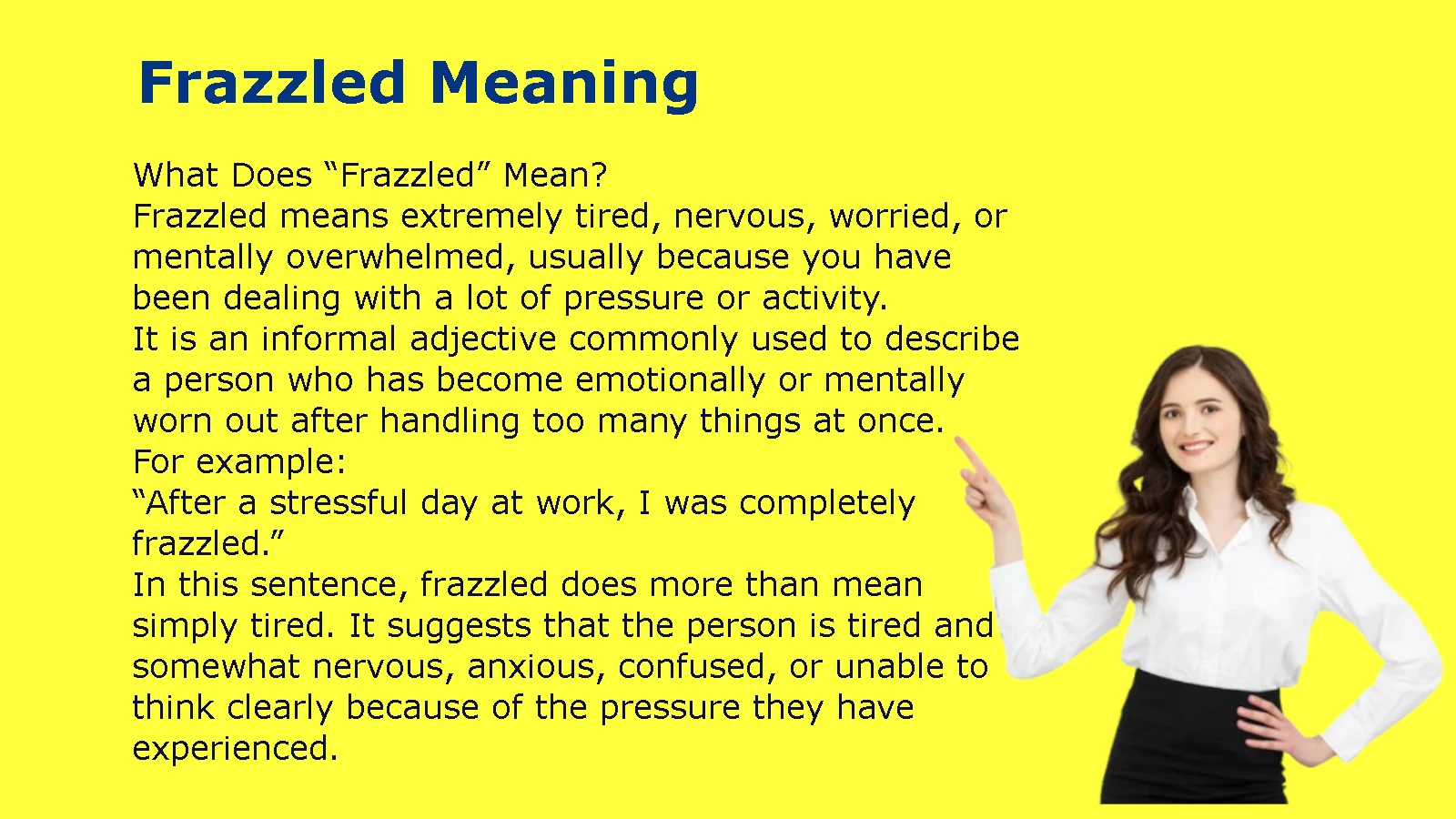
What Does “Frazzled” Mean?
Frazzled means extremely tired, nervous, worried, or mentally overwhelmed, usually because you have been dealing with a lot of pressure or activity.
It is an informal adjective commonly used to describe a person who has become emotionally or mentally worn out after handling too many things at once.
For example:
“After a stressful day at work, I was completely frazzled.”
In this sentence, frazzled does more than mean simply tired. It suggests that the person is tired and somewhat nervous, anxious, confused, or unable to think clearly because of the pressure they have experienced.
Cambridge Dictionary defines the main sense of frazzled as being extremely tired in a nervous or slightly worried way after considerable mental or physical effort. Its American English definition similarly describes someone who is tired and nervous or anxious because they are dealing with too many things at the same time. Cambridge Dictionary
The word can also have a separate informal sense in British English related to something being burned or dried out, particularly through excessive heat.
So, depending on context, frazzled can describe a person’s state of mind or something that has been badly affected by heat.
Frazzled Meaning in English
In everyday English, frazzled usually describes a person who has been pushed to the point of feeling exhausted, nervous, and mentally overloaded.
Imagine someone who has:
- three deadlines on the same day
- several unanswered messages
- a difficult meeting
- a long commute
- little time to rest
- several problems demanding attention at once
You might say that person looks frazzled.
The important idea is accumulated pressure. Someone who is merely sleepy after a short night may be tired, but they are not necessarily frazzled.
Likewise, someone who becomes briefly annoyed may be frustrated without being frazzled.
Simple definition of frazzled
A simple way to understand the word is:
Frazzled = very tired and mentally stressed because of too much pressure, activity, or worry.
Here are a few examples:
- I was frazzled after dealing with customers all afternoon.
- She looked frazzled after rushing to finish the report.
- The children left their mother feeling completely frazzled.
- He became frazzled when several problems appeared at once.
The word is especially natural in conversational English.
What Does Frazzled Mean When Describing a Person?
When frazzled describes a person, it usually suggests a combination of fatigue, nervousness, worry, and mental overload.
For example:
The frazzled manager struggled to answer all the questions.
The manager is not necessarily incompetent or permanently distressed. The sentence simply presents someone who is under considerable pressure at that moment.
That temporary quality is important.
You can be:
- frazzled after a busy morning
- frazzled before an important presentation
- frazzled during exam week
- frazzled after traveling all day
- frazzled while organizing a major event
The condition can disappear once the pressure decreases.
Frazzled person examples
At work:
The receptionist looked frazzled after answering dozens of calls.
At home:
By bedtime, I was completely frazzled after taking care of everything.
At school:
The students were frazzled during the final week of exams.
While traveling:
We arrived at the airport late and already felt frazzled.
In each example, the person has experienced enough activity or pressure to become mentally and physically worn down.
Frazzled Meaning in Different Contexts
The exact shade of meaning can change depending on what surrounds the word.
Frazzled Mind
A frazzled mind is a mind that feels overloaded, tired, distracted, or unable to process things normally because of stress or too much mental activity.
For example:
After six hours of meetings, I had a completely frazzled mind.
The expression does not necessarily indicate a medical problem. In ordinary conversation, it is a casual way of saying that someone feels mentally exhausted.
You might also hear:
- My mind is frazzled.
- I can’t think straight because my mind is frazzled.
- After studying all night, my mind was completely frazzled.
My Brain Is Frazzled Meaning
When someone says “my brain is frazzled,” they usually mean:
I am mentally exhausted, overwhelmed, or having trouble thinking clearly because I have dealt with too much information, stress, or activity.
For example:
My brain is frazzled after trying to understand all these instructions.
This does not normally mean that the brain has literally been damaged.
It is a figurative expression used to communicate mental exhaustion.
Frazzled Nerves Meaning
Frazzled nerves refers to a state in which someone feels tense, nervous, irritated, or emotionally worn out after prolonged pressure.
For example:
The constant noise was getting on my frazzled nerves.
The related verb frazzle can also be used with nerves. Cambridge gives frazzle someone’s nerves as an example of making someone very tired, nervous, or worried. Cambridge Dictionary
The phrase frazzled nerves is especially useful when a person has been under pressure for some time.
Frazzled Meaning in Hair
The phrase “frazzled hair” can create some confusion because frazzled has more than one established sense.
When frazzled is applied to hair, it can describe hair that has become damaged, dried out, or affected by excessive heat.
For example:
Her hair looked frazzled after repeated heat styling.
This use is connected to the verb frazzle, which can mean to damage or dry something out through excessive heat or other harsh conditions. Cambridge lists this as a separate sense of frazzle. Cambridge Dictionary
However, don’t automatically confuse frazzled with frizzled.
Frazzled vs. frizzled hair
Frizzled can specifically describe hair that is very dry, curly, and not smooth or shiny. Cambridge treats frizzled as a separate word. Cambridge Dictionary
| Word | Typical meaning |
| Frazzled | Damaged or dried out, especially from excessive heat; also mentally exhausted when describing a person |
| Frizzled | Very dry, curly, or rough-looking hair; can also describe food or plants affected by heat |
So, if you are talking about someone’s emotional state, frazzled is the natural choice:
She felt frazzled after a difficult day.
If you are describing very dry, curly hair, frizzled may be the more precise word.
Frazzled Synonyms
There is no single synonym that matches frazzled perfectly in every context. The best choice depends on whether you want to emphasize tiredness, anxiety, confusion, pressure, or irritation.
Common frazzled synonyms include:
- stressed
- overwhelmed
- exhausted
- tired
- worried
- anxious
- flustered
- agitated
- drained
- worn out
- mentally exhausted
- overburdened
Frazzled vs. stressed
Stressed is broader than frazzled.
You can be stressed about an upcoming examination, financial problem, job interview, or difficult conversation without necessarily being exhausted.
Frazzled often combines stress with fatigue and mental overload.
| Word | Main emphasis |
| Stressed | Pressure or tension |
| Frazzled | Stress plus tiredness, nervousness, or mental overload |
| Exhausted | Extreme tiredness |
| Flustered | Confusion or nervous agitation |
| Overwhelmed | Feeling unable to handle everything |
| Anxious | Worry or apprehension |
Consider these examples:
I am stressed about tomorrow’s exam.
This focuses on worry or pressure.
I have been studying all night, and now I am completely frazzled.
This suggests that the pressure has combined with exhaustion and mental overload.
Frazzled vs. Flustered
Frazzled and flustered are related, but they are not identical.
Someone who is flustered is usually confused, nervous, embarrassed, or agitated, especially because something unexpected has happened.
Someone who is frazzled is generally worn down by accumulated stress, effort, or too many demands.
Compare these examples
I got flustered when everyone started asking questions.
The sudden situation caused confusion or nervousness.
I was frazzled after answering questions for eight hours.
The emphasis is on prolonged effort and exhaustion.
A person can also be both flustered and frazzled.
For example:
After a long day of problems, she was so frazzled that the unexpected question left her flustered.
Frazzled vs. Overwhelmed
Overwhelmed means feeling that something is too much to handle.
Frazzled often describes what you feel after that pressure has worn you down.
For example:
I feel overwhelmed by everything I need to finish.
This focuses on the amount of work or responsibility.
I have been dealing with this all week, and now I am completely frazzled.
This focuses more on the resulting exhaustion and nervous strain.
The words overlap, so they can sometimes be substituted for one another. However, frazzled has a more informal and conversational flavor.
How to Use “Frazzled” in a Sentence
Frazzled works naturally as an adjective before a noun or after a linking verb such as feel, look, seem, or become.
Before a noun
- The frazzled employee asked for a short break.
- A frazzled parent tried to calm the children.
- The frazzled traveler searched for the correct gate.
- The frazzled student forgot where he had placed his notes.
After a linking verb
- I feel frazzled today.
- She looked frazzled after the meeting.
- He seemed frazzled by the constant interruptions.
- We became frazzled after hours of waiting.
With “completely”
The phrase completely frazzled is common because it emphasizes the extent of the person’s exhaustion or nervousness.
By the end of the week, I was completely frazzled.
With “a little” or “a bit”
These expressions soften the description:
I’m a little frazzled today.
She seemed a bit frazzled after the interview.
This can make the statement sound less dramatic and more conversational.
Examples of “Frazzled” in Everyday English
Here are natural examples across different situations.
Work
The team was frazzled after working through several urgent problems.
School
I was so frazzled during finals week that I forgot my calculator.
Parenting
After getting three children ready for school, she felt completely frazzled.
Travel
The delayed flight and missed connection left us frazzled.
Technology
After trying to fix the computer for two hours, I was completely frazzled.
Social situations
He looked frazzled after hosting a large dinner party.
Customer service
The customer-service representative sounded frazzled after dealing with complaints all morning.
Daily responsibilities
Between work, errands, and appointments, I have been feeling frazzled lately.
These examples show why frazzled is particularly useful in everyday English. It captures a combination of pressure + tiredness + nervous strain in one word.
Is “Frazzled” a Positive or Negative Word?
Frazzled is generally negative or sympathetic in tone, because it describes an unpleasant state of stress, nervousness, exhaustion, or mental overload.
However, the word is often used lightly or humorously.
For example:
I was a complete mess this morning. My brain was totally frazzled.
The speaker may not be describing a serious situation. They may simply be joking about forgetting their keys or making several small mistakes.
That makes frazzled more flexible than strongly negative words associated with severe emotional distress.
The surrounding context determines how serious the statement sounds.
Is Frazzled an Adjective?
Yes. Frazzled is commonly used as an adjective.
It describes the condition or state of a person or, in another sense, something affected by heat.
Examples:
- a frazzled worker
- a frazzled parent
- a frazzled student
- a frazzled mind
- frazzled nerves
- frazzled hair
Grammatically, frazzled is also the past participle of the verb frazzle.
Frazzle as a verb
Frazzle can mean to make someone extremely tired, nervous, or worried.
The constant interruptions frazzled me.
It can also describe becoming mentally worn out:
I was beginning to frazzle under the pressure.
The word has a separate heat-related verb sense as well, referring to something becoming burned or dried out.
Frazzle vs. Frazzled
The relationship is straightforward:
Frazzle = the base verb or noun.
Frazzled = the past-tense/past-participle form and a common adjective.
Frazzling = the present participle.
| Form | Example |
| Frazzle | The constant delays frazzle me. |
| Frazzled | I feel frazzled after the delays. |
| Frazzling | The constant interruptions are frazzling me. |
As a noun, frazzle can refer to a state of extreme tiredness or nervous exhaustion.
One established expression is:
wear yourself to a frazzle
This means to make yourself extremely tired and nervous through too much effort. Cambridge Dictionary lists frazzle as both a noun and a verb and gives this expression as an example. Cambridge Dictionary
What Does “Worn to a Frazzle” Mean?
Worn to a frazzle means extremely tired, nervous, or exhausted because of sustained effort or pressure.
For example:
She was worn to a frazzle after preparing for the conference.
The phrase emphasizes the result of prolonged effort.
It is similar to:
- completely exhausted
- worn out
- drained
- mentally exhausted
- at the end of one’s energy
The expression comes from the noun frazzle, which refers to a state of extreme tiredness or nervous exhaustion.
Frazzled Pronunciation
The standard pronunciation of frazzled is represented by Cambridge as:
/ˈfræz.əld/
The first syllable receives the primary stress. The word contains two syllables.
Cambridge provides separate UK and US pronunciation information for the word. Cambridge Dictionary
A useful point for learners is that the ending is pronounced as a syllable rather than simply treating the word as frazzle + d with no change in rhythm.
Common pronunciation mistake
Some learners may pronounce the first vowel as though it were the vowel in words such as face. That is not the standard pronunciation.
The beginning of frazzled uses the vowel sound represented by /æ/ in the IPA transcription.
Origin and Etymology of “Frazzled”
The history of frazzled is particularly interesting because its original meaning was connected with fraying or unraveling.
The Online Etymology Dictionary traces frazzle to around 1825, when it was used in the sense of “to unravel” in connection with clothing. It connects the word with an East Anglian variant of fasel, meaning to unravel or fray, and ultimately with Middle English and Old English words associated with fringes, fibers, or borders. Online Etymology Dictionary
The noun sense referring to a worn-out condition appeared in American English around 1865, according to the same source.
That development helps explain the modern figurative sense.
Something that becomes frayed or worn can be described as being physically deteriorated. The word later developed a figurative association with people who are similarly worn down by pressure or effort.
This is why frazzled is such a vivid word: it suggests a person who feels as though their mental or emotional resources have been stretched too far.
Frazzled Meaning in Farsi, French, and Russian
Translations of frazzled vary because the English word combines several ideas: tiredness, nervousness, worry, and mental overload.
Frazzled meaning in Farsi
Depending on context, possible Persian equivalents can express ideas such as:
- خسته و کلافه
- آشفته و خسته
- کلافه
- مضطرب و خسته
For example, “I feel frazzled” could be translated in a way that conveys being both tired and mentally overwhelmed, rather than simply being physically tired.
Frazzled meaning in French
Possible French translations depend on the context and can include expressions such as:
- épuisé
- stressé
- à bout
- nerveux et épuisé
The best translation depends on whether the original sentence emphasizes exhaustion, anxiety, or being overwhelmed.
Frazzled meaning in Russian
Depending on context, Russian translations may use expressions conveying:
- измученный
- измотанный
- встревоженный
- нервный
- измученный и нервный
A direct one-word translation does not always preserve the full meaning of frazzled, so context matters.
Common Phrases With “Frazzled”
Several combinations occur naturally in English.
| Phrase | Meaning |
| feeling frazzled | Feeling stressed, tired, and mentally overloaded |
| completely frazzled | Extremely stressed or exhausted |
| a frazzled parent | A parent worn down by responsibilities |
| frazzled nerves | Nervousness or emotional strain caused by pressure |
| a frazzled mind | A mentally tired or overloaded mind |
| my brain is frazzled | I am mentally exhausted or struggling to think clearly |
| frazzled hair | Hair that has become damaged or dried out |
| worn to a frazzle | Extremely tired or nervous after sustained effort |
These phrases help reveal an important feature of the word: frazzled is highly contextual.
The meaning changes slightly depending on whether it modifies a person, mind, nerves, hair, or another object.
Common Mistakes When Using “Frazzled”
Confusing frazzled with frustrated
These words sound somewhat similar, but their meanings differ.
Frustrated means annoyed or upset because something is difficult, blocked, delayed, or not going as expected.
Frazzled emphasizes tiredness and nervous or mental strain caused by too much pressure or activity.
I was frustrated because the website would not load.
After fixing the website for five hours, I was completely frazzled.
A person can certainly be both.
Assuming frazzled only means tired
This misses an important part of the word.
Frazzled usually carries a sense of nervousness, worry, pressure, or mental overload along with tiredness.
Calling someone merely tired does not necessarily suggest the same emotional strain.
Confusing frazzled with frizzled
This is particularly common when talking about hair.
Frazzled can describe hair that is damaged or dried out, particularly by heat.
Frizzled is a different word and can describe hair that is very dry, curly, and not smooth or shiny. Cambridge Dictionary
Assuming frazzled always describes people
It commonly describes people, but the word also has a heat-related sense.
For example:
The meat was completely frazzled after being left in the heat.
This is different from:
The cook was completely frazzled after preparing the meal.
The first describes physical damage from heat. The second describes a person’s mental and physical state.
Real-World Context: How “Frazzled” Works in Conversation
Consider this short situation.
A project manager has spent the entire morning answering emails. In the afternoon, two deadlines change, a client calls with a complaint, and a team member asks for urgent help.
At 6 p.m., someone asks:
“How are you doing?”
The manager replies:
“Honestly, I’m frazzled.”
That answer communicates more than “I’m tired.”
It suggests:
- the person has had too much to deal with
- the pressure has continued for some time
- they feel mentally worn down
- they may be nervous or irritable
- they need a break or some relief
This is why frazzled is useful in everyday speech. One word captures a whole cluster of related feelings.
Case Study: Frazzled vs. Tired in a Sentence
Imagine two employees finish a long shift.
Employee A
I am tired.
This tells us that Employee A has low energy.
Employee B
I am frazzled.
This suggests more than low energy. Employee B may have dealt with constant interruptions, difficult customers, deadlines, mistakes, and pressure.
The difference can be summarized like this:
| Expression | What it tells the listener |
| I’m tired. | I have low energy. |
| I’m stressed. | I’m under pressure. |
| I’m overwhelmed. | There is too much to handle. |
| I’m flustered. | I’m nervous or confused. |
| I’m frazzled. | I’m worn down by pressure and mental or emotional strain. |
The boundaries overlap, but frazzled often combines several of these ideas.
Is “Frazzled” Formal or Informal?
Frazzled is generally informal.
It is very natural in:
- conversations
- text messages
- personal emails
- blogs
- interviews
- everyday workplace conversations
- informal writing
For highly formal academic or legal writing, alternatives such as exhausted, distressed, overwhelmed, or under considerable pressure may sometimes be more appropriate, depending on the intended meaning.
Compare:
I was completely frazzled after the meeting.
This sounds natural and conversational.
A more formal version might be:
I felt considerably overwhelmed after the meeting.
Neither is automatically better. The appropriate choice depends on audience and tone.
When Should You Use “Frazzled”?
Use frazzled when you want to communicate that someone has become mentally or emotionally worn down by pressure, activity, worry, or too many demands.
It works particularly well when:
- several things happen at once
- someone has been busy for a long time
- pressure is causing exhaustion
- someone feels nervous and tired
- someone has trouble thinking clearly after too much activity
A useful test
Ask yourself:
Is this person not only tired but also mentally or emotionally strained by everything happening around them?
If the answer is yes, frazzled may be a good choice.
Quick Comparison of Related Words
| Word | Core meaning | Example |
| Frazzled | Tired, nervous, and mentally overloaded | I was frazzled after the hectic day. |
| Stressed | Under pressure or tension | I’m stressed about the deadline. |
| Overwhelmed | Feeling unable to manage everything | I’m overwhelmed by the workload. |
| Flustered | Nervous or confused | She became flustered by the unexpected question. |
| Exhausted | Extremely tired | I was exhausted after the trip. |
| Frustrated | Annoyed because something is difficult or blocked | He was frustrated by the delay. |
| Anxious | Worried or apprehensive | She felt anxious before the interview. |
| Drained | Having very little energy left | The long meeting left me drained. |
The table shows why replacing frazzled with any single synonym can slightly change the meaning.
Facts to Remember About “Frazzled”
Here are the key points to remember:
- Frazzled is an adjective.
- It commonly describes someone who is very tired and nervous or mentally overloaded.
- The word is generally informal.
- It often suggests more than ordinary tiredness.
- Frazzled can describe a temporary state caused by pressure or excessive activity.
- My brain is frazzled means that someone feels mentally exhausted or overloaded.
- Frazzled nerves refers to nerves worn down by stress or pressure.
- Frazzled hair can refer to hair damaged or dried out by heat.
- Frizzled is a separate word and should not automatically be substituted for frazzled.
- The verb form is frazzle.
- The noun frazzle can describe a state of extreme tiredness or nervous exhaustion.
- The word’s history is connected with the idea of fraying or unraveling.
- The modern emotional sense developed from the idea of being worn down.
Frequently Asked Questions About Frazzled Meaning
What does frazzled mean in simple words?
Frazzled means very tired, stressed, nervous, or mentally overwhelmed because you have been dealing with too much pressure or activity.
For example:
I’m frazzled after dealing with problems all day.
What is another word for frazzled?
Depending on context, possible synonyms include stressed, overwhelmed, exhausted, flustered, drained, worn out, anxious, and agitated.
However, these words are not exact substitutes in every sentence.
Does frazzled mean stressed?
Yes, but it usually suggests more than stress alone.
Someone who is frazzled is often both stressed and tired, with an additional sense of nervousness or mental overload.
What does “my brain is frazzled” mean?
It means “I am mentally exhausted or overwhelmed, and I am having trouble thinking clearly.”
It is normally a figurative expression rather than a literal statement about physical brain damage.
What does “frazzled nerves” mean?
Frazzled nerves means nerves that are worn down by stress, worry, pressure, or prolonged difficult circumstances.
What does frazzled hair mean?
Frazzled hair can describe hair that has become damaged or dried out, particularly because of excessive heat.
Do not automatically confuse this with frizzled hair, which is a separate expression associated with very dry, curly, or non-smooth hair.
Is frazzled a negative word?
Usually, yes. It describes an unpleasant state of exhaustion, nervousness, or mental strain.
However, people often use it casually or humorously to describe ordinary hectic situations.
Is frazzled an adjective?
Yes. Frazzled is commonly used as an adjective.
Examples include:
- a frazzled worker
- a frazzled parent
- a frazzled student
- a frazzled mind
- frazzled nerves
It is also the past-tense and past-participle form of frazzle.
How do you pronounce frazzled?
Cambridge gives the pronunciation /ˈfræz.əld/ for frazzled, with the main stress on the first syllable. Cambridge Dictionary
What is the difference between frazzled and overwhelmed?
Overwhelmed emphasizes feeling that there is too much to handle. Frazzled often emphasizes the resulting tiredness, nervousness, and mental strain.
What is the difference between frazzled and frustrated?
Frustrated means annoyed because something is difficult, delayed, blocked, or not working as expected. Frazzled means worn down by pressure, activity, worry, or mental overload.
Is frazzled a slang word?
No. Frazzled is an established English word, although its everyday use is informal. Major dictionaries, including Cambridge, recognize it as an adjective with established meanings.
Conclusion: Frazzled Meaning Explained
The simplest frazzled meaning is extremely tired, nervous, and mentally overwhelmed after dealing with a lot of pressure, effort, or activity.
The word is stronger and more expressive than simply saying tired. It often suggests that several pressures have accumulated until a person feels mentally worn down.
For example:
After a week of deadlines, meetings, and constant interruptions, I was completely frazzled.
The word can also have a physical meaning related to something being burned or dried out, especially in British informal usage. That sense explains expressions involving things such as heat-damaged material or hair.
Remember these distinctions:
- Frazzled = tired + nervous + mentally overloaded
- Stressed = under pressure
- Overwhelmed = unable to manage everything
- Flustered = nervous or confused
- Exhausted = extremely tired
- Frustrated = annoyed because something is difficult or blocked
Once you understand these differences, frazzled becomes a useful word for describing the very common experience of feeling like you’ve simply had too much to deal with.