Have you ever written “waver” or “waiver” and stopped to wonder which word is correct? While Waver or Waiver may look and sound similar, these two words have very different meanings and uses. Choosing the wrong one can easily change the meaning of your sentence.
Waver is a verb that means to become uncertain, hesitate, or lose firmness. Waiver, on the other hand, is a noun that refers to an official document or statement that gives up a right, claim, or requirement.
Examples:
- Her confidence began to waver before the big presentation.
- You must sign a waiver before joining the activity.
The confusion is understandable. People often search for waver vs waiver, waver or waiver difference, waiver meaning, or waver meaning because the words sound almost identical. And here’s the kicker: one extra i can turn a word about hesitation into a legal document.
In this guide, you’ll learn the complete difference between waver and waiver, including their meanings, definitions, pronunciations, parts of speech, and correct usage. You’ll also see clear examples of waver and waiver in sentences, so you can choose the right word with confidence.
Waver vs. Waiver at a Glance
The quickest way to understand waver or waiver is to compare the words side by side.
| Word | Part of Speech | Main Meaning | Example |
| Waver | Verb | To hesitate, become uncertain, weaken, or move unsteadily | Her determination began to waver. |
| Waiver | Noun | The act or document involving the voluntary giving up of a right, claim, or requirement | He signed a waiver before the event. |
| Waive | Verb | To give up a right or choose not to enforce a rule or charge | The company agreed to waive the fee. |
| Wave | Verb/Noun | To move back and forth, especially as a greeting | She waved goodbye. |
Here’s the simplest rule:
Waver means hesitate or become unsteady. Waiver means giving up a right, requirement, claim, or privilege.
Cambridge Dictionary defines waver as losing strength, determination, or purpose and also uses it for difficulty choosing between possibilities. Merriam Webster similarly defines it in terms of vacillating, swaying, flickering, or faltering.
By contrast, Merriam Webster defines waiver as the intentional relinquishment or abandonment of a known right, claim, or privilege. It also uses the word for the legal instrument that records such an act.
What Does Waver Mean?
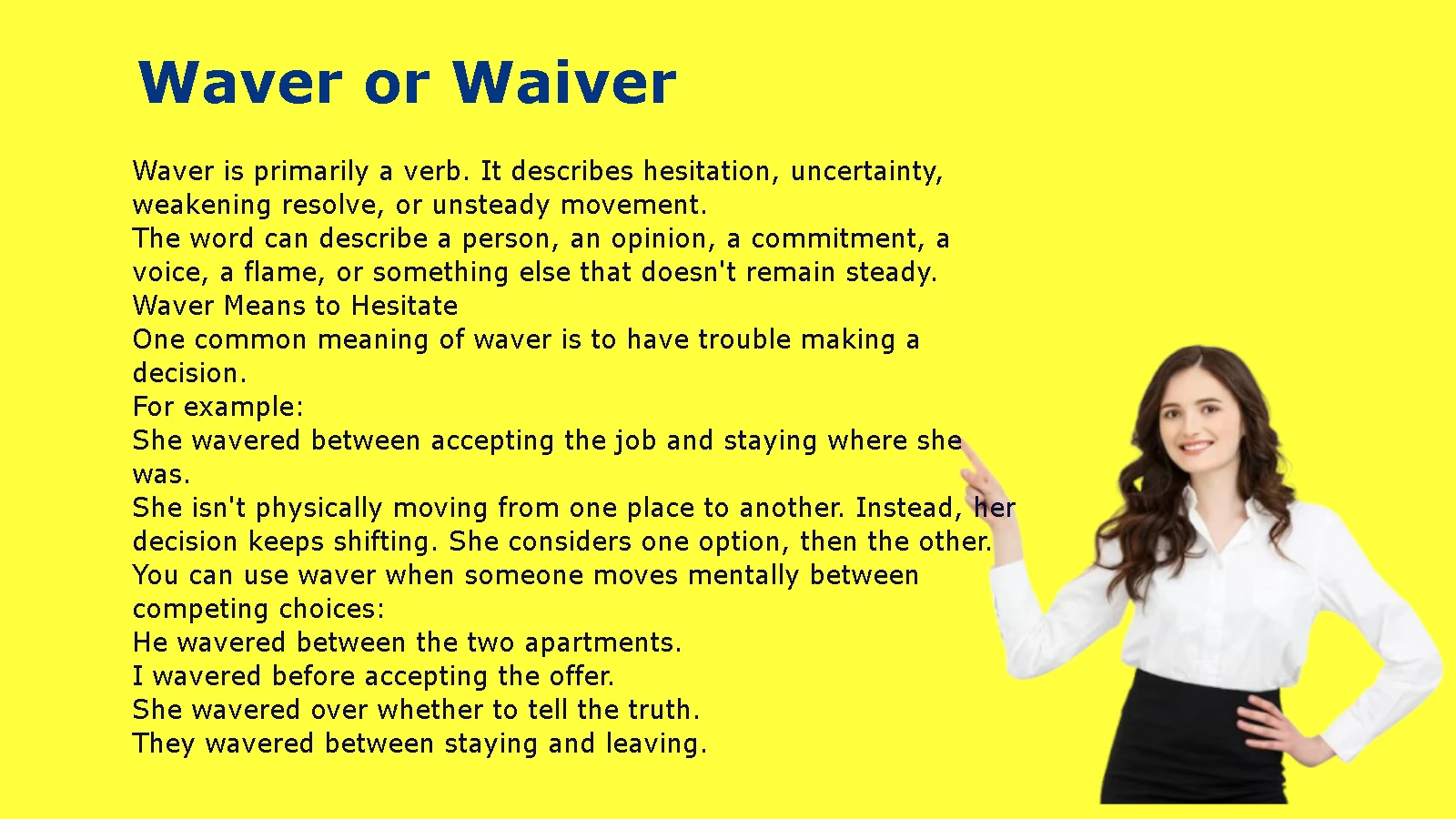
Waver is primarily a verb. It describes hesitation, uncertainty, weakening resolve, or unsteady movement.
The word can describe a person, an opinion, a commitment, a voice, a flame, or something else that doesn’t remain steady.
Waver Means to Hesitate
One common meaning of waver is to have trouble making a decision.
For example:
She wavered between accepting the job and staying where she was.
She isn’t physically moving from one place to another. Instead, her decision keeps shifting. She considers one option, then the other.
You can use waver when someone moves mentally between competing choices:
- He wavered between the two apartments.
- I wavered before accepting the offer.
- She wavered over whether to tell the truth.
- They wavered between staying and leaving.
A particularly common structure is waver between:
waver between A and B
For example:
He wavered between buying the car and saving the money.
This construction is useful because it captures the idea of going back and forth between possibilities. Cambridge specifically describes waver between as being unable to decide which possibility to choose or repeatedly shifting from one choice to another.
Waver Means to Lose Confidence or Determination
Waver can also describe a weakening belief, commitment, purpose, or resolve.
For example:
Her confidence began to waver after several unsuccessful attempts.
The confidence hasn’t necessarily disappeared. It has simply become weaker.
Other examples include:
- His determination never wavered.
- Their support began to waver.
- Her commitment to the project did not waver.
- His faith in the plan started to waver.
- The team’s resolve wavered under pressure.
This meaning often appears with abstract nouns such as confidence, commitment, support, faith, resolve, determination, belief, and purpose.
Waver Means to Move Unsteadily
The word can also describe physical movement.
A flame can waver. A person’s voice can waver. Something hanging in the air can move irregularly from side to side.
For example:
The candle flame wavered in the breeze.
Here, wavered doesn’t mean the candle was undecided. It describes the flame’s unstable movement.
Merriam Webster includes meanings involving swaying, quivering, flickering, and giving an unsteady sound.
You might therefore see sentences such as:
- The candle flame wavered in the wind.
- His voice wavered as he delivered the news.
- The light wavered across the wall.
- The flag wavered in the distance.
- Her hands wavered as she opened the letter.
The underlying idea stays consistent: something isn’t steady.
What Does Waiver Mean?
Waiver is a noun. It relates to the voluntary giving up of a right, claim, privilege, requirement, or similar entitlement.
It can describe the act itself or the document that records the act.
Merriam Webster gives two closely connected meanings: the intentional abandonment of a known right, claim, or privilege and the legal instrument that evidences that act.
Waiver as an Agreement
In everyday situations, a waiver often refers to an agreement that says a person accepts certain conditions or gives up a particular right.
For example:
Everyone had to sign a waiver before participating in the activity.
The document might explain risks, limitations, responsibilities, or rights that the participant agrees to relinquish.
Other examples include:
- The gym requires members to sign a waiver.
- Participants completed a waiver before the race.
- The organization provided a liability waiver.
- Visitors must sign a safety waiver.
- The applicant requested a waiver of the requirement.
A waiver isn’t necessarily a single type of legal document. Its exact purpose depends on the context and the right or requirement involved.
Waiver as the Act of Giving Something Up
A waiver doesn’t always mean a piece of paper.
It can refer to the act of intentionally giving up a right, claim, or privilege.
For example:
The defendant’s waiver of a jury trial became part of the legal record.
Here, waiver describes the decision or act of giving up the right rather than simply naming a physical document.
This distinction matters in formal writing. A waiver can be an agreement or document, but the word can also describe the underlying legal act.
Fee Waiver
One of the most common everyday uses of waiver involves fees.
A fee waiver means a fee that someone does not have to pay because an authorized person or organization has agreed to remove it.
Examples include:
- application fee waiver
- tuition fee waiver
- late fee waiver
- registration fee waiver
- admission fee waiver
For example:
The university granted her an application fee waiver.
The university didn’t merely give her a discount. It removed the requirement to pay that particular fee.
Cambridge gives fee waivers as an example of the broader use of waiver for an official decision or arrangement that removes an otherwise applicable requirement.
Waver or Waiver: The Main Difference
The difference becomes much clearer when you focus on what the word does in a sentence.
Waver describes instability.
Waiver describes relinquishment.
Think of it this way:
Waver = go back and forth.
Waiver = give something up.
Examples Compared
| Waver | Waiver |
| Her confidence began to waver. | She signed a waiver. |
| He wavered between the two choices. | The school granted a fee waiver. |
| His resolve never wavered. | They requested a waiver of the requirement. |
| Her voice wavered during the speech. | Every participant signed a liability waiver. |
| The flame wavered in the wind. | The organization approved the waiver. |
Notice the grammatical difference, too.
You can say:
- She wavered.
- His confidence wavered.
- They signed a waiver.
- The company approved the waiver.
You cannot normally replace one with the other without changing the meaning.
Waver or Waiver in a Sentence?
Choosing the correct word becomes simple when you identify the idea you want to express.
Use Waver When Someone Hesitates
Use waver when a person can’t settle on a decision.
She wavered between accepting the promotion and staying in her current role.
Use Waver When Confidence Weakens
Use waver when determination, confidence, support, or belief becomes weaker.
His confidence began to waver after repeated setbacks.
Use Waver for Unsteady Movement
Use waver when something moves, flickers, shakes, or sounds unsteadily.
The candlelight wavered across the room.
Use Waiver for a Right or Requirement
Use waiver when someone gives up a right, claim, privilege, fee, or requirement.
The applicant received a fee waiver.
Use Waiver for a Document
Use waiver when referring to an agreement or document that records such an arrangement.
Please sign the liability waiver before entering the facility.
Waver vs. Waive vs. Wave
The waver or waiver question often gets mixed up with two more words: waive and wave.
They look and sound related, but they perform different jobs.
| Word | Meaning | Example |
| Waver | Hesitate, weaken, or move unsteadily | Her confidence began to waver. |
| Waive | Give up or choose not to enforce something | They agreed to waive the fee. |
| Waiver | The act, agreement, or document involving that decision | She received a fee waiver. |
| Wave | Move back and forth or signal with your hand | He waved at the driver. |
The most important pair here is waive and waiver.
Think of the relationship like this:
waive → action
waiver → thing or arrangement associated with the action
For example:
The company agreed to waive the fee.
The customer received a fee waiver.
The first sentence uses the verb waive. The second uses the noun waiver.
Cambridge defines waive as choosing not to demand something you’re entitled to demand or choosing not to make a rule apply.
Waive a Fee vs. Fee Waiver
These phrases are closely connected but grammatically different.
- The company waived the fee.
- The company granted a fee waiver.
- The fee was waived.
- Customers can request a waiver.
The first and third examples use waive as a verb. The second and fourth use waiver as a noun.
Waver vs. Wave
Waver and wave share a historical connection, but modern English gives them different meanings.
Wave commonly describes a deliberate movement of the hand:
She waved goodbye.
It can also describe physical movement:
The flag waved in the wind.
Waver, however, emphasizes instability, irregularity, hesitation, or fluctuation:
The candle flame wavered in the breeze.
The distinction can be subtle when describing physical movement. Wave often presents movement itself. Waver tends to emphasize an unsteady or fluctuating quality.
Merriam Webster defines wave as moving or shaking back and forth and also as signaling with the hand.
Are Waver and Waiver Homophones?
Yes. In standard US English, waver and waiver are pronounced essentially the same way.
Both are commonly pronounced:
/ˈweɪ.vɚ/
That shared pronunciation explains much of the spelling confusion.
Cambridge lists the US pronunciation of both waver and waiver as /ˈweɪ.vɚ/.
This makes them a classic spelling problem. You can’t reliably choose the spelling by sound alone. You have to consider the meaning.
For example:
Her determination began to waver.
She signed a waiver.
When spoken aloud, the distinction disappears. On the page, the spelling carries the meaning.
Waver and Waiver Pronunciation
The pronunciation is another reason people often search for waver or waiver.
Waver
US pronunciation: /ˈweɪ.vɚ/
The first syllable sounds like way.
Waiver
US pronunciation: /ˈweɪ.vɚ/
It has the same basic pronunciation.
Waive
US pronunciation: /weɪv/
Waive has one syllable and rhymes with save, gave, and wave.
Wave
US pronunciation: /weɪv/
Wave and waive are also homophones.
That gives you an easy pronunciation map:
| Word | Pronunciation | Meaning |
| Waver | /ˈweɪ.vɚ/ | Hesitate or become unsteady |
| Waiver | /ˈweɪ.vɚ/ | Act, agreement, or document involving giving something up |
| Waive | /weɪv/ | Give up or remove a requirement |
| Wave | /weɪv/ | Move back and forth or signal |
Examples of Waver in Sentences
The best way to recognize waver is to see how it works in different contexts.
- Her confidence began to waver after the unexpected criticism.
- He wavered between accepting the offer and turning it down.
- She never wavered in her commitment to the project.
- His determination didn’t waver even after several failures.
- The team’s support began to waver as the season progressed.
- I wavered for a moment before making my decision.
- The candle flame wavered whenever the door opened.
- His voice wavered as he tried to explain what happened.
- She refused to waver from her original position.
- Their confidence wavered under intense pressure.
- The light wavered across the surface of the water.
- He briefly wavered before choosing the more difficult option.
These examples show that waver can describe both mental and physical instability.
Examples of Waiver in Sentences
Now compare those examples with real uses of waiver.
- Everyone must sign a waiver before participating.
- The school approved her application fee waiver.
- He signed a liability waiver before entering the facility.
- The company requested a waiver of the standard requirement.
- The organization granted a temporary waiver.
- She asked whether a fee waiver was available.
- The participant read the waiver carefully before signing it.
- The agreement included a waiver of certain rights.
- The court considered the defendant’s waiver of a jury trial.
- The college offered a tuition waiver to eligible students.
- The applicant submitted a request for a waiver.
- The insurance company required the customer to review the waiver.
The context changes, but the central idea remains the same: waiver relates to voluntarily giving something up or officially setting aside a right or requirement.
Waver or Waiver in Legal and Business Writing
The distinction matters even more in legal, financial, and business contexts because the words can describe very different actions.
A waiver can involve a right, claim, privilege, condition, fee, deadline, or requirement. The exact legal effect depends on the relevant agreement and applicable law.
Common expressions include:
- waiver of rights
- waiver of liability
- waiver of a claim
- waiver of a requirement
- fee waiver
- application fee waiver
- waiver agreement
- signed waiver
- written waiver
For example:
The applicant requested a waiver of the filing fee.
Here, the applicant isn’t hesitating. The person is asking for the fee requirement to be removed.
Compare that with:
The applicant wavered before signing the agreement.
Now the person is hesitating.
One letter changes the word, and the meaning moves in an entirely different direction.
A Practical Legal Example
Imagine that a company normally charges a $100 administrative fee.
If the company decides not to charge that particular customer, you could write:
The company agreed to waive the administrative fee.
If you’re referring to the arrangement itself, you could write:
The customer received an administrative fee waiver.
But this would be incorrect:
The company agreed to waver the administrative fee.
The problem is grammatical as well as semantic. Waver doesn’t mean “give up a fee.”
Waiver in Sports
US sports provide another important use of waiver.
In professional sports, a player can be placed on waivers. This means the player’s team has taken a roster action that makes the player available to other teams under the rules of the relevant league.
Cambridge specifically identifies waivers as a US sports term for the process involving a team removing a player from its roster and making that player available to other teams.
You’ll therefore encounter expressions such as:
- placed on waivers
- cleared waivers
- claimed off waivers
- waiver claim
- waiver wire
For example:
The team placed the player on waivers.
Or:
Another team claimed the player off waivers.
The details of the process vary by league. The important language point is that waiver remains a noun.
The verb is waive:
The team waived the player.
Merriam Webster also lists this sports sense of waive, meaning to place a player on waivers and, in certain contexts, release the player after the waiver process.
Common Mistakes With Waver and Waiver
Because the words sound identical, spelling mistakes are common. Most errors fall into a few predictable patterns.
Mistake: “Her Confidence Began to Waiver”
Incorrect:
Her confidence began to waiver.
Correct:
Her confidence began to waver.
Confidence can become weaker or less certain. It doesn’t become a legal document or a relinquishment of rights.
Mistake: “He Signed a Waver”
Incorrect:
He signed a waver before the activity.
Correct:
He signed a waiver before the activity.
A document that records the giving up of certain rights or claims is a waiver.
Mistake: “The Company Issued a Waive”
Incorrect:
The company issued a waive.
Correct:
The company issued a waiver.
Waive is a verb. Waiver is a noun.
You can say:
The company agreed to waive the fee.
Or:
The company issued a fee waiver.
Mistake: “She Waved Between Two Options”
Incorrect:
She waved between the two options.
Correct:
She wavered between the two options.
When someone repeatedly shifts between choices, the correct verb is waver.
Mistake: “He Waived Between Two Choices”
Incorrect:
He waived between the two choices.
Correct:
He wavered between the two choices.
Waive means to give something up or refrain from enforcing something. It doesn’t mean hesitate.
How to Remember Waver vs. Waiver
A simple memory trick can save you from the spelling trap.
Waver = Uncertainty
Think of someone standing at a fork in the road.
They look left.
Then they look right.
They can’t decide.
They waver.
So remember:
Waver = wonder which way to go.
This isn’t a formal linguistic rule. It’s simply a memory aid.
Waiver = Give Something Up
Now picture a person signing a form before entering an activity.
That form is a waiver.
So remember:
Waiver = a document or arrangement connected to giving something up.
Another useful pair is:
You waver over a decision. You sign a waiver before an activity.
Once you attach the meaning to the visual image, the spelling becomes easier to recall.
A Quick Waver or Waiver Decision Guide
When you’re unsure which word to use, ask yourself one question:
What is happening in the sentence?
Is someone hesitating?
Use waver.
She wavered before accepting the offer.
Is someone’s confidence weakening?
Use waver.
His confidence began to waver.
Is something moving unsteadily?
Use waver.
The flame wavered in the wind.
Is someone giving up a right or requirement?
Use waiver for the noun.
They requested a waiver of the requirement.
Is someone choosing not to enforce or demand something?
Use waive for the verb.
The company agreed to waive the fee.
Is someone moving a hand as a greeting?
Use wave.
She waved goodbye.
This decision tree handles most everyday uses of these words.
Waver or Waiver: A Real World Case Study
Consider a student applying to a college.
The application requires a $75 fee. The student qualifies for a program that removes the fee.
The college might waive the application fee.
The college agreed to waive the application fee.
The student now has a fee waiver.
The student received an application fee waiver.
But suppose the student isn’t sure whether to apply.
The student wavered over whether to submit the application.
These three sentences describe three different ideas:
- Waive = remove the fee.
- Waiver = the arrangement that removes the fee.
- Waver = hesitate about applying.
That’s the entire distinction in action.
Waver or Waiver Quiz
Choose waver, waiver, waive, or wave to complete each sentence.
- Her confidence began to ______ after several setbacks.
- All participants must sign a ______ before entering.
- The company agreed to ______ the late fee.
- He ______ between the two job offers.
- She ______ goodbye as the train left.
- The school granted him a tuition ______.
- His commitment never began to ______.
- The bank agreed to ______ the additional charge.
- The organization required every visitor to sign a liability ______.
- The candle flame began to ______ in the breeze.
Answer Key
- waver
- waiver
- waive
- wavered
- waved
- waiver
- waver
- waive
- waiver
- waver
The fastest way to check your answers is to replace the blank with the basic meaning:
- hesitate or become unsteady → waver
- give up or remove → waive
- act, agreement, or document involving that decision → waiver
- gesture or move back and forth → wave
Frequently Asked Questions About Waver or Waiver
Is it “waver” or “waiver”?
Both are correct words, but they have different meanings.
Waver means to hesitate, weaken, or move unsteadily. Waiver means the act of giving up a right or requirement, or a document or agreement recording that decision.
What is the difference between waver and waiver?
Waver is mainly a verb describing hesitation, uncertainty, weakening resolve, or unsteady movement.
Waiver is a noun referring to the voluntary relinquishment of a right, claim, privilege, or requirement. It can also refer to the related document or agreement.
Is waiver a verb or a noun?
Waiver is a noun.
For example:
She signed a waiver.
The related verb is waive:
She agreed to waive the requirement.
Is waver a verb or a noun?
Waver is most commonly used as a verb.
For example:
His confidence began to waver.
Merriam Webster also records noun uses of waver, including an act of wavering or an individual who waves. Those uses are much less common in ordinary writing than the verb.
Are waver and waiver pronounced the same?
Yes. In standard US English, they have essentially the same pronunciation: /ˈweɪ.vɚ/.
That’s why context matters so much when you hear these words.
What is the difference between waive and waiver?
Waive is a verb. It means to give up a right or choose not to enforce or demand something.
Waiver is a noun. It refers to the act, agreement, or document associated with giving up that right or requirement.
For example:
The company agreed to waive the fee.
The customer received a fee waiver.
What is an example of waver?
Her determination began to waver after several difficult days.
Here, waver means that her determination became less firm.
What is an example of waiver?
Everyone had to sign a waiver before participating.
Here, waiver refers to the agreement or document.
Is “waver between” correct?
Yes. Waver between is a standard construction used when someone has difficulty choosing between two or more possibilities.
He wavered between accepting the offer and staying in his current job.
Cambridge specifically gives this use for situations where someone cannot decide between alternatives.
Is “waiver” the same as “waiving”?
No.
Waive is the base verb.
Waiving is its present participle or gerund.
Waiver is a noun.
Compare:
- The company agreed to waive the fee.
- The company is waiving the fee.
- The customer received a fee waiver.
These words belong to the same word family, but they aren’t interchangeable.
Final Takeaway: Waver or Waiver?
The difference between waver and waiver is simple once you focus on the meaning.
Waver means to hesitate, become less certain, weaken, or move unsteadily.
Waiver means the act, agreement, or document connected with voluntarily giving up a right, claim, privilege, fee, or requirement.
Then there’s waive, the verb related to waiver, and wave, the word used for a hand gesture or other back and forth movement.
Keep this quick reference handy:
| If you mean… | Use… |
| Hesitate between choices | Waver |
| Lose confidence or determination | Waver |
| Move or sound unsteadily | Waver |
| Give up a right or requirement | Waive |
| A document or arrangement involving that decision | Waiver |
| Remove a fee | Waive |
| A removed fee or related arrangement | Fee waiver |
| Signal with your hand | Wave |
Once that distinction clicks, waver or waiver stops being a spelling trap and becomes a straightforward vocabulary choice.