Have you ever wondered whether learned or learnt is the correct past tense of “learn”? The difference between Learned vs Learnt can be confusing because both forms are grammatically correct, but your choice often depends on the type of English, country, and context in which you are writing.
Learned and learnt both mean that someone gained knowledge, a skill, or understanding through study or experience. Learned is the standard form in American English, while learnt is more commonly used in British English and other varieties influenced by British usage. However, learned is also widely accepted in British English.
Examples:
- She learned how to play the piano at a young age.
- She learnt how to play the piano at a young age.
The confusion is understandable. People often search for learned vs learnt, learned or learnt, which spelling is correct, or learnt meaning in English because both forms are accepted, yet their usage varies across English varieties. And here’s the kicker: the difference is mainly about regional preference, not meaning.
In this guide, you’ll learn the complete difference between Learned vs Learnt, including their meaning, pronunciation, origin, correct usage, and past tense forms. You’ll also discover which form to use in American English vs British English, along with clear examples to help you choose the right one.
Learned vs Learnt: Quick Answer
Learned and learnt are two past forms of the verb learn.
| Word | Function | American English | British English |
| learned | Past tense of learn | Standard | Correct |
| learnt | Past tense of learn | Less common | Correct and common |
| learned | Past participle | Standard | Correct |
| learnt | Past participle | Less common | Correct and common |
| learned | Adjective meaning educated or knowledgeable | Correct | Correct |
| learnt | Adjective meaning educated or knowledgeable | Not standard | Not standard |
For example:
- I learned how to drive.
- I learnt how to drive.
Both sentences mean the same thing. The first is the natural choice in American English. The second is especially associated with British English.
Cambridge Grammar Today confirms that British English allows both -ed and -t forms for verbs such as learn, while American English generally prefers the -ed ending.
Quick rule: Use learned in US English. In UK English, learned and learnt are both acceptable.
What Does Learned Mean?
Learned is the standard American English past tense and past participle of learn.
The verb learn means to gain knowledge, understanding, or a skill. Cambridge gives examples involving learning a subject, acquiring a skill, and discovering information.
Learned as the Past Tense of Learn
Use learned when talking about something that happened in the past.
For example:
- I learned Spanish in college.
- She learned how to swim when she was six.
- We learned an important lesson from the experience.
- He learned the rules before the competition.
- They learned about the problem yesterday.
The basic pattern is simple:
learn → learned
For example:
I learn something new every day.
Yesterday, I learned something new.
The word changes because the action has moved into the past.
Learned as a Past Participle
Learned also works as the past participle of learn. You usually see it with auxiliary verbs such as have, has, or had.
Examples include:
- I have learned a lot this year.
- She has learned to manage the software.
- We had learned the basics before the course began.
- They have learned from their mistakes.
- He had learned the truth before anyone told him.
Notice the difference:
I learned the answer yesterday.
Here, learned is the simple past.
I have learned the answer.
Here, learned is the past participle used with have.
The spelling stays the same, but its grammatical role changes.
Learned as an Adjective
Here’s where learned becomes especially interesting.
The word can also function as an adjective meaning highly educated, knowledgeable, or scholarly. Cambridge defines a learned person as someone who has studied for a long time and gained substantial knowledge.
For example:
- She is a learned professor.
- He was a learned scholar.
- The book contains a learned discussion of ancient philosophy.
- Everyone respected the learned historian.
In this sense, learned doesn’t simply mean “someone who learned something.”
Compare these two sentences:
Maria learned about ancient history.
Here, learned is a verb.
Maria is a learned historian.
Here, learned is an adjective describing her extensive knowledge.
That distinction matters because learnt doesn’t replace learned in this adjective sense.
Learned Can Have a Different Pronunciation
The adjective learned, meaning educated or scholarly, is typically pronounced with two syllables.
Cambridge gives the adjective pronunciation as /ˈlɜː.nɪd/ in British English and /ˈlɝː.nɪd/ in American English.
By contrast, the verb form is pronounced as one syllable.
So you can hear a difference between:
- learned as the past form of learn
- learned as the adjective meaning educated
That distinction becomes clearer in sentences such as:
She learned the material quickly.
versus:
She was a learned professor.
The spelling is identical, but the pronunciation and grammatical function differ.
What Does Learnt Mean?
Learnt is the past tense and past participle of learn, particularly in British English.
Cambridge labels learnt as a UK form and defines it directly as the past simple and past participle of learn.
Learnt as the Past Tense of Learn
You can use learnt for an action that happened in the past.
For example:
- I learnt French at school.
- She learnt how to drive last year.
- We learnt an important lesson.
- He learnt the rules quickly.
- They learnt about the changes yesterday.
These sentences are grammatically correct.
The key point is that learnt doesn’t represent a different action from learned. The two forms simply reflect different usage patterns.
Compare:
I learned to play the guitar.
and:
I learnt to play the guitar.
The meaning is essentially identical.
Learnt as a Past Participle
Like learned, learnt can function as a past participle.
For example:
- I have learnt a great deal from her.
- She has learnt to be more patient.
- We had learnt the procedure beforehand.
- They have learnt from previous mistakes.
- He had learnt the truth by then.
Cambridge’s examples include constructions such as had learnt, showing that learnt can function naturally as a past participle.
Learned vs Learnt in American English
If your goal is standard US English, learned is the clear choice.
American English generally prefers regular -ed forms for this group of verbs. Cambridge’s grammar guidance specifically notes that American English prefers learned, while British English permits both learned and learnt.
So American English normally uses:
- learned
- dreamed
- spelled
- burned
- spilled
For example:
She learned to play the piano.
He dreamed about becoming an astronaut.
I spelled the word incorrectly.
These forms sound completely natural to American readers.
Why Learnt Can Sound Unusual in American English
An American reader will usually understand learnt without difficulty. However, it can sound distinctly British or international.
Consider:
I learnt how to cook when I was twelve.
There’s nothing inherently wrong with the sentence. It simply isn’t the form most Americans would naturally choose.
An American writer would normally say:
I learned how to cook when I was twelve.
That’s an important distinction. Learnt isn’t grammatically broken in American English. It’s simply not the usual American preference.
Learned vs Learnt in British English
British English gives you more flexibility.
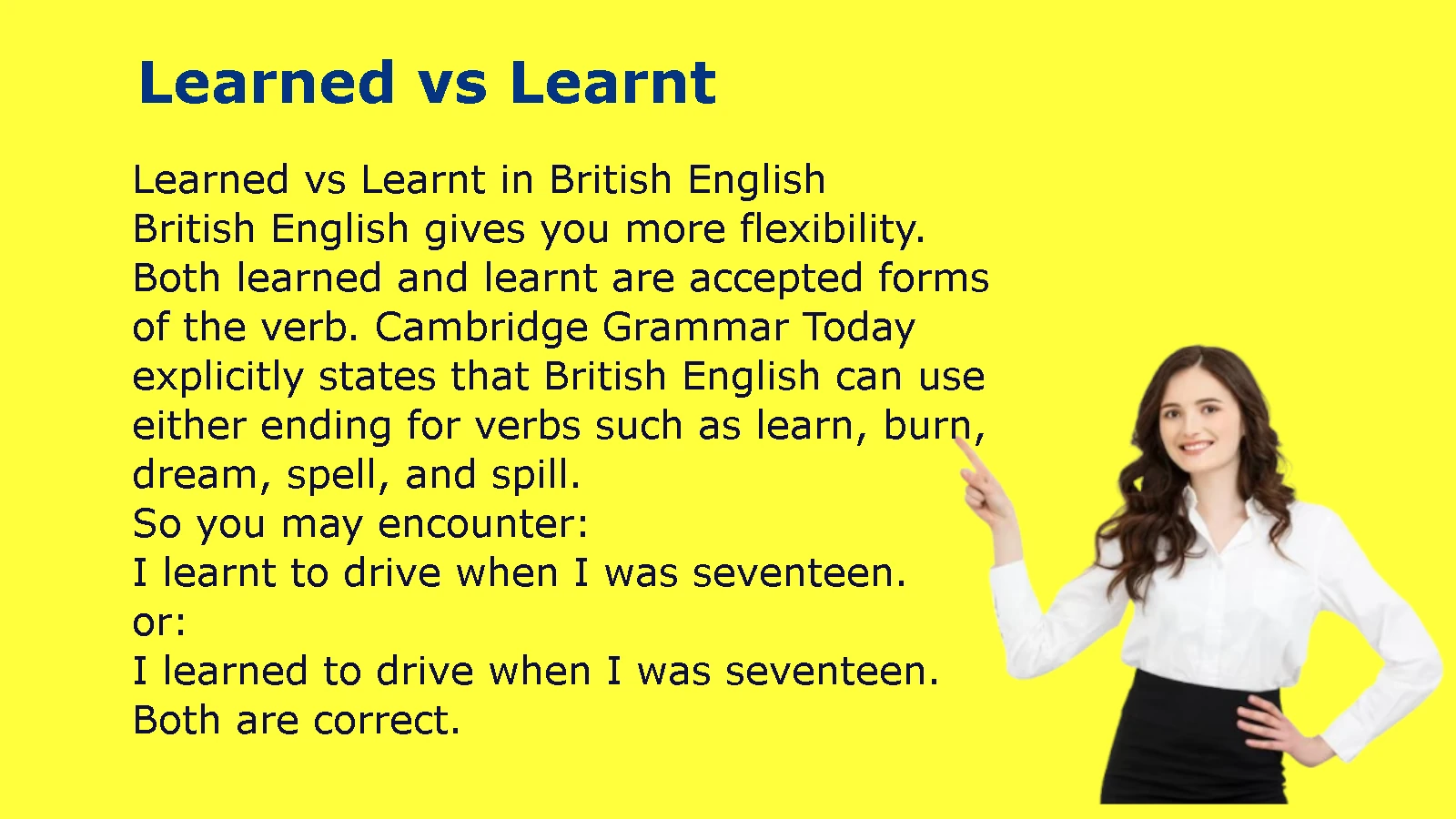
Both learned and learnt are accepted forms of the verb. Cambridge Grammar Today explicitly states that British English can use either ending for verbs such as learn, burn, dream, spell, and spill.
So you may encounter:
I learnt to drive when I was seventeen.
or:
I learned to drive when I was seventeen.
Both are correct.
Why Do British Speakers Use Both Forms?
English verbs don’t always follow one neat pattern.
Historically, forms ending in -t were common in British English for several verbs. Over time, regular -ed forms became increasingly common.
BBC Learning English explains that both forms are correct and notes that the -ed form has become increasingly common in British English. It also connects this broader shift to the tendency of verbs to become more regular over time.
This is why modern British English can contain both:
- learned / learnt
- dreamed / dreamt
- spelled / spelt
- burned / burnt
- spilled / spilt
Language doesn’t always replace one form overnight. Instead, two forms can coexist for generations.
Learned vs Learnt in a Sentence
The easiest way to understand the distinction is to place the forms side by side.
| Meaning | American English | British English |
| Learned a skill | I learned to swim. | I learnt to swim. |
| Gained knowledge | She learned about history. | She learnt about history. |
| Discovered information | We learned the truth. | We learnt the truth. |
| Learned from experience | He learned from his mistake. | He learnt from his mistake. |
| Studied a language | They learned French. | They learnt French. |
| Learned a lesson | I learned an important lesson. | I learnt an important lesson. |
The important thing is that the meaning doesn’t change simply because the spelling changes.
Learned and Learnt With “Have”
Both forms can also appear after have.
American English:
I have learned a lot from this experience.
British English:
I have learnt a lot from this experience.
You might also encounter:
I have learned a valuable lesson.
and:
I have learnt a valuable lesson.
Again, the difference is mainly regional preference.
Is Learned or Learnt More Correct?
Neither is universally more correct.
That’s the short answer.
The better choice depends on the variety of English you’re using.
Cambridge’s grammar reference makes this distinction particularly clear: British English permits both forms, while American English favors the -ed form.
So saying “learnt is wrong” would be inaccurate.
Likewise, saying “learned is only American” would also be inaccurate.
Lesson Learned vs Lesson Learnt
One of the most common places you’ll encounter this difference is the phrase lesson learned.
Lesson Learned
Lesson learned is the standard American English form.
For example:
The project failed because nobody checked the data. Lesson learned.
You might also write:
The experience taught us a valuable lesson learned through trial and error.
The phrase often appears in business, education, personal reflection, and everyday conversation.
Lesson Learnt
Lesson learnt is common in British English.
For example:
The project failed because nobody checked the data. Lesson learnt.
British publications and speakers can use this form naturally.
Cambridge’s examples of learnt include the phrase lessons learnt, showing that this construction is well established.
Which One Should You Use?
If you’re writing for an American audience:
Lesson learned.
If you’re following British English:
Lesson learnt is perfectly acceptable.
The choice isn’t about intelligence or grammatical correctness. It’s about English variety and consistency.
Learned vs Learnt for School and Education
Both forms work when describing education, studying, and acquiring knowledge.
For example, an American student might say:
I learned about World War II in high school.
A British student might say:
I learnt about World War II at school.
Both sentences communicate the same basic idea.
You can also use either form with skills:
- I learned to play chess.
- I learnt to play chess.
- She learned how to code.
- She learnt how to code.
- They learned three languages.
- They learnt three languages.
However, the adjective learned remains different:
He is a learned professor.
Here, learned means highly educated or knowledgeable. Learnt cannot replace it.
That’s one of the few situations where the two words aren’t simply interchangeable variants.
Learned vs Learnt and Other -Ed / -T Forms
The difference between learned and learnt isn’t unique.
English contains several verbs with competing -ed and -t past forms.
| Verb | -ed form | -t form |
| learn | learned | learnt |
| burn | burned | burnt |
| dream | dreamed | dreamt |
| spell | spelled | spelt |
| spill | spilled | spilt |
| smell | smelled | smelt |
| lean | leaned | leant |
The regional pattern isn’t identical for every verb. Some forms are much more common than others in particular varieties.
Cambridge specifically notes that British English can use both -ed and -t forms for several of these verbs, while American English tends to prefer the -ed forms.
This gives you a useful broader pattern:
American English often favors the regular -ed form, while British English may retain both -ed and -t alternatives for certain verbs.
That doesn’t mean every British speaker always chooses the -t form. Modern British English is flexible.
Common Mistakes With Learned and Learnt
Mistake: Thinking Learnt Is a Misspelling
It’s not.
Learnt is a standard past tense and past participle of learn. Cambridge explicitly lists it as the UK form.
So this sentence is perfectly valid:
I learnt a lot from that experience.
It simply fits British usage more naturally than standard American usage.
Mistake: Thinking Learned Is Only American
This is another common misconception.
British English uses learned too. In fact, Cambridge Grammar Today explicitly gives both forms for British English.
So this British sentence is also correct:
She learned to speak Spanish while living in Madrid.
Mistake: Using Learnt as the Adjective
This is where the distinction matters.
You can say:
He is a learned scholar.
But you wouldn’t normally replace the adjective with learnt:
He is a learnt scholar. ❌
The adjective learned has its own meaning: knowledgeable, educated, or scholarly.
Mistake: Assuming the Forms Have Different Meanings
When learned and learnt function as the past tense or past participle of learn, they generally have the same meaning.
Compare:
She learned the answer.
She learnt the answer.
The difference is primarily regional usage, not meaning.
Mistake: Mixing Forms Without a Reason
Suppose a British document contains:
She learnt the rules and learned several new techniques.
There’s no major grammatical error here. Still, consistency often makes writing feel more polished.
BBC Learning English recommends choosing one form and using it consistently rather than switching unnecessarily between the -ed and -t forms.
Learned vs Learnt: Grammar Rules at a Glance
Here’s the whole issue in one table.
| Form | Role | Example |
| learn | Base verb | I want to learn. |
| learned | American past tense | I learned yesterday. |
| learnt | British past tense | I learnt yesterday. |
| learned | American past participle | I have learned a lot. |
| learnt | British past participle | I have learnt a lot. |
| learned | Adjective | She is a learned scholar. |
| learning | Present participle | I am learning Spanish. |
This table reveals something important: learned isn’t simply the American spelling of learnt in every context.
It also has an adjective use that deserves separate attention.
Learned vs Learnt vs Learn
These three forms can look confusing when they appear together, but their roles are straightforward.
Learn
Learn is the base form.
I want to learn Italian.
Learned
Learned is the standard American past form and is also used in British English.
I learned Italian last year.
It can also serve as the past participle:
I have learned Italian.
And it can function as an adjective:
She is a learned linguist.
Learnt
Learnt is an alternative past form and past participle, especially common in British English.
I learnt Italian last year.
I have learnt Italian.
The present participle doesn’t change:
I am learning Italian.
This gives you the basic pattern:
learn → learned / learnt → learning
How to Choose Between Learned and Learnt
Choosing the right form doesn’t need to become a grammar headache.
Use this simple decision process.
If You’re Writing in US English
Choose learned.
I learned how to use the software.
She learned an important lesson.
We learned about the new policy.
This is the most natural choice for American readers.
If You’re Writing in UK English
You can choose learned or learnt.
I learnt how to use the software.
I learned how to use the software.
Both are acceptable.
If a particular publication, employer, school, or style guide has a preferred form, follow that preference.
If You’re Describing an Educated Person
Use learned.
The learned professor answered the question.
Don’t use learnt simply because you’re writing British English. The adjective is learned.
If You’re Writing for an International Audience
Consistency is more useful than trying to eliminate every regional difference.
If the rest of your content follows American English, use learned.
If it follows British English and uses other British conventions, learnt can fit naturally.
The goal isn’t to make every reader use the same form. The goal is to make your own writing clear and consistent.
Learned vs Learnt: Real-World Usage
The difference becomes easier to understand when you look at how reference sources describe the two forms.
Cambridge’s main entry for learn gives the forms as learned or UK also learnt, making the regional distinction explicit.
Its separate learnt entry labels the word as UK and identifies it as the past simple and past participle of learn.
Cambridge Grammar Today goes a step further. It explains that British English can use either learned or learnt, while American English prefers learned.
BBC Learning English also explains that both forms are correct and points to the increasing use of the -ed form in British English.
So the evidence points to a clear conclusion: this is a variation in English usage, not a simple right-versus-wrong spelling question.
A Practical Case Study: Choosing a Form for Different Readers
Imagine three writers describing the same experience.
An American writer
I learned to drive when I was sixteen.
This sounds completely natural in US English.
A British writer
I learnt to drive when I was seventeen.
This is also completely natural in British English.
Another British writer
I learned to drive when I was seventeen.
Still correct. British English allows this form too.
The underlying message doesn’t change.
What changes is the regional flavor of the writing.
This is similar to other British and American differences such as color/colour or center/centre. The important thing is to know which variety you’re using and apply it consistently.
Learned vs Learnt Examples
Here are more examples grouped by meaning.
Learning a Skill
American English:
Maya learned to swim during the summer.
British English:
Maya learnt to swim during the summer.
Gaining Knowledge
American English:
We learned about the history of the region.
British English:
We learnt about the history of the region.
Discovering Information
American English:
I learned the truth from my brother.
British English:
I learnt the truth from my brother.
Learning From Experience
American English:
He learned from his mistakes.
British English:
He learnt from his mistakes.
Learning a Lesson
American English:
She learned an important lesson that day.
British English:
She learnt an important lesson that day.
Using the Past Participle
American English:
They have learned everything they need to know.
British English:
They have learnt everything they need to know.
Using the Adjective
The learned professor delivered a detailed lecture.
Here, learned means knowledgeable or scholarly. It isn’t simply another regional version of learnt.
Frequently Asked Questions About Learned vs Learnt
Is learned or learnt correct?
Both are correct as past tense and past participle forms of learn. Learned is the standard form in American English. British English uses both learned and learnt.
Is learnt American or British?
Learnt is primarily associated with British English. American English normally uses learned instead.
Do Americans use learnt?
Americans can understand learnt, and it does appear in some American contexts. However, learned is the normal choice in standard American English.
Can I use learned in British English?
Yes. Learned is completely acceptable in British English. British English allows both learned and learnt for the past tense and past participle of learn.
Is learnt a real word?
Yes. Learnt is a standard English word. Cambridge defines it as the UK past simple and past participle of learn.
Is learned an adjective?
Yes. Learned can be an adjective meaning highly educated, knowledgeable, or scholarly.
For example:
She is a learned historian.
Cambridge specifically gives this adjective meaning and distinguishes its pronunciation from the verb form.
Is “lesson learned” or “lesson learnt” correct?
Both are correct.
Lesson learned is the natural American English form, while lesson learnt is common in British English.
Which is better for formal American writing?
Use learned.
For example:
The team learned several valuable lessons from the project.
That form fits standard US English.
Which is more common in British English, learned or learnt?
Both occur in British English. Learnt has a strong traditional British association, but learned has become increasingly common. Cambridge and BBC Learning English both document the coexistence of the two forms.
Can learned and learnt be used interchangeably?
When they function as the past tense or past participle of learn, they generally carry the same meaning and can represent regional alternatives.
However, learned has an additional adjective use meaning knowledgeable or scholarly. In that sense, learnt isn’t a substitute.
Learned vs Learnt: Final Verdict
The difference between learned and learnt is much simpler once you separate grammar from regional usage.
Learned is the standard past tense and past participle in American English. It’s also perfectly acceptable in British English.
Learnt is another past tense and past participle of learn. It’s especially common in British English and is less typical in American English.
There’s one more distinction worth remembering. Learned can also be an adjective meaning educated, knowledgeable, or scholarly, as in a learned professor.
So the practical rule is easy:
| If you’re writing… | Choose |
| US English | learned |
| UK English | learned or learnt |
| A knowledgeable or scholarly person | learned |
| A formal American document | learned |
| A British document using traditional -t forms | learnt |
In short, learned isn’t more correct than learnt in every situation, and learnt isn’t a mistake. They’re legitimate forms of the same verb with different regional preferences.
For American English, stick with learned. For British English, learned and learnt are both available. Most importantly, choose the form that fits your variety of English and use it consistently.