Have you ever felt strongly drawn to someone and couldn’t stop thinking about them, even though you barely knew them? That intense feeling may be infatuation. The infatuation meaning refers to a powerful but often short-lived feeling of love, admiration, or attraction toward someone. It can feel exciting and overwhelming, especially when emotions grow faster than a real relationship develops.
Infatuation usually involves intense attraction or fascination with another person. Unlike deeper, lasting love, infatuation can be based more on excitement, physical attraction, or imagination than on truly knowing someone. It can also describe a strong enthusiasm for an idea, activity, or thing, although its use with romantic attraction is much more common.
Examples:
- Her infatuation with him made it difficult for her to think about anything else.
- His sudden infatuation with photography lasted for several months.
The confusion is understandable. People often search for infatuation meaning, what does infatuation mean, infatuation meaning in love, infatuation vs love, or what does it mean to be infatuated with someone because the feeling can seem similar to love at first. And here’s the kicker: infatuation can feel incredibly intense without necessarily becoming lasting love.
In this guide, you’ll learn the complete infatuation meaning, including its definition, pronunciation, origin, synonyms, examples, and usage. You’ll also discover how infatuation differs from love, what it means in a romantic context, and how to recognize the word in everyday conversations.
What Does Infatuation Mean in Simple Words?
In simple words, infatuation means being extremely attracted to or fascinated by someone or something, often for a limited period.
Imagine meeting someone who seems almost perfect. You think about them throughout the day. Their text makes your mood instantly better. You remember tiny things they said. Even their ordinary habits seem charming.
That intense emotional excitement can be infatuation.
The important part is that infatuation doesn’t necessarily mean you truly know the person. You may be responding partly to what you imagine they are.
For example:
Maya met Alex at a party and became infatuated with him after only a few conversations.
This doesn’t necessarily mean Maya loves Alex. It means she has developed unusually strong feelings of attraction toward him.
Infatuation can also describe interests that have nothing to do with romance:
His infatuation with vintage cars lasted for several years.
Here, the word means an intense fascination rather than romantic attraction. Cambridge specifically recognizes this broader use of infatuation with something.
Infatuation Definition
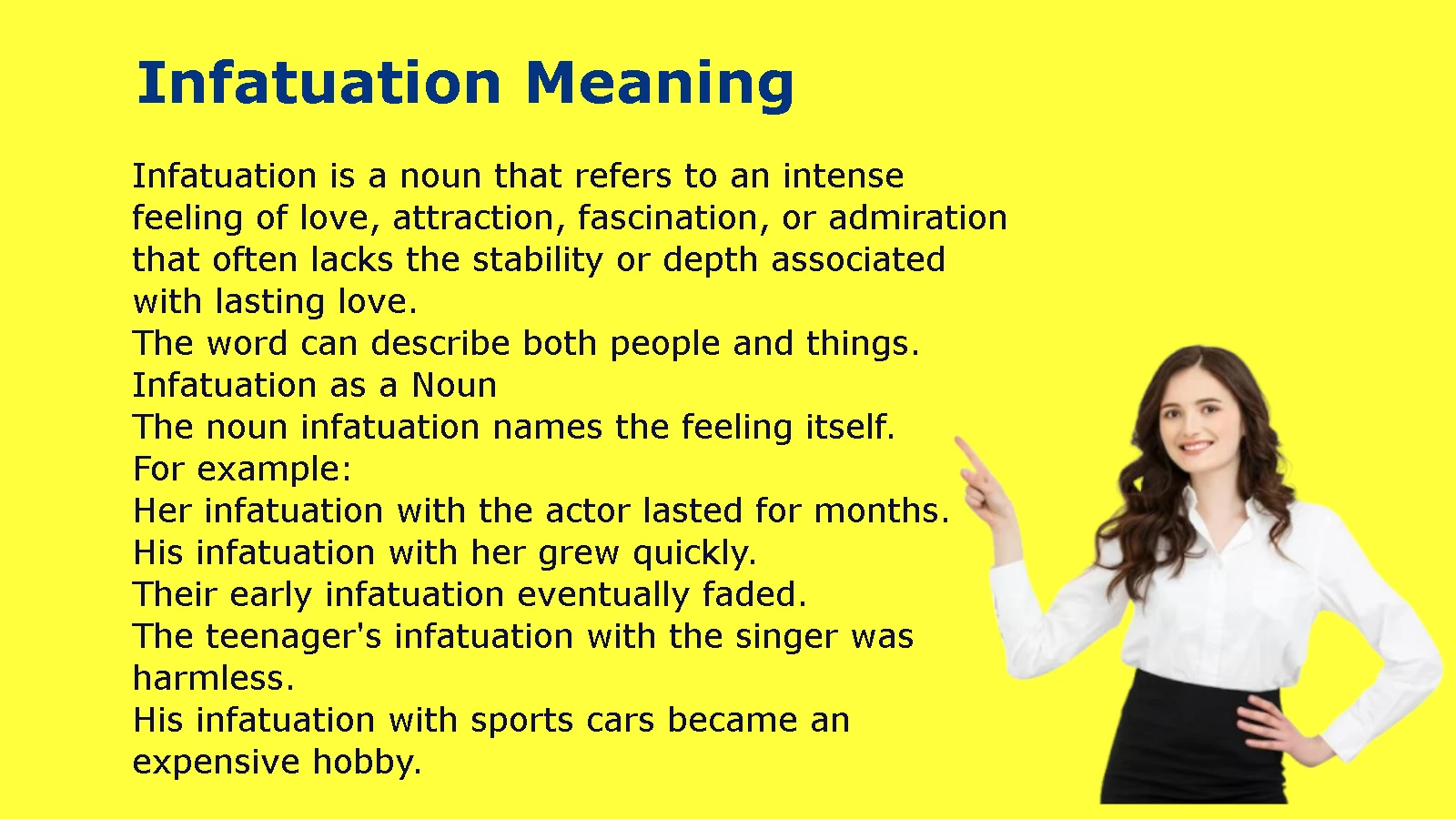
Infatuation is a noun that refers to an intense feeling of love, attraction, fascination, or admiration that often lacks the stability or depth associated with lasting love.
The word can describe both people and things.
Infatuation as a Noun
The noun infatuation names the feeling itself.
For example:
- Her infatuation with the actor lasted for months.
- His infatuation with her grew quickly.
- Their early infatuation eventually faded.
- The teenager’s infatuation with the singer was harmless.
- His infatuation with sports cars became an expensive hobby.
The usual pattern is infatuation with + person or thing.
You can also say:
- an intense infatuation
- a romantic infatuation
- a brief infatuation
- a teenage infatuation
- a growing infatuation
- a mutual infatuation
Infatuated Meaning
Infatuated is the adjective form.
If you are infatuated with someone, you feel an unusually strong attraction or fascination toward that person.
For example:
She was completely infatuated with her new coworker.
Cambridge describes infatuated as having a very strong but usually temporary feeling of love or attraction toward someone. It can also describe an intense and sometimes unreasonable interest in something.
The distinction is easy to remember:
Infatuation = the feeling.
Infatuated = the person experiencing the feeling.
Infatuation Meaning in Love
In romantic relationships, infatuation means intense attraction that can make someone feel emotionally consumed by another person.
You may feel excited whenever that person appears. Constant communication can start to feel important. Daydreaming about them may become common, and even small gestures can seem like meaningful signs.
At this stage, emotions can move faster than reality.
For example, you might think:
“I’ve only known this person for two weeks, but I feel like they’re perfect for me.”
That doesn’t automatically mean the feeling is false. The attraction can be completely genuine. However, the image you have of the person may contain assumptions that haven’t been tested by real experience.
Infatuation often thrives on novelty. A new person gives your mind plenty to discover, imagine, and anticipate.
What Does It Mean to Be Infatuated With Someone?
Being infatuated with someone means you feel an unusually strong attraction or fascination toward that person.
Common experiences include:
- Thinking about them repeatedly
- Feeling excited when they contact you
- Wanting their attention
- Imagining romantic possibilities
- Focusing heavily on their positive qualities
- Feeling disappointed when they don’t respond
- Remembering small details about them
- Wanting to spend as much time with them as possible
- Feeling unusually nervous or energized around them
However, these signs don’t prove that someone is infatuated. People experience attraction differently.
Infatuation also doesn’t automatically mean the relationship is unhealthy. Strong attraction can be a normal part of romantic development. The more important question is whether the feeling allows you to maintain perspective and function normally.
Signs of Infatuation
Infatuation often shows up through a combination of thoughts, emotions, and behaviors rather than one single symptom.
Constantly Thinking About Someone
One of the clearest signs of infatuation is persistent thinking about a person.
You might replay conversations, imagine future dates, wonder what they are doing, or check your phone hoping to see their name.
A few thoughts about someone you like are perfectly normal. Infatuation becomes more noticeable when that person occupies a surprisingly large amount of your attention.
For example, you could be working on an important project while your mind suddenly drifts back to something they said earlier.
Idealizing the Person
Infatuation often involves idealization.
Instead of seeing someone as a complete person with strengths, weaknesses, habits, and contradictions, you may focus heavily on the qualities that attract you.
His confidence becomes “amazing.”
Their stubbornness becomes “determination.”
Their frequent texting becomes “proof they really care.”
That’s where perspective can become blurry.
Idealization doesn’t mean your positive observations are wrong. It simply means you may not yet have enough information to see the whole picture.
Wanting Their Attention
Another common sign is a strong desire for attention from the person.
A message can feel disproportionately exciting. A delayed reply might make you anxious. You may find yourself checking whether they’ve viewed a message or reacted to something you posted.
The underlying attraction isn’t unusual. New romantic interest naturally makes attention feel rewarding.
The intensity matters more than the existence of the feeling.
Overlooking Their Flaws
When you’re infatuated, flaws can become surprisingly easy to ignore.
You might know that someone is unreliable but explain it away because you’re attracted to them. You might dismiss behavior that would normally bother you.
This happens because attraction can influence how you interpret information.
As you get to know someone better, the fantasy often meets reality. That’s one reason infatuation may either fade or develop into a more grounded relationship.
Feeling Emotionally Drawn to Them
Infatuation can create a powerful sense of emotional pull.
You may want to share news with the person first. Their approval may suddenly matter more than expected. Even ordinary activities can seem more exciting when you do them together.
That emotional intensity can feel wonderful.
Still, intensity alone doesn’t tell you how durable a relationship will be.
Infatuation Meaning Long Term
The phrase infatuation meaning long term often appears in searches from people wondering whether intense attraction can last.
The short answer is that there is no universal expiration date for infatuation.
Dictionary definitions emphasize that infatuation is usually not lasting, rather than saying it always ends after a fixed number of days, weeks, or months.
Some intense attractions fade quickly. Others can continue for a long time, especially when uncertainty, fantasy, limited contact, or intermittent attention keeps the excitement alive.
How Long Does Infatuation Last?
There isn’t a scientifically established number that applies to every infatuation.
A person might lose interest after several weeks. Someone else may remain intensely attracted for months. In some situations, strong preoccupation can continue much longer.
That’s why claims that infatuation always lasts a specific number of months should be treated cautiously.
Research and psychological writing sometimes discuss related concepts such as limerence, which involves intense romantic preoccupation and a strong desire for reciprocation. However, limerence and infatuation aren’t simply interchangeable terms. Contemporary psychological sources also note that limerence isn’t a formally validated clinical diagnosis.
The duration of an infatuation can depend on factors such as:
- How often you see the person
- Whether they return your feelings
- How much you actually know about them
- How much uncertainty exists
- Whether the relationship develops
- Whether reality matches your expectations
- How strongly you idealize the person
Can Infatuation Turn Into Love?
Yes, infatuation can develop into love, but it doesn’t always do so.
A relationship may begin with powerful attraction and gradually develop deeper qualities such as trust, emotional intimacy, mutual respect, shared experiences, and commitment.
The key change is often a movement from imagining the person to knowing the person.
During infatuation, you may think:
“They’re exactly what I’ve always wanted.”
As a relationship develops, a more grounded perspective might become:
“I know their strengths and flaws, and I still care deeply about them.”
That second experience involves more information and realism.
Infatuation can therefore be the beginning of a relationship rather than its final form.
What Happens When Infatuation Fades?
When infatuation fades, one of several things can happen.
The relationship can deepen. You may discover genuine compatibility beneath the initial excitement.
The attraction can decrease. Once novelty disappears, you may realize that the connection wasn’t as strong as you imagined.
The relationship can change. Initial passion may give way to companionship, affection, intimacy, and commitment.
The relationship can end. Sometimes the intense feeling was the main thing holding the connection together.
A fading rush doesn’t automatically mean something went wrong. Early excitement and long-term attachment don’t have to feel identical.
Infatuation vs. Love
Although people often use the words interchangeably, infatuation and love describe different experiences.
| Infatuation | Love |
| Often intense and exciting | Can feel intense but may also feel calm and secure |
| Often develops quickly | Usually develops through experience |
| Can involve idealization | Requires knowing the person’s real qualities |
| Often centers on attraction | Can include care, intimacy, trust, and commitment |
| May fade when novelty disappears | Can remain through ordinary life and difficulties |
| Can exist without deep knowledge | Usually becomes more grounded through knowledge |
One major difference is perspective.
Infatuation can make someone seem larger than life. Love generally requires seeing the person more completely.
That doesn’t mean love lacks passion. Healthy romantic love can be deeply passionate. The distinction is that love isn’t defined only by emotional intensity.
Infatuation vs. Attraction
Attraction is broader than infatuation.
You can feel attracted to someone without being infatuated with them.
For example, you might find someone physically attractive when you first meet them. That’s attraction. If you then become intensely preoccupied with them and start idealizing them, the experience may move closer to infatuation.
Think of attraction as a spark.
Infatuation is what can happen when that spark becomes a much bigger emotional fire.
| Attraction | Infatuation |
| Can be mild or strong | Usually feels intense |
| May be physical, emotional, or intellectual | Often involves strong emotional fixation |
| Doesn’t require constant thoughts | Often involves repeated thoughts |
| Can remain realistic | May involve idealization |
| Can exist without wanting a relationship | Often includes a strong desire for closeness |
Infatuation vs. Crush
A crush and an infatuation overlap considerably.
A crush usually describes a strong liking or romantic interest in someone. Cambridge lists crush as a related term when explaining infatuation.
The difference often comes down to emphasis.
A crush may be relatively light:
“I have a crush on someone in my class.”
Infatuation tends to suggest greater intensity:
“He became completely infatuated with her.”
Still, there isn’t a strict scientific boundary between the two words. Everyday English often uses them in similar situations.
Infatuation vs. Obsession
Infatuation and obsession aren’t the same thing, although intense infatuation can sometimes involve obsessive-style thoughts.
It describes a strong attraction or fascination. Obsession generally suggests a more persistent and intrusive preoccupation that can interfere with daily life.
Consider the difference:
| Infatuation | Obsession |
| Strong attraction or fascination | Persistent preoccupation |
| Often associated with excitement | Can involve distress |
| Usually describes feelings | Can describe thoughts or behaviors |
| May fade naturally | May become difficult to control |
| Doesn’t necessarily impair daily life | Can interfere with normal functioning |
A related term is limerence. Psychological sources describe limerence as an intense form of romantic preoccupation involving intrusive thoughts and a strong desire for reciprocation. However, it shouldn’t automatically be treated as a medical diagnosis.
Infatuation Meaning in Medical Contexts
The phrase infatuation meaning in medical contexts can be confusing because ordinary infatuation isn’t itself a medical diagnosis.
Doctors don’t generally diagnose someone with “infatuation” simply because they feel intensely attracted to another person.
Instead, mental health professionals may consider the broader pattern when intense romantic preoccupation becomes distressing or interferes with everyday functioning.
Is Infatuation a Medical Condition?
No. Infatuation itself isn’t generally classified as a medical condition or mental disorder.
It’s an ordinary term for a powerful feeling of attraction or fascination.
The distinction becomes important when discussing related concepts such as obsessive thoughts, compulsive behavior, anxiety, or limerence. Those concepts may involve clinically relevant symptoms in some circumstances, but simply having intense romantic feelings doesn’t mean someone has a disorder.
In other words:
Strong feelings aren’t automatically a medical problem.
A person’s experience deserves closer attention when thoughts or behaviors become persistent, distressing, unsafe, or significantly disruptive to work, school, relationships, sleep, or everyday responsibilities.
When Can Intense Feelings Become Concerning?
The intensity itself isn’t the only factor to consider.
Pay attention to the impact of the behavior.
Potential warning signs can include:
- Being unable to concentrate on everyday responsibilities
- Severe sleep disruption caused by persistent thoughts
- Repeatedly checking or monitoring another person
- Ignoring clear boundaries or requests for space
- Experiencing major distress over ordinary changes in communication
- Neglecting work, school, friends, or personal responsibilities
- Feeling unable to control intrusive thoughts
- Engaging in behavior that could harm yourself or someone else
Those signs don’t automatically indicate a particular diagnosis. They simply suggest that the situation may deserve support from a qualified mental health professional.
Is Infatuation a Positive or Negative Feeling?
Infatuation can be either enjoyable or difficult depending on how it affects you.
The early excitement can make life feel brighter. You may feel energized, hopeful, creative, and motivated to connect with someone.
At the same time, infatuation can distort your perspective.
Potentially positive aspects
- Excitement about meeting someone
- Increased motivation to socialize
- Strong romantic energy
- Curiosity about another person
- Enjoyment of new experiences
- Inspiration and emotional excitement
Potentially difficult aspects
- Unrealistic expectations
- Idealizing someone
- Fear of rejection
- Jealousy
- Constantly checking for attention
- Difficulty concentrating
- Emotional dependence on another person’s responses
The feeling itself isn’t automatically good or bad. What matters is how you respond to it.
A useful rule is simple: enjoy the excitement while keeping both feet on the ground.
Infatuation Examples in Sentences
Here are natural examples showing how infatuation works in everyday English:
- Her infatuation with the actor began after she watched his latest movie.
- His initial infatuation faded once they started spending more time together.
- The teenager had a harmless infatuation with a famous singer.
- Their early infatuation eventually developed into a strong friendship.
- She couldn’t tell whether her feelings were love or infatuation.
- His infatuation with the new technology lasted for several months.
- The novel explores the difference between genuine love and romantic infatuation.
- Everyone noticed his growing infatuation with his new coworker.
- Her infatuation made her overlook several obvious warning signs.
- What began as infatuation gradually became a deeper emotional connection.
Notice that the word can describe romantic feelings and intense interests.
How to Use Infatuation in a Sentence
The most common structure is:
infatuation with + person or thing
Examples:
She developed an infatuation with her neighbor.
His infatuation with basketball started when he was a child.
You can also use the word with descriptive adjectives:
- brief infatuation
- intense infatuation
- romantic infatuation
- sudden infatuation
- youthful infatuation
- growing infatuation
- mutual infatuation
The adjective infatuated usually follows a form of be:
She is infatuated with him.
They were completely infatuated with each other.
He became infatuated with the idea of moving abroad.
Avoid confusing infatuated with and infatuation for. While both constructions can appear in English, infatuated with is the most natural everyday pattern.
Infatuation Synonyms
The best synonym depends on the exact context.
| Synonym | Best used when… |
| Fascination | You feel strongly interested in someone or something |
| Attraction | Romantic or physical appeal is the focus |
| Crush | You want an informal word for romantic interest |
| Fascination | Curiosity and intense interest are central |
| Passion | Strong emotional enthusiasm is involved |
| Adoration | Deep admiration or affection is emphasized |
| Obsession | The interest has become unusually consuming |
| Enchantment | Someone or something seems especially captivating |
| Smitten | You want an informal adjective for strong romantic attraction |
Not every synonym has exactly the same meaning.
For example, passion doesn’t necessarily suggest that feelings are temporary. Obsession can suggest a level of preoccupation that goes beyond ordinary infatuation.
Infatuation Antonyms
There isn’t one perfect opposite of infatuation in every context.
Depending on the sentence, useful contrasts include:
- Indifference
- Disinterest
- Apathy
- Detachment
- Dislike
- Aversion
- Dispassion
For romantic situations, indifference is often a useful contrast because it describes a lack of strong emotional interest.
For example:
His infatuation with her eventually turned into indifference.
That sentence clearly shows a major shift in emotional interest.
Common Expressions With Infatuation
Certain phrases appear frequently when people talk about romantic infatuation.
Infatuated With Someone
Infatuated with someone means strongly attracted to or fascinated by that person.
She was completely infatuated with him.
The phrase usually carries a stronger sense of intensity than simply saying:
She liked him.
Completely Infatuated
Completely infatuated emphasizes the strength of the feeling.
He was completely infatuated with his new girlfriend.
This phrase suggests that the person’s thoughts and emotions are heavily focused on the other person.
Infatuated With the Idea of Someone
Sometimes you can become attached to an idea of a person rather than the person you actually know.
For example, someone may imagine a new romantic interest as confident, loyal, exciting, and perfectly compatible before enough real-life experience exists to support those assumptions.
That distinction matters because infatuation can grow around possibility and imagination.
The more you actually learn about someone, the easier it becomes to determine whether the attraction has a solid foundation.
Frequently Asked Questions About Infatuation
Is Infatuation the Same as Love?
No. Infatuation and love can overlap, but they aren’t identical.
Infatuation often involves intense attraction, excitement, idealization, and fascination. Love can involve those feelings while also developing through trust, intimacy, care, knowledge, and commitment.
An infatuation may become love, but it may also fade.
In everyday conversation, however, people often use the terms almost interchangeably.
Does Infatuation Mean You Love Someone?
Not necessarily.
You can be intensely attracted to someone without having developed the deeper emotional connection associated with love.
Infatuation may be the beginning of love, but the feeling alone doesn’t establish that you love someone.
How Long Does Infatuation Last?
There is no fixed timeline.
Infatuation may last weeks, months, or longer depending on the person and circumstances. The term itself implies that the feeling is often temporary, but it doesn’t provide a precise expiration date.
Can Infatuation Turn Into Love?
Yes.
As two people spend time together and learn about each other, intense initial attraction can develop into a more stable relationship.
However, infatuation can also disappear when reality doesn’t match expectations.
Is Infatuation Always Romantic?
No.
Infatuation can describe intense interest in people, hobbies, places, ideas, activities, or things.
For example:
She developed an infatuation with ancient architecture.
That sentence has nothing to do with romance.
What Is Another Word for Infatuation?
Depending on the context, alternatives include fascination, attraction, crush, passion, adoration, enchantment, and obsession.
The exact choice depends on the intensity and meaning you want to convey.
Is Infatuation a Medical Condition?
No. Infatuation itself isn’t generally considered a medical condition.
However, unusually intense romantic preoccupation can sometimes overlap with concepts such as limerence or obsessive thinking. Those experiences shouldn’t automatically be treated as diagnoses.
Final Thoughts on Infatuation Meaning
The infatuation meaning is simple at its core: an intense feeling of love, attraction, or fascination that often doesn’t last.
In romantic situations, infatuation can make someone seem extraordinary. You may think about them constantly, crave their attention, overlook their flaws, and imagine a future together. Those feelings can be exciting and completely genuine.
Still, intensity isn’t the same thing as depth.
As you get to know someone, the fantasy has a chance to meet reality. Sometimes the attraction fades. Sometimes it becomes a deeper bond built on trust, intimacy, and commitment.
That’s why understanding infatuation vs. love matters. Infatuation can be the spark, but lasting love depends on much more than the initial rush.
The word also extends beyond romance. You can have an infatuation with a hobby, celebrity, place, idea, or interest. In every case, the central idea remains the same: an unusually strong fascination that captures your attention.
In short:
Infatuation is intense. Love is deeper. Attraction is broader. A crush is often lighter. Obsession can be more consuming.
Knowing those differences makes the word easier to understand and much easier to use correctly.