Jawn meaning is simple once you understand the context: jawn is Philadelphia slang for a person, place, thing, event, or almost anything someone wants to reference without naming it directly. Pronounced like John, this versatile word is deeply connected to Philly slang, African American Vernacular English (AAVE), and the city’s cultural identity. You might hear someone say, “Pass me that jawn,” “That jawn was amazing,” or “Are we going to that jawn tonight?” Each sentence can mean something different.
Unlike most nouns, jawn doesn’t have one fixed meaning in everyday conversation. Its interpretation depends on the subject, the situation, and what the speakers already know. Understanding the word also means exploring its origin, its relationship to joint, expressions such as bad jawn, and its growing recognition in popular culture. Whether you encountered it in a text message, a Philadelphia conversation, or a TV show, this guide explains how to understand and use it naturally.
What Does Jawn Mean?
Jawn is a Philadelphia slang noun that can refer to almost any person, place, thing, or event. Speakers use it as a flexible substitute for a more specific noun when the meaning is already clear from context. The word is strongly associated with Philadelphia and surrounding communities, where it serves as both everyday slang and a marker of local identity.
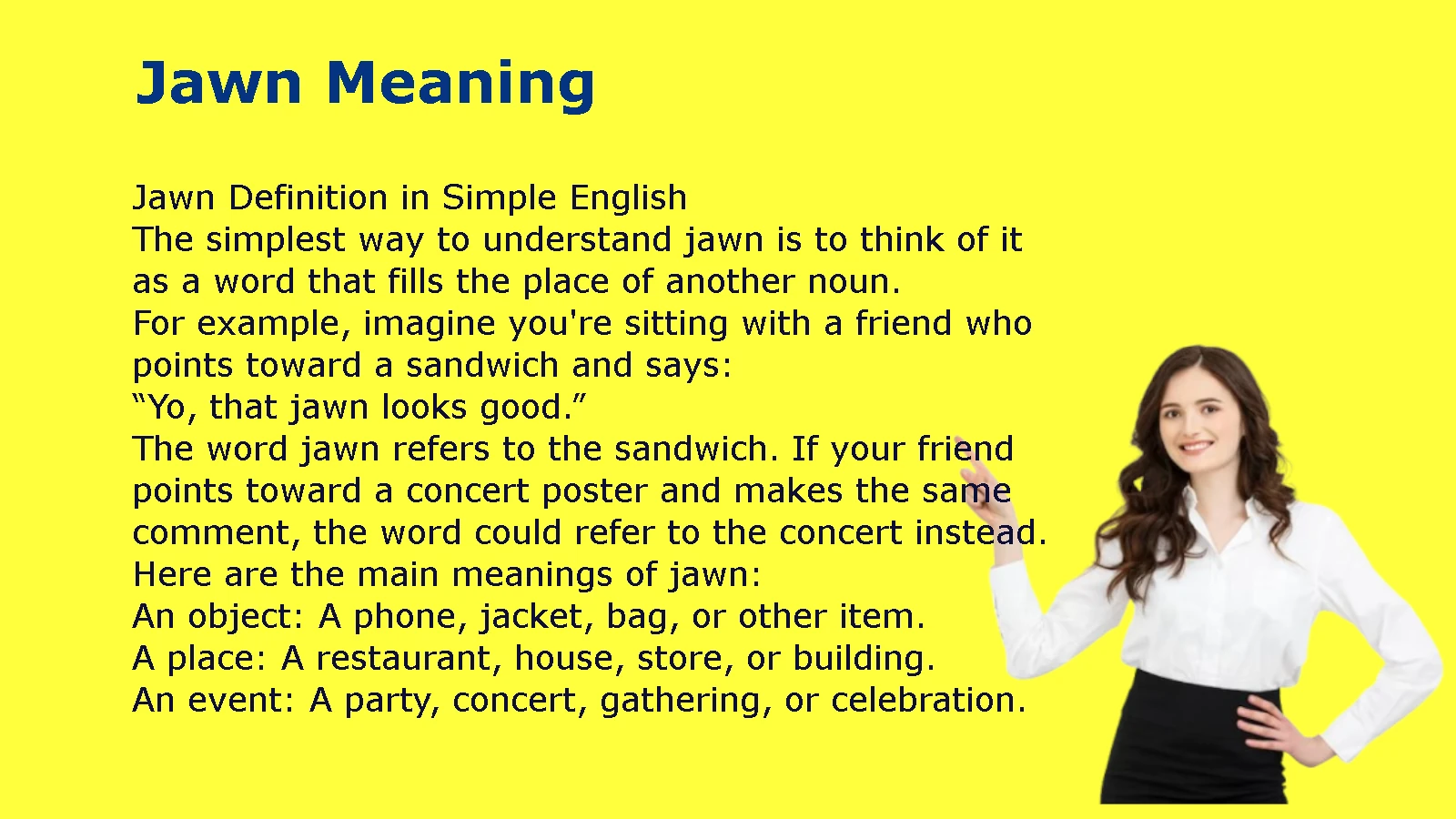
Jawn Definition in Simple English
The simplest way to understand jawn is to think of it as a word that fills the place of another noun.
For example, imagine you’re sitting with a friend who points toward a sandwich and says:
“Yo, that jawn looks good.”
The word jawn refers to the sandwich. If your friend points toward a concert poster and makes the same comment, the word could refer to the concert instead.
Here are the main meanings of jawn:
- An object: A phone, jacket, bag, or other item.
- A place: A restaurant, house, store, or building.
- An event: A party, concert, gathering, or celebration.
- Food or drink: A meal, snack, dessert, or beverage.
- A person: Someone being discussed, depending on the speaker and situation.
- A general subject: Something the speakers understand without naming it directly.
The word’s flexibility makes it unusual. Most nouns identify a particular category of thing. Jawn can stand in for many different categories without changing its spelling.
How to Pronounce Jawn
Jawn is pronounced to rhyme with John. It has one syllable, with a sound similar to the name John in common American English pronunciation.
You don’t pronounce it like “jown” with a long o sound. Instead, use the familiar vowel sound in John.
| Feature | Description |
| Word | Jawn |
| Syllables | One |
| Rhymes with | John |
| Part of speech | Noun |
| Common setting | Informal conversation and texting |
| Regional association | Philadelphia, Pennsylvania |
For example, if someone says, “That jawn is mine,” the word should sound natural within the sentence rather than overly emphasized.
Is Jawn a Philly Slang Word?
Yes. Jawn is one of the best-known expressions associated with Philadelphia slang. It has a particularly strong connection to the city’s Black communities and local speech traditions.
Philadelphia residents may use the word in casual conversations, text messages, music, and jokes. Its meaning can shift from one sentence to another, but its local association remains recognizable.
The word also functions as a cultural signal. When someone uses jawn naturally, listeners may associate the speaker with Philadelphia or with familiarity with its speech patterns.
That doesn’t mean every Philadelphia resident uses it all the time. Slang varies by age, neighborhood, social group, and personal preference. Some people use jawn constantly, while others use it only in particular situations.
Where Did Jawn Come From? Origin and Etymology
The jawn origin story is closely associated with Philadelphia’s linguistic history, African American Vernacular English, and the broader development of American slang. The word is commonly linked to joint, a slang term that has referred to different places, objects, and social settings. Over time, jawn developed into a distinctive Philadelphia expression with an exceptionally broad range of meanings.
The Connection Between Jawn and Joint
To understand jawn, it helps to look at the word joint.
In American slang, joint has long served as a flexible noun. Depending on the context, it can describe a place, an establishment, an object, or a gathering. Someone might refer to a music venue as “the joint” or describe a particular place as “a nice joint.”
Philadelphia slang developed a distinctive form, jawn, that expanded this kind of flexibility.
The connection between the two words is commonly cited in explanations of Philadelphia slang. However, language doesn’t always develop through a single, clearly documented change. Pronunciation, community usage, and shifting meanings can interact over time.
The important distinction is that jawn is not simply interchangeable with every modern use of joint. Although the words share a commonly recognized linguistic relationship, jawn developed its own regional character and became especially useful as an all-purpose noun.
Consider these examples:
- “Let’s go to that joint.” The speaker may mean a restaurant, bar, or other establishment.
- “Let’s go to that jawn.” A Philadelphia speaker could mean a venue, party, event, or another place, depending on context.
- “Hand me that jawn.” The speaker probably means an object nearby.
The last example illustrates how broadly jawn can function in everyday conversation.
Jawn and African American Vernacular English (AAVE)
African American Vernacular English (AAVE) is a systematic variety of English with its own grammatical patterns, pronunciation features, vocabulary, and cultural history. It is not simply incorrect or informal standard English.
Philadelphia’s Black communities have played an important role in the development and everyday use of jawn. The word reflects how local communities create expressions that communicate more than a literal definition. Slang can also signal shared experiences, cultural knowledge, humor, and a sense of belonging.
For example, two friends who grew up in Philadelphia may understand a sentence such as “You saw that jawn last night?” without needing further explanation. Depending on their conversation, they might know that the speaker means a party, a performance, a person, or something else entirely.
Someone unfamiliar with the local usage might need to ask, “Which one?”
That difference illustrates an important feature of regional slang: meaning often depends on shared cultural and conversational knowledge.
When discussing the origin of jawn, it’s also important not to treat AAVE as a single, uniform way of speaking. Language varies across cities and communities. A word may develop a particular meaning in Philadelphia even when related expressions exist elsewhere.
Why Jawn Can Mean Almost Anything
Linguists use the term semantic bleaching to describe a process in which a word loses some of its original, specific meaning and becomes more general.
For instance, a word that once referred to a particular type of object might eventually become a broader label. The word can retain traces of its earlier meaning while gaining new uses.
The flexibility of jawn is consistent with this general linguistic idea. In many Philadelphia conversations, the word no longer needs to identify one particular type of thing. Instead, it acts as a placeholder whose meaning comes from the situation.
Imagine a group of friends planning an evening:
“Are we going to that jawn?”
The speaker might mean a party, a restaurant, a concert, or another gathering. The people listening use their shared plans to interpret the sentence.
Now consider another conversation:
“Where’s my jawn?”
The missing item could be a phone, wallet, set of keys, or almost anything else. The conversation determines the intended meaning.
The word’s pronunciation and history also matter, but it’s best not to explain its entire development as a simple case of dropping the final t from joint. Accent patterns can influence how words sound, yet the history of slang usually involves broader community usage and changes in meaning.
How to Use Jawn in a Sentence
To use jawn correctly, replace a noun with it when the people you’re speaking to can understand what you mean. The word is informal, context-dependent, and strongly associated with Philadelphia. You can use it for objects, places, events, food, and people, but your listener’s familiarity with the slang affects how natural the sentence sounds.
Using Jawn to Refer to Objects
One common use of jawn is to refer to an object without naming it.
For example:
“Can you pass me that jawn over there?”
If you’re pointing toward a remote control, the word means remote control. If you’re standing beside a table full of tools, it might refer to a screwdriver or another item.
The object doesn’t have to be mysterious. Speakers often use flexible nouns because the details are obvious to everyone involved.
Here are more examples:
- “I like your new jawn.” — A new jacket, pair of shoes, accessory, or other item.
- “Put that jawn on the table.” — An object the speaker expects the listener to recognize.
- “Where’d you get that jawn?” — Something the speaker finds interesting or wants to buy.
- “This jawn isn’t working.” — A device, machine, or other object that has stopped functioning.
- “Grab that jawn before we leave.” — An item that both speakers can identify.
Practical tip: When using jawn for an object, a gesture or a reference to something already mentioned often makes the sentence clearer.
Using Jawn to Refer to Places and Events
Philadelphia speakers also use jawn to refer to locations, parties, concerts, and other events.
Consider this sentence:
“Are we heading down to that jawn tonight?”
The sentence doesn’t identify a specific destination. The speaker assumes the listener already knows which event or place they’re discussing.
More examples include:
- “That jawn downtown gets packed on Fridays.”
- “Everybody was at the jawn last night.”
- “What time does that jawn start?”
- “We’re meeting at that jawn near the station.”
- “The jawn on Saturday was wild.”
Notice that the word doesn’t always make a sentence vague. If everyone knows the subject, the sentence can be perfectly clear.
Using Jawn to Talk About Food
Food is another natural setting for the word.
For example:
“Put some extra hot sauce on that jawn.”
If someone says this while pointing at a plate, jawn could refer to a sandwich, taco, bowl of food, or another dish.
Other examples include:
- “This jawn tastes amazing.”
- “I need the recipe for that jawn.”
- “Who made this jawn?”
- “Save me a piece of that jawn.”
- “That jawn needs more cheese.”
The same word can describe different foods without changing its form.
However, jawn doesn’t mean food by definition. It refers to food in these sentences because the surrounding conversation establishes that meaning.
For example, “That jawn is expensive” could describe a meal, but it could just as easily refer to a pair of shoes or a concert ticket.
Using Jawn to Refer to People
In some Philadelphia contexts, jawn can refer to a person. The intended meaning and tone depend on the relationship between the speakers and the subject.
Examples include:
- “You know that jawn from the party?”
- “I saw that jawn earlier.”
- “Who’s that jawn standing by the door?”
These sentences may sound natural to some speakers familiar with the slang, while others might find them unusual or overly casual.
It’s also important to recognize that referring to a person as jawn can carry social nuances. The word may appear in conversations about attraction, dating, or someone whose identity is understood from context.
Don’t assume it is always a respectful or neutral way to refer to someone. Tone, setting, and community norms matter.
If you’re learning the word, listen to how people use it before adopting it in conversations with strangers or in formal settings.
Jawn Examples in Everyday Conversation
The following table summarizes how context changes the meaning of jawn.
| Example sentence | Possible meaning of jawn | Contextual clue |
| “Pass me that jawn.” | An object | Someone points toward an item |
| “That jawn starts at eight.” | An event | The conversation concerns a schedule |
| “This jawn tastes great.” | Food or drink | The speakers are eating |
| “I love that jawn.” | A person, object, or experience | The topic of conversation |
| “We went to that jawn last night.” | A venue or event | The speakers are discussing their plans |
| “Where’s my jawn?” | A missing item | The speaker is looking for something |
| “That jawn is expensive.” | A product, meal, event, or service | The discussion concerns cost |
| “Put the jawn in the car.” | An object | The item has already been identified |
A Short Dialogue Using Jawn Naturally
Here’s how the word might appear in an informal conversation between friends familiar with Philadelphia slang.
Malik: “You going to that jawn tonight?”
Chris: “Yeah. What time does that jawn start?”
Malik: “Around nine. Bring that new jawn you bought, too.”
Chris: “You mean my jacket?”
Malik: “Yeah, that one.”
In this fictional dialogue, jawn refers first to an event and then to a jacket. The speakers understand the intended meaning through context and a brief clarification.
The exchange also shows an important point: using jawn doesn’t mean every listener will automatically understand the reference. Even familiar speakers may clarify what a person means.
What Does Bad Jawn Mean?
Bad jawn is a Philadelphia slang expression that can describe an attractive person, particularly a woman in some contexts. Here, bad can carry a positive meaning, similar to saying someone looks exceptionally good. However, the expression isn’t limited to one interpretation in every conversation, so the surrounding words and situation still matter.
Bad Jawn as a Compliment
In some informal Philadelphia conversations, calling someone a bad jawn is a way of complimenting their appearance.
For example:
“She’s a bad jawn.”
Depending on the speaker and situation, this may mean the woman is very attractive or stylish.
The expression reflects a familiar feature of informal English: bad can sometimes mean impressive, desirable, or exceptionally good rather than unpleasant.
You can see similar positive uses of bad in phrases such as “a bad outfit” or “a bad performance,” although the exact meaning varies by context.
Here are a few illustrative examples:
- “That girl is a bad jawn.” — A compliment about her appearance.
- “He said she was a bad jawn.” — A report of someone’s informal description.
- “Everybody noticed that bad jawn at the party.” — A statement about someone who attracted attention.
These examples illustrate possible usage rather than a universal rule. Not every speaker will use the expression in the same way.
When Bad Jawn Has a Different Meaning
The word bad doesn’t always communicate admiration, and jawn can refer to things other than people.
For example:
“That was a bad jawn.”
Depending on the situation, the speaker might be praising something impressive or describing something negative. The sentence alone doesn’t establish the intended meaning.
Compare these examples:
| Expression | Possible interpretation | What helps clarify it |
| “She’s a bad jawn.” | An attractive woman | The conversation concerns appearance or attraction |
| “That was a bad jawn.” | Something impressive or something undesirable | The speaker’s tone and the situation |
| “That jawn is bad.” | A positive or negative judgment | What is being discussed |
| “That’s a bad idea.” | An unfavorable judgment | The established meaning of bad in the sentence |
Don’t assume every sentence containing bad jawn refers to a woman. Context determines whether the speaker is describing a person, praising something, or expressing a negative judgment.
Can Jawn Be Plural?
Yes, jawn can appear in sentences that refer to multiple things. However, speakers’ plural patterns vary, and the word doesn’t always follow a simple, standardized rule.
For example:
- “I saw three jawns at the store.”
- “Put those jawns over there.”
- “All these jawns need to be fixed.”
These examples use jawns as a written plural. You may also hear jawn used in a broader or less explicitly marked way when context already identifies multiple things.
The safest approach is to pay attention to how local speakers use the word. Don’t assume that every speaker follows identical grammatical patterns, especially with informal regional slang.
It’s also worth noting that the plural form doesn’t change the basic meaning of the word. Whether someone refers to one jawn or several jawns, the audience still relies on context to identify the subject.
Is Jawn a Real Word? Dictionary Recognition and Pop Culture
Yes, jawn is a real word in the sense that it has an established meaning and a recognized place in regional English. Its informal status doesn’t make it linguistically invalid. The term’s association with Philadelphia has also helped it attract attention beyond the region through entertainment, online conversations, and discussions of local culture.
Jawn in Online Dictionaries
Dictionaries record how people use language, including regional expressions, informal words, and slang. A word doesn’t have to appear in formal writing to qualify for dictionary recognition.
Jawn has received dictionary attention, including entries associated with major online dictionary publishers. When writing about a particular dictionary’s definition or publication date, verify the current entry rather than assuming that every publisher uses identical wording.
It’s helpful to distinguish three related ideas:
- A real word: An expression people use with an established meaning.
- A slang word: An informal expression associated with particular social groups, situations, or communities.
- A dictionary entry: A published record describing a word’s meaning and usage.
These categories overlap. A slang term can become widely recognized without losing its informal character.
For example, jawn may appear in a casual text message but remain inappropriate for a formal business report. Its dictionary recognition doesn’t automatically make it suitable for every audience.
Jawn in Movies and Television
Philadelphia’s identity has appeared in films and television for decades. Stories set in the city can introduce audiences to its speech patterns, neighborhoods, and cultural references.
The film Creed and the television series Abbott Elementary are relevant examples when discussing Philadelphia’s representation in popular culture. However, it’s important not to claim that either production single-handedly popularized jawn without specific evidence.
A more useful way to understand the connection is to consider how entertainment affects language awareness.
When audiences watch a show set in Philadelphia, they may encounter:
- Local expressions and regional pronunciation.
- References to familiar neighborhoods and city landmarks.
- Characters whose speech reflects aspects of local culture.
- Informal vocabulary that differs from the English they hear in other settings.
Viewers may then search for words they don’t understand or repeat them in online conversations.
That process can introduce a regional expression to new audiences, even when its everyday use remains concentrated in the community where it developed.
How Social Media Spread Philadelphia Slang
Social media makes regional expressions easier to encounter outside their original communities.
A short video, comedy clip, interview, or meme can introduce a word to thousands of people who have never visited Philadelphia. Someone might hear jawn in a conversation, search for its meaning, and then use it in a comment or message.
The process often follows a simple pattern:
- Exposure: Someone hears jawn in a video or conversation.
- Curiosity: They search for the meaning or ask someone who knows the term.
- Recognition: They learn that it can replace many different nouns.
- Imitation: They try using it in a message or joke.
- Broader awareness: Other people encounter the word through those interactions.
However, recognition isn’t the same as natural usage. Someone may understand jawn perfectly without using it in everyday speech.
Regional slang also carries cultural context. Repeating a word from another community doesn’t automatically give someone the same familiarity with its history, tone, or social meaning.
Why Jawn Matters to Philadelphia Identity
For many people, jawn represents more than a convenient way to avoid naming an object. It is associated with a particular place and the people who helped shape its language.
The word’s flexibility also makes it useful. In a conversation where everyone knows the subject, a single word can replace a long description.
Imagine someone asking, “Did you like that jawn?”
Instead of naming a specific concert, restaurant, outfit, or event, the speaker can rely on shared knowledge. The listener understands what the conversation concerns and answers accordingly.
That kind of linguistic shorthand is common in informal speech, but jawn stands out because its range of possible meanings is unusually broad.
The term also illustrates how regional language contributes to the wider English vocabulary. Words often develop in local communities long before people elsewhere recognize them.
Understanding jawn therefore means understanding both its flexible definition and its connection to Philadelphia speech.
Joint vs. Jawn: What’s the Difference?
Jawn and joint are closely related in commonly cited explanations of Philadelphia slang, but they aren’t identical in modern usage. Jawn is strongly associated with Philadelphia and often functions as an all-purpose noun. Joint has broader slang uses across American English, including references to places, establishments, objects, and other subjects.
Jawn vs. Joint: Meaning and Usage
The main difference is how speakers use the words in everyday conversation.
Joint can refer to an establishment, a place, or a gathering. In some contexts, it also has meanings connected to music, cannabis, anatomy, or objects, depending on the phrase.
Jawn, by contrast, is especially associated with Philadelphia’s use of a flexible noun that can refer to nearly anything.
Compare these sentences:
Using joint:
- “That’s a nice joint.” — A restaurant or other establishment.
- “They played a new joint.” — A song or musical track.
- “We met at the joint downtown.” — A place or venue.
Using jawn:
- “That’s a nice jawn.” — An object, place, or other subject identified by context.
- “They played that jawn again.” — A song or another previously discussed item.
- “We met at that jawn downtown.” — A place or event.
These examples show where the words can overlap. They don’t mean that jawn and joint are interchangeable in every sentence.
Jawn vs. Joint: Regional Differences
The regional association is one of the clearest distinctions.
Jawn is especially connected with Philadelphia, while joint has a much broader presence in American slang. A person who grew up in Philadelphia may use jawn naturally in conversation, while someone from another region might recognize it but rarely say it.
This difference matters when learning regional vocabulary. A word’s dictionary meaning doesn’t always explain how common, natural, or culturally appropriate it sounds in a particular place.
For example, someone might understand the sentence “Pass me that jawn” but find it unfamiliar because they don’t use the expression themselves.
A Philadelphia listener may understand the same sentence immediately, provided the object is clear from context.
Neither response is inherently wrong. Speakers simply have different linguistic backgrounds.
Jawn vs. Joint: Quick Comparison Table
| Feature | Jawn | Joint |
| Regional association | Strongly associated with Philadelphia | Used more broadly across American English |
| Main function | Flexible, all-purpose noun in Philly slang | Slang noun with several established meanings |
| Interpretation | Highly dependent on context | Depends on the phrase and context |
| Cultural association | Philadelphia speech and identity | Multiple regional and cultural traditions |
| Example | “Pass me that jawn.” | “Let’s eat at that joint.” |
The easiest rule to remember is this: joint has several established slang meanings, while jawn is especially known for its ability to stand in for almost any noun in Philadelphia speech.
Frequently Asked Questions About Jawn
Is Jawn Only a Philly Thing?
Jawn is strongly associated with Philadelphia and the surrounding region, but people outside the area can recognize or use it. Social media, entertainment, and online discussions have helped spread awareness of the word. Still, its regional roots remain an important part of its identity.
What Does Jawn Mean in Texting?
In texting, jawn works much like it does in spoken conversation. Someone might write, “I loved that jawn,” to refer to a song, event, outfit, or another subject already being discussed. The surrounding messages usually make the intended meaning clear.
What Is the Difference Between Jawn and Joint?
Jawn is a Philadelphia-associated slang noun that can replace many different nouns. Joint has broader slang usage and several established meanings, including a place or establishment. The terms have a commonly cited linguistic relationship, but they aren’t interchangeable in every situation.
Can You Call a Person a Jawn?
Yes, jawn can refer to a person in some Philadelphia contexts. However, the expression’s tone depends on the conversation, relationship, and community norms. Expressions such as bad jawn may describe an attractive woman, but you shouldn’t assume the word is always neutral or appropriate when referring to someone.
What Does Bad Jawn Mean in Philly Slang?
Bad jawn can describe an attractive person, particularly a woman, in some Philadelphia slang contexts. Here, bad carries a positive meaning. However, the phrase’s exact interpretation still depends on the sentence, the speaker’s intention, and the surrounding conversation.
Is Jawn in the Dictionary?
Yes, jawn has been documented in major online dictionary resources. Dictionary recognition records an established use of the word; it doesn’t mean the expression is formal or appropriate in every setting. Check the current entry if you need a particular publisher’s definition or publication date.
Conclusion: Understanding Jawn Meaning and Philly Slang
The meaning of jawn becomes much easier to understand once you stop looking for one fixed definition. Jawn is a versatile Philadelphia slang noun that can refer to a person, place, object, event, or almost anything else the context makes clear.
Its connection to joint, its place in Philadelphia’s Black linguistic traditions, and its presence in popular culture help explain why the word is more than a passing expression. It reflects the way communities shape language to suit their everyday conversations.
Remember these key points:
- Meaning: A flexible noun that can replace many different nouns.
- Pronunciation: Rhymes with John.
- Origin: Commonly linked to joint and the development of Philadelphia slang.
- Usage: Depends heavily on context and shared knowledge.
- Special expression: Bad jawn can describe an attractive person.
- Cultural significance: A recognizable marker of Philadelphia speech and identity.
If you encounter jawn in a text, song, movie, or conversation, look at the surrounding words before deciding what it means. And if you’re learning Philly slang, listen to how local speakers use it in real situations. That’s the best way to understand not only the definition but also the cultural context behind the word.













