The mountebank meaning describes a flamboyant trickster who deceives people through exaggerated claims, persuasive performances, or false promises. A mountebank often pretends to possess special knowledge or expertise to gain money, attention, or influence. The word has historical roots in public marketplaces, where traveling sellers promoted questionable remedies to curious crowds.
Understanding mountebank, charlatan, quack, and swindler can help you recognize subtle differences between these terms. Although they all describe forms of deception, each word emphasizes a different aspect of dishonest behavior. Learning the word’s definition, pronunciation, etymology, synonyms, and sentence usage will help you use it in conversation, literature, and formal writing.
What Does Mountebank Mean?
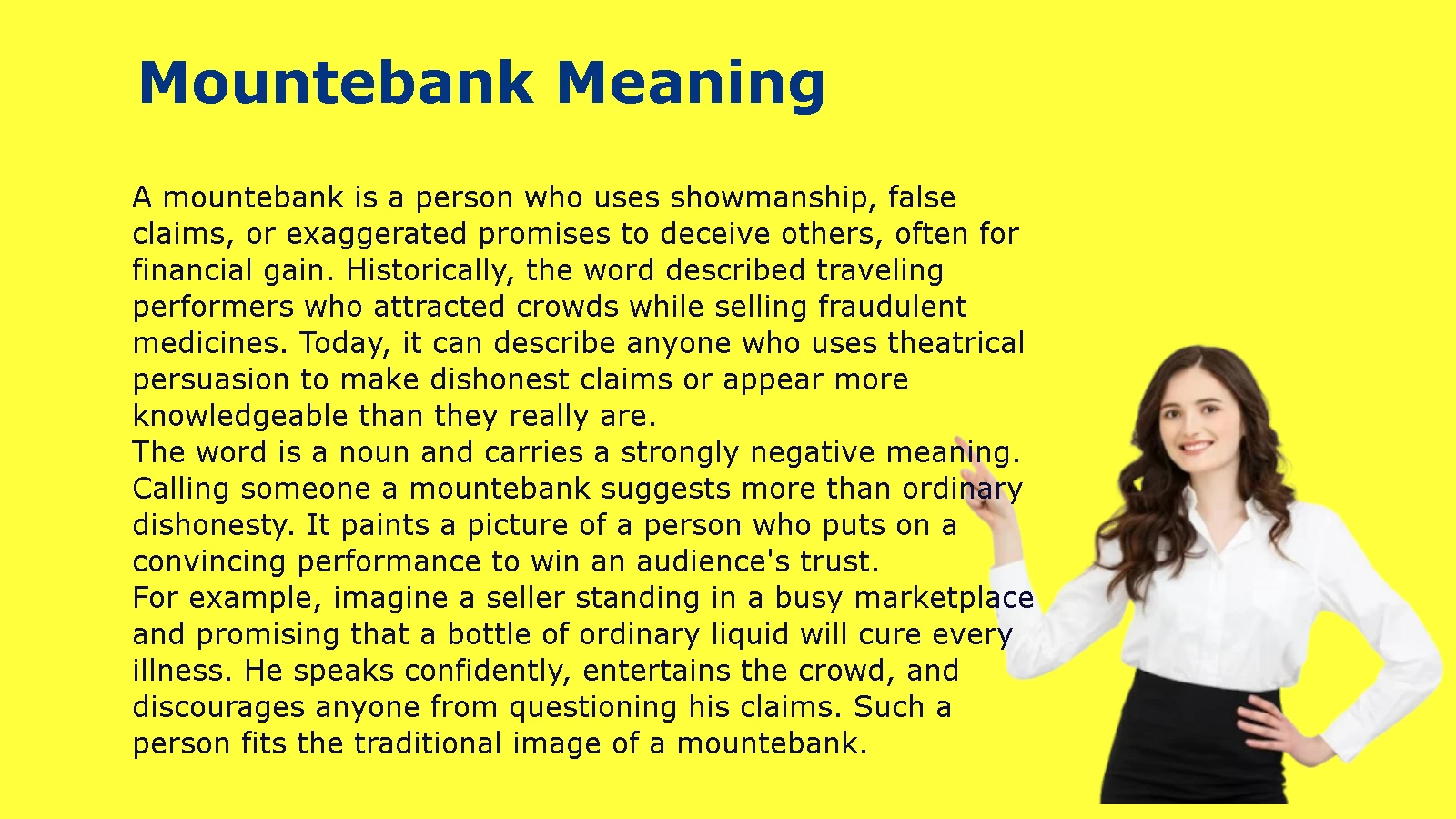
A mountebank is a person who uses showmanship, false claims, or exaggerated promises to deceive others, often for financial gain. Historically, the word described traveling performers who attracted crowds while selling fraudulent medicines. Today, it can describe anyone who uses theatrical persuasion to make dishonest claims or appear more knowledgeable than they really are.
The word is a noun and carries a strongly negative meaning. Calling someone a mountebank suggests more than ordinary dishonesty. It paints a picture of a person who puts on a convincing performance to win an audience’s trust.
For example, imagine a seller standing in a busy marketplace and promising that a bottle of ordinary liquid will cure every illness. He speaks confidently, entertains the crowd, and discourages anyone from questioning his claims. Such a person fits the traditional image of a mountebank.
Mountebank Pronunciation and Part of Speech
The word mountebank is pronounced /ˈmaʊntɪbæŋk/. It has three syllables, with the primary stress on the first syllable.
- Part of speech: Noun
- Pronunciation: /ˈmaʊntɪbæŋk/
- Plural form: Mountebanks
- Meaning: A showy or deceptive person who wins people’s trust through false claims or theatrical persuasion
- Tone: Negative, formal, and sometimes literary
The opening sound resembles the word mount, while the final part sounds like bank. The spelling may look unusual, but its pronunciation becomes easier when you divide it into three syllables.
Here is an example:
The villagers eventually discovered that the charming salesman was nothing more than a mountebank selling worthless remedies.
In this sentence, mountebank identifies a person whose confident performance hides dishonest intentions.
Mountebank Synonyms and Related Words
Several English words describe dishonest people, but they do not all carry the same meaning. The best synonym depends on the kind of deception you want to emphasize.
| Synonym | Meaning | How it differs from mountebank |
| Charlatan | Someone who falsely claims special knowledge or skill | Emphasizes fake expertise |
| Quack | Someone who makes fraudulent or irresponsible medical claims | Focuses on medicine and health |
| Fraud | A person or act involving deliberate deception | A broad term for dishonesty |
| Swindler | Someone who cheats people, often out of money | Emphasizes financial deception |
| Impostor | Someone who pretends to be another person or have an identity they lack | Focuses on false identity or status |
| Con artist | Someone who tricks people through a planned deception | Emphasizes manipulation and scams |
| Humbug | A person, claim, or practice that is deceptive or pretentious | Often carries a dismissive or old-fashioned tone |
A mountebank stands out because of the theatrical quality of the deception. The word suggests someone who attracts attention, delivers a persuasive pitch, and uses confidence or spectacle to influence an audience.
For instance, a person who falsely claims to hold a medical degree might be a charlatan. If that person also performs dramatic demonstrations to sell fake cures, mountebank may capture the behavior more vividly.
Origin and Etymology of Mountebank
The word mountebank entered English during the 16th century through Italian. Its history connects the term to people who mounted benches or raised platforms to attract public attention while selling goods, performing tricks, or promoting supposed remedies.
The original image helps explain the word’s modern meaning. A mountebank was not simply someone who lied. The person often turned deception into a public performance, using confidence, entertainment, and persuasive language to attract customers.
Over time, the term became associated with fraudulent claims and false expertise. Its meaning expanded beyond traveling medicine sellers to include people who use elaborate performances to mislead others.
What Does the Italian Root Mean?
The word is associated with the Italian expression montimbanco, commonly explained through the elements related to mounting or climbing and a bench.
- Montare: To mount, climb, or get onto something.
- Banco: A bench, counter, or similar raised surface.
The literal image is of a person getting onto a bench to address a crowd. In a marketplace, a raised position helped a seller become visible and audible above the surrounding noise.
Picture a crowded square filled with merchants, shoppers, entertainers, and curious onlookers. A traveling seller climbs onto a wooden bench and begins shouting about a remarkable remedy. He promises renewed energy, relief from pain, and protection against illness. His dramatic delivery draws a crowd before anyone has examined the product.
That scene captures the connection between the word’s historical roots and its modern connotation.
The important distinction is that public performance alone does not make someone a mountebank. A legitimate entertainer or salesperson may use dramatic techniques without deceiving anyone. The negative meaning arises when showmanship supports false claims or dishonest intentions.
The Historical Mountebank in Public Markets
Traveling sellers and performers once relied on public gatherings to find customers. Markets and fairs offered ideal opportunities because large crowds brought potential buyers together in one place.
Some sellers combined entertainment with product demonstrations. They might tell elaborate stories, perform tricks, display unusual objects, or claim to possess secret knowledge. A dramatic presentation helped them stand out from ordinary merchants.
The most notorious examples involved questionable medical products. A seller might advertise a tonic as a cure for numerous unrelated illnesses, even when there was little or no evidence that it worked.
These sellers often used several persuasive tactics:
- Exaggerated promises: They claimed that one product could solve many different problems.
- Manufactured urgency: They warned customers that the opportunity would disappear soon.
- Appeals to authority: They presented themselves as experts or guardians of secret knowledge.
- Public demonstrations: They used performances to make their claims appear convincing.
- Emotional persuasion: They appealed to people’s fears, hopes, and desire for a better life.
These techniques help explain why the word became associated with deception.
The historical mountebank also belongs to a wider tradition of traveling entertainers who performed tricks, told stories, and sold merchandise. Not every performer was fraudulent. The term became especially negative when sellers used their public performances to support dishonest claims.
How Snake-Oil Salesmen Became a Familiar Example
The phrase snake-oil salesman is closely related to the traditional image of a mountebank. It describes someone who promotes a product or service with exaggerated promises, often while lacking credible evidence that it delivers the advertised results.
The phrase is especially associated with traveling medicine sellers in the American West. Some sellers marketed supposed cures with impressive claims that customers could not easily verify.
The comparison remains useful today because the underlying behavior has not disappeared. The setting may change from a wooden platform to a livestream, but the pattern can remain familiar:
- A seller identifies a problem that matters deeply to an audience.
- The seller promises an unusually simple solution.
- The seller presents confidence or a compelling story as proof.
- The seller discourages careful examination of the evidence.
- The audience is encouraged to pay before independently checking the claims.
A modern mountebank does not need a bottle of miracle medicine or a crowded marketplace. A polished website, persuasive video, or convincing testimonial can serve the same purpose.
Key Characteristics of a Mountebank
A mountebank combines persuasive presentation with misleading claims. The person may be charming, entertaining, and confident, but those qualities serve a deceptive purpose when the person deliberately misrepresents a product, skill, or source of knowledge.
The word is particularly effective when the deception depends on winning an audience rather than relying only on a hidden lie.
A Dramatic and Persuasive Sales Pitch
Mountebanks often use a performance to capture attention. They may speak rapidly, tell entertaining stories, make bold promises, or present ordinary products as extraordinary discoveries.
The presentation can make an audience feel that something remarkable is happening. People may become so absorbed in the performance that they pay less attention to the actual evidence.
Consider this example:
The mountebank dazzled the crowd with extravagant promises, claiming that his ordinary tonic could restore youth and cure every common ailment.
The seller’s performance creates excitement, but excitement does not prove the claims are true.
A dramatic sales pitch becomes suspicious when it relies on:
- Promises that sound too good to be realistic.
- Claims that cannot be independently verified.
- Testimonials without reliable supporting evidence.
- Pressure to buy immediately.
- Attempts to ridicule or silence skeptical questions.
However, enthusiasm alone is not evidence of dishonesty. A skilled public speaker can be energetic and persuasive while remaining honest. The defining issue is whether the person knowingly uses deception.
The Illusion of Expertise
Another characteristic of a mountebank is the appearance of knowledge that the person does not genuinely possess.
Someone might invent credentials, exaggerate professional experience, claim access to secret information, or present personal opinions as established facts. The goal is to make an audience believe that the person has authority that has not been earned or demonstrated.
For example, imagine an online personality who calls himself a financial expert and promises guaranteed investment returns. He uses technical language, displays expensive possessions, and insists that ordinary investors cannot understand his exclusive method. Yet he provides no credible evidence for his claims.
The theatrical confidence may be persuasive, but it does not establish expertise.
When evaluating a claim, consider the following questions:
- Can the person’s qualifications be verified?
- Does the evidence support the promised result?
- Are the risks explained honestly?
- Can independent sources confirm the central claims?
- Does the person welcome reasonable questions?
These questions help separate genuine expertise from a performance designed to imitate it.
Deception for Money, Influence, or Personal Gain
Financial gain is a common motive associated with mountebanks, but money is not the only possible reward. A deceptive person may also seek admiration, influence, status, or control over an audience.
The word suggests deliberate misrepresentation. A person who makes an honest mistake is not automatically a mountebank, nor is someone who offers an unpopular opinion.
The distinction depends on the nature of the conduct.
| Behavior | Does it fit the meaning of mountebank? | Reason |
| A seller knowingly promotes a fake cure | Yes | The seller uses false claims to deceive customers |
| A comedian exaggerates a story for entertainment | Usually not | The audience understands the performance as entertainment |
| A consultant makes a prediction that later proves wrong | Not necessarily | A mistaken prediction does not establish deliberate deception |
| A fake expert invents credentials to attract paying clients | Yes | The person creates a false impression of expertise |
| A salesperson describes a real product enthusiastically | Not by itself | Persuasion is not the same as fraud |
Intent and evidence matter. The term should describe deceptive behavior, not simply a person who is confident, theatrical, or mistaken.
Mountebank Examples in History and Modern Life
The meaning of mountebank becomes clearer when you see how it works in different situations. Historically, the word evokes a public performer who sells false promises. In modern contexts, it can describe someone who uses a similar combination of spectacle, persuasion, and deception.
The examples below are illustrative scenarios, not accusations against specific people or entire professions.
Historical Mountebanks and Snake-Oil Salesmen
Imagine a traveling seller arriving at a small town fair. He places a wooden case on a table, climbs onto a platform, and announces that he has discovered a secret remedy unknown to ordinary physicians.
The seller’s pitch relies on excitement and trust rather than reliable proof. If he knowingly misrepresents the product, he fits the traditional meaning of a mountebank.
Historical accounts and fictional portrayals often use this character to explore broader themes:
- Credulity: Why people believe claims that promise relief or success.
- Authority: How a confident performance can imitate genuine expertise.
- Hope: Why people facing difficult problems may accept extraordinary promises.
- Manipulation: How sellers turn emotions into opportunities for personal gain.
The character remains recognizable because people still encounter persuasive claims that deserve careful scrutiny.
Modern Examples of Mountebank Behavior
Today’s mountebank may use digital platforms instead of public benches. Social media, online advertising, livestreams, and paid communities provide new ways to attract an audience.
The essential pattern remains the same: a person builds credibility through performance and uses that credibility to promote misleading claims.
Social Media Personalities Promoting Fake Wealth Schemes
Imagine an influencer who displays luxury cars and expensive vacations while promising followers that they can become wealthy in a few weeks through a secret trading system.
The influencer claims that the method works for everyone but avoids explaining the risks. Followers must pay for an expensive course to access the supposed secret.
If the influencer knowingly misrepresents the results or fabricates the evidence, the behavior may fit the meaning of a mountebank.
The warning signs include guaranteed returns, unverifiable testimonials, fabricated success stories, and pressure to purchase before asking questions.
Wellness Sellers Making Miracle-Cure Claims
Consider a seller who markets a supplement as a universal solution for fatigue, chronic pain, and numerous unrelated health problems. The seller uses dramatic testimonials and claims that medical professionals are hiding the product’s benefits.
The problem is not that every supplement seller is dishonest. The concern is the deliberate use of unsupported medical claims to influence customers.
When a seller knowingly invents benefits or misrepresents evidence, mountebank becomes a fitting description of the deceptive conduct.
Online Gurus Promising Guaranteed Success
An online business coach might claim to possess a secret formula that guarantees financial independence. The coach advertises exceptional results but offers no reliable evidence that typical customers achieve them.
A legitimate coach can teach useful skills and share personal experience. The term mountebank becomes relevant when the person knowingly manufactures authority or promises results that the advertised method cannot support.
Cryptocurrency Scammers Using Theatrical Confidence
Imagine a promoter who describes a digital token as a once-in-a-lifetime opportunity. The promoter uses complicated terminology, makes extraordinary claims about future prices, and pressures followers to invest immediately.
The person may present confidence as proof and portray skeptics as people who simply fail to understand the opportunity.
If the promoter knowingly conceals material facts or makes fraudulent promises, the behavior resembles that of a modern mountebank.
This example also illustrates an important distinction: a risky investment is not automatically a scam. The word applies to deceptive conduct, not to every person or project associated with financial risk.
Example Sentences Using Mountebank
These original sentences demonstrate how to use mountebank naturally in different contexts.
| Context | Example sentence | Meaning in context |
| Historical | The mountebank promised that his tonic could cure nearly every illness. | A seller used false medical claims. |
| Literary | The novel’s mountebank charmed the villagers before stealing their savings. | A deceptive character gained trust through charm. |
| Professional | The investigator exposed the consultant as a mountebank who had invented his qualifications. | The consultant falsely presented himself as an expert. |
| Financial | Investors eventually questioned the mountebank’s promises of guaranteed profits. | The promoter used misleading financial claims. |
| Social commentary | The columnist described the self-proclaimed prophet as a mountebank. | The writer criticized someone for deceptive claims. |
| Everyday conversation | I would be cautious about trusting that mountebank with my money. | The speaker expresses distrust. |
| Fiction | The king’s advisers warned him that the traveling healer was a mountebank. | The healer’s claims appeared fraudulent. |
| Formal writing | The speech exposed the mountebank’s elaborate performance as a calculated deception. | The performance helped conceal dishonest intentions. |
Here are a few more examples that show the word in a natural sentence structure:
- The town grew suspicious when the mountebank refused to explain how his miracle remedy worked.
- Beneath his polished presentation, the mountebank concealed a complete lack of expertise.
- The playwright created a memorable mountebank whose charm proved more dangerous than his lies.
- Rather than offering evidence, the mountebank relied on grand promises and emotional appeals.
- Her investigation revealed that the celebrated healer was a mountebank selling false hope.
Writing tip: Because mountebank is relatively uncommon, use enough context to make the meaning clear. In casual writing, fraudster or con artist may sound more natural. In literary or formal writing, mountebank can add color and precision.
A Practical Case Study: Recognizing a Modern Mountebank
Consider a fictional online entrepreneur named Daniel. He claims that he has developed a secret business method that guarantees a six-figure income within 90 days.
Daniel posts photographs of luxury hotels and expensive cars. His videos feature confident speeches, dramatic success stories, and testimonials from supposed students. He charges a large fee for access to his private program.
At first glance, his presentation appears convincing. However, potential customers notice several problems:
- He cannot provide verifiable evidence for his income claims.
- His testimonials cannot be independently confirmed.
- He avoids explaining the risks and costs of his method.
- He pressures customers to enroll immediately.
- He claims that anyone who questions him lacks ambition.
These warning signs do not, by themselves, prove fraud. They do justify further investigation. If evidence eventually establishes that Daniel knowingly fabricated his results and misled customers to collect payments, calling him a mountebank would capture both his deceptive claims and his theatrical sales approach.
This example demonstrates how to apply the word carefully. A strong vocabulary choice should reflect the evidence rather than replace it.
Mountebank vs. Charlatan vs. Quack
Mountebank, charlatan, and quack all describe people associated with deception, but they emphasize different behaviors. A mountebank relies on showmanship and persuasive performance. A charlatan falsely claims knowledge or expertise. A quack makes fraudulent or irresponsible medical claims.
The words overlap, so one person can fit more than one description. The most accurate choice depends on what the sentence emphasizes.
Mountebank vs. Charlatan
A mountebank is associated with theatrical persuasion. The word suggests someone who attracts an audience, creates excitement, and uses an impressive presentation to mislead people.
A charlatan is someone who pretends to possess knowledge, skills, or qualifications that they do not genuinely have.
For example:
- Mountebank: The mountebank entertained the crowd while selling a supposedly magical remedy.
- Charlatan: The charlatan claimed to be a medical authority despite having no relevant qualifications.
The first sentence emphasizes the public performance. The second emphasizes the false claim of expertise.
A person may be both. A fake medical expert who stages dramatic demonstrations to sell fraudulent treatments could reasonably be described as a mountebank and a charlatan.
Mountebank vs. Quack
A quack is specifically associated with fraudulent, misleading, or irresponsible medical practice. The term often describes someone who promotes unproven cures or pretends to have medical knowledge.
A mountebank does not have to work in medicine. The person might sell a fake investment strategy, promote a dishonest business opportunity, or use theatrical persuasion to obtain money.
Compare these sentences:
- Mountebank: The promoter used a dramatic presentation to sell a worthless investment scheme.
- Quack: The seller advertised a false cure for a serious illness.
The first focuses on deceptive showmanship. The second focuses on medical deception.
A medical fraudster may fit both descriptions if the person combines theatrical sales techniques with fraudulent health claims.
Mountebank vs. Swindler and Impostor
Two additional words can help clarify the meaning.
A swindler cheats people, commonly to obtain money or property. The term emphasizes the act of cheating rather than the person’s performance style.
An impostor pretends to be someone or something they are not. For example, someone who invents a professional identity to obtain a job may be an impostor.
A mountebank may also be a swindler or impostor, but the words highlight different aspects of the conduct.
| Word | Main focus | Example |
| Mountebank | Theatrical deception | A performer sells a fake miracle cure to a crowd. |
| Charlatan | False expertise | Someone invents specialist knowledge to attract clients. |
| Quack | Medical deception | A seller promotes fraudulent treatments. |
| Swindler | Cheating people, often financially | Someone tricks customers into paying for a nonexistent service. |
| Impostor | False identity or status | Someone pretends to hold a professional license. |
| Con artist | A planned scheme based on manipulation | Someone builds trust before stealing money. |
When Should You Use Mountebank Instead of Charlatan?
Use mountebank when the person’s theatrical behavior is central to the deception. It is particularly useful when someone wins an audience through charm, dramatic claims, or public spectacle.
Choose charlatan when the main issue is false expertise or invented knowledge.
For example:
- The mountebank captivated the audience with a theatrical demonstration before selling his fake remedy.
- The charlatan claimed to understand a complex scientific process but could not support his claims.
Both words criticize dishonesty, but the emphasis changes.
If you simply need a broad term for someone who cheats others, fraudster, swindler, or con artist may communicate the idea more directly.
Is Mountebank Stronger Than Quack?
Neither word is automatically stronger in every situation. They describe different kinds of misconduct.
Quack is more specific because it usually concerns medical claims or practice. Mountebank is broader and more theatrical, emphasizing the way a person presents themselves to an audience.
Calling someone a quack points toward questionable medical conduct. Calling someone a mountebank suggests that the person uses a persuasive performance to create a false impression.
The choice should depend on the behavior you want to describe, not on which word sounds more insulting.
How to Use Mountebank in a Sentence
The word mountebank works best when you want to describe someone who combines deception with an impressive or theatrical presentation. It is more common in formal writing, literary criticism, historical accounts, and pointed commentary than in casual conversation.
You can use it to describe a fictional character, discuss a historical practice, or criticize a person whose public performance supports dishonest claims.
Common Sentence Patterns for Mountebank
Several sentence patterns make the word easy to use.
A mountebank who…
This structure introduces the person’s deceptive behavior.
- The mountebank who visited the village promised to cure every illness.
- The mountebank who led the investment scheme relied on fabricated success stories.
The mountebank’s…
This possessive form draws attention to the person’s actions or methods.
- The mountebank’s promises persuaded several customers to buy the worthless product.
- The investigator questioned the mountebank’s claims about his qualifications.
He or she was dismissed as a mountebank…
This pattern explains how others judged the person.
- He was dismissed as a mountebank after his supposed discovery failed every independent test.
- The healer was dismissed as a mountebank when investigators uncovered the deception.
A modern mountebank…
This form compares contemporary behavior with the traditional image.
- A modern mountebank may use polished videos instead of a raised platform.
- The article described the fictional promoter as a modern mountebank selling false promises of success.
These patterns help you use the word without forcing it into a sentence where a simpler synonym would work better.
Is Mountebank Insulting or Offensive?
Mountebank is a strongly negative word because it suggests deliberate deception, false claims, or dishonest manipulation. It is not a neutral description of someone who is merely mistaken or overly enthusiastic.
Calling a person a mountebank can sound formal, literary, sarcastic, or openly critical depending on the context.
For example:
- The presenter is an energetic salesperson. This statement describes a style without alleging dishonesty.
- The presenter is a mountebank who knowingly sells false promises. This statement makes a serious accusation.
The second sentence should be supported by evidence if it refers to a real person. A misleading impression or personal disagreement is not enough to establish deliberate fraud.
In fiction, however, the word can be a useful characterization tool. It immediately suggests a person who uses charm, spectacle, or false authority to deceive others.
Is Mountebank Archaic or Still Used Today?
Mountebank is an uncommon word in everyday conversation, but it remains useful in modern English. Writers use it when they want a more vivid or literary alternative to fraudster, charlatan, or con artist.
Its historical associations give it a particular flavor. It evokes a showy figure who attracts attention, performs confidence, and uses that performance to mislead an audience.
You may encounter the word in:
- Historical writing about traveling sellers and fraudulent remedies.
- Novels featuring deceptive healers, tricksters, or con artists.
- Political or cultural commentary criticizing misleading performances.
- Essays discussing false expertise and exaggerated claims.
- Literary descriptions of people who manipulate audiences.
The word’s old-fashioned tone can be an advantage. It adds character to a sentence when a plain term feels too ordinary.
However, clarity should guide your choice. If your readers may not know the word, explain it briefly or choose a more familiar alternative.
Frequently Asked Questions About Mountebank
What Does Mountebank Mean in Simple Words?
A mountebank is a person who tricks others through showmanship, false promises, or exaggerated claims. The word traditionally describes a performer who sells fraudulent remedies, but it can also refer to a modern scammer who uses charm and confidence to mislead an audience.
Is Mountebank a Negative Word?
Yes. Mountebank has a strongly negative meaning because it suggests that someone deliberately deceives others. It is not simply a word for a confident speaker or entertaining performer. The term implies dishonest claims or misleading behavior.
Is Mountebank Still Used Today?
Yes. Although mountebank is relatively uncommon in everyday speech, writers still use it in literature, historical accounts, essays, and criticism. It is especially useful when a person combines theatrical persuasion with deception.
Can Mountebank Be Used as a Verb?
Yes, mountebank has a rare verb use meaning to behave like a mountebank or deceive people through showmanship. However, the noun is much more common. Most modern writers use the word to identify a deceptive person rather than describe an action.
What Is the Difference Between a Mountebank and a Charlatan?
A mountebank emphasizes theatrical deception and attention-grabbing persuasion, while a charlatan emphasizes false claims of expertise or special knowledge. A person can be both if they pretend to possess professional knowledge and use a dramatic performance to make their claims convincing.
What Is Another Word for Mountebank?
Common alternatives include charlatan, fraudster, swindler, impostor, quack, and con artist. Use charlatan for false expertise, quack for fraudulent medical claims, and swindler for someone who cheats people. Mountebank is especially suitable when the deception involves showmanship.
Conclusion: Understanding the Meaning of Mountebank
The mountebank meaning centers on a person who uses theatrical persuasion, exaggerated claims, or false promises to deceive others. Historically, the word described public performers and sellers who attracted crowds while promoting questionable remedies. Today, it can describe anyone whose impressive presentation helps disguise dishonest claims.
The closest alternatives include charlatan, quack, swindler, and impostor, but each emphasizes a different kind of deception. A mountebank stands out for the performance itself: the confident pitch, the carefully constructed image, and the attempt to win an audience before the truth becomes clear.
When you encounter this word in a book, article, or conversation, look beyond the person’s confidence or charisma. Ask whether the person is using a performance to support claims that cannot withstand scrutiny.