Have you ever heard someone say “I’m grossed out” and wondered what they really mean? Grossed out is a common informal expression used when something makes you feel disgusted, uncomfortable, or strongly put off. You might use it after seeing something unpleasant, smelling something bad, or hearing something that makes your stomach turn.
Grossed out means feeling disgust or strong aversion toward something. It can describe a reaction to food, smells, images, behavior, or situations that you find unpleasant. The expression is especially common in casual conversations, texting, social media, and everyday American English.
Examples:
- I was totally grossed out by the smell coming from the refrigerator.
- She got grossed out when she saw the bug crawling on her plate.
The confusion is understandable. People often search for grossed out meaning, what does grossed out mean, grossed out meaning in text, or grossed out meaning in chat because the phrase sounds different from the literal meaning of gross. And here’s the kicker: grossed out usually describes your emotional reaction to something unpleasant rather than simply saying that something is “gross.”
In this guide, you’ll learn the complete meaning of grossed out, including its definition, pronunciation, origin, usage, synonyms, and examples. You’ll also see how to use grossed out naturally in everyday conversations, texts, and different situations.
What Does Grossed Out Mean?
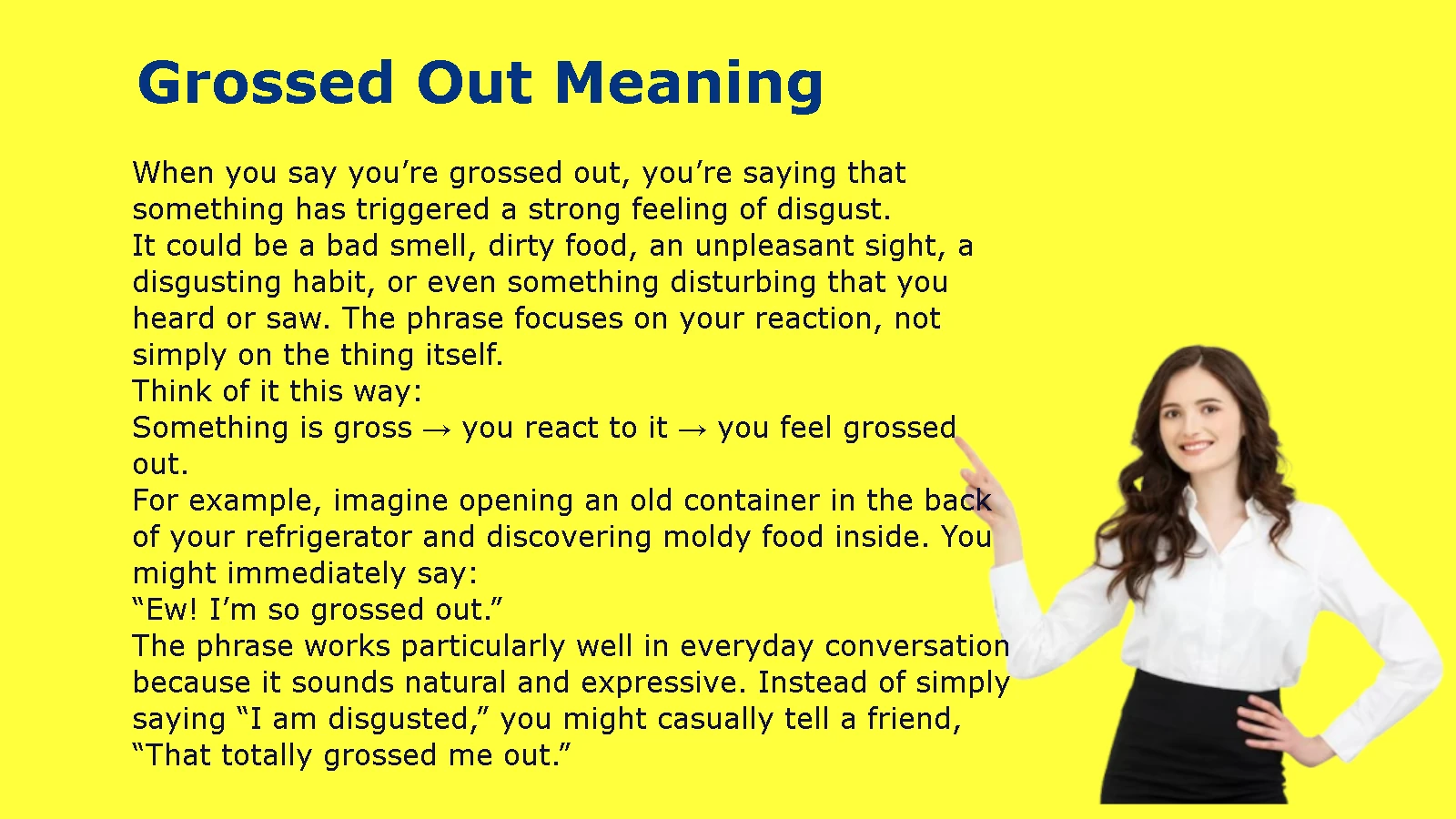
When you say you’re grossed out, you’re saying that something has triggered a strong feeling of disgust.
It could be a bad smell, dirty food, an unpleasant sight, a disgusting habit, or even something disturbing that you heard or saw. The phrase focuses on your reaction, not simply on the thing itself.
Think of it this way:
Something is gross → you react to it → you feel grossed out.
For example, imagine opening an old container in the back of your refrigerator and discovering moldy food inside. You might immediately say:
“Ew! I’m so grossed out.”
The phrase works particularly well in everyday conversation because it sounds natural and expressive. Instead of simply saying “I am disgusted,” you might casually tell a friend, “That totally grossed me out.”
Everyday examples of grossed out
Here are some common situations:
| Situation | Natural example |
| Bad smell | That smell really grossed me out. |
| Dirty bathroom | I was completely grossed out by the bathroom. |
| Insects | Seeing all those cockroaches made me grossed out. |
| Spoiled food | I got grossed out when I noticed the milk had gone bad. |
| Graphic movie scene | That scene in the movie grossed me out. |
| Unpleasant habit | I get grossed out when people chew with their mouths open. |
Notice the pattern. Grossed out describes an emotional or physical reaction to something unpleasant.
It doesn’t necessarily mean the person is literally sick. Someone can feel grossed out without vomiting or becoming physically ill.
What Does “I Am Grossed Out” Mean?
“I am grossed out” means “I feel disgusted or repelled by something.”
It’s a direct way to express a reaction to something unpleasant.
For example:
- I am grossed out by the smell.
- I am grossed out by those pictures.
- I am so grossed out right now.
- I’m grossed out by the thought of eating that.
The phrase can describe different levels of disgust. You might say “I’m a little grossed out” when something bothers you slightly. On the other hand, “I’m totally grossed out” communicates a much stronger reaction.
What does “I’m so grossed out” mean?
“I’m so grossed out” means “I feel extremely disgusted.”
The word so adds emphasis.
For example:
“I’m so grossed out by that picture. Why did you send it to me?”
The speaker isn’t simply saying the picture looks unpleasant. The picture caused a noticeable emotional reaction.
Can you say “I got grossed out”?
Yes.
“I got grossed out” means that you became disgusted after encountering something unpleasant.
For example:
I got grossed out when I found a dead insect in my drink.
The difference is small but useful:
- I am grossed out = I feel disgusted now.
- I got grossed out = I became disgusted because of something.
- It grossed me out = It caused me to feel disgusted.
Grossed Out Meaning in Slang
Grossed out is informal English and is also commonly described as slang. Collins identifies gross out as informal and gives it a US slang usage meaning to disgust, shock, or offend.
That makes it especially common in casual conversations, texts, social media, movies, and everyday speech.
You wouldn’t normally choose grossed out for a highly formal report. In formal writing, disgusted, repelled, or another more precise term may fit better.
Examples of grossed out in casual speech
- That video totally grossed me out.
- I’m grossed out just thinking about it.
- She was grossed out by the dirty dishes.
- Don’t show me that. I’m already grossed out.
- He doesn’t get grossed out easily.
The expression also appears in the related noun gross-out, as in gross-out humor. That term refers to humor designed to provoke disgust or shock. Collins lists gross-out as a noun and adjective in this sense.
Is “grossed out” rude?
Not usually.
It’s an informal expression, but it isn’t inherently offensive. You can use it in ordinary conversation with friends, family, classmates, or coworkers in a casual setting.
Still, the tone matters. Saying “That food grossed me out” is casual. Saying “I found the food extremely unpleasant” sounds much more restrained and formal.
Grossed Out Synonyms
Several words can replace grossed out, but they don’t all carry exactly the same tone or strength.
| Synonym | Meaning | Typical tone |
| Disgusted | Strongly bothered by something unpleasant | General |
| Repulsed | Strongly driven away by disgust | Stronger, formal |
| Nauseated | Feeling sick or as if you might vomit | Physical |
| Sickened | Made to feel physically or emotionally sick | Strong |
| Appalled | Shocked and horrified by something | Strong, often moral or emotional |
| Revolted | Feeling intense disgust | Strong and formal |
| Squeamish | Easily disturbed by unpleasant or graphic things | Describes a tendency |
| Queasy | Feeling physically sick or uneasy | Physical |
Thesaurus references commonly associate grossed out with words such as disgusted, appalled, nauseated, repelled, repulsed, and sickened. However, these words aren’t interchangeable in every sentence.
For example, nauseated usually emphasizes physical sickness:
The smell made me nauseated.
Meanwhile, grossed out sounds more conversational:
The smell totally grossed me out.
Likewise, appalled can suggest shock or horror rather than simple disgust:
She was appalled by his behavior.
So, the best synonym depends on the exact reaction you want to describe.
Grossed Out vs. Disgusted
Grossed out and disgusted have almost the same basic meaning, but their tone differs.
Disgusted is the broader and more standard word. Grossed out is more casual and conversational.
Compare these examples:
I was disgusted by the smell.
I was grossed out by the smell.
Both sentences tell you that the smell caused a negative reaction. The second sounds more relaxed and conversational.
Key difference
| Grossed out | Disgusted |
| Informal | Neutral and widely usable |
| Very common in conversation | Works in casual and formal contexts |
| Often sounds expressive | Can sound more serious |
| Usually describes a reaction to something unpleasant | Can describe disgust toward things, actions, behavior, or situations |
Disgusted can also carry a broader emotional meaning.
For example:
I was disgusted by the way he treated his employees.
You could say:
I was grossed out by the way he treated his employees.
However, the second sentence sounds more informal and may suggest a visceral reaction rather than a serious moral judgment.
A useful shortcut is this:
Grossed out = casual disgust.
Disgusted = general disgust.
Grossed Out vs. Gross
These two expressions are closely related, but they don’t play the same grammatical role.
Gross usually describes something that causes disgust.
Grossed out describes the person’s reaction to it.
Consider this simple example:
That bug is gross.
Here, gross describes the bug.
Now compare:
I am grossed out by that bug.
Here, grossed out describes the person’s reaction.
Compare the two
| Gross | Grossed out |
| Describes something unpleasant | Describes someone’s reaction |
| Usually an adjective | Usually a participial adjective from the phrasal verb gross out |
| That smell is gross. | That smell grossed me out. |
| This food looks gross. | I’m grossed out by this food. |
The distinction becomes even clearer in conversation:
“That’s gross!”
means something like:
“That is disgusting.”
But:
“I’m grossed out!”
means:
“I feel disgusted!”
So, gross points toward the unpleasant thing, while grossed out points toward the person experiencing the reaction.
What Does “Grossed Up” Mean?
Grossed up has a completely different meaning from grossed out.
The similarity between the phrases can cause confusion because they both begin with grossed, but out and up change the meaning entirely.
In financial and tax contexts, gross up means to increase an amount so that it reaches its value before taxes or deductions. Collins defines it as increasing net income to its pretax value.
For example, suppose an employer promises an employee a particular amount after tax. The employer may need to increase the gross payment so that the employee receives the promised amount after tax is deducted.
The UK government’s HMRC explains that an employer can gross up a payment by increasing the gross remuneration so that the employee receives the expected net amount after tax.
Grossed out vs. grossed up
| Phrase | Meaning | Example |
| Grossed out | Made to feel disgusted | That smell grossed me out. |
| Grossed up | Increased to a gross or pretax amount | The company grossed up the payment for tax purposes. |
There is also another use of gross up in ordinary language. Depending on the context, gross up can refer to increasing a total amount or bringing an amount to a gross figure.
So don’t treat grossed up as another spelling of grossed out.
They are completely different expressions.
Grossed Out Meaning in a Sentence
The easiest way to understand grossed out is to see how people use it naturally.
Everyday examples
1. Bad food
I was grossed out when I opened the container and saw moldy food inside.
The mold caused the speaker to feel disgusted.
2. Strange smell
That smell coming from the kitchen really grossed me out.
The smell triggered the person’s reaction.
3. Insects
She gets grossed out whenever she sees a spider.
This describes a person’s usual reaction to spiders.
4. Dirty surroundings
We were completely grossed out by the condition of the hotel bathroom.
The bathroom caused strong discomfort or disgust.
5. A movie
The special effects in that horror movie grossed me out.
The movie caused the speaker to feel disgusted or disturbed.
6. An unpleasant habit
I get grossed out when someone talks while chewing food.
The person’s eating habit causes a feeling of disgust.
7. Spoiled milk
He was grossed out after realizing he had accidentally drunk spoiled milk.
The discovery caused a strong unpleasant reaction.
8. A disturbing picture
Don’t send me pictures like that. They gross me out.
The speaker finds the pictures disgusting or disturbing.
Grossed out in different sentence patterns
You can use the phrase in several common ways:
Be grossed out by + noun
I’m grossed out by dirty dishes.
Be grossed out by + -ing verb
She’s grossed out by people spitting in public.
Get grossed out + when/if
I get grossed out when I see mold.
Gross someone out
That video grossed me out.
Gross someone out with + noun
He grossed everyone out with that story.
The phrasal verb is flexible, which helps explain why you see several different sentence patterns around grossed out.
How Do You Pronounce Grossed Out?
Grossed out is pronounced approximately:
/ɡroʊst aʊt/
The first word rhymes closely with toast, while out has the familiar vowel sound in words such as shout and about.
When spoken naturally, the two words flow together:
grossed out
The -ed ending in grossed does not create an extra syllable. The word remains one syllable.
Grossed Out Meaning in Tagalog
In Tagalog, grossed out can be expressed with words and phrases related to disgust or revulsion, depending on the context.
A common expression is “nandidiri”, which conveys the idea of feeling disgusted or repelled by something. Translation resources also use nandidiri in contexts corresponding to “getting grossed out.”
For example:
I’m grossed out.
Nandidiri ako.
A more context-specific translation may use a phrase related to something being nakakadiri, meaning disgusting or capable of causing disgust.
Because translations depend on the situation, grossed out doesn’t always have one perfect Tagalog equivalent. The best choice depends on whether you’re describing disgust, nausea, discomfort, or a reaction to something unpleasant.
Frequently Asked Questions About Grossed Out
What does grossed out mean?
Grossed out means feeling disgusted, repelled, or uncomfortable because of something unpleasant. It’s an informal expression commonly used in everyday English.
I was grossed out by the smell.
What does “I am grossed out” mean?
“I am grossed out” means “I feel disgusted.” It tells someone that something has caused a strong feeling of disgust or discomfort.
For example:
I am grossed out by the insects in this room.
Is grossed out slang?
Grossed out is informal English and is commonly classified as slang. It comes from the phrasal verb gross out, which means to make someone feel disgusted or strongly dislike something. Collins identifies the expression as informal and also gives a US slang usage.
It’s perfectly natural in casual conversation, but a more formal word such as disgusted may work better in formal writing.
What is another word for grossed out?
Common alternatives include:
- Disgusted
- Repulsed
- Nauseated
- Sickened
- Appalled
- Revolted
- Queasy
- Squeamish
The best alternative depends on the context. Nauseated, for instance, emphasizes physical sickness, while appalled can emphasize shock or horror.
What does grossed up mean?
Grossed up has a different meaning from grossed out.
In financial contexts, gross up means to increase an amount to its gross or pretax value. For example, an employer may gross up a payment so the employee receives a specific amount after taxes.
Is grossed out the same as disgusted?
They are very similar, but grossed out sounds more informal and conversational.
That movie grossed me out.
That movie disgusted me.
Both sentences express a negative reaction. Grossed out simply has a more casual, everyday feel.
How do you pronounce grossed out?
Grossed out is pronounced /ɡroʊst aʊt/. The phrase contains two one-syllable words, and the -ed in grossed doesn’t add another syllable.
Final Takeaway
Grossed out means feeling disgusted, repelled, or uncomfortable because of something unpleasant. It’s an informal expression that works especially well in everyday conversations.
You can use it to describe reactions to bad smells, spoiled food, insects, graphic scenes, dirty places, disturbing behavior, and many other unpleasant things.
The most useful distinction to remember is simple:
- Gross describes something unpleasant.
- Grossed out describes your reaction to it.
- Disgusted has a similar meaning but sounds more neutral.
- Grossed up has an entirely different meaning related to increasing an amount to its gross or pretax value.
Once you understand that difference, grossed out becomes a straightforward phrase to use naturally in everyday English.