Have you ever wondered what fertility really means when you see it used in conversations about health, pregnancy, farming, or reproduction? The word can refer to more than one thing, but its basic meaning is connected to the ability to produce life or support growth.
Fertility means the ability to produce offspring or, in the case of land, the ability to support healthy plant growth. When people talk about human fertility, they usually mean the ability of a person to conceive or contribute to reproduction. For soil, fertility describes how well the soil can provide the nutrients plants need to grow.
Examples:
- The couple talked to a doctor about fertility.
- Farmers work to improve the fertility of the soil.
The meaning is usually clear from context. People may search for fertility meaning, what does fertility mean, fertility meaning in English, or fertility meaning in a relationship because the word can appear in both everyday and specialized contexts. And here’s the kicker: fertility doesn’t only describe human reproduction. It can also describe the productive quality of soil, land, or other natural resources.
In this guide, you’ll learn the complete fertility meaning, including its definition, pronunciation, origin, synonyms, and usage. You’ll also see how fertility is used in different contexts, along with clear examples to help you understand the word and use it correctly.
Fertility Meaning
The simplest fertility definition is:
Fertility is the ability to reproduce, produce offspring, or support productive growth, depending on the context.
For humans and animals, fertility generally concerns reproductive ability. A fertile individual has the biological capacity to contribute to reproduction.
In plants, fertility can refer to an organism’s ability to reproduce or produce viable offspring. The term can also describe the reproductive capacity of a population.
Agriculture gives the word another important meaning. Soil fertility refers to the ability of soil to support plant growth by providing essential nutrients and suitable chemical, physical, and biological conditions.
That distinction matters because fertility doesn’t always refer to people or pregnancy.
Fertility at a glance
| Context | Meaning of fertility |
| Humans | The ability to reproduce or conceive |
| Animals | The ability to produce offspring |
| Plants | Reproductive capacity or ability to produce viable offspring |
| Agriculture | The ability of soil to support plant growth |
| Demography | Patterns and levels of childbearing within a population |
| Population studies | Measured levels of births or childbearing |
In everyday conversation, the human reproductive meaning is usually the first one people think of. In scientific and agricultural writing, though, context determines the meaning.
What Does Fertility Mean?
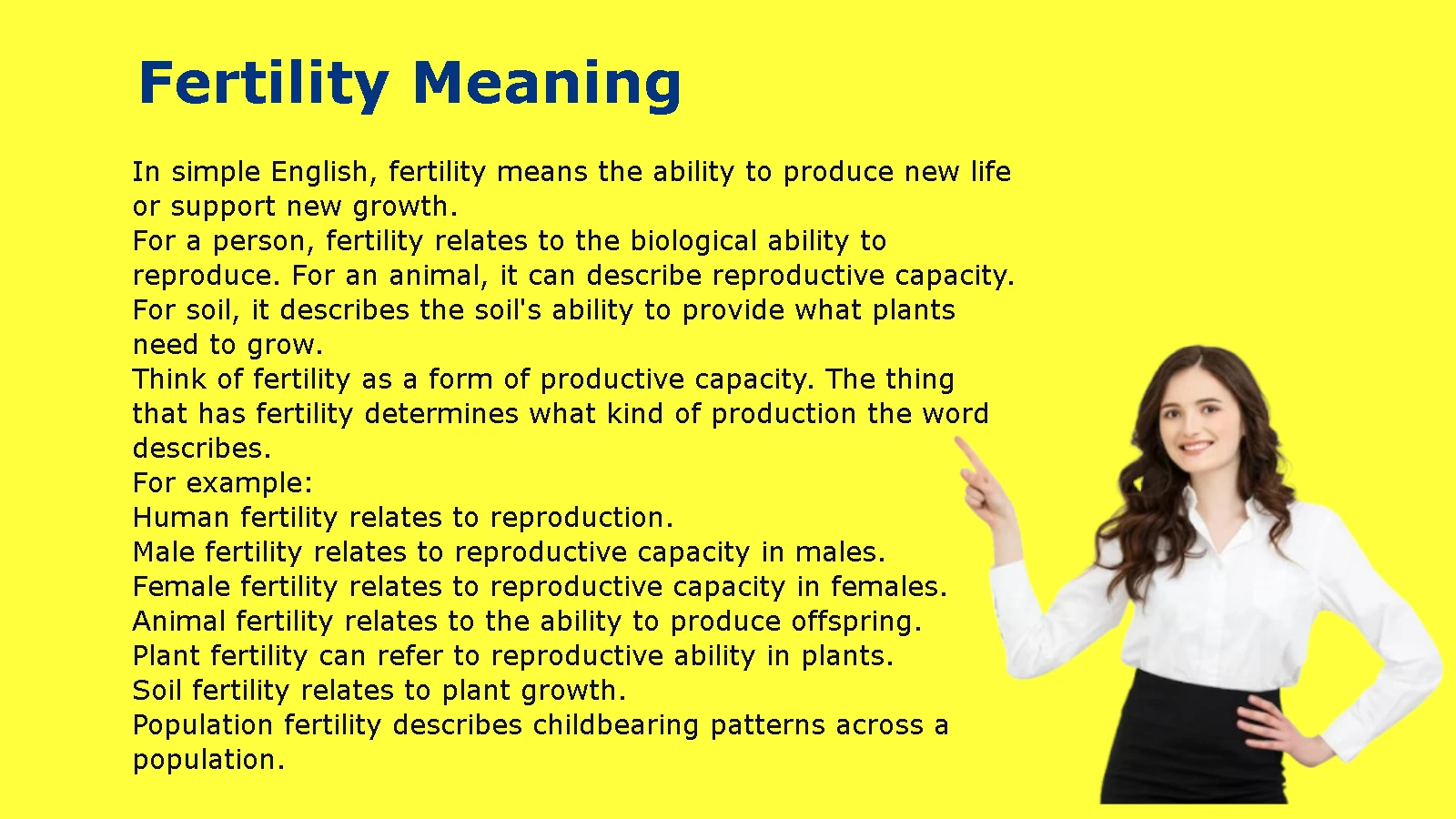
In simple English, fertility means the ability to produce new life or support new growth.
Think of fertility as a form of productive capacity. The thing that has fertility determines what kind of production the word describes.
For example:
- Human fertility relates to reproduction.
- Male fertility relates to reproductive capacity in males.
- Female fertility relates to reproductive capacity in females.
- Animal fertility relates to the ability to produce offspring.
- Plant fertility can refer to reproductive ability in plants.
- Soil fertility relates to plant growth.
- Population fertility describes childbearing patterns across a population.
Everyday examples of fertility
Here are a few examples that show how the meaning changes with context:
The couple spoke with a specialist about fertility.
Here, fertility refers to the ability to conceive.
The study examined fertility patterns among different age groups.
In this sentence, fertility has a demographic meaning.
Farmers test the soil to evaluate its fertility.
This example refers to the soil’s capacity to support plant growth.
The word therefore isn’t limited to one narrow subject. Context does most of the work.
Fertility Meaning in Humans
In humans, fertility means the biological ability to reproduce or achieve conception.
Human fertility involves both male and female reproductive systems. Successful reproduction requires several biological processes to work together, including the production of reproductive cells, reproductive function, fertilization, and the ability to support early development.
Fertility isn’t simply a yes-or-no characteristic in every practical situation. Reproductive ability can vary among individuals and can change over time.
Several biological factors can influence fertility, including:
- Age
- Reproductive anatomy
- Hormonal function
- Ovulation
- Sperm production and function
- Conditions affecting the reproductive organs
- Certain genetic factors
- General health and environmental influences
Importantly, fertility and the ability to become pregnant aren’t identical concepts for every person or situation. Human reproduction involves contributions from both reproductive partners, and difficulties conceiving can have male, female, combined, or unexplained causes.
The World Health Organization describes infertility as a disease of the male or female reproductive system involving failure to achieve pregnancy after 12 months or more of regular unprotected sexual intercourse.
That clinical definition describes infertility, not the everyday definition of fertility. It also shows why fertility should be understood as a broader concept than simply asking whether someone has ever become pregnant.
A simple example
Imagine two people who are both capable of contributing biologically to conception. Their reproductive capacity is part of their fertility.
If conception occurs, pregnancy can follow. If conception doesn’t occur after repeated attempts, many different biological or other factors may be relevant.
That’s why the word fertility often appears alongside terms such as conception, reproduction, ovulation, sperm, pregnancy, and infertility.
Fertility Meaning in Pregnancy
The relationship between fertility and pregnancy can cause confusion because the two terms describe different stages or concepts.
Fertility refers to reproductive ability, particularly the ability to conceive. Pregnancy is the state that begins after conception and continues as the developing pregnancy progresses.
In other words:
Fertility → conception → pregnancy
This is a simplified sequence, but it helps separate the concepts.
A person can have reproductive capacity without currently being pregnant. Likewise, being pregnant means conception has already occurred, although fertility itself isn’t synonymous with pregnancy.
Fertility vs. pregnancy
| Term | Basic meaning |
| Fertility | Ability or capacity to reproduce or conceive |
| Conception | The beginning of pregnancy following fertilization |
| Pregnancy | The state of carrying a developing pregnancy |
| Infertility | A clinical condition involving difficulty achieving pregnancy under defined circumstances |
This distinction becomes especially useful when reading health articles.
For example, the question “What does fertility mean?” asks about reproductive capacity. The question “What does pregnancy mean?” asks about a reproductive state.
They are related, but they aren’t interchangeable.
Fertility Meaning in Women
When people use fertility meaning in women, they generally mean a woman’s biological ability to conceive and contribute to reproduction.
Female fertility involves several parts of the reproductive system working together. Ovulation is particularly important because conception generally requires the release of an egg. The reproductive tract also plays an important role in allowing sperm and egg to meet and supporting the early stages following fertilization.
Age can influence female reproductive capacity. Fertility also varies because individuals have different biological characteristics and health histories.
Other factors can affect reproductive function as well. These may involve the ovaries, fallopian tubes, uterus, endocrine system, or other parts of the reproductive system. WHO notes that female infertility can result from a range of abnormalities involving reproductive organs and endocrine function.
However, fertility isn’t something that can be accurately judged from one visible characteristic.
What can affect fertility?
Depending on the individual, reproductive capacity can be influenced by factors such as:
- Age
- Ovulatory function
- Ovarian function
- Reproductive anatomy
- Hormonal factors
- Certain medical conditions
- Genetic factors
- Previous reproductive or pelvic conditions
These factors don’t mean that one particular characteristic automatically determines whether someone can conceive.
Fertility is a biological concept, not a simple label that predicts an individual’s reproductive future.
Fertility Meaning in Biology
In biology, fertility refers broadly to the capacity of an organism to reproduce or produce offspring.
This meaning extends far beyond humans.
A biological discussion might describe the fertility of mammals, birds, fish, insects, plants, or other organisms. Researchers can study fertility at the level of an individual, a breeding group, or a population.
Human fertility
Human fertility concerns reproduction and childbearing.
Animal fertility
In animals, fertility can describe reproductive capacity and the ability to produce offspring. Scientists may study fertility when examining breeding populations, reproductive success, or changes in animal populations.
Plant fertility
Plants reproduce through biological processes that differ greatly from those of animals. Some plants reproduce sexually through flowers, pollen, ovules, seeds, and fruits. Others can also reproduce through vegetative processes.
The broader biological idea remains similar: fertility concerns reproductive capacity.
Fertility and fecundity
Biology and demography sometimes distinguish fertility from fecundity.
Fecundity generally refers to the biological potential or capacity to reproduce, while fertility is often used to describe actual reproductive performance or childbearing, particularly in demographic contexts.
The distinction can become technical because researchers define these terms according to the population, species, and measurement being studied.
For everyday English, however, fertility is the more familiar term.
Fertility Meaning in Agriculture
Agriculture gives fertility an entirely different practical meaning.
Soil fertility is the ability of soil to provide essential nutrients and suitable chemical, physical, and biological conditions that allow plants to grow. The Food and Agriculture Organization uses this concept in its soil and agricultural resources.
A fertile soil isn’t simply soil that contains a lot of nutrients.
Plant growth depends on several interacting properties. Nutrients must be available in appropriate amounts and forms. Soil structure, water availability, chemical conditions, organic matter, and biological activity can all influence how well plants grow.
What makes soil fertile?
Important aspects of soil fertility include:
- Nutrient availability
- Organic matter
- Soil structure
- Water availability
- Chemical balance
- Biological activity
- Root-zone conditions
- Nutrient cycling
FAO describes soil fertility as involving the availability of nutrients such as nitrogen and phosphorus as well as the processes that store, recycle, and regulate those nutrients.
That means a field can contain nutrients without necessarily providing ideal growing conditions.
Soil fertility vs. soil productivity
These terms are related, but they’re not identical.
Soil fertility focuses on the soil’s capacity to support plant growth. Productivity is broader and can involve the actual output produced under particular environmental and management conditions.
For example, two fields may have similar nutrient levels but produce different yields because they receive different amounts of water, experience different weather, or use different farming practices.
Example of soil fertility
Suppose a farmer plants corn in two fields.
Field A has adequate nutrients, good structure, suitable moisture, and healthy biological activity.
Field B has depleted nutrients and poor soil structure.
Even if the same seeds go into both fields, the conditions aren’t equal. Field A provides a stronger foundation for plant growth.
That’s soil fertility in action.
Fertility Rate Meaning
Fertility rate is a demographic measure that describes childbearing within a population.
It differs from an individual’s fertility.
When demographers discuss fertility rates, they aren’t simply asking, “Can this person have a child?” Instead, they measure patterns of births among a defined population.
One of the most widely used measures is the total fertility rate (TFR).
The United Nations describes total fertility as an indicator calculated by summing age-specific fertility rates across the reproductive ages.
WHO expresses total fertility rate as children per woman and defines it as the average number of children a hypothetical woman would have if she experienced the age-specific fertility rates of a particular period throughout her reproductive years.
Why fertility rate isn’t the same as fertility
Consider this distinction:
Fertility: reproductive capacity or actual childbearing, depending on context.
Fertility rate: a statistical measure of childbearing in a population.
A fertility rate doesn’t tell you whether one particular person is fertile.
For example, a country could have a total fertility rate of 2.0 children per woman. That figure describes a population-level pattern. It doesn’t mean every woman in that population will have exactly two children.
That’s a crucial point.
Common fertility measures
Demographers use several related measures, including:
- Age-specific fertility rate (ASFR)
- Total fertility rate (TFR)
- General fertility rate
- Crude birth rate
Each measure answers a slightly different question.
Fertility Meaning in Demography
In demography, fertility refers to actual childbearing patterns within a population.
Demographers study fertility to understand how populations change over time. They may examine the number of births, the ages at which people have children, differences between regions, and changes in childbearing patterns.
One especially useful measure is the age-specific fertility rate. It examines births associated with particular age groups.
When researchers combine age-specific fertility rates across reproductive ages, they can calculate the total fertility rate. The United Nations notes that TFR and mean age at childbearing are useful for comparing fertility levels across populations and over time because they aren’t directly dependent on the population’s age distribution in the same way as crude measures.
Fertility rate vs. birth rate
These terms often appear together, but they aren’t identical.
| Term | What it measures |
| Fertility rate | Childbearing among a specified population, often measured by age |
| Total fertility rate | Expected number of children per woman based on current age-specific fertility rates |
| Birth rate | Number of births relative to the total population |
| Age-specific fertility rate | Births associated with women in a specific age group |
The denominator matters.
A birth rate typically relates births to the entire population. A fertility rate usually focuses more specifically on the population exposed to childbearing, such as women in specified reproductive age groups.
Why demographers study fertility
Fertility patterns can affect:
- Population growth
- Population aging
- School enrollment
- Workforce size
- Household structure
- Health planning
- Social services
- Long-term population projections
A change in fertility therefore affects much more than the number of babies born in one year. Over decades, changing fertility patterns can reshape the age structure of an entire population.
Fertility vs. Fertile
both come from the same word family, but they have different grammatical roles.
Fertility is a noun.
Fertile is an adjective.
Compare these examples:
The doctor discussed fertility with the patient.
The patient is in a fertile period of the reproductive cycle.
In agriculture:
The farm depends on good soil fertility.
The field has fertile soil.
The relationship is easy to remember:
| Word | Part of speech | Example |
| Fertility | Noun | Soil fertility supports crop growth. |
| Fertile | Adjective | The farmer has fertile soil. |
There is also a related adverb, fertilely, although it is uncommon in everyday English.
Fertility vs. fertile in simple terms
Think of fertility as the quality or capacity and fertile as a word that describes something possessing that quality.
For example:
- fertility = the capacity
- fertile = having that capacity
This pattern is similar to other noun-adjective relationships in English.
Fertility vs. Infertility
Fertility refers to reproductive capacity, while infertility describes a clinical condition involving difficulty achieving pregnancy under a defined set of circumstances.
The World Health Organization currently defines infertility as a disease of the male or female reproductive system involving failure to achieve pregnancy after 12 months or more of regular unprotected sexual intercourse.
Infertility can involve:
- Male factors
- Female factors
- A combination of factors
- Factors that remain unexplained
WHO also distinguishes primary infertility from secondary infertility. Primary infertility refers to situations in which a pregnancy has never been achieved, while secondary infertility occurs after at least one previous pregnancy.
The distinction is important because infertility doesn’t necessarily mean that reproduction is biologically impossible.
Instead, it is a defined medical condition used to describe difficulty achieving pregnancy.
A simple comparison
| Fertility | Infertility |
| Refers to reproductive capacity | Refers to a clinical condition involving difficulty achieving pregnancy |
| Can describe humans, animals, plants, or populations | Usually refers to human reproductive health |
| Has biological and demographic meanings | Has a specific clinical meaning |
| Doesn’t necessarily mean current pregnancy | Doesn’t necessarily mean reproduction is impossible |
Fertility Meaning in Different Contexts
The word fertility changes meaning depending on what you’re discussing.
| Context | Meaning |
| Humans | The ability to reproduce or conceive |
| Pregnancy | Reproductive capacity related to conception |
| Biology | The capacity of an organism to reproduce |
| Agriculture | The ability of soil to support plant growth |
| Demography | Patterns or levels of childbearing within a population |
This is why context matters so much.
When someone says, “The patient is concerned about fertility,” the subject is probably human reproduction.
If a farmer says, “The field has poor fertility,” the subject is soil.
If a statistician says, “The country’s fertility rate declined,” the subject is population-level childbearing.
One word. Three very different conversations.
Fertility Meaning in a Sentence
Seeing fertility in complete sentences makes the differences easier to understand.
Human reproduction
Age can influence fertility and reproductive capacity.
Here, fertility refers to the ability to reproduce.
Pregnancy
Fertility concerns the ability to conceive, while pregnancy refers to the state that follows conception.
This sentence separates two closely related concepts.
Biology
Researchers studied fertility in a population of breeding animals.
Here, the word refers to reproductive capacity or reproductive performance.
Agriculture
Adding organic matter can be part of a strategy for maintaining soil fertility.
In this sentence, fertility concerns the soil’s ability to support plant growth.
Demography
The researchers examined fertility rates across several age groups.
Here, fertility describes population-level childbearing patterns.
More examples
- The study examined changes in human fertility over several decades.
- The farmer tested the field to assess soil fertility.
- The biologist measured fertility in the animal population.
- The report discussed declining fertility rates.
- Fertility can vary among individuals and populations.
- Good soil fertility helps crops access essential nutrients.
Synonyms for Fertility
The best synonym for fertility depends heavily on context. No single word works as a perfect replacement in every sentence.
Reproductive capacity
Reproductive capacity is one of the clearest alternatives when discussing human or animal reproduction.
The research focused on reproductive capacity.
This phrase sounds more technical than fertility.
Fecundity
Fecundity is a more specialized biological and demographic term. It can refer to reproductive potential or capacity and shouldn’t automatically be treated as an exact synonym for fertility in every context.
For technical writing, the distinction can matter.
Fruitfulness
Fruitfulness can describe the ability to produce results, offspring, or abundance. It has a broader and sometimes more literary tone.
The fertile land was associated with agricultural fruitfulness.
It isn’t normally the best replacement for fertility in a medical sentence.
Productivity
Productivity can be related to fertility in agriculture, but it isn’t a direct synonym.
Soil fertility describes the soil’s ability to provide conditions and nutrients that support plant growth. Productivity concerns output or production and can depend on many factors beyond soil fertility.
Fertility synonyms by context
| Context | Useful related term |
| Human reproduction | Reproductive capacity |
| Biology | Reproductive capacity, fecundity |
| Demography | Childbearing, reproductive performance |
| Agriculture | Soil productivity, productive capacity |
| General/literary | Fruitfulness |
The safest approach is to choose a synonym based on the exact meaning you need rather than replacing fertility automatically.
Frequently Asked Questions About Fertility
What does fertility mean?
Fertility means the ability to reproduce or produce offspring. In humans, it usually refers to the biological ability to conceive. In agriculture, soil fertility describes the soil’s capacity to support plant growth.
What does fertility mean in pregnancy?
Fertility refers to the ability to conceive, while pregnancy is the state that follows conception. The terms are closely connected, but they don’t mean the same thing.
What does fertility mean in humans?
In humans, fertility means reproductive ability, particularly the biological ability to conceive and contribute to reproduction. Fertility can vary between individuals and can change over time.
What does fertility mean in women?
Female fertility refers to a woman’s biological reproductive capacity, including the ability to ovulate, conceive, and support the early reproductive process. Various biological factors can influence fertility.
What does fertility mean in biology?
In biology, fertility refers to the capacity of an organism to reproduce or produce offspring. Scientists can use the term when studying humans, animals, plants, and populations.
What does fertility mean in agriculture?
In agriculture, fertility usually means soil fertility. It describes the soil’s ability to provide essential nutrients and suitable physical, chemical, and biological conditions for plant growth.
What does fertility rate mean?
A fertility rate is a statistical measure of childbearing within a population. One important measure is the total fertility rate, which represents the average number of children a hypothetical woman would have if she experienced the age-specific fertility rates of a particular period throughout her reproductive years.
What does fertility mean in demography?
In demography, fertility refers to childbearing patterns within a population. Researchers use measures such as age-specific fertility rates and total fertility rates to study these patterns.
Is fertility the same as pregnancy?
No. Fertility refers to reproductive capacity or the ability to conceive. Pregnancy is the state that begins after conception.
Is fertility the same as fertile?
Not exactly. Fertility is a noun, while fertile is an adjective.
For example:
The soil has high fertility.
The soil is fertile.
Both sentences express a related idea, but they use different grammatical forms.
Is fertility the same as fecundity?
Not always. Fecundity is a more technical term that generally refers to biological reproductive potential or capacity. In scientific and demographic writing, the two words can have distinct meanings.
Does fertility only refer to humans?
No. The word can describe reproductive capacity in humans, animals, plants, and other biological contexts. It can also describe soil fertility in agriculture and childbearing patterns in demography.
Key Takeaways About Fertility
The meaning of fertility becomes much easier to understand once the context is clear.
- Fertility generally refers to the capacity to reproduce or support productive growth.
- In humans, it usually means the ability to reproduce or conceive.
- In pregnancy, fertility refers to reproductive capacity rather than the state of being pregnant.
- In women, fertility involves biological reproductive processes such as ovulation and the function of the reproductive system.
- In biology, fertility can describe reproductive capacity across many organisms.
- In agriculture, soil fertility describes the soil’s ability to support plant growth.
- In demography, fertility describes patterns of childbearing in a population.
- A fertility rate is a statistical measure, not a direct diagnosis of an individual’s reproductive ability.
- Fertility is a noun, while fertile is an adjective.
- Infertility has a specific clinical meaning and shouldn’t be treated as simply the opposite of fertility in every everyday situation.
Ultimately, fertility is a context-dependent word with one broad idea at its center: the capacity to produce or support new life or growth. Whether the subject is a person, an animal, a plant, a population, or a field of soil, the surrounding words reveal exactly which meaning applies.