The exaggeration meaning refers to the act of making something seem greater, smaller, better, worse, or more significant than it actually is. People often use exaggeration in everyday conversations, storytelling, comedy, advertising, and literature. Terms such as overstatement, hyperbole, embellishment, amplification, and magnification are related but can have slightly different meanings and uses.
Exaggeration is more than just making something sound bigger or more important than it really is. It’s a way of describing people, events, feelings, or situations in an overly dramatic way to emphasize a point, express emotion, or make a statement more interesting. If you’ve come across the word “exaggeration” and wondered what it means, how it is used, or why people exaggerate certain things, the term is closely connected to overstatement, hyperbole, emphasis, dramatic expression, and figurative language.
In this guide, you’ll learn what “exaggeration” means, how the word is used in sentences, what causes people to exaggerate, and how exaggeration differs from related expressions such as “hyperbole” and “overstatement.” You’ll also see clear examples to make the meaning easy to understand.
By the end, you’ll know exactly what exaggeration means and how to use this common English word naturally and correctly.
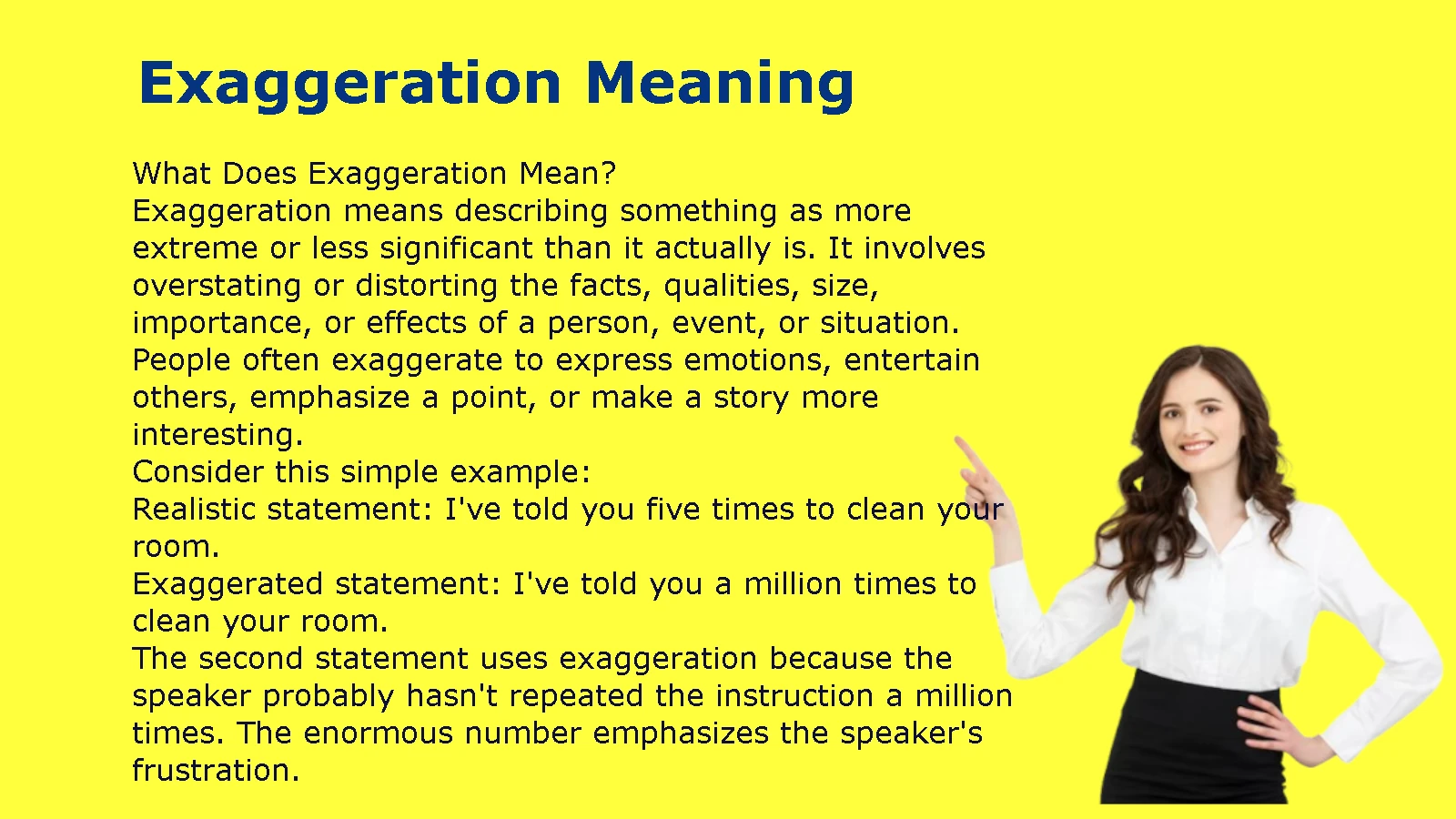
What Does Exaggeration Mean?
Exaggeration means describing something as more extreme or less significant than it actually is. It involves overstating or distorting the facts, qualities, size, importance, or effects of a person, event, or situation. People often exaggerate to express emotions, entertain others, emphasize a point, or make a story more interesting.
Consider this simple example:
- Realistic statement: I’ve told you five times to clean your room.
- Exaggerated statement: I’ve told you a million times to clean your room.
The second statement uses exaggeration because the speaker probably hasn’t repeated the instruction a million times. The enormous number emphasizes the speaker’s frustration.
Exaggeration doesn’t always involve numbers. You can exaggerate someone’s abilities, the difficulty of a task, the quality of a product, or the intensity of an experience.
Exaggeration Meaning in Simple Words
In simple words, exaggeration means making something sound bigger, better, worse, or more extreme than it really is.
Imagine that your friend takes a ten-minute walk and later says, “I walked across the entire country today!”
Your friend isn’t giving a factual account of the journey. They’re making the experience sound much larger than it was, perhaps to express tiredness or make you laugh.
Here are a few everyday examples:
- “This backpack weighs a ton.” The backpack feels heavy, but it doesn’t weigh a literal ton.
- “Everyone in the school knows about it.” The speaker may mean that many students know, not every single person.
- “That was the best meal in the history of the world.” The speaker wants to emphasize how much they enjoyed the food.
- “I’ve got a mountain of homework.” The student has a lot of work, not an actual mountain of assignments.
These expressions make communication more expressive. Listeners usually understand the intended meaning because they recognize that the speaker isn’t being literal.
Exaggeration Definition in the Dictionary
As a noun, exaggeration refers to the act of overstating something or a statement that makes something seem more extreme than the facts support.
The word has two closely related uses.
The act of exaggerating: This refers to the process of making something appear greater or more significant than it really is.
Example: “His exaggeration of the problem worried the entire team.”
An exaggerated statement: This refers to the overstatement itself.
Example: “Saying the meeting lasted forever is an exaggeration.”
The word can describe intentional overstatement, such as a joke, or an inaccurate description that makes a situation seem different from reality.
Context helps you determine which meaning applies.
Examples of Exaggeration in Everyday Life
Exaggeration appears in ordinary conversations because people rarely communicate through literal facts alone. They use overstatement to show excitement, frustration, surprise, admiration, and disappointment.
The key is to recognize the difference between the words someone uses and the message they intend to communicate.
Examples of Exaggeration in Conversations
Here are original examples of exaggeration you might hear in daily life.
| Exaggerated statement | Intended meaning |
| “My phone battery dies every two seconds.” | The battery drains unusually quickly. |
| “I’ve been cleaning this house all day.” | The speaker has spent a long time cleaning. |
| “That child has endless energy.” | The child is extremely energetic. |
| “I’m freezing to death in here.” | The room feels very cold. |
| “My little brother eats everything in sight.” | The brother has a large appetite. |
| “This traffic will never end.” | The traffic is moving very slowly. |
| “I laughed until my stomach exploded.” | The speaker laughed very hard. |
| “You’ve asked me that a hundred times.” | The question has been repeated many times. |
These statements are effective because they communicate more than basic information. They reveal the speaker’s feelings and make the message easier to remember.
For example, “The traffic is slow” gives you a fact. “This traffic will never end” adds frustration and impatience.
Examples of Exaggeration in Writing
Writers use exaggeration to create vivid descriptions, build memorable characters, and make readers feel the intensity of a scene.
Consider this sentence:
“The old suitcase was so heavy that carrying it felt like dragging a boulder up a mountain.”
The suitcase probably doesn’t weigh as much as a boulder. The comparison exaggerates its weight to help readers imagine the character’s struggle.
Here are more examples:
- “Her smile could light up an entire city.” This emphasizes how bright or joyful her smile appears.
- “The wind howled loudly enough to wake the dead.” This makes the wind sound exceptionally powerful.
- “He had a million ideas racing through his mind.” This suggests that he was thinking about many possibilities.
- “The silence lasted an eternity.” This conveys how long and uncomfortable the silence felt.
- “The tiny puppy filled the entire house with noise.” This emphasizes the puppy’s loud barking.
Writers should use exaggeration with a purpose. Too much overstatement can make a story feel unrealistic or tiresome. A strong exaggerated phrase stands out best when the surrounding language remains clear and controlled.
Examples of Exaggeration in the Workplace
Exaggeration also appears in professional settings, especially when people describe achievements, deadlines, workloads, or business results.
Some exaggerations are harmless expressions of frustration. Others can damage credibility.
Compare these statements:
| Exaggerated statement | More accurate alternative |
| “I’ve answered a million emails today.” | “I’ve answered more than 80 emails today.” |
| “This project has taken forever.” | “This project has taken six weeks.” |
| “Our sales have exploded overnight.” | “Our sales increased by 25% this month.” |
| “The entire department hates this policy.” | “Several team members have raised concerns about this policy.” |
| “We have the best customer service in the world.” | “Our customer satisfaction score reached 94% this quarter.” |
The exaggerated versions may sound energetic, but the factual alternatives provide clearer information.
Practical lesson: Use expressive language in casual conversations, but rely on measurable evidence when reporting results, presenting budgets, or making professional claims.
Exaggeration in a Sentence
Exaggeration in a sentence involves using words or descriptions that go beyond literal reality to emphasize a feeling, quality, event, or experience.
You can use exaggeration as a noun or describe an action with the verb exaggerate. The right choice depends on your sentence structure.
For example:
- “That sounds like an exaggeration.”
- “Don’t exaggerate how difficult the exam was.”
- “Her exaggerated reaction surprised everyone.”
Each sentence uses a different word form to express a related idea.
Positive and Humorous Examples of Exaggeration
Exaggeration can make positive experiences sound more exciting and ordinary situations more entertaining.
- “That chocolate cake was so good I could have eaten ten of them.” The speaker emphasizes how much they enjoyed the cake.
- “Your new haircut looks a million times better.” This expresses strong approval rather than a precise comparison.
- “My dog is the smartest animal on the planet.” The owner expresses affection and pride.
- “I was so excited that I could have jumped over the moon.” This conveys extraordinary excitement.
- “The party was so good that people will talk about it for a hundred years.” This emphasizes how memorable the party felt.
These statements usually work well among friends because listeners understand the playful intent.
However, the same approach may be less effective in formal writing. A report describing a product as “a million times better” offers little useful information unless the writer explains what improved and by how much.
Negative Examples of Exaggeration
- “One typo ruined my entire career.” The speaker makes a single mistake sound career-ending.
- “Nobody ever listens to me.” The speaker may feel ignored, although some people do listen.
- “This is the worst day anyone has ever experienced.” The speaker expresses distress through an extreme comparison.
- “The smallest inconvenience turns my life into a disaster.” This makes a minor problem sound overwhelming.
- “That one customer complaint destroyed our reputation.” The statement overstates the impact unless the complaint genuinely caused extensive damage.
Negative exaggeration can influence how other people interpret events. In an argument, for instance, describing a small disagreement as “the biggest betrayal in history” can make it harder to resolve the actual issue.
A more accurate description often helps people focus on the problem instead of reacting to an inflated version of it.
Common Expressions With Exaggeration
Several English expressions use the word exaggeration in predictable ways.
| Expression | Meaning | Example |
| A slight exaggeration | A small overstatement | “Calling the room messy is a slight exaggeration; it’s practically spotless.” |
| A gross exaggeration | An extreme or substantial overstatement | “Claiming that one missed call ended the friendship is a gross exaggeration.” |
| Without exaggeration | Used to emphasize that a statement is meant seriously or is not overstated | “Without exaggeration, this was the most challenging week of my year.” |
| It would be no exaggeration to say | Introduces a strong claim the speaker considers justified | “It would be no exaggeration to say that practice transformed her performance.” |
| That’s an exaggeration | Indicates that a description goes too far | “You made two mistakes, not twenty. That’s an exaggeration.” |
The expression “without exaggeration” deserves special attention. Speakers often use it to signal that they genuinely believe a strong statement, although the phrase itself doesn’t prove that the statement is accurate.
For example, “Without exaggeration, the presentation lasted three hours” makes a factual claim that can be checked. The phrase adds emphasis, but the duration still needs to be correct.
What Is the Difference Between Exaggeration, Hyperbole, and Lying?
Exaggeration, hyperbole, and lying can all involve statements that differ from literal reality, but they serve different purposes. Exaggeration is the broad practice of overstating something. Hyperbole is deliberate, often dramatic exaggeration used for emphasis. Lying generally involves intentionally presenting something false as true to deceive someone.
Consider three examples:
- Exaggeration: “The queue was a mile long.” The queue was unusually long, but not literally a mile.
- Hyperbole: “I’ve waited an eternity for my coffee.” The speaker uses an extreme statement for dramatic effect.
- Lying: “I submitted the assignment yesterday,” when the speaker knows they never submitted it and wants the teacher to believe otherwise.
These categories can overlap. A lie can contain exaggeration, and hyperbole is a form of exaggeration. The distinction depends on the language, context, and purpose of the statement.
Exaggeration vs. Hyperbole
Exaggeration is the broader term. Hyperbole is a specific rhetorical device that deliberately stretches reality to create emphasis, humor, or emotional impact.
In everyday language, people often use the two words interchangeably. In literary analysis, however, hyperbole is the more precise term for a deliberate figure of speech.
For example:
Exaggeration: “The restaurant was packed with customers.”
This may be an overstatement if the restaurant was busy but not completely full.
Hyperbole: “There were a billion people waiting for a table.”
The second statement uses an obviously impossible number to emphasize the size of the crowd.
Here are the main differences:
| Feature | Exaggeration | Hyperbole |
| Meaning | Any overstatement or distortion of degree | Deliberate, often extreme overstatement |
| Common purpose | Emphasis, description, persuasion, or entertainment | Emphasis, humor, drama, or rhetorical effect |
| Degree | Can be mild or extreme | Often noticeably extreme |
| Example | “The bag is incredibly heavy.” | “This bag weighs a thousand tons.” |
| Typical context | Everyday speech, reporting, advertising, and storytelling | Conversation, comedy, poetry, speeches, and fiction |
Remember: All hyperbole is exaggeration, but not every exaggeration functions as hyperbole in the strict rhetorical sense.
Exaggeration vs. Lying
The difference between exaggeration and lying often comes down to intent and context.
An exaggerated statement may be so obviously figurative that nobody expects it to be taken literally. A lie, by contrast, usually involves knowingly presenting a false statement as true.
Imagine that a student says, “I studied for a hundred hours last night.”
A friend will probably recognize this as humorous overstatement. The student likely means they studied for a long time.
Now imagine that the student tells a scholarship committee, “I completed 100 hours of supervised volunteer work,” despite having completed only 10 hours. If the student knows the number is false and uses it to secure an advantage, the claim becomes deceptive.
The distinction matters because exaggeration can be harmless in one setting and seriously misleading in another.
Consider these factors when evaluating a statement:
- Intent: Is the speaker joking, emphasizing a feeling, or trying to deceive?
- Context: Is the statement part of a casual conversation, a fictional story, or a formal report?
- Audience: Would a reasonable listener recognize the overstatement?
- Consequences: Could the claim influence a financial, professional, academic, or personal decision?
A person may exaggerate without intending harm. Nevertheless, exaggeration can still mislead others, even when the speaker doesn’t intend to lie.
Exaggeration vs. Understatement
Exaggeration makes something seem more extreme than it is, while understatement makes it seem less significant than it really is.
These techniques often produce opposite effects.
Suppose someone receives 200 messages in one afternoon.
- Exaggeration: “My phone received a million messages today.”
- Understatement: “My phone was a little busy today.”
The first statement magnifies the experience. The second deliberately downplays it.
Writers often use understatement to create dry humor or irony. For example, someone standing in a rainstorm might say, “It’s slightly damp outside.”
The humor comes from the obvious mismatch between the mild description and the actual situation.
| Situation | Exaggeration | Understatement |
| A difficult exam | “That exam destroyed my brain.” | “That exam was a little challenging.” |
| A crowded room | “A billion people were packed inside.” | “There were a few people around.” |
| A severe storm | “The wind could carry away a building.” | “It’s a bit breezy.” |
| An excellent performance | “She could win every award on Earth.” | “She did reasonably well.” |
Neither technique is automatically dishonest. Both can communicate a feeling more effectively than a literal statement, provided the audience understands the intended meaning.
Synonyms and Antonyms of Exaggeration
The best synonym for exaggeration depends on what you want to express. Some related words describe an inflated claim, while others refer to dramatic language, added details, or excessive emphasis.
Choosing the right word helps you avoid repetition and communicate more precisely.
Common Synonyms for Exaggeration
Here are five useful synonyms and related terms.
Overstatement: A description or claim that goes beyond what the facts justify.
Example: “Calling a minor delay a complete catastrophe is an overstatement.”
Hyperbole: A deliberate, often extreme exaggeration used to create emphasis or a rhetorical effect.
Example: “Her claim that she could eat a mountain of pancakes was obvious hyperbole.”
Embellishment: An added or altered detail that makes a story more impressive, colorful, or interesting.
Example: “His account of the fishing trip included some embellishment.”
Overemphasis: Giving a particular feature, point, or detail more attention or importance than it deserves.
Example: “The advertisement places too much overemphasis on the product’s appearance.”
Amplification: Expanding or strengthening an idea, explanation, or argument. In rhetoric, amplification can involve developing a point through additional details and emphasis.
Example: “The writer used amplification to explain why the decision mattered.”
These terms overlap with exaggeration, but they aren’t exact substitutes in every sentence. For example, embellishment often suggests adding details to a story, whereas overstatement focuses more directly on making a claim too strong.
Antonyms of Exaggeration
An antonym expresses an opposite or contrasting meaning. The most relevant opposite of exaggeration is understatement, particularly when exaggeration means overstating the importance or severity of something.
Other useful contrasting terms include:
- Minimization: Making something seem less important, serious, or significant than it is.
- Restraint: Avoiding excessive language, emotion, or emphasis.
- Moderation: Keeping something within reasonable or balanced limits.
- Accuracy: Describing something in a way that matches the facts.
- Precision: Communicating with exactness and attention to detail.
These words differ slightly. Accuracy and precision aren’t direct antonyms of exaggeration in every context, but they describe qualities that help prevent unsupported overstatement.
For example:
- Exaggeration: “The repair will cost a fortune.”
- Accurate description: “The repair estimate is $450.”
- Minimization: “The repair will cost practically nothing,” when the $450 expense is substantial for the person paying it.
The most appropriate alternative depends on whether you want to describe an opposite rhetorical technique or emphasize factual communication.
Exaggeration Synonyms Compared
Use this table to choose a related word based on the context.
| Word | Meaning | Best use |
| Overstatement | A claim that goes beyond the facts | Formal writing and everyday discussion |
| Hyperbole | Deliberate, often dramatic exaggeration | Humor, speeches, and literature |
| Embellishment | Added or altered details that make a story more interesting | Personal stories and storytelling |
| Overemphasis | Giving excessive importance to one point | Analysis, criticism, and argument |
| Amplification | Expanding or strengthening an idea | Explanatory writing and rhetoric |
| Understatement | Making something seem less significant than it is | Irony, humor, and restrained descriptions |
| Minimization | Reducing the perceived importance of something | Discussions of risks, mistakes, and consequences |
For example, if a salesperson describes an ordinary product as “the greatest invention in human history,” overstatement is a natural choice. If a comedian claims to have waited “since the beginning of time” for lunch, hyperbole is more precise.
Types of Exaggeration
Exaggeration takes different forms depending on how people communicate and what they want to achieve. It can appear in spoken language, creative writing, visual art, advertising, and persuasive arguments.
Recognizing these forms helps you understand how overstatement works across different settings.
Verbal Exaggeration
Verbal exaggeration occurs when someone uses spoken or written words to make something sound more extreme than it really is.
It’s common in everyday expressions.
Examples include:
- “I’ve got a million things to do.”
- “That suitcase weighs a ton.”
- “You scared ten years off my life.”
- “This coffee is hotter than the sun.”
The speaker generally wants to express a feeling rather than provide a literal description.
Verbal exaggeration can make a conversation lively, but it can also create confusion when listeners expect accurate information. A project manager who says, “We’re a thousand hours behind schedule,” may create unnecessary alarm if the actual delay is only a few days.
Literary Exaggeration
Literary exaggeration helps writers create dramatic effects, memorable images, and emotional depth.
Authors may exaggerate a character’s strength, a setting’s size, or the intensity of a feeling to make an idea stand out.
For example:
“The king’s anger shook the walls of the palace.”
The sentence suggests that the king was furious. His anger doesn’t literally shake the building; the writer uses an extreme image to communicate emotional intensity.
Literary exaggeration can serve several purposes:
- Characterization: Making a character seem unusually boastful, frightened, confident, or dramatic.
- Humor: Creating an amusing gap between reality and description.
- Emphasis: Drawing attention to an important quality or event.
- Imagery: Helping readers visualize an experience.
- Satire: Exposing foolish behavior or social problems through extreme descriptions.
Writers should consider the genre and tone. A comic novel can use extravagant exaggeration freely, while a realistic news report should prioritize accurate details.
Visual Exaggeration
Visual exaggeration involves distorting an object’s appearance, proportions, or features to emphasize a particular quality.
Cartoonists and caricature artists often use this technique. An artist might draw a politician with an unusually large head to emphasize perceived arrogance or give a character enormous eyes to express surprise.
Examples include:
- A cartoon character with a giant stomach to suggest extreme hunger.
- A caricature with an exaggerated nose to make a facial feature more noticeable.
- An animated character whose eyes grow enormous when surprised.
- A comic-book hero drawn with unusually broad shoulders to emphasize strength.
Visual exaggeration doesn’t rely on words. Instead, it uses size, shape, proportion, color, or movement to communicate an idea.
As with verbal exaggeration, context matters. A cartoon’s distorted proportions are usually understood as artistic choices, not realistic measurements.
Why Do People Use Exaggeration?
People exaggerate for several reasons. They may want to entertain others, express intense emotions, attract attention, strengthen an argument, or make an ordinary experience sound more memorable.
The technique itself doesn’t reveal whether someone has good or bad intentions. You need to consider the purpose and consequences of the statement.
To Make Stories More Interesting
A story becomes more entertaining when the speaker highlights surprising or unusual details.
Imagine that two friends describe the same camping trip.
The first says, “We saw a large spider near the tent.”
The second says, “We found a spider so enormous that it could have carried our tent away.”
The second description creates a more vivid image. The listener may laugh or ask questions, even though the spider was probably much smaller than the description suggests.
People use this type of exaggeration to:
- Keep an audience interested.
- Make a story easier to remember.
- Add suspense or surprise.
- Turn an ordinary event into a funny anecdote.
- Emphasize a memorable part of an experience.
However, exaggeration can weaken a story when every detail sounds extraordinary. A few well-placed overstatements often work better than a constant stream of them.
To Express Strong Emotions
People sometimes struggle to communicate the intensity of their feelings with ordinary words. Exaggeration offers a quick way to express excitement, disappointment, anger, or exhaustion.
For example:
- “I’m so happy I could burst.”
- “That mistake broke my heart into a million pieces.”
- “I’ve never been this embarrassed in my entire life.”
- “I’m exhausted beyond human understanding.”
These statements emphasize emotion rather than provide precise measurements.
In casual conversation, listeners usually understand the intended feeling. Still, extreme wording can cause problems in sensitive discussions.
If someone says, “You never help me,” the listener may become defensive because the statement leaves no room for exceptions. Saying, “I’ve felt unsupported with the last few household tasks” identifies the concern more clearly and gives both people something specific to discuss.
To Persuade or Influence Others
Exaggeration can make an argument sound more convincing, a product more attractive, or a problem more urgent.
Advertisers, salespeople, political speakers, and ordinary people may all use overstatement to influence an audience.
Consider these claims:
- “This is the only solution you’ll ever need.”
- “Everyone agrees that our plan is perfect.”
- “One small mistake will destroy the entire business.”
- “Our service is a thousand times faster than every competitor.”
These statements sound powerful, but they raise important questions. Is the solution genuinely sufficient for every situation? Does everyone agree? Is the risk supported by evidence? Has the company measured the speed of its competitors?
Persuasive exaggeration becomes problematic when it causes people to make decisions based on misleading information.
A more responsible approach replaces extreme claims with evidence.
Instead of saying, “Our service is the fastest in the world,” a business could state, “Our service reduced average processing time from 12 minutes to 4 minutes in our latest internal test.”
The second statement provides measurable information that readers can evaluate.
Word Forms, Pronunciation, and Origin of Exaggeration
Understanding the grammar, pronunciation, and origin of exaggeration can help you use it confidently in speech and writing.
The word is a noun related to the verb exaggerate. Other forms describe something that has been overstated or the act of overstating it.
How to Pronounce Exaggeration
In American English, exaggeration is commonly pronounced /ɪɡˌzædʒ.əˈreɪ.ʃən/.
The word contains five syllables:
- ig
- zag
- uh
- RAY
- shun
The primary stress falls on RAY, the fourth syllable.
To practice, say the word slowly, then gradually bring the syllables together into a natural rhythm.
Be careful not to confuse exaggeration with exasperation. They look somewhat similar, but they have different meanings:
- Exaggeration: An overstatement.
- Exasperation: Intense irritation or frustration.
For example, “His story contained an exaggeration” refers to an overstated detail. “She sighed in exasperation” describes someone’s frustration.
Exaggeration as a Noun and Related Word Forms
The word family includes several forms that perform different grammatical functions.
| Word form | Part of speech | Meaning | Example |
| Exaggeration | Noun | An act or instance of overstating something | “That claim is an exaggeration.” |
| Exaggerate | Verb | To make something seem more extreme than it is | “Don’t exaggerate the results.” |
| Exaggerated | Adjective or past-tense verb form | Overstated or made more extreme | “The report included exaggerated claims.” |
| Exaggerating | Present participle or gerund | The act of overstating something | “You’re exaggerating the difficulty.” |
| Exaggerator | Noun | A person who tends to exaggerate | “He’s a notorious exaggerator.” |
Here are examples showing how these forms work together:
- Noun: “Her exaggeration made the story more amusing.”
- Verb: “He tends to exaggerate when describing his travels.”
- Adjective: “The movie features exaggerated facial expressions.”
- Present participle: “She was exaggerating the seriousness of the mistake.”
- Person: “The audience knew he was an exaggerator.”
Pay attention to the sentence structure. You can make an exaggeration, exaggerate a claim, or describe a claim as exaggerated. These expressions share a root but serve different grammatical purposes.
Origin and Etymology of Exaggeration
The word exaggeration comes through French from Latin exaggeratio, related to the verb exaggerare.
The Latin verb carried the idea of heaping up or piling something higher. Over time, the word developed its modern sense of increasing or overstating the apparent size, importance, or intensity of something.
That history offers a useful way to remember the meaning.
Imagine adding extra layers to a pile until it looks much larger than it originally was. Exaggeration works similarly in language: a speaker adds intensity to a description until the situation sounds more extreme than reality supports.
For example, saying “The meeting was long” describes its duration. Saying “The meeting lasted a lifetime” piles on extra emphasis to make the experience sound much longer.
The modern meaning extends beyond physical size. You can exaggerate someone’s importance, a problem’s severity, a product’s benefits, or the difficulty of a task.
How to Avoid Exaggeration in Formal and Professional Writing
Exaggeration can make everyday communication lively, but it often weakens formal writing when readers need precise information. Reports, academic papers, business proposals, and professional emails benefit from specific claims that readers can verify.
You don’t need to eliminate every expressive phrase. Instead, recognize when a strong description adds value and when it obscures the facts.
Replace Extreme Claims With Specific Details
The simplest way to avoid unnecessary exaggeration is to replace vague, dramatic descriptions with measurable information.
Compare the following examples:
| Exaggerated claim | Clearer alternative |
| “The project took forever.” | “The project took six weeks.” |
| “We received endless complaints.” | “We received 37 complaints in April.” |
| “Sales skyrocketed overnight.” | “Sales increased by 18% over two weeks.” |
| “The entire team worked nonstop.” | “All 12 team members worked late on Thursday.” |
| “The product lasts forever.” | “The product comes with a five-year warranty.” |
Specific details give readers something concrete to understand and evaluate.
If you don’t have exact figures, avoid inventing them. You can still write accurately by using qualified language such as “several customers,” “a substantial increase,” or “over the past few weeks,” provided those descriptions fit the available evidence.
Separate Facts From Opinions
A statement can be strongly worded without being an objective fact.
For example, “This was the worst customer service experience in history” expresses a personal judgment through exaggeration.
A more informative version might say, “I waited 45 minutes for assistance and received no update about the delay.”
The revised sentence explains what happened. Readers can understand the complaint without having to interpret an extreme claim.
When writing, distinguish among these categories:
- Fact: A statement that can be checked against evidence.
- Opinion: A personal judgment or interpretation.
- Inference: A conclusion drawn from available information.
- Hyperbole: An intentional overstatement used for emphasis.
For instance, “The event attracted 500 attendees” is a factual claim if the attendance count supports it. “The event was unbelievably successful” is an evaluation. “The event may increase future sales” is an inference. “Half the city came to the event” may be hyperbole if the actual audience was much smaller.
Separating these categories helps readers understand what you know, what you believe, and what you are suggesting.
Check Whether Your Statement Matches the Evidence
Before publishing a claim, review its wording and ask whether the available evidence supports it.
This matters particularly when using words such as:
- Always
- Never
- Everyone
- Nobody
- Best
- Worst
- Guaranteed
- Impossible
- Completely
- Unprecedented
These words aren’t automatically wrong. However, they can make a claim stronger than the evidence justifies.
For example, “Our software never experiences downtime” is difficult to defend unless the company can support an absolute claim. “Our software achieved 99.95% uptime during the previous quarter” provides a measurable description with a defined time frame.
Use this quick editing checklist:
- Identify absolute language. Look for words that imply there are no exceptions.
- Verify numbers and comparisons. Make sure statistics and rankings have a reliable basis.
- Remove unsupported superlatives. Don’t call something the best unless you can explain the standard.
- Clarify the time frame. Specify when a result occurred or how long it lasted.
- Preserve appropriate emphasis. Keep colorful language when it helps readers understand the point without distorting the facts.
A practical rule is to use expressive language to describe feelings and measurable language to describe results.
Frequently Asked Questions About Exaggeration
What Does Exaggeration Mean in Simple Words?
Exaggeration means making something sound more extreme than it really is. For example, saying “I’m so hungry I could eat a horse” emphasizes hunger rather than describing a literal meal. People often exaggerate to express emotions, entertain others, or make a point more memorable.
What Is an Example of Exaggeration?
An example of exaggeration is, “This suitcase weighs a ton.” The suitcase may be heavy, but it doesn’t weigh a literal ton. The speaker uses an overstatement to emphasize how difficult it is to carry.
Is Exaggeration the Same as Hyperbole?
Exaggeration and hyperbole are closely related, but hyperbole usually refers to deliberate, often extreme overstatement used for emphasis or humor. Exaggeration is the broader term. For example, describing a crowded room as “packed with people” may be an overstatement, while claiming that “a billion people filled the room” is hyperbole.
Is Exaggeration a Form of Lying?
Exaggeration isn’t automatically lying. People often use obvious overstatements as jokes, figures of speech, or emotional expressions. However, exaggeration can become deceptive when someone knowingly inflates a claim to mislead others, gain an unfair advantage, or influence an important decision.
What Is the Opposite of Exaggeration?
The most relevant opposite of exaggeration is understatement, which makes something seem less significant than it really is. For example, calling a severe storm “a little windy” understates the conditions. Depending on the context, accuracy, precision, or moderation may also contrast with exaggeration.
What Is the Difference Between Exaggerate and Exaggeration?
Exaggerate is a verb that means to make something seem more extreme than it really is. Exaggeration is a noun that describes the act or result of doing so. For example, “Don’t exaggerate the story” uses the verb, while “That detail is an exaggeration” uses the noun.
Conclusion: Understanding the Meaning of Exaggeration
The meaning of exaggeration centers on making something seem greater, smaller, better, worse, or more important than it actually is. People use it in everyday conversations, creative writing, humor, and persuasive communication to emphasize feelings and make ideas more memorable.
Recognizing exaggeration also helps you distinguish between harmless overstatement and misleading claims. Hyperbole often uses dramatic exaggeration for effect, while lying generally involves knowingly presenting false information as true. Understatement works in the opposite direction by making something seem less significant than it is.
To use exaggeration effectively, consider your audience, purpose, and context. Let expressive language add color to casual conversations and creative writing, but rely on accurate details when readers need facts.