The difference between lose and miss depends on what you fail to keep or experience. Lose means you no longer have something or fail to win, while miss means you fail to catch, reach, notice, or attend something. Lose vs Miss: Lose means to no longer have something or fail to win, while miss means to fail to catch, reach, notice, or experience something.
The confusion usually happens when talking about lost opportunities, missing people, forgotten items, or failed attempts. And here’s the kicker: using the wrong word can change the meaning of your sentence completely.
In this guide, you’ll learn the difference between Lose vs Miss, including their meanings, definitions, pronunciation, and common uses. You’ll also see clear sentence examples, learn when to use lose or miss, and discover simple tricks to avoid this common English word confusion.
By the end, you’ll know exactly when to say lose and when to use miss, helping you write and speak English with more confidence.
Lose vs Miss: Quick Difference
The easiest way to understand lose vs miss is to look at what happens in each situation.
| Word | Main Meaning | Used For | Example |
| Lose | To no longer have something or fail to win | Possessions, games, control, opportunities | “I lost my wallet.” |
| Miss | To fail to reach, catch, attend, or notice something | Events, transportation, targets, people | “I missed my flight.” |
The main difference:
- Lose focuses on something you had or controlled.
- Miss focuses on something you failed to reach or experience.
Here are two examples that show the contrast:
Lose:
“Sarah lost her phone.”
Sarah had the phone before. Now she cannot find it.
Miss:
“Sarah missed her phone call.”
Sarah did not answer or notice the call when it happened.
The phone was never in question. The timing was.
What Does Lose Mean?
Lose Meaning and Definition
The verb lose means to no longer have something, fail to keep something, or fail to win something.
It usually involves a change from having something to not having it anymore.
The word lose has several common meanings:
- To misplace something
- To fail in a competition
- To stop having something
- To waste something valuable
- To become separated from someone or something
The past tense of lose is lost.
Examples:
- “I lose my keys often.”
- “I lost my keys yesterday.”
- “They lost the championship game.”
- “She lost her confidence.”
Lose Meaning: To No Longer Have Something
One of the most common uses of lose involves possessions.
When something disappears and you cannot find it, you lose it.
Examples:
- “I lost my wallet at the mall.”
- “He lost his glasses.”
- “She lost her passport before the trip.”
In these examples, the person owned or controlled the item before it disappeared.
A simple test:
Ask yourself:
“Did I have it before?”
If the answer is yes, lose is often the correct choice.
Example:
❌ “I missed my wallet.”
✅ “I lost my wallet.”
You cannot usually “miss” an object that you misplaced. You lose it.
Lose Meaning: To Fail to Win
Another common meaning of lose appears in sports, competitions, and arguments.
Examples:
- “Our team lost the match.”
- “He lost the chess game.”
- “The company lost the competition.”
In this situation, you had a chance to succeed but failed.
The opposite of lose in this meaning is win.
| Situation | Correct Word |
| Your team does not win | Lose |
| Your team wins | Win |
Example:
“The Lakers lost the game.”
This means the Lakers played but did not win.
Lose Meaning: To No Longer Have Control
You can also use lose when something becomes difficult to control.
Examples:
- “I lost my patience.”
- “She lost control of the car.”
- “He lost interest in the project.”
Here, the person did not physically lose an object. Instead, they lost something they previously had.
Lose Meaning: To Waste Something
Lose can also describe wasted chances, time, or opportunities.
Examples:
- “Don’t lose this opportunity.”
- “We lost valuable time.”
- “He lost his chance to explain.”
The idea is that something valuable existed but is no longer available.
What Does Miss Mean?
Miss Meaning and Definition
The word miss means to fail to reach, catch, notice, attend, or experience something.
Unlike lose, miss usually involves timing, distance, attention, or connection.
Common uses of miss include:
- Missing transportation
- Missing an event
- Missing a target
- Missing information
- Missing someone emotionally
Examples:
- “I missed the train.”
- “She missed the meeting.”
- “He missed the goal.”
- “I miss my family.”
The past tense of miss is missed.
Miss Meaning: To Fail to Catch or Reach Something
One of the most common uses of miss involves transportation.
Examples:
- “I missed the bus.”
- “She missed her flight.”
- “They missed the train.”
The important idea is that the bus, flight, or train existed. You simply failed to arrive at the right time.
Compare:
“I lost my car.”
This means you cannot find your car.
“I missed my car.”
This usually means you failed to catch a ride or did not use your car when you could have.
Miss Meaning: To Fail to Hit a Target
In sports and physical activities, miss means failing to hit the intended target.
Examples:
- “The player missed the goal.”
- “He missed the shot.”
- “The arrow missed the target.”
The target was there, but the attempt did not succeed.
Example:
A basketball player throws the ball toward the basket.
- The player misses the shot.
- The team may later lose the game.
These two words can appear in the same situation but describe different actions.
Miss Meaning: To Fail to Attend Something
You use miss when you do not attend an event or activity.
Examples:
- “I missed the meeting.”
- “She missed class today.”
- “He missed the concert.”
You do not lose a meeting because you never owned it. You miss it because you were not there.
Incorrect:
❌ “I lost the meeting.”
Correct:
✅ “I missed the meeting.”
Miss Meaning: To Feel Someone’s Absence
One unique use of miss involves emotions.
When someone is not around and you feel their absence, you say you miss them.
Examples:
- “I miss my old friends.”
- “She misses her hometown.”
- “He misses his family.”
This meaning is different from losing someone.
Compare:
Lose:
“She lost her grandfather.”
This means her grandfather passed away.
Miss:
“She misses her grandfather.”
This means she feels sadness because he is no longer present.
Lose vs Miss: Key Differences Explained
Lose Means You Had It, Then It Was Gone
The easiest way to remember lose is to think about something leaving your possession or control.
Examples:
- Lost keys
- Lost money
- Lost a game
- Lost confidence
- Lost an opportunity
The pattern looks like this:
Have → Something changes → No longer have
Example:
You put it somewhere.
You cannot find it.
You lost your phone.
Miss Means You Failed to Reach It
The word miss focuses on a missed connection.
Examples:
- Missed a bus
- Missed a deadline
- Missed a call
- Missed a chance
- Missed a person
The pattern looks like this:
Something is available → You fail to connect with it
Example:
The bus arrives.
You reach the stop too late.
You missed the bus.
Lose vs Miss Examples in Everyday Situations
| Situation | Correct Word | Example |
| Your keys disappear | Lose | “I lost my keys.” |
| You arrive late for a flight | Miss | “I missed my flight.” |
| Your team gets defeated | Lose | “We lost the game.” |
| You do not attend a party | Miss | “I missed the party.” |
| You cannot find your wallet | Lose | “I lost my wallet.” |
| You do not notice an email | Miss | “I missed your email.” |
| You forget an important chance | Miss/Lose | “I missed my chance.” / “I lost the opportunity.” |
A Real-Life Example: Losing vs Missing an Opportunity
Consider this situation:
Emma sees a job opening online.
She plans to apply but waits too long.
The deadline passes.
She can say:
“I missed the opportunity.”
Why?
Because she failed to act while the opportunity was available.
She can also say:
“I lost the opportunity.”
Why?
Because the opportunity is no longer available to her.
Both can work, but they highlight different parts of the situation.
- Missed opportunity focuses on the failure to take action.
- Lost opportunity focuses on the opportunity being gone.
Common Mistakes When Using Lose and Miss
Many English learners confuse lose vs miss because both words can describe something negative. However, they describe different types of problems.
Knowing the common mistakes makes it easier to choose the right word in everyday conversations.
Using Lose for Events
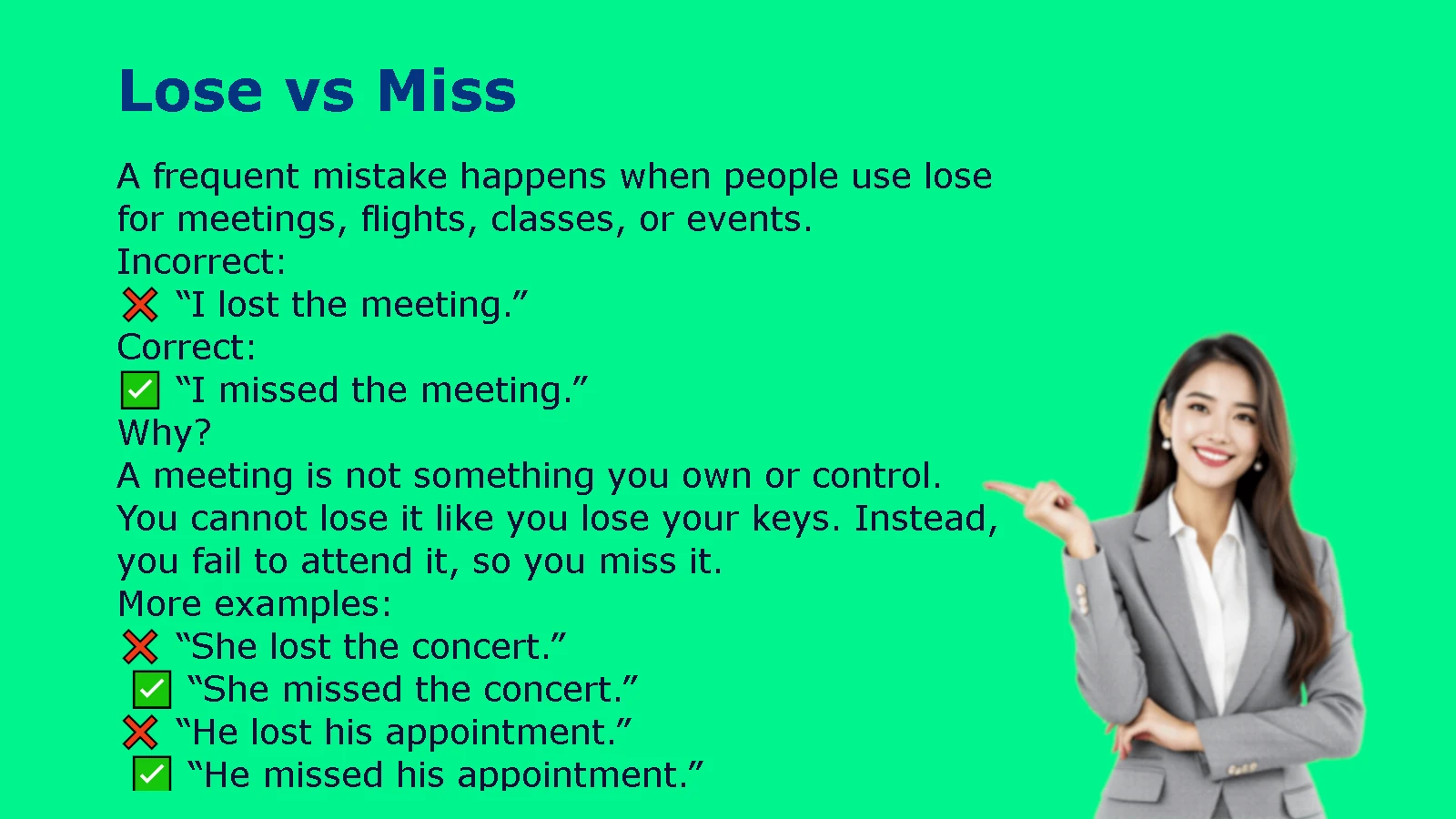
A frequent mistake happens when people use lose for meetings, flights, classes, or events.
Incorrect:
❌ “I lost the meeting.”
Correct:
✅ “I missed the meeting.”
Why?
A meeting is not something you own or control. You cannot lose it like you lose your keys. Instead, you fail to attend it, so you miss it.
More examples:
❌ “She lost the concert.”
✅ “She missed the concert.”
❌ “He lost his appointment.”
✅ “He missed his appointment.”
The rule:
Use miss for events you fail to attend.
Using Miss for Possessions
Another common mistake is using miss when something you own disappears.
Incorrect:
❌ “I missed my wallet.”
Correct:
✅ “I lost my wallet.”
Why?
A wallet is a possession. You had it before, but now you cannot find it.
More examples:
❌ “I missed my keys.”
✅ “I lost my keys.”
❌ “She missed her laptop.”
✅ “She lost her laptop.”
Remember:
- You lose things.
- You miss events.
Confusing Lose With Loose
Many people also confuse lose with loose because they look similar.
They have completely different meanings.
| Word | Meaning | Example |
| Lose | To no longer have something or fail | “Don’t lose your phone.” |
| Loose | Not tight or firmly attached | “My shoes are loose.” |
Pronunciation also changes:
- Lose sounds like “looz.”
- Loose sounds like “loos.”
Examples:
✅ “I don’t want to lose my keys.”
✅ “This jacket feels loose.”
Incorrect:
❌ “I don’t want to loose my keys.”
This mistake changes the meaning completely.
Lose vs Miss in Different Contexts
The meaning of lose and miss becomes clearer when you see how native speakers use them in different situations.
Lose vs Miss in Sports
Sports provide one of the clearest examples of the difference.
You lose a game when your team does not win.
You miss a shot when you fail to hit the target.
Examples:
- “The team lost the championship.”
- “The striker missed the penalty.”
- “The player missed the three-point shot.”
- “The team lost because they missed several chances.”
A player can miss a shot and the team can still win.
A team can lose even if every player performs well.
The words describe different moments:
| Action | Word |
| Failing to score | Miss |
| Failing to win | Lose |
Example:
“The striker missed the penalty, and the team lost the match.”
Here, missed explains the failed attempt, while lost explains the final result.
Lose vs Miss in Relationships
Relationships create another interesting difference.
You can lose someone and miss someone, but these phrases do not mean the same thing.
Losing Someone
To lose someone means they are no longer part of your life.
This can happen because of:
- A breakup
- Distance
- A disagreement
- Death
- A major life change
Examples:
- “He lost his best friend after the argument.”
- “She lost her grandfather last year.”
The focus is on separation or absence.
Missing Someone
To miss someone means you feel their absence.
Examples:
- “I miss my childhood friends.”
- “She misses living near the ocean.”
- “He misses his old coworkers.”
You can miss someone even when you have not lost them.
For example:
A student moves to another city for college.
They can say:
“I miss my family.”
They have not lost their family. They simply feel their absence.
Lose vs Miss at Work
Work situations often involve both words.
Missing a Deadline
You miss a deadline when you fail to finish something on time.
Examples:
- “I missed the deadline.”
- “The team missed the submission date.”
The deadline existed, but you did not meet it.
Losing a Job or Opportunity
You lose something when it is no longer yours.
Examples:
- “He lost his job.”
- “She lost the promotion.”
- “The company lost a major client.”
The thing was once available or possessed, but it is gone.
Lose vs Miss: Opportunity Difference
The words lose and miss often appear with the word “opportunity,” which creates confusion.
Both can be correct.
However, they emphasize different ideas.
| Phrase | Meaning | Example |
| Miss an opportunity | Fail to take advantage of a chance | “I missed an opportunity to study abroad.” |
| Lose an opportunity | No longer have access to a chance | “The company lost the opportunity to expand.” |
Think about it like catching a train:
- You miss the train because you arrive late.
- You lose the chance to travel because the train has already left.
Lose vs Miss Grammar Rules
Understanding grammar makes these words easier to use correctly.
Verb Forms of Lose
Lose is an irregular verb.
| Form | Word |
| Base form | Lose |
| Past tense | Lost |
| Past participle | Lost |
| Present participle | Losing |
Examples:
- “I often lose my glasses.”
- “I lost my glasses yesterday.”
- “I have lost my glasses again.”
- “I am losing my patience.”
Verb Forms of Miss
Miss is a regular verb.
| Form | Word |
| Base form | Miss |
| Past tense | Missed |
| Past participle | Missed |
| Present participle | Missing |
Examples:
- “I miss my hometown.”
- “I missed the train.”
- “I have missed several meetings.”
- “She is missing her old routine.”
Lose vs Miss Sentence Examples
Examples With Lose
Here are common sentences using lose:
- “I don’t want to lose my passport before traveling.”
- “The team lost the final game.”
- “She lost her confidence after the mistake.”
- “Don’t lose hope during difficult times.”
- “He lost his chance to join the project.”
- “The company lost millions of dollars.”
- “I lost track of time.”
Examples With Miss
Here are common sentences using miss:
- “I missed the morning train.”
- “She missed the important announcement.”
- “I miss my old neighborhood.”
- “He missed the deadline by one day.”
- “The player missed the winning shot.”
- “I missed your call earlier.”
- “They missed the chance to explain their decision.”
Memory Trick to Remember Lose vs Miss
A simple memory trick can help you choose the correct word quickly.
Lose = It Leaves You
Think:
Lose = Something you had is gone.
Examples:
- Lost keys
- Lost money
- Lost a game
- Lost a job
The thing was connected to you before.
Miss = You Miss the Connection
Think:
Miss = Something was there, but you didn’t reach it.
Examples:
- Missed a bus
- Missed a meeting
- Missed a call
- Missed a chance
The opportunity existed, but you did not connect with it.
Simple Comparison
Imagine you are holding an umbrella.
You put it somewhere and cannot find it.
You lost your umbrella.
Now imagine rain starts, but you leave your umbrella at home.
You missed having your umbrella when you needed it.
The difference is small but important:
- Lose = the object disappears from your possession.
- Miss = you fail to use or reach something.
Lose vs Miss: Frequently Asked Questions
Is it Correct to Say “I Lost the Bus”?
No, this sentence is usually incorrect.
The correct phrase is:
✅ “I missed the bus.”
A bus is not something you own. You fail to catch it, so you miss it.
What Is the Difference Between Losing Someone and Missing Someone?
Losing someone means that person is no longer part of your life.
Example:
“She lost her father.”
This often means her father passed away.
Missing someone means you feel their absence.
Example:
“She misses her father.”
This means she wishes he was present.
Can You Lose an Opportunity?
Yes, you can.
Example:
“He lost the opportunity to lead the project.”
This means the opportunity is no longer available.
Can You Miss an Opportunity?
Yes.
Example:
“She missed an opportunity to meet the CEO.”
This means she failed to take advantage of the chance.
Both phrases work, but they focus on different parts:
- Miss = failure to act.
- Lose = something is gone.
Is “I Missed My Chance” Correct?
Yes.
“I missed my chance” is one of the most common English expressions.
It means you failed to take an opportunity when it was available.
Examples:
- “I missed my chance to apologize.”
- “He missed his chance to buy the house.”
Is “I Lost My Chance” Correct?
Yes.
However, it sounds slightly different.
“I lost my chance” emphasizes that the chance is no longer available.
Example:
“I lost my chance to apply because the deadline passed.”
Lose vs Miss: Final Thoughts
The difference between lose vs miss becomes simple once you focus on the situation.
Use lose when something you had, controlled, or possessed is gone.
Examples:
- Lose your keys.
- Lose a game.
- Lose your job.
- Lose an opportunity.
Use miss when you fail to reach, catch, attend, notice, or experience something.
Examples:
- Miss a bus.
- Miss a meeting.
- Miss a deadline.
- Miss someone.
The easiest rule to remember:
Lose means you no longer have something. Miss means you failed to get something.
Once you understand that small difference, you’ll avoid one of the most common English mistakes and use both words naturally in conversations and writing.
lose-vs-miss
Learn the difference between lose and miss with clear meanings, examples, and usage rules to understand when to use each word correctly.