Have you ever wondered whether Pronunciation vs. Pronounciation is simply a spelling variation or if one of them is actually wrong? You’re not alone. Thousands of people search for the correct spelling of pronunciation, how to spell pronunciation, and pronunciation vs pronounciation because this is one of the most common English spelling mistakes.
In simple terms, Pronunciation refers to the correct way a word is spoken in the English language, including sound, stress, and articulation. It is the standard and grammatically correct form used in dictionaries, education, and professional communication. On the other hand, Pronounciation is actually a misspelling of the word “pronunciation” and is not accepted in formal English writing, even though many people mistakenly use it due to its natural sound and spelling pattern.
This confusion often appears in searches like pronunciation meaning, how to pronounce pronunciation, and commonly misspelled English words, because learners try to match spelling with sound. However, English spelling rules do not always follow pronunciation patterns, which is why this mistake is so common.
If you’ve ever paused while writing or saying this word, you’re not alone—this is one of those tricky cases where English spelling and pronunciation don’t align perfectly.
Below is the correct pronunciation guide to help you use it confidently in speech and writing:
pronunciation (pro-nun-see-ay-shun)
pronounciation (pro-noun-see-ay-shun)
In this guide, you’ll learn the correct spelling, pronunciation rules, common mistakes, and easy memory tricks so you never confuse Pronunciation with its incorrect form again.
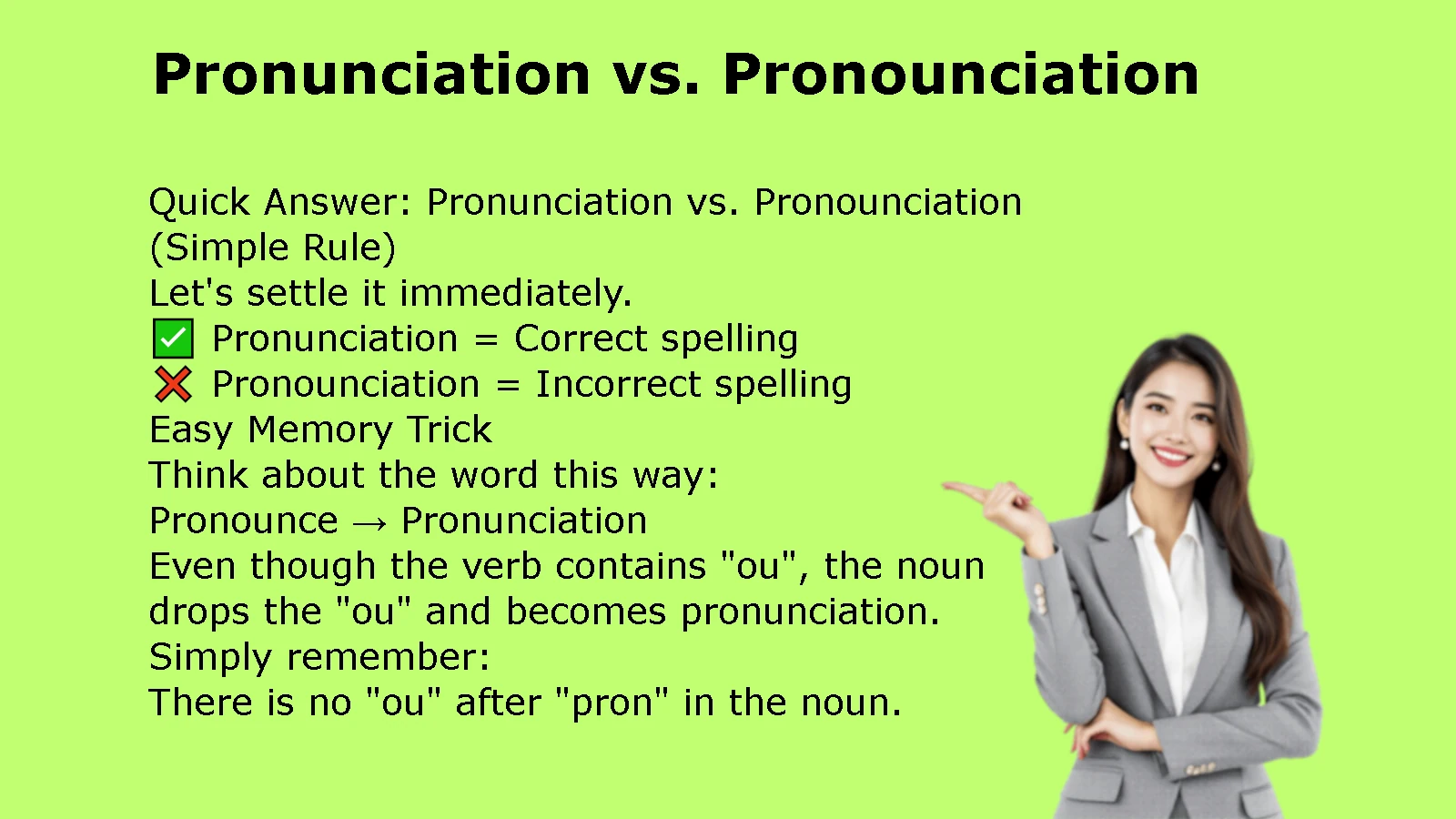
Quick Answer: Pronunciation vs. Pronounciation (Simple Rule)
Let’s settle it immediately.
✅ Pronunciation = Correct spelling
❌ Pronounciation = Incorrect spelling
Easy Memory Trick
Think about the word this way:
Pronounce → Pronunciation
Even though the verb contains “ou”, the noun drops the “ou” and becomes pronunciation.
Simply remember:
There is no “ou” after “pron” in the noun.
Why Do People Write “Pronounciation”?
This mistake is completely understandable.
People naturally form nouns from verbs.
For example:
- Inform → Information
- Celebrate → Celebration
- Educate → Education
So many assume:
Pronounce → Pronounciation
Unfortunately, English doesn’t follow that pattern here.
Instead, the correct noun is:
Pronunciation
This is simply an irregular spelling that has become standard English.
The Grammar Behind “Pronunciation”
Here’s the grammar rule.
Verb
Pronounce
Example:
Please pronounce your name clearly.
Noun
Pronunciation
Example:
Your pronunciation is excellent.
Notice that the spelling changes when the noun is formed.
The “ou” disappears.
Pronunciation Explained Clearly
The word pronunciation refers to the way a word is spoken.
pronunciation (pruh-nun-see-AY-shun)
Definition
The correct way of saying a word.
Examples
- Her pronunciation is improving every day.
- Good pronunciation helps people understand you.
- English pronunciation can be difficult.
Common Uses
- Language learning
- Public speaking
- Dictionaries
- Speech training
Pronounciation Explained
Now let’s look at the other spelling.
Pronounciation is not an English word.
Although millions of people search for it online every year, dictionaries do not recognize it as the correct spelling.
If you write:
pronounciation
Most spell checkers will automatically change it to:
pronunciation
Key Takeaway
Always use pronunciation in writing.
Why English Uses “Pronunciation” Instead
English has several words whose spelling changes when forming nouns.
Consider these examples:
| Verb | Noun |
| Speak | Speech |
| Choose | Choice |
| Lose | Loss |
| Pronounce | Pronunciation |
English isn’t always predictable.
Sometimes spelling changes completely as words evolve over time.
The Biggest Mistake People Make
Most people believe the noun should match the verb exactly.
Since the verb is:
Pronounce
they naturally write:
Pronounciation
That’s incorrect.
The noun has its own spelling.
Side-by-Side Comparison Table
| Word | Correct? | Meaning | Use |
| Pronunciation | ✅ Yes | The way words are spoken | Always use |
| Pronounciation | ❌ No | Misspelling | Never use |
Real-Life Examples of “Pronunciation”
Let’s see how native speakers use it.
Everyday Conversation
“My pronunciation has improved.”
“The teacher corrected my pronunciation.”
“British pronunciation differs from American pronunciation.”
In Education
Students often practice pronunciation before learning advanced grammar.
In Dictionaries
Every dictionary includes pronunciation guides for words.
Common Incorrect Examples
These are mistakes.
❌ My pronounciation is getting better.
✅ My pronunciation is getting better.
❌ Check the pronounciation.
✅ Check the pronunciation.
❌ English pronounciation is difficult.
✅ English pronunciation is difficult.
Why Spell Checkers Catch This Error
Modern spelling tools recognize pronunciation because it’s the standard dictionary spelling.
When you type:
pronounciation
Most software suggests:
pronunciation
This includes:
- Microsoft Word
- Google Docs
- Grammarly
- Most web browsers
British vs. American English
Unlike many English words, this one is easy.
Both British English and American English use exactly the same spelling:
Pronunciation
There is no regional difference.
The only variation may be in how people say the word, not how they spell it.
How to Remember the Correct Spelling
Use these tricks.
Think of the Ending
Ignore the spelling of pronounce.
Just memorize:
Pronunciation
Notice the Missing Letters
There is no “ou” after pron.
Read It Often
The more often you see the correct spelling, the easier it becomes to remember.
What to Say Instead
Whenever you’re writing about how words are spoken, always choose:
- pronunciation
- correct pronunciation
- proper pronunciation
- English pronunciation
- American pronunciation
- British pronunciation
Never use:
- pronounciation
Quick Decision Guide (Use This Instantly)
If you’re writing about how a word is spoken:
Use:
✅ Pronunciation
Never use:
❌ Pronounciation
If you’re unsure:
Check a dictionary or remember:
The noun loses the “ou.”
FAQ: Pronunciation vs. Pronounciation
Is “pronounciation” ever correct?
No.
It is considered a spelling mistake.
Why is the verb “pronounce” but the noun “pronunciation”?
English inherited the word through historical language changes, so the noun developed a different spelling from the verb.
Which spelling should I use in school or business writing?
Always use pronunciation.
Using pronounciation may be marked as a spelling error.
Do native speakers make this mistake?
Yes.
Even fluent English speakers occasionally write pronounciation because it seems logical.
Case Study: A Common Classroom Mistake
An English teacher asked students to write:
“Describe how your pronunciation has improved.”
Several students wrote:
“My pronounciation has become better.”
The teacher corrected every paper.
Why?
Because pronunciation is the only accepted spelling in English.
After learning the rule, students rarely repeated the mistake.
Key Facts You Should Remember
- Pronunciation is the correct spelling.
- Pronounciation is incorrect.
- The noun comes from pronounce but changes its spelling.
- British and American English both use pronunciation.
- Spell checkers recognize pronunciation as the standard form.
- Remember that the noun drops the “ou” found in the verb.
Final Takeaway: The One Rule That Never Fails
The confusion between Pronunciation vs. Pronounciation comes from the way English forms words. Since the verb is pronounce, it’s easy to assume the noun should be pronounciation. However, that’s one of English’s irregular spelling patterns.
The rule is simple:
- ✅ Pronunciation = Correct
- ❌ Pronounciation = Incorrect
Whenever you’re writing about the way words are spoken, always choose pronunciation. If you ever hesitate, remember one simple trick: the noun drops the “ou.” Learning this small difference will make your writing more accurate, professional, and grammatically correct every time.