Have you ever come across the word capacious and wondered what it means? If you’re searching for capacious meaning, what does capacious mean, or capacious definition, you’re looking for a simple explanation of a word that describes something with plenty of room or space.
Capacious means having a lot of space inside or being able to hold a large amount. It is commonly used to describe something spacious, roomy, or large enough to contain more than usual, such as a bag, room, vehicle, or container. It can also describe a person’s mind or memory when they have a great ability to hold ideas or information.
Examples:
- She carried all her belongings in a capacious bag.
- The capacious dining room was large enough for the entire family.
The confusion is understandable. People often search for capacious meaning in English, what is the meaning of capacious, capacious synonyms, capacious antonyms, or how to use capacious in a sentence because the word is relatively formal and less common in everyday conversation. The good news is that once you understand its connection with space, room, and capacity, its meaning becomes much easier to remember.
In this guide, you’ll learn the complete capacious meaning, including its definition, pronunciation, synonyms, antonyms, origin, and usage. You’ll also find clear examples of capacious in a sentence and learn how to use this word naturally in different contexts.
What Does Capacious Mean?
Capacious is an adjective that describes something with a large amount of available space or capacity.
In its most literal sense, it means that something can hold a lot.
For example:
She carried everything she needed in a capacious handbag.
Here, capacious tells us that the handbag has plenty of room inside.
The word can also be used figuratively. A person’s mind, for example, can be called capacious if it is able to accommodate many ideas, subjects, experiences, or perspectives. Cambridge specifically gives the figurative sense of being able to include a lot of different things.
Capacious Definition
| Word | Definition |
| Capacious | Having a lot of space inside or able to contain a lot |
| Part of speech | Adjective |
| Register | Formal |
| Basic idea | Large in capacity |
| Common synonyms | Spacious, roomy, ample |
| Opposites | Cramped, confined, small |
Oxford defines capacious as having a lot of space in which to put things, with roomy given as a synonym.
So, in simple terms:
Capacious = roomy enough to hold a lot.
Capacious Meaning in Simple English
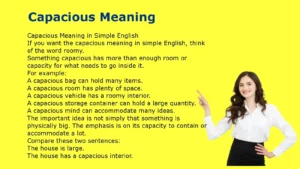
If you want the capacious meaning in simple English, think of the word roomy.
Something capacious has more than enough room or capacity for what needs to go inside it.
For example:
- A capacious bag can hold many items.
- A capacious room has plenty of space.
- A capacious vehicle has a roomy interior.
- A capacious storage container can hold a large quantity.
- A capacious mind can accommodate many ideas.
The important idea is not simply that something is physically big. The emphasis is on its capacity to contain or accommodate a lot.
Compare these two sentences:
The house is large.
The house has a capacious interior.
The first sentence simply tells you about size. The second emphasizes the amount of usable space inside.
That distinction is one reason capacious can be more precise than simply saying large.
How to Pronounce Capacious
The standard pronunciation of capacious is:
/kəˈpeɪ.ʃəs/
Cambridge gives this pronunciation for both British and American English.
The main stress falls on the second syllable.
The word has three syllables:
ca-pa-cious
It sounds similar to the ending found in words such as gracious, although the pronunciation is not identical.
Is Capacious a Formal Word?
Yes. Major dictionaries identify capacious as a formal adjective.
That does not mean it is inappropriate in ordinary English. It simply means that words such as roomy, spacious, or large may sound more natural in casual conversation.
For example:
Casual:
We found a really roomy apartment.
More formal or literary:
We found a capacious apartment with unusually generous living space.
Both communicate the idea of plenty of space, but capacious has a more formal and descriptive tone.
What Does Capacious Mean in Different Contexts?
The meaning of capacious stays fairly consistent across contexts, but what it describes can change.
It can refer to physical capacity, mental capacity, or even the ability of an abstract concept to encompass many things.
Capacious Space or Room
A room can be called capacious when it has plenty of space.
The hotel provided a capacious conference room for the meeting.
The adjective emphasizes the room’s ability to accommodate people or activities comfortably.
Other examples include:
- a capacious dining room
- a capacious office
- a capacious hall
- a capacious apartment
- a capacious interior
In this context, capacious is closely related to spacious.
Capacious Bag or Container
This is one of the clearest uses of the word.
A capacious handbag has enough room to hold many items. A capacious suitcase can accommodate a substantial amount of luggage.
For example:
Her capacious backpack held a laptop, notebooks, a jacket, and several books.
Oxford specifically uses capacious pockets as an example of the word’s ordinary physical sense.
Other natural combinations include:
- capacious handbag
- capacious suitcase
- capacious backpack
- capacious pocket
- capacious storage bin
- capacious container
- capacious trunk
The word is particularly useful when you want to emphasize capacity rather than appearance.
A large-looking bag is not necessarily capacious. A relatively compact bag may have an unusually well-designed interior and therefore be capacious.
Capacious Mind or Memory
The word also has a figurative meaning.
A capacious mind is one that can accommodate a large amount of information, knowledge, ideas, or different perspectives.
For example:
She had a capacious mind and could move comfortably between mathematics, history, and literature.
Here, capacious does not mean that the person’s brain is physically larger. It describes the breadth of what the mind can contain or accommodate.
Cambridge provides examples of capacious applied to a brain and to an organization that can include many different things.
This figurative use gives the word a richer meaning than simply intelligent.
Capacious Legal or Formal Usage
Capacious can appear in formal or legal writing, but it is important not to treat capacious as a special legal term.
In legal or academic contexts, the word may describe an idea, definition, provision, interpretation, or concept that covers a broad range of matters.
For example:
The court adopted a capacious interpretation of the provision.
Here, capacious suggests that the interpretation encompasses a broad range of situations.
Corpus examples collected by Cambridge include formal uses involving statutory provisions, legal concepts, and broader interpretations.
So, if you encounter capacious legal meaning, the word generally retains its ordinary sense of broad or able to encompass a lot. It does not acquire a completely separate legal definition.
Capacious Examples in Sentences
Seeing the word in context makes its meaning much easier to understand.
Everyday Examples
- She bought a capacious handbag for her daily commute.
- The capacious suitcase held all of his clothes.
- The kitchen has a capacious pantry with plenty of storage.
- They moved into a capacious apartment with three bedrooms.
- The car has a surprisingly capacious trunk.
- He wore a jacket with capacious pockets.
- The library occupies a capacious room on the second floor.
Figurative Examples
- Her capacious mind could retain details from hundreds of books.
- The historian developed a capacious understanding of the period.
- The novel offers a capacious view of human experience.
- His capacious imagination allowed him to connect unrelated ideas.
- The organization has a capacious definition of membership.
Formal Examples
- The report proposes a more capacious definition of the term.
- The statute was interpreted through a capacious reading of its language.
- The theory provides a capacious framework for understanding social change.
Notice that the word can describe both physical things and abstract concepts.
Capacious Synonyms
The best capacious synonyms depend on what you are describing.
Common alternatives include:
- spacious
- roomy
- ample
- large
- voluminous
- commodious
- expansive
- broad
- vast
- generous
However, these words are not interchangeable in every sentence.
Capacious vs. Spacious
Spacious is probably the closest everyday synonym for capacious when talking about physical space.
The apartment is spacious.
The apartment is capacious.
Both suggest that the apartment has plenty of room.
However, spacious focuses more directly on the amount of open space, while capacious emphasizes the ability to contain or accommodate a lot.
Cambridge lists spacious as a synonym of capacious.
Capacious vs. Roomy
Roomy is more conversational.
The car has a roomy interior.
The car has a capacious interior.
The first sounds natural in everyday speech. The second sounds more formal.
Oxford explicitly gives roomy as a synonym.
Capacious vs. Ample
Ample means enough or more than enough.
The room has ample seating.
This does not necessarily mean the room itself is physically large. It means the available seating is sufficient.
By contrast:
The room is capacious.
focuses on the room’s considerable capacity or space.
Capacious vs. Large
Large is much broader.
You can say:
a large building
a large dog
a large company
a large problem
But capacious is specifically associated with capacity, interior space, or the ability to encompass a lot.
You would not normally replace large with capacious in every situation.
For example:
She owns a capacious dog.
does not naturally mean the same thing as:
She owns a large dog.
The second describes physical size. The first does not fit the ordinary meaning of the word.
Capacious Antonyms
The main capacious antonyms describe a lack of room or capacity.
Common opposites include:
- cramped
- confined
- small
- narrow
- restricted
- limited
- tight
- constricted
The most natural opposite depends on the context.
| Capacious | Possible Antonym |
| capacious room | cramped room |
| capacious bag | small bag |
| capacious vehicle | cramped vehicle |
| capacious storage | limited storage |
| capacious mind | narrow-minded thinking |
| capacious interpretation | narrow interpretation |
There is no single antonym that works perfectly in every situation.
For example, cramped works particularly well for physical spaces, while narrow can work better for abstract ideas.
Is Capacious a Positive or Negative Word?
Capacious is generally neutral to positive, depending on the context.
When describing a bag, room, vehicle, or storage area, it usually communicates a useful quality: there is plenty of space.
The capacious trunk easily accommodated six large boxes.
That is clearly favorable.
When describing an abstract concept, the meaning can also be positive:
She brought a capacious understanding of the subject to the discussion.
However, the word itself does not automatically mean excellent, intelligent, or superior.
Its core meaning remains large in capacity or broad in what it can contain.
Is Capacious a Formal Word?
Yes. Dictionaries such as Cambridge and Oxford label the word formal.
That makes it especially useful in:
- academic writing
- literary criticism
- formal descriptions
- professional writing
- essays
- journalism
- historical writing
In casual speech, people usually choose simpler alternatives.
Formal vs. Casual Usage
| Formal | More Casual |
| capacious handbag | roomy handbag |
| capacious interior | roomy interior |
| capacious storage area | large storage area |
| capacious residence | spacious home |
| capacious understanding | broad understanding |
Using capacious in casual conversation is not grammatically wrong. It simply has a more elevated tone.
Capacious Word Origin and Etymology
The history of capacious helps explain why the word is connected to capacity.
Oxford traces the word to the early 17th century and identifies its origin as Latin capax, meaning capable, together with the suffix -ious.
Etymonline traces the English word to the 1610s, from Latin capax and ultimately capere, meaning to take or to grasp. The sense of being able to hold much developed in English during the 1630s.
This connection is particularly useful because capacity comes from the same Latin family.
In other words, capacious is closely connected to the basic idea of being capable of taking in or holding something.
Related Words
The same linguistic family helps explain several familiar English words:
- capacity
- capable
- capacious
- capture
- accept
- receive
They have historical connections to the Latin root associated with taking, grasping, or receiving.
Capacious Meaning in English
In English, capacious primarily means:
Having a lot of space inside or being able to contain a large amount.
It can be literal:
a capacious room
or figurative:
a capacious mind
The distinction matters because the word is not limited to physical objects.
Cambridge’s examples show that capacious can describe everything from handbags and cars to brains, organizations, works of fiction, and broader concepts.
This makes capacity the best central idea to remember.
A Simple Memory Trick
Think:
capacity → capacious
If something has a large capacity, it can hold a lot.
Therefore:
capacious = having a large capacity
That simple association makes the word much easier to remember.
Capacious Meaning in Chinese
In Chinese, dictionary translations convey the idea of having a large capacity or a lot of space.
Cambridge lists Simplified Chinese translations including 容量大的 and 空间大的.
The appropriate translation depends on the noun being described.
For example, when referring to a physical container, the sense may correspond to something that has a large capacity. When describing a room, the meaning is closer to spacious or large in interior space.
A direct one-word translation is therefore not always the best approach. The surrounding noun determines the most natural Chinese expression.
Common Mistakes With Capacious
Although capacious is straightforward, learners sometimes use it too broadly.
Using Capacious for Any Large Object
Not every large object is capacious.
A large elephant is not normally described as capacious simply because it is large.
The word focuses on space, capacity, or the ability to contain.
Better:
The elephant is large.
But:
The elephant’s stomach is capacious.
The second sentence makes sense because a stomach has a capacity for holding something.
Confusing Capacious With Spacious
These words overlap significantly, but capacious can carry a stronger idea of holding or accommodating a lot.
The room is spacious.
focuses on available space.
The storage facility is capacious.
emphasizes its ability to accommodate a substantial amount.
Assuming Capacious Always Means Physically Large
The word can be metaphorical.
He has a capacious imagination.
Here, there is no physical container. The adjective describes the breadth or range of imagination.
Treating Capacious as an Everyday Slang Word
Capacious is not slang. It is a standard English adjective that dictionaries classify as formal.
If you are speaking casually, roomy, spacious, or big enough may sound more natural.
Capacious in Real-World Usage
One of the most interesting things about capacious is how easily its basic meaning extends beyond physical containers.
Case Study: A Car
Consider:
The new sedan has a capacious trunk.
The word does not merely say that the trunk is physically large. It tells the reader that the trunk can accommodate a substantial amount of luggage or cargo.
That is why capacious is especially useful in descriptions of vehicles, luggage, storage, and interiors.
Case Study: A Mind
Now consider:
She has a capacious mind.
The meaning changes from physical capacity to intellectual breadth.
The mind is metaphorically treated as a container capable of holding many ideas.
Case Study: An Academic Concept
Consider:
The researcher developed a capacious framework for analyzing the problem.
Here, the framework is not physically large. It is broad enough to encompass many factors or perspectives.
This illustrates the word’s central semantic idea:
A capacious thing can accommodate a lot.
Capacious vs. Spacious vs. Roomy vs. Large
These words overlap, but they are not identical.
| Word | Core Meaning | Register | Typical Use |
| Capacious | Able to contain a lot | Formal | Bags, rooms, minds, concepts |
| Spacious | Having plenty of open space | Neutral | Homes, rooms, vehicles |
| Roomy | Having plenty of room | Informal/neutral | Cars, clothes, rooms |
| Large | Big in size or amount | Neutral | Almost anything |
| Ample | More than enough | Neutral/formal | Space, supply, opportunity |
| Voluminous | Very large in volume | Formal | Documents, hair, clothing, quantities |
This comparison shows why capacious is not simply a fancy substitute for large.
Its strongest feature is capacity.
How to Use Capacious Correctly
A useful sentence pattern is:
capacious + noun
Examples:
- capacious handbag
- capacious suitcase
- capacious room
- capacious interior
- capacious storage space
- capacious pockets
- capacious mind
- capacious imagination
- capacious understanding
- capacious framework
You can also use the word after a linking verb:
The apartment is capacious.
The vehicle feels capacious inside.
The storage room proved surprisingly capacious.
Comparative and Related Forms
The ordinary comparative and superlative forms are:
- more capacious
- most capacious
For example:
This suitcase is more capacious than my old one.
That is the most capacious room in the building.
The word also has derived forms such as capaciously and capaciousness. Collins lists both forms.
However, these forms are much less common than the adjective itself.
Quick Facts About Capacious
| Fact | Answer |
| Word | Capacious |
| Part of speech | Adjective |
| Meaning | Having a lot of space or capacity |
| Pronunciation | /kəˈpeɪ.ʃəs/ |
| Register | Formal |
| Closest synonym | Spacious |
| Another common synonym | Roomy |
| Main concept | Capacity to hold or accommodate |
| Origin | Latin capax, related to capere |
| Common figurative use | Mind, imagination, ideas, concepts |
Frequently Asked Questions About Capacious
What does capacious mean?
Capacious means having a lot of space inside or being able to contain a large amount. It can describe physical objects such as rooms, bags, cars, and containers, as well as abstract things such as minds and ideas.
What is a synonym for capacious?
Common synonyms include spacious, roomy, ample, commodious, expansive, and voluminous. The best synonym depends on the context.
For everyday physical space, spacious or roomy is often the closest choice.
Does capacious mean spacious?
Yes, the two words overlap strongly. In fact, Cambridge lists spacious as a synonym for capacious.
However, capacious often emphasizes the ability to contain or accommodate a lot, while spacious focuses more directly on the amount of available space.
What does capacious mind mean?
A capacious mind is a mind that can accommodate many ideas, subjects, experiences, or perspectives.
It is a figurative use of the word and suggests breadth and intellectual capacity.
Is capacious a positive word?
Usually, yes, when it describes something that benefits from having plenty of room or capacity.
For example, a capacious suitcase is useful because it can hold more belongings.
However, the word itself is primarily descriptive rather than inherently positive.
Is capacious a formal word?
Yes. Cambridge and Oxford both identify capacious as a formal adjective.
It is perfectly correct in everyday English, but roomy, spacious, or large may sound more natural in casual conversation.
What is the opposite of capacious?
Possible antonyms include cramped, confined, narrow, restricted, small, and limited.
The best opposite depends on the noun being described.
How do you pronounce capacious?
Capacious is pronounced /kəˈpeɪ.ʃəs/ in both British and American English according to Cambridge.
What is the origin of capacious?
The word entered English in the early 17th century from Latin capax, meaning capable or able to contain, with a connection to capere, meaning to take or grasp.
Conclusion
The simplest way to remember the capacious meaning is “having a lot of capacity.”
The word is closely related to spacious, roomy, and ample, but it has a distinctive emphasis on capacity and the ability to contain or accommodate.
It is also a relatively formal English word, which makes it particularly useful in essays, professional writing, literary descriptions, and academic contexts.
Once you connect capacious with capacity, its meaning becomes easy to recognize: if something can take in a lot, it can be described as capacious.