Hang out and play are both common expressions, but they are used in different situations. Hang out means to spend time casually with someone, usually for fun or relaxation, while play means to take part in a game, activity, or imaginative action. When comparing Hang Out vs Play, hang out is used for casual social time, while play is usually connected to games, sports, or activities.
The confusion is common because hang out usually means casually spending time with someone, while play often refers to taking part in a game, activity, or fun action. Using the wrong phrase can make your sentence sound unnatural, especially when talking about social activities, leisure time, or casual conversations.
In this guide, you’ll learn the difference between Hang Out vs Play, including their meanings, usage rules, examples in sentences, and common situations where each phrase fits best. You’ll also discover related expressions like spending time with friends, playing games, socializing, and having fun to help you choose the right words naturally.
By the end, you’ll know exactly when to use hang out and when to use play without second-guessing your choice.
What Does “Hang Out” Mean?
“Hang out” means to spend relaxed, informal time with someone without needing a specific purpose or planned activity.
People usually use this phrase when they want to describe casual social time. The focus is not on what they do but on being together.
For example:
- “I’m going to hang out with my friends tonight.”
- “We hung out at the park after school.”
- “Do you want to hang out this weekend?”
In each example, the main idea is companionship. The people may talk, eat, watch something, walk around, or simply relax.
Think of hanging out like sitting with a friend on a quiet afternoon. You don’t need a schedule. You’re there because you enjoy each other’s company.
The Meaning of “Hang Out” in Everyday Conversation
The phrase hang out is very common in casual American English. It appears frequently among:
- Friends
- Teenagers
- College students
- Coworkers
- Couples
- Family members
For example:
“I’m meeting my manager tomorrow” sounds professional and planned.
But:
“I’m hanging out with my coworkers after work” sounds casual and social.
The difference comes from the purpose. A meeting has an objective. Hanging out is about spending time together.
Common Activities People Do When They Hang Out
Hanging out does not require a specific activity. People can do almost anything while hanging out.
Common examples include:
| Activity | Example Sentence |
| Watching movies | “We hung out and watched a movie.” |
| Drinking coffee | “I hung out with my friend at a café.” |
| Talking | “We just hung out and talked for hours.” |
| Shopping | “She hung out with her sister at the mall.” |
| Walking around | “We hung out downtown after dinner.” |
| Relaxing at home | “They hung out at my place.” |
The activity itself is not the important part. The social connection is.
What Does “Play” Mean?
“Play” means to take part in an enjoyable activity, especially a game, sport, or creative activity.
Unlike hang out, the word play focuses on what people are doing.
Examples:
- “The children are playing outside.”
- “We played basketball yesterday.”
- “She plays the piano.”
- “They play video games together.”
When someone says play, listeners usually expect an activity.
You are not simply spending time together. You are participating in something.
Different Meanings of “Play”
The word play has several meanings depending on the situation.
Playing Games or Sports
This is one of the most common uses.
Examples:
- Play soccer
- Play basketball
- Play tennis
- Play chess
- Play cards
Sentence examples:
- “I play soccer every Saturday.”
- “They played chess after dinner.”
- “We’re playing basketball at the park.”
Here, play means participating in a structured activity.
Children Playing
When talking about children, play often means exploring, imagining, and having fun.
Examples:
- “The kids are playing in the backyard.”
- “My daughter likes to play with dolls.”
- “The children played together all afternoon.”
For children, playing does not always involve rules. It can include imagination, creativity, and exploration.
A child pretending a cardboard box is a spaceship is still playing.
Playing With Objects, Animals, or Ideas
The phrase play with has several meanings.
Examples:
- “The puppy is playing with a ball.”
- “The baby is playing with a toy.”
- “He likes to play with new ideas.”
However, it can also have a negative meaning:
- “Don’t play with someone’s feelings.”
In this sentence, play with means to treat something carelessly.
Hang Out vs Play: The Main Difference
The biggest difference between hang out vs play comes down to focus.
- Hang out focuses on the people.
- Play focuses on the activity.
Here is a simple comparison:
| Feature | Hang Out | Play |
| Main meaning | Spend casual time together | Do an activity for fun |
| Focus | Relationship and conversation | Game or entertainment |
| Tone | Relaxed and social | Active and playful |
| Common users | Teens and adults | Children, athletes, gamers, hobbyists |
| Needs an activity? | No | Usually yes |
| Example | “Let’s hang out tonight.” | “Let’s play tennis.” |
Hang Out vs Play: Purpose Compared to Activity
A useful way to remember the difference is:
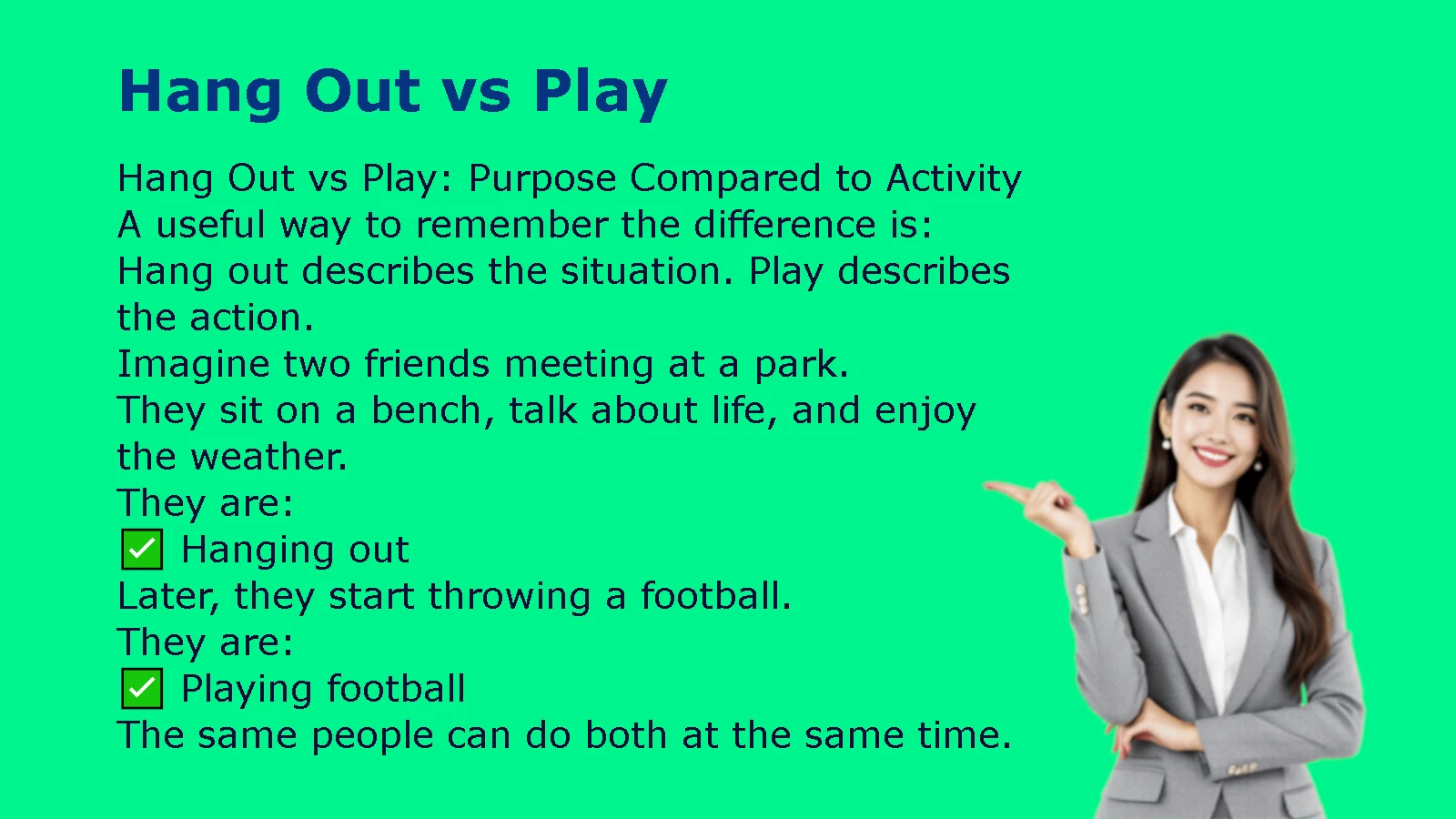
Hang out describes the situation. Play describes the action.
Imagine two friends meeting at a park.
They sit on a bench, talk about life, and enjoy the weather.
They are:
✅ Hanging out
Later, they start throwing a football.
They are:
✅ Playing football
The same people can do both at the same time.
Example:
“My friends and I hung out at the park and played basketball.”
The phrase hung out describes the overall experience. The phrase played basketball describes the specific activity.
A Simple Analogy: Hang Out Is the Container, Play Is the Activity Inside
Think of hanging out as a backpack.
Inside that backpack, you can put many activities:
- Eating
- Talking
- Watching movies
- Playing games
- Walking
- Shopping
The backpack is the overall experience.
The activities inside are the things you do while hanging out.
That’s why someone can say:
“We hung out and played video games.”
The two phrases work together because they describe different parts of the experience.
Can Adults Say “Play”?
Yes, adults can absolutely use play, but the meaning depends on context.
Adults commonly say play when talking about:
- Sports
- Musical instruments
- Video games
- Board games
- Performances
Examples:
- “I play tennis every weekend.”
- “She plays the guitar.”
- “We play online games together.”
- “The band played at the festival.”
These uses sound completely natural.
When “Play” Sounds Unnatural for Adults
Sometimes adults avoid saying “play with my friends” because it can sound childish.
For example:
“I’m going to play with my friends tonight.”
Many native speakers may imagine children playing games.
An adult would usually say:
- “I’m hanging out with my friends tonight.”
- “I’m meeting up with my friends.”
- “I’m spending time with my friends.”
However, if the activity is clear, play works:
- “I’m playing basketball with my friends.”
- “I’m playing video games with my friends.”
The activity changes the meaning.
Hang Out vs Play for Different Age Groups
The preferred phrase often changes with age.
| Age Group | More Common Phrase | Example |
| Young children | Play | “The kids are playing outside.” |
| Teenagers | Hang out | “We’re hanging out after school.” |
| Adults | Hang out | “I’m hanging out with friends tonight.” |
| Athletes | Play | “I play soccer every weekend.” |
| Gamers | Play | “We play online together.” |
Children usually play because their time together revolves around activities.
Adults often hang out because the relationship itself becomes the main focus.
Can You Say “Hang Out and Play” Together?
Yes, you can use “hang out” and “play” together in the same sentence because they describe different parts of an experience.
Hang out explains that people are spending casual time together, while play explains the activity they are doing.
For example:
“The kids hung out at the park and played soccer.”
This sentence tells us two things:
- The kids spent time together at the park.
- They played soccer as the activity.
Another example:
“My friends and I hung out at my house and played video games.”
The phrase hung out describes the social gathering. Played video games describes the entertainment.
This combination is common because people often socialize while doing something fun.
Why “Hang Out” and “Play” Can Overlap
The two phrases overlap because many enjoyable activities include both social connection and entertainment.
Imagine a group of friends meeting on a Saturday afternoon.
They:
- Talk for an hour
- Order food
- Watch a movie
- Play a board game
- Laugh together
How would you describe the day?
You could say:
“We hung out all day.”
You could also say:
“We played board games.”
Both are correct, but they highlight different parts of the experience.
The first focuses on the friendship. The second focuses on the activity.
Hang Out vs Play in Different Contexts
The correct choice between hang out vs play often depends on the situation. The same people may use both phrases differently depending on what they are doing.
Hang Out vs Play With Friends
When talking about friends, hang out is usually the more natural choice for casual social plans.
Examples:
✅ “Do you want to hang out after school?”
✅ “I’m hanging out with my friends this weekend.”
These sentences suggest:
- Talking
- Relaxing
- Spending time together
- Doing whatever feels fun
However, if the group has a specific activity, play may work better.
Examples:
✅ “Do you want to play basketball after school?”
✅ “We’re playing a board game tonight.”
The difference is simple:
| Situation | Better Phrase |
| Meeting friends at a café | Hang out |
| Talking at someone’s house | Hang out |
| Playing football | Play |
| Playing video games | Play |
| Watching a movie together | Hang out |
| Playing cards | Play |
Hang Out vs Play in Dating and Relationships
In romantic relationships, hang out has a special meaning.
People often use it when they spend time together casually, especially when they are getting to know each other.
For example:
“Do you want to hang out this weekend?”
This can mean:
- Spend time together
- Go somewhere casually
- Have a relaxed date
- Get to know each other better
The phrase does not automatically mean romance, but context can change the meaning.
For example:
“I’m hanging out with Sarah.”
This could mean:
- Sarah is a friend.
- Sarah is someone they are dating.
- Sarah is someone they are interested in.
The phrase itself does not give enough information.
Why “Play” Usually Does Not Work for Dating
Using play in a romantic situation can create confusion.
For example:
“I’m going to play with my girlfriend tonight.”
Most people would not understand this as a normal date. It may sound like:
- Playing a game
- Being childish
- A different meaning involving emotions or relationships
Instead, people usually say:
- “I’m hanging out with my girlfriend.”
- “We’re spending time together.”
- “We’re going on a date.”
Hang Out vs Play for Children
For children, play is usually the natural word.
Parents often say:
- “Go play outside.”
- “The kids are playing together.”
- “My children love to play.”
Children’s activities often involve:
- Imagination
- Games
- Toys
- Physical movement
- Creativity
For example:
“The children played in the backyard for three hours.”
This sounds natural because the focus is on their activity.
Why “Hang Out” Sounds Different for Children
Children can technically hang out, but adults usually use this phrase more often.
A parent might say:
“The kids hung out after school.”
This sounds more like teenagers than small children.
For younger children, people usually say:
- “The kids played together.”
- “They spent time together.”
- “They had a playdate.”
The word playdate is especially common for younger children.
Example:
“Emma is having a playdate with her friend tomorrow.”
Hang Out vs Play Online
The internet has changed how people use these phrases.
Today, people can spend time together without being physically near each other.
Both phrases work online, but they mean different things.
“Hang Out Online”
This means spending virtual time together.
Examples:
- Chatting on Discord
- Talking on video calls
- Watching videos together
- Sharing conversations
Example:
“We usually hang out online after work.”
The focus is the social connection.
“Play Online”
This usually means participating in an online game.
Examples:
- Playing Minecraft
- Playing Fortnite
- Playing chess online
- Playing multiplayer games
Example:
“We play online every Friday night.”
The focus is the game.
Online Example Comparison
| Sentence | Meaning |
| “We hang out on Discord.” | We chat and spend time together. |
| “We play on Discord.” | This sounds incomplete or unusual. |
| “We play Minecraft together.” | We participate in the game. |
| “We hang out while playing Minecraft.” | We socialize during the game. |
Common Mistakes When Using Hang Out and Play
Many English learners confuse these phrases because both involve having fun. However, using the wrong one can make a sentence sound unnatural.
Mistake: Using “Play” for Every Fun Activity
Some learners use play whenever they spend enjoyable time with someone.
Incorrect:
“I played with my friends at the mall.”
This sounds like children doing an activity.
Better:
“I hung out with my friends at the mall.”
The mall visit is about socializing, not a game.
Mistake: Using “Hang Out” for Specific Games
The opposite mistake also happens.
Incorrect:
“We hung out soccer yesterday.”
Better:
“We played soccer yesterday.”
You can say:
“We hung out and played soccer yesterday.”
But you need play for the actual sport.
Mistake: Forgetting That “Play With” Has Multiple Meanings
The phrase play with does not always mean having fun.
Literal Meaning
“The puppy played with the ball.”
Meaning:
The puppy interacted with the ball for fun.
Creative Meaning
“She likes to play with new ideas.”
Meaning:
She experiments with ideas.
Negative Meaning
“Don’t play with my feelings.”
Meaning:
Don’t treat someone’s emotions carelessly.
Alternatives to “Hang Out”
Sometimes another phrase fits better depending on the situation.
| Alternative | Meaning | Example |
| Spend time together | General social time | “We spent time together after work.” |
| Meet up | Arrange a meeting | “Let’s meet up tomorrow.” |
| Chill | Relax casually | “We chilled at home.” |
| Catch up | Talk after time apart | “We caught up over coffee.” |
| Socialize | Interact with others | “She likes to socialize.” |
“Hang Out” vs “Meet Up”
These phrases are similar but not identical.
Meet up focuses on the meeting itself.
Example:
“Let’s meet up at 5 PM.”
It suggests a planned meeting.
Hang out focuses more on relaxing together.
Example:
“Let’s hang out after dinner.”
It sounds more casual.
Alternatives to “Play”
The best replacement depends on the activity.
| Alternative | Used For | Example |
| Participate | Activities or events | “She participated in the tournament.” |
| Compete | Sports or contests | “They competed in the race.” |
| Practice | Skill improvement | “He practices the piano daily.” |
| Enjoy | General fun | “We enjoyed the game.” |
| Join | Becoming part of activity | “Come join the game.” |
Quick Rule to Remember Hang Out vs Play
If you are unsure, ask yourself one question:
“Am I focusing on the people or the activity?”
If the answer is the people:
✅ Use hang out
Example:
“I’m hanging out with my cousins.”
If the answer is the activity:
✅ Use play
Example:
“I’m playing basketball with my cousins.”
A quick memory trick:
Hang out is about who you’re with. Play is about what you’re doing.
Grammar: How to Use “Hang Out” and “Play” Correctly
Understanding the meaning of hang out vs play is important, but using these phrases correctly in sentences matters just as much.
Both words are verbs, but they follow slightly different patterns. Once you understand their grammar, your sentences will sound much more natural.
How to Use “Hang Out” as a Verb
The phrase hang out is a phrasal verb. It means “to spend casual time with someone.”
A key grammar rule:
“Hang out” stays as two separate words when it acts as a verb.
Correct:
- “I hang out with my friends.”
- “She hangs out with her classmates.”
- “We hung out yesterday.”
Incorrect:
- “I hangout with my friends.”
Hangout as one word is usually a noun, not a verb.
Example:
- “This café is a popular hangout.”
Here, hangout means a place where people spend time.
Verb Forms of “Hang Out”
| Tense | Example |
| Present | “I hang out with my friends often.” |
| Present continuous | “I am hanging out with my friends now.” |
| Past | “I hung out with my cousins yesterday.” |
| Future | “I will hang out with them tomorrow.” |
| Present perfect | “I have hung out there many times.” |
One common mistake is using the wrong past form.
Correct:
“We hung out last night.”
Incorrect:
“We hanged out last night.”
The past tense of hang out is hung out.
How to Use “Play” as a Verb
The verb play is more flexible than hang out because it works with many activities.
You can use it with:
- Sports
- Games
- Instruments
- Theater performances
- Children’s activities
Examples:
- “I play basketball.”
- “She plays the violin.”
- “They play video games.”
- “The actors played their roles perfectly.”
Verb Forms of “Play”
| Tense | Example |
| Present | “I play tennis every week.” |
| Present continuous | “I am playing tennis right now.” |
| Past | “We played tennis yesterday.” |
| Future | “We will play tomorrow.” |
| Present perfect | “I have played this game before.” |
Unlike hang out, the meaning of play changes depending on what comes after it.
Compare:
- “I play soccer.” → participate in a sport
- “I play guitar.” → create music
- “I play with my dog.” → interact for fun
- “I play a character.” → perform a role
Real-Life Examples: Hang Out vs Play
The easiest way to understand the difference is by looking at everyday situations.
Situation: Meeting Friends at a Coffee Shop
Imagine you meet your friends at a café. You talk, laugh, and drink coffee for two hours.
Natural sentence:
“I hung out with my friends at a coffee shop.”
Why?
Because the main purpose was spending time together.
You would not normally say:
“I played with my friends at a coffee shop.”
That sounds like you were doing a game or activity.
Situation: Playing a Board Game
Imagine your friends visit your house and you play Monopoly.
Natural sentences:
“We played Monopoly.”
or:
“We hung out and played Monopoly.”
Both work because:
- Played Monopoly explains the activity.
- Hung out explains the social experience.
Situation: Watching a Movie
Imagine you invite friends over to watch a movie.
You could say:
“We hung out and watched a movie.”
You usually would not say:
“We played a movie.”
Because you are not participating in a game. You are relaxing together.
Situation: Playing Sports
Imagine you meet your friends for basketball.
Natural sentence:
“We played basketball.”
You can also say:
“We hung out after playing basketball.”
The first sentence focuses on the sport. The second focuses on the social time afterward.
Case Study: How Native Speakers Choose Between “Hang Out” and “Play”
Imagine three different groups of people spending their Saturday together.
Group One: Young Children
Scenario:
Five children meet at a playground. They run around, use swings, and create imaginary games.
Most natural description:
“The children played together.”
Why?
Their main activity is play.
Group Two: Teenagers
Scenario:
A group of teenagers meets at a shopping mall. They talk, eat snacks, browse stores, and take pictures.
Most natural description:
“The teenagers hung out at the mall.”
Why?
The goal is socializing.
Group Three: Adult Friends
Scenario:
Four coworkers meet after work. They have dinner, talk about life, and relax.
Most natural description:
“The coworkers hung out after work.”
Why?
The relationship matters more than the activity.
Common Questions About Hang Out vs Play
Is “Hang Out” the Same as “Spend Time Together”?
Yes, they are very similar.
However, hang out sounds more casual and conversational.
Compare:
“I spent time with my family.”
This sounds neutral.
“I hung out with my family.”
This sounds relaxed and friendly.
Both are correct.
Is “Play” Only for Children?
No.
Many adults use play every day.
Examples:
- “I play tennis.”
- “I play chess.”
- “I play guitar.”
- “I play video games.”
The difference is that adults usually do not say:
“I play with my friends.”
unless they mean a specific activity.
Instead, they say:
“I hang out with my friends.”
Can “Hang Out” Mean Dating?
Sometimes.
The phrase itself does not always mean romance.
Example:
“I’m hanging out with Alex tonight.”
This could mean:
- Meeting a friend
- Going on a casual date
- Spending time with someone you like
The context decides the meaning.
Which Is More Casual: Hang Out or Play?
Both can be casual, but in different ways.
Hang out is casual because there is little pressure or planning.
Example:
“Let’s hang out sometime.”
Play is casual when the activity is fun.
Example:
“Let’s play a game.”
The difference is not formality. The difference is focus.
Frequently Asked Questions About Hang Out vs Play
What is the main difference between hang out and play?
The main difference is focus.
Hang out means spending relaxed time with someone.
Play means doing a fun activity, game, or sport.
Example:
- “We hung out at the beach.” → social time
- “We played volleyball at the beach.” → activity
Can you hang out without playing?
Yes.
You can hang out by:
- Talking
- Eating
- Watching movies
- Walking
- Relaxing
No game or activity is required.
Can you play while hanging out?
Yes.
Many activities include both.
Example:
“We hung out and played cards.”
You spent time together and participated in a game.
Should adults say “hang out” or “play”?
Adults usually say hang out when talking about friends.
Example:
“I’m hanging out with my friends tonight.”
They use play for specific activities.
Example:
“I’m playing tennis with my friends tonight.”
Is “hang out” formal or informal?
Hang out is informal.
It works well in:
- Conversations
- Text messages
- Social situations
It is less suitable for formal writing.
Instead of:
“I hung out with the client.”
A professional setting may require:
“I met with the client.”
Final Thoughts on Hang Out vs Play
The difference between hang out vs play becomes much easier once you focus on the purpose behind the words.
Hang out is about spending time with people. It highlights friendship, connection, and relaxation.
Play is about taking part in an activity. It highlights games, sports, creativity, and entertainment.
Here is the simplest way to remember it:
| If you focus on… | Use… |
| The people you are with | Hang out |
| The activity you are doing | Play |
So:
- You hang out with your friends.
- You play basketball with your friends.
- You can hang out and play basketball with your friends.
Once you understand this small difference, your English will sound more natural and closer to how native speakers communicate every day.