Sell vs. sale is a common English word confusion because both terms are closely related to buying, selling, prices, products, and commercial transactions. If you’ve come across the words “sell” and “sale” and wondered which one is correct, the key difference is their grammatical function and meaning.
The sell vs. sale difference is simple once you understand how each word works. Sell is primarily a verb meaning to give something to someone in exchange for money, while sale is a noun referring to the act of selling, a transaction, or an event in which products are offered at reduced prices. For example, you might sell a car, but you might advertise a car sale. Related terms such as selling, sold, purchase, discount, bargain, deal, and clearance are also commonly used in similar contexts.
In this guide, you’ll learn the difference between “sell” and “sale,” what each word means, how to use them in sentences, and why they cannot always be used interchangeably. You’ll also see clear examples, practical comparisons, and common mistakes to help you choose the right word in everyday and professional English.
By the end, you’ll know exactly when to use “sell” and when to use “sale” and how to use both words naturally and correctly.
What Does “Sell” Mean?
Sell is primarily a verb. It describes the action of exchanging something for money.
When you sell something, you give it to another person in exchange for payment. The thing you sell could be almost anything: a house, car, phone, product, service, or even an idea.
Definition of Sell
Sell means to give or transfer something to another person in exchange for money.
For example:
- I want to sell my old phone.
- She sells handmade jewelry online.
- They plan to sell their house next year.
- The company sells software to small businesses.
The important point is that sell describes what someone does.
Sell as a Verb
Here are some common forms of sell:
| Form | Word | Example |
| Base form | sell | I want to sell my car. |
| Third-person singular | sells | She sells clothes online. |
| Present participle | selling | They are selling their house. |
| Past tense | sold | He sold his old computer. |
| Past participle | sold | The tickets have sold quickly. |
Notice something unusual: the past tense of sell isn’t selled. It’s sold.
Present: I sell books.
Past: I sold the books yesterday.
Perfect: I have sold all the books.
Examples of “Sell” in a Sentence
Here are several natural examples:
- I want to sell my old phone.
- She sells handmade jewelry online.
- They are selling their house.
- He sold his car last week.
- The store sells fresh bread.
- We’re selling tickets for the concert.
- The company sells products throughout the United States.
In every example, sell refers to an action.
“Sell” Can Also Appear as a Noun
Although sell primarily functions as a verb, English sometimes uses it as a noun in informal expressions.
For example:
That product is a hard sell.
Here, a hard sell means something that’s difficult to persuade people to accept or buy.
You’ll also hear:
That’s a great sell.
However, these specialized noun uses don’t change the basic rule. In ordinary sentences, sell is the verb and sale is the noun.
What Does “Sale” Mean?
Sale is a noun. It can describe a transaction, the act of selling, or a special event in which products are offered for purchase, often at reduced prices.
Unlike sell, it doesn’t describe the action someone performs.
For example:
The store is having a summer sale.
Here, sale names the event.
Definition of Sale
Sale can have several closely related meanings.
It can refer to:
- A transaction in which something changes ownership for money.
- The act or process of selling something.
- A special retail event, often involving discounts.
- The availability of something for purchase.
For example:
The sale of the house was completed yesterday.
Here, sale means the transaction.
Now consider:
The store’s winter sale starts tomorrow.
In this sentence, sale refers to a promotional event.
Examples of “Sale” in a Sentence
- The store is having a massive summer sale.
- The sale of the property was finalized yesterday.
- These shoes are currently on sale.
- The company announced a clearance sale.
- The house is for sale.
- We made the sale before closing time.
Because sale is a noun, it can follow words such as the, a, this, or that:
- a sale
- the sale
- this sale
- that sale
- the house sale
You can’t use sale as the ordinary action verb in place of sell.
❌ I want to sale my car.
✅ I want to sell my car.
Sell vs Sale: What’s the Difference?
The simplest distinction comes down to action vs. thing.
Sell describes the action of selling. Sale names the transaction, event, or opportunity connected with selling.
| Feature | Sell | Sale |
| Part of speech | Verb | Noun |
| Main meaning | To exchange something for money | A transaction or selling event |
| Describes | An action | A thing, event, or transaction |
| Example | I want to sell my car. | The sale of my car was easy. |
| Common forms | sell, sells, selling, sold | sale, sales |
| Common phrase | sell something | for sale, on sale |
A useful test is to ask:
“Is someone doing something?”
If the answer is yes, sell will often fit.
They want to sell their house.
If you’re naming the transaction or event, use sale.
The sale of their house took three months.
Sell vs Sale Pronunciation
Although sell and sale are closely related in meaning, they don’t rhyme.
Sell sounds like words such as:
- tell
- bell
- well
- fell
Sale rhymes with:
- fail
- pale
- nail
This pronunciation difference can help you recognize the words when you’re speaking. It also explains why confusing them in writing is especially easy: the words look similar and relate to the same general idea.
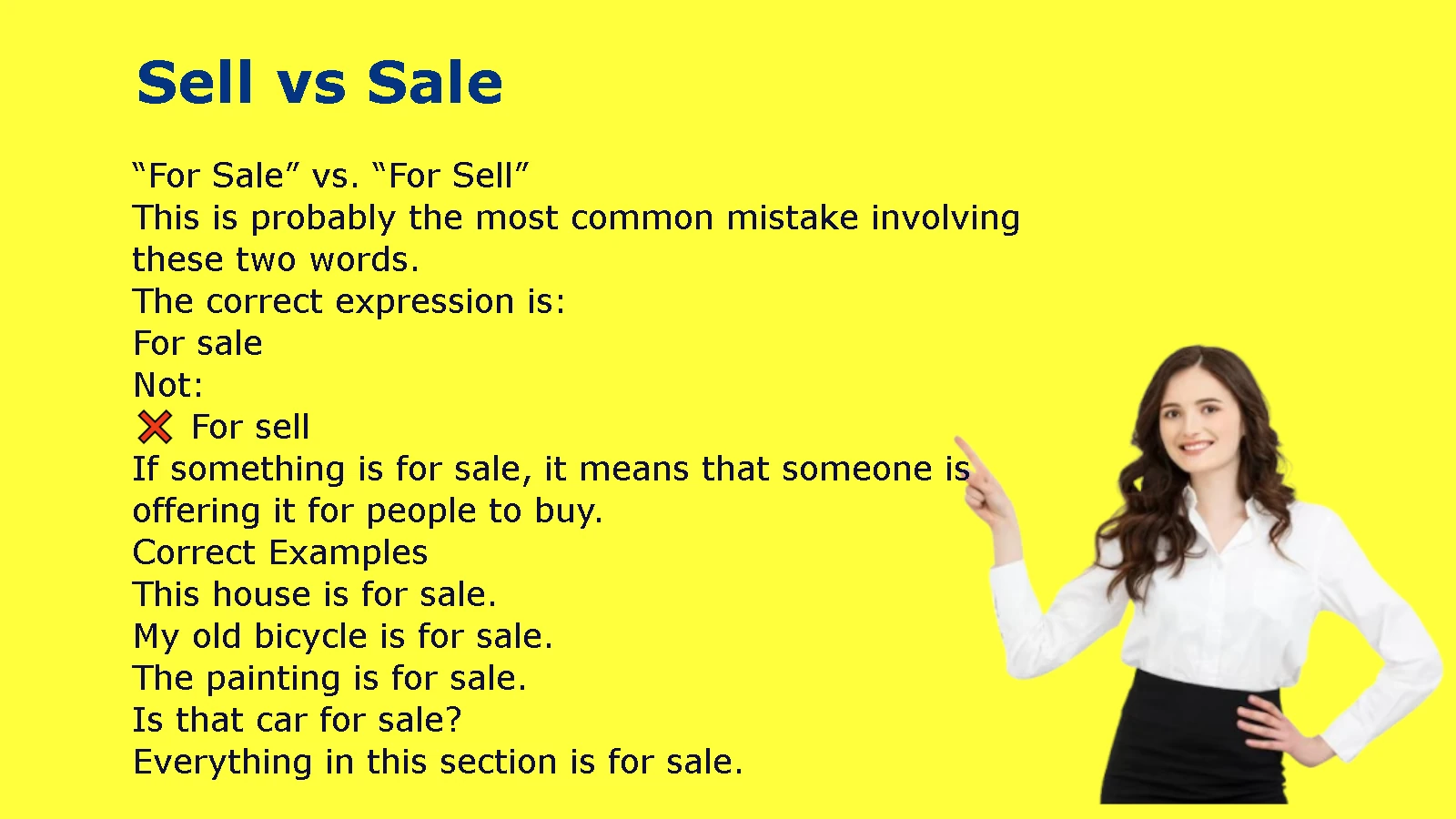
“For Sale” vs. “For Sell”
This is probably the most common mistake involving these two words.
The correct expression is:
For sale
Not:
❌ For sell
If something is for sale, it means that someone is offering it for people to buy.
Correct Examples
- This house is for sale.
- My old bicycle is for sale.
- The painting is for sale.
- Is that car for sale?
- Everything in this section is for sale.
Why does sale work here?
Because for sale describes the item’s availability for purchase. The phrase uses the noun sale, not the verb sell.
Think of the structure like this:
The house is for sale.
= The house is available to be purchased.
You wouldn’t say:
❌ The house is for sell.
The verb sell needs an appropriate grammatical structure:
I want to sell the house.
That’s the key difference.
“On Sale” vs. “For Sale”
Another common source of confusion is the difference between on sale and for sale.
The two expressions aren’t always interchangeable.
For Sale
For sale means something is available to buy.
The house is for sale.
The sentence doesn’t necessarily tell you that the price has been reduced.
On Sale
On sale commonly means that something is being offered at a discounted or special price.
These shoes are on sale for $40.
The shoes are available to buy, but the phrase emphasizes the promotional price.
Side-by-Side Comparison
| Expression | Meaning | Example |
| For sale | Available to purchase | The car is for sale. |
| On sale | Offered at a reduced or special price | The shoes are on sale for $30. |
There’s one nuance worth knowing. In some contexts, especially regional or historical usage, on sale can simply mean offered for purchase. In everyday American English, however, people commonly understand on sale to suggest a discount or special offer.
Compare These Sentences
The house is for sale.
This tells you the owner wants to sell it.
The shoes are on sale.
This usually suggests that the shoes have a special or reduced price.
The shoes are for sale.
This simply means you can buy them.
Why “Shoes on Sell” Is Wrong
You’ve probably seen or heard expressions such as:
❌ Shoes on sell
The correct version is:
✅ Shoes on sale
That’s because sale is the noun required in the expression on sale.
You can say:
The store is selling shoes.
But you can’t transfer the verb sell into the fixed expression on sale.
Compare:
- The store sells shoes.
- The store is selling shoes.
- The shoes are on sale.
- The shoes are for sale.
Each sentence uses the correct grammatical form.
Sell vs Sale Examples
Seeing the words in different contexts makes the distinction much easier.
Examples With “Sell”
- I want to sell my old laptop.
- She sells handmade candles.
- They are selling their house.
- He sold his car last month.
- We need to sell these products quickly.
- The company sells software online.
Examples With “Sale”
- The store is having a sale.
- The sale begins tomorrow.
- The house is for sale.
- These jackets are on sale.
- The sale of the property took several weeks.
- We completed the sale yesterday.
Sell and Sale in Real-Life Situations
The easiest way to understand the distinction is to see how native speakers naturally use both words in the same situation.
Selling a Car
Imagine you want to get rid of your old car.
You might say:
I want to sell my car.
That’s an action.
You could then put an advertisement online:
Car for sale — $8,500.
That’s describing the car’s availability.
After finding a buyer, you might say:
The sale was completed yesterday.
Now you’re talking about the transaction.
So one situation can contain all three forms:
sell → for sale → sale
I want to sell my car.
My car is for sale.
The sale was completed yesterday.
Once you see the pattern, the distinction becomes much harder to forget.
Common Mistakes With Sell and Sale
English learners often make a few predictable mistakes with these words.
| Incorrect | Correct | Why? |
| I want to sale my car. | I want to sell my car. | Sell is the verb. |
| The car is for sell. | The car is for sale. | For sale is the standard expression. |
| The shoes are on sell. | The shoes are on sale. | On sale uses the noun. |
| She sale clothes online. | She sells clothes online. | The third-person verb is sells. |
| They sale their house last year. | They sold their house last year. | Sold is the past tense of sell. |
Mistake 1: “I Want to Sale My Car”
❌ I want to sale my car.
✅ I want to sell my car.
After to, you normally need the base form of the verb:
to sell
to buy
to drive
to write
Sale isn’t the ordinary verb here.
Mistake 2: “The House Is for Sell”
❌ The house is for sell.
✅ The house is for sale.
The expression is for sale.
It’s worth memorizing as a complete phrase rather than trying to construct it word by word.
Mistake 3: “Everything Is on Sell”
❌ Everything is on sell.
✅ Everything is on sale.
Again, the fixed phrase is on sale.
Mistake 4: “She Sale Clothes”
❌ She sale clothes online.
✅ She sells clothes online.
Because she is the subject, the verb needs its third-person singular form:
sell → sells
A Simple Trick to Remember Sell vs Sale
Here’s an easy memory trick:
Sell = action
Sale = thing or event
You can also connect the words to familiar sentence patterns.
Think “Sell = Do”
If someone does something, you probably need sell.
I sell cars.
She sells jewelry.
They are selling tickets.
Think “Sale = Event”
If you’re talking about an event or transaction, use sale.
The store has a sale.
The sale starts Friday.
The sale was completed yesterday.
Remember the Fixed Phrases
Two phrases are especially useful:
For sale = available to buy
On sale = available at a special or discounted price
If you remember those two expressions, you’ll avoid many of the most common mistakes.
Sell vs Sale: A Quick Decision Guide
When you’re unsure which word to use, run through these questions.
Are you describing an action?
Use sell.
They want to sell their house.
Are you describing a transaction?
Use sale.
The sale of the house took six months.
Is something available to purchase?
Use for sale.
The house is for sale.
Is something being offered at a discount?
Use on sale.
The shoes are on sale this weekend.
Are you talking about what a person or business does?
Use sell.
The company sells computers.
This quick test handles most everyday situations.
Sell vs Sale in Business and Marketing
The distinction becomes even clearer in business writing.
A company might sell a product. The company might then run a sale to encourage customers to buy it.
For example:
The retailer sells home appliances.
This weekend, it is holding a clearance sale.
Marketing language often uses both words together:
- Sell more products
- Boost sales
- Increase sales
- Sales team
- Sales manager
- Sale price
- For sale
- On sale
Notice that sales is the plural form of the noun sale.
The company’s sales increased by 15%.
Here, sales doesn’t mean that the company is performing the action sell. It refers to the amount or volume of products sold.
“Sales” vs. “Selling”
These words can also cause confusion.
Selling is the -ing form of the verb sell.
She is selling cars.
Sales is the plural noun related to sale.
Car sales increased this year.
Compare them:
| Word | Function | Example |
| Sell | Verb | They sell cars. |
| Selling | Verb form | They are selling cars. |
| Sale | Noun | The sale was successful. |
| Sales | Plural noun | Sales increased this month. |
| Sold | Past form of sell | They sold 100 cars. |
This distinction matters in professional writing because business articles frequently use sales, selling, and sold in the same paragraph.
Can “Sale” Ever Mean the Action of Selling?
Yes. This is one reason the words can feel confusing.
Sale can refer to the act or process of selling as well as a particular transaction.
For example:
The sale of the property was completed in June.
Here, sale doesn’t necessarily mean a discount event. It refers to the transaction through which the property changed hands.
Likewise:
The sale of the company attracted international attention.
In this sentence, sale means the business transaction involving the company’s ownership.
So don’t assume that sale always means “discount.”
Its meaning depends on context.
Sell vs Sale: Fill-in-the-Blank Quiz
Now test yourself.
Choose sell, sale, sells, sold, or selling where appropriate.
1. Is that house down the street for _____?
Answer: sale
Is that house down the street for sale?
2. I want to _____ my old computer.
Answer: sell
I want to sell my old computer.
3. The store is having a huge summer _____.
Answer: sale
The store is having a huge summer sale.
4. She _____ handmade bags online.
Answer: sells
She sells handmade bags online.
5. They _____ their car last week.
Answer: sold
They sold their car last week.
6. These jackets are _____ sale this weekend.
Answer: on
These jackets are on sale this weekend.
The last example is a useful reminder: on sale is a fixed expression.
Sell vs Sale: Final Summary
The difference between sell and sale becomes simple once you focus on grammar.
Sell is primarily a verb. It describes the action of exchanging something for money.
I want to sell my car.
Sale is a noun. It can describe a transaction, selling event, or promotional event.
The sale of my car went smoothly.
Remember these four patterns:
| Expression | Meaning |
| Sell something | Perform the action of selling |
| For sale | Available to buy |
| On sale | Offered at a special or usually reduced price |
| A sale | A transaction or selling event |
The fastest memory trick is:
Sell = action
Sale = noun
So when you’re talking about what someone does, choose sell. When you’re talking about the transaction, event, or availability, choose sale.
Once that distinction clicks, phrases such as “for sale,” “on sale,” “sell online,” and “increase sales” become much easier to use correctly.