Have you ever wondered whether sulfate or sulphate is the correct spelling? If you’ve seen both forms in chemistry books, product labels, or scientific writing, the difference can be confusing. Sulfate vs Sulphate is mainly a matter of English spelling conventions, with the preferred form depending on the country and type of English you’re using.
Sulfate and sulphate have the same meaning. Both refer to a chemical compound or ion containing sulfur and oxygen, commonly represented by the sulfate ion SO₄²⁻. Sulfate is the standard spelling in American English, while sulphate is traditionally preferred in British English and other varieties influenced by British spelling.
Examples:
- The laboratory tested the sulfate concentration in the water.
- The laboratory tested the sulphate concentration in the water.
The confusion is understandable. People often search for sulfate vs sulphate, sulfate or sulphate, which spelling is correct, or sulphate meaning in English because both spellings appear in textbooks, scientific articles, and everyday products. However, the difference is mainly spelling-based, and neither form changes the chemical meaning of the term.
In this guide, you’ll learn the complete difference between Sulfate vs Sulphate, including their meaning, pronunciation, origin, correct spelling, and usage. You’ll also discover which spelling to use in American English vs British English, along with clear examples to help you choose the right form.
Sulfate vs Sulphate: Quick Answer
Sulfate and sulphate have the same meaning and refer to the same class of chemical compounds or the sulfate ion. The spelling changes according to language convention and, in some contexts, scientific naming practice.
| Feature | Sulfate | Sulphate |
| Meaning | A chemical term associated with sulfuric acid and the SO₄²⁻ group | Same |
| Main spelling | US English | Mainly British English |
| Scientific terminology | Standard modern form | Traditional variant |
| Pronunciation | /ˈsʌl.feɪt/ | /ˈsʌl.feɪt/ |
| Chemical ion | SO₄²⁻ | SO₄²⁻ |
| Example | magnesium sulfate | magnesium sulphate |
| Plural | sulfates | sulphates |
Cambridge gives both forms the same pronunciation and identifies sulphate as mainly UK and sulfate as the usual US spelling.
The easiest rule to remember
If you’re writing for an American audience, choose sulfate.
If you’re following traditional British spelling, sulphate is appropriate.
When you’re writing a modern chemistry paper and want to follow internationally recognized chemical nomenclature, sulfate is the safer choice.
What Does Sulfate Mean?
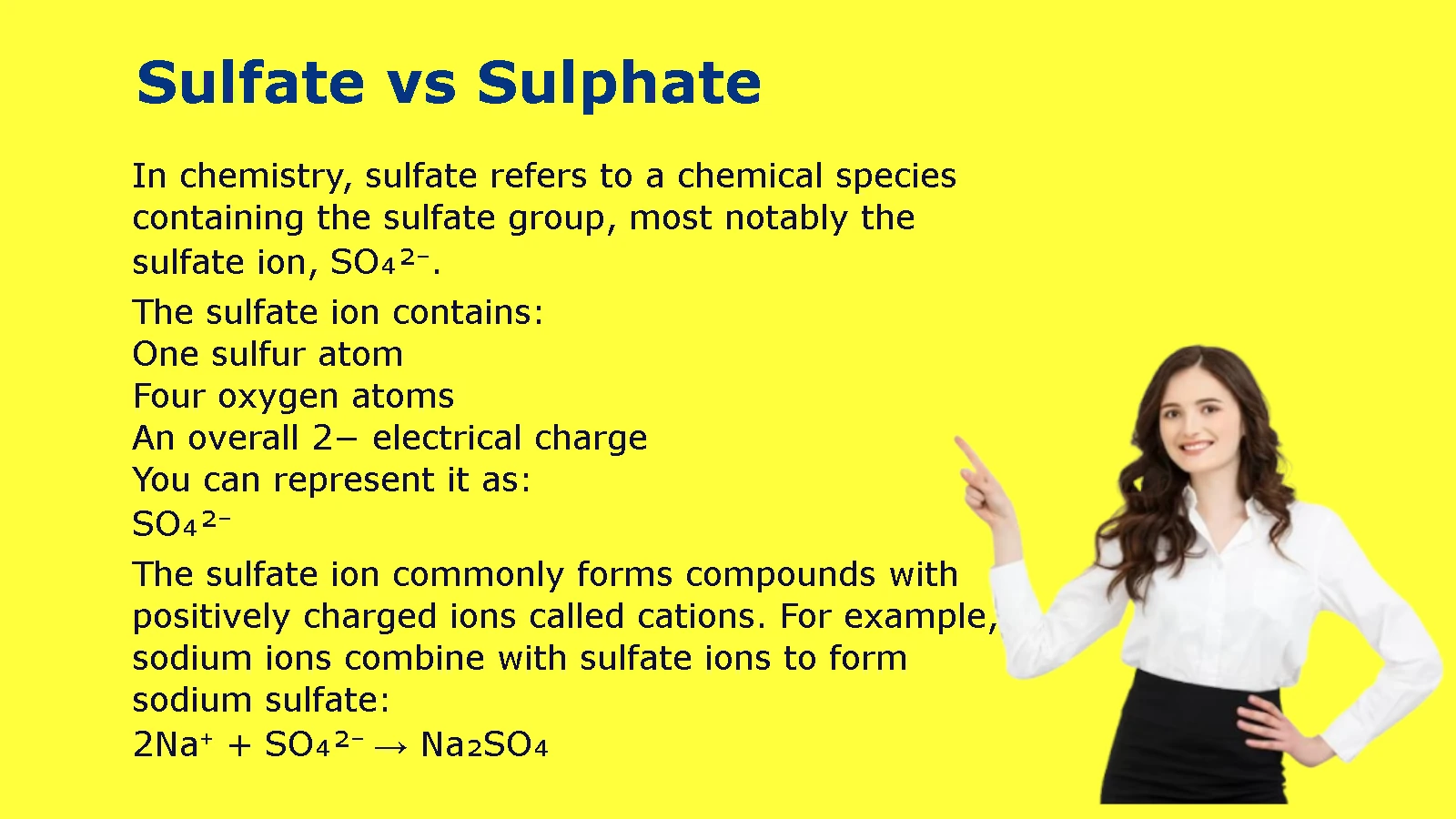
In chemistry, sulfate refers to a chemical species containing the sulfate group, most notably the sulfate ion, SO₄²⁻.
The sulfate ion contains:
- One sulfur atom
- Four oxygen atoms
- An overall 2− electrical charge
You can represent it as:
SO₄²⁻
The sulfate ion commonly forms compounds with positively charged ions called cations. For example, sodium ions combine with sulfate ions to form sodium sulfate:
2Na⁺ + SO₄²⁻ → Na₂SO₄
The word also appears in the names of many salts and other compounds. For example, magnesium sulfate, calcium sulfate, and copper sulfate all contain sulfate.
IUPAC’s Principles of Chemical Nomenclature lists SO₄²⁻ as sulfate and gives systematic alternatives based on the same chemical species.
Sulfate in simple terms
Think of sulfate as the name attached to a particular sulfur-and-oxygen group in chemistry.
For example:
- Sodium sulfate contains sodium and sulfate.
- Magnesium sulfate contains magnesium and sulfate.
- Calcium sulfate contains calcium and sulfate.
- Copper sulfate contains copper and sulfate.
The spelling may change to sulphate in British usage, but the underlying chemistry doesn’t suddenly change.
What Does Sulphate Mean?
Sulphate means the same thing as sulfate. It is the traditional British spelling of the term.
Cambridge defines sulphate as a chemical formed from sulfur and oxygen and another element. It labels the spelling as mainly UK, while noting that the US normally uses sulfate.
For example, a British source might write:
magnesium sulphate
An American source would normally write:
magnesium sulfate
The chemical formula remains MgSO₄ in both cases.
This is an important point. Changing “ph” to “f” doesn’t change the chemical substance. You’re looking at two spelling conventions for the same terminology.
Sulfate vs Sulphate: The Key Difference
The difference between sulfate and sulphate becomes much easier to understand when you separate spelling, pronunciation, meaning, and scientific usage.
Spelling
The only visible difference in the word itself is:
- sulfate → uses f
- sulphate → uses ph
That small change follows the broader spelling difference between sulfur and sulphur.
American English generally favors the -f- forms:
- sulfur
- sulfide
- sulfate
- sulfite
- sulfonamide
Traditional British English often retains the -ph- forms:
- sulphur
- sulphide
- sulphate
- sulphite
- sulphonamide
Cambridge similarly identifies sulphide as mainly UK and sulfide as the usual US form.
Meaning
There is no difference in basic meaning between sulfate and sulphate.
Both can refer to the sulfate ion or compounds containing the sulfate group.
For example:
- magnesium sulfate
- magnesium sulphate
These names refer to the same compound, MgSO₄.
Pronunciation
The two spellings are also pronounced the same in standard English:
/ˈsʌl.feɪt/
The spelling changes, but the pronunciation doesn’t normally change with it. Cambridge lists the same pronunciation for both forms.
Regional preference
The biggest practical difference is regional.
Sulfate is the normal choice in US English.
Sulphate remains common in traditional British English.
However, scientific terminology doesn’t always follow everyday regional spelling. Modern chemical nomenclature uses sulfate, even in contexts where traditional British spelling might otherwise use sulphate. IUPAC materials explicitly use sulfate for SO₄²⁻.
Is Sulfate or Sulphate Correct?
Both are correct, but the appropriate choice depends on your writing context.
If you’re writing in US English, use sulfate.
When you’re following a traditional British English style, sulphate is a legitimate spelling.
The important thing is not to treat sulphate as a spelling mistake in every context. British dictionaries recognize it as a legitimate form. Cambridge specifically labels it as mainly UK spelling.
A practical decision rule
| Your situation | Best choice |
| American English article | sulfate |
| US school assignment | sulfate |
| Modern chemistry paper | sulfate |
| IUPAC-based terminology | sulfate |
| Traditional British English | sulphate |
| Quoting an older British source | Keep sulphate |
| Reproducing a British product or document name | Preserve the original spelling |
When a style guide gives you a specific instruction, follow it. Consistency matters more than trying to mix regional conventions.
Why Does Sulfate Have Two Spellings?
The two spellings reflect a broader history of English spelling rather than a difference in chemistry.
The sulfur/sulphur distinction is particularly important. Once English developed different spelling traditions on either side of the Atlantic, related chemical words followed similar patterns.
That produced pairs such as:
| US form | Traditional British form |
| sulfur | sulphur |
| sulfate | sulphate |
| sulfide | sulphide |
| sulfite | sulphite |
The pattern is easy to spot. American scientific and technical writing generally uses sulf-, while traditional British spelling has historically used sulph-.
Over time, however, scientific nomenclature has increasingly favored standardized forms. That is why modern chemistry sources can use sulfate even when the surrounding English follows a British convention.
The result can look confusing at first. It isn’t really a contradiction. General English spelling and scientific nomenclature operate under slightly different conventions.
Is Sulfate the Scientific Spelling?
Yes. Sulfate is the standard form used in modern chemical nomenclature.
IUPAC’s Principles of Chemical Nomenclature identifies SO₄²⁻ as sulfate. It also provides systematic nomenclature for related species.
This matters because scientific names aren’t chosen simply according to whether the writer uses American or British English. International scientific organizations need terminology that researchers can use consistently across countries.
For example, IUPAC materials use:
- sulfate
- sulfite
- thiosulfate
- disulfate
The standardized terminology makes scientific communication more consistent.
Sulfate in chemical nomenclature
The sulfate ion is:
SO₄²⁻
IUPAC materials list it as sulfate and also provide systematic names such as tetraoxosulfate(2−) for formal nomenclature purposes.
That doesn’t mean ordinary chemistry students need to replace sulfate with the longer systematic name. Quite the opposite. Sulfate is the familiar common chemical name used in normal scientific communication.
Sulfate vs Sulphate in American and British English
Regional spelling is where most people encounter this distinction.
American English
American English normally uses sulfate.
Examples include:
- magnesium sulfate
- copper sulfate
- calcium sulfate
- sodium sulfate
- ferrous sulfate
- sulfate ion
This follows the broader American preference for sulfur rather than sulphur.
British English
Traditional British English uses sulphate.
Examples include:
- magnesium sulphate
- copper sulphate
- calcium sulphate
- sodium sulphate
- ferrous sulphate
Cambridge labels sulphate as mainly UK while identifying sulfate as the usual US spelling.
Modern British scientific writing
Here’s where the simple “American versus British” rule needs a little refinement.
A British writer may use sulfate in scientific or technical material because modern chemical terminology favors the sulf- form.
So you shouldn’t assume that every British chemistry textbook, journal article, or laboratory document will use sulphate.
The safest distinction is:
“Sulphate” is a traditional British English spelling. “Sulfate” is the modern standardized scientific form and the normal US spelling.
Sulfate vs Sulphate Examples
Examples with sulfate
- Magnesium sulfate has the chemical formula MgSO₄.
- The laboratory used copper sulfate in the experiment.
- Calcium sulfate occurs naturally in minerals such as gypsum.
- The report measured sulfate concentrations in the water.
- The compound contains a sulfate ion.
- The product label lists a form of sulfate among its ingredients.
with sulphate
A British publication might write:
- Magnesium sulphate has the chemical formula MgSO₄.
- The laboratory used copper sulphate in the experiment.
- Calcium sulphate occurs naturally in gypsum.
- The researchers measured sulphate concentrations.
- The solution contained sulphate ions.
Notice what stays the same: the chemistry.
Only the spelling changes.
Side-by-side examples
| US / scientific style | Traditional British style |
| magnesium sulfate | magnesium sulphate |
| copper sulfate | copper sulphate |
| calcium sulfate | calcium sulphate |
| sodium sulfate | sodium sulphate |
| zinc sulfate | zinc sulphate |
| ammonium sulfate | ammonium sulphate |
| barium sulfate | barium sulphate |
This is one of those cases where a single spelling difference can make a text look more regionally specific without changing its meaning.
Common Sulfate and Sulphate Compounds
Sulfate appears in hundreds of chemical names, but several compounds show up repeatedly in chemistry, medicine, industry, agriculture, geology, and everyday product information.
| Compound | US spelling | British spelling | Formula |
| Sodium sulfate | sodium sulfate | sodium sulphate | Na₂SO₄ |
| Magnesium sulfate | magnesium sulfate | magnesium sulphate | MgSO₄ |
| Calcium sulfate | calcium sulfate | calcium sulphate | CaSO₄ |
| Copper sulfate | copper sulfate | copper sulphate | CuSO₄ |
| Zinc sulfate | zinc sulfate | zinc sulphate | ZnSO₄ |
| Ammonium sulfate | ammonium sulfate | ammonium sulphate | (NH₄)₂SO₄ |
| Barium sulfate | barium sulfate | barium sulphate | BaSO₄ |
| Ferrous sulfate | ferrous sulfate | ferrous sulphate | FeSO₄ |
The table illustrates an important principle: changing sulfate to sulphate doesn’t change the formula.
For instance, copper sulfate and copper sulphate both refer to CuSO₄ when they are naming the same compound.
Cambridge’s dictionary entries include common compounds such as calcium sulphate, copper sulphate, zinc sulphate, barium sulphate, ammonium sulphate, and magnesium sulphate under the British spelling.
Sulfates vs Sulphates: What About the Plural?
The same spelling difference appears in the plural.
- sulfate → sulfates
- sulphate → sulphates
For example:
The sample contained several sulfates.
A British source might write:
The sample contained several sulphates.
The plural doesn’t create a new chemical meaning. It simply refers to more than one sulfate compound or instance of the sulfate group.
This distinction becomes particularly useful when reading scientific literature from different countries. A paper discussing sulphates isn’t necessarily describing something different from a paper discussing sulfates.
Sulfate vs Sulphate in Scientific and Technical Writing
Scientific writing rewards consistency.
If you’re preparing a chemistry report, dissertation, research article, laboratory manual, or technical document, decide which naming convention the publication or institution expects before you start.
Chemistry papers
Sulfate is the strongest default for modern chemical terminology.
If your paper follows IUPAC nomenclature, using sulfate also keeps the terminology aligned with IUPAC’s naming conventions.
Medical writing
Medical terminology provides plenty of examples of both forms.
For instance, ferrous sulfate is the standard US spelling. British sources may use ferrous sulphate.
Cambridge lists ferrous sulphate as a UK medical and chemistry term and gives ferrous sulfate as the US equivalent.
The underlying compound remains the same.
Academic writing
Academic writers should prioritize the style guide and terminology used by their field.
If you’re studying chemistry in an American institution, sulfate is the natural choice.
If you’re writing for a British publication that follows traditional spelling, sulphate may be expected.
However, if the assignment specifically requires IUPAC terminology, use sulfate.
Product labels
Product terminology can vary by market.
A product sold in the United States may say sulfate, while a product marketed using traditional British spelling may say sulphate.
This is especially noticeable in personal-care products, where consumers frequently see terms such as:
- sodium sulfate
- sodium lauryl sulfate
- sodium laureth sulfate
- sulfate-free
A British-facing product may instead use the -ph- spelling.
The spelling alone doesn’t tell you that the product contains a different chemical.
Sulfate vs Sulphate in Everyday Products
You don’t have to work in a laboratory to encounter sulfate terminology.
These words appear on:
- Shampoo bottles
- Cosmetics
- Cleaning products
- Fertilizer labels
- Medicines
- Mineral descriptions
- Water-quality reports
- Laboratory supplies
- Industrial chemicals
One particularly common phrase is sulfate-free.
In US English, you’ll generally see:
sulfate-free shampoo
A British source may write:
sulphate-free shampoo
The spelling reflects the language convention. It doesn’t create two different categories of chemical compounds.
Why “sulfate-free” appears so often
The phrase became especially prominent in consumer product marketing, particularly in hair-care and personal-care products.
However, it’s important not to turn the spelling question into a safety claim. “Sulfate-free” is a product description, not automatically a statement that one product is healthier, gentler, or better for everyone.
Those claims depend on the specific ingredients, formulation, concentration, and intended use.
Sulfate-Free vs Sulphate-Free
The same regional distinction applies to this phrase.
| US / modern scientific style | Traditional British style |
| sulfate-free | sulphate-free |
| sulfate-free shampoo | sulphate-free shampoo |
| sulfate-free cleanser | sulphate-free cleanser |
| sulfate-free product | sulphate-free product |
The choice between the two forms should match the audience.
For a US website, sulfate-free is the natural spelling.
For a traditional British publication, sulphate-free may be more appropriate.
Don’t change the spelling inside a quotation or official product name simply to make it match your preferred style. Preserve the original wording when accuracy requires it.
Sulfur vs Sulphur and Related Spellings
Understanding sulfate vs sulphate becomes easier when you recognize the larger spelling pattern.
Sulfur vs Sulphur
Sulfur is the standard US spelling and the spelling used in modern scientific nomenclature.
Sulphur is the traditional British spelling.
The same contrast appears in related words.
Sulfide vs Sulphide
American English uses:
sulfide
Traditional British English uses:
sulphide
Cambridge identifies sulphide as mainly UK and gives sulfide as the usual US form.
Sulfite vs Sulphite
The same pattern appears with:
- sulfite
- sulphite
The general pattern is easy to remember:
US and modern scientific usage often favor “sulf-,” while traditional British usage may use “sulph-.”
This pattern explains why sulfate and sulphate coexist.
Is Sulphate Wrong in American English?
In standard American English, sulfate is the normal spelling.
That doesn’t mean sulphate is meaningless or incomprehensible to American readers. It simply looks like a British or traditional spelling.
For a US-focused article, report, or educational resource, sulfate is the better choice.
The distinction is similar to other US and UK spelling differences. A British spelling isn’t necessarily an error in every English context. It may simply belong to a different spelling convention.
So if you encounter sulphate in an older British chemistry book, don’t “correct” the chemistry. The word is still referring to sulfate.
Is Sulfate Only an American Spelling?
No.
This is an important point because the labels US and UK can make the situation look more rigid than it really is.
Cambridge describes sulfate as the US spelling of sulphate, but modern scientific nomenclature also uses sulfate as the chemical name. IUPAC materials explicitly list sulfate for SO₄²⁻.
Therefore, calling sulfate simply “the American version” misses part of the story.
A better description is:
Sulfate is the standard US spelling and the standard modern scientific form, while sulphate remains a traditional British spelling.
That wording captures both everyday English and scientific usage.
Common Mistakes With Sulfate and Sulphate
A few misconceptions appear repeatedly.
Mistake: Thinking sulfate and sulphate are different chemicals
They aren’t different chemical substances simply because the spelling changes.
Sulfate and sulphate can both refer to the same sulfate group and the same compounds.
Mistake: Calling sulphate an incorrect spelling everywhere
That’s too broad.
Sulphate is a recognized spelling in British English. Cambridge explicitly labels it as mainly UK.
Mistake: Assuming sulfate is only used in the United States
Modern scientific nomenclature uses sulfate internationally.
IUPAC uses sulfate in its chemical nomenclature materials.
Mistake: Changing the chemical formula
Changing sulfate to sulphate does not change the formula.
The sulfate ion remains:
SO₄²⁻
Mistake: Mixing spelling conventions randomly
A document that uses sulfur, sulfate, and sulfide in one paragraph and then suddenly switches to sulphur, sulphate, and sulphide can look inconsistent.
Pick the convention that fits your audience and stay consistent unless you’re quoting a source.
Which Spelling Should You Use?
The best choice depends on your purpose.
Use “sulfate” when:
- You’re writing in US English.
- You’re writing a modern chemistry article.
- You’re following IUPAC terminology.
- You’re writing for an international scientific audience.
- You’re preparing a US academic paper.
- You’re writing about chemical formulas or nomenclature.
- You want the spelling most familiar to American readers.
Use “sulphate” when:
- You’re deliberately following traditional British English.
- You’re reproducing an older British source.
- You’re quoting text that uses sulphate.
- A publication’s house style specifically requires it.
- You’re preserving the original spelling of a historical or archival document.
A quick style test
Ask yourself three questions:
- Who will read this?
- Which style guide am I following?
- Does my field require a specific scientific naming convention?
Those three questions usually settle the issue immediately.
Sulfate vs Sulphate: A Practical Comparison
| Category | Sulfate | Sulphate |
| Basic meaning | Chemical term for sulfate species and compounds | Same |
| Ion | SO₄²⁻ | SO₄²⁻ |
| Pronunciation | /ˈsʌl.feɪt/ | /ˈsʌl.feɪt/ |
| US English | Preferred | Uncommon |
| Traditional UK English | Less traditional | Preferred |
| Modern scientific nomenclature | Standard | Traditional variant |
| Plural | sulfates | sulphates |
| Example | magnesium sulfate | magnesium sulphate |
| Chemical formula changes? | No | No |
The table captures the central point: the spelling changes, but the chemistry does not.
A Closer Look at the Sulfate Ion
The sulfate ion deserves a little more attention because it explains why the word appears in so many different chemical names.
The ion is written as:
SO₄²⁻
It consists of one sulfur atom surrounded by four oxygen atoms.
The ion has an overall charge of −2, which allows it to combine with positively charged ions to form electrically neutral compounds.
For example, sodium has a +1 charge in sodium sulfate. Two sodium ions are therefore required to balance one sulfate ion:
2Na⁺ + SO₄²⁻ → Na₂SO₄
Magnesium commonly forms a +2 ion. That means one magnesium ion balances one sulfate ion:
Mg²⁺ + SO₄²⁻ → MgSO₄
Calcium behaves similarly:
Ca²⁺ + SO₄²⁻ → CaSO₄
This charge balance explains why different sulfate compounds have different formulas even though they all contain the same sulfate ion.
Why the formula matters
The spelling difference can make the names look different:
- magnesium sulfate
- magnesium sulphate
But the formula immediately shows the chemical identity:
MgSO₄
The same principle applies to many other sulfate compounds.
Real-World Examples of Sulfate Compounds
Sulfate compounds aren’t limited to chemistry classrooms.
Magnesium sulfate
Magnesium sulfate (MgSO₄) is commonly encountered as the mineral-related compound associated with Epsom salt, particularly in its hydrated form.
A British source may write magnesium sulphate.
Calcium sulfate
Calcium sulfate (CaSO₄) occurs naturally in minerals including gypsum. It also has important industrial applications.
The British spelling is calcium sulphate.
Copper sulfate
Copper sulfate (CuSO₄) is a widely known copper compound used in laboratory and industrial contexts.
A US chemistry text will normally use copper sulfate, while a traditional British source may use copper sulphate.
Ferrous sulfate
Ferrous sulfate (FeSO₄) contains iron in the +2 oxidation state.
British medical material may call it ferrous sulphate. Cambridge gives ferrous sulphate as a UK chemistry and medical term and identifies ferrous sulfate as the US equivalent.
These examples demonstrate why the spelling question matters beyond vocabulary. A reader may encounter the same chemical under two different-looking names.
Sulfate vs Sulphate in Older Sources
Older scientific and medical documents can contain sulphate even when a modern writer would use sulfate.
That doesn’t necessarily mean the older source uses outdated chemistry.
It may simply reflect the spelling conventions of its time and place.
For example, an older British medical reference might discuss magnesium sulphate, while a current American medical resource might use magnesium sulfate.
When reading historical material, preserve the original spelling if you’re quoting it. When paraphrasing, use the spelling appropriate to your own publication style.
This distinction is especially useful for researchers working with:
- Historical medical literature
- Older chemistry textbooks
- British scientific publications
- Archived newspapers
- Geological reports
- Historical product documents
Sulfate vs Sulphate in Academic and Professional Writing
Consistency is one of the easiest ways to make technical writing look polished.
Suppose a chemistry paper begins with:
Sulfur compounds were analyzed to determine sulfate concentrations.
Switching later to:
The sulphate concentration was measured again.
may make the reader wonder if the writer is referring to a different term.
The chemistry may be perfectly correct, but the spelling looks inconsistent.
A cleaner approach is to choose one convention:
Sulfur compounds were analyzed to determine sulfate concentrations.
Then maintain that spelling throughout the document.
If you’re quoting another source, however, keep the source’s original spelling:
The 1950 report referred to the compound as “magnesium sulphate.”
That makes the distinction intentional rather than accidental.
Frequently Asked Questions About Sulfate vs Sulphate
Is sulfate and sulphate the same thing?
Yes. Sulfate and sulphate are spelling variants for the same chemical term. The main difference is regional and stylistic. Sulfate is the normal US spelling and is also the form used in modern scientific nomenclature. Sulphate is mainly associated with traditional British English.
Which is correct, sulfate or sulphate?
Both are correct, depending on context. Use sulfate in US English and modern scientific writing. Use sulphate when following traditional British spelling.
Is sulfate American or British?
Sulfate is the standard American spelling, but it isn’t limited to American English. Modern scientific nomenclature also uses sulfate. IUPAC lists SO₄²⁻ as sulfate.
Is sulphate still used in British English?
Yes. Sulphate remains a recognized and commonly encountered British spelling. Cambridge labels it as mainly UK.
How do you pronounce sulfate and sulphate?
Both are normally pronounced /ˈsʌl.feɪt/. The spelling differs, but the standard pronunciation is essentially the same.
What is the formula for sulfate?
The sulfate ion is SO₄²⁻. It contains one sulfur atom and four oxygen atoms and carries an overall charge of −2.
Is sulphate wrong in scientific writing?
Not necessarily. It can appear in scientific writing, particularly in material following traditional British spelling. However, sulfate is the standard form used in modern IUPAC chemical nomenclature.
Should I use sulfate or sulphate in academic writing?
Follow your institution, journal, or style guide. If no special instruction applies, sulfate is a strong choice for modern scientific writing and is the standard US form.
Is magnesium sulfate the same as magnesium sulphate?
Yes. Magnesium sulfate and magnesium sulphate refer to the same chemical compound when they are used as equivalent regional spellings. Its formula is MgSO₄.
Is sulfate-free the same as sulphate-free?
From a spelling perspective, yes. Sulfate-free is the US and modern scientific-style spelling, while sulphate-free follows traditional British spelling. The spelling itself doesn’t determine the properties or safety of a product.
Sulfate vs Sulphate: Final Verdict
The difference between sulfate and sulphate is primarily a matter of spelling convention, not chemistry.
Sulfate is the preferred form in US English and the standard form used in modern chemical nomenclature. Sulphate is a legitimate traditional British spelling that remains in use.
Both refer to the same sulfate chemistry, including the SO₄²⁻ ion.
The easiest rule is:
Use “sulfate” for US English and modern scientific writing. Use “sulphate” when following traditional British English.
Once you know that rule, the apparent contradiction disappears. A bottle labeled magnesium sulphate, an American textbook discussing magnesium sulfate, and an IUPAC document referring to sulfate can all be talking about the same chemical terminology.
The spelling may cross the Atlantic. The chemistry doesn’t.