The difference between meet and see depends on the situation. Meet usually means to come together with someone for the first time or for a planned interaction, while see means to look at someone, visit someone, or spend time with someone you already know. Meet vs See: Meet is used for introductions or planned gatherings, while see is used for visiting, viewing, or spending time with someone.
The confusion happens because many people use meet and see in similar conversations, such as making plans, talking about relationships, or describing past experiences. And here’s the kicker: choosing the wrong word can slightly change the meaning of your sentence.
In this guide, you’ll learn the difference between Meet vs See, including meet meaning, see meaning, when to use meet, when to use see, and meet vs see examples in everyday sentences. You’ll also discover common phrases like nice to meet you, see you later, and how native speakers use these words naturally.
By the end, you’ll know exactly when to use meet and when to use see so your English sounds clearer and more natural.
Meet vs See: Quick Difference
The easiest way to understand meet vs see is to focus on the type of interaction.
| Word | Main Meaning | Typical Situation | Example |
| Meet | To come together with someone, often for the first time or a planned purpose | Introductions, appointments, gatherings | “I met my new neighbor yesterday.” |
| See | To notice someone or spend time with someone | Sight, visits, familiar people | “I saw my neighbor at the store.” |
Think of it this way:
Meeting creates a connection. Seeing notices a connection.
When you meet someone, there is usually some form of interaction. You exchange names, shake hands, talk, or share an experience.
When you see someone, you might talk to them, but you don’t have to. You can simply notice them from a distance.
For example:
“I saw John at the airport, but I didn’t meet him.”
This means you noticed John, but you did not introduce yourself or have a conversation.
Another example:
“I met John at the airport.”
This suggests you interacted with John, possibly for the first time.
What Does “Meet” Mean?
The verb meet means to come together with another person or group. It often involves communication, interaction, or a shared purpose.
The word can describe both new introductions and planned gatherings.
Meet as a First Introduction
The most common use of meet happens when two people come into contact for the first time.
Examples:
- “Nice to meet you.”
- “I met my wife in college.”
- “She met her new manager yesterday.”
- “I met Tom at a conference last year.”
In these examples, the people did not have an established relationship before that moment.
The phrase “Nice to meet you” is especially important in English. People use it when they introduce themselves for the first time.
Example conversation:
Emily: Hi, I’m Emily. I work in marketing.
David: Nice to meet you, Emily. I’m David.
You would not normally say:
❌ “Nice to meet you again.”
Instead, use:
✅ “Nice to see you again.”
The difference comes from familiarity. A second meeting means the person is no longer new to you.
Meet for a Planned Event or Purpose
The word meet also describes organized interactions.
You can meet:
- A friend for coffee
- A client for business
- A doctor for an appointment
- A team for a discussion
Examples:
- “I’m meeting my friend for lunch.”
- “The company will meet with investors next week.”
- “We need to meet tomorrow to discuss the project.”
Here, meet does not mean the first time. It means people are coming together intentionally.
For example:
“I’m meeting my boss tomorrow.”
You probably already know your boss. The word meet works because the sentence describes a planned conversation.
Meet Someone vs Meet With Someone
Many learners confuse these two phrases.
| Phrase | Meaning | Example |
| Meet someone | Encounter or become introduced to someone | “I met Lisa at university.” |
| Meet with someone | Have a planned discussion or appointment | “I met with Lisa to review the report.” |
The difference is subtle but useful.
Meet someone
This often focuses on the person and the relationship.
Example:
“I met my neighbor yesterday.”
The important detail is that you were introduced or interacted.
Meet with someone
This focuses on the purpose of the meeting.
Example:
“I met with my lawyer yesterday.”
The sentence suggests a scheduled appointment or discussion.
What Does “See” Mean?
The verb see has several meanings, which makes it more flexible than meet.
At its basic level, see means to use your eyes to notice something. However, English speakers also use it to describe visits, relationships, and experiences.
See as Using Your Eyes
The simplest meaning of see is visual awareness.
Examples:
- “I saw a beautiful sunset.”
- “Did you see that movie?”
- “I can see the mountains from my window.”
- “I saw Sarah walking down the street.”
In these cases, seeing does not require interaction.
You can see someone without speaking to them.
Example:
“I saw my teacher at the mall, but I didn’t say hello.”
The speaker noticed the teacher but did not interact.
See as Spending Time With Someone
English speakers often use see when talking about spending time with people they already know.
Examples:
- “I see my parents every weekend.”
- “I saw my friends yesterday.”
- “I’m seeing my doctor next Monday.”
Here, see means visiting or meeting regularly.
For example:
“I see my dentist twice a year.”
This does not mean you only look at your dentist. It means you visit your dentist for appointments.
See in Romantic Relationships
The word see can also describe dating or romantic relationships.
Examples:
- “She is seeing someone.”
- “They have been seeing each other for six months.”
In this context, see means spending romantic time together or dating.
Compare these sentences:
“I met Alex yesterday.”
This usually means:
- You were introduced to Alex.
- It may have been the first time.
“I’m seeing Alex.”
This usually means:
- You are dating Alex.
- You have an ongoing relationship.
The meaning changes completely based on context.
Meet vs See: The Biggest Differences Explained
Although meet and see can overlap, they focus on different parts of an experience.
First Time vs Someone You Already Know
The biggest difference between meet vs see is familiarity.
| Situation | Correct Word | Example |
| First introduction | Meet | “I met Anna yesterday.” |
| Seeing a familiar person | See | “I saw Anna yesterday.” |
| Planned discussion | Meet | “I met with Anna about work.” |
| Watching someone from a distance | See | “I saw Anna at the station.” |
A useful rule:
New connection = meet.
Existing connection = see.
Example:
Imagine you attend a company event.
You introduce yourself to a person named Mark.
You say:
“I met Mark at the event.”
A month later, you run into Mark again.
You say:
“I saw Mark at the event.”
The first time created the relationship. The second time simply continued it.
Planned Event vs Unexpected Encounter
Another difference between meet and see involves intention.
Meet usually involves a plan
Examples:
- “We’re meeting at 7 PM.”
- “I’m meeting my teacher tomorrow.”
- “The teams will meet next week.”
Someone usually expects the interaction.
See can happen by chance
Examples:
- “I saw my old friend at the supermarket.”
- “I saw my neighbor walking his dog.”
- “I saw my cousin at the airport.”
You may not have planned the encounter.
A simple comparison:
| Planned | Unexpected |
| “I’m meeting Sarah for coffee.” | “I saw Sarah at the coffee shop.” |
| “I’m meeting my doctor tomorrow.” | “I saw my doctor at the hospital.” |
Physical Sight vs Personal Interaction
The difference becomes clearer when you compare two similar sentences.
Example 1:
“I saw James at the party.”
Meaning:
- You noticed James.
- You may or may not have talked.
Example 2:
“I met James at the party.”
Meaning:
- You were introduced.
- You interacted with James.
The word meet involves a social connection.
The word see involves awareness or presence.
Meet vs See in Different Tenses
Understanding meet vs see becomes easier when you look at how both verbs work in different tenses. The meaning stays mostly the same, but the time of the action changes.
Both verbs are irregular, which means their past forms do not simply add -ed.
| Verb | Present Tense | Past Tense | Past Participle |
| Meet | meet | met | met |
| See | see | saw | seen |
For example:
- Present: “I meet new people at work.”
- Past: “I met a new coworker yesterday.”
- Present perfect: “I have met many interesting people.”
And:
- Present: “I see my friends every weekend.”
- Past: “I saw my friends last weekend.”
- Present perfect: “I have seen that movie before.”
Meet vs See in the Present Tense
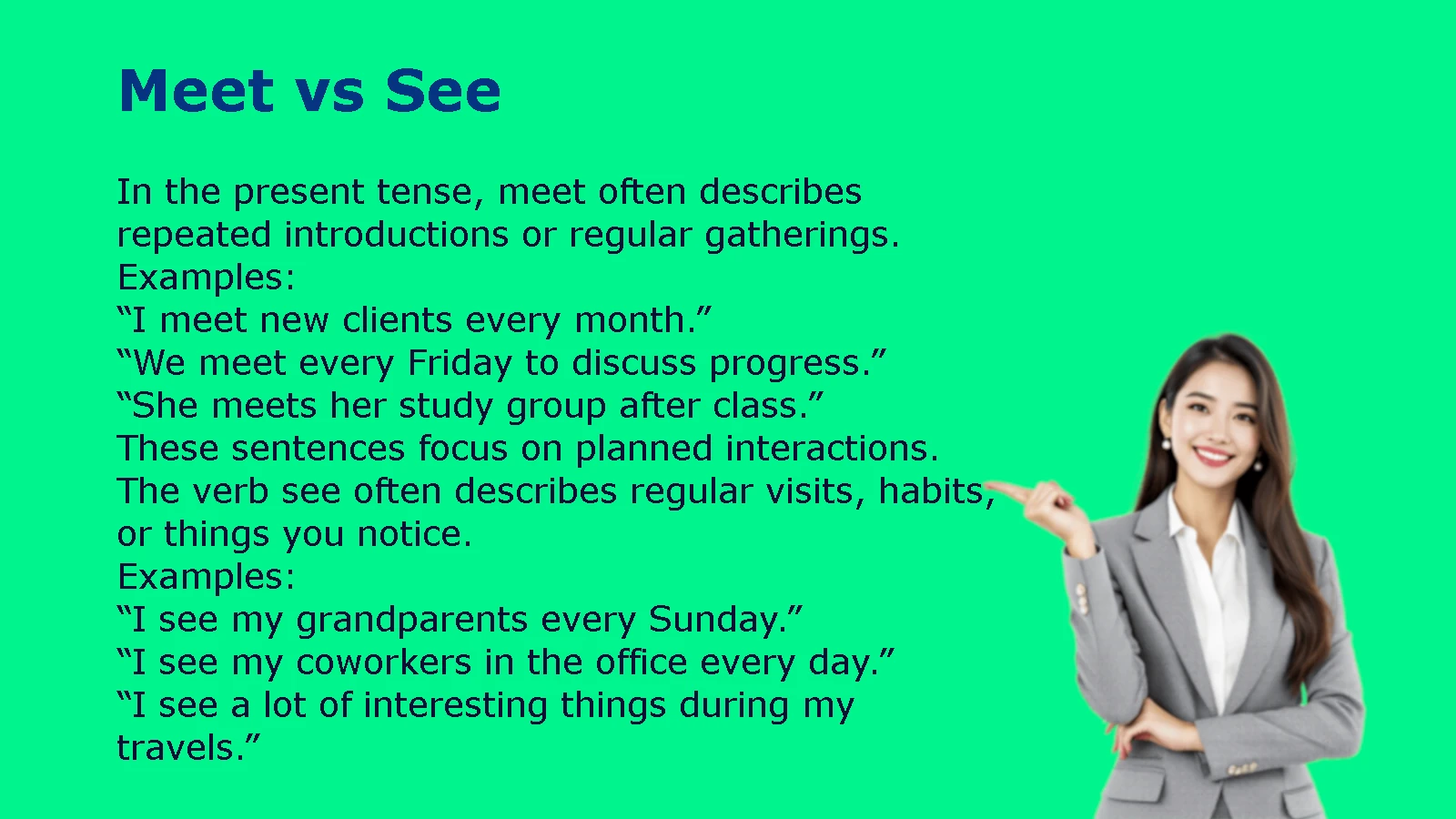
In the present tense, meet often describes repeated introductions or regular gatherings.
Examples:
- “I meet new clients every month.”
- “We meet every Friday to discuss progress.”
- “She meets her study group after class.”
These sentences focus on planned interactions.
The verb see often describes regular visits, habits, or things you notice.
Examples:
- “I see my grandparents every Sunday.”
- “I see my coworkers in the office every day.”
- “I see a lot of interesting things during my travels.”
The difference is about the purpose.
Compare:
“I meet my manager every Monday.”
This suggests a scheduled meeting.
“I see my manager every Monday.”
This suggests you encounter or interact with your manager regularly, but it does not emphasize the meeting itself.
Meet vs See in the Past Tense
The past tense creates some of the most common mistakes.
Consider these examples:
“I met Sarah yesterday.”
This usually means:
- Sarah was new to you.
- You were introduced.
- You had some interaction.
Example:
“I met Sarah yesterday at the conference. She works in finance.”
“I saw Sarah yesterday.”
This usually means:
- You noticed Sarah.
- You encountered her.
- You may or may not have talked.
Example:
“I saw Sarah yesterday at the mall, but she didn’t notice me.”
Both sentences are grammatically correct. The difference is the type of encounter.
Meet vs See in the Future Tense
Future sentences often depend on whether you want to emphasize the appointment or the encounter.
Examples:
“I’ll meet my doctor tomorrow.”
This emphasizes:
- A scheduled appointment.
- A planned interaction.
“I’ll see my doctor tomorrow.”
This emphasizes:
- A visit.
- Receiving care.
Both are common and natural.
The same pattern appears in everyday situations:
| Sentence | Meaning |
| “I’ll meet my friend tomorrow.” | A planned get-together |
| “I’ll see my friend tomorrow.” | I’ll spend time with my friend |
| “I’ll meet the new employee tomorrow.” | First introduction |
| “I’ll see the new employee tomorrow.” | I’ll encounter or visit them |
Common Mistakes With Meet and See
Even native speakers sometimes notice subtle differences between these verbs. However, English learners often make a few predictable mistakes.
Understanding these errors will help you choose the right word naturally.
Mistake: Using “Meet” for Someone You Already Know
A common mistake is saying:
❌ “I met my best friend yesterday.”
This sounds unusual because your best friend is not a new person in your life.
A more natural sentence would be:
✅ “I saw my best friend yesterday.”
However, meet can still work if the situation involves a planned gathering.
Example:
✅ “I met my best friend yesterday to discuss our travel plans.”
Why does this work?
Because the sentence focuses on the meeting event, not the first introduction.
The phrase meet with makes the meaning even clearer:
✅ “I met with my best friend yesterday.”
This suggests a planned conversation.
Mistake: Thinking “See” Only Means Looking
Many learners think see only describes vision.
That is only one meaning.
English speakers use see in many situations.
Examples:
Visiting someone
“I see my parents every weekend.”
Meaning:
- I visit my parents.
Understanding something
“I see what you mean.”
Meaning:
- I understand your point.
Dating someone
“She is seeing someone.”
Meaning:
- She is in a romantic relationship.
Receiving professional services
“I’m seeing a doctor tomorrow.”
Meaning:
- I have a medical appointment.
The context determines the meaning.
Mistake: Confusing “Meet,” “Meet Up,” and “See”
These phrases overlap, but they are not identical.
| Phrase | Meaning | Example |
| Meet | Come together, often formally or generally | “We need to meet tomorrow.” |
| Meet up | Casual gathering | “Let’s meet up after work.” |
| See | Visit, encounter, or spend time with someone | “I’ll see you later.” |
Meet
Usually sounds neutral or slightly formal.
Example:
“I’m meeting my manager at noon.”
Meet up
Usually sounds relaxed and social.
Example:
“Let’s meet up for coffee.”
See
Often sounds natural in everyday conversation.
Example:
“I’ll see you this weekend.”
Meet vs See in Everyday Conversations
Real conversations show the difference better than definitions alone.
Here are examples from common situations.
Example: Meeting Someone New
Situation: You attend a friend’s birthday party.
You talk to someone named Emma for the first time.
You might say:
“I met Emma at the party.”
Why?
Because Emma was new to you. You formed a first connection.
You would not usually say:
“I saw Emma at the party.”
unless you only noticed her.
Example:
“I saw Emma at the party, but I didn’t get a chance to talk to her.”
This means Emma was present, but no introduction happened.
Example: Seeing Someone You Know
Situation: You run into your old teacher at a bookstore.
You say:
“I saw my old teacher today.”
Why?
Because you recognized someone familiar.
If you talked for a while, you could also say:
“I met with my old teacher today.”
This suggests a planned conversation.
Example: Professional Situation
Imagine you work with a client.
You might say:
“I’m meeting the client tomorrow.”
This sounds professional because the interaction has a purpose.
You might also say:
“I’ll see the client tomorrow.”
This sounds more like a visit or appointment.
Both work, but meet highlights the business interaction.
Meet vs See: Similar Words and Alternatives
Sometimes another word fits better depending on the situation.
Alternatives for Meet
Encounter
Used for unexpected situations.
Example:
“I encountered an old classmate while traveling.”
Introduce Yourself To
Used for first introductions.
Example:
“I introduced myself to the new employee.”
Gather
Used for groups.
Example:
“The family gathered for dinner.”
Connect With
Used for building relationships.
Example:
“I connected with several professionals at the event.”
Alternatives for See
Notice
Used when you become aware of something.
Example:
“I noticed my neighbor outside.”
Observe
Used when watching carefully.
Example:
“The scientist observed the changes.”
Visit
Used when spending time with someone.
Example:
“I visited my grandparents last weekend.”
Watch
Used for movies, shows, or events.
Example:
“I watched the game yesterday.”
Common Expressions With Meet
The word meet appears in many everyday expressions.
Meet Someone Halfway
Meaning:
- Compromise.
- Find a solution that works for both sides.
Example:
“We disagreed about the budget, but we met halfway.”
Nice to Meet You
Meaning:
- A polite greeting when introduced.
Example:
“Hi, I’m Daniel.”
“Nice to meet you, Daniel.”
Meet Your Match
Meaning:
- Find someone equally skilled or challenging.
Example:
“The champion finally met his match.”
Meet the Deadline
Meaning:
- Complete something before the required time.
Example:
“The team worked hard to meet the deadline.”
Common Expressions With See
The word see also appears in many useful phrases.
See Eye to Eye
Meaning:
- Agree with someone.
Example:
“We don’t always see eye to eye, but we respect each other.”
See You Later
Meaning:
- Goodbye.
Example:
“I have to go now. See you later!”
Wait and See
Meaning:
- Be patient and observe what happens.
Example:
“We’ll wait and see how the situation develops.”
See What Happens
Meaning:
- Allow events to unfold before deciding.
Example:
“Let’s see what happens before making a final decision.”
Meet vs See: Which One Should You Use?
Choosing between meet vs see becomes much easier when you focus on one question:
What kind of interaction are you describing?
The answer determines the right verb.
Use this simple guide:
| Question | Use | Example |
| Is this the first time you interact with someone? | Meet | “I met my new neighbor yesterday.” |
| Are you noticing someone visually? | See | “I saw my neighbor walking outside.” |
| Are you planning a conversation or appointment? | Meet | “I’m meeting my manager tomorrow.” |
| Are you visiting someone you know? | See | “I’m seeing my parents this weekend.” |
| Are you talking about dating? | See | “She’s seeing someone new.” |
A helpful memory trick:
You meet someone new, but you see someone familiar.
This rule works in most everyday situations.
However, English has flexibility. Context can change the meaning, so don’t treat the rule as unbreakable.
For example:
“I’m meeting my friend tomorrow.”
This does not mean your friend is new. It means you have a planned get-together.
Meet vs See: Real-Life Case Studies
Looking at realistic examples makes the difference between these words much clearer.
Case Study: A New Coworker
Imagine you start a new job. On your first day, your manager introduces you to a coworker named Alex.
You say:
“I met Alex today.”
Why?
Because Alex was new to you.
A week later, you see Alex in the office hallway.
You say:
“I saw Alex this morning.”
Why?
Because Alex is no longer a new introduction. You simply encountered him.
The relationship changed, so the verb changed.
Case Study: A Business Appointment
Imagine you work with a customer who needs help with a project.
You schedule a discussion.
You say:
“I’m meeting the client tomorrow.”
This sounds natural because the conversation has a purpose.
After the appointment, you might say:
“I saw the client yesterday.”
This works if you want to emphasize the visit rather than the business discussion.
Both sentences can describe the same event, but they highlight different details.
Case Study: Running Into an Old Friend
Imagine you are shopping and unexpectedly see a friend from high school.
You say:
“I saw my old friend at the store.”
This means you noticed them.
If you talked and caught up, you might say:
“I met up with my old friend at the store.”
The phrase met up shows that you spent time together intentionally.
Meet vs See: Professional English Examples
Choosing the correct word matters in professional communication because small differences can change the tone.
Workplace Meetings
Correct:
“Let’s meet tomorrow to discuss the proposal.”
Meaning:
- A planned business conversation.
Less natural:
“Let’s see tomorrow to discuss the proposal.”
Why?
Because see does not usually describe arranging a formal discussion.
Client Communication
Examples:
✅ “I’m meeting the client at 2 PM.”
✅ “I’ll see the client tomorrow for a follow-up appointment.”
Both are correct.
The difference:
- Meeting emphasizes the discussion.
- Seeing emphasizes the appointment or visit.
Networking Situations
When attending professional events, use meet for new connections.
Example:
“I met several industry experts at the conference.”
You would not normally say:
“I saw several industry experts at the conference.”
unless you only noticed them.
Meet vs See: Common Questions Answered
Is “meet” the same as “see”?
No, meet and see are not exactly the same.
They can overlap in some situations, but they focus on different things.
Meet focuses on interaction or coming together.
Example:
“I met Maria at university.”
This suggests you became acquainted with Maria.
See focuses on noticing, visiting, or spending time with someone.
Example:
“I saw Maria at university.”
This suggests you noticed Maria there.
Can I Say “I Met My Friend Yesterday”?
Yes, but the meaning depends on context.
If you say:
“I met my friend yesterday.”
It may sound like you were introduced to that person recently.
For a person you already know, native speakers usually say:
“I saw my friend yesterday.”
However, this sentence works:
“I met my friend yesterday to talk about our vacation.”
Why?
Because the focus is on a planned meeting.
Should I Say “Nice to Meet You” or “Nice to See You”?
Use:
“Nice to meet you” when you are introduced for the first time.
Example:
“Hi, I’m Rachel.”
“Nice to meet you, Rachel.”
Use:
“Nice to see you” when you already know the person.
Example:
“Hey Mike! Nice to see you again.”
A simple way to remember:
- First introduction → meet
- Familiar person → see
What Is the Difference Between “Meet” and “Meet Up”?
Both words describe getting together, but they have different tones.
| Phrase | Tone | Example |
| Meet | Neutral or formal | “We need to meet about the project.” |
| Meet up | Casual and social | “Let’s meet up this weekend.” |
Examples:
Formal:
“The team will meet on Monday.”
Casual:
“Let’s meet up for coffee.”
You can use meet up with friends, family, or casual groups.
Can “See” Mean Dating Someone?
Yes.
When someone says:
“I’m seeing someone.”
It often means they are dating or romantically involved with someone.
Example:
“She has been seeing him for three months.”
This does not mean she is only looking at him. It means they have a romantic connection.
Meet vs See: Quick Reference Chart
| Situation | Correct Choice | Example |
| First introduction | Meet | “I met my new teacher.” |
| Watching something | See | “I saw a great movie.” |
| Visiting family | See | “I saw my parents last weekend.” |
| Business discussion | Meet | “We met to discuss the contract.” |
| Casual friendship | See or Meet Up | “I saw my friends yesterday.” |
| Romantic relationship | See | “They are seeing each other.” |
| Unexpected encounter | See | “I saw my cousin downtown.” |
| Scheduled gathering | Meet | “We’re meeting at noon.” |
Final Thoughts on Meet vs See
The difference between meet vs see comes down to the type of connection you are describing.
Meet usually involves:
- A first introduction
- A planned gathering
- A purposeful interaction
- Building a connection
Examples:
- “I met my new coworker.”
- “We met to discuss the project.”
- “I met my partner at college.”
See usually involves:
- Noticing someone
- Visiting someone
- Spending time with someone you know
- Dating someone
Examples:
- “I saw my friend yesterday.”
- “I see my doctor every year.”
- “They are seeing each other.”
The easiest rule to remember is:
You meet someone when a connection begins. You see someone when that connection already exists or when you simply notice them.
Once you understand this difference, choosing between meet and see becomes much more natural. These two small words may look similar, but they tell different stories about your relationships, experiences, and interactions.