The correct spelling is making, not makeing. If you’ve come across the spelling “makeing” and wondered whether it is correct, the confusion usually comes from the way the verb make changes when the -ing ending is added. Understanding this spelling rule is closely connected to English spelling rules, verb forms, silent e, present participles, gerunds, and common spelling mistakes.
The making vs makeing distinction is simple: making is the correct form of the verb make with -ing, while makeing is an incorrect spelling. When a verb ends in a silent e, that final e is usually dropped before adding -ing. Therefore, make + ing = making, not makeing. Similar examples include taking, writing, giving, and coming.
In this guide, you’ll learn why “making” is correct, why “makeing” is wrong, how the silent-e spelling rule works, and how to use “making” correctly in sentences. You’ll also see clear examples and comparisons with other verbs that follow the same spelling pattern.
By the end, you’ll know exactly whether to use making or makeing, understand the rule behind the correct spelling, and avoid this common English spelling mistake.
Making vs Makeing: Quick Answer
The correct spelling is making.
Makeing is a misspelling and should not be used in standard English.
| Spelling | Correct? | Explanation |
| making | ✅ Yes | Correct form of make + -ing |
| makeing | ❌ No | Incorrectly retains the final e |
| make | ✅ Yes | Base form of the verb |
| made | ✅ Yes | Past tense and past participle of make |
The basic spelling transformation is:
make + -ing → making
The final e in make is dropped before -ing is added.
This isn’t an unusual form of the word. Making is an established English word and is listed in major dictionaries. Cambridge Dictionary, for example, gives making as a noun referring to the activity or process of producing something and also recognizes its use in established expressions.
The simplest rule to remember
When a regular verb ends in a silent e, the e is usually removed before -ing:
- make → making
- take → taking
- write → writing
- give → giving
- hope → hoping
- use → using
So if you’re wondering whether to write making or makeing, choose making.
Why Is Making the Correct Spelling?
The answer becomes much clearer when you look at the two parts of the word.
The base verb is make. When you form its -ing form, English spelling normally removes the final silent e before adding -ing.
That gives us:
make → mak + ing → making
The resulting word contains one k and the ending -ing.
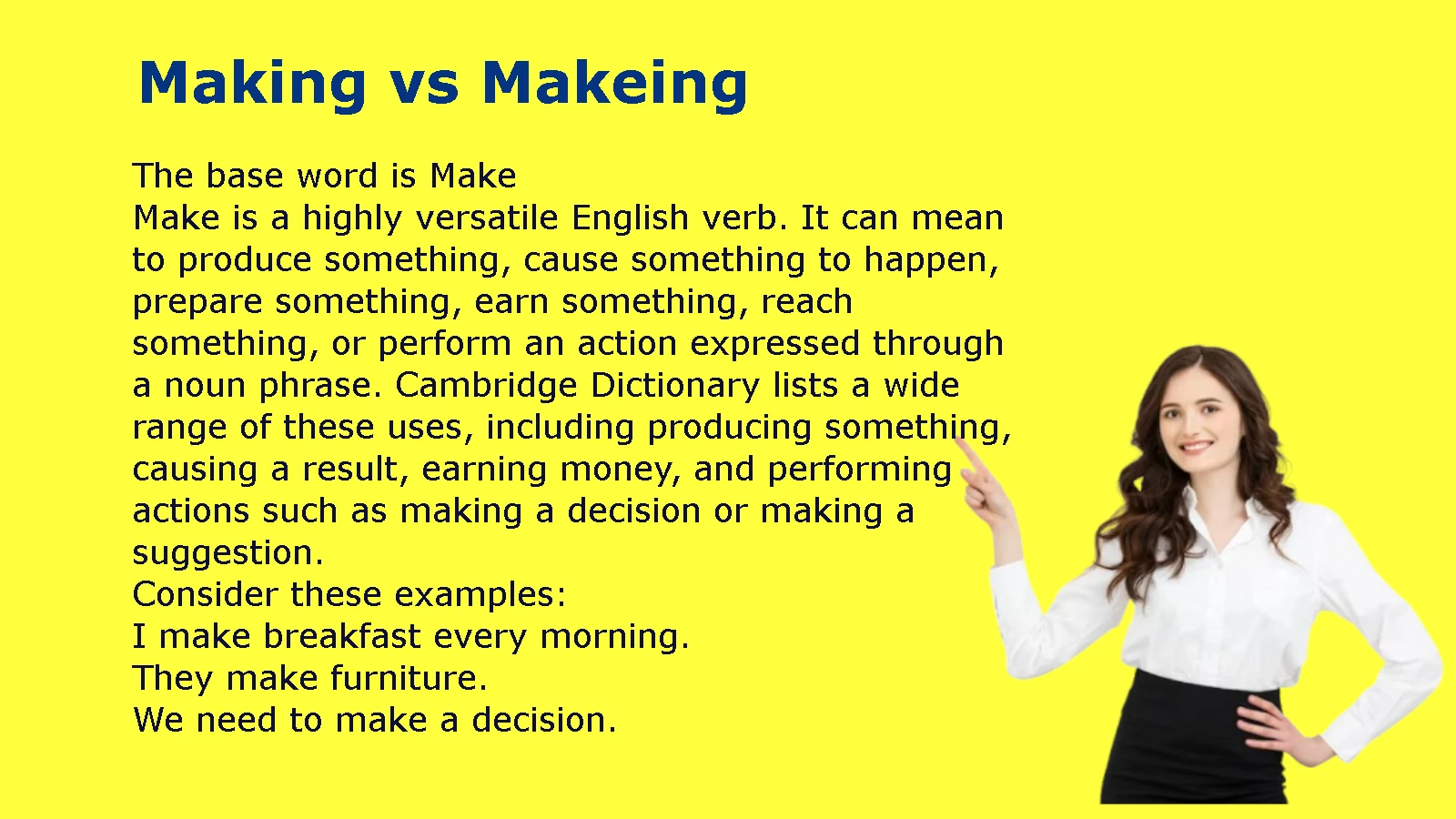
The base word is Make
Make is a highly versatile English verb. It can mean to produce something, cause something to happen, prepare something, earn something, reach something, or perform an action expressed through a noun phrase. Cambridge Dictionary lists a wide range of these uses, including producing something, causing a result, earning money, and performing actions such as making a decision or making a suggestion.
Consider these examples:
- I make breakfast every morning.
- They make furniture.
- We need to make a decision.
- She wants to make a change.
- He makes enough money to support his family.
When you need the continuous or gerund form, make changes to making.
Why the E Is Dropped Before -ing
The final e in make is silent. It helps establish the pronunciation of the vowel in the base word, but it isn’t retained when the -ing suffix is attached.
Compare:
- make → making
- bake → baking
- take → taking
- shake → shaking
- save → saving
Writing makeing would incorrectly preserve the final e.
The same issue appears with bake. We write:
bake → baking
not:
bake → bakeing
Likewise:
take → taking
not:
take → takeing
This pattern makes making easier to remember once you recognize the underlying rule.
Why Is Makeing Incorrect?
Makeing looks tempting because it seems to follow a simple formula:
make + ing = makeing
But standard English spelling requires a change before the suffix is added.
The correct process is:
make → remove the final e → mak → add ing → making
Therefore, makeing is not a second acceptable spelling. It is simply an incorrect formation of the -ing form.
A dictionary entry for make lists making among its grammatical forms, while standard dictionary resources do not treat makeing as the correct form.
Why the mistake happens
There are several reasons people write makeing:
- They add -ing without changing the base word.
- They remember the spelling of make but forget the silent-e rule.
- They assume every verb keeps all its letters when taking -ing.
- They may hear the word but have less confidence with its written form.
- They may type quickly and fail to notice the extra e.
The mistake is understandable, but the correction is straightforward.
A useful comparison
| Base verb | Incorrect | Correct |
| make | makeing | making |
| take | takeing | taking |
| write | writeing | writing |
| give | giveing | giving |
| hope | hopeing | hoping |
| use | useing | using |
Once you recognize the pattern, making becomes much easier to spell correctly.
Making Meaning and Definition
Making has several grammatical and semantic uses because it comes from the extremely versatile verb make.
At its simplest, making refers to the act of producing, creating, preparing, or causing something.
For example:
She is making a cake.
Here, making means preparing or producing the cake.
But the word can express much more than physical creation.
Making as an action
In:
They are making changes to the website.
Making describes the action of creating or implementing changes.
Making as causing something
Consider:
The loud noise is making the baby cry.
Here, making doesn’t mean producing a physical object. It means causing a particular result.
Cambridge Dictionary similarly recognizes make in constructions where it means to cause someone or something to be in a particular condition.
Making as earning
You can also say:
She is making $80,000 a year.
In this context, making means earning.
This use comes directly from another established meaning of make: to earn or get money.
Making as performing an action
English frequently uses making + noun in established combinations:
- making a decision
- making a mistake
- making a suggestion
- making an offer
- making a request
- making an effort
These expressions don’t necessarily involve physically producing anything.
For example:
We’re making a decision today.
The speaker isn’t manufacturing a physical decision. The phrase means deciding.
Making vs Makeing Examples
Seeing the spelling in complete sentences is one of the easiest ways to understand the difference.
Correct Examples With Making
Here are several natural examples:
- She is making dinner for the family.
- We’re making progress on the project.
- He is making a list of things to buy.
- They are making plans for the weekend.
- I’m making an effort to arrive earlier.
- The company is making changes to its website.
- She is making a cake for the party.
- We are making improvements to the house.
- The noise is making it difficult to concentrate.
- He is making new friends at college.
Each sentence uses the standard spelling making.
Incorrect Examples With Makeing
The following sentences contain the common spelling error:
- ❌ She is makeing dinner.
- ❌ We’re makeing progress.
- ❌ He is makeing a list.
- ❌ They are makeing plans.
- ❌ I’m makeing an effort.
The corrections are simple:
- ✅ She is making dinner.
- ✅ We’re making progress.
- ✅ He is making a list.
- ✅ They are making plans.
- ✅ I’m making an effort.
Making vs Makeing in a comparison table
| Incorrect sentence | Correct sentence |
| She is makeing breakfast. | She is making breakfast. |
| We are makeing progress. | We are making progress. |
| He is makeing a mistake. | He is making a mistake. |
| They are makeing plans. | They are making plans. |
| I am makeing changes. | I am making changes. |
| She is makeing an offer. | She is making an offer. |
Making in Different Grammar Contexts
The spelling making stays the same, but its grammatical function can change depending on the sentence.
Understanding those functions helps explain why you encounter making in so many different contexts.
Making as a Present Participle
Making can function as the present participle of make.
It commonly appears with a form of be to create a continuous verb phrase:
- is making
- am making
- are making
- was making
- were making
Examples:
She is making dinner.
We are making improvements.
He was making a presentation when I arrived.
They were making too much noise.
In these examples, making forms part of a verb phrase describing an action in progress.
Making as a Gerund
Making can also function as a gerund, meaning that the -ing form performs a noun-like role.
For example:
Making mistakes is part of learning.
Here, making mistakes acts as the subject of the sentence.
Another example:
Making good decisions requires careful thought.
The word making isn’t describing an action currently happening at a specific moment. Instead, the entire activity functions as a noun-like concept.
Compare:
She is making dinner.
with:
Making dinner takes an hour.
In the first sentence, making is part of a continuous verb phrase.
In the second, making dinner functions as the subject.
Making in Common Phrases
Making appears in countless standard English combinations.
Some of the most common include:
| Phrase | Meaning |
| making a decision | deciding |
| making money | earning money |
| making progress | advancing or improving |
| making a mistake | doing something incorrectly |
| making plans | deciding what to do in the future |
| making an effort | trying |
| making a difference | producing a meaningful effect |
| making changes | altering something |
| making an offer | proposing a price or arrangement |
| making a suggestion | proposing an idea |
Cambridge’s dictionary examples include established combinations such as make progress, make a request, make an offer, make a speech, and make a suggestion.
The Spelling Rule Behind Making
The spelling of making belongs to a broader English pattern involving verbs that end in a silent e.
When these verbs take -ing, the final e is generally removed.
Common examples of the silent-e rule
| Base form | Correct -ing form |
| make | making |
| bake | baking |
| take | taking |
| write | writing |
| drive | driving |
| give | giving |
| save | saving |
| hope | hoping |
| move | moving |
| use | using |
The important point is that you shouldn’t simply attach -ing to the unchanged spelling.
For make:
make + ing ❌
mak + ing ✅
making ✅
Why the rule matters
English spelling often reflects how words are formed, rather than simply adding letters to the complete dictionary form.
That’s why:
- make becomes making
- write becomes writing
- come becomes coming
- drive becomes driving
The spelling change doesn’t create a new verb. It creates the appropriate grammatical form of the existing verb.
A useful memory trick
Think of make and take together:
make → making
take → taking
Both lose the final e before -ing.
You can also connect make with bake:
bake → baking
make → making
That gives you a simple visual pattern to remember.
When the Silent-E Rule Needs More Care
Although the rule is useful, English spelling has exceptions and additional patterns.
For example, some words ending in -ee, -ye, or -oe retain the final e in their -ing forms in standard spelling:
- see → seeing
- agree → agreeing
- free → freeing
- dye → dyeing
- shoe → shoeing
These aren’t contradictions to the spelling of making. They demonstrate why it’s better to learn the common pattern alongside the specific forms of individual words.
The important rule for your spelling question remains:
make → making
not:
make → makeing
Common Mistakes With Making
The most obvious mistake is adding -ing directly to make, but several related errors are worth recognizing.
Writing Makeing Instead of Making
This is the main spelling error:
❌ makeing
✅ making
The extra e doesn’t belong in the -ing form.
Confusing Making With Make
The words are related but have different grammatical roles.
Compare:
I make coffee every morning.
and:
I am making coffee right now.
Make is the base form.
Making is the -ing form.
Confusing Making With Made
Made is the past tense and past participle of make.
Compare:
She makes dinner every night.
She is making dinner now.
These three forms describe different grammatical situations.
| Form | Example |
| make | I make breakfast. |
| makes | She makes breakfast. |
| making | She is making breakfast. |
| made | She made breakfast. |
Cambridge identifies made as the past tense and past participle of make, while making is the corresponding -ing form.
Adding an Unnecessary E
Some writers understand that -ing needs to be added but forget that the final e must disappear.
That produces:
❌ makeing
The better approach is to think of the word as undergoing a spelling change:
make → making
rather than mechanically attaching letters.
Making vs Makeing: Side-by-Side Comparison
Here’s the complete comparison at a glance.
| Feature | Making | Makeing |
| Standard spelling | ✅ Yes | ❌ No |
| Base word | make | make |
| Uses -ing | Yes | Intended but incorrectly formed |
| Final e retained | No | Yes |
| Dictionary-standard form | Yes | No |
| Used in formal writing | Yes | No |
| Example | She is making dinner. | She is makeing dinner. |
| Recommended | Use it | Avoid it |
The distinction is straightforward: making follows the normal spelling pattern for make + -ing, whereas makeing does not.
How to Remember the Correct Spelling
If you frequently hesitate between making or makeing, use one of these methods.
Remember Make → Making
The shortest method is simply:
Make loses e before -ing.
That gives:
make → making
Compare It With Taking
The pair is especially useful:
take → taking
make → making
You wouldn’t normally write takeing, so don’t write makeing either.
Look for the Silent E
When a verb ends in a silent e, ask:
Does the word take -ing?
If it does, check whether the final e needs to disappear.
For common words such as make, take, write, give, and hope, it does.
Use the Word in a Sentence
If you’re unsure, mentally complete a sentence:
I am ___ dinner.
The correct form is immediately recognizable:
I am making dinner.
This is particularly useful when proofreading your own writing.
Making vs Makeing in Formal Writing
Use making in every standard formal writing situation.
That includes:
- school assignments
- college papers
- resumes
- cover letters
- business emails
- reports
- websites
- articles
- professional documents
- academic writing
Because makeing is a spelling error, it can distract readers from the actual message.
Consider these two sentences:
The company is making significant improvements to its website.
The company is makeing significant improvements to its website.
The meaning is still understandable in the second sentence, but the spelling error immediately stands out.
Why correct spelling matters
Correct spelling isn’t just about passing a grammar test. In professional writing, spelling contributes to clarity and credibility.
A single typo doesn’t automatically make writing poor, of course. Everyone makes occasional typing mistakes. However, repeatedly using makeing instead of making suggests that the writer may not know the standard spelling.
For published or professional material, the safer choice is simple: use making.
A Quick Case Study: Correcting a Common Sentence
Imagine someone writes:
“Our team is makeing changes to the website.”
At first glance, the meaning is perfectly clear. The problem is entirely in the spelling of the -ing form.
Step 1: Identify the base verb
The verb is:
make
Step 2: Add the -ing ending correctly
Because make ends in a silent e, remove that e:
mak + ing
Step 3: Write the final form
making
Correct sentence
Our team is making changes to the website.
This example illustrates why the issue isn’t vocabulary or meaning. It’s a spelling and word-formation issue.
Making Meaning in Different Contexts
One reason making appears so frequently in English is that make has many meanings.
Creating Something
The workers are making furniture.
Here, making means producing something.
Preparing Something
I’m making dinner.
The word refers to preparing food.
Causing Something
The cold weather is making the roads dangerous.
Here, making means causing a particular condition.
Earning Money
She is making enough money to support her family.
In this sentence, making means earning.
Performing an Action
We’re making a decision tomorrow.
The expression means deciding.
Achieving Progress
The project is making good progress.
This means the project is advancing.
These meanings all connect back to the broad range of uses associated with make. Cambridge Dictionary documents meanings involving production, causation, earning, performing actions, reaching results, and other uses.
Making as a Noun
Although making is commonly encountered as the -ing form of make, it can also function as a noun.
Cambridge Dictionary defines making as the activity or process of producing something. It also records expressions such as in the making, the making of, and of your own making.
For example:
The documentary explains the making of the film.
Here, making refers to the process of producing the film.
Another example is:
The project has been years in the making.
The expression in the making means that something is in the process of being created or developed. Merriam-Webster likewise defines the phrase as being in the process of being made.
Common expressions with making
Some useful examples include:
- in the making
- the making of
- of your own making
- the making of a movie
- the making of history
These uses show that making isn’t limited to continuous verb constructions.
Making vs Makeing: Grammar Examples
A few contrasting examples can make the distinction even clearer.
Present Simple
I make coffee every morning.
Present Continuous
I am making coffee right now.
Past Simple
I made coffee earlier.
Gerund
Making coffee is part of my morning routine.
The base verb changes according to grammatical function, but makeing never becomes the correct form.
| Grammatical use | Correct form | Example |
| Base verb | make | I make dinner. |
| Third-person singular | makes | She makes dinner. |
| Present participle | making | She is making dinner. |
| Gerund | making | Making dinner takes time. |
| Past tense | made | She made dinner. |
| Past participle | made | She has made dinner. |
Words Similar to Making
Depending on context, making can be replaced by different words. There isn’t one universal synonym because making has several meanings.
When Making Means Creating
Possible alternatives include:
- creating
- producing
- constructing
- building
- developing
- crafting
Example:
They are making a new product.
Possible rewrite:
They are developing a new product.
When Making Means Preparing
Depending on context:
- preparing
- cooking
- assembling
- producing
Example:
She is making dinner.
Possible rewrite:
She is preparing dinner.
When Making Means Causing
Possible alternatives include:
- causing
- producing
- creating
- generating
- prompting
Example:
The delay is making customers angry.
Possible rewrite:
The delay is causing customers to become angry.
When Making Means Earning
The appropriate alternative is often:
- earning
- receiving
- bringing in
Example:
He is making $60,000 a year.
Possible rewrite:
He is earning $60,000 a year.
The correct synonym therefore depends on what making means in the particular sentence.
Frequently Asked Questions
Is Making or Makeing correct?
Making is correct. Makeing is an incorrect spelling.
The correct formation is:
make → making
The final silent e is removed before -ing is added.
Why is makeing wrong?
Makeing is wrong because the final e in make is normally dropped before the -ing ending.
Therefore:
❌ makeing
✅ making
Why does make become making?
The word make ends in a silent e. When the -ing suffix is added, that final e is removed.
So:
make + ing → making
The same pattern occurs in words such as:
- take → taking
- write → writing
- give → giving
- hope → hoping
What is the correct spelling of making?
The correct spelling is:
making
It contains one e-free stem before -ing:
mak + ing = making
Is making a verb or a noun?
It can be either, depending on how it is used.
In:
She is making dinner.
Making is part of a continuous verb phrase.
In:
Making dinner takes time.
Making functions as a gerund and the phrase making dinner acts as a noun-like subject.
It can also be used as a noun referring to the process of producing something, as in the making of a film.
What is the difference between making and make?
Make is the base form of the verb, while making is its -ing form.
Compare:
I make coffee every day.
I am making coffee now.
The first describes a general or habitual action. The second describes an action in progress.
What are some words similar to making?
The appropriate synonym depends on context.
For creating, you might use creating, producing, or building.
For preparing, preparing or cooking may work.
Is makeing ever correct?
No. Makeing is not the standard English spelling of the -ing form of make.
Use making instead.
What is the rule for make + ing?
The spelling rule is:
Drop the final silent e before adding -ing.
Therefore:
make → making
not:
make → makeing
Making or Makeing: Which One Should You Use?
If you’re choosing between making vs makeing, the answer is definitive:
Use “making.”
Making is the standard spelling of the -ing form of make. Makeing incorrectly retains the final e before the -ing ending.
The easiest way to remember it is:
make → making
You can reinforce the pattern with similar words:
- take → taking
- bake → baking
- write → writing
- give → giving
- save → saving
- hope → hoping
The spelling isn’t arbitrary once you recognize the silent-e pattern. Instead of adding -ing to make unchanged, remove the final e first.
Conclusion
The correct spelling is making, not makeing.
The reason is straightforward: make ends in a silent e, and that e is normally dropped when the -ing suffix is added.
Make + -ing = making.
The word making can describe creating, preparing, causing, earning, performing an action, or progressing toward a result. It can also function as a gerund or noun, as in making a decision or the making of a film. Major dictionary sources document these uses and the grammatical relationship between make and making.
The key comparison is simple:
| Correct | Incorrect |
| making | makeing |
So, whenever you find yourself wondering “Making or Makeing?”, remember the short rule:
Drop the silent e before -ing: make → making.
That one pattern will also help you spell many related words correctly, including taking, writing, giving, hoping, saving, and using.