A practicing vs practising comparison can be confusing because both spellings are correct, but they are used in different varieties of English. If you’ve come across “practicing” and “practising” and wondered which spelling is correct, the answer depends mainly on whether you are writing in American English or British English.
The practicing vs practising distinction refers to the spelling of the present participle and gerund of the verb practice. In American English, “practicing” is the standard spelling for activities such as developing a skill, while British English generally uses “practising” for the verb. The noun practice remains spelled with a c in both varieties.
In this guide, you’ll learn the difference between practicing and practising, which spelling is correct, when to use each form, and how American and British English handle the words “practice” and “practise.” You’ll also see clear examples, spelling rules, and simple comparisons to help you choose the right form.
By the end, you’ll know exactly when to use practicing or practising and how to avoid this common spelling confusion.
Profiting Meaning: What Does It Mean?
Profiting means making money or gaining some other benefit or advantage from something.
It comes from the verb profit, which can be used in both financial and broader contexts. Cambridge defines profit as earning money or benefiting from something.
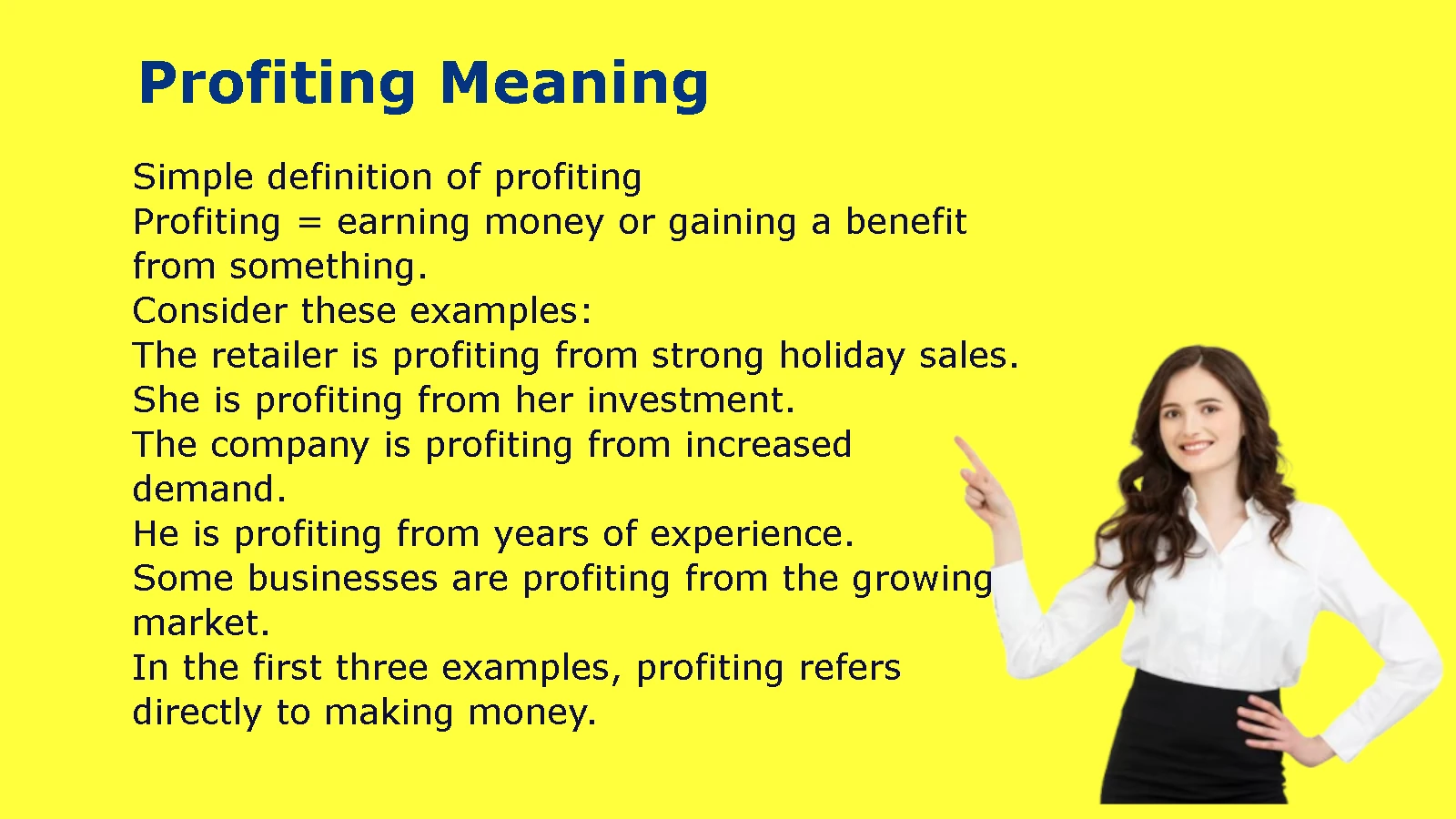
Simple definition of profiting
Profiting = earning money or gaining a benefit from something.
Consider these examples:
- The retailer is profiting from strong holiday sales.
- She is profiting from her investment.
- The company is profiting from increased demand.
- He is profiting from years of experience.
- Some businesses are profiting from the growing market.
In the first three examples, profiting refers directly to making money.
In the fourth example, it means benefiting or gaining an advantage from experience rather than necessarily receiving money.
Cambridge similarly recognizes profit from something as meaning either earning money or achieving an advantage.
Is Profiting a Word?
Yes. Profiting is a standard English word.
It is formed from the verb profit by adding -ing:
profit → profiting
The word functions as the present participle of profit and can also function as a gerund, depending on how it appears in a sentence.
For example:
The business is profiting from the new policy.
Here, profiting is part of the present progressive verb phrase is profiting.
Now consider:
Profiting from investments requires patience.
Here, profiting acts as a noun-like form and functions as the subject of the sentence.
Is “profitting” correct?
No. The standard spelling is:
profiting ✅
Not:
profitting ❌
The important spelling point is that profit ends in a consonant followed by a single t, and adding -ing does not require doubling the t.
| Form | Correct? | Example |
| profit | ✅ | They profit from the business. |
| profiting | ✅ | They are profiting from the business. |
| profitted | ❌ | Incorrect spelling |
| profitting | ❌ | Incorrect spelling |
| profited | ✅ | They profited from the sale. |
This distinction is particularly useful if you are checking whether profiting is spelled correctly.
How Do You Pronounce Profiting?
Profiting is pronounced with the stress on the first syllable.
Its pronunciation follows the pronunciation of profit, followed by the -ing ending.
For American English, you can think of the word as having three syllables:
PROF-it-ing
The first syllable receives the strongest stress.
Profiting pronunciation compared with profit
| Word | Syllables | Stress |
| profit | 2 | First syllable |
| profiting | 3 | First syllable |
| profited | 3 | First syllable |
| profitable | 4 | First syllable |
The pronunciation is therefore closely connected to the base word profit, rather than being pronounced like a different word.
Profiting vs. Profit: What Is the Difference?
The difference between profit and profiting is mainly grammatical.
Profit can be a noun or a verb. Profiting is the -ing form of the verb profit.
| Word | Part of speech | Meaning | Example |
| profit | noun | Money gained after costs | The company made a large profit. |
| profit | verb | To earn money or benefit | The company can profit from the trend. |
| profiting | verb form | Currently earning or benefiting | The company is profiting from the trend. |
| profited | past-tense verb | Earned or benefited | The company profited from the change. |
| profitable | adjective | Producing profit or benefit | It is a profitable business. |
Profit as a noun
As a noun, profit commonly refers to money left after the costs involved in producing or selling something have been paid.
For example:
The store made a $20,000 profit last year.
Cambridge defines financial profit as money earned in trade or business after paying the relevant production and selling costs.
Profit as a verb
As a verb, profit means to earn money or benefit from something.
Investors profited from the company’s growth.
Profiting as an -ing form
When you use the continuous form, you get profiting:
Investors are profiting from the company’s growth.
The meaning remains related to earning or benefiting, but the grammar changes.
Profiting From Meaning
Profiting from means earning money or gaining an advantage because of something.
This is one of the most common constructions involving profiting.
Cambridge specifically defines profit from something as either earning money from it or gaining an advantage from it.
Examples of profiting from
- The company is profiting from rising demand.
- Investors are profiting from the market’s recovery.
- She is profiting from her years of experience.
- Farmers are profiting from higher crop prices.
- The retailer is profiting from online sales.
Notice that profiting from does not always have to involve cash.
Consider:
She is profiting from her mentor’s advice.
This can mean that she is benefiting from the advice rather than literally receiving money.
Financial meaning
The business is profiting from increased sales.
Here, the company is making money.
General benefit meaning
He is profiting from his previous experience.
Here, the person is gaining an advantage.
That distinction is important when interpreting the word in different contexts.
Profiting Off Meaning
Profiting off generally means making money or gaining a benefit from something.
It is especially common in informal speech and writing in expressions such as:
They are profiting off the trend.
The meaning is broadly similar to profiting from.
Profiting off vs. profiting from
| Expression | Meaning | Typical feel |
| profiting from | Earning money or benefiting from something | Neutral and widely usable |
| profiting off | Earning money or benefiting from something | More conversational |
| profiting by | Gaining an advantage or benefit through something | More formal or specific |
For formal writing, profiting from is often the safest choice.
For example:
The company is profiting from increased demand.
This sounds natural in business writing.
In casual conversation, you might hear:
They’re profiting off the trend.
Both constructions communicate the basic idea of gaining something from a situation.
“Profiting off of” meaning
You may also encounter:
The company is profiting off of the trend.
This has the same basic meaning as profiting off the trend.
However, off of is generally more conversational. In polished formal writing, profiting from is often the cleaner option.
Profiting by Meaning
Another construction is profiting by.
It means gaining an advantage or financial benefit through a particular action or method.
For example:
Traders can profit by buying shares at a lower price and selling them later.
The construction emphasizes how the benefit is obtained.
Compare these sentences:
- She is profiting from the investment.
- She is profiting by selling the shares at a higher price.
The first identifies the source of the benefit.
The second emphasizes the method used to obtain it.
Cambridge gives profit by something/doing something as a construction meaning to earn money through a particular action.
Profiting Synonyms
The best synonym for profiting depends on the context.
If the sentence involves money, words such as earning, gaining, and making money may work.
If the sentence describes a broader advantage, benefiting may be more appropriate.
Common synonyms for profiting
| Synonym | Best used when | Example |
| earning | Receiving money | She is earning money from the business. |
| benefiting | Receiving an advantage | He is benefiting from the experience. |
| gaining | Obtaining an advantage | They are gaining from the arrangement. |
| making money | Informal financial context | She is making money from her store. |
| succeeding | Achieving a favorable result | The business is succeeding in the new market. |
| prospering | Growing successfully | The company is prospering overseas. |
| capitalizing | Taking advantage of an opportunity | The brand is capitalizing on demand. |
| obtaining a benefit | Formal explanation | The organization is obtaining a benefit from the change. |
Not every synonym works in every sentence.
For example:
The company is profiting from increased sales.
You could write:
The company is earning money from increased sales.
But replacing profiting with benefiting changes the emphasis. Benefiting does not necessarily mean the company is making a financial profit.
Examples of Profiting in a Sentence
Seeing profiting in different contexts makes its meaning much clearer.
Business examples
The retailer is profiting from increased online demand.
Small businesses are profiting from the growth of local tourism.
The manufacturer is profiting from lower production costs.
The company began profiting after expanding into new markets.
Investment examples
Investors are profiting from the rise in the stock price.
She is profiting from an investment she made several years ago.
Some traders were profiting from short-term price movements.
Personal benefit examples
He is profiting from the experience he gained during his internship.
Students are profiting from the additional training.
She is profiting from her mentor’s advice.
Negative or critical contexts
The word itself is not necessarily negative, but the object of the preposition can create a negative implication.
Consider:
The company is profiting from increased demand.
That is generally neutral.
Now compare:
The company is profiting from people’s desperation.
The second sentence suggests that the source of the profit is ethically troubling.
Likewise:
They were accused of profiting from the disaster.
Here, profiting refers to financial gain, while the surrounding context creates the criticism.
The grammar has not changed. The context has changed the tone.
Profiting From vs. Benefiting From
These expressions overlap, but they are not exact substitutes.
Profiting from often emphasizes financial gain, although it can also mean gaining an advantage.
Benefiting from has a broader meaning and does not necessarily involve money.
Compare:
The company is profiting from the new contract.
This strongly suggests financial gain.
The company is benefiting from the new contract.
This could mean more customers, stronger relationships, better reputation, or increased revenue.
Quick comparison
| Expression | Financial gain implied? | Broader benefit possible? |
| profiting from | Often | Yes |
| benefiting from | Not necessarily | Yes |
| earning from | Usually | Less often |
| gaining from | Sometimes | Yes |
| making money from | Yes | No |
Choosing the right word depends on what you actually want to communicate.
Profiting From vs. Earning
Earning usually focuses on receiving money.
She is earning $5,000 a month.
Profiting focuses more specifically on gaining money or another advantage from an activity, transaction, situation, or resource.
She is profiting from the business.
The distinction becomes especially useful in business writing.
A company can have substantial revenue without necessarily having substantial profit because it still has expenses to pay.
A simple business example
Imagine a business sells products worth $100,000 in one year.
Its expenses total $75,000.
The simplified profit is:
$100,000 − $75,000 = $25,000
So the company generated $100,000 in sales revenue but had $25,000 left before considering any other relevant accounting or tax adjustments.
That is why sales, revenue, and profit should not automatically be treated as synonyms.
What Does Profiting Mean in Business?
In business, profiting generally means generating financial gain from an activity after considering its associated costs.
For example:
The company is profiting from its subscription service.
This tells readers that the service is producing financial benefit for the company.
Business writing frequently uses related expressions such as:
- making a profit
- turning a profit
- generating profit
- increasing profits
- boosting profits
- operating profitably
- profiting from sales
- profiting from an investment
Cambridge also lists expressions such as turn a profit, profit margin, gross profit, and net profit among common profit-related terminology.
Profiting does not mean revenue
This is a common misunderstanding.
Revenue is money coming into a business from its activities.
Profit is what remains after relevant costs are deducted.
Therefore:
High revenue ≠ automatically high profit.
A business could increase its sales while its expenses increase even faster.
What Does Profiting Mean in Investing?
In investing, profiting usually means making a financial gain from an investment.
For example:
The investor is profiting from the rise in the stock price.
Suppose someone buys an asset for $1,000 and later sells it for $1,300.
The basic difference is:
$1,300 − $1,000 = $300
That $300 represents a $300 gain before considering applicable fees, taxes, and other costs.
The phrase profiting from an investment therefore describes the process of obtaining financial benefit from that investment.
Common Grammar Patterns With Profiting
Knowing the usual structures makes the word easier to use correctly.
Profiting + from
This is probably the most useful pattern.
Subject + be + profiting + from + noun
The company is profiting from higher demand.
Or:
Subject + be + profiting + from + gerund
She is profiting from investing early.
Profiting + by
Use by when you want to emphasize the method.
They are profiting by buying products cheaply and selling them at higher prices.
Profiting + off
This is common in conversational English.
Some businesses are profiting off the trend.
Profiting as a gerund
The -ing form can also function as a noun-like element:
Profiting from every transaction is not the company’s only goal.
Here, profiting from every transaction functions as the subject of the sentence.
Common Mistakes With Profiting
Several mistakes appear repeatedly when people use this word.
Mistake: Writing “profitting”
Incorrect:
The company is profitting from sales.
Correct:
The company is profiting from sales.
The standard spelling has one t before -ing.
Mistake: Confusing profit and profitable
These words perform different grammatical jobs.
Incorrect:
The company is very profit.
Correct:
The company is very profitable.
Profit is primarily a noun or verb.
Profitable is an adjective describing something that produces profit or benefit. Cambridge defines profitable as producing or likely to produce profit, and it can also describe something advantageous or useful.
Mistake: Treating revenue as profit
Incorrect assumption:
The company earned $1 million in sales, so it made $1 million in profit.
Sales revenue and profit are different financial concepts.
A business must account for costs before determining its actual profit.
Mistake: Assuming profiting is always negative
The word profiting is neutral by itself.
Compare:
The farmer is profiting from a successful harvest.
with:
The company is profiting from someone’s suffering.
The first sentence is neutral.
The second carries a negative implication because of the situation being described.
Profiting in Formal and Informal English
Profiting works in both formal and informal English.
The main difference is often the expression surrounding it.
Formal
The company is profiting from increased consumer demand.
Investors may profit from changes in market conditions.
Neutral
She is profiting from her experience.
Informal
They’re profiting off the trend.
The word profiting itself does not sound unusually informal. Constructions such as profiting off can make the sentence more conversational.
For professional reports, academic writing, and formal business communication, profiting from is usually a straightforward choice.
Is “Profiting Off” Grammatically Correct?
Yes, profiting off is used in English to mean making money or gaining an advantage from something.
For example:
The business is profiting off increased demand.
However, profiting from is a more broadly established and straightforward construction, especially in formal writing.
A useful rule is:
- Formal writing: prefer profiting from when it fits.
- Conversational writing: profiting off can sound natural.
- “Profiting off of” is also heard, but it is more conversational.
The choice is therefore partly about register and style, not simply whether one expression has a meaning and the other does not.
Profiting Synonyms by Context
Instead of memorizing a single synonym, choose a replacement based on what profiting means in your sentence.
When you mean making money
Use:
- earning
- making money
- generating income
- gaining financially
- turning a profit
Example:
The business is profiting from online sales.
Possible alternatives:
The business is earning money from online sales.
The business is making money from online sales.
When you mean gaining an advantage
Use:
- benefiting
- gaining
- advancing
- capitalizing on
- taking advantage of
Example:
She is profiting from the training.
Possible alternative:
She is benefiting from the training.
The second sentence makes the broader meaning especially clear.
Profiting: Word Forms and Related Words
Understanding the word family can help prevent grammatical mistakes.
| Word | Part of speech | Meaning |
| profit | noun | Financial gain or benefit |
| profit | verb | Earn money or gain an advantage |
| profited | verb | Earned or benefited in the past |
| profiting | verb/gerund | Earning or benefiting |
| profitable | adjective | Producing profit or benefit |
| profitability | noun | The ability to produce profit |
| profitably | adverb | In a profitable manner |
Example word family
The company profits from international sales.
The company profited from the expansion.
The expansion has been profitable.
The company’s profitability improved.
These forms are related, but they cannot simply be substituted for one another.
A Practical Case Study: Choosing the Right Word
Imagine a small online store that sells handmade furniture.
The owner spends $400 making a table and sells it for $700.
The basic difference is:
$700 − $400 = $300
The owner can say:
The business made a $300 profit on the table.
If several tables are selling well, the owner could say:
The business is profiting from strong demand.
If the business has become financially successful, the owner could say:
The business is profitable.
If the owner has learned valuable skills from the process, you could say:
She is benefiting from the experience.
These four sentences are related, but each emphasizes something different.
| Sentence | Main focus |
| The business made a $300 profit. | Amount of financial gain |
| The business is profiting from strong demand. | Ongoing financial gain |
| The business is profitable. | Overall financial performance |
| She is benefiting from the experience. | Personal advantage |
This is why choosing between profit, profiting, profitable, and benefiting requires attention to grammar as well as meaning.
Frequently Asked Questions About Profiting
Is profiting a real word?
Yes. Profiting is the standard -ing form of the verb profit. It can describe earning money or gaining an advantage.
What is the simple meaning of profiting?
Profiting means earning money or gaining a benefit from something.
What is a synonym for profiting?
Depending on the context, synonyms include earning, benefiting, gaining, making money, prospering, and capitalizing on.
Is profiting the same as earning?
Not exactly. Earning generally emphasizes receiving money, while profiting can emphasize making financial gain from an activity or gaining a broader advantage.
What does profiting from mean?
Profiting from means earning money or gaining an advantage because of something. Cambridge recognizes both financial and broader-benefit meanings for this construction.
What does profiting off mean?
Profiting off generally means earning money or gaining a benefit from something. It is common in conversational English.
Is “profitting” spelled correctly?
No. The correct spelling is profiting, with one t before the -ing ending.
Is profiting a verb?
Yes. Profiting is an -ing form of the verb profit. Depending on its grammatical position, it can function as part of a verb phrase or as a gerund.
What is the difference between profiting and profitable?
Profiting describes an action or process, while profitable is an adjective describing something that produces profit or benefit.
The company is profiting from sales.
The company is profitable.
Can you say “profiting off of”?
Yes. Profiting off of is used in English and generally means the same thing as profiting off. However, profiting from is often preferable in formal writing because it is concise and widely established.
Final Takeaway on the Meaning of Profiting
Profiting is a correct English word meaning earning money or gaining an advantage from something.
Its meaning becomes clearer when you look at the construction around it:
- profiting from = earning money or gaining a benefit from something
- profiting by = gaining through a particular method or action
- profiting off = making money or gaining a benefit from something, often conversational
- profiting from an investment = making a financial gain from an investment
- profiting from experience = gaining a benefit or advantage from experience
The spelling is also simple: profiting, not profitting.
When you need a neutral and broadly appropriate expression, profiting from is usually the clearest choice. If you are talking about a broader advantage rather than money, benefiting from may communicate your meaning more precisely.
Ultimately, the surrounding context determines whether profiting refers to financial gain, practical benefit, or an advantage. Understanding that distinction helps you use the word naturally in business writing, everyday conversation, academic contexts, and formal English.