Have you ever wondered whether you should use Life vs Lives in a sentence? These two words look almost identical, but they have different meanings and grammatical uses. Knowing the difference can help you avoid common mistakes in everyday writing and conversation.
Life is the singular form of the noun, while lives is the plural form. However, lives can also be the third person singular form of the verb live, depending on the sentence.
Examples:
- She has a happy life.
- Many people live different lives.
- He lives in New York.
The confusion is understandable. People often search for life vs lives, life or lives, what is the plural of life, or when to use life and lives because the spelling changes in an unusual way. And here’s the kicker: lives can mean more than one life or describe where someone lives.
In this guide, you’ll learn the complete difference between Life vs Lives, including their meanings, definitions, pronunciations, parts of speech, and correct usage. You’ll also see clear examples of life and lives in sentences, learn when to use each word, and discover how lives works as both a noun and a verb.
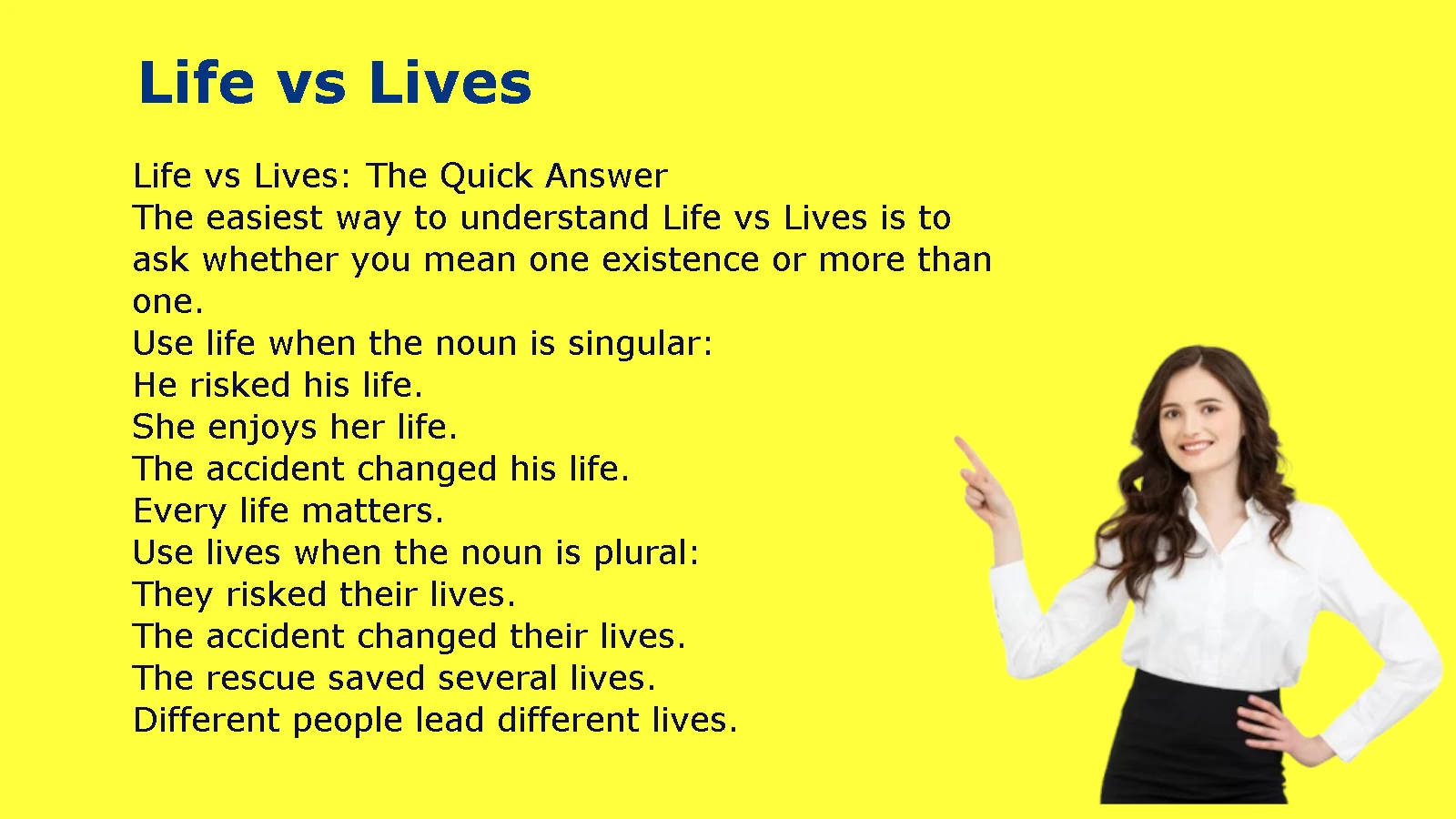
Life vs Lives: The Quick Answer
The easiest way to understand Life vs Lives is to ask whether you mean one existence or more than one.
Use life when the noun is singular:
- He risked his life.
- She enjoys her life.
- The accident changed his life.
- Every life matters.
Use lives when the noun is plural:
- They risked their lives.
- The accident changed their lives.
- The rescue saved several lives.
- Different people lead different lives.
But there is another use.
Lives can also be a verb:
- She lives in Dallas.
- My brother lives nearby.
- The animal lives in the forest.
In those sentences, lives doesn’t mean “multiple lives.” It means that a singular subject resides or exists somewhere.
Merriam Webster lists lives as both the plural of life and the present tense third person singular form of live.
The Three Forms You Need to Remember
| Form | Meaning | Example |
| life | One existence | He lived a long life. |
| lives | More than one existence | The medicine saved many lives. |
| lives | He/she/it + live | She lives in New York. |
So if you’re asking, “Is lives the plural of life?”, the answer is yes.
If you’re asking, “Can lives also be a verb?”, the answer is also yes.
What Does “Life” Mean?
The noun life has several related meanings. It can describe biological existence, a person’s experiences, a period of existence, a lifestyle, or even the useful period of an object.
Merriam Webster defines life in several senses, including the condition that distinguishes living organisms from dead matter and the sequence of physical and mental experiences that make up an individual’s existence.
Life as Existence
The most basic meaning refers to being alive.
Examples:
- The doctor fought to save his life.
- The plant needs water to sustain life.
- The accident put her life at risk.
- The body showed no signs of life.
Here, life doesn’t necessarily mean one particular person’s biography. It can refer to the state of being alive itself.
Oxford describes this sense of life as the ability people, animals, and plants have to breathe, grow, reproduce, and remain alive.
Life as One Person’s Existence
Life can also refer to the complete existence of one person.
For example:
- He devoted his life to science.
- She has lived a remarkable life.
- The decision changed his life.
- He spent most of his life abroad.
In this sense, you’re talking about one person’s existence as a whole.
That’s why we say:
She had a difficult life.
Not:
She had a difficult lives.
The noun is singular because the sentence describes one person’s existence.
Life as a Person’s Experiences
Sometimes life refers to the experiences, circumstances, relationships, work, and events that make up someone’s existence.
Consider these examples:
- College changed my life.
- He wants a quieter life.
- Her family gave her a new perspective on life.
- Moving abroad completely changed his life.
Here, life is broader than simply “being alive.” It describes the way existence unfolds.
Life as a General Concept
English also uses life as an uncountable noun when discussing existence or living in general.
Examples include:
- Life can be unpredictable.
- Life is full of surprises.
- Life on Earth depends on certain conditions.
- Modern life moves quickly.
- There is life beyond our immediate surroundings.
This is an important distinction.
A sentence such as “Life is unpredictable” does not mean one particular person’s life is unpredictable. It refers to life as a general human experience or condition.
What Does “Lives” Mean?
Lives has two main grammatical jobs.
First, it is the plural noun form of life.
Second, it is the third person singular present form of the verb live.
Those two uses look identical in writing, but context tells you which one you’re seeing.
Lives as the Plural of Life
When you talk about more than one life, use lives.
Examples:
- The firefighters saved three lives.
- The decision affected thousands of lives.
- Their lives changed after the move.
- The documentary follows the lives of several families.
- War can destroy countless lives.
Oxford lists lives as the plural of life and gives its noun pronunciation as /laɪvz/.
Why Does Life Become Lives?
The plural isn’t formed by simply adding s.
The pattern is:
life → lives
The spelling changes from f to v before the plural ending.
You can see a similar pattern in other common words:
- wife → wives
- knife → knives
- life → lives
This pattern is part of the history of English rather than a rule you can apply mechanically to every word ending in f or fe. English has plenty of exceptions, which is one reason spelling patterns need to be learned alongside individual words.
Examples of Lives as a Plural Noun
Singular:
The accident changed her life.
Plural:
The accident changed their lives.
Singular:
The doctor saved a life.
Plural:
The doctors saved several lives.
Singular:
He wants to improve his life.
Plural:
They want to improve their lives.
The meaning stays connected. The number changes.
Lives as a Verb
Now comes the part that causes many mistakes.
Lives can be the verb form of live when the subject is he, she, or it.
Examples:
- She lives in Chicago.
- He lives with his parents.
- My sister lives nearby.
- The bird lives in tropical forests.
- The company lives by its core values.
Here, lives has nothing to do with the plural noun lives.
The base verb is live.
| Subject | Verb |
| I | live |
| You | live |
| We | live |
| They | live |
| He | lives |
| She | lives |
| It | lives |
This follows the ordinary English present tense pattern in which a third person singular subject takes -s with many verbs.
Compare These Two Sentences
Consider:
The rescue team saved five lives.
Here, lives is a plural noun. It means five human lives.
Now compare:
The rescue worker lives nearby.
Here, lives is a verb. It means the worker resides nearby.
The spelling is identical, but the grammatical function is completely different.
That distinction becomes even clearer when you say the words aloud.
Life vs Lives Pronunciation
Pronunciation makes Life vs Lives more interesting.
Life is pronounced:
/laɪf/
The plural noun lives is pronounced:
/laɪvz/
But the verb lives is pronounced:
/lɪvz/
So there are actually two pronunciations of lives.
| Word | Pronunciation | Function |
| life | /laɪf/ | Singular noun |
| lives | /laɪvz/ | Plural noun |
| lives | /lɪvz/ | Third person singular verb |
Oxford gives the noun lives as /laɪvz/, while Merriam Webster gives life as /ˈlīf/ and its plural as /ˈlīvz/.
“Lives” as a Noun
The accident claimed several lives.
Here, lives rhymes closely with the vowel sound in five.
“Lives” as a Verb
She lives in Miami.
Here, the vowel is shorter. The word sounds closer to livz.
This distinction matters in spoken English because the listener cannot rely on spelling. The pronunciation and context reveal the meaning.
Is “Lives” the Plural of “Life”?
Yes.
The standard plural of life is lives.
The pattern is:
one life → two lives
This is confirmed by major dictionary sources, including Merriam Webster and Oxford.
Here are some straightforward examples:
- one life
- two lives
- a person’s life
- several people’s lives
- one life was lost
- several lives were lost
Why “Lifes” Is Usually Wrong
English doesn’t form the ordinary plural of life as lifes.
So these are incorrect in standard English:
- ❌ three lifes
- ❌ many lifes
- ❌ their lifes
- ❌ several lifes were saved
Use:
- ✅ three lives
- ✅ many lives
- ✅ their lives
- ✅ several lives were saved
Dictionary.com also identifies lives as the plural form of life.
Is “Lifes” a Word?
If you’re wondering whether lifes can replace lives, the answer is no in ordinary standard English.
For the normal noun meaning, write:
life → lives
Don’t write:
life → lifes
This is a useful spelling rule to memorize because spell checkers may not always explain why the form is wrong.
A Simple Memory Trick
Think of the related words:
- knife → knives
- wife → wives
- life → lives
The f changes to v before the plural ending.
However, don’t assume that every English noun ending in f follows the same pattern. English pluralization includes several different patterns, so words such as roof normally become roofs, not rooves.
Life vs Lives in Examples
Examples are one of the fastest ways to make the difference stick.
One Person, One Life
Use life when the noun refers to one person’s existence.
- She changed her life.
- He risked his life.
- I love my life.
- She devoted her life to teaching.
- He wants a better life.
- The accident nearly ended his life.
Multiple People, Multiple Lives
Use lives when multiple individual lives are involved.
- Their lives changed.
- The program improved thousands of lives.
- The disaster affected many lives.
- The story follows several lives.
- Their lives took different paths.
General Life
Use life when you’re discussing living or existence generally.
- Life is complicated.
- Life can be beautiful.
- Life continues despite setbacks.
- Life on Earth is remarkably diverse.
Lives as a Verb
Use lives with a singular third person subject.
- She lives in Seattle.
- He lives alone.
- My cousin lives abroad.
- The animal lives in the desert.
- The plant lives for several years.
The sentence structure tells you which lives you have.
Life vs Lives in “Our Life” and “Our Lives”
One of the more subtle questions involving Life vs Lives is whether to say our life or our lives.
Both can be correct.
The choice depends on whether you’re describing one shared life or multiple individual lives.
When to Use “Our Life”
Use our life when two or more people are treated as having one shared existence, lifestyle, or experience.
Examples:
- We built a peaceful life together.
- Our life together has changed.
- We enjoy our quiet life in the country.
- We created a comfortable life for our family.
The focus is on the shared experience.
When to Use “Our Lives”
Use our lives when you mean the individual lives of multiple people.
Examples:
- Our lives are very different.
- The experience changed our lives.
- Technology has transformed our lives.
- We each have busy lives.
Here, each person has an individual life.
Compare the Meaning
Consider these two sentences:
We built a happy life together.
This emphasizes one shared life.
Now:
Our lives changed after we moved.
This emphasizes the individual experiences of the people involved.
The difference is subtle but meaningful.
Life vs Lives vs. Live
Because lives can function as both a noun and a verb, it helps to put the four related forms side by side.
| Word | Grammar | Meaning | Example |
| life | Singular noun | One existence | She enjoys her life. |
| lives | Plural noun | More than one existence | They enjoy their lives. |
| live | Verb | Exist or reside | They live nearby. |
| lives | Verb | Exists or resides | She lives nearby. |
The most important verb rule is simple:
I live. You live. We live. They live.
But:
He lives. She lives. It lives.
A Common Agreement Error
Incorrect:
She live in California.
Correct:
She lives in California.
Incorrect:
They lives in California.
Correct:
They live in California.
The subject determines the verb.
Life’s vs. Lives vs. Lives’
Punctuation creates another layer of confusion.
These three forms look similar:
- life’s
- lives
- lives’
But they serve different purposes.
Life’s
Life’s can be the possessive form of the singular noun life.
Example:
Life’s challenges can make people stronger.
It can also be a contraction of life is.
Example:
Life’s too short to worry about every little mistake.
The context tells you which meaning applies.
Lives
Lives can be either:
- the plural noun of life
- the third person singular verb of live
Examples:
The rescue saved several lives.
She lives nearby.
Lives’
Lives’ is the plural possessive form.
For example:
The workers’ lives were affected.
More clearly, with a possessive construction:
The patients’ lives depended on quick treatment.
The apostrophe belongs to the noun that owns or relates to something. In patients’ lives, patients’ is plural possessive, while lives remains the noun being described.
A useful comparison is:
| Form | Meaning | Example |
| life | Singular noun | Her life changed. |
| life’s | Singular possessive or “life is” | Life’s challenges are real. |
| lives | Plural noun or singular verb | Their lives changed. / She lives here. |
| lives’ | Plural possessive | The victims’ lives were affected. |
Common Life vs Lives Mistakes
These errors are easy to fix once you understand the underlying grammar.
Mistake: Writing “Lifes”
Incorrect:
The accident affected many lifes.
Correct:
The accident affected many lives.
Why? The plural of life is irregular.
Mistake: Using “Lives” for One Person
Incorrect:
She risked her lives.
Correct:
She risked her life.
Why? One person has one life in the ordinary literal sense.
Mistake: Using “Life” After a Plural Number
Incorrect:
Five life were saved.
Correct:
Five lives were saved.
Why? The number five requires the plural noun.
Mistake: Using “Lives” With “They”
Incorrect:
They lives in New York.
Correct:
They live in New York.
Why? They takes the base form live, not lives.
Mistake: Using “Live” With “She”
Incorrect:
She live in New York.
Correct:
She lives in New York.
Why? She is third person singular.
Mistake: Confusing “Life’s” With “Lives”
Incorrect:
Their life’s are completely different.
Correct:
Their lives are completely different.
Why? You need the plural noun lives, not the singular possessive life’s.
Life vs Lives in Common Expressions
Many everyday expressions use these words in predictable ways.
“A Matter of Life and Death”
Here, life remains singular because the phrase refers to the general concept of being alive.
“Save a Life”
Use life when one person is involved.
The treatment saved a life.
“Save Lives”
Use lives when multiple people are involved.
The treatment saves lives.
“Change Your Life”
When speaking to one person:
This opportunity could change your life.
When speaking to several people:
This opportunity could change your lives.
“All My Life”
This means throughout one person’s existence.
I’ve lived here all my life.
“All Their Lives”
When multiple people are involved:
They had known each other all their lives.
“Bring Back to Life”
This expression normally uses the singular life because life refers to the state of being alive.
Scientists hope to bring the species back to life.
These established expressions show why you can’t choose between life and lives by looking only at the word immediately before it. Meaning and number matter.
Special Case: “Still Life” vs. “Still Lifes”
Here’s an important exception to the simple life → lives rule.
The standard plural of the art term still life is:
still lifes
not:
still lives
Merriam Webster lists still lifes as the plural form.
Dictionary.com does the same.
For example:
The museum displayed several still lifes.
A still life is an artwork that typically depicts inanimate objects such as fruit, flowers, dishes, or household objects.
Why Is It “Still Lifes”?
At first glance, this seems inconsistent.
If life becomes lives, why doesn’t still life become still lives?
The answer lies partly in how English treats established compound nouns.
Merriam Webster explains that still life is treated as an independent compound rather than simply as the noun life with a modifier. As a result, its plural takes the regular -s ending: still lifes.
This doesn’t mean the ordinary plural lives is wrong.
It means that still life has developed its own conventional plural.
Compare the Two
The artist painted several portraits of people’s lives.
Here, lives is the ordinary plural of life.
The gallery displayed several still lifes.
Here, still lifes refers to multiple artworks.
That distinction is worth remembering because it prevents an overly broad rule such as “every compound ending in life must become lives.”
Other Compounds With “Life”
Not every compound ending in life behaves exactly the same way.
For example, Merriam Webster notes that compounds such as afterlife, nightlife, and shelf life commonly form plurals with -ves, while still life takes -s.
Examples include:
- afterlife → afterlives
- nightlife → nightlives
- shelf life → shelf lives
- still life → still lifes
Usage can vary with some compounds, which is why dictionaries and established usage are more reliable than trying to invent a universal rule.
The practical lesson is simple:
Don’t assume that every phrase containing “life” must automatically use “lives” in the plural. Check the established form when you’re dealing with a fixed compound or specialized term.
A Practical Way to Choose Between Life and Lives
If you’re unsure which word belongs in your sentence, use this quick process.
Ask: How Many?
If you mean one:
life
If you mean more than one:
lives
Examples:
- one life
- two lives
- her life
- their lives
Ask: Is It a Verb?
If you’re describing where someone lives or how someone exists, check the subject.
Use live with:
- I
- you
- we
- they
Use lives with:
- he
- she
- it
Examples:
They live in Texas.
She lives in Texas.
Ask: What Does the Sentence Mean?
Consider:
Life is difficult.
This talks about life generally.
Now:
Their lives are difficult.
This refers to multiple individual experiences.
The difference isn’t just grammatical. It changes the scope of the statement.
Life vs Lives: A Detailed Comparison Table
| Situation | Correct form | Example |
| One existence | life | He lived a long life. |
| Multiple existences | lives | They lived long lives. |
| General existence | life | Life is unpredictable. |
| One person’s experience | life | Her life changed. |
| Several people’s experiences | lives | Their lives changed. |
| One person resides somewhere | lives | She lives in Boston. |
| Multiple people reside somewhere | live | They live in Boston. |
| Singular possessive | life’s | Life’s challenges can be difficult. |
| Plural noun | lives | Many lives were affected. |
| Plural possessive construction | lives’ | The animals’ lives were protected. |
| Artworks | still lifes | The museum displayed several still lifes. |
Real Usage Case Study: “Save a Life” vs. “Save Lives”
Imagine a news report about a single emergency.
A bystander performed CPR and helped save a life.
Only one person’s life is being discussed, so life is singular.
Now imagine the report describes a larger emergency response:
The new safety system has already helped save hundreds of lives.
The number changes from one to many, so the noun changes from life to lives.
Notice something else: the verb doesn’t determine the noun form. The quantity does.
That’s an important point for learners because phrases such as save a life, save lives, lose a life, and lose lives all follow the same number distinction.
Real Usage Case Study: “My Life” vs. “Our Lives”
Consider a couple who moves to another city.
One person might say:
Moving here changed my life.
The speaker is talking about one person’s experience.
The couple might say:
Moving here changed our lives.
Now the statement covers two individual lives.
But they could also say:
Moving here changed our life together.
This emphasizes the shared life they built as a couple.
None of these forms is automatically right or wrong. The intended meaning controls the choice.
Real Usage Case Study: “She Lives” vs. “Their Lives”
Now compare:
She lives in Denver.
Here, lives is a verb.
Their lives are in Denver.
Here, lives is a plural noun.
The first sentence answers where she resides.
The second sentence describes the lives of multiple people.
This is why context matters so much when reading or listening to English. The same spelling can represent different grammatical forms.
Quick Rules for Remembering Life vs Lives
If you only have a few seconds to decide, remember these rules:
- One = life
- More than one = lives
- He/she/it = lives
- I/you/we/they = live
- life’s = life is or singular possession
- still life = still lifes
A compact memory sentence makes the pattern even easier:
One life, many lives. She lives, they live.
Once that becomes automatic, most Life vs Lives questions disappear.
Frequently Asked Questions About Life vs Lives
Is “lives” the plural of “life”?
Yes. Lives is the standard plural of the noun life. For example, one life becomes two lives.
Is “lifes” correct?
No. The standard plural of life is lives, not lifes.
Correct:
The accident affected many lives.
Incorrect:
The accident affected many lifes.
What is the plural of life?
The plural of life is lives.
Life → lives
Why does life become lives instead of lifes?
English uses an irregular plural pattern for life. The spelling changes from f to v, producing lives.
Similar examples include:
- wife → wives
- knife → knives
- life → lives
Is “lives” a noun or a verb?
It can be either.
As a noun:
The rescue saved several lives.
As a verb:
She lives in Chicago.
The context tells you which form you’re seeing. Merriam Webster explicitly lists both grammatical uses.
Is “life” singular or plural?
Life is singular when used as a countable noun.
For example:
She lived a long life.
Its plural is:
They lived long lives.
However, life can also function as an uncountable noun when referring to existence generally:
Life is precious.
Should I say “our life” or “our lives”?
Both can be correct.
Use our life when you emphasize a shared life or lifestyle:
We built a wonderful life together.
Use our lives when you refer to multiple individual lives:
Our lives changed after the move.
Should I say “save a life” or “save lives”?
Use save a life for one person:
The treatment saved a life.
Use save lives for multiple people:
The treatment saves lives.
Is “life’s” the same as “lives”?
No.
Life’s can mean life is or show singular possession.
Lives can mean multiple lives or the verb lives.
Compare:
Life’s too short to worry about everything.
Their lives changed.
She lives nearby.
Is “lives” pronounced like “life”?
No.
The singular noun life is pronounced /laɪf/.
The plural noun lives is pronounced /laɪvz/.
The verb lives is pronounced /lɪvz/.
Is the plural of “still life” “still lives”?
No. The standard plural is still lifes. Merriam Webster and Dictionary.com both list still lifes as the plural.
What is the difference between “life” and “lives”?
Life is the singular noun. Lives is its plural. Lives can also be the third person singular form of the verb live.
For example:
- life → She changed her life.
- lives → They changed their lives.
- lives → She lives in Texas.
Is “they lives” correct?
No.
Use:
They live in Texas.
Use lives with a singular third person subject:
She lives in Texas.
Is “she live” correct?
Not in standard present tense English when live means reside or exist.
Use:
She lives in Texas.
The third person singular subject she takes lives.
Life vs Lives: Final Comparison
The difference becomes simple once you separate number from verb agreement.
| Word | What it means | Example |
| life | One life or existence | He risked his life. |
| lives | More than one life | They risked their lives. |
| live | Base verb | They live nearby. |
| lives | Third person singular verb | She lives nearby. |
| life’s | “Life is” or singular possessive | Life’s too short. |
| still lifes | Plural of the art term | The gallery displayed still lifes. |
Final Takeaway: Life vs Lives
The Life vs Lives distinction isn’t as complicated as it first appears.
Remember these core rules:
- Life is the singular noun.
- Lives is the plural noun.
- Lives is also the third person singular form of live.
- Live is used with I, you, we, and they.
- Lifes is not the standard plural of life.
- Life’s can mean life is or show singular possession.
- Still lifes is the standard plural of the art term still life.
The easiest memory trick is still the best:
One life. Many lives. She lives. They live.