Have you ever wondered whether you should say “half” or “halves” when talking about one part or two equal parts? While Half vs Halves may seem like a simple grammar question, the correct word depends on whether you’re talking about one half or more than one.
Half is the singular form used for one of two equal parts of something. Halves is the plural form used when referring to two or more halves. For example, you can say “half of the cake” when talking about one part, but “two halves of the cake” when referring to both equal parts.
Examples:
- I ate half of the sandwich.
- The two halves of the apple were placed on separate plates.
The confusion is understandable. People often search for half vs halves, half plural, what is the plural of half, or when to use halves because the spelling changes from f to ves in the plural form. And here’s the kicker: halves doesn’t follow the usual rule of simply adding s to the singular word.
In this guide, you’ll learn the complete difference between half and halves, including their meanings, plural forms, pronunciation, correct usage, and examples in sentences. You’ll also discover why half becomes halves, common mistakes to avoid, and how to use both words correctly in everyday English.
Half vs Halves at a Glance
The easiest way to understand Half vs Halves is to think about quantity.
| Word | Number | Meaning | Example |
| half | Singular | One of two equal or nearly equal parts | I ate half the sandwich. |
| halves | Plural | Two or more halves | We divided the sandwich into two halves. |
| halve | Verb | To divide something into two equal parts or reduce it by 50% | Halve the sandwich before serving. |
| halfs | Incorrect standard plural | Not the standard plural of half | ❌ We cut it into two halfs. |
The core distinction is simple:
One half. Two halves.
Cambridge defines half as one of two equal or nearly equal parts that together form a whole. It also explicitly gives halves as its plural form.
The simplest rule
Remember this:
One = half
More than one = halves
That rule works in ordinary sentences, measurements, sports, food, mathematics, and many other contexts.
What Does “Half” Mean?
Half refers to one of two equal or nearly equal parts of something.
If you divide a pizza into two equal pieces, each piece is half of the pizza. If you eat one of those pieces, you ate half the pizza.
In mathematical terms, a half is 1/2, which equals 50%.
For example:
- Half of 10 is 5.
- Half of 20 is 10.
- Half of 100 is 50.
- Half of the cake is gone.
- She spent half her money.
- We walked half a mile.
Cambridge also recognizes half in several grammatical roles, including as a noun, pronoun, adjective, predeterminer, and adverb.
That means half appears in far more constructions than simply describing a fraction.
Half as a noun
As a noun, half identifies one part of a whole.
Examples:
- I ate half.
- She gave me half of the cake.
- Half of the students arrived early.
- We finished half of the project.
- He owns half of the business.
Here, half represents an amount or portion.
Half as a measurement
You also commonly see half with measurements:
- half an hour
- half a mile
- half a cup
- half a pound
- half a dozen
- half a year
For example:
We waited half an hour for the bus.
In American English, a half hour is also common:
The meeting lasted a half hour.
Cambridge gives half an hour and half a kilometre as standard examples of the half + a/an + measurement pattern.
Half as part of a number
Half can also appear after a whole number:
- one and a half
- two and a half
- three and a half
- four and a half
Examples:
The recipe needs two and a half cups of flour.
She has lived there for three and a half years.
The phrase one and a half means 1.5. Likewise, two and a half means 2.5.
What Does “Halves” Mean?
Halves is simply the plural form of half.
It refers to more than one half.
Cambridge gives the definition directly: “plural of half.”
For example, if you cut an apple into two pieces, you have two halves.
The two halves of the apple were the same size.
You can also have more than two halves when you’re discussing multiple objects.
Suppose you cut three apples in half. You now have six pieces. Each piece is a half, so you have six halves.
That distinction matters because half describes an individual portion, while halves describes multiple portions.
Examples of “halves”
- Cut the orange into two halves.
- The two halves fit together perfectly.
- We compared the two halves of the document.
- Both halves of the game were competitive.
- Place the two halves on separate plates.
- The recipe calls for two lemon halves.
- The machine separates the fruit into halves.
- The book has two distinct halves.
Oxford also identifies halves as the plural of half.
Why Is the Plural of “Half” “Halves”?
Here’s where English gets a little quirky.
If you’re following the most common plural pattern, you might expect:
half → halfs
But standard English uses:
half → halves
The spelling changes from f to v, followed by es.
This isn’t completely unique to half. English contains several nouns that have historically developed plural forms ending in ves.
| Singular | Plural |
| half | halves |
| calf | calves |
| leaf | leaves |
| loaf | loaves |
| shelf | shelves |
| knife | knives |
| wife | wives |
| wolf | wolves |
However, don’t treat this as a perfect rule for every noun ending in f.
English has exceptions:
- roof → roofs
- belief → beliefs
- chef → chefs
- chief → chiefs
So the safest approach isn’t to apply a mechanical rule to every word. Learn the standard plural form of each noun.
For half, the correct form is firmly established:
half → halves
Is “Halfs” Correct?
In standard modern English, halfs is not the normal plural form of half.
Use halves instead.
Incorrect
I cut the oranges into two halfs.
Correct
I cut the oranges into two halves.
Another example
❌ The two halfs were equal.
✅ The two halves were equal.
One more
❌ We divided the cake into four halfs.
✅ We divided the cake into four halves.
The important point is that halfs isn’t the standard plural you should use in ordinary writing, schoolwork, professional communication, or edited content.
When in doubt, remember the spelling:
H A L F → H A L V E S
Half vs. Halve vs. Halves
The words half, halves, and halve can cause confusion because they share the same basic letters.
They aren’t interchangeable, though.
| Word | Function | Meaning | Example |
| half | Noun/adjective/adverb and other uses | One of two parts; partly; 50% | I ate half the cake. |
| halves | Plural noun or verb form | More than one half; third-person form of halve | The two halves fit together. |
| halve | Verb | Divide into two equal parts or reduce by half | Halve the tomatoes. |
The distinction becomes much easier when you identify the job the word performs.
“Half” describes a part
I ate half the pizza.
You’re talking about one portion.
“Halves” describes multiple parts
We divided the pizza into two halves.
You’re talking about two portions.
“Halve” describes an action
Halve the pizza before serving it.
You’re telling someone to divide it into two parts.
Oxford defines halve as a verb meaning to reduce something by half or divide something into two equal parts.
That gives you a useful three word pattern:
Half = a part
Halves = multiple parts
Halve = the action of dividing
Examples of “Half” in a Sentence
The word half appears in many everyday structures. Understanding these patterns will help you use it naturally rather than simply memorizing the plural.
Half as one part of a whole
I ate half the apple.
She finished half of the book.
He drank half the bottle.
We used half the flour.
In each example, half identifies approximately 50% of something.
Half with “of”
The construction half of is especially common.
Examples:
- Half of the cake is gone.
- Half of the students are absent.
- Half of them agreed.
- Half of the money was donated.
- Half of the answers were correct.
Cambridge notes that half of can be used before nouns and pronouns in several common constructions.
Half without “of”
English also commonly drops of before certain noun phrases:
This can make sentences shorter and more natural.
Compare:
Half of the cake is gone.
Half the cake is gone.
Both are standard. The second version is often more compact.
Half with measurements
Common examples include:
- half an hour
- half a mile
- half a cup
- half a pound
- half a dozen
Examples:
I’ll be there in half an hour.
Add half a cup of sugar.
We walked half a mile.
She bought half a dozen eggs.
Examples of “Halves” in a Sentence
Halves appears whenever you need to refer to two or more individual halves.
Consider these examples:
Cut the sandwich into two halves.
The two halves of the orange were equal.
Both halves were placed on separate plates.
The book is divided into two halves.
The researchers examined both halves separately.
We joined the two halves together.
The children each received one of the two halves.
Notice something important: you don’t use halves simply because the object has been divided.
You use halves because you’re referring to multiple half portions.
That’s why these two sentences have different structures:
I cut the apple in half.
I looked at the two halves.
The first sentence describes the act of dividing. The second identifies the resulting parts.
Half vs Halves in Food and Cooking
Cooking provides some of the clearest examples of the difference.
Imagine a recipe that asks you to divide a lemon into two equal pieces.
You might write:
Cut the lemon in half.
Once you’ve made the cut, you can say:
Place the two lemon halves in the bowl.
The first sentence uses half because in half describes the result of dividing something into two parts.
The second uses halves because you’re now talking about two separate pieces.
More cooking examples
- Add half an onion.
- Cut the onion into two halves.
- Use half the butter.
- Squeeze both lemon halves.
- Divide the dough in half.
- Roll out the two halves separately.
This distinction is useful because recipes often switch between the singular concept and the resulting plural pieces.
Half vs Halves in Time
Time creates another common set of examples.
A period of 30 minutes is half an hour.
The trip takes half an hour.
If you’re describing a period divided into two parts, however, you may use halves.
The game is divided into two halves.
In sports, half can also refer to one of two periods of play:
- the first half
- the second half
For example:
The team played better in the second half.
If you’re referring to both periods:
Both halves were closely contested.
Cambridge identifies half as a sports noun for either of the two periods into which a game is divided.
A useful comparison
| Meaning | Correct form | Example |
| One period | half | The first half was exciting. |
| Both periods | halves | Both halves were exciting. |
| 30 minutes | half an hour | I’ll arrive in half an hour. |
| Divide time into two parts | halve | The schedule was halved. |
Half vs Halves in Mathematics
The mathematical relationship is straightforward:
1 half = 1/2 = 50%
Two halves make one whole:
1/2 + 1/2 = 1
This gives us one of the most familiar expressions involving the word:
Two halves make a whole.
The phrase isn’t just a saying. It describes a basic mathematical relationship.
If a chocolate bar represents one whole and you divide it into two equal pieces, each piece represents one half.
Together:
one half + one half = one whole
If you divide two separate objects into halves, however, you can have four halves.
For example:
- 1 apple = 2 halves
- 2 apples = 4 halves
- 3 apples = 6 halves
So halves doesn’t necessarily mean exactly two. It means more than one half.
One Half vs. Two Halves
The difference becomes crystal clear when you compare these phrases:
| Singular | Plural |
| one half | two halves |
| a half | several halves |
| half of the cake | both halves of the cake |
| half an apple | two apple halves |
| one half of the group | the two halves of the group |
The singular form remains half even when the phrase describes a fraction of something.
One half of the class left.
The plural appears when you’re referring to multiple individual halves:
The two halves of the class met separately.
“Half of” and Subject Verb Agreement
One subtle grammar issue deserves attention because it often causes confusion.
The verb after half of depends on the noun that follows.
Consider:
Half of the cake is gone.
Here, cake is treated as a singular mass noun, so is works naturally.
Now compare:
Half of the students are absent.
Students is plural, so are is appropriate.
Compare the patterns
| Sentence | Why? |
| Half of the cake is gone. | Cake is singular/mass. |
| Half of the water is gone. | Water is a mass noun. |
| Half of the students are absent. | Students is plural. |
| Half of the books are missing. | Books is plural. |
| Half of us are ready. | Us refers to multiple people. |
The word half doesn’t automatically determine whether the verb should be singular or plural.
The noun or pronoun following the construction matters.
This is a useful distinction because writers sometimes assume that half must always take a singular verb. It doesn’t.
“In Half” vs. “Into Halves”
These expressions look similar, but they emphasize different things.
“In half”
In half usually describes the act or result of dividing something into two parts.
Cut the paper in half.
Fold the sheet in half.
Break the cookie in half.
“Into halves”
Into halves emphasizes the resulting pieces.
Cut the orange into halves.
Divide the sandwich into halves.
The machine cuts the fruit into halves.
The difference is subtle rather than absolute.
Think of it this way:
in half → focus on division into two parts
into halves → focus on the resulting half pieces
Cambridge specifically gives both in half and into halves as standard constructions.
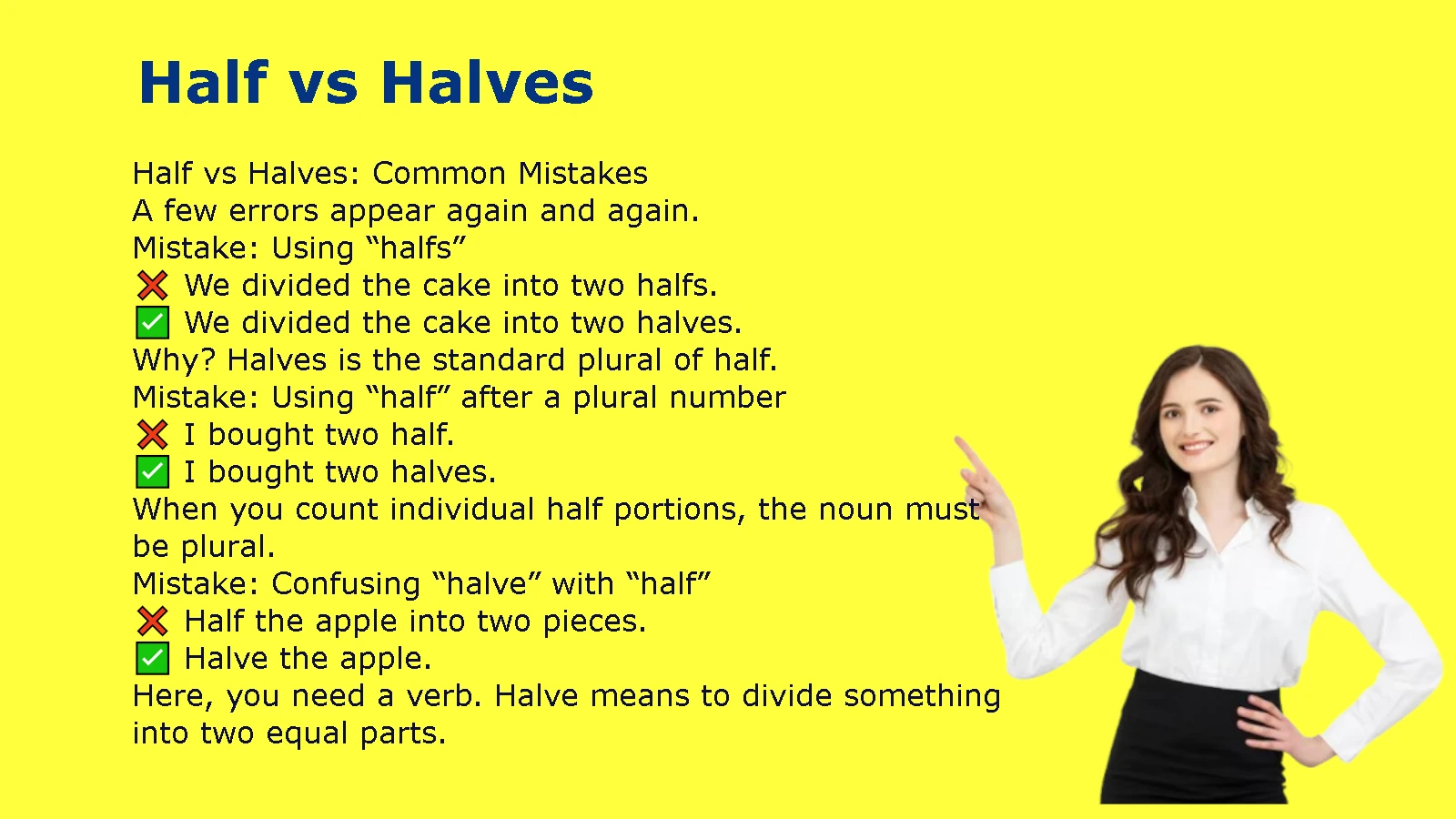
Half vs Halves: Common Mistakes
A few errors appear again and again.
Mistake: Using “halfs”
❌ We divided the cake into two halfs.
✅ We divided the cake into two halves.
Why? Halves is the standard plural of half.
Mistake: Using “half” after a plural number
❌ I bought two half.
✅ I bought two halves.
When you count individual half portions, the noun must be plural.
Mistake: Confusing “halve” with “half”
❌ Half the apple into two pieces.
✅ Halve the apple.
Here, you need a verb. Halve means to divide something into two equal parts.
Mistake: Treating “halves” as a verb in every situation
Halves can actually function as a verb in some sentences, but that use comes from halve, not from the plural noun halves.
For example:
She halves the recipe.
Here, halves is a third person singular verb.
But:
The recipe has two halves.
Here, halves is a plural noun.
The surrounding words tell you which meaning is intended.
Halves Can Also Be a Verb
This is an important detail that simple explanations often miss.
Although halves is the plural noun form of half, halves can also be the third person singular present form of the verb halve.
Compare:
The orange was cut into two halves.
Here, halves is a noun.
Now:
The company halves its prices during the promotion.
Here, halves is a verb.
Oxford lists the verb forms as:
- halve
- halves
- halved
- halving
The verb means to reduce something by half or divide it into two equal parts.
Why context matters
Consider this sentence:
The machine halves the apples.
Here, halves tells us what the machine does.
Now compare:
The machine separates the apple halves.
Here, halves identifies the pieces.
Same spelling. Different grammatical function.
Pronunciation of Half and Halves
The pronunciation changes along with the spelling.
In American English:
- half = /hæf/
- halves = /hævz/
Cambridge gives the US pronunciation of half as /hæf/ and halves as /hævz/.
Notice the consonant change:
half → /hæf/
halves → /hævz/
The final f sound in half becomes a v sound in halves, followed by a z sound.
So don’t pronounce halves as though it were spelled half-s.
It’s closer to:
havz
The spelling may look odd, but the pronunciation follows the established plural form.
Common Expressions With “Half” and “Halves”
The word half appears in many established expressions.
“Go halves”
Go halves means that two people each pay or contribute half of something.
For example:
We decided to go halves on the cost.
Cambridge defines go halves as a situation in which two people each pay half the price of something.
“Do things by halves”
This expression describes someone who does something without giving it their full effort or commitment.
For example:
She never does things by halves.
Cambridge explains that the expression means putting a great deal of effort and enthusiasm into something rather than doing it incompletely.
“Half and half”
Half and half means equal amounts of two different things.
Mix the ingredients half and half.
In American English, half-and-half also refers to a milk and cream product commonly added to coffee.
“Half past”
In American English, people commonly say half past when referring to 30 minutes after an hour, although everyday American speech often favors expressions such as half past seven depending on context.
For example:
The meeting starts at half past seven.
Cambridge notes that half past is particularly associated with British usage.
A Practical Case Study: Cutting an Apple
Imagine you have one apple.
Before cutting it, you can say:
I have one apple.
You cut it into two equal pieces.
Now you have:
two halves
You pick up one piece.
That piece is:
half the apple.
You tell someone to cut another apple into two pieces.
You can say:
Halve the apple.
Three related words now describe three different ideas:
| Situation | Correct word |
| One of the two pieces | half |
| Both pieces | halves |
| The action of dividing | halve |
This simple example captures the entire Half vs Halves vs. halve distinction.
A Practical Case Study: Dividing a Recipe
Suppose a recipe serves eight people, but you only need four servings.
You might say:
Halve the recipe.
That means reduce the recipe by 50%.
If the recipe calls for one cup of flour, you now need:
half a cup of flour
If the recipe originally called for two lemons and you cut each lemon into two pieces, you have:
four lemon halves
Again, the vocabulary changes according to what you’re describing:
- halve the recipe
- use half the ingredients
- cut the lemons into halves
This distinction appears naturally in everyday English because the words describe different grammatical and practical relationships.
Half vs Halves Examples
Here are examples that show the difference side by side.
| Half | Halves |
| I ate half the sandwich. | I ate both halves of the sandwich. |
| She drank half the juice. | She poured the two halves into separate glasses. |
| We finished half the work. | We divided the work into two halves. |
| He read half the book. | The book has two distinct halves. |
| I used half an onion. | I saved the onion halves for later. |
| They played one half of the game. | Both halves were competitive. |
| She owns half the property. | The two halves were sold separately. |
| Add half a cup of water. | Divide the mixture into two halves. |
| I walked half a mile. | The route was divided into two halves. |
| We completed half the task. | The task has two main halves. |
The pattern stays consistent even when the context changes.
Quick Facts About Half and Halves
- Half represents one of two equal or nearly equal parts.
- Halves is the standard plural of half.
- Half represents 1/2 or 50%.
- Halfs is not the standard plural form.
- Halve is a verb.
- Halves can also be the third person singular present form of halve.
- In American English, half is pronounced /hæf/.
- In American English, halves is pronounced /hævz/.
- Two halves make one whole.
- Three halves equal 1.5.
- Four halves equal 2.
- Half an hour means 30 minutes.
- Half of the students normally takes a plural verb because students is plural.
- Half of the cake normally takes a singular verb because cake is singular or treated as a mass noun.
- Go halves means two people each contribute half.
- Do things by halves means to do something without full effort.
- Half and half can mean equal amounts of two things.
Frequently Asked Questions About Half vs Halves
Is “halves” the plural of “half”?
Yes. Halves is the standard plural form of half.
one half
two halves
Both Cambridge and Oxford list halves as the plural of half.
Is “halfs” correct?
No. Halfs isn’t the standard plural form of half.
Use halves instead.
❌ two halfs
✅ two halves
What is the singular of “halves”?
The singular form is half.
one half → two halves
What is the plural of “half”?
The plural is halves.
half → halves
The spelling changes from f to v and adds es.
What is the difference between half and halves?
Half refers to one part of a whole.
Halves refers to more than one half.
I ate half the cake.
We divided the cake into two halves.
Is “halve” the plural of “half”?
No.
Halve is a verb meaning to divide something into two equal parts or reduce it by 50%.
Halve the recipe.
Halves can be either the plural noun of half or the third person singular form of the verb halve, depending on context.
Is “two halves” correct?
Yes.
Two halves is the standard plural construction.
The two halves fit together perfectly.
Is “one and a half” correct?
Yes.
One and a half means 1.5.
Examples:
I waited one and a half hours.
She ate one and a half slices of pizza.
Is “half an hour” correct?
Yes.
Half an hour means 30 minutes.
I’ll call you in half an hour.
In American English, a half hour is also common.
Should you say “half of the cake” or “half the cake”?
Both are standard.
Half of the cake is gone.
Half the cake is gone.
The shorter form, half the cake, is especially natural in everyday English.
Should you say “cut it in half” or “cut it into halves”?
Both constructions can be correct, but they emphasize slightly different things.
How do you remember the spelling of halves?
Use this simple memory trick:
Half loses the f and gains ves: half → halves.
Then remember the quantity:
One half. Two halves.
Half vs Halves: The Final Answer
The difference between half and halves is simple once you focus on number.
Half is the singular form. It refers to one of two equal or nearly equal parts.
Halves is the plural form. It refers to two or more halves.
Halve is a verb. It means to divide something into two equal parts or reduce it by half.
| Word | Meaning | Example |
| half | One part of two | I ate half the apple. |
| halves | Two or more half portions | The two halves were equal. |
| halve | Divide into two parts | Halve the apple. |
| halfs | Not the standard plural | ❌ Avoid halfs. |
The easiest rule to carry with you is:
One = half. More than one = halves.
So if you cut one apple into two pieces, you have two halves. If you eat one of those pieces, you eat half the apple. If you tell someone to divide another apple into two pieces, you ask them to halve it.
Once you see the three forms as part, parts, and action, the distinction becomes much harder to forget.