Have you ever wondered whether you should say “loaf” or “loaves” when talking about bread? While Loaf vs Loaves may seem like a simple grammar question, the difference can be confusing when you’re unsure whether you need a singular or plural form.
Loaf is the singular form used to describe one whole piece of bread, while loaves is the plural form used for two or more whole pieces of bread. The spelling changes from loaf to loaves when you make it plural.
Examples:
- I bought one loaf of bread this morning.
- The bakery sells fresh loaves every day.
The confusion is understandable. English has many nouns that change their spelling when they become plural, and loaf vs loaves is a common example. You may also search for loaf plural, plural of loaf, loaf or loaves, or what is the plural of loaf when you’re trying to use the word correctly. And here’s the kicker: although the difference looks small, using the wrong form can make your sentence sound awkward.
In this guide, you’ll learn the complete difference between Loaf vs Loaves, including their meaning, plural form, pronunciation, correct usage, and examples in sentences. You’ll also discover when to use loaf and loaves, why the spelling changes, and other useful rules for forming plurals in English.
Loaf vs Loaves: Quick Answer
The difference between loaf and loaves comes down to grammatical number.
| Word | Number | Meaning | Example |
| loaf | Singular | One loaf | I bought a loaf of bread. |
| loaves | Plural | Two or more loaves | I bought three loaves of bread. |
A loaf is generally a shaped piece of bread or another food that has been baked or formed as one piece. Cambridge defines a loaf as bread or cake shaped and baked in a single piece that can be sliced.
The plural is loaves, not loafs.
The basic rule
Think of the two forms this way:
- 1 = loaf
- 2 = loaves
- 3 = loaves
- 10 = loaves
- 100 = loaves
For example:
- one loaf
- a loaf
- another loaf
- two loaves
- several loaves
- many loaves
The noun changes because the quantity changes.
What Does “Loaf” Mean?
Loaf is a countable noun when it refers to a single shaped piece of bread or a similar food. You can place a number or an article such as a or one before it.
For example:
- a loaf of bread
- one loaf of sourdough
- a fresh loaf
- one loaf of banana bread
A loaf usually refers to bread that has been shaped and baked as one piece. It can then be sliced into individual pieces for eating. Cambridge gives examples such as a loaf of white bread, a loaf of brown bread, and five loaves of bread.
The word isn’t limited to one particular kind of bread, either. A loaf can be white bread, wheat bread, sourdough, rye bread, banana bread, or another type of bread prepared in a loaf shape.
Examples of “loaf” in a sentence
- I bought a loaf of whole wheat bread.
- The loaf is still warm from the oven.
- She sliced the loaf before dinner.
- We shared one loaf between four people.
- He baked a loaf of sourdough this morning.
- The recipe makes one large loaf.
Notice the pattern. Each example describes one loaf.
If you say, “I bought one loaves,” the noun doesn’t agree with the number. The correct sentence is “I bought one loaf.”
What Does “Loaves” Mean?
Loaves is the plural form of loaf. It refers to more than one loaf.
Cambridge Dictionary states the relationship directly: “loaves” is the plural of “loaf.”
That means you use loaves after numbers greater than one and after plural quantifiers such as several, many, some, and few.
Examples of “loaves” in a sentence
- The bakery sells fresh loaves every morning.
- We bought two loaves of bread.
- She baked three loaves for the party.
- The baker placed the loaves on the cooling rack.
- Several loaves were ready to be sliced.
- They delivered dozens of loaves to local stores.
The important point is that loaves doesn’t describe a different kind of bread. It simply tells you that you’re talking about more than one loaf.
Why Does “Loaf” Become “Loaves”?
This is where English spelling gets a little less predictable.
The plural of loaf is formed by changing the final f to ves:
loaf → loaves
This pattern appears in several common English nouns:
| Singular | Plural |
| loaf | loaves |
| leaf | leaves |
| knife | knives |
| wife | wives |
| life | lives |
| wolf | wolves |
| half | halves |
That pattern makes loaves easier to remember once you recognize the connection.
However, don’t treat it as a universal rule. English has plenty of nouns ending in f that simply take s.
For example:
| Singular | Plural |
| roof | roofs |
| chief | chiefs |
| belief | beliefs |
| chef | chefs |
| cliff | cliffs |
| proof | proofs |
So you can’t reliably look at every noun ending in f and automatically change the f to ves.
That’s one reason memorizing the common plural form of an individual word remains useful.
For loaf, the correct form is firmly established:
loaf → loaves
Is “Loafs” the Plural of Loaf?
No. “Loafs” is not the standard plural of the noun loaf.
The correct plural noun is loaves.
- ❌ I bought two loafs.
- ✅ I bought two loaves.
- ❌ The bakery sells fresh loafs.
- ✅ The bakery sells fresh loaves.
However, there’s an important detail here. Loafs is a real English word, but it has a different grammatical job.
It is the third person singular present form of the verb loaf.
Collins Dictionary specifically distinguishes the forms: the noun has the plural loaves, while loafs is the third person singular present tense of the verb.
“Loafs” as a verb
The verb loaf means to spend time doing little or nothing, especially when you should be working.
For example:
- He loafs around the house all afternoon.
- She loafs instead of finishing her assignment.
- He often loafs on weekends.
Here, loafs is a verb.
Compare these two sentences:
The bakery sells fresh loaves.
Here, loaves is a plural noun.
He loafs around after work.
Here, loafs is a verb.
The difference becomes obvious when you look at what the word is doing in the sentence.
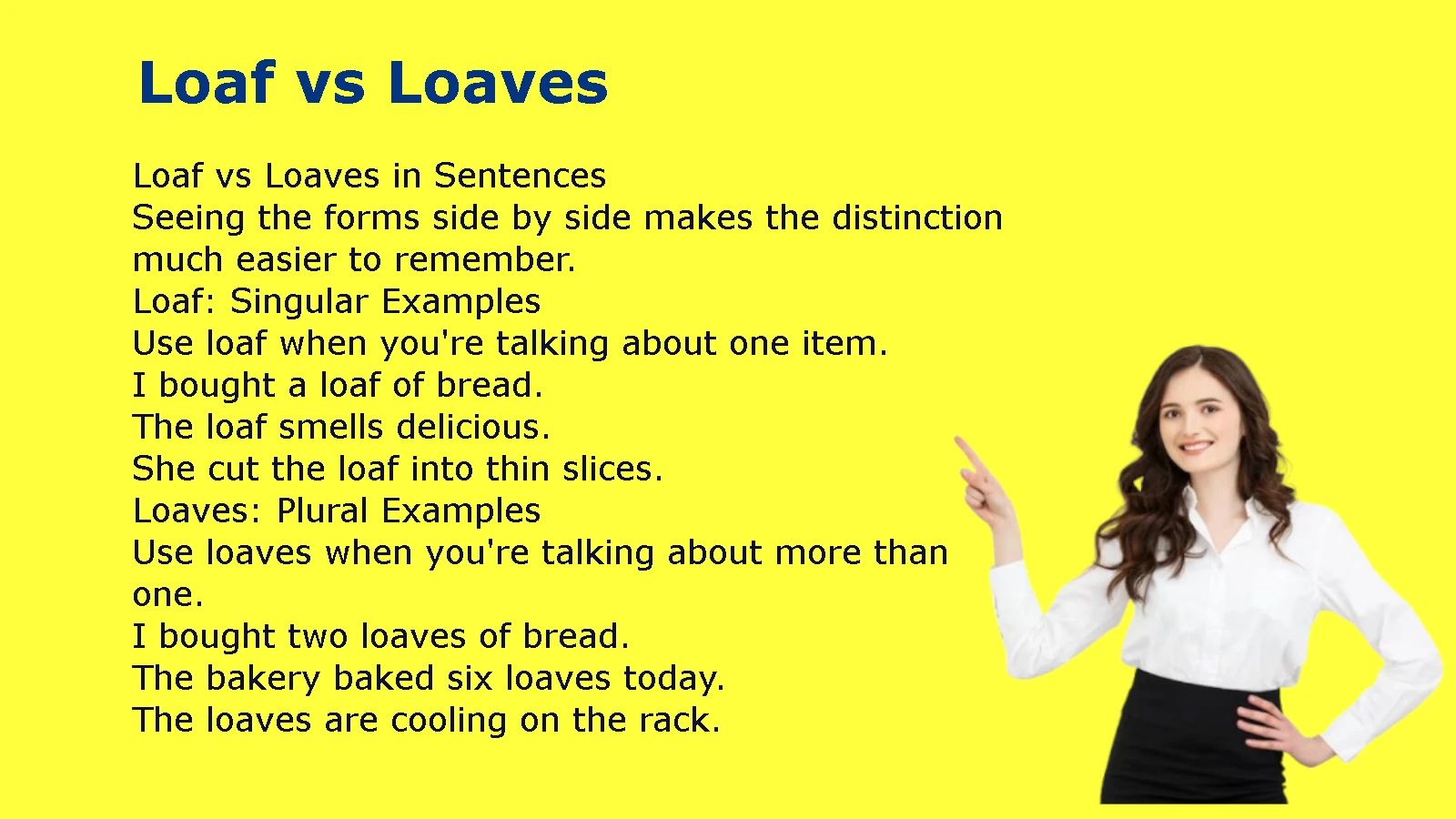
Loaf vs Loaves in Sentences
Seeing the forms side by side makes the distinction much easier to remember.
Loaf: Singular Examples
Use loaf when you’re talking about one item.
- I bought a loaf of bread.
- The loaf smells delicious.
- She cut the loaf into thin slices.
- One loaf should be enough for dinner.
- He left the loaf on the kitchen counter.
- The baker removed the loaf from the oven.
Loaves: Plural Examples
Use loaves when you’re talking about more than one.
- I bought two loaves of bread.
- The bakery baked six loaves today.
- The loaves are cooling on the rack.
- We need several loaves for the event.
- The baker delivered ten loaves to the restaurant.
- Those loaves look freshly baked.
Compare the meaning
| Singular | Plural |
| I bought a loaf. | I bought two loaves. |
| The loaf is fresh. | The loaves are fresh. |
| She baked one loaf. | She baked four loaves. |
| Cut the loaf. | Cut the loaves. |
| This loaf is heavy. | These loaves are heavy. |
The surrounding words usually make the correct choice obvious.
Words such as a, one, this, and that generally point toward the singular loaf.
Words such as two, three, many, several, these, and those point toward plural loaves.
Loaf vs Loaves: A Simple Grammar Test
When you’re unsure which form to use, look at the quantity.
Ask yourself:
Am I talking about one or more than one?
If the answer is one, use loaf.
If the answer is more than one, use loaves.
Example
Suppose you’re buying bread.
If you buy one:
I need one loaf of bread.
If you buy two:
I need two loaves of bread.
If you buy five:
I need five loaves of bread.
The number changes, and the noun changes with it.
This same principle works with indefinite quantities:
- a loaf
- one loaf
- another loaf
- each loaf
versus:
- several loaves
- many loaves
- two loaves
- both loaves
- these loaves
How Do You Pronounce “Loaf” and “Loaves”?
The spelling changes, and so does the final sound.
In US English:
- loaf = /loʊf/
- loaves = /loʊvz/
Cambridge gives these pronunciations for American English.
The beginning of the words sounds similar. The key difference comes at the end.
Loaf
loaf ends with an f sound:
/loʊf/
The final consonant is unvoiced.
Loaves
loaves ends with a vz sound:
/loʊvz/
The final consonant is voiced.
So the words aren’t pronounced as though you simply added an s sound to loaf. The plural spelling reflects a genuine change in the ending.
| Word | US pronunciation | Final sound |
| loaf | /loʊf/ | /f/ |
| loaves | /loʊvz/ | /vz/ |
This distinction matters when you’re speaking because the plural can sound noticeably different from the singular.
Loaf and Loaves With Different Types of Food
Although bread is the most familiar use of loaf, the word can describe other foods shaped into a single solid mass.
Cambridge includes food uses such as meat loaf and nut loaf in addition to bread.
For example:
- a loaf of bread
- a banana loaf
- a meat loaf
- a nut loaf
The plural depends on the same rule:
- one loaf
- two loaves
Examples
- She baked one banana loaf.
- The bakery sells several banana loaves.
- We prepared one meat loaf for dinner.
- The restaurant prepared two meat loaves for the event.
The meaning can change depending on the food, but the singular and plural grammar doesn’t.
Loaf vs Loaves With Numbers
Numbers provide one of the easiest ways to choose the correct form.
Use “loaf” with one
- one loaf
- 1 loaf
- a loaf
Use “loaves” with numbers above one
- two loaves
- three loaves
- four loaves
- 12 loaves
- 100 loaves
For example:
The bakery produced 1 loaf for the test batch.
But:
The bakery produced 25 loaves for the morning shipment.
This is a standard count noun pattern. You wouldn’t normally say 25 loaf because the noun must agree with the plural quantity.
Loaf vs Loaves With Quantifiers
Numbers aren’t the only words that determine whether you need the singular or plural form.
Singular quantifiers and determiners
These commonly work with loaf:
- a
- one
- each
- every
- this
- that
- another
Examples:
- Each loaf has a crisp crust.
- Every loaf was inspected.
- This loaf tastes fresh.
- Another loaf is in the oven.
Plural quantifiers and determiners
These commonly work with loaves:
- two
- several
- many
- few
- these
- those
- both
- multiple
Examples:
- Several loaves were delivered.
- Both loaves are ready.
- These loaves need to cool.
- Many loaves are baked here every day.
This is a useful shortcut because you don’t always have an explicit number in a sentence.
Loaf’s vs. Loaves’ vs. Loaves
The difference becomes slightly more interesting when possession enters the picture.
There are three forms worth knowing:
- loaf
- loaf’s
- loaves
- loaves’
Each has a different job.
| Form | Meaning | Example |
| loaf | Singular noun | The loaf is fresh. |
| loaf’s | Singular possessive | The loaf’s crust is crisp. |
| loaves | Plural noun | The loaves are fresh. |
| loaves’ | Plural possessive | The loaves’ crusts are crisp. |
Loaf’s
Use loaf’s when one loaf possesses or is associated with something.
The loaf’s crust is golden brown.
You’re talking about the crust of one loaf.
Loaves
Use loaves when you’re simply talking about multiple loaves.
The loaves are on the counter.
There’s no possessive apostrophe because you’re only making the noun plural.
Loaves’
Use loaves’ when something belongs to or is associated with multiple loaves.
The loaves’ crusts were unusually thick.
The apostrophe comes after the s because loaves is already plural.
This distinction is small, but it can prevent confusing sentences.
Common Mistakes With Loaf and Loaves
Most mistakes with these words come from treating loaf like a regular noun that forms its plural by adding s.
Mistake: “Loafs” as a plural noun
Incorrect:
We bought three loafs.
Correct:
We bought three loaves.
The noun plural is loaves.
Mistake: “Loaves” after one
Incorrect:
I bought one loaves.
Correct:
I bought one loaf.
The number one requires the singular form.
Mistake: “Loaf” after a plural number
Incorrect:
The bakery delivered six loaf.
Correct:
The bakery delivered six loaves.
A number greater than one normally requires the plural noun.
Mistake: Confusing the noun and verb
Incorrect for multiple bread products:
The store sells five loafs.
Correct:
The store sells five loaves.
But this sentence is grammatically correct:
He loafs around all day.
Here, loafs is a verb, not a plural noun.
Why English Has “Loaves” Instead of “Loafs”
The form loaves reflects an older pattern in English plural formation.
Modern English has inherited many plural forms that don’t follow the simple add s pattern. Some words developed spelling and sound changes over time, particularly words ending in f or fe.
That’s why you get forms such as:
- leaf → leaves
- knife → knives
- wife → wives
- life → lives
- wolf → wolves
- loaf → loaves
The historical development explains why the forms look different today. However, you don’t need to memorize the history to use the word correctly.
The practical rule is much simpler:
Loaf becomes loaves in the plural.
It’s also important not to overgeneralize. English contains many exceptions, including roof → roofs and chief → chiefs.
So the safest approach is to learn the plural form as part of the vocabulary word:
loaf, plural loaves
Loaf vs Loaves in Everyday Situations
The distinction appears constantly in ordinary conversations.
At a grocery store
Could you pick up a loaf of bread?
One loaf is needed.
If the shopping list changes:
Could you pick up two loaves of bread?
Now you’re buying more than one.
At a bakery
This loaf was baked this morning.
One loaf is being discussed.
These loaves were baked this morning.
Several loaves are being discussed.
When baking at home
A recipe might say:
Shape the dough into one loaf.
If the recipe makes multiple pieces:
Divide the dough and shape it into two loaves.
The same grammar works whether you’re buying, baking, selling, slicing, or discussing bread.
A Practical Case Study: Choosing the Correct Form
Imagine a small bakery preparing its morning orders.
The baker starts with one sourdough loaf:
The baker checks the loaf before slicing it.
A customer then orders four.
The sentence changes:
The baker checks the four loaves before slicing them.
Later, the bakery prepares 20 loaves for delivery:
Twenty loaves leave the bakery before noon.
Now imagine the baker takes a break instead of working:
The baker loafs around after lunch.
The vocabulary looks similar, but the grammar changes:
| Sentence | Word | Function |
| The loaf is fresh. | loaf | Singular noun |
| The loaves are fresh. | loaves | Plural noun |
| The loaf’s crust is crisp. | loaf’s | Singular possessive |
| The loaves’ crusts are crisp. | loaves’ | Plural possessive |
| He loafs around. | loafs | Verb |
This is the easiest way to see why loafs shouldn’t automatically be labeled a misspelling. It has a legitimate grammatical use. It simply isn’t the plural form of the noun.
Loaf vs Loaves in American English
In American English, the standard forms are:
- loaf for the singular noun
- loaves for the plural noun
Cambridge’s American Dictionary gives /loʊf/ for loaf and lists loaves as its plural.
The same distinction applies in British English. The pronunciation of the vowel differs slightly in dictionary notation, but the plural spelling remains loaves.
So there isn’t a separate American plural such as loafs.
Whether you’re writing for readers in the United States, the United Kingdom, Canada, Australia, or another English speaking region, loaves is the standard plural noun.
Loaf vs Loaves: Quick Memory Trick
If the spelling keeps slipping your mind, connect loaf with leaf.
Think:
leaf → leaves
Then:
loaf → loaves
Another simple memory rule is:
One loaf, two loaves.
That’s all you need in most situations.
Don’t try to create a complicated rule for every English word ending in f. English has too many exceptions for that shortcut to work perfectly.
Instead, remember the specific pair:
loaf → loaves
Practice: Loaf or Loaves?
Choose the correct word in each sentence.
- I bought one ___ of bread.
- The bakery sells fresh ___ every morning.
- She baked two ___ yesterday.
- The ___ is still warm.
- We need three ___ for the party.
- Each ___ was carefully wrapped.
- Both ___ are on the counter.
- He bought another ___ before leaving.
- Several ___ were delivered to the restaurant.
- This ___ has a crispy crust.
Answers
- loaf
- loaves
- loaves
- loaf
- loaves
- loaf
- loaves
- loaf
- loaves
- loaf
The pattern is consistent: singular references take loaf, while plural references take loaves.
Frequently Asked Questions About Loaf vs Loaves
What is the plural of loaf?
The plural of loaf is loaves.
For example:
- one loaf
- two loaves
- several loaves
Cambridge Dictionary explicitly lists loaves as the plural form of loaf.
Is loaf singular or plural?
Loaf is singular.
You can say:
I bought a loaf of bread.
You cannot use loaf as the ordinary plural after a number such as two or three.
Is loaves singular or plural?
Loaves is plural.
For example:
I bought two loaves of bread.
The word refers to more than one loaf.
Is “loafs” the plural of loaf?
No.
The plural noun is loaves.
However, loafs is a valid verb form. It is the third person singular present tense of loaf.
For example:
He loafs around instead of working.
Collins confirms that loaves is the noun plural and loafs is the third person singular present verb form.
Why does loaf change to loaves?
Loaf belongs to a group of English nouns whose plurals developed with a change from f to ves.
Examples include:
- loaf → loaves
- leaf → leaves
- knife → knives
- wolf → wolves
However, this isn’t a universal spelling rule. Words such as roof and chief form their plurals with s.
How do you use loaf in a sentence?
You can use loaf when referring to one loaf:
I bought a loaf of bread for breakfast.
How do you use loaves in a sentence?
Use loaves when referring to more than one:
The bakery delivered five loaves of bread.
How do you pronounce loaf?
In US English, loaf is pronounced /loʊf/.
How do you pronounce loaves?
In US English, loaves is pronounced /loʊvz/.
What is the difference between loaf’s and loaves’?
Loaf’s is singular possessive:
The loaf’s crust is crisp.
Loaves’ is plural possessive:
The loaves’ crusts are crisp.
The difference is whether you’re talking about one loaf or several.
Can loaf refer to food other than bread?
Yes. Loaf can refer to a shaped mass of food such as meat loaf or nut loaf. Cambridge lists food uses beyond ordinary bread.
Loaf vs Loaves: Final Answer
The difference between loaf and loaves is straightforward once you focus on number.
Loaf is the singular form.
Loaves is the plural form.
| If you’re talking about… | Use |
| One | loaf |
| More than one | loaves |
| The possession of one loaf | loaf’s |
| The possession of multiple loaves | loaves’ |
| A person who idles or avoids work | loafs as a verb |
The most important rule is easy to remember:
One loaf, two loaves.
So write:
- a loaf of bread
- one loaf
- two loaves
- several loaves
- five loaves of bread
Don’t write loafs when you mean the plural noun. Loafs has a legitimate place in English, but as a verb rather than the plural of loaf.
Once you remember loaf → loaves, this particular English spelling trap becomes a piece of cake. Or, in this case, a piece of bread.