Color and colour are two spellings of the same word. “Color” is the standard spelling in American English, while “colour” is the standard spelling in British English and many other varieties of English. Both refer to the appearance of an object as produced by the way it reflects or emits light.
If you’re searching for “color vs colour,” “color or colour,” or “which spelling is correct,” you’re likely wondering which form you should use. The answer depends mainly on the type of English you’re writing. Use color for American English and colour for British English, Canadian English, Australian English, and other varieties that follow the British spelling.
| Question | Answer |
|---|---|
| What is the difference between color and colour? | They have the same meaning but differ in spelling. |
| Is color or colour correct? | Both are correct. The choice depends on the variety of English. |
| Which is American English? | Color is the standard American spelling. |
| Which is British English? | Colour is the standard British spelling. |
Color vs Colour: Quick Answer
Here’s the difference at a glance:
| Word | English variety | Example |
| color | American English | My favorite color is blue. |
| colour | British English | My favourite colour is blue. |
| colors | American English | The artist used bright colors. |
| colours | British English | The artist used bright colours. |
| colored | American English | She colored the picture. |
| coloured | British English | She coloured the picture. |
| colorful | American English | The garden looks colorful. |
| colourful | British English | The garden looks colourful. |
There’s no difference in meaning between the two base forms. Merriam Webster lists colour as a “chiefly British spelling of color,” while Cambridge gives the same regional distinction.
The simple rule
American English → color
British English → colour
That’s the rule worth remembering.
If you’re writing an American essay, use color. If you’re writing for a British publication, use colour. Once you choose one variety, keep your spelling consistent throughout the document.
What Does Color or Colour Mean?
The word color/colour has several related meanings. Its most common use refers to the visual quality that lets you distinguish one object from another.
Red, blue, green, yellow, purple, orange, black, white, and countless shades in between can all be described as colors or colours.
Merriam Webster defines color in terms of the phenomenon of light and visual perception, including qualities such as hue, lightness, and saturation.
Color or Colour as a Noun
As a noun, color or colour can refer to a specific hue or the visual appearance of something.
For example:
- The walls are a pale color.
- What is your favorite color?
- The dress comes in several colors.
- What is your favourite colour?
- The dress comes in several colours.
The word can also refer to the general use or combination of colors.
For example, an artist might talk about the color in a painting. A designer might choose a particular colour palette for a website.
The word also appears in expressions with meanings that go beyond simple visual appearance. For example, show your true colors means to reveal your real character or intentions. Merriam Webster also records figurative uses involving vitality, interest, character, appearance, and other meanings.
Color or Colour as a Verb
The word also works as a verb.
In American English:
She colored the picture with crayons.
In British English:
She coloured the picture with crayons.
As a verb, color/colour can mean to add a particular hue to something, change its appearance with paint or dye, or become a particular color.
It can also have figurative meanings. For example, an experience can color someone’s opinion, meaning that the experience influences the way that person thinks about something.
What Is the Difference Between Color and Colour?
The difference between color and colour is a matter of regional spelling, not meaning.
Think of it like center and centre. American English normally uses center, while British English normally uses centre. The underlying word and meaning remain the same.
The same pattern applies here:
- color → American English
- colour → British English
The extra u in colour doesn’t change the pronunciation or meaning.
Color Is the American Spelling
Color is the standard American English spelling.
You’ll see it in American dictionaries, textbooks, newspapers, websites, software, business documents, and everyday writing.
Examples include:
- favorite color
- primary colors
- color scheme
- color palette
- color photograph
- color printer
- color wheel
- colorful design
- colored pencils
Cambridge Dictionary labels color as the US spelling of colour.
Colour Is the British Spelling
Colour is the standard British English spelling.
Examples include:
- favourite colour
- primary colours
- colour scheme
- colour palette
- colour photograph
- colour printer
- colour wheel
- colourful design
- coloured pencils
Cambridge Dictionary identifies colour as the UK spelling of color.
The Pronunciation Is the Same
In ordinary English pronunciation, color and colour sound the same.
Cambridge gives US pronunciation as approximately /ˈkʌl.ɚ/ and UK pronunciation as approximately /ˈkʌl.ər/. The main difference is the broader accent difference between American and British English rather than a difference caused by the spelling color versus colour.
The extra u is therefore a spelling feature. You don’t pronounce an additional sound because of it.
Why Does Color Have Two Spellings?
The story behind color vs colour is tied to the development of American English and efforts to simplify English spelling.
The spelling with -our has a long history in English. American spelling eventually developed a preference for the shorter -or form in words such as color, honor, and humor.
One major figure in that change was Noah Webster, the American lexicographer whose dictionaries helped establish many spelling conventions associated with American English.
Noah Webster and American Spelling
Noah Webster believed English spelling could be made simpler and more consistent.
In his spelling reforms, he promoted several changes that distinguished American usage from British conventions. Among them was dropping the u from words such as colour and honour. Merriam Webster specifically notes that Webster dropped the u from words such as humour and colour.
Webster’s influence became particularly important through his dictionaries and spelling books.
His 1806 A Compendious Dictionary of the English Language was an important early American dictionary. In 1828, he published An American Dictionary of the English Language, a much larger work containing about 70,000 entries.
His reforms didn’t all succeed. Some proposed spellings were too radical to catch on. However, several did become established in American English.
That includes the familiar contrast between:
| American English | British English |
| color | colour |
| honor | honour |
| humor | humour |
| center | centre |
| theater | theatre |
| mold | mould |
| labor | labour |
Webster didn’t invent every American spelling from scratch. Many of the variations he promoted already existed in some form. His influence helped select and popularize particular spellings in American English. Merriam Webster notes that many of these spellings existed before Webster, although he played an important role in championing them.
That distinction matters. English spelling didn’t suddenly change because one person made a list of new words. Language is messier than that. Usage develops over time, and dictionaries can help establish conventions that speakers and writers already find useful.
Color vs Colour Examples
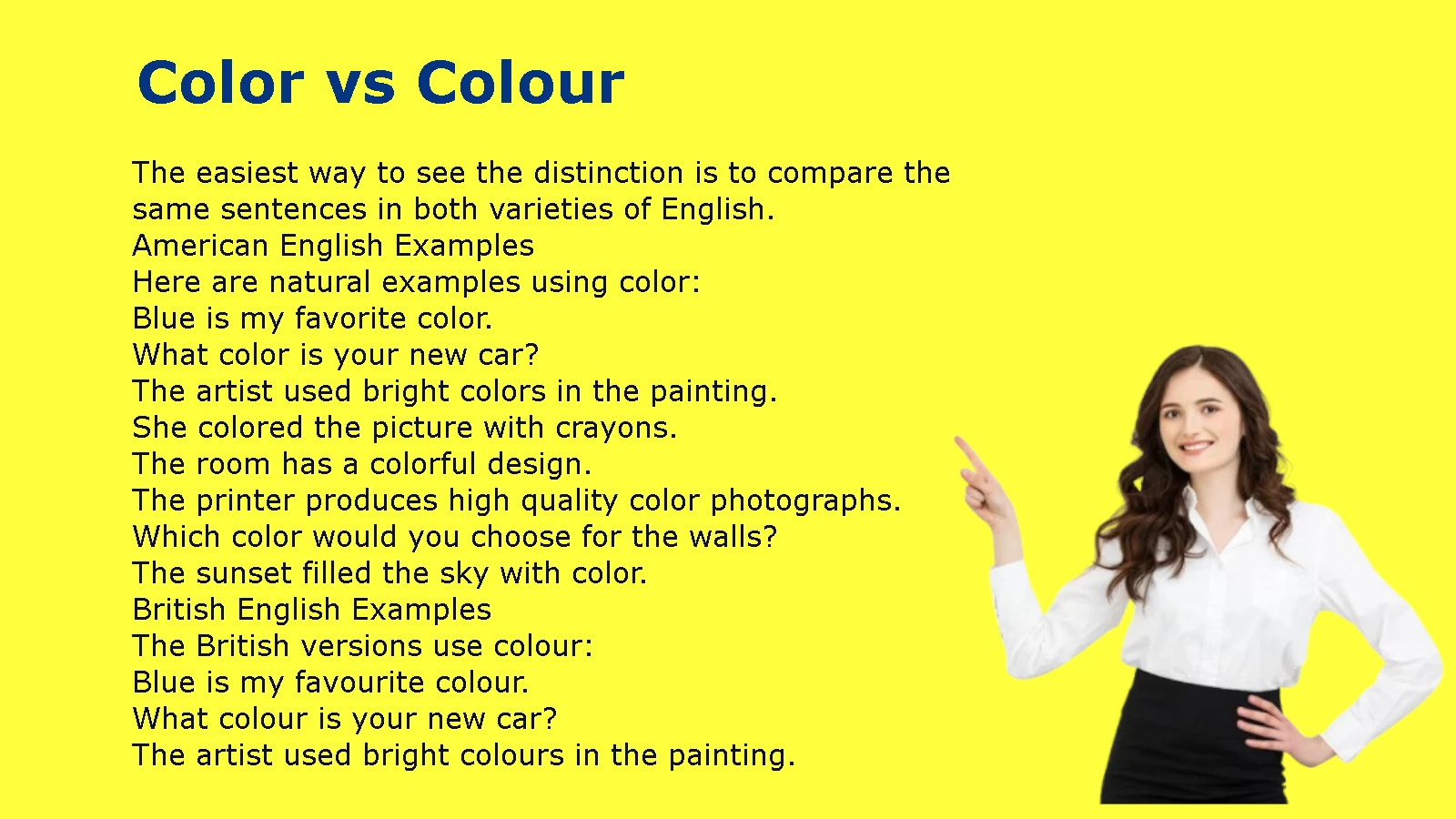
The easiest way to see the distinction is to compare the same sentences in both varieties of English.
American English Examples
Here are natural examples using color:
- Blue is my favorite color.
- What color is your new car?
- The artist used bright colors in the painting.
- She colored the picture with crayons.
- The room has a colorful design.
- The printer produces high quality color photographs.
- Which color would you choose for the walls?
- The sunset filled the sky with color.
British English Examples
The British versions use colour:
- Blue is my favourite colour.
- What colour is your new car?
- The artist used bright colours in the painting.
- She coloured the picture with crayons.
- The room has a colourful design.
- The printer produces high quality colour photographs.
- Which colour would you choose for the walls?
- The sunset filled the sky with colour.
Notice something important: the spelling changes, but the meaning doesn’t.
In some sentences, other words may change too. For example, American English normally uses favorite, while British English uses favourite. That difference has nothing to do with color itself. It’s another example of the broader spelling differences between the two varieties.
Color vs Colour in American English
If you’re writing in American English, use color.
That applies whether you’re writing casually or professionally.
Common American English Forms
| Form | American English |
| Singular noun | color |
| Plural noun | colors |
| Past tense | colored |
| Present participle | coloring |
| Adjective | colorful |
| Opposite or removal form | discolor |
For example:
- My favorite color is green.
- The artist mixed several colors.
- She colored the drawing.
- The children are coloring.
- The garden is bright and colorful.
- Sunlight can discolor certain fabrics.
If an American publication asks for US English, these are the forms to use.
Color vs Colour in British English
If you’re writing in British English, use colour.
The related forms generally retain the u as well.
Common British English Forms
| Form | British English |
| Singular noun | colour |
| Plural noun | colours |
| Past tense | coloured |
| Present participle | colouring |
| Adjective | colourful |
| Opposite or removal form | discolour |
For example:
- My favourite colour is green.
- The artist mixed several colours.
- She coloured the drawing.
- The children are colouring.
- The garden is bright and colourful.
- Sunlight can discolour certain fabrics.
The key is consistency. Switching between color and colour in the same document can make your writing look careless even though both spellings are correct.
Is Color or Colour Correct?
Both are correct.
That’s the most important answer.
The correct choice depends on the variety of English you’re using.
Use Color When Writing American English
Choose color when your audience expects American spelling.
For example:
What is your favorite color?
This is standard American English.
Use Colour When Writing British English
Choose colour when your audience expects British spelling.
For example:
What is your favourite colour?
This is standard British English.
Neither Spelling Is a Mistake
It would be misleading to call colour a misspelling simply because American English uses color. The reverse is also true.
Merriam Webster describes colour as a “chiefly British spelling of color,” while Cambridge describes color as the US spelling of colour.
So the issue isn’t right vs wrong.
It’s American vs British usage.
Color vs Colour in Other English Varieties
English doesn’t stop at two varieties. Other national forms of English have their own spelling conventions.
Canada
Canadian English occupies an interesting position because its spelling conventions can draw from both British and American English.
For colour, Canadian dictionaries commonly recognize the -our spelling. Cambridge, for example, labels its American English entry for color as “Cdn Br colour”, reflecting Canadian usage alongside British usage.
That means you shouldn’t automatically assume that every English speaking country follows American spelling simply because it is geographically close to the United States.
Australia and New Zealand
Australian and New Zealand English generally follow British spelling conventions for words such as colour.
Therefore, writing for readers in those countries often means using:
- colour
- colours
- coloured
- colouring
- colourful
The larger lesson is straightforward: identify your audience before choosing a spelling style.
Color vs Colour: Related Words
The difference doesn’t stop at the base word.
Once you choose color or colour, related words often follow the same regional pattern.
| American English | British English |
| color | colour |
| colors | colours |
| colored | coloured |
| coloring | colouring |
| colorful | colourful |
| colorless | colourless |
| discolor | discolour |
| recolor | recolour |
| multicolor | multicolour |
These forms are useful to remember because writers sometimes spell the main noun correctly but switch conventions in related words.
For example, this combination mixes varieties:
The colorful design uses several bright colours.
If you’re writing consistently in American English, use:
The colorful design uses several bright colors.
For British English:
The colourful design uses several bright colours.
The same principle applies throughout a document.
Color vs Colour in a Sentence
Seeing the words in context makes the difference easy to remember.
| American English | British English |
| What is your favorite color? | What is your favourite colour? |
| Red is my favorite color. | Red is my favourite colour. |
| The artist used several colors. | The artist used several colours. |
| She colored the picture. | She coloured the picture. |
| The design is colorful. | The design is colourful. |
| The walls need more color. | The walls need more colour. |
| Which color looks better? | Which colour looks better? |
| The photographs are in color. | The photographs are in colour. |
A Simple Writing Test
If you’re unsure which spelling to use, look at another spelling in your document.
Do you write:
- favorite or favourite?
- center or centre?
- honor or honour?
- theater or theatre?
If your writing consistently uses the first forms, color will usually fit your American English style.
If it uses the second forms, colour will usually fit your British English style.
This isn’t an absolute test for every word, especially in varieties such as Canadian English. Still, it provides a useful clue when you’re trying to maintain a consistent style.
Common Mistakes With Color and Colour
The biggest mistakes usually come from mixing regional spelling conventions rather than misunderstanding the meaning.
Mixing American and British Spellings
Consider this sentence:
My favourite color is blue.
It’s understandable. However, it mixes British favourite with American color.
If you’re following American English, write:
My favorite color is blue.
If you’re following British English, write:
My favourite colour is blue.
The goal isn’t to eliminate one spelling. The goal is to choose the appropriate variety and stick with it.
Assuming Colour Has a Different Meaning
It doesn’t.
Color and colour refer to the same concept. The spelling difference doesn’t create a new definition.
For instance:
- color = American spelling
- colour = British spelling
Both can refer to red, blue, green, visual appearance, pigment, or related figurative ideas.
Assuming the Extra U Changes the Pronunciation
It doesn’t create an extra syllable.
The words are pronounced essentially the same, with the normal differences between American and British accents.
The u is a spelling distinction, not a separate sound.
Treating Color as the Only Correct Form
This is perhaps the most common misconception.
If someone writes colour in British English, they haven’t made a spelling error. Likewise, an American writer who uses color hasn’t removed a letter incorrectly.
Each spelling belongs to an established regional standard.
How to Choose Between Color and Colour
Choosing the right spelling doesn’t have to be complicated.
Use Color If:
- You’re writing in American English.
- Your audience is primarily American.
- You’re following a US style guide.
- You’re writing for an American school, business, publication, or website.
- The rest of your document follows American spelling.
Use Colour If:
- You’re writing in British English.
- Your audience is primarily British.
- You’re following a British style guide.
- You’re writing for a British school, business, publication, or website.
- The rest of your document follows British spelling.
The Consistency Rule
Once you’ve chosen a spelling system, stay consistent.
That matters more than trying to force one version onto every English speaking audience.
Imagine a reader moving through an article that uses color, favourite, centre, honour, and theatre. Nothing is impossible to understand, but the inconsistent spelling creates unnecessary friction.
Good editing removes that friction.
A Practical Color vs Colour Style Guide
For longer documents, this quick guide can help:
| If your document uses… | Choose… |
| favorite | color |
| center | color |
| honor | color |
| theater | color |
| travelled | depends on style and regional convention |
| favourite | colour |
| centre | colour |
| honour | colour |
| theatre | colour |
| audience expects UK spelling | colour |
| audience expects US spelling | color |
The important point is that English varieties contain sets of conventions, not isolated spelling choices.
You shouldn’t decide that color is correct simply because you prefer the shorter spelling. Decide based on the language variety your audience expects.
Color vs Colour: A Real World Writing Example
Consider a company that operates in both the United States and the United Kingdom.
Its American website might say:
Choose your favorite color and customize your design.
Its British website might say:
Choose your favourite colour and customise your design.
Notice that more than one spelling changes.
The American version uses favorite, color, and customize. The British version uses favourite, colour, and customise.
This illustrates an important point about localization: translating content isn’t always enough. A business may also need to adapt spelling, punctuation, vocabulary, and style to match the target variety of English.
Why Consistency Matters for Professional Writing
A spelling mismatch rarely prevents understanding. However, professional readers notice patterns.
A British customer who sees color on a page may recognize it as American English immediately. An American reader will usually recognize colour as a British form.
Neither is inherently inferior.
The better choice is the one that matches the publication, brand, audience, and style guide.
Color vs Colour and Related Spelling Differences
The color/colour distinction belongs to a much larger group of differences between American and British English.
Here are some familiar examples:
| American English | British English |
| color | colour |
| favorite | favourite |
| honor | honour |
| humor | humour |
| center | centre |
| theater | theatre |
| meter | metre |
| liter | litre |
| behavior | behaviour |
| neighbor | neighbour |
| catalog | catalogue |
| dialog | dialogue |
| traveled | travelled |
| canceled | cancelled |
Not every word follows a simple one letter rule, and some words have multiple accepted forms depending on context or style guide. That’s why it’s better to think in terms of regional conventions rather than memorizing one universal formula.
Frequently Asked Questions About Color vs Colour
Is color or colour correct?
Both are correct. Color is the standard American English spelling, while colour is the standard British English spelling.
Is color American or British?
Color is the standard American English spelling.
Is colour American or British?
Colour is the standard British English spelling.
Do color and colour mean the same thing?
Yes. They have the same basic meaning. The difference is primarily regional spelling.
Are color and colour pronounced the same?
Yes. The spelling difference does not add a separate sound. American and British accents can produce slightly different pronunciations, but the distinction isn’t caused by the extra u.
Why does British English spell color as colour?
The -our spelling has historical roots in English. American spelling later developed a preference for the shorter -or form. Noah Webster promoted dropping the u from words such as colour, honour, and humour as part of his efforts to simplify and distinguish American spelling.
Is color or colour used in Canada?
Canadian English can differ from both American and British English. Colour is a recognized Canadian spelling, and Cambridge specifically identifies colour as a Canadian British form in its dictionary information.
Which spelling should I use in an American essay?
Use color.
For example:
My favorite color is green.
Which spelling should I use in a British essay?
Use colour.
For example:
My favourite colour is green.
Is colorful or colourful correct?
Both are correct in their respective varieties.
- colorful = American English
- colourful = British English
Is colored or coloured correct?
Again, both are correct.
- colored = American English
- coloured = British English
Is coloring or colouring correct?
Both forms are used.
- coloring = American English
- colouring = British English
Can I use color and colour in the same article?
You can, but you generally shouldn’t if you’re aiming for a consistent regional style.
Choose the variety that fits your audience and use it throughout the article.
Final Verdict: Color vs Colour
The color vs colour debate is much simpler than it first appears.
Color is the standard American English spelling.
Colour is the standard British English spelling.
They have the same basic meaning and are pronounced essentially the same. The extra u marks a regional spelling difference rather than a difference in meaning.
| Question | Answer |
| American spelling | color |
| British spelling | colour |
| Same meaning? | Yes |
| Same basic pronunciation? | Yes |
| Different grammar? | No |
| Different spelling? | Yes |
| Related US form | colorful |
| Related UK form | colourful |
The best rule is simple: match your audience and stay consistent.
If you’re writing for an American audience, choose color. If you’re writing for a British audience, choose colour. Once that choice is made, carry the same regional pattern through related words such as colored/coloured and colorful/colourful.
English has room for both spellings. There’s no need to pick a winner when the real answer is a matter of where and for whom you write.