Have you ever wondered whether Artifact vs Artefact is a spelling difference or if the two words have different meanings? At first glance, artifact and artefact may look like two separate words, but they actually have the same meaning and pronunciation. The main difference is where each spelling is commonly used.
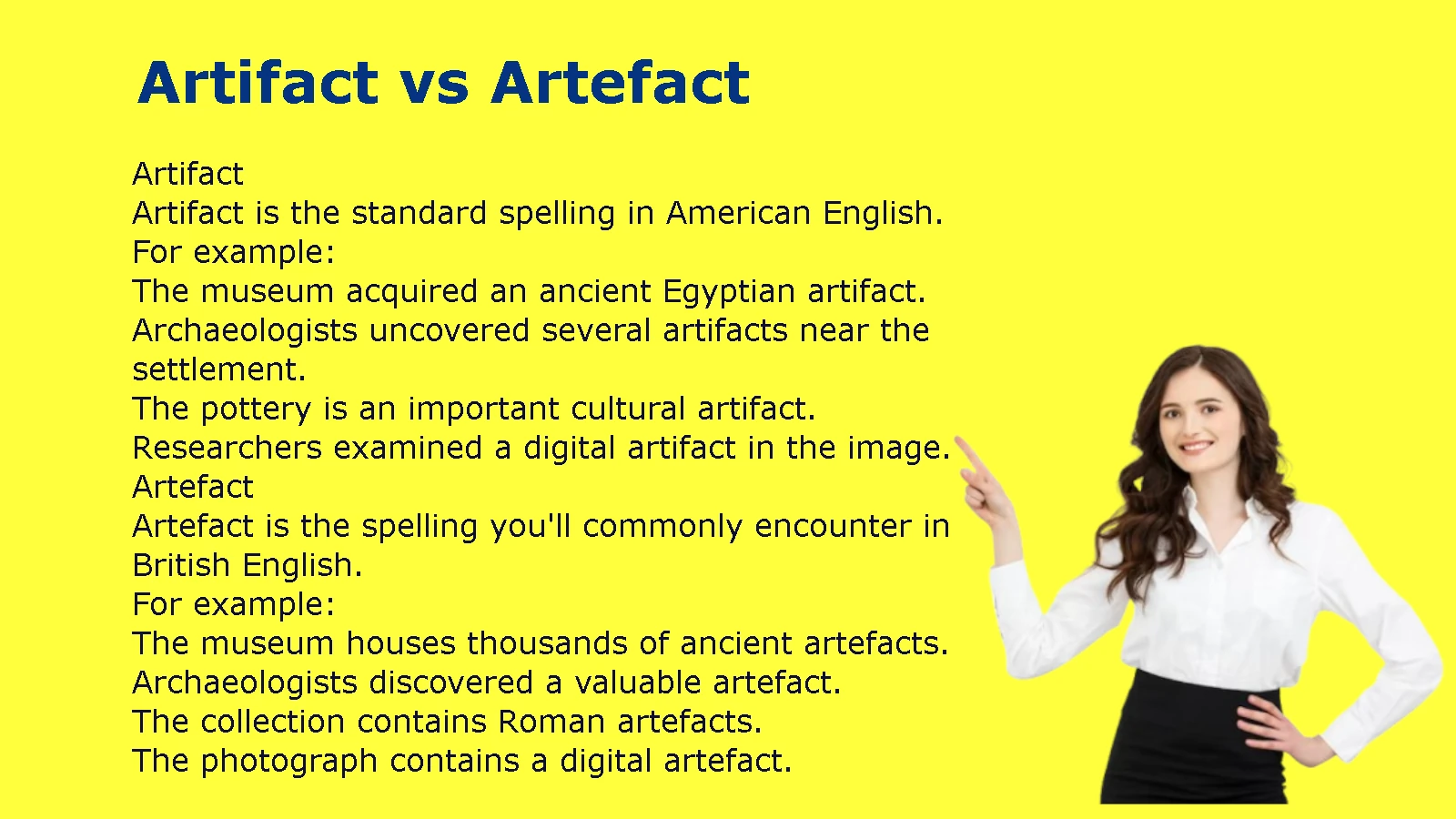
Artifact is the standard spelling in American English, while artefact is the preferred spelling in British English and many other varieties of English. Both words refer to an object made or changed by humans, especially one with historical, cultural, or archaeological importance.
Examples:
- The museum displayed an ancient artifact from Egypt.
- The museum displayed an ancient artefact from Egypt.
The confusion is understandable. People often search for artifact vs artefact, artifact meaning, artefact meaning, or is artefact British or American because the spelling changes depending on the variety of English being used. And here’s the interesting part: neither spelling is wrong. Your choice usually depends on your audience and the style of English you follow.
In this guide, you’ll learn the complete difference between Artifact vs Artefact, including their meanings, pronunciation, spelling, origins, and correct usage. You’ll also discover whether artifact or artefact is preferred in American and British English, see clear examples in sentences, and learn how to choose the right spelling for your writing.
Artifact vs Artefact: What’s the Difference?
The main difference between artifact and artefact is spelling.
| Word | Main usage | Meaning | Plural |
| Artifact | American English | A human made object, especially one with historical or cultural interest | Artifacts |
| Artefact | Mainly British English | A human made object, especially one with historical or cultural interest | Artefacts |
Cambridge Dictionary identifies artefact as the mainly UK spelling of artifact. It also lists artifact as the US spelling of artefact. Oxford likewise identifies artifact as especially North American and lists artefact as its British counterpart.
That means you don’t have two different objects here. You have one word with two accepted spellings.
For example:
The museum displayed several ancient artifacts.
An American writer would normally use artifacts. A British writer would normally write:
The museum displayed several ancient artefacts.
The meaning stays the same.
Artifact
Artifact is the standard spelling in American English.
Oxford defines it as an object made by a person, particularly one that has historical or cultural significance. Common examples include tools, decorations, household objects, weapons, and other objects that help researchers understand earlier societies.
For example:
- The museum acquired an ancient Egyptian artifact.
- Archaeologists uncovered several artifacts near the settlement.
- The pottery is an important cultural artifact.
- Researchers examined a digital artifact in the image.
The word also has specialized meanings in science and technology. Those uses matter because artifact doesn’t always refer to something you can hold in your hand.
Artefact
Artefact is the spelling you’ll commonly encounter in British English.
Oxford lists artefact as the main entry and notes that artifact is especially common in North American English. Cambridge similarly describes artefact as mainly a UK spelling.
For example:
- The museum houses thousands of ancient artefacts.
- Archaeologists discovered a valuable artefact.
- The collection contains Roman artefacts.
- The photograph contains a digital artefact.
Again, nothing changes except the spelling.
Is Artifact or Artefact Correct?
Both are correct.
The better question isn’t “Which spelling is correct?” It’s “Which spelling fits the variety of English I’m using?”
Use this simple rule:
- American English → artifact
- British English → artefact
- British influenced academic or professional writing → usually artefact
- North American academic or professional writing → usually artifact
Cambridge and Oxford both support this regional distinction.
Suppose you’re writing an American history essay. You’d normally write:
The archaeologists discovered several artifacts near the ancient settlement.
If you’re writing for a British publication, you’d normally write:
The archaeologists discovered several artefacts near the ancient settlement.
Neither writer has made a spelling mistake.
Why Both Spellings Are Accepted
English doesn’t have one worldwide spelling system.
American English and British English developed different spelling preferences across many words. You can see the same pattern in pairs such as:
| American English | British English |
| color | colour |
| center | centre |
| behavior | behaviour |
| organize | organise |
| theater | theatre |
| artifact | artefact |
The important point is that regional spelling doesn’t automatically make one version “correct” and the other “incorrect.”
Instead, consistency matters.
If an American article uses color, center, and artifact, suddenly switching to artefact can look out of place. Likewise, British writing that consistently uses colour, centre, and artefact will normally keep that pattern.
Artifact vs Artefact in American and British English
The easiest way to remember artifact vs artefact is to connect the spelling to the audience.
| Question | Artifact | Artefact |
| Is it correct? | Yes | Yes |
| Mainly associated with | American English | British English |
| Meaning | Same | Same |
| Singular | artifact | artefact |
| Plural | artifacts | artefacts |
| Historical use | Yes | Yes |
| Archaeological use | Yes | Yes |
| Scientific use | Yes | Yes |
| Technology use | Yes | Yes |
Cambridge explicitly labels artefact as mainly UK and artifact as the US spelling.
There is one useful wrinkle: dictionaries don’t always describe regional usage with absolute boundaries. English is messy in real life. Some writers outside the United States use artifact, while some North American sources may contain artefact. Still, artifact is the normal American choice and artefact is the normal British choice.
That’s the practical rule most writers need.
What Does Artifact Mean?
An artifact is something made by humans, especially an object that provides evidence about a particular culture, period, or way of life.
Think of an artifact as a physical clue from human activity.
A stone tool can reveal how people hunted. A piece of pottery can tell researchers about manufacturing techniques. A coin can provide information about trade, politics, or economics. A personal object can offer clues about ordinary life.
The object doesn’t have to be beautiful.
It doesn’t even have to be rare.
Its value can come from what it reveals.
Cambridge gives examples such as tools and decorations, particularly when they have historical importance.
Examples of Artifacts
Here are some objects that can qualify as artifacts depending on their context:
- Ancient pottery
- Stone tools
- Coins
- Jewelry
- Weapons
- Religious objects
- Writing tablets
- Household tools
- Clothing
- Musical instruments
- Sculptures
- Personal belongings
Consider an old cooking vessel discovered at an archaeological site. On its own, it might look like a broken piece of pottery. To an archaeologist, however, it could provide evidence about food preparation, technology, trade, materials, or daily life.
That’s what gives an artifact its significance.
What Does Artefact Mean?
Artefact means the same thing as artifact. The difference lies in spelling rather than definition.
British English commonly uses artefact when referring to an object made by humans, particularly one with historical or cultural significance. Oxford gives examples involving ancient objects and museum collections.
For example:
- The museum contains ancient artefacts from Nubia.
- Researchers carefully documented each artefact.
- The excavation produced several important artefacts.
- The collection includes religious artefacts from the region.
If you change these sentences to American English, you would normally change artefact to artifact.
The meaning doesn’t move an inch.
Artifact vs Artefact in Archaeology
Archaeology is probably the context most people associate with the word artifact.
Archaeologists study physical evidence of human activity. Artifacts can help them reconstruct how people lived, worked, traded, worshiped, traveled, and interacted.
For example, imagine an excavation uncovers:
- A clay pot
- Several stone blades
- A bronze ornament
- A small coin
- Pieces of decorated pottery
Those objects may become artifacts worthy of documentation and analysis.
However, context matters enormously. Archaeologists don’t simply collect old objects because they’re old. Where an object appears, what surrounds it, and how it relates to other discoveries can be just as important as the object itself.
A coin found inside a sealed archaeological layer may provide different information from an identical coin found on the surface.
That’s why archaeological artifacts aren’t merely “old things.” They are evidence.
Artifact vs Relic
The words artifact and relic overlap, but they aren’t perfect synonyms.
A relic often refers to something surviving from an earlier time. It can also have a religious meaning.
An artifact focuses more strongly on something made by humans and its value as evidence of human activity.
For example:
The archaeologist cataloged the pottery fragment as an artifact.
The same object might also be described as a relic of an earlier civilization, depending on the context.
The words highlight slightly different ideas.
Artifact vs Artefact in History and Museums
Museums frequently use artifacts to help visitors connect with the past.
A historical artifact might be an ordinary object that once belonged to a particular person or community. Its importance can come from its association with a significant event, culture, occupation, or period.
For example, a typewriter owned by a famous writer could be considered a historical artifact. So could a military uniform, handwritten document, household object, or piece of industrial equipment.
This is why the word shouldn’t be reduced to “ancient object.”
An artifact can be relatively recent.
The central idea is that the object was made by humans and has value as evidence, history, or cultural material.
Artifact vs Artefact in Science
Here’s where the word takes an important turn.
In science, an artifact can mean something that appears in an observation or result because of the method used to produce or examine it rather than because it naturally exists in the subject being studied.
Cambridge describes this specialized sense as something seen in an experiment or study that doesn’t exist naturally but results from the way the experiment or study is conducted.
Merriam Webster also records specialized scientific and medical meanings for artifact, including features introduced through manipulation, preparation, or other external factors.
A Simple Scientific Example
Imagine you’re examining a biological sample under a microscope.
You notice an unusual structure.
At first, it appears to be part of the specimen. Further investigation shows that the structure formed because of the preparation process.
That structure is an artifact.
In other words:
Real feature → exists in the original subject
Artifact → produced or altered by the method of observation or preparation
The distinction matters because researchers need to avoid mistaking a technical effect for a genuine finding.
Scientific Artifact vs Historical Artifact
The same word carries two related but distinct ideas:
| Context | Meaning |
| Archaeology | A human made object with historical or cultural significance |
| History | A physical object that provides evidence about the past |
| Science | A feature or result introduced by a method, procedure, or external influence |
| Medicine | A misleading feature produced by preparation, measurement, or recording |
| Technology | Something produced during a development or computing process |
The underlying concept is something produced or made, but the exact meaning depends on the field.
Artifact vs Artefact in Technology
Modern technology has expanded the meaning of artifact far beyond archaeology.
In software and systems development, an artifact can refer to a product or work created during a development process. That might include documents, models, specifications, source code, diagrams, test outputs, or compiled software.
Software engineering literature uses artefact in this broader sense to include documents, deliverables, and work products created during development.
For example:
- A software build may produce a deployable artifact.
- A design team may create a requirements artifact.
- A development project may store build artifacts in a repository.
- A testing process may generate reports and other project artifacts.
This use can surprise people who learned that an artifact is an ancient object in a museum.
But the connection makes sense.
A software artifact is something produced by a human process, just as a physical artifact is something produced through human activity.
Digital Artifact
A digital artifact can refer broadly to a digital object or a feature created by a digital process.
For instance, an image might contain an unwanted visual effect caused by compression, processing, or another technical operation. That effect can be called a digital artifact.
The exact definition depends on the technical field. Context does the heavy lifting.
Artifact vs Artefact Examples
Seeing the words in context makes the distinction much easier.
Examples With Artifact
Here are natural examples using the American spelling:
- The museum acquired a rare Roman artifact.
- Archaeologists discovered several artifacts beneath the ancient floor.
- The stone tool is an important archaeological artifact.
- The collection contains religious artifacts from the region.
- Researchers documented each artifact before moving it.
- The experiment produced an unexpected artifact.
- The image contains a digital artifact caused by compression.
- The development team stored the build artifacts in a repository.
- The artifact provides evidence of early human activity.
- The museum carefully preserves each historical artifact.
Examples With Artefact
Here are the same kinds of examples using the British spelling:
- The museum acquired a rare Roman artefact.
- Archaeologists discovered several artefacts beneath the ancient floor.
- The stone tool is an important archaeological artefact.
- The collection contains religious artefacts from the region.
- Researchers documented each artefact before moving it.
- The experiment produced an unexpected artefact.
- The image contains a digital artefact caused by compression.
- The development team stored the build artefacts in a repository.
- The artefact provides evidence of early human activity.
- The museum carefully preserves each historical artefact.
Notice what changed.
Only the spelling changed.
Artifact vs Artefact Plural Forms
The plural forms follow the same regional spelling pattern.
| Singular | Plural |
| artifact | artifacts |
| artefact | artefacts |
So, if you’re writing American English:
The museum displays hundreds of ancient artifacts.
In British English:
The museum displays hundreds of ancient artefacts.
Don’t write artifactes or artefacts when you’re trying to form the American plural. The American spelling simply adds s to artifact.
Likewise, artefact becomes artefacts in British English.
How Do You Pronounce Artifact and Artefact?
Despite the spelling difference, artifact and artefact have essentially the same pronunciation.
Cambridge lists both pronunciations with regional differences between US and UK English.
A rough pronunciation guide is:
artifact: AR-ti-fact
artefact: AR-ti-fact
The exact vowel sounds can vary by accent. The extra e in artefact doesn’t create a dramatically different spoken word.
So if you hear someone say artefact, you shouldn’t assume they’re referring to a different term.
They’re simply using a different spelling convention.
Why Does Artifact Have Two Spellings?
The history of the word helps explain why the two forms exist.
Merriam Webster traces artifact to New Latin arte factus, meaning “made by human agency.” The Latin components relate to skill or craft and making or doing. Merriam Webster records the first known use in English as 1644.
Oxford also traces artefact to Latin roots involving arte, meaning by or using art, and factum, meaning something made.
The spelling later developed differently in English varieties.
Merriam Webster notes that the usual American spelling artifact reflects assimilation to Latin compounds with arti-.
That gives us a useful historical picture:
Latin roots → English word → regional spelling conventions → artifact / artefact
The difference isn’t a modern typo. Both forms have established dictionary histories.
Which Spelling Should You Use?
When you’re unsure about artifact vs artefact, don’t overthink it.
Use the spelling that matches your audience.
Use Artifact When Writing American English
Choose artifact for:
- US websites
- American school assignments
- US newspapers
- American business writing
- US academic writing
- American technical documentation
- Content written specifically for a US audience
Example:
The archaeologists uncovered several artifacts from the settlement.
Use Artefact When Writing British English
Choose artefact for:
- UK publications
- British academic writing
- British educational material
- UK government or institutional content
- Writing that follows British spelling conventions
Example:
The archaeologists uncovered several artefacts from the settlement.
What If Your Audience Is International?
For an international audience, consistency is more important than trying to please every reader.
If the rest of your article follows American English, use artifact. If it follows British English, use artefact.
Don’t alternate between them simply because both are technically correct.
A reader won’t usually misunderstand you. However, inconsistent regional spelling can make polished content look less deliberate.
Artifact vs Artefact in Academic Writing
Academic writing requires a little more care because universities, journals, and publishers often follow specific style guides.
Before choosing between artifact and artefact, check the required English variety.
For example, if a British university asks for British English, artefact will normally fit the expected convention. If an American institution expects US English, artifact is the natural choice.
The same principle applies to scientific papers.
Follow the Publication’s Style
If a journal consistently uses British spelling, don’t randomly switch to American spelling for this one word.
Check:
- The journal’s author guidelines
- The university’s writing guide
- The publisher’s style guide
- The required regional variety of English
- Existing terminology in your research field
The goal isn’t to prove that one spelling is superior.
The goal is consistent, professional communication.
Artifact vs Artefact: Common Mistakes
The spelling itself is rarely the real problem. Most mistakes happen when writers misunderstand how the two forms relate.
Mistake: Thinking Artefact Is Wrong
Artefact isn’t a misspelling.
It is a recognized spelling used mainly in British English. Cambridge and Oxford both document it.
Mistake: Thinking Artifact Is Wrong in Britain
That’s also too strong.
Artifact is widely recognized, and dictionaries explicitly associate it with North American English. The practical distinction is regional preference rather than a simple correct versus incorrect judgment.
Mistake: Switching Between Both Forms
Consider this paragraph:
The museum acquired several ancient artifacts. These artefacts came from different archaeological sites.
There’s no grammatical disaster here. However, the spelling switch is unnecessary if the article follows one regional variety.
Pick one form and stick with it.
Mistake: Assuming an Artifact Must Be Ancient
An artifact doesn’t have to be thousands of years old.
Historical and cultural artifacts can be relatively recent. The term can also appear in science, medicine, computing, and software development.
Context determines the meaning.
Mistake: Treating Artifact as a Synonym for Artwork
An artifact isn’t necessarily artwork.
A painting can be both an artwork and an artifact in an appropriate historical context. A hammer can be an artifact but not an artwork.
The categories overlap sometimes, but they aren’t identical.
Artifact vs Artefact vs Artwork
These three words can appear in the same conversation, yet they don’t mean exactly the same thing.
Artifact / artefact refers broadly to something made by humans, especially an object with historical or cultural significance.
Artwork specifically refers to a work created as art.
Consider three objects:
| Object | Could be an artifact? | Could be artwork? |
| Ancient clay pot | Yes | Possibly |
| Stone hammer | Yes | No, normally |
| Oil painting | Yes, in a historical context | Yes |
| Digital illustration | Yes, depending on context | Yes |
| Ancient coin | Yes | Usually not |
The word artifact focuses on human creation and its significance as an object or product. Artwork focuses on artistic creation.
That distinction becomes especially useful in museums and cultural studies.
Artifact vs Artefact: A Practical Case Study
Imagine a museum in London acquires a 19th century mechanical instrument.
A British curator might write:
The collection includes a mechanical artefact from the industrial period.
Now imagine an American museum describing the same object:
The collection includes a mechanical artifact from the industrial period.
The object hasn’t changed.
Its history hasn’t changed.
The only difference is the regional spelling convention.
Now take the same word into software development.
A British software team might refer to a generated file as a software artefact, while an American team may call it a software artifact.
Again, the spelling changes while the basic concept remains connected to something produced through a process.
This case study shows why context and regional English matter more than the letter e.
Artifact vs Artefact: Quick Comparison
Here’s the answer at a glance:
| Category | Artifact | Artefact |
| Correct spelling? | Yes | Yes |
| Main variety | American English | British English |
| Core meaning | Human made object | Human made object |
| Historical meaning | Yes | Yes |
| Archaeological meaning | Yes | Yes |
| Scientific meaning | Yes | Yes |
| Technology meaning | Yes | Yes |
| Singular | Artifact | Artefact |
| Plural | Artifacts | Artefacts |
| Pronunciation | Essentially the same | Essentially the same |
| Best choice for US readers | Artifact | Usually avoid |
| Best choice for UK readers | Usually avoid | Artefact |
The simplest takeaway is this:
Artifact is the usual American spelling. Artefact is the usual British spelling.
Facts About Artifact and Artefact
A few facts make the distinction easier to remember:
- Artifact and artefact have the same core meaning.
- Artifact is the usual American spelling.
- Artefact is mainly the British spelling.
- Both forms can refer to historical or cultural objects.
- Both forms can occur in scientific contexts.
- Both forms can appear in technology and software contexts.
- Artifacts is the American plural.
- Artefacts is the British plural.
- The word ultimately comes from Latin roots associated with making something through skill or craft.
- Merriam Webster records 1644 as the first known use of artifact in English.
Frequently Asked Questions About Artifact vs Artefact
Is artifact the American spelling?
Yes. Artifact is the usual American English spelling. Cambridge identifies it as the US spelling, while Oxford labels it especially North American.
Is artefact the British spelling?
Yes. Artefact is mainly used in British English. Cambridge explicitly describes it as the mainly UK spelling of artifact.
Are artifact and artefact the same word?
Yes. Artifact and artefact have the same core meaning. The difference is primarily regional spelling.
Which is correct, artifact or artefact?
Both are correct. Use artifact for American English and artefact for British English.
What is the plural of artifact?
The American English plural is artifacts.
Example:
The museum contains several ancient artifacts.
What is the plural of artefact?
The British English plural is artefacts.
Example:
The museum contains several ancient artefacts.
Does artifact mean artwork?
No. An artifact can be an artwork, but the terms aren’t interchangeable. Artifact has a broader meaning that includes many human made objects that aren’t works of art.
Can an artifact be modern?
Yes. The word doesn’t require an object to be ancient. Modern scientific, digital, and software contexts also use artifact for things produced by human processes.
Is artifact used in science?
Yes. In science, an artifact can be a feature or result introduced by the method used to observe, measure, prepare, or analyze something. Cambridge and Merriam Webster both document this specialized meaning.
Is artefact used in science too?
Yes. British English can use artefact for the same scientific concept. The spelling follows the regional convention.
Does the extra e in artefact change the pronunciation?
No significant meaning or pronunciation difference comes from the extra e. Regional accents can affect the exact sounds, but artifact and artefact refer to the same word.
Which spelling should I use in an American article?
Use artifact.
For example:
The researchers discovered an important archaeological artifact.
Which spelling should I use in a British article?
Use artefact.
For example:
The researchers discovered an important archaeological artefact.
Can I use both artifact and artefact in the same article?
You can, but normally you shouldn’t switch between them without a reason. Choose the spelling that matches your target variety of English and keep it consistent.
Final Verdict: Artifact vs Artefact
The artifact vs artefact debate has a surprisingly simple answer.
Artifact and artefact are both legitimate spellings of the same word. The main difference is regional:
- 🇺🇸 Artifact → standard American English
- 🇬🇧 Artefact → mainly British English
Both words can describe human made objects with historical or cultural importance. Both can also appear in specialized scientific and technical contexts.
The best choice, therefore, isn’t about picking the “more correct” spelling. It’s about matching your audience.
And remember the plural forms:
artifact → artifacts
artefact → artefacts
Once you know that pattern, the spelling question becomes much less mysterious. The extra e doesn’t create a new word. It simply tells you something about the English spelling tradition behind the text.