Have you ever wondered whether you should write Neighbor vs Neighbour? Both words have the same meaning, pronunciation, and usage, but their spelling depends on the variety of English you use. Knowing the difference can help you choose the correct spelling for your audience and avoid unnecessary confusion.
Neighbor is the American English spelling, while Neighbour is the British English spelling. Both words refer to a person who lives near you or, more broadly, something located nearby.
Examples:
- My neighbor helped me carry the boxes.
- Our neighbour invited us over for dinner.
The confusion is understandable. People often search for Neighbor vs Neighbour, neighbor meaning, neighbour meaning, American vs British spelling, or which is correct: neighbor or neighbour because the two spellings look almost identical. And here’s the kicker: neither spelling is wrong. The right choice depends on which form of English you’re using.
In this guide, you’ll learn the complete Neighbor vs Neighbour difference, including their definitions, pronunciation, correct spelling, usage, and examples in sentences. You’ll also discover which spelling is used in American and British English, along with other regional variations and simple tips to remember the difference.
Neighbor vs Neighbour: What’s the Difference?
The difference between neighbor and neighbour is primarily a matter of regional spelling. The words don’t have different meanings.
| Word | Standard variety | Meaning | Pronunciation |
| neighbor | American English | A person or place nearby | Essentially the same |
| neighbour | British English | A person or place nearby | Essentially the same |
For example:
- American English: My neighbor has a new car.
- British English: My neighbour has a new car.
The message doesn’t change. Only the spelling does.
Cambridge defines neighbor as the US spelling and neighbour as the UK spelling. Both can refer to someone who lives nearby, while both forms can also describe a country or place that is next to another.
This distinction matters most when you’re writing formally. If you’ve chosen American English, use neighbor consistently. If you’re writing in British English, use neighbour consistently.
Neighbor vs Neighbour at a Glance
Here’s the simplest way to remember the difference:
Neighbor = American English
Neighbour = British English
Think of the u as part of the British spelling pattern. The same pattern appears in words such as:
- color → colour
- favor → favour
- honor → honour
- labor → labour
- behavior → behaviour
- neighbor → neighbour
The spelling changes, but the underlying word and meaning remain the same.
What Does Neighbor or Neighbour Mean?
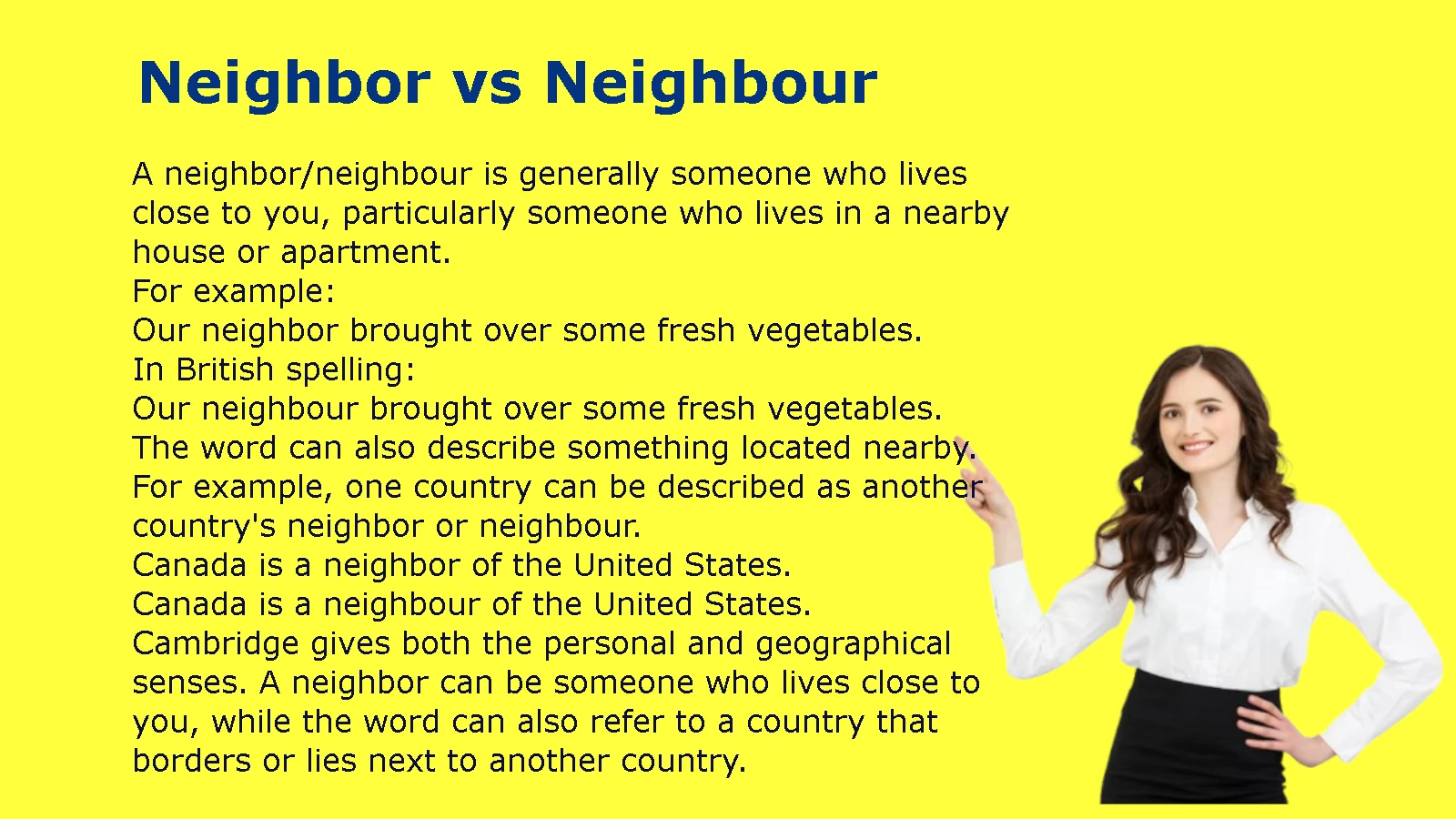
A neighbor/neighbour is generally someone who lives close to you, particularly someone who lives in a nearby house or apartment.
For example:
Our neighbor brought over some fresh vegetables.
In British spelling:
Our neighbour brought over some fresh vegetables.
The word can also describe something located nearby. For example, one country can be described as another country’s neighbor or neighbour.
- Canada is a neighbor of the United States.
- Canada is a neighbour of the United States.
Cambridge gives both the personal and geographical senses. A neighbor can be someone who lives close to you, while the word can also refer to a country that borders or lies next to another country.
The idea can extend beyond people and countries, too. In technical or scientific writing, neighboring can describe things that are next to or near one another.
For example:
- neighboring cells
- neighboring regions
- neighboring states
- neighboring countries
Cambridge defines neighboring as describing places that are next to or near one another.
Neighbor: The American English Spelling
Neighbor is the standard spelling in American English.
If you’re writing an essay for a school in the United States, creating content for an American publication, or simply following US English conventions, neighbor is the form to use.
Examples of Neighbor in American English
- My neighbor has a friendly dog.
- I spoke with my neighbor yesterday.
- Our next-door neighbor is a teacher.
- The neighbors organized a community event.
- Mexico is America’s southern neighbor.
- Several neighboring states experienced heavy rain.
Notice that the spelling remains consistent when the word changes form.
| Form | American English |
| Singular noun | neighbor |
| Plural noun | neighbors |
| Verb | neighbor |
| Past tense | neighbored |
| Present participle/adjective | neighboring |
| Related noun | neighborhood |
The noun neighborhood follows the same American spelling pattern. Cambridge identifies neighborhood as the US spelling of British neighbourhood.
Why “Neighbor” Is Not a Shortened Form
It’s easy to look at neighbor and think that American English simply removed a letter from neighbour. That’s too simplistic.
The two spellings developed within different spelling traditions. American English eventually standardized many words with -or where British English retained -our.
Therefore, neighbor isn’t an abbreviation or casual version of neighbour. It’s a standard spelling in its own right.
Neighbour: The British English Spelling
Neighbour is the standard British English spelling.
If you’re writing according to British English conventions, use neighbour rather than neighbor.
You’ll commonly see it in British newspapers, books, educational materials, government writing, and everyday communication.
Examples of Neighbour in British English
- My neighbour has a new car.
- Our next-door neighbour is very friendly.
- Several neighbours attended the meeting.
- France is a neighbour of several European countries.
- The storm affected neighbouring villages.
- The two neighbouring countries share a border.
Cambridge’s British English entry uses neighbour for both the noun and verb and gives examples involving people, countries, and nearby places.
British Forms of Neighbour
| Form | British English |
| Singular noun | neighbour |
| Plural noun | neighbours |
| Verb | neighbour |
| Past tense | neighboured |
| Present participle/adjective | neighbouring |
| Related noun | neighbourhood |
The same regional pattern appears throughout the word family.
Neighbor → neighbors → neighboring → neighborhood
becomes:
Neighbour → neighbours → neighbouring → neighbourhood
That consistency makes the distinction easier to remember.
Neighbor vs Neighbour Pronunciation
One of the most useful things to know about neighbor vs neighbour is that the extra u doesn’t normally change the pronunciation.
Both spellings are pronounced approximately:
NAY-bər
In IPA, Cambridge gives the American pronunciation as approximately /ˈneɪ.bɚ/ and the British pronunciation as /ˈneɪ.bə/.
The difference between the final sounds reflects broader differences between American and British pronunciation rather than the spelling distinction itself.
Does the “u” in Neighbour Make It Sound Different?
No.
The u in neighbour is part of the spelling rather than a separate vowel sound. You don’t pronounce it as an extra syllable.
So these pairs sound essentially alike:
- neighbor / neighbour
- color / colour
- favor / favour
- honor / honour
This is a useful reminder that English spelling doesn’t always tell you exactly how a word sounds.
Why Does Neighbor Have Two Spellings?
The story behind neighbor vs neighbour goes back much further than modern American and British English.
The word traces back to Old English. Etymonline derives it from Old English neahgebur, meaning roughly “one who dwells nearby.” The compound combines an element meaning “near” with another referring to a dweller or inhabitant.
Over time, the word passed through Middle English forms before developing into the modern spelling.
The spelling history also connects with the broader -or/-our difference. Etymonline identifies the British -our spelling as part of a historical spelling tradition involving Middle English and Old French forms.
The Basic Historical Path
A simplified version looks like this:
Old English → Middle English → Early Modern English → Modern regional spellings
The exact spelling wasn’t frozen at one point in history. English spelling changed gradually as pronunciation, printing practices, regional traditions, and standardization influenced written English.
That’s why treating neighbour as the “original correct spelling” and neighbor as a later mistake would be misleading.
Both belong to the history of English. Modern English simply settled on different conventions in different regions.
Why Does American English Use “Neighbor”?
American English developed its own spelling conventions after English was established in North America.
American spelling eventually favored shorter forms in several groups of words. The -or spelling became standard in words such as:
- color
- favor
- honor
- labor
- neighbor
British English generally retained:
- colour
- favour
- honour
- labour
- neighbour
This doesn’t mean that every word ending in -our becomes -or in American English. English spelling has plenty of exceptions and historical quirks.
For that reason, it’s better to learn neighbor as part of a broader spelling pattern rather than applying a mechanical rule to every word.
Neighbor vs Neighbour in Different English-Speaking Countries
The choice isn’t simply “America versus everywhere else.” English has several major regional standards, and spelling conventions can differ among them.
United States
Neighbor is the standard spelling.
Examples:
- neighbor
- neighbors
- neighboring
- neighborhood
United Kingdom
Neighbour is the standard spelling.
Examples:
- neighbour
- neighbours
- neighbouring
- neighbourhood
Canada
Canadian English has influences from both American and British English. However, neighbour and related -our forms are conventional Canadian spellings.
Cambridge specifically labels neighbor as “Cdn Br” in its American English entry, reflecting Canadian/British usage of neighbour.
Australia and New Zealand
Australian and New Zealand English generally follow British spelling conventions, so neighbour is the expected form.
This matters when you’re writing for a specific audience. A spelling that looks unusual in one country can be completely ordinary in another.
Neighbor vs Neighbour: A Regional Comparison
| Variety of English | Preferred spelling |
| American English | neighbor |
| British English | neighbour |
| Canadian English | neighbour |
| Australian English | neighbour |
| New Zealand English | neighbour |
Regional language isn’t a contest. Each spelling belongs to a legitimate English convention.
The best choice depends on which variety of English you’re using.
Neighbor vs Neighbour in Sentences
Seeing the two spellings side by side makes the difference especially clear.
| American English | British English |
| My neighbor is a doctor. | My neighbour is a doctor. |
| We invited our neighbors over. | We invited our neighbours over. |
| Our neighbor has a new puppy. | Our neighbour has a new puppy. |
| The neighboring town is five miles away. | The neighbouring town is five miles away. |
| Several neighboring states were affected. | Several neighbouring states were affected. |
| We live in a quiet neighborhood. | We live in a quiet neighbourhood. |
Nothing about the underlying meaning changes.
Only the regional spelling changes.
Neighbor vs Neighbour: Related Words
The difference becomes even more important when you use the word’s related forms.
Neighbors vs Neighbours
The plural follows the same pattern:
- American: neighbors
- British: neighbours
Example:
The neighbors held a meeting.
British English:
The neighbours held a meeting.
Neighboring vs Neighbouring
The adjective and present participle also preserve the spelling distinction:
- American: neighboring
- British: neighbouring
Cambridge explicitly lists neighboring as the US form and neighbouring as the UK form.
Example:
The two neighboring towns share the same railway station.
British English:
The two neighbouring towns share the same railway station.
Neighborhood vs Neighbourhood
This is another important member of the same word family.
- American: neighborhood
- British: neighbourhood
Cambridge identifies neighborhood as the US spelling of neighbourhood.
Example:
She lives in a quiet neighborhood.
British English:
She lives in a quiet neighbourhood.
If you’re writing a complete article, essay, or report, don’t switch between these forms randomly.
Neighbor and Neighbour as Verbs
Most people encounter neighbor/neighbour as a noun, but the word can also function as a verb.
As a verb, it means to be next to or near another place.
For example:
The two properties neighbor each other.
In British English:
The two properties neighbour each other.
Cambridge lists both forms as verbs and defines them in terms of being next to or near another place.
Verb Examples
American English:
- The two farms neighbor one another.
- Several states neighbor the region.
- The country is neighbored by three other nations.
British English:
- The two farms neighbour one another.
- Several states neighbour the region.
- The country is neighboured by three other nations.
The spelling principle remains the same.
Common Expressions With Neighbor or Neighbour
The word appears in many everyday phrases.
Next-Door Neighbor
A next-door neighbor is someone who lives in the house or apartment immediately next to yours.
British English:
next-door neighbour
Example:
Our next-door neighbor helped us carry the boxes.
Good Neighbor
A good neighbor is someone who behaves considerately toward people living nearby.
British English:
good neighbour
Example:
Keeping the noise down at night is part of being a good neighbor.
Neighboring Country
A neighboring country is a country located next to or near another country.
British English:
neighbouring country
Example:
The two neighboring countries share a long border.
Neighboring State
In American English, neighboring state is common when discussing states that share a border or lie nearby.
Example:
Many people commute between the two neighboring states.
The British equivalent uses neighbouring.
Neighbor vs Neighbour: Common Mistakes
Although the difference looks simple, several mistakes appear regularly.
Mistake 1: Treating One Spelling as Universally Correct
It’s inaccurate to say that neighbor is always correct or that neighbour is always correct.
The appropriate spelling depends on the English variety.
Better approach: Match the spelling to your audience and style guide.
Mistake 2: Mixing Regional Spellings
Consider this sentence:
My neighbor lives in a quiet neighbourhood with several friendly neighbors.
The sentence mixes American and British spellings.
A consistent American version would be:
My neighbor lives in a quiet neighborhood with several friendly neighbors.
A consistent British version would be:
My neighbour lives in a quiet neighbourhood with several friendly neighbours.
Mistake 3: Assuming the Words Have Different Meanings
They don’t.
Neighbor and neighbour refer to the same concept. The difference is spelling.
Mistake 4: Forgetting Related Forms
Once you choose one spelling, remember the entire word family.
| American | British |
| neighbor | neighbour |
| neighbors | neighbours |
| neighboring | neighbouring |
| neighborhood | neighbourhood |
| neighbored | neighboured |
This small table can prevent a surprisingly common consistency problem.
Neighbor vs Neighbour: Which One Should You Use?
The answer depends on where and for whom you’re writing.
Use “Neighbor” When Writing American English
Choose neighbor when:
- Your audience is primarily American.
- You’re writing a US school assignment.
- You’re following American English conventions.
- You’re writing for an American publication.
- Your organization’s style guide uses US English.
- You’re using other American spellings such as color, favor, and behavior.
Use “Neighbour” When Writing British English
Choose neighbour when:
- You’re following British English.
- Your audience is primarily British.
- You’re writing for a British publication.
- Your style guide specifies British spelling.
- Your surrounding text uses forms such as colour, favour, and behaviour.
The key isn’t deciding which spelling “wins.” The key is consistency.
Is “Neighbour” Wrong in American English?
Neighbour isn’t a meaningless or misspelled word in American English. American readers will generally understand it immediately.
However, neighbor is the standard American spelling.
That distinction matters in formal writing. If an American essay, website, or business document follows US English, neighbor is the more appropriate choice.
Using neighbour in an American context may simply make the writing look like it follows British or another non-American spelling convention.
Is “Neighbor” Wrong in British English?
The situation works in reverse.
British readers understand neighbor, and the spelling appears in American English. However, neighbour is the conventional British form.
If you’re deliberately writing in British English, use neighbour.
This is especially important when maintaining a consistent house style. A British document that repeatedly switches between -or and -our spellings can look poorly edited even when every individual word remains understandable.
Neighbor vs Neighbour and the “-or” vs “-our” Pattern
The neighbor/neighbour distinction makes more sense when you recognize the larger spelling pattern.
| American English | British English |
| color | colour |
| favor | favour |
| honor | honour |
| labor | labour |
| neighbor | neighbour |
| behavior | behaviour |
These pairs aren’t all identical in their history, but they illustrate the broader regional preference.
American English often uses -or, while British English often retains -our in this group.
A Useful Memory Trick
If you’re writing American English, remember:
Neighbor → no “u”
If you’re writing British English:
Neighbour → “u”
Then connect it with:
color → colour
favor → favour
honor → honour
The pattern becomes much easier to recall once you see several examples together.
A Closer Look at the History of the Word
The history of neighbor/neighbour is older than the modern spelling debate.
Etymonline traces the noun to Old English neahgebur, a compound associated with the ideas of being near and being a dweller. The word passed into Middle English as forms including neighebor before eventually developing into the modern forms.
That history also shows why the word’s meaning has remained remarkably stable.
At its core, a neighbor has always been someone—or something—nearby.
The modern geographical sense follows naturally from that original idea. A person living next to you can be your neighbor. A country next to yours can also be described as a neighbor.
English didn’t invent a completely new meaning for the word. It extended the same idea of proximity.
Case Study: Choosing the Correct Spelling
Imagine that an American student writes:
My neighbour lives next door, and the neighbouring house belongs to another family.
The meaning is perfectly clear. However, if the assignment requires American English, the student should change the spellings to:
My neighbor lives next door, and the neighboring house belongs to another family.
Now imagine a British student writing:
My neighbor lives next door, and the neighboring house belongs to another family.
The same principle applies in reverse:
My neighbour lives next door, and the neighbouring house belongs to another family.
What This Case Shows
The issue isn’t grammar.
It isn’t pronunciation.
It isn’t meaning.
It’s regional spelling consistency.
That’s the central lesson behind neighbor vs neighbour.
Neighbor vs Neighbour in Formal Writing
Formal writing makes spelling consistency especially important.
Suppose you’re preparing a report for an American organization. You use:
- neighbor
- neighborhood
- neighboring
Using those forms throughout gives the document a consistent American English style.
Now imagine a British organization using:
- neighbour
- neighbourhood
- neighbouring
That consistency signals that the document follows British conventions.
Keep Your Spelling Style Consistent
When editing a long document, check related words rather than correcting only the first occurrence.
For example, if you’ve chosen American English, search for:
- neighbour
- neighbours
- neighbouring
- neighbourhood
Then replace them where appropriate with:
- neighbor
- neighbors
- neighboring
- neighborhood
The reverse works for British English.
This simple editing step can catch inconsistencies that spell-checkers sometimes miss because both spellings are legitimate English words.
Neighbor vs Neighbour: Quick Facts
Here are the essential facts in one place:
- Neighbor is the standard American English spelling.
- Neighbour is the standard British English spelling.
- Both words have the same basic meaning.
- Both can function as nouns and verbs.
- Their pronunciation is essentially the same.
- The plural forms are neighbors and neighbours.
- The related forms are neighboring/neighbouring and neighborhood/neighbourhood.
- Canadian, Australian, and New Zealand English generally use neighbour.
- The word has Old English roots.
- The spelling difference belongs to a larger -or/-our pattern.
Neighbor vs Neighbour FAQs
Is “neighbor” or “neighbour” correct?
Both are correct. The appropriate choice depends on the variety of English you’re using. Neighbor is standard in American English, while neighbour is standard in British English.
Is “neighbor” American or British?
Neighbor is the standard American English spelling.
Is “neighbour” American or British?
Neighbour is the standard British English spelling.
Do neighbor and neighbour mean the same thing?
Yes. They have the same basic meanings. Both can refer to someone who lives nearby or to a nearby country, region, or place.
Do neighbor and neighbour sound the same?
They are generally pronounced the same. The spelling difference doesn’t add an extra syllable or an additional vowel sound.
What is the plural of neighbor?
The American English plural is neighbors.
What is the plural of neighbour?
The British English plural is neighbours.
What is the American spelling of neighbouring?
The American spelling is neighboring. Cambridge specifically identifies neighboring as the US form of British neighbouring.
What is the British spelling of neighborhood?
The British spelling is neighbourhood. The American spelling is neighborhood.
Is “neighbour” a misspelling in American English?
No. It is the British spelling of the word. However, if you’re deliberately following American English, neighbor is the standard form.
Is “neighbor” a misspelling in British English?
No. It’s the American spelling. British English normally uses neighbour.
Which spelling should you use in a US essay?
Use neighbor.
Which spelling should you use in a UK essay?
Use neighbour.
Does neighbor mean someone who lives next door?
It can. More broadly, a neighbor is someone who lives nearby. The term can also describe a nearby country or other place.
Can neighbor be a verb?
Yes. In American English, neighbor can function as a verb meaning to be next to or near another place. British English uses neighbour.
Neighbor vs Neighbour: Final Comparison
| Feature | Neighbor | Neighbour |
| Main variety | American English | British English |
| Meaning | Person/place nearby | Person/place nearby |
| Pronunciation | Essentially the same | Essentially the same |
| Singular | neighbor | neighbour |
| Plural | neighbors | neighbours |
| Verb | neighbor | neighbour |
| Present participle/adjective | neighboring | neighbouring |
| Related noun | neighborhood | neighbourhood |
| Common in the US | Yes | No, except in contexts using another spelling convention |
| Common in the UK | Less common | Yes |
| Common in Canada | Less common | Yes |
| Common in Australia | Less common | Yes |
| Common in New Zealand | Less common | Yes |
Neighbor vs Neighbour: The Easy Rule to Remember
When you’re stuck between neighbor vs neighbour, don’t overthink it.
Use neighbor for American English.
Use neighbour for British English and other varieties that follow the British -our spelling.
The meaning stays exactly the same.
Neighbor = US English
Neighbour = UK English
Once you remember that one distinction, the related forms become much easier:
neighbor → neighbors → neighboring → neighborhood
neighbour → neighbours → neighbouring → neighbourhood
The extra u doesn’t change the word’s meaning or normally change its pronunciation. It simply reflects a different English spelling tradition.
In other words, neighbor and neighbour are two spellings of the same word—not two different words. Choose the form that matches your audience, keep the rest of the word family consistent, and you’re on solid linguistic ground.