Have you ever wondered whether you should write Honor vs Honour? Both words have the same meaning, but the spelling changes depending on the type of English you use. Knowing the difference can help you choose the correct spelling for your audience and avoid common writing mistakes.
Honor and honour are nouns and verbs that refer to respect, admiration, dignity, or a strong sense of moral duty. Honor is the standard spelling in American English, while honour is preferred in British English and other varieties of English.
Examples:
- It was an honor to meet you.
- It was an honour to meet you.
The confusion is understandable. People often search for Honor vs Honour, honor meaning, honour meaning, honor or honour, or which spelling is correct because both forms are widely used. And here’s the kicker: neither spelling is wrong. The right choice depends mainly on the variety of English you’re writing in.
In this guide, you’ll learn the complete Honor vs Honour difference, including their definitions, pronunciations, correct spelling, usage, and examples in sentences. You’ll also discover the difference between American and British English, when to use honor or honour, and other common spelling differences to watch for.
Honor vs Honour: Quick Answer
| Feature | American English | British English |
| Main spelling | honor | honour |
| Noun | honor | honour |
| Verb | honor | honour |
| Past tense | honored | honoured |
| -ing form | honoring | honouring |
| Adjective | honorable | honourable |
| Meaning | Same | Same |
| Pronunciation | Depends on accent | Depends on accent |
Both forms can describe respect, dignity, integrity, recognition, or a privilege. As a verb, both can mean to show respect, recognize someone, or fulfill a promise or agreement.
The easiest way to remember it
Think of the difference as a regional spelling rule:
American English: honor
British English: honour
The extra u doesn’t create a different word. It simply reflects a different spelling tradition.
Honor vs Honour Meaning
The meanings of honor and honour are the same. The spelling changes depending on the variety of English, not the basic definition.
As a noun, the word can refer to respect, personal integrity, recognition, or something that gives a person pride. As a verb, it can describe showing respect, giving recognition, or keeping a commitment.
Honor or Honour as a Noun
The word can describe deep respect for someone or something.
- “The award was given in honor of her achievements.”
- “The award was given in honour of her achievements.”
It can also refer to good character, honesty, and integrity.
- “He was known as a man of honor.”
- “He was known as a man of honour.”
Another common meaning involves a special privilege.
- “It was an honor to meet the author.”
- “It was an honour to meet the author.”
Cambridge defines the noun in terms that include respect, pride, honesty, rewards, titles, and distinctions.
Honor or Honour as a Verb
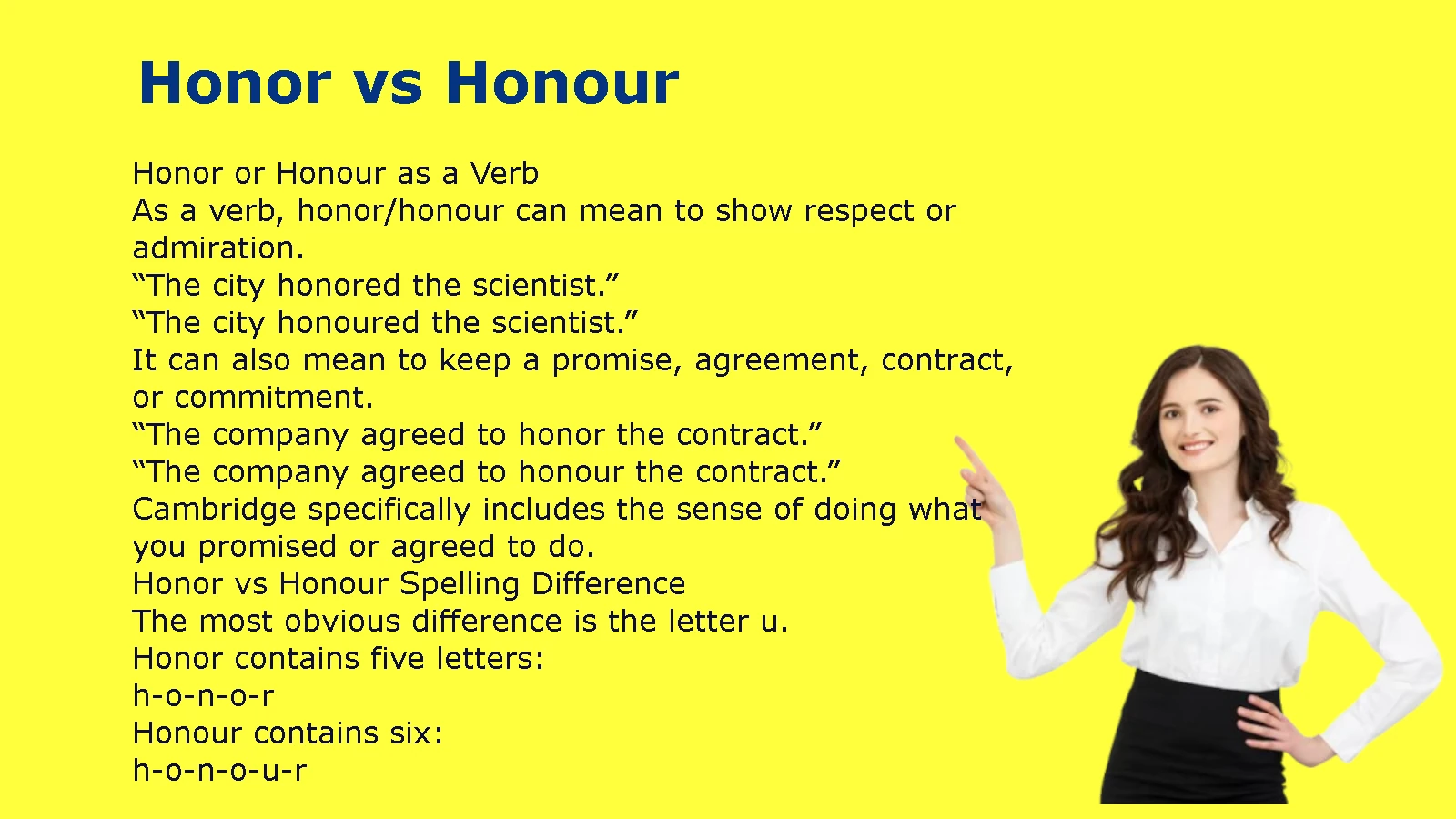
As a verb, honor/honour can mean to show respect or admiration.
- “The city honored the scientist.”
- “The city honoured the scientist.”
It can also mean to keep a promise, agreement, contract, or commitment.
- “The company agreed to honor the contract.”
- “The company agreed to honour the contract.”
Cambridge specifically includes the sense of doing what you promised or agreed to do.
Honor vs Honour Spelling Difference
The most obvious difference is the letter u.
Honor contains five letters:
h-o-n-o-r
Honour contains six:
h-o-n-o-u-r
That small difference reflects a larger pattern in English spelling.
American English commonly uses -or in several words where British English uses -our:
| American English | British English |
| color | colour |
| favor | favour |
| labor | labour |
| neighbor | neighbour |
| behavior | behaviour |
| humor | humour |
| honor | honour |
This doesn’t mean one system is better. English developed multiple standard spelling traditions, and regional dictionaries, publishers, schools, and style guides reinforce those conventions.
The Difference Extends to Related Words
The spelling change can carry through related forms.
| American English | British English |
| honor | honour |
| honored | honoured |
| honoring | honouring |
| honorable | honourable |
| dishonor | dishonour |
| dishonored | dishonoured |
| dishonoring | dishonouring |
For example:
American English:
“The organization honored the volunteers for their service.”
British English:
“The organization honoured the volunteers for their service.”
The meaning stays the same. Only the regional spelling changes.
Why Does American English Use “Honor”?
The American spelling fits a broader pattern in American English that favors -or in words that traditionally appear with -our in British English.
The distinction isn’t unique to honor. You see it in everyday words such as color/colour and favor/favour.
Over time, American English developed and standardized its own spelling conventions. Dictionaries and educational systems helped establish these forms as normal American usage.
That means honor isn’t a shortened or incorrect version of honour. It’s the established American spelling.
The same principle applies to color. An American writer doesn’t need to add the u to make the word “proper.” In American English, color is the standard form.
Why Does British English Use “Honour”?
British English generally retains the u in words ending in -our.
That gives us forms such as:
- honour
- colour
- favour
- labour
- neighbour
- humour
These spellings reflect the historical development of English and its interaction with French and Latin vocabulary.
The important point for modern writers is practical rather than historical: honour is the standard British spelling.
Cambridge identifies honour as the UK form and honor as the US form.
Honor vs Honour in American English
If you’re writing in American English, use honor.
This applies across ordinary writing as well as formal contexts.
Common American expressions
- in honor of
- on my honor
- honor roll
- honor system
- honor student
- guest of honor
- code of honor
- honor guard
- honorary degree
For example:
“The school held a ceremony in honor of its graduating students.”
A US publication would normally write honor, not honour, unless it is reproducing an official name, quotation, or source that uses the British spelling.
American examples
- “It was an honor to receive the award.”
- “The ceremony was held in honor of the retiring teacher.”
- “She graduated with honors.”
- “The university honored the professor.”
- “He kept his word and honored the agreement.”
Cambridge’s American English entry uses honor for these meanings and identifies it as the US spelling.
Honour in British English and Other Varieties
British English normally uses honour.
You’ll therefore see:
- in honour of
- on my honour
- honour roll
- honour system
- honour student
- guest of honour
- code of honour
- honoured
- honouring
For example:
“The ceremony was held in honour of the retiring teacher.”
The meaning is identical to the American version.
The spelling also appears in British institutional and academic language. For example, British English uses honours in certain educational contexts. Cambridge defines an honours degree as a university qualification at a higher level than an ordinary degree.
Honor vs Honour Pronunciation
Despite the spelling difference, honor and honour don’t represent two completely different words with unrelated pronunciations.
Pronunciation varies by accent, but dictionaries show regional differences in the vowel sound.
Cambridge gives US pronunciation as approximately /ˈɑː.nɚ/ and UK pronunciation as approximately /ˈɒn.ər/.
In simple terms, the word has roughly two syllables:
HON-er
The exact vowel quality depends on the speaker’s accent.
Does the “u” change the pronunciation?
Not in the straightforward way you might expect.
The u in honour doesn’t create an additional syllable. Both forms are pronounced as the same basic word in their respective regional accents.
So don’t assume:
honor = one pronunciation
honour = completely different pronunciation
It’s primarily a spelling distinction.
Honor vs Honour as a Noun
The noun has several important uses. Understanding them helps you recognize the word in different contexts.
Respect and Esteem
One of the most common meanings involves respect or admiration.
- “The community held him in high honor.”
- “The community held him in high honour.”
The word can describe the respect a person earns because of their actions, character, achievements, or position.
Personal Integrity
Honor/honour can also describe a person’s commitment to honesty and moral principles.
For example:
- “She acted according to her sense of honor.”
- “He was a man of honour.”
This meaning appears in expressions such as a person of honor or a matter of honor.
A Privilege
You may also use the word when something makes you feel proud or privileged.
- “It was an honor to be invited.”
- “It was an honour to be invited.”
This is particularly common in formal speeches, ceremonies, introductions, and invitations.
A Reward or Distinction
Honor/honour can refer to a public distinction given to recognize achievement or service.
For example:
- “She received one of the country’s highest civilian honors.”
- “He received several national honours.”
Cambridge lists a reward, prize, or title expressing admiration or respect as one meaning of the noun.
Honor vs Honour as a Verb
The verb is just as useful as the noun.
To Show Respect
When you honor/honour someone, you recognize or show respect for them.
- “The city honored the firefighter.”
- “The city honoured the firefighter.”
This use often appears in ceremonies and public recognition.
To Recognize an Achievement
Organizations may honor/honour people for accomplishments, service, courage, or contributions.
- “The university honored the researcher.”
- “The university honoured the researcher.”
To Keep a Promise or Agreement
This meaning is especially useful in business and legal contexts.
To honor/honour an agreement means to follow through on it.
- “The company honored the terms of the contract.”
- “The company honoured the terms of the contract.”
Cambridge specifically gives honour the meaning of doing what was promised or agreed to.
Honor vs Honour in Common Phrases
Many familiar expressions use this word. The spelling simply follows the English variety being used.
| American English | British English |
| in honor of | in honour of |
| on my honor | on my honour |
| guest of honor | guest of honour |
| code of honor | code of honour |
| honor system | honour system |
| honor roll | honour roll |
| honor student | honour student |
| honor guard | honour guard |
| badge of honor | badge of honour |
| honor-bound | honour-bound |
“In honor of” vs “In honour of”
This phrase means to show respect for or celebrate someone or something.
American English:
“The scholarship was established in honor of the professor.”
British English:
“The scholarship was established in honour of the professor.”
Cambridge defines the expression as doing something to celebrate or show great respect for someone or something.
“Your Honor” vs “Your Honour”
The spelling also changes in formal judicial address.
American English:
Your Honor
British English:
Your Honour
Cambridge identifies Your/His/Her Honour as a formal way to address or refer to a judge in British English and gives Your/His/Her Honor as the US form.
Honor vs Honour: Related Words
The same regional pattern appears in several derivatives.
| Word Type | American English | British English |
| Base noun | honor | honour |
| Past tense | honored | honoured |
| Present participle | honoring | honouring |
| Adjective | honorable | honourable |
| Opposite/negative form | dishonor | dishonour |
| Negative past tense | dishonored | dishonoured |
| Negative -ing form | dishonoring | dishonouring |
Notice the spelling of honoring/honouring carefully.
American English:
honoring
British English:
honouring
British English retains the u and uses -ouring. American English uses -oring.
Similarly:
honorable → American English
honourable → British English
Cambridge lists honourable as the UK spelling of honorable.
Honor vs Honour in Academic Writing
Choosing the right spelling matters in academic writing because consistency signals that you understand the English variety you’re using.
If your assignment follows American English, write:
- honor
- honored
- honoring
- honorable
If it follows British English, write:
- honour
- honoured
- honouring
- honourable
A simple academic rule
Follow the style guide first.
If your school, university, publisher, or instructor specifies American English, use honor.
If the required variety is British English, use honour.
Don’t switch between the two simply because you encounter both forms online.
Why consistency matters
Consider this paragraph:
“The university honored the professor in recognition of her work. The ceremony was held in honour of her achievements.”
The meaning is clear, but the spelling is inconsistent if the entire piece is supposed to follow one variety.
A consistent American version would use:
“The university honored the professor in recognition of her work. The ceremony was held in honor of her achievements.”
A consistent British version would use:
“The university honoured the professor in recognition of her work. The ceremony was held in honour of her achievements.”
That small detail can make polished writing look much more deliberate.
Honor vs Honour in Professional Writing
The same principle applies to professional communication.
If you’re writing for a US company or audience, honor will usually be the natural choice.
If you’re writing for a British audience, honour is normally appropriate.
For international publications, check the publication’s style guide. Some organizations use a particular English variety throughout their editorial content.
Examples
US professional writing:
“We are honored to welcome you to the annual conference.”
UK professional writing:
“We are honoured to welcome you to the annual conference.”
Both sentences are correct. The choice depends on the intended variety of English.
Honor vs Honour in Names and Official Text
There’s one important exception to the “pick your regional spelling” rule: official names.
Suppose an organization officially uses Honour in its name. Don’t automatically change it to Honor just because you’re writing American English.
Proper names preserve their established spelling.
The same principle applies to:
- Organization names
- Awards
- Institutions
- Titles
- Historical documents
- Quoted material
- Official program names
If you’re quoting a source, retain the source’s spelling unless your editorial rules specifically require another treatment.
In other words, don’t “correct” a proper name simply because it doesn’t match your preferred English variety.
Honor vs Honour in American and British English
Here’s the distinction at a glance:
| Feature | American English | British English |
| Noun | honor | honour |
| Verb | honor | honour |
| Past tense | honored | honoured |
| Present participle | honoring | honouring |
| Adjective | honorable | honourable |
| “In…” phrase | in honor of | in honour of |
| Judicial title | Your Honor | Your Honour |
| Basic meaning | Same | Same |
The spelling changes, but the underlying word remains the same.
Honor vs Honour vs Honorary
Honor and honour shouldn’t be confused with honorary.
Honor/Honour
These can function as nouns or verbs.
“It was an honor to attend.”
“The committee honored her work.”
Honorary
Honorary describes something given as a distinction or honor rather than as a result of performing the usual role.
Examples include:
- honorary degree
- honorary title
- honorary member
- honorary position
Interestingly, honorary is generally spelled the same in both American and British English.
So:
honorary — US
honorary — UK
But:
honorable — US
honourable — UK
That’s a useful distinction because it’s easy to assume every related word must follow the exact same spelling pattern.
Honor vs Honour: Common Mistakes
Mistake: Calling “Honour” Incorrect
If you’re writing American English, honour isn’t the standard spelling for ordinary US usage.
However, that doesn’t make the word universally wrong.
In British English, honour is the standard form. Cambridge explicitly labels it as the UK spelling.
Mistake: Calling “Honor” Incorrect
The reverse mistake happens too.
Honor isn’t a misspelling simply because it lacks the u. It’s the standard American spelling.
Mistake: Mixing the Two Forms
Switching between honor and honour in the same piece can make your writing inconsistent.
Choose one variety and stick with it.
Mistake: Changing a Proper Name
If a proper name officially contains Honour, don’t change it to Honor merely to match the surrounding text.
Official names are a different matter from ordinary spelling choices.
Mistake: Assuming the Meanings Are Different
They aren’t.
Honor and honour carry the same core meanings. The spelling signals regional English rather than a difference in definition.
Honor vs Honour Examples in Sentences
Seeing the words in context makes the distinction much easier.
American English Examples
Respect:
“The community held the teacher in high honor.”
Recognition:
“The city honored her for decades of public service.”
Privilege:
“It was an honor to speak at the ceremony.”
Celebration:
“The event was organized in honor of the school’s founder.”
Commitment:
“The company agreed to honor the original agreement.”
Academic achievement:
“She graduated with honors.”
British English Examples
Respect:
“The community held the teacher in high honour.”
Recognition:
“The city honoured her for decades of public service.”
Privilege:
“It was an honour to speak at the ceremony.”
Celebration:
“The event was organized in honour of the school’s founder.”
Commitment:
“The company agreed to honour the original agreement.”
Academic achievement:
“She graduated with honours.”
The sentences demonstrate the central rule: the meaning remains intact while the spelling changes.
Honor vs Honour: A Practical Writing Case Study
Imagine you’re writing two versions of the same school announcement.
Version for a US audience
“The school will host a ceremony in honor of students who demonstrated outstanding academic achievement. Several students will receive special honors for their contributions.”
This follows American spelling.
Version for a British audience
“The school will host a ceremony in honour of students who demonstrated outstanding academic achievement. Several students will receive special honours for their contributions.”
This follows British spelling.
Neither version is more correct. Each matches its intended variety of English.
The lesson: Don’t choose the spelling based on which version “looks right.” Choose it based on the English variety you’re using.
Honor or Honour: Which One Should You Use?
Use honor when you’re writing in American English.
Use honour when you’re writing in British English.
For other varieties, follow the local convention or the relevant style guide. Canadian, Australian, and other English varieties can use British-style -our spellings, although individual conventions can vary by word and context.
A quick decision guide helps:
| Your situation | Preferred spelling |
| US audience | honor |
| British audience | honour |
| American school assignment | honor |
| British school assignment | honour |
| US publication | honor |
| UK publication | honour |
| Official name | Keep the official spelling |
| Direct quotation | Usually preserve the original spelling |
| International publication | Follow its style guide |
When in doubt, check the style guide rather than guessing.
Honor vs Honour: Historical Background
The spelling difference has deep historical roots.
English absorbed a large amount of vocabulary from French after the Norman Conquest. Many words associated with French and Latin traditions developed spellings that later varied across English-speaking regions.
The -our/-or distinction became part of the broader divergence between British and American spelling conventions.
That history helps explain why you see pairs such as:
- colour / color
- honour / honor
- favour / favor
- labour / labor
The American forms weren’t created from scratch. They developed as part of a broader process of spelling standardization and variation.
For modern readers, however, the history matters less than the practical rule: both spellings are established English forms.
Honor vs Honour: What About “Honours” in Education?
This is an area where British English can use the word in a particularly recognizable way.
In British English, honours can refer to a level or type of university qualification.
For example:
“She graduated with a second-class honours degree.”
Cambridge lists honours as a British educational term for a university course or degree at a higher level than an ordinary degree.
American English also uses honors in education, but the educational systems and exact meanings aren’t necessarily identical.
For example, an American student might say:
“I graduated with honors.”
An American high school may also have an honor roll.
So while the spelling follows the same regional pattern, don’t assume every educational term has exactly the same institutional meaning in every country.
Honor vs Honour: Important Facts
Here are the key facts worth remembering:
- Honor is the standard American spelling.
- Honour is the standard British spelling.
- Both words have the same basic meanings.
- Both can function as nouns and verbs.
- The spelling difference extends to words such as honored/honoured.
- American English generally uses honorable.
- British English generally uses honourable.
- Honor and honour have regional pronunciation differences, but they’re not separate words.
- Honors and honours can have different educational uses depending on the country.
- Official names should retain their established spelling.
- Consistency matters in formal and academic writing.
Honor vs Honour FAQs
Is “honor” American or British?
Honor is the standard American English spelling. British English generally uses honour.
Is “honour” American or British?
Honour is the standard British English spelling. American English normally uses honor.
Are honor and honour the same word?
Yes. Honor and honour are regional spellings of the same word. Their core meanings are the same.
Why does American English spell honor without a U?
American English developed spelling conventions that use -or in several words that British English spells with -our, including color/colour, favor/favour, and honor/honour.
Why does British English spell honour with a U?
British English generally retains the -our spelling in this group of words. The spelling reflects historical English usage and later regional standardization.
Is “honour” a correct spelling?
Yes. Honour is the standard British English spelling.
Is “honor” a correct spelling?
Yes. Honor is the standard American English spelling.
Should I use honor or honour in an essay?
Use the form required by your instructor, institution, or style guide. If you’re writing in American English, use honor. If you’re writing in British English, use honour.
Is “honored” or “honoured” correct?
Both are correct in their respective varieties.
- American English: honored
- British English: honoured
Is “honoring” or “honouring” correct?
Again, both are correct regionally.
- American English: honoring
- British English: honouring
Do honor and honour have different meanings?
No. The spelling difference generally reflects the variety of English rather than a difference in meaning.
Which spelling should you use in formal writing?
Match your audience and style guide. Honor fits American English, while honour fits British English.
Honor vs Honour: Final Takeaway
The honor vs honour difference is straightforward once you know the regional rule.
Honor is the standard American English spelling, while honour is the standard British English spelling. Both refer to the same ideas, including respect, integrity, recognition, distinction, and privilege. As verbs, both can mean to show respect, recognize someone, or fulfill an obligation.
The same distinction appears in related forms such as honored/honoured, honoring/honouring, and honorable/honourable.
So, when you’re deciding between the two, don’t ask which one is “more correct.” Ask a better question: Which variety of English am I writing?
For American English, write honor.
For British English, write honour.
That one rule will keep your spelling accurate and consistent in almost every ordinary situation.