Have you ever wondered whether you should use datum vs data when talking about information or facts? These two words are closely related, but they aren’t always interchangeable. Understanding the difference can help you choose the right word for academic writing, research, reports, and everyday communication.
Datum is a singular noun that refers to a single piece of information, fact, or measurement. Data is traditionally the plural form of datum and refers to multiple pieces of information or measurements. However, in modern English, data is also commonly used as a singular mass noun, especially in technical and scientific contexts.
Examples:
- This datum supports our conclusion.
- The data show a clear trend.
The confusion is understandable. People often search for datum vs data, datum meaning, data meaning, is data singular or plural, or even what is the plural of datum because English doesn’t always follow the rules people expect. And here’s the kicker: while datum has a clear singular meaning, data can work as either plural or singular depending on the context and style of writing.
In this guide, you’ll learn the complete difference between datum vs data, including their meanings, definitions, pronunciations, plural forms, and correct usage. You’ll also see clear examples of datum and data in sentences, learn when to use each word, and discover whether data is singular or plural in modern English.
Datum vs Data at a Glance
The quickest way to understand Datum vs Data is to look at their traditional relationship:
| Word | Traditional grammatical number | Basic meaning | Example |
| datum | Singular | One fact, observation, measurement, or piece of information | One datum supports the conclusion. |
| data | Plural | More than one datum | The data support the conclusion. |
| data | Singular mass noun | Information considered as a whole | The data is stored securely. |
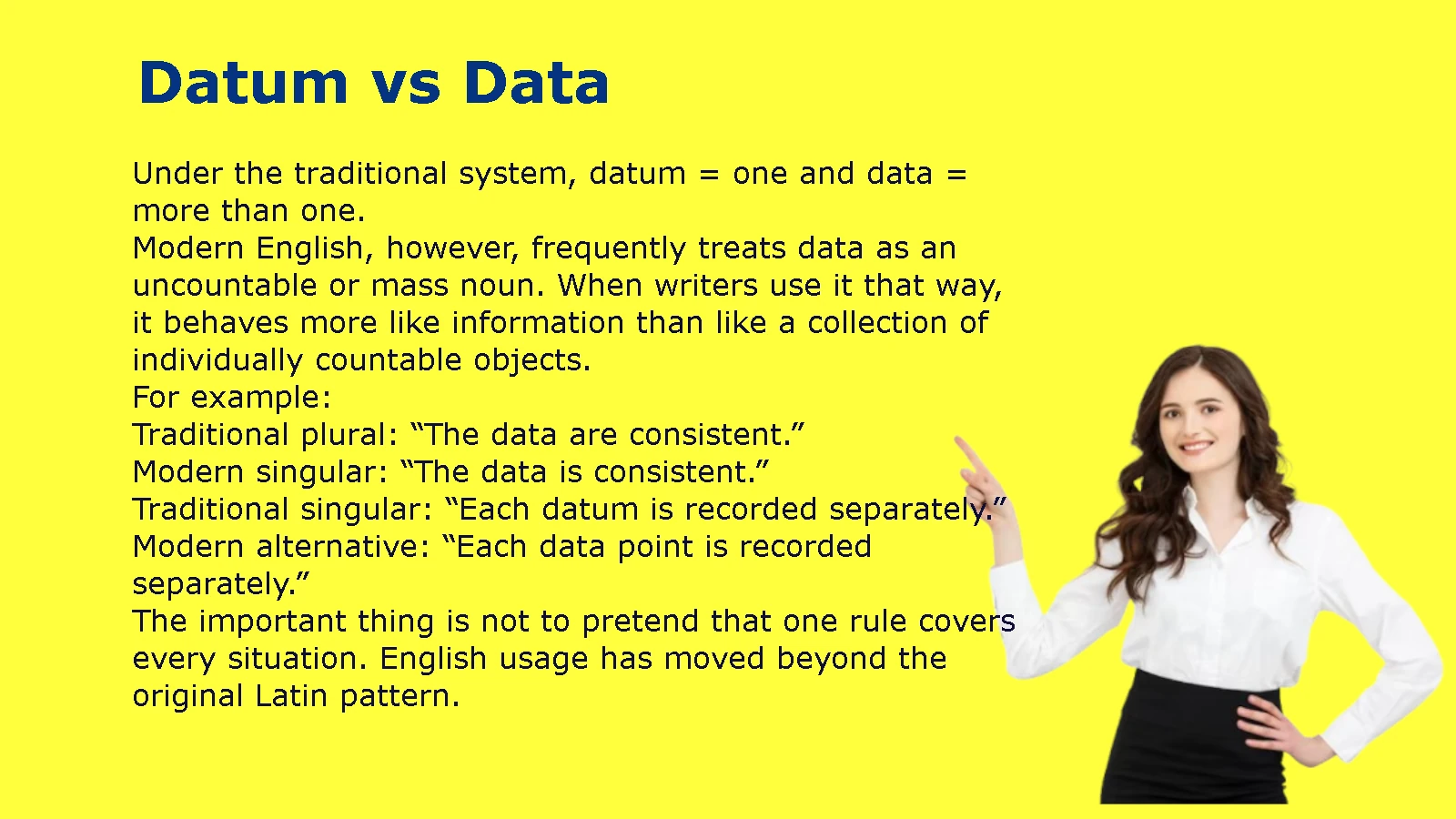
Under the traditional system, datum = one and data = more than one.
Modern English, however, frequently treats data as an uncountable or mass noun. When writers use it that way, it behaves more like information than like a collection of individually countable objects.
For example:
- Traditional plural: “The data are consistent.”
- Modern singular: “The data is consistent.”
- Traditional singular: “Each datum is recorded separately.”
- Modern alternative: “Each data point is recorded separately.”
The important thing is not to pretend that one rule covers every situation. English usage has moved beyond the original Latin pattern.
What Does Datum Mean?
Datum means a single piece of information, fact, observation, or measurement.
Oxford identifies datum as a specialist noun meaning “a fact or piece of information” and lists data as its plural.
For example:
“The researcher recorded one datum from the experiment.”
Here, datum refers to one individual piece of information.
You might also write:
- “Each datum was checked for accuracy.”
- “The datum supports the proposed explanation.”
- “One unusual datum changed the analysis.”
- “The researcher removed an unreliable datum.”
- “That datum provides useful evidence.”
Notice the verb agreement. Because datum is singular, it takes a singular verb:
“The datum is important.”
Not:
“The datum are important.”
Is Datum Common in Everyday English?
Not particularly.
Although datum is a legitimate English word, most people rarely use it in ordinary conversation. If someone says, “I found an interesting datum,” the sentence sounds formal or technical.
In many situations, English speakers prefer expressions such as:
- data point
- piece of data
- piece of information
- fact
- measurement
- observation
For example, instead of:
“This datum is unusual.”
a general audience may find this more natural:
“This data point is unusual.”
That doesn’t make datum incorrect. It simply reflects how modern English normally communicates the idea.
Datum in Technical Contexts
Datum has another important meaning in specialized fields.
In mathematics, surveying, geography, engineering, and measurement, a datum can serve as a reference point, reference line, reference surface, or basis for measurement. Merriam-Webster lists this specialized meaning separately and notes that datums can be used as the plural in this sense.
That creates an important distinction:
- datum → data when referring to a piece of information
- datum → datums in certain specialized measurement contexts
For example:
“The survey uses multiple horizontal datums.”
Here, datums refers to reference systems or bases for measurement rather than individual pieces of information.
That specialized meaning is easy to miss if you learn datum only as “the singular of data.”
What Does Data Mean?
Data refers to factual information, measurements, observations, statistics, or information in digital form.
Merriam-Webster defines data as factual information used for reasoning, discussion, or calculation. It also includes information in digital form that can be transmitted or processed.
Examples include:
- survey responses
- medical measurements
- financial figures
- sales records
- scientific observations
- customer information
- computer files
- website analytics
- sensor readings
- experimental results
For example:
“The company analyzed customer data before changing its pricing strategy.”
Here, data refers to a collection of information.
Data as a Traditional Plural
Historically, data is the plural of datum.
That gives us the traditional pattern:
- one datum
- two data
- one observation = one datum
- several observations = data
Under this system, plural verbs and pronouns follow data:
“The data show a clear trend.”
“The data were collected over six months.”
“These data support the hypothesis.”
This construction remains especially common in scientific and formal writing.
Oxford still identifies data as a plural form in technical English when datum is used as the singular.
Can Data Be Singular?
Yes.
This is where the Datum vs Data debate gets interesting.
Modern English often treats data as a mass noun, meaning information considered collectively rather than as individually countable pieces.
Think about the word information.
You normally say:
“The information is useful.”
You don’t usually say:
“The information are useful.”
When data functions in a similar way, singular agreement sounds natural:
“The data is useful.”
“The data shows a clear pattern.”
Merriam-Webster specifically recognizes this singular use and explains that data can function like information when it refers to a body or collection of information.
This is why the statement “data is always plural” is too absolute for modern English.
It describes the traditional grammatical pattern. It does not describe all current usage.
Data Is vs. Data Are: Which Is Correct?
Both data is and data are appear in standard English.
The better choice depends on how data functions in the sentence.
Use Data Is When Data Means Information Collectively
When data refers to information as a whole, singular agreement is common:
- “The data is available online.”
- “The data is incomplete.”
- “The data shows a strong relationship.”
- “This data is useful for the analysis.”
- “The data was collected from several sources.”
Here, data behaves much like information.
You aren’t necessarily thinking about hundreds of separate pieces. You’re treating the information as one body.
Use Data Are When Data Means Individual Observations
In scientific, statistical, and formal contexts, writers often preserve the traditional plural:
- “The data are consistent with the hypothesis.”
- “The data show a significant difference.”
- “These data support the conclusion.”
- “The data were collected during the experiment.”
- “The data indicate a relationship between the variables.”
Here, the writer is treating the observations or measurements as separate units.
A Simple Test
Ask yourself:
Am I thinking of data as one body of information or as individual observations?
If you mean information collectively, data is may be appropriate.
If you mean separate observations, measurements, or results, data are may be appropriate.
This isn’t a perfect test because style guides can impose their own rules. Still, it gives you a useful starting point.
Why Do People Disagree About Data Is and Data Are?
The disagreement comes from two different systems operating in English.
The first system follows the original Latin relationship:
datum → data
Under this approach, datum is singular and data is plural.
The second system treats data as a modern English mass noun. Under this approach, data behaves like information, evidence, or research.
Both systems have strong usage traditions.
Merriam-Webster describes data as “plural in form but singular or plural in construction.”
That description captures the modern situation neatly.
The debate isn’t really about whether speakers have forgotten Latin. It’s about how English has absorbed and adapted a Latin-derived word over time.
Datum vs Data in Scientific Writing
Scientific writing is one of the places where the traditional distinction remains especially visible.
A scientific paper may use datum for one individual observation and data for multiple observations.
For example:
“Each datum was entered into the statistical model.”
Then:
“The data were analyzed using regression analysis.”
This system makes the relationship between individual observations and the complete collection explicit.
Why Scientists May Prefer the Plural
Scientific work often deals with observations as individual units.
Imagine an experiment measuring plant growth.
Each measurement might contain:
- plant identification
- height
- temperature
- light exposure
- measurement time
Each individual observation can be treated as a separate piece of data. Collectively, those observations form a dataset.
A formal scientific writer might therefore write:
“The data were collected at weekly intervals.”
The plural emphasizes the multiple observations.
Scientific Style Is Not Universal
Even in technical fields, you shouldn’t assume every organization uses data in exactly the same way.
Some style guides require plural agreement. Others accept or prefer singular agreement.
For example, Microsoft’s current style guidance tells technical writers to use data as both singular and plural, while also recommending a singular verb and advising writers not to use datum.
That means a Microsoft style guide user would write:
“The data shows that 95 percent of users prefer a graphical interface.”
rather than:
“The data show that 95 percent of users prefer a graphical interface.”
By contrast, other academic and scientific style traditions continue to favor plural agreement.
The lesson is simple: follow the style guide that governs your publication.
Datum vs Data in Technology and Computing
Technology has strongly influenced the modern use of data.
In computing, data commonly means information stored, transmitted, processed, or analyzed by a computer system.
Examples include:
- user data
- customer data
- application data
- database data
- personal data
- website data
- sensor data
- training data
- transaction data
In this context, singular data is extremely natural:
“The data is encrypted.”
“The data is stored in the cloud.”
“User data is protected by access controls.”
Microsoft’s style guide explicitly recommends using data as singular and plural and says technical writers should not use datum.
This reflects an important shift. Modern technology writing usually isn’t interested in preserving the Latin singular/plural relationship. It treats data as a general mass of information.
Why “Datum” Sounds Unusual in Technology
Imagine someone saying:
“The application received one datum from the server.”
The sentence isn’t necessarily impossible. It simply sounds unusually formal.
A developer would more likely write:
“The application received one data point.”
or:
“The application received one piece of data.”
In everyday technical communication, those alternatives are clearer.
Datum vs Data vs. Data Point
These three terms overlap, but they aren’t interchangeable in every situation.
| Term | Meaning | Typical use |
| datum | One piece of information or one observation | Formal or specialized writing |
| data | Information collectively or multiple observations | General, technical, scientific, and business writing |
| data point | One specific observation or measurement within a dataset | Statistics, analytics, research, charts |
Suppose a survey collects 10,000 responses.
The data could refer to all 10,000 responses collectively.
A single response could be described as a data point.
You could technically call that individual item a datum, but data point will usually sound more natural to a broad audience.
Why Data Point Is Often Better
The phrase data point removes ambiguity.
Compare:
“The analyst removed one datum.”
with:
“The analyst removed one data point.”
The second sentence immediately tells most readers what happened.
That clarity matters in business reports, journalism, marketing, dashboards, and general web content.
What Is the Plural of Datum?
The traditional plural of datum is data.
So:
- one datum
- two data
- several data
- many data
However, English also uses datums in certain specialized contexts.
Merriam-Webster lists data as the plural of datum in its information-related sense and datums in mathematics for things used as a basis for calculating or measuring.
That distinction is worth remembering.
Information Context
“The researcher recorded several data.”
This follows the traditional Latin-based system, although many modern writers would instead say:
“The researcher recorded several data points.”
or:
“The researcher recorded several pieces of data.”
Measurement Context
“The engineers compared the two datums.”
Here, datums can refer to reference systems or measurement bases.
So data isn’t the only possible plural of datum. Context determines which plural makes sense.
What Is the Singular of Data?
Traditionally, the singular of data is datum.
For example:
“One datum was missing from the dataset.”
But this doesn’t mean you should automatically replace every instance of data with datum when discussing one item.
Modern English offers more natural alternatives:
- a datum
- a data point
- a piece of data
- a piece of information
- an observation
- a measurement
- a result
For general audiences, data point or piece of data often communicates the idea more naturally.
The key distinction is between grammatical history and modern usage.
Historically:
datum → data
Modern English:
data → often used as a mass noun
Both facts matter.
Can You Say “A Data”?
Usually, no.
A data is not the normal way to express one piece of information in standard English.
Instead, use:
- a datum
- a data point
- a piece of data
- a piece of information
For example:
❌ “The analyst found a data that didn’t match the others.”
Better:
✅ “The analyst found a data point that didn’t match the others.”
Or:
✅ “The analyst found a piece of data that didn’t match the others.”
Or, in formal usage:
✅ “The analyst found a datum that didn’t match the others.”
The last option is grammatically traditional but may sound more technical than necessary.
Can You Say “Five Data”?
This depends on the style and intended meaning.
In careful modern writing, five data points or five pieces of data is usually clearer than five data.
For example:
❌ “The survey produced five data.”
Better:
✅ “The survey produced five data points.”
Or:
✅ “The survey produced five pieces of data.”
A professional writing guide from the Canadian Institutes of Health Research similarly advises against using a number directly as a modifier for data and recommends expressions such as “five pieces of data.”
This is especially useful when writing for a general audience.
Common Mistakes With Datum and Data
Mistake: Treating Datum as Plural
Incorrect:
“The datum are important.”
Correct:
“The datum is important.”
Datum is singular when it means one piece of information.
Mistake: Assuming Data Must Always Be Plural
The traditional rule says data is plural.
Modern English says something more complicated.
Merriam-Webster recognizes both singular and plural constructions.
Therefore:
“The data are compelling.”
can be correct.
So can:
“The data is compelling.”
The appropriate choice depends on context and style.
Mistake: Writing “This Data Are”
This sentence mixes singular and plural forms:
“This data are important.”
If data is plural, use these:
“These data are important.”
If data is singular, use this:
“This data is important.”
The important thing is agreement within the sentence.
| If you use | Pair it with |
| this data | is / shows / was |
| these data | are / show / were |
| the data | is or are, depending on usage |
| each datum | is / shows / was |
| each data point | is / shows / was |
Mistake: Thinking “Data Is” Is Always Wrong
This is one of the most common oversimplifications.
Modern dictionaries recognize singular data. Merriam-Webster describes singular use as especially common when data functions as a mass noun.
So don’t automatically “correct” every instance of data is.
Instead, ask what the writer means and which style the document follows.
Mistake: Using Datum When Data Point Is Clearer
A word can be technically correct and still be a poor choice.
For a general audience:
“The chart contains 500 data points.”
is usually easier to understand than:
“The chart contains 500 data.”
The goal of good writing isn’t to sound more scholarly than necessary. It’s to communicate accurately and clearly.
Datum vs Data in Academic Writing
Academic writing deserves special attention because expectations can vary between disciplines.
A research paper in statistics may preserve plural data:
“The data were analyzed using a linear regression model.”
A technology paper or general academic document may use singular data:
“The data was collected from several online sources.”
Neither sentence should be judged in isolation without considering the publication’s style.
Follow the House Style
If a journal says to treat data as plural, use plural agreement throughout.
If an organization treats data as singular, follow that convention.
Consistency matters.
A document that switches randomly between:
“The data is…”
and:
“The data are…”
without a reason can look careless.
A consistent style makes the writing easier to trust.
Datum vs Data in Business Writing
Business writing usually favors clarity over grammatical history.
You will commonly see phrases such as:
- customer data
- sales data
- financial data
- market data
- employee data
- performance data
- business data
Singular agreement often sounds natural:
“The sales data shows that demand increased in July.”
“Customer data is stored in the company database.”
For a general business audience, this approach is often more accessible than insisting on the traditional plural.
However, if a business follows a formal editorial style that requires plural agreement, use that style instead.
Datum vs Data in Everyday English
In ordinary conversation, data is far more common than datum.
People regularly say:
- “We need more data.”
- “The data doesn’t support that idea.”
- “Can you send me the data?”
- “The data shows a decline.”
- “This data is useful.”
They rarely say:
- “We need another datum.”
- “That datum proves the point.”
The second group isn’t automatically wrong. It simply belongs to a more formal or specialized register.
If you want natural modern English, data will usually be the better choice.
A Practical Case Study: Research Data
Imagine a researcher studies 1,000 customers.
Each customer provides:
- age
- location
- purchase frequency
- average order value
- product preferences
The researcher now has a large collection of information.
The collection is data.
If the researcher wants to discuss one specific observation, several choices are available:
“One datum was missing.”
“One data point was missing.”
“One piece of data was missing.”
All three communicate the basic idea, but they don’t have the same tone.
Datum sounds formal and technical.
Data point sounds precise and familiar in analytical contexts.
Piece of data sounds straightforward and accessible.
For most modern readers, data point is likely to be the clearest option.
A Practical Case Study: Computer Data
Consider an online store with millions of customer records.
The company might store:
- names
- email addresses
- purchase histories
- browsing activity
- product preferences
- transaction records
A technical writer might say:
“The customer data is stored securely.”
That sentence treats data as a collective body of digital information.
Microsoft’s style guidance follows this singular approach and recommends singular verbs with data.
Calling every individual record a datum would add unnecessary formality.
In this context, data is the natural word.
A Practical Case Study: Scientific Measurements
Now imagine a laboratory records the temperature of a chemical reaction every minute for two hours.
The experiment generates 120 measurements.
A scientific writer who follows the traditional plural system might write:
“The data were collected at one-minute intervals.”
If discussing one measurement:
“One datum was excluded because the sensor malfunctioned.”
Or, for a broader audience:
“One data point was excluded because the sensor malfunctioned.”
This example shows why the traditional distinction still has practical value. The researcher can distinguish one observation from the collection of observations.
How to Choose Between Datum and Data
Use this quick guide when you’re writing.
Choose Datum When:
- You mean one individual piece of information.
- You’re writing in a formal or specialized context.
- The traditional singular/plural distinction matters.
- You’re discussing a single observation or measurement.
- You’re working in a field where datum has a specific technical meaning.
Example:
“Each datum was independently verified.”
Choose Data When:
- You mean information generally.
- You mean multiple observations or measurements.
- You’re discussing digital information.
- You’re writing about databases or computing.
- You’re writing for a general audience.
- You mean a collection of facts or measurements.
Examples:
“The data is stored securely.”
“The data are consistent with the hypothesis.”
Choose Data Point When:
- You mean one individual observation.
- You want maximum clarity.
- You’re writing for a general or business audience.
- You’re discussing statistics, charts, analytics, or experiments.
Example:
“The analyst removed one unusual data point.”
Datum vs Data: Quick Grammar Rules
Keep these rules handy:
- Datum is traditionally singular.
- Data is traditionally plural.
- Data can also function as a singular mass noun.
- Data is is common in general and technology writing.
- Data are remains common in scientific and formal writing.
- A datum means one piece of information.
- A data point is often a clearer modern alternative to datum.
- A data is generally not standard for one item.
- Five data is usually less clear than five data points or five pieces of data.
- Datums can be the plural of datum in specialized measurement contexts.
- Follow the style guide of the publication, organization, or field you’re writing for.
Datum vs Data: A Grammar Comparison Table
| Question | Answer |
| What is the singular of data? | Traditionally datum |
| What is the plural of datum? | Traditionally data |
| Can data be singular? | Yes |
| Is “data is” correct? | Yes, when data functions as a singular mass noun or when the applicable style permits it |
| Is “data are” correct? | Yes, when data functions as a plural noun |
| Is “datum is” correct? | Yes |
| Is “datum are” correct? | No |
| Is “a data” correct? | Generally no |
| Is “a datum” correct? | Yes, in formal or specialized usage |
| Is “a data point” correct? | Yes |
| Can “datums” be a plural? | Yes, especially in specialized measurement contexts |
The History Behind Datum and Data
The difference between the words becomes easier to understand once you know their origin.
Datum comes from Latin and literally relates to something “given.” Merriam-Webster traces the English noun to Latin, while Oxford gives the same basic origin and connects it with the Latin verb meaning “to give.”
Latin nouns had grammatical gender and number systems that English no longer uses in the same way.
English borrowed datum as a singular noun and data as its plural.
That pattern resembles other Latin-derived pairs:
- criterion → criteria
- phenomenon → phenomena
- medium → media
- bacterium → bacteria
- datum → data
But borrowed words don’t always remain frozen in their original grammatical form.
English frequently reshapes borrowed words to fit ordinary usage.
That’s what happened with data.
Instead of always treating it as a plural collection of individual data, many English speakers began treating it as a collective mass of information.
The result is today’s flexible usage.
Why Data Behaves Like Information
Consider these two sentences:
“The information is useful.”
“The data is useful.”
They work in a similar way.
In both cases, the writer sees the noun as a body of information rather than a collection of individually counted objects.
Now compare:
“The measurements are useful.”
Here, the individual measurements are clearly countable.
This gives you a useful conceptual distinction:
Mass view:
“The data is useful.”
Individual view:
“The data are useful.”
The grammatical difference reflects how the writer conceptualizes the noun.
This is one reason the debate isn’t solved simply by memorizing “data is plural.”
What Major Style Guides Say
Style guidance isn’t completely uniform.
That fact matters because writers often encounter conflicting advice.
| Source or context | General approach |
| Merriam-Webster | Recognizes singular and plural data |
| Oxford | Recognizes plural data in technical English while also showing uncountable use |
| Microsoft Style Guide | Uses data as singular and plural but recommends singular verbs |
| Some scientific styles | Prefer plural data |
| General modern usage | Frequently treats data as singular |
Merriam-Webster’s current dictionary explicitly labels data as “singular or plural in construction.”
Microsoft takes a much more prescriptive technical approach and instructs writers to use a singular verb with data.
Oxford’s learner dictionaries show both the technical plural relationship and common uncountable usage.
So if two editors give different answers, that doesn’t necessarily mean one of them misunderstands English. They may be following different editorial traditions.
A Note on Consistency
Suppose an article begins with:
“The data are compelling.”
Later, it says:
“The data is stored in the database.”
That shift may confuse readers if nothing explains it.
A better approach is to establish a consistent house style.
For example, an organization might decide:
Use data as singular in all general and technical content.
Another organization might decide:
Treat data as plural in scientific and academic writing.
Both approaches can work when applied consistently.
Consistency is particularly important in:
- academic papers
- scientific reports
- technical manuals
- research documentation
- corporate style guides
- books
- websites
- educational materials
Frequently Asked Questions About Datum vs Data
Is datum singular or plural?
Datum is singular. Traditionally, it means one piece of information, fact, observation, or measurement.
Example:
“The datum is accurate.”
Is data the plural of datum?
Yes. Data is traditionally the plural of datum.
However, modern English also uses data as a singular mass noun.
Is data singular or plural?
It can be either.
In traditional scientific or formal usage, data often takes plural verbs:
“The data are reliable.”
In modern general and technical usage, data often takes singular verbs:
“The data is reliable.”
Merriam-Webster recognizes both constructions.
Should you say data is or data are?
Both can be correct.
Use data is when data functions as a singular mass noun or when your style guide requires singular agreement.
Use data are when data functions as a plural noun referring to individual observations, especially in scientific or formal writing.
Is “a datum” grammatically correct?
Yes.
A datum means one piece of information in the traditional system.
However, the word can sound formal or technical. A data point may be more natural for many audiences.
Is “a data” correct?
Generally, no.
Use a datum, a data point, or a piece of data instead.
What is the plural of datum?
The traditional plural is data.
In specialized measurement contexts, datums is also used.
Is data point the same as datum?
They can refer to similar things when datum means one piece of information or one observation.
However, data point is generally more familiar in modern English, especially in statistics, analytics, business, and research.
Is data always plural?
No.
Although data originated as the plural of datum, modern English commonly uses it as a singular mass noun.
Which is more common: datum or data?
Data is far more common.
Modern English uses data across science, technology, business, education, government, computing, and everyday discussion.
Datum survives mainly in formal, academic, scientific, mathematical, and specialized contexts.
Can you say “these data”?
Yes.
These data is correct when data functions as a plural noun.
Example:
“These data show a relationship between the variables.”
Can you say “this data”?
Yes.
This data is correct when data functions as a singular mass noun.
Example:
“This data shows a relationship between the variables.”
The choice depends on the grammatical system you’re using.
Datum vs Data: The Bottom Line
The traditional distinction is straightforward:
Datum is singular.
Data is plural.
One datum represents one piece of information. Multiple pieces traditionally form data.
Modern English, however, doesn’t always preserve that Latin-based distinction. Data also functions as a singular mass noun, particularly in general, business, technology, and computing contexts. Major dictionaries recognize both singular and plural constructions.
That means both of these can be correct:
The data are convincing.
The data is convincing.
The first treats data as plural. The second treats it as a collective mass noun.
When you need to refer to one individual observation, data point is often the clearest modern choice. If you’re writing in a formal field that preserves the traditional distinction, datum remains perfectly valid.
The best rule isn’t simply “datum is singular and data is plural.” A better rule is:
Understand the traditional distinction, recognize modern usage, and follow the style appropriate to your audience.
Once you know whether you’re talking about one observation, several observations, or information as a whole, choosing between datum and data becomes much easier.