Quick Answer: Counseled or Counselled?
Counseled and counselled are both correct spellings. The difference is mainly regional: counseled is the standard spelling in American English, while counselled is commonly used in British English and other varieties of English.
The main difference is the number of l’s:
C-O-U-N-S-E-L-E-D → counseled
C-O-U-N-S-E-L-L-E-D → counselled
Unlike a simple spelling mistake, counselled is not an incorrect form of counseled. Both spellings represent the past tense and past participle of the verb counsel, but the preferred form depends on the variety of English being used.
The verb counsel means to give advice, guidance, or recommendations, especially about a serious personal, professional, or legal matter. It can also refer to advising someone about a particular course of action.
| Spelling | Usage | Meaning |
| counseled | Standard American English | Advised or gave guidance |
| counselled | Standard British English and other varieties | Advised or gave guidance |
So, if you’re deciding between counseled vs counselled, use counseled in American English and counselled in British English. Both spellings are correct, so the key is to follow the English variety you’re using consistently.
Quick Comparison of Counseled and Counselled
| Feature | Counseled | Counselled |
| Main spelling convention | American English | British English |
| Base verb | counsel | counsel |
| Past tense | counseled | counselled |
| Past participle | counseled | counselled |
| Meaning | advised or guided | advised or guided |
| Pronunciation | Generally the same | Generally the same |
| Related noun | counselor | counsellor |
| Related -ing form | counseling | counselling |
Cambridge likewise identifies counselled as the past simple and past participle of counsel, while its American English entries use counseled.
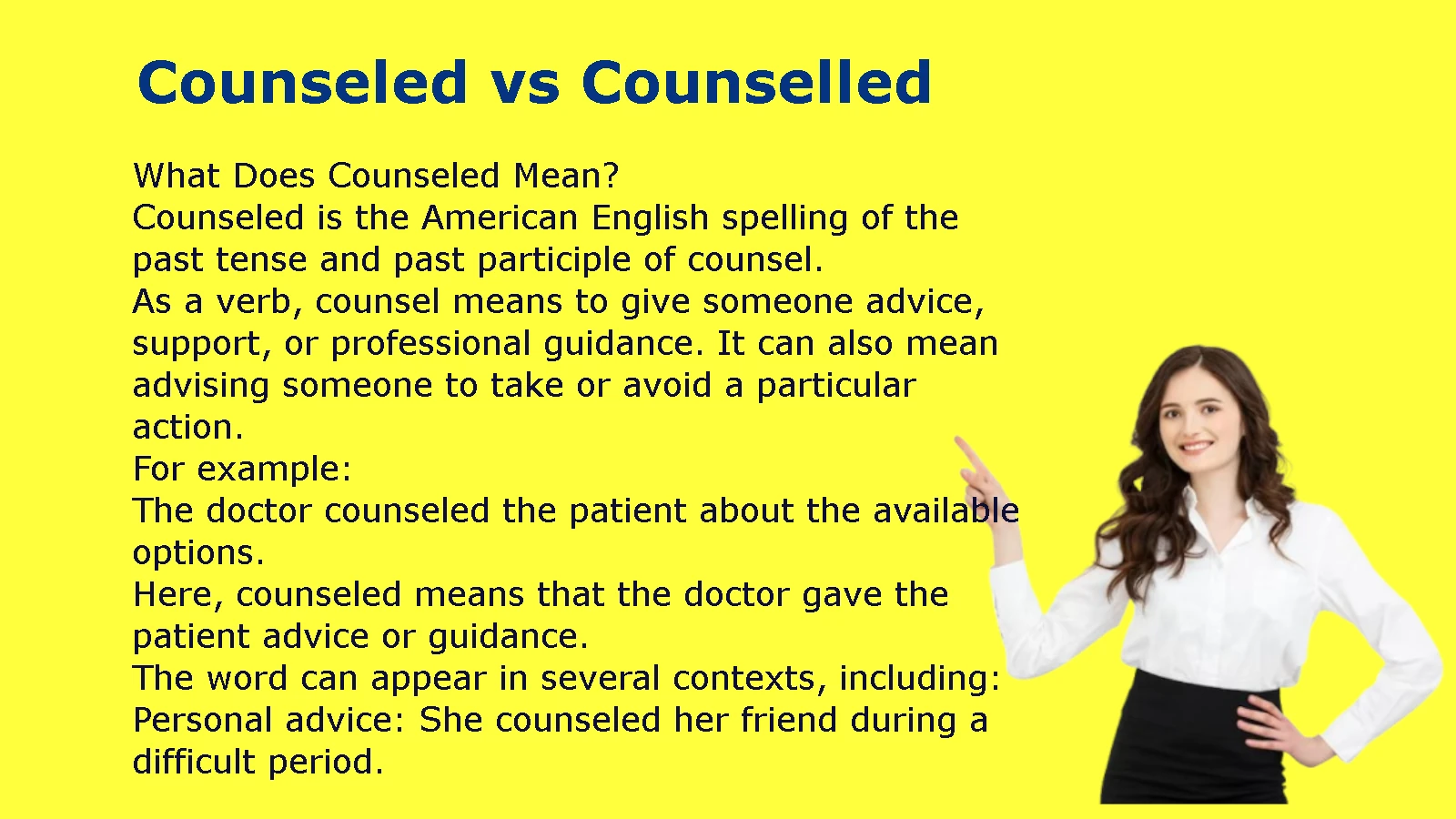
What Does Counseled Mean?
Counseled is the American English spelling of the past tense and past participle of counsel.
As a verb, counsel means to give someone advice, support, or professional guidance. It can also mean advising someone to take or avoid a particular action.
For example:
The doctor counseled the patient about the available options.
Here, counseled means that the doctor gave the patient advice or guidance.
The word can appear in several contexts, including:
- Personal advice: She counseled her friend during a difficult period.
- Professional guidance: The adviser counseled employees about retirement planning.
- Education: The school counselor counseled students about college applications.
- Legal advice: The attorney counseled the client before the hearing.
- Therapy: The therapist counseled the couple.
- Formal advice: Experts counseled caution before making the decision.
Oxford defines the verb counsel as listening to someone and giving support or professional advice, and it also records the more formal sense of advising someone to do something.
Counseled as a Past-Tense Verb
When counseled describes an action that happened in the past, it functions as the past tense of counsel.
Examples:
- The teacher counseled the student about her options.
- The lawyer counseled his client before the trial.
- The manager counseled the employee about the problem.
- The doctor counseled the family about the treatment.
- Her mentor counseled her to wait before accepting the offer.
In each sentence, the counseling or advice happened in the past.
Counseled as a Past Participle
Counseled can also function as a past participle.
For example:
- The employee had been counseled about the policy.
- Several students were counseled before choosing their courses.
- She had previously been counseled by an experienced adviser.
The exact grammatical role depends on how the word appears in the sentence.
What Does Counselled Mean?
Counselled has the same basic meaning as counseled, but it is the spelling normally associated with British English.
Cambridge defines counselled as the past simple and past participle of counsel. Its examples include contexts involving patients, students, officials, and people receiving advice.
For example:
- The doctor counselled the patient about the procedure.
- The teacher counselled the student about her career.
- The solicitor counselled his client before the hearing.
- The adviser counselled the organization to reconsider its approach.
The meaning is the same as in the American spelling.
Why Does Counselled Have Two L’s?
The additional l reflects a British spelling convention used in certain words when suffixes are added.
Compare:
- counsel → counselled
- counselling
- counsellor
American English generally uses:
- counsel → counseled
- counseling
- counselor
The difference is therefore part of a broader spelling pattern rather than a difference in pronunciation or definition.
Counseled vs Counselled in American and British English
The easiest way to choose between the two spellings is to consider which English variety your writing follows.
Counseled in American English
American English normally uses counseled.
Examples include:
- The therapist counseled the couple.
- The school counselor counseled several students.
- The attorney counseled his client.
- The financial adviser counseled the family about retirement.
- The doctor counseled the patient about lifestyle changes.
Oxford’s American English dictionary gives counseled as the past simple and counseling as the -ing form.
This spelling is therefore appropriate when following standard American English usage.
Counselled in British English
British English normally uses counselled.
Examples include:
- The therapist counselled the couple.
- The school counsellor counselled several students.
- The solicitor counselled his client.
- The adviser counselled the family.
- The doctor counselled the patient about the risks.
Cambridge’s entries show the British pattern with counselled and counselling.
The same spelling distinction appears in the related noun counsellor, which Cambridge identifies as the UK spelling of American counselor.
Is Counseled or Counselled Correct?
Both are correct.
The important point is that correctness depends on the English variety being followed.
Use counseled in standard American English.
Use counselled in standard British English.
Calling one spelling simply “wrong” misses the regional distinction.
For example, an American publication might write:
The counselor counseled the student.
A British publication might write:
The counsellor counselled the student.
Both sentences are grammatically valid.
The most important rule is consistency. If a document follows American English, use the American spelling throughout. If it follows British English, use the British spelling throughout.
Which Spelling Should You Use?
| If you are writing for… | Preferred spelling |
| United States readers | counseled |
| British readers | counselled |
| A US academic publication | counseled, unless its style guide says otherwise |
| A British publication | counselled, unless its style guide says otherwise |
| A company with an established house style | Follow its style guide |
| A document mixing US and UK audiences | Choose a consistent house style |
A publication’s own style guide can override a general regional preference, so professional writers should follow the applicable editorial rules.
Counseled vs Counselled Examples
The clearest way to understand the difference is to compare the two spellings in equivalent sentences.
Examples With Counseled
Here are examples using the American spelling:
- The school counselor counseled the student about her career options.
- The therapist counseled the couple during several sessions.
- The lawyer counseled his client before the interview.
- The doctor counseled the patient about possible lifestyle changes.
- Her mentor counseled her to consider the offer carefully.
- The financial adviser counseled the family about retirement planning.
- The manager counseled the employee about the company’s policies.
- The professor counseled the student against dropping the course.
- The organization counseled employees on workplace safety.
- The adviser counseled caution before the company invested.
Examples With Counselled
The same ideas can be written with the British spelling:
- The school counsellor counselled the student about her career options.
- The therapist counselled the couple during several sessions.
- The solicitor counselled his client before the interview.
- The doctor counselled the patient about possible lifestyle changes.
- Her mentor counselled her to consider the offer carefully.
- The financial adviser counselled the family about retirement planning.
- The manager counselled the employee about the company’s policies.
- The professor counselled the student against dropping the course.
- The organization counselled employees on workplace safety.
- The adviser counselled caution before the company invested.
Notice that the meaning remains unchanged. The spelling changes because the surrounding English variety changes.
Counseled vs Counselled Pronunciation
Counseled and counselled are generally pronounced the same way.
Oxford gives the past forms as approximately /ˈkaʊnsəld/. Its American English entry likewise gives the past form counseled with the same pronunciation pattern.
The extra l in counselled does not normally create an additional syllable.
This is important because English spelling often contains letters that do not correspond to a separate sound.
Therefore:
- counseled and counselled have the same basic pronunciation.
- The spelling difference is not a pronunciation difference.
- You should not pronounce the second l as a separate sound.
The base verb counsel is also pronounced with two syllables, and the past forms do not gain another syllable simply because British English doubles the l.
Counsel, Counseled, and Counseling: How Are They Related?
Understanding the base word makes the spelling difference much easier to remember.
The word family includes:
| Form | American English | British English |
| Base verb | counsel | counsel |
| Past tense | counseled | counselled |
| Past participle | counseled | counselled |
| -ing form | counseling | counselling |
| Person | counselor | counsellor |
Cambridge lists counseling as the US form and counselling as the mainly UK form.
Oxford similarly identifies counselling as the British form and counseling as the US form.
What Does Counsel Mean?
Counsel can be a verb or a noun.
As a verb, it means to give advice, guidance, or support, or formally, to advise someone to take a particular course of action.
For example:
The adviser counseled the company to delay the launch.
As a noun, counsel can mean advice or, particularly in legal contexts, a lawyer or lawyers representing someone.
Oxford gives both the advice-related and legal meanings of the noun.
Examples:
- She sought counsel from an experienced mentor.
- The defendant was represented by legal counsel.
- His counsel was to wait before making a decision.
What Is Counseling?
Counseling is the American spelling.
It refers to the process or work of giving advice and support, particularly in professional or personal settings.
For example:
- The university offers career counseling.
- The couple began marriage counseling.
- The patient was referred for professional counseling.
Cambridge defines counseling as the job or process of listening to someone and giving advice about problems.
The British spelling is counselling.
So the pattern is consistent:
American English
- counseled
- counseling
- counselor
British English
- counselled
- counselling
- counsellor
Why Does American English Use Counseled but British English Use Counselled?
The difference comes from established spelling conventions in the two varieties of English.
British English commonly doubles a final consonant in certain words when adding suffixes, while American English has adopted different conventions in a number of cases.
The important point is not to treat this as a universal rule that applies to every word.
English spelling contains many historical patterns and exceptions. The safest approach is to learn the conventional form for the particular word.
With counsel, the standard contrast is:
US: counseled
UK: counselled
The same distinction appears in the related forms counseling/counselling and counselor/counsellor. Cambridge explicitly labels counsellor as mainly UK and counselor as the usual US form.
The Pattern Is Easier to Remember as a Word Family
Instead of memorizing only one spelling, learn the complete set.
American English:
- counsel
- counseled
- counseling
- counselor
British English:
- counsel
- counselled
- counselling
- counsellor
This approach reduces the chance of mixing spelling systems within the same document.
Common Mistakes With Counseled and Counselled
Using Counseled in British English
Using counseled in British English does not change the meaning of the word, but it may conflict with the spelling convention expected by a British publication or institution.
If your document consistently follows British English, counselled is normally the better choice.
For example:
British style:
The counsellor counselled the student about her options.
Mixing styles could produce:
The counsellor counseled the student about her options.
The sentence is understandable, but it combines the British counsellor with the American counseled.
That inconsistency is easy to avoid.
Using Counselled in American English
The reverse problem can occur in American English.
An American document would normally use:
The counselor counseled the student.
rather than:
The counsellor counselled the student.
Again, the issue is not meaning. It is consistency with the selected spelling convention.
Confusing Counsel With Council
One of the most important related spelling problems is counsel vs council.
These words are pronounced differently and have different meanings.
Counsel relates to advice or legal representation.
Council refers to an organized group, especially one involved in government or administration.
Oxford notes that counsel can mean advice or a lawyer or group of lawyers representing someone in court.
Compare:
- She sought legal counsel.
- The city council approved the proposal.
Remembering this distinction helps prevent a separate but common spelling error.
Counsel vs Council: Examples
| Word | Meaning | Example |
| Counsel | Advice or guidance | She asked her mentor for counsel. |
| Counsel | Lawyer or legal representation | The defendant consulted legal counsel. |
| Council | Organized governing or advisory body | The city council met on Tuesday. |
| Council | Group established for a particular purpose | The student council organized the event. |
A useful memory trick is to associate council with a group.
For example:
The city council voted on the proposal.
Associate counsel with advice:
The lawyer provided counsel.
The two words have related historical origins, but their modern meanings and uses are different.
Counseled vs Counselled in Formal Writing
Both spellings can appear in formal writing. The appropriate choice depends on the English variety and the style requirements of the publication.
Academic Writing
Academic writers should first identify the spelling convention required by their university, journal, publisher, or style guide.
If the paper uses American English, counseled will normally fit the document.
If it uses British English, counselled will normally fit.
The most important consideration is consistency.
Business Writing
Businesses often have a house style.
If a US company uses American English throughout its communications, use:
- counseled
- counseling
- counselor
A British organization may use:
- counselled
- counselling
- counsellor
When editing company material, do not change one spelling in isolation without checking the rest of the document.
Legal Writing
The word counsel has a particularly important legal meaning.
In legal contexts, counsel can refer to a lawyer or lawyers representing a party. Oxford gives this as a specific legal sense of the noun.
The past-tense verb still follows the regional spelling convention:
- US: The attorney counseled the client.
- UK: The solicitor counselled the client.
Legal publications may have their own style requirements, so the relevant jurisdiction or publisher’s guide should take precedence over a general rule.
A Practical Case Study: Choosing the Right Spelling
Imagine an American university is preparing a student handbook.
The handbook contains this sentence:
Students who need academic guidance may speak with a counselor.
Later, an editor writes:
Students may be counselled about their academic options.
The second sentence introduces a British spelling into an otherwise American document.
For consistency, the American version would be:
Students may be counseled about their academic options.
Now imagine the same handbook is being produced by a British university. The consistent version would be:
Students who need academic guidance may speak with a counsellor.
and:
Students may be counselled about their academic options.
What This Shows
The spelling decision is not really about which word is “more correct.”
It is about which spelling system the document follows.
That principle applies throughout the word family.
How to Remember the Difference
The simplest memory rule is:
US English = counseled
UK English = counselled
You can extend the same memory pattern to the related words:
US: counseling, counselor
UK: counselling, counsellor
Another useful approach is to remember the double-l family in British English:
- counselled
- counselling
- counsellor
American English normally reduces the doubled l in these forms:
- counseled
- counseling
- counselor
This gives you a practical way to recognize the correct form while writing.
Counseled vs Counselled: Related Spelling Differences
The distinction belongs to a larger set of US and UK spelling differences.
For example:
| American English | British English |
| counseled | counselled |
| counseling | counselling |
| counselor | counsellor |
The difference is especially useful to recognize because the same base word appears in all three forms.
A writer who remembers only counseled may still accidentally write counselling in the next sentence. Learning the entire family prevents that inconsistency.
Is Counseled a Misspelling of Counselled?
No.
Counseled is a standard American English spelling.
Likewise, counselled is not a misspelling when used in British English.
The Oxford American English dictionary explicitly gives counseled as the past form, while Oxford’s broader learner dictionary lists counselled as the standard form and counseled as the US form.
Therefore, the context matters.
If a spelling checker set to British English flags counseled, it may be applying a regional spelling preference. Similarly, an American English checker may prefer counseled over counselled.
Does Counseled Mean the Same as Counselled?
Yes.
Both forms mean that someone gave advice, guidance, support, or professional counsel.
For example:
The doctor counseled the patient.
and:
The doctor counselled the patient.
have the same basic meaning.
The spelling is different, but the underlying verb is the same.
Cambridge’s definition of counsel centers on giving advice, particularly regarding social or personal problems, while Oxford also includes the formal sense of advising someone to do something.
Does Counseled Have a Different Pronunciation From Counselled?
No significant pronunciation difference is created by the extra “l.”
Both forms are generally pronounced with the same syllable pattern and ending.
The spelling counselled does not mean that the second l should be pronounced as a separate syllable.
Oxford lists both regional forms with the same basic pronunciation for the past form.
This makes counseled vs counselled a spelling distinction rather than a pronunciation distinction.
Counseled vs Counselled in a Sentence
Here is the simplest side-by-side comparison:
American English:
The therapist counseled the patient about her options.
British English:
The therapist counselled the patient about her options.
The sentence structure and meaning are identical.
Only the spelling of the past-tense verb changes.
More examples:
| American English | British English |
| The adviser counseled him to wait. | The adviser counselled him to wait. |
| The doctor counseled the family. | The doctor counselled the family. |
| She was counseled about the risks. | She was counselled about the risks. |
| The teacher counseled the student. | The teacher counselled the student. |
This is why the two spellings should not be treated as two separate vocabulary words.
Frequently Asked Questions About Counseled vs Counselled
Is counseled or counselled correct?
Both are correct. Counseled is the standard American English spelling, while counselled is the standard British English spelling. Both are forms of the verb counsel.
Is counseled American or British English?
Counseled is the standard American English spelling. Oxford’s American English dictionary lists it as the past form of counsel.
Is counselled the British spelling?
Yes. Counselled is the standard British English spelling. Cambridge defines it as the past simple and past participle of counsel.
What is the past tense of counsel?
The past tense can be counseled or counselled, depending on the English variety.
- American English: counseled
- British English: counselled
What is the difference between counseled and counselled?
The main difference is spelling convention.
Counseled uses one l before -ed, while counselled uses two. The first is standard in American English, and the second is standard in British English.
Do counseled and counselled have the same meaning?
Yes. Both mean gave advice, guidance, or professional support, or, in a formal construction, advised someone to take a particular action.
Do counseled and counselled have the same pronunciation?
Generally, yes. The extra l in counselled does not normally create a different pronunciation.
Is counseling or counselling correct?
Both are correct, depending on the English variety.
- Counseling = American English
- Counselling = British English
Cambridge lists counseling as the US form and counselling as the mainly UK form.
Is counselor or counsellor correct?
Both spellings are used.
- Counselor = standard US spelling
- Counsellor = standard UK spelling
Cambridge identifies counsellor as the UK spelling of counselor.
What is the difference between counsel and council?
Counsel means advice or, in legal contexts, a lawyer or lawyers representing someone.
Council means an organized group, often a governing or advisory body.
For example:
She sought legal counsel.
The city council passed a new regulation.
Is counselled more formal than counseled?
No. The extra l does not make the word more formal.
The difference is primarily regional spelling. Counselled is associated with British English, while counseled is associated with American English.
Which spelling should I use in American English?
Use counseled.
For consistency, related forms are generally:
- counsel
- counseled
- counseling
- counselor
Which spelling should I use in British English?
Use counselled.
The related British forms are generally:
- counsel
- counselled
- counselling
- counsellor
Counseled vs Counselled: Quick Comparison
| Question | Answer |
| Are both spellings correct? | Yes |
| US spelling | Counseled |
| UK spelling | Counselled |
| Base word | Counsel |
| Meaning | Advised, guided, or supported |
| Past tense | Counseled / counselled |
| Past participle | Counseled / counselled |
| US -ing form | Counseling |
| UK -ing form | Counselling |
| US noun for a person | Counselor |
| UK noun for a person | Counsellor |
| Pronunciation difference | Generally none |
| Main distinction | Regional spelling |
Final Answer: Counseled or Counselled?
Counseled and counselled are both correct spellings of the past tense and past participle of counsel.
Use counseled when following American English:
The therapist counseled the patient.
Use counselled when following British English:
The therapist counselled the patient.
The two forms have the same basic meaning and pronunciation. The difference is the spelling convention, particularly the use of one or two l’s.
The same regional distinction appears in the related forms:
- US: counseling, counselor
- UK: counselling, counsellor
If you’re writing for an American audience, choose counseled. For British English, choose counselled. Most importantly, keep the spelling consistent throughout your document.