End vs Finish: What’s the Difference?
End means something stops or reaches its final point. Finish means completing a task, activity, or process. While both can refer to completion, finish emphasizes successfully completing something, whereas end focuses on the point where something stops.
Examples:
- The movie ended at 9 p.m.
- She finished her homework before dinner.
This distinction helps you choose the correct word based on whether you’re referring to a stopping point or the completion of a task.
Many people struggle to understand the difference between end and finish, especially when writing emails, essays, or having everyday conversations. Here’s the kicker: while both words refer to something coming to a conclusion, end and finish have distinct meanings and are used differently depending on the context.
In this guide, you’ll learn End vs Finish with simple explanations, discover when to use end or finish, explore the meaning of end and finish, and see plenty of end vs finish examples in sentences. You’ll also learn common mistakes, correct usage, and easy memory tips to help you choose the right word every time.
End vs Finish: Quick Comparison
| Feature | End | Finish |
| Main meaning | Bring something to a stop or close | Complete a task or activity |
| Focus | Stopping | Completing |
| Implies completion | Not always | Almost always |
| Common with | Meetings, relationships, conversations, events, wars | Homework, meals, books, races, projects |
| Can describe an unexpected stop | Yes | Usually no |
| Part of speech | Verb, noun | Verb, noun |
Quick Rule
Think of it this way:
- End = Stop
- Finish = Complete
That simple distinction solves most situations.
What Does “End” Mean?
Definition
End means to bring something to a close or stop. It can describe the final point of an event, a period of time, a relationship, or any situation that reaches its conclusion.
Unlike finish, the word end doesn’t always suggest that everything happened as planned. Something can end naturally, suddenly, intentionally, or unexpectedly.
For example:
- The concert ended at 10 PM.
- The storm ended overnight.
- Their friendship ended after years of disagreement.
- The discussion ended without a decision.
Each example focuses on the point where something stopped.
Origin and Word History
The word end comes from the Old English word ende, meaning the limit, boundary, or conclusion of something. Similar forms appear in Germanic languages, showing that people have used this word for centuries to describe the final point of events, journeys, and periods of time.
Although its spelling has stayed remarkably stable, its meaning has expanded beyond physical boundaries to include abstract concepts like conversations, contracts, and emotions.
When to Use “End”
Use end whenever your focus is on bringing something to a stop rather than completing a task.
Common situations include:
- Events
- Meetings
- Relationships
- Stories
- Phone calls
- Wars
- Agreements
- Seasons
- Conversations
- Television shows
Examples:
- Let’s end the meeting now.
- Winter ends in March.
- The movie ends with a surprising twist.
- They decided to end the partnership.
Notice that none of these examples involve “completing work.” Instead, they describe something reaching its closing point.
Common Meanings of “End”
To Stop Something
Someone intentionally brings an activity or situation to a close.
Examples:
- The manager ended the discussion.
- The referee ended the match early.
- The teacher ended the class five minutes early.
To Reach the Final Point
Something naturally reaches its conclusion.
Examples:
- Summer ends in September.
- The road ends at the river.
- The story ends happily.
The Final Part of Something
As a noun, end refers to the last section or conclusion.
Examples:
- I enjoyed the end of the movie.
- Skip to the end of the chapter.
- Everyone applauded at the end.
To Terminate Unexpectedly
Sometimes something ends before people expect.
Examples:
- Their vacation ended suddenly because of bad weather.
- The project ended after funding disappeared.
- The broadcast ended due to technical problems.
Here, end emphasizes stopping rather than successful completion.
Example Sentences Using “End”
- The meeting ended at noon.
- Their friendship ended peacefully.
- We should end this discussion before it becomes an argument.
- The road ends near the lake.
- The concert ended with fireworks.
- She ended the call politely.
- His contract ends next month.
- The school year ends in June.
- The celebration ended late at night.
- The movie ended on an emotional note.
What Does “Finish” Mean?
Definition
Finish means to complete something fully. It emphasizes reaching the final step of a task, project, activity, or competition.
Unlike end, finish usually implies that all required work has been completed.
For example:
- I finished my homework.
- She finished writing her novel.
- They finished building the bridge.
Each sentence highlights successful completion.
Origin and Word History
The word finish entered English through Old French from the Latin word finis, meaning end or boundary.
Although both end and finish share historical roots related to “the end,” modern English has gradually given them different jobs.
Today, finish almost always emphasizes accomplishment instead of simply stopping.
When to Use “Finish”
Choose finish whenever someone completes an activity that has clear steps or a goal.
Typical examples include:
- Homework
- Projects
- Meals
- Books
- Movies
- Reports
- Assignments
- Cleaning
- Cooking
- Races
Examples:
- I finished the report yesterday.
- She finished reading the novel.
- They finished dinner before sunset.
- He finished first in the race.
Common Meanings of “Finish”
Complete a Task
This is the most common meaning.
Examples:
- Finish your assignment.
- Finish your work before leaving.
- She finished decorating the house.
Reach the Final Stage
Sometimes finish describes arriving at the end of a long process.
Examples:
- Construction finished last month.
- The repairs finished ahead of schedule.
- The renovation finished after six months.
Consume Completely
People often use finish with food and drinks.
Examples:
- Finish your vegetables.
- He finished the entire pizza.
- We finished our coffee before the meeting.
Complete a Competition
Sports frequently use finish.
Examples:
- She finished the marathon.
- He finished second.
- They finished the tournament undefeated.
Example Sentences Using “Finish”
- Finish your homework before dinner.
- I finished reading the article.
- We finished the project ahead of schedule.
- She finished cooking by six.
- He finished the race despite the rain.
- They finished painting the room.
- Please finish your meal.
- We finished packing last night.
- She finished the presentation successfully.
- I finally finished the last chapter.
The Main Difference Between End and Finish
Although people sometimes use end and finish interchangeably, they highlight different ideas.
The easiest way to remember the difference is this:
| End | Finish |
| Focuses on stopping | Focuses on completing |
| May happen naturally or unexpectedly | Usually involves effort |
| Doesn’t always imply success | Usually implies success |
| Common for events | Common for tasks |
Imagine a marathon.
- The race ended at noon.
- Sarah finished the race.
The first sentence describes the event itself.
The second describes someone’s successful completion.
End Focuses on Stopping
Think about things that naturally come to a close.
Examples include:
- Meetings
- Conversations
- Relationships
- Contracts
- Seasons
- Performances
- Wars
- Speeches
Examples:
- The meeting ended after two hours.
- Their friendship ended years ago.
- The concert ended with applause.
Each sentence highlights the stopping point.
Finish Focuses on Completing
Now think about activities requiring effort.
Examples include:
- Homework
- Reports
- Books
- Cleaning
- Cooking
- Assignments
- Building projects
- Races
Examples:
- Finish your homework.
- She finished the report.
- They finished building the house.
The emphasis is on reaching the goal.
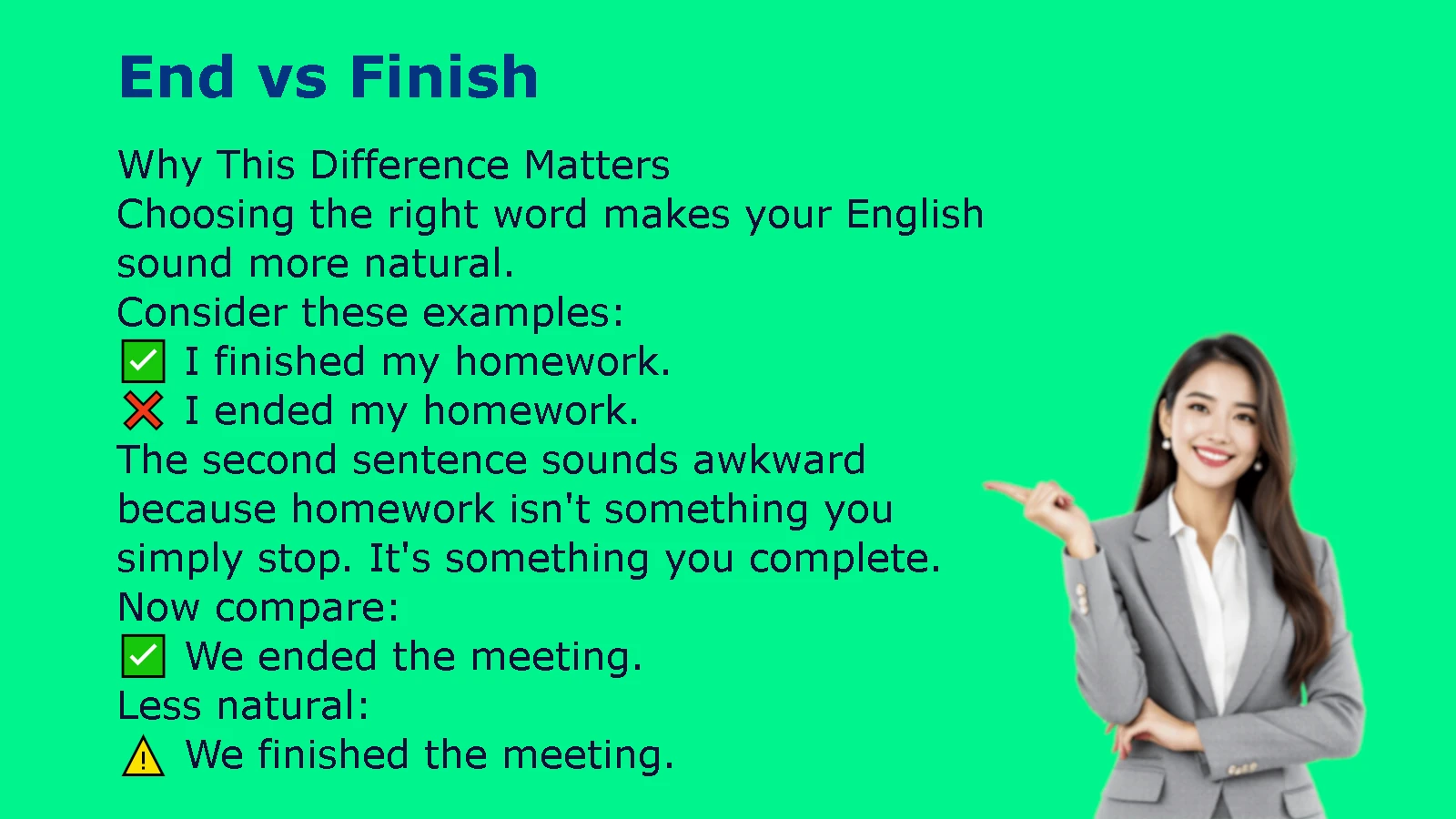
Why This Difference Matters
Choosing the right word makes your English sound more natural.
Consider these examples:
✅ I finished my homework.
❌ I ended my homework.
The second sentence sounds awkward because homework isn’t something you simply stop. It’s something you complete.
Now compare:
✅ We ended the meeting.
Less natural:
⚠️ We finished the meeting.
Although people sometimes say finish the meeting, especially when emphasizing that all agenda items were covered, end the meeting is far more common because meetings are events that conclude rather than tasks that require completion.
Can End and Finish Be Used Interchangeably?
Sometimes yes. Sometimes no. The context determines whether both words sound natural.
In the next section, you’ll see exactly when end and finish can replace each other and when choosing the wrong one makes a sentence sound unnatural or changes its meaning.
Can End and Finish Be Used Interchangeably?
The short answer is sometimes. Both words describe reaching a final point, which is why people often confuse them. However, they’re not true synonyms in every situation.
A helpful way to decide is to ask yourself this question:
Are you talking about stopping something or completing something?
If you’re emphasizing the close of an event, end usually fits best. If you’re emphasizing the completion of work or an activity, finish is usually the better choice.
Situations Where Both Are Correct
In some contexts, both verbs sound natural because an activity both ends and gets completed.
| Sentence with End | Sentence with Finish | Notes |
| The meeting ended at 3 PM. | We finished the meeting at 3 PM. | End focuses on the closing time. Finish emphasizes completing the agenda. |
| The movie ended at midnight. | The movie finished at midnight. | Both are acceptable, although ended is more common. |
| The class ended early. | We finished class early. | Both appear in everyday speech. |
| The interview ended after 30 minutes. | We finished the interview in 30 minutes. | Slight difference in emphasis. |
Notice the subtle shift in meaning. The facts stay the same, but the focus changes.
Situations Where Only Finish Sounds Natural
Some activities involve completing work, eating, reading, writing, or building something. In these cases, finish is the natural choice.
Examples:
- Finish your homework.
- Finish the report.
- Finish reading the book.
- Finish dinner.
- Finish cleaning the kitchen.
- Finish packing your suitcase.
- Finish the race.
- Finish the presentation.
Now compare them with end.
❌ End your homework.
End your dinner.
End reading the book.
These sound awkward because you’re not simply stopping the activity. You’re completing it.
Situations Where Only End Sounds Natural
Certain nouns describe events, relationships, or conditions rather than tasks. Those normally pair with end.
Examples:
- End the conversation.
- End the argument.
- End the contract.
- End the relationship.
- End the war.
- End the debate.
- End the discussion.
- End the broadcast.
Now look at the alternatives.
❌ Finish the relationship.
Finish the war.
Finish the contract.
These sound unnatural because they suggest completing a task instead of bringing something to a close.
When the Meaning Changes
Sometimes both words work, but they communicate different ideas.
| Sentence | Meaning |
| The meeting ended. | The meeting came to a close. |
| We finished the meeting. | We completed everything planned in the meeting. |
| The concert ended. | The performance reached its conclusion. |
| I finished the concert review. | I completed writing the review. |
| The race ended. | The event was over. |
| She finished the race. | She successfully completed the race. |
These differences may seem small, but native speakers notice them immediately.
End vs Finish in Everyday English
You don’t have to memorize dozens of grammar rules. Instead, notice how native speakers naturally use these words in everyday situations.
At School
Students usually finish tasks but classes end.
Examples:
- Finish your assignment before Friday.
- Finish your science project this week.
- The school day ends at 3:30 PM.
- The semester ends in December.
Notice the pattern.
Assignments require completion. School days simply come to a close.
At Work
The same distinction appears in offices.
Examples:
- Finish the report.
- Finish preparing the presentation.
- The meeting ended on time.
- The conference ends tomorrow.
- Our contract ends next month.
Managers often say:
“Let’s end the meeting.”
But they may also say:
“Let’s finish today’s agenda.”
One focuses on closing the meeting. The other focuses on completing the remaining work.
During Sports
Sports provide excellent examples.
Examples:
- She finished first.
- He finished the marathon.
- They finished the tournament undefeated.
- The match ended in a draw.
- The season ends in October.
Here, finish belongs to athletes, while end belongs to events.
In Conversations
Conversations usually end.
Examples:
- Let’s end this discussion.
- Their conversation ended politely.
- The phone call ended unexpectedly.
However, you might hear:
- Finish your sentence.
- Finish what you were saying.
Here, you’re asking someone to complete their thought rather than stop speaking.
Reading and Watching
Books and movies create another useful contrast.
Examples:
- I finished reading the novel.
- She finished watching the series.
- The movie ended with a cliffhanger.
- The book ends on a hopeful note.
The activity uses finish.
The story itself uses end.
Eating
Meals almost always use finish.
Examples:
- Finish your breakfast.
- Finish your vegetables.
- We finished dinner at seven.
The meal itself can also end.
For example:
- Dinner ended with dessert.
Notice the shift.
Here, dinner is viewed as an event rather than food.
Travel
Trips demonstrate both words perfectly.
Examples:
- Our vacation ended on Sunday.
- We finished packing before sunrise.
- The flight ended safely.
- She finished organizing the itinerary.
Again, events end.
Tasks finish.
Examples of End vs Finish in Sentences
The easiest way to master these verbs is by seeing them in realistic situations.
Examples Using End
- The ceremony ended with a standing ovation.
- Their friendship ended years ago.
- Winter ends in late March.
- Please end the call politely.
- The discussion ended without agreement.
- The contract ends next year.
- His speech ended with a memorable quote.
- The movie ended unexpectedly.
- The road ends near the beach.
- The conference ended yesterday.
- The game ended in overtime.
- The festival ends on Sunday.
- The lesson ended early.
- Negotiations ended peacefully.
- The storm finally ended overnight.
Examples Using Finish
- I finished my homework before dinner.
- She finished writing the report.
- They finished building the bridge.
- We finished dinner at eight.
- He finished reading the novel yesterday.
- Finish cleaning your room.
- She finished the race in under four hours.
- We finished decorating the house.
- They finished preparing lunch.
- I finally finished the online course.
- Finish answering the questions.
- He finished painting the fence.
- She finished the puzzle in one afternoon.
- We finished organizing the files.
- The workers finished repairing the road.
Side-by-Side Comparisons
| End | Finish |
| End the meeting. | Finish the agenda. |
| The concert ended at ten. | I finished the concert review. |
| The relationship ended. | She finished the assignment. |
| The discussion ended peacefully. | We finished discussing every topic. |
| The season ends next month. | The team finished first. |
| The story ends sadly. | I finished reading the story. |
| The debate ended early. | We finished debating every issue. |
| The show ended with fireworks. | She finished watching the show. |
Common Grammar Patterns
Understanding common sentence patterns makes choosing the correct word much easier.
End + Noun
Use this structure when bringing something to a close.
Examples:
- End the meeting.
- End the discussion.
- End the contract.
- End the relationship.
- End the investigation.
- End the debate.
- End the ceremony.
- End the call.
Finish + Noun
Use this structure when completing work or an activity.
Examples:
- Finish homework.
- Finish dinner.
- Finish the assignment.
- Finish the race.
- Finish work.
- Finish the project.
- Finish the report.
- Finish the book.
End + With
This pattern describes how something concludes.
Examples:
- The ceremony ended with applause.
- The movie ended with a surprise.
- The meeting ended with good news.
- The story ends with hope.
- The concert ended with fireworks.
Finish + -ing Verb
One of the most common grammar patterns in English.
Examples:
- Finish reading.
- Finish writing.
- Finish cooking.
- Finish studying.
- Finish cleaning.
- Finish packing.
- Finish painting.
- Finish practicing.
Examples in sentences:
- Finish reading before class tomorrow.
- She finished cooking before everyone arrived.
- They finished cleaning the house.
- We finished packing just before sunrise.
Common Collocations
Native speakers use certain word combinations repeatedly. Learning these collocations makes your English sound much more natural.
Collocations with End
| Collocation | Example |
| end a meeting | We ended the meeting early. |
| end a relationship | They ended their relationship. |
| end a conversation | Let’s end the conversation here. |
| end a war | The peace treaty ended the war. |
| end a strike | Negotiations ended the strike. |
| end a contract | The company ended the contract. |
| end a call | She ended the phone call politely. |
| end a debate | The moderator ended the debate. |
| end a broadcast | The station ended the broadcast. |
| end an argument | They finally ended the argument. |
Common Collocations with Finish
| Collocation | Example |
| finish homework | Finish your homework tonight. |
| finish dinner | We finished dinner before sunset. |
| finish work | She finished work early. |
| finish reading | He finished reading the novel. |
| finish writing | I finished writing the article. |
| finish cooking | Dinner will be ready after I finish cooking. |
| finish cleaning | They finished cleaning the garage. |
| finish building | The workers finished building the bridge. |
| finish the race | She finished the marathon. |
| finish first | Our team finished first. |
Common Idioms and Expressions
English uses end and finish in many fixed expressions.
Expressions with End
| Expression | Meaning |
| at the end of the day | Ultimately or when everything is considered |
| end of the line | The final point or no more options |
| no end | A very great amount |
| make ends meet | Earn enough money to cover expenses |
| in the end | Eventually |
| the end is in sight | Success or completion is close |
Example:
At the end of the day, honesty matters more than winning an argument.
After months of saving, they finally made ends meet.
Expressions with Finish
| Expression | Meaning |
| finish strong | End with excellent performance |
| finish first | Win a competition |
| finish what you started | Complete your work |
| photo finish | A race decided by a tiny margin |
| finished product | A completed item |
Example:
She struggled during training but finished strong.
Always finish what you started because consistency builds success.
Common Mistakes English Learners Make with End vs Finish
Even advanced English learners mix up end and finish because the words overlap in many situations. Understanding the most common mistakes will help you sound more natural in everyday conversations and writing.
Using “End” Instead of “Finish”
The biggest mistake is using end for activities that require completion.
Incorrect:
- ❌ End your homework.
- ❌ End your dinner.
- ❌ End reading the book.
- ❌ End the report before noon.
Correct:
- ✅ Finish your homework.
- ✅ Finish your dinner.
- ✅ Finish reading the book.
- ✅ Finish the report before noon.
The reason is simple. Homework, meals, books, and reports are tasks. You complete them rather than simply stop them.
Using “Finish” Instead of “End”
The opposite mistake also happens.
Incorrect:
- ❌ Finish the relationship.
- ❌ Finish the meeting immediately.
- ❌ Finish the conversation.
- ❌ Finish the contract.
More natural:
- ✅ End the relationship.
- ✅ End the meeting.
- ✅ End the conversation.
- ✅ End the contract.
Although you’ll occasionally hear finish the meeting when people mean they’ve covered every agenda item, end the meeting remains the standard expression.
Confusing Events with Tasks
A quick way to choose the right verb is to identify whether you’re describing an event or a task.
| If It’s an Event | Use | Example |
| Meeting | End | The meeting ended at noon. |
| Concert | End | The concert ended with fireworks. |
| Conversation | End | Their conversation ended politely. |
| Season | End | The season ends in October. |
| If It’s a Task | Use | Example |
| Homework | Finish | I finished my homework. |
| Project | Finish | They finished the project. |
| Book | Finish | She finished the novel. |
| Meal | Finish | We finished dinner. |
Assuming They Always Mean the Same Thing
Many learners believe the verbs are interchangeable.
They’re not.
Consider these examples:
- The race ended.
- She finished the race.
The first sentence describes the event.
The second describes the participant.
That subtle difference makes your English more accurate and natural.
End vs Finish in American and British English
The good news is that both American English and British English use these words in nearly the same way.
The core meanings don’t change.
However, you’ll notice a few small differences in preference.
| Situation | American English | British English |
| End the meeting | Very common | Very common |
| Finish the meeting | Common when referring to completing the agenda | Slightly more common than in American English in some workplaces |
| Finish school | Graduate or complete the school day (depends on context) | Frequently used to mean leaving school permanently |
| End school | Refers to the school day ending | Similar usage |
For everyday communication, the grammar rules remain the same regardless of which variety of English you use.
End vs Finish in Different Contexts
Different settings naturally favor one verb over the other.
Academic Writing
Formal writing often uses both words carefully.
Examples:
- The study ended in 2024.
- Researchers finished collecting the data.
- The experiment ended unexpectedly.
- Scientists finished analyzing the results.
Business English
Business communication frequently uses both verbs.
Examples:
- Let’s end today’s meeting.
- We finished the quarterly report.
- The contract ends next June.
- The team finished the project ahead of schedule.
Legal Language
Legal documents almost always use end, terminate, or expire rather than finish.
Examples:
- The agreement ends on December 31.
- Both parties agreed to end the contract.
- The lease ends automatically after one year.
Sports Commentary
Sports provide excellent examples of both verbs.
Examples:
- The match ended in a tie.
- She finished first.
- The season ends next month.
- He finished the marathon despite an injury.
Literature and Storytelling
Authors often use end to describe stories.
Examples:
- The novel ends with hope.
- The chapter ends dramatically.
- The film ends on a cliffhanger.
Readers, however, finish books.
Examples:
- I finished reading the novel yesterday.
- She finished the trilogy in one week.
Everyday Conversation
Daily speech naturally mixes both words.
Examples:
- Did you finish your homework?
- When does your shift end?
- I finally finished cleaning.
- The party ended around midnight.
Synonyms of End
Sometimes another word fits better than end.
| Synonym | Best Used For | Example |
| Stop | Everyday situations | Stop the music. |
| Close | Meetings, stores | Close the meeting. |
| Conclude | Formal writing | The conference concluded successfully. |
| Cease | Formal or legal language | Hostilities ceased immediately. |
| Terminate | Contracts, legal contexts | The company terminated the agreement. |
| Wrap up | Informal speech | Let’s wrap up today’s discussion. |
Choosing the Right Synonym
Each synonym carries its own tone.
For example:
- Terminate sounds formal and legal.
- Wrap up sounds casual and conversational.
- Conclude works well in academic and professional writing.
- Stop is the simplest everyday choice.
Synonyms of Finish
Several words can replace finish, depending on the context.
| Synonym | Best Used For | Example |
| Complete | Formal writing | Complete the application. |
| Accomplish | Goals | She accomplished every objective. |
| Finalize | Business | Finalize the proposal. |
| Wrap up | Informal speech | Let’s wrap up this project. |
| Polish off | Food (informal) | He polished off the pizza. |
| Conclude | Formal speeches or presentations | The speaker concluded the presentation. |
Using varied vocabulary makes your writing richer while preserving the original meaning.
Memory Trick to Remember the Difference
Sometimes a simple mental image works better than a grammar rule.
Think of End as Stopping
Imagine someone turning off the lights after a concert.
The performance ends.
The lights go out.
Everything stops.
Think of Finish as Completing
Now imagine a student writing the last answer on an exam.
The student finishes the test.
The work is complete.
Easy Reminder
Events end. Tasks finish.
While there are exceptions, this rule works in most situations.
Quick Decision Chart
| Ask Yourself… | Choose |
| Am I talking about completing work? | Finish |
| Am I talking about stopping an event? | End |
| Is someone reaching a goal? | Finish |
| Is something coming to a close? | End |
Case Study: Why Word Choice Matters
Imagine two managers ending a weekly team meeting.
Manager A
“Let’s end today’s meeting.”
Everyone understands that the discussion is over.
Manager B
“Let’s finish today’s meeting.”
This sounds natural too, but it subtly suggests that the team has completed every item on the agenda before closing.
The difference is small yet meaningful.
Native speakers often choose one over the other based on exactly what they want to emphasize.
Expert Quote
“Vocabulary isn’t just about knowing words. It’s about knowing which word best fits the situation.”
That’s exactly why understanding end vs finish improves both spoken and written English.
Frequently Asked Questions
Is finish the same as end?
No. Both words describe reaching a final point, but finish usually means completing a task, while end focuses on bringing something to a close.
Can you say “finish a meeting”?
Yes, but the meaning differs slightly.
- End the meeting emphasizes closing the meeting.
- Finish the meeting emphasizes completing everything planned during the meeting.
Is it “end dinner” or “finish dinner”?
Normally, you say finish dinner because you’re completing a meal.
However, you can say:
Dinner ended with dessert.
In this sentence, dinner is treated as an event.
Can a movie both end and finish?
Yes.
You can say:
- The movie ended at 9:30 PM.
- The movie finished at 9:30 PM.
Most native speakers prefer ended when referring to the film itself.
Which word is more common?
Both are extremely common.
The choice depends on context rather than frequency.
Can something end without being finished?
Yes.
Examples include:
- A project ended because funding disappeared.
- A conversation ended suddenly.
- A relationship ended unexpectedly.
In these cases, the activity stopped before reaching its intended completion.
Can something be finished without ending?
Generally, no.
When something is finished, it has reached its end.
However, one person’s task may finish while the larger event continues.
Example:
- She finished her presentation, but the conference continued.
Practice Quiz
Choose the correct word.
Questions
- Please ______ your homework before dinner.
- The meeting ______ at 2 PM.
- She ______ the marathon despite the heat.
- Their friendship ______ years ago.
- We finally ______ cleaning the garage.
- The concert ______ with a standing ovation.
- He ______ reading the novel yesterday.
- The school year ______ in June.
- They ______ building the new bridge last month.
- The phone call suddenly ______.
Answer Key
- finish
- ended
- finished
- ended
- finished
- ended
- finished
- ends
- finished
- ended
If you answered most of these correctly, you’ve already mastered the main distinction.
Key Takeaways: End vs Finish
Remember these simple rules whenever you’re unsure.
- End means to bring something to a close or stop.
- Finish means to complete something successfully.
- Events, meetings, conversations, relationships, and seasons usually end.
- Homework, projects, books, meals, reports, and races usually finish.
- Some situations allow both words, but the emphasis changes.
- Choosing the correct verb makes your English sound more natural and precise.
Final Comparison Table
| Feature | End | Finish |
| Main idea | Stop or close | Complete |
| Focus | Conclusion of an event | Completion of work |
| Implies success | Not necessarily | Usually yes |
| Common with | Meetings, conversations, relationships, events | Homework, books, meals, projects, races |
| Typical question | When did it stop? | Was it completed? |
| Example | The meeting ended at noon. | I finished the report before noon. |