Changeable vs Changable is a common spelling question in English. The correct spelling is changeable, with an e between the root word change and the suffix -able. The spelling changable is incorrect in standard English. Although writers often drop a silent e when adding certain suffixes, changeable follows a spelling pattern that preserves the soft g sound.
Understanding the difference between changeable and changable also helps you learn the changeable meaning, recognize the correct adjective form, and avoid similar mistakes with words such as manageable and noticeable. The spelling becomes easier once you understand how English suffixes affect a word’s final letter. You can then apply that knowledge to everyday writing, school assignments, business communication, and online content.
Changeable vs Changable: What’s the Difference?
Changeable is the correct spelling, while changable is a misspelling. The correct word describes something that can change, vary, or be altered. It can refer to weather, plans, prices, moods, opinions, and many other things. Remember to keep the e when forming the adjective from the verb change.
The difference is simple, but the reason behind it deserves attention. English uses several suffixes that affect the final letters of root words. Writers sometimes apply one spelling rule too broadly and remove a letter that should remain.
| Word | Correct? | Meaning or explanation |
| Changeable | Yes | Capable of changing or being changed |
| Changable | No | Common misspelling of changeable |
| Change | Yes | To become different or make something different |
| Changing | Yes | Becoming different or making something different |
| Changed | Yes | Became different or was made different |
The key is to recognize the suffix you are adding. The spelling of changeable differs from the spelling of changing, even though both words come from the same root.
Changable Is an Incorrect Spelling
Changable is a spelling mistake that occurs when someone removes the final e from change before adding -able. The mistake often happens because writers remember a familiar rule: English frequently drops a silent e before a suffix that begins with a vowel.
For example, the final e disappears in these words:
- Bake + ing = baking
- Write + ing = writing
- Hope + ed = hoped
- Drive + er = driver
However, English spelling rules depend on the word and suffix involved. You cannot apply the same rule to every word without checking the resulting spelling and pronunciation.
Writing changable may seem logical if you focus only on the silent e. Yet the standard spelling retains that letter: changeable.
Consider these examples:
- Incorrect: The mountain weather is highly changable.
- Correct: The mountain weather is highly changeable.
- Incorrect: We need a changable schedule.
- Correct: We need a changeable schedule.
A spell-checker may flag changable as an error, but you should learn to recognize it without relying entirely on software. This is particularly useful when editing handwritten assignments, published articles, reports, and professional emails.
Changeable Is the Correct Spelling
Changeable is an adjective formed from the verb change and the suffix -able. The suffix generally means capable of, suitable for, or able to undergo an action. Therefore, changeable describes something that can change or be changed.
The word has three useful features:
- Part of speech: Adjective
- Pronunciation: /ˈtʃeɪndʒəbəl/
- Basic meaning: Capable of changing, varying, or being altered
For example, consider this sentence:
“The weather in the mountains is highly changeable.”
Here, the adjective describes weather that can shift from sunny to rainy or from warm to cold within a short period.
The same word works in other contexts:
- “The company offers a changeable payment schedule.”
- “Her changeable opinions made the discussion unpredictable.”
- “The device has a changeable battery.”
- “We need a changeable design that can accommodate future updates.”
In each sentence, the word communicates the possibility of change. The exact meaning depends on the noun it describes.
Why Does Changeable Keep the Letter E?
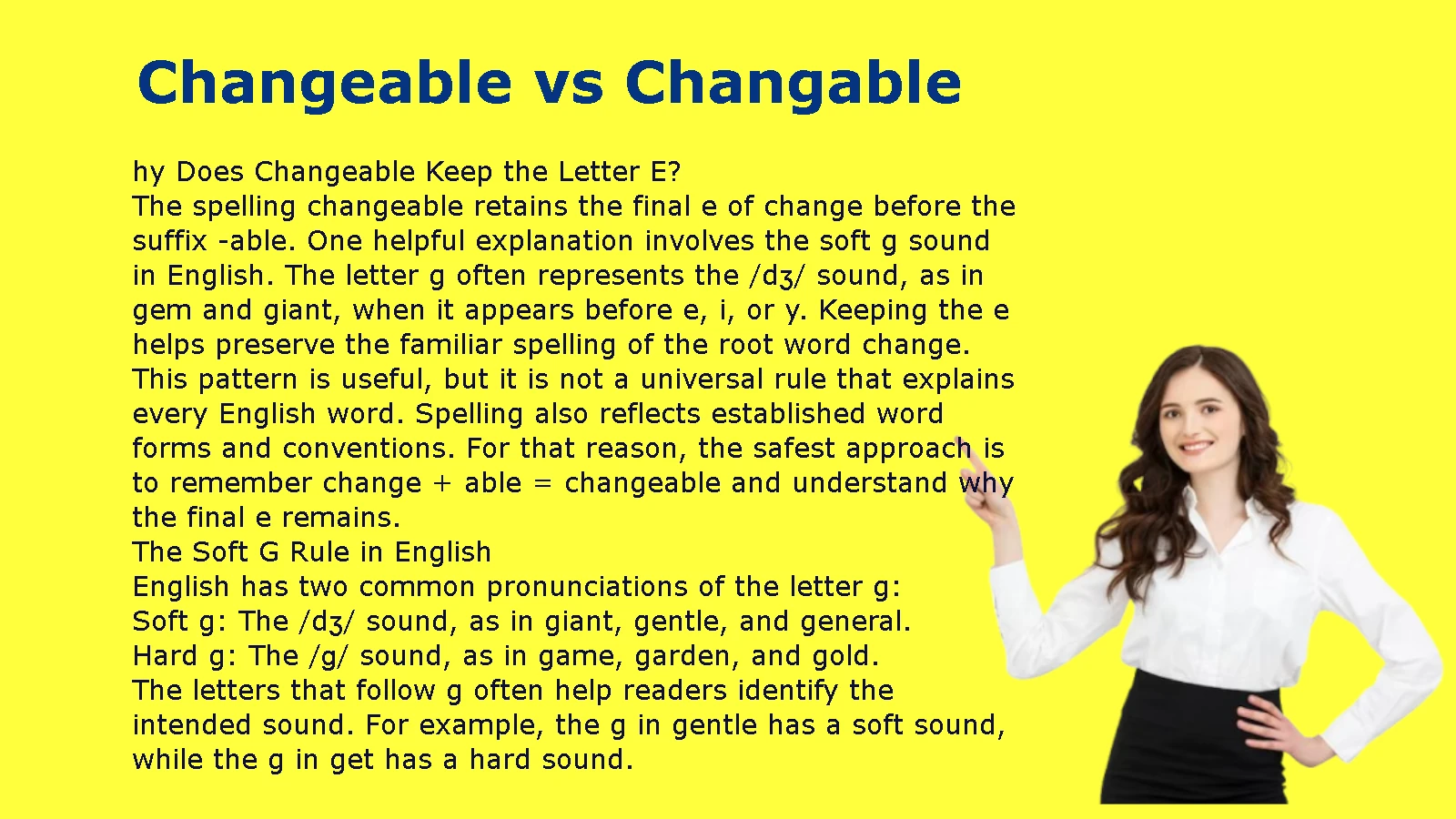
The spelling changeable retains the final e of change before the suffix -able. One helpful explanation involves the soft g sound in English. The letter g often represents the /dʒ/ sound, as in gem and giant, when it appears before e, i, or y. Keeping the e helps preserve the familiar spelling of the root word change.
This pattern is useful, but it is not a universal rule that explains every English word. Spelling also reflects established word forms and conventions. For that reason, the safest approach is to remember change + able = changeable and understand why the final e remains.
The Soft G Rule in English
English has two common pronunciations of the letter g:
- Soft g: The /dʒ/ sound, as in giant, gentle, and general.
- Hard g: The /ɡ/ sound, as in game, garden, and gold.
The letters that follow g often help readers identify the intended sound. For example, the g in gentle has a soft sound, while the g in get has a hard sound.
The root word change already contains the letter combination ge, which represents the soft /dʒ/ sound. When you form changeable, you retain the spelling of the root and add -able.
Compare the forms:
| Form | Spelling | What to remember |
| Root verb | Change | Ends in ge |
| Adjective | Changeable | Retains the root’s final e |
| Present participle | Changing | Drops the final e before -ing |
| Past tense | Changed | Drops the final e before -ed |
The spelling changable removes the e from the familiar ge combination. That disrupts the normal spelling pattern used in the word changeable.
It is worth remembering that the soft-g explanation is a helpful guide rather than an absolute law. English contains exceptions, and the letters following g do not always determine pronunciation perfectly.
When to Drop the E Before Adding a Suffix
The general drop the e rule in English explains why some words lose their final e when they take a suffix. A common pattern is to remove a silent final e before a vowel-starting suffix such as -ing.
Examples include:
- Make → Making: The final e disappears before -ing.
- Write → Writing: The spelling drops the final e.
- Smile → Smiling: The root loses its final e.
- Change → Changing: The final e disappears before -ing.
The pattern also appears in many past-tense forms:
- Bake → Baked
- Hope → Hoped
- Change → Changed
However, the suffix -able behaves differently in certain words. English retains the final e in changeable, manageable, and noticeable to preserve established spelling patterns and the pronunciation of the root consonant.
Compare the two constructions:
- Change + ing = changing
- Change + able = changeable
Both forms are correct. They simply follow different spelling conventions.
A practical rule is to learn common word families instead of relying on one broad rule. If you know change, changing, changed, and changeable, you can select the correct form according to the sentence.
Changeable Definition and Meaning
Changeable means capable of changing, varying, or being altered. The word can describe physical objects, conditions, schedules, prices, opinions, moods, and behavior. Depending on the context, it can suggest flexibility, unpredictability, or a tendency to shift frequently. It is an adjective, so it typically describes a noun rather than naming an action.
Although the core meaning stays the same, the word can communicate different ideas in different situations.
Changeable Means Capable of Changing
In its broadest sense, changeable describes something that does not have to remain the same. A changeable object, arrangement, or condition can take a different form or state.
For example:
“The office has a changeable seating arrangement.”
This sentence means the office can rearrange its seating when needed. The furniture arrangement is not permanent.
Other examples include:
- “The company introduced a changeable pricing plan.”
- “This jacket has a changeable lining for different seasons.”
- “The website uses a changeable layout.”
- “Our travel dates are changeable if the weather becomes dangerous.”
In these examples, changeable often carries a neutral or positive meaning. The ability to change can make something more practical, flexible, or useful.
A changeable design may accommodate new requirements. A changeable schedule may help a team respond to unexpected events. Similarly, changeable settings allow users to personalize a device or application.
The word does not automatically mean that something changes constantly. It can simply mean that a change is possible.
Changeable Can Describe Moods and Behavior
Changeable can also describe a person whose moods, attitudes, preferences, or opinions shift frequently. In this context, the word often suggests unpredictability.
For example:
“His changeable mood made it difficult to decide how to approach the conversation.”
The sentence suggests that his emotional state may shift, making his reactions harder to anticipate.
Here are additional examples:
- “Her changeable preferences made choosing a restaurant difficult.”
- “The manager’s changeable expectations confused the team.”
- “His attitude toward the proposal was surprisingly changeable.”
- “The child’s changeable interests made it difficult to choose a long-term hobby.”
When you describe people, choose the word carefully. Calling someone’s mood changeable describes a pattern of shifting emotions. It does not necessarily mean the person is unreliable or intentionally inconsistent.
Context matters. A changeable opinion might reflect new evidence, while a changeable attitude might reflect uncertainty or shifting circumstances.
Changeable vs. Adaptable, Variable, and Unpredictable
Several English words overlap with changeable, but they are not interchangeable in every sentence.
| Word | Meaning | Example |
| Changeable | Capable of changing or varying | The weather is changeable. |
| Adaptable | Able to adjust to new conditions | She is adaptable in unfamiliar workplaces. |
| Variable | Likely to differ or not remain constant | Delivery times are variable. |
| Unpredictable | Difficult to forecast or anticipate | The storm’s path is unpredictable. |
| Mutable | Capable of undergoing change; often formal | The document contains mutable settings. |
| Fickle | Frequently changing loyalties, interests, or preferences | The fickle customer kept changing his choice. |
The most suitable synonym depends on what you want to emphasize.
Use adaptable when the ability to adjust is important. Choose variable when something differs across occasions or cases. Use unpredictable when you cannot reliably anticipate what will happen. Reserve fickle for contexts where frequent changes in preference or loyalty carry a negative implication.
For instance, a changeable schedule may be flexible because someone can revise it. An unpredictable schedule may be difficult to plan around because the changes happen without a reliable pattern.
How to Use Changeable in a Sentence
The adjective changeable works in everyday conversations and formal writing. You can use it to describe weather, business arrangements, technology, emotions, and other situations in which something can change. The following examples show how the meaning shifts with the context.
Changeable Examples in a Sentence: Weather and Climate
Weather is one of the most familiar contexts for changeable. Conditions may shift throughout the day, especially in mountainous areas or during transitional seasons.
Examples:
- “The mountain weather is highly changeable, so pack a raincoat.”
- “Spring temperatures can be changeable, with warm afternoons and cold evenings.”
- “We postponed the picnic because the forecast predicted changeable conditions.”
- “The coastal climate is changeable, so visitors should prepare for sudden showers.”
- “The weather became less changeable as the season progressed.”
These sentences describe conditions that may vary. They do not necessarily suggest that every change will be unexpected or extreme.
Changeable in Business and Technology
In professional writing, changeable can describe arrangements, components, prices, requirements, or settings that someone can revise.
Examples:
- “The business uses a changeable pricing model to respond to market conditions.”
- “Our software includes changeable settings for different user groups.”
- “The team created a changeable project timeline to accommodate new requirements.”
- “The contract contains a changeable delivery schedule.”
- “The designer chose changeable website components to simplify future updates.”
Consider a small business that sells seasonal products. Demand may rise during certain months and fall during others. A changeable inventory plan allows the business to adjust its orders as demand shifts.
In this situation, changeable describes the plan’s flexibility. If the business wants to emphasize its ability to respond effectively, adaptable might be more precise.
The distinction helps you select words that communicate the intended benefit instead of simply repeating the idea of change.
Changeable in Emotions and Behavior
When you describe feelings, opinions, or behavior, changeable often means that a person’s reactions or preferences do not remain consistent.
Examples:
- “His changeable moods made it difficult to predict his response.”
- “Her changeable opinion reflected the new information she received.”
- “The team’s changeable priorities delayed the project.”
- “My changeable taste in music keeps my playlists varied.”
- “Their changeable plans made it hard to arrange a group dinner.”
Notice that these examples do not all carry the same tone. A changeable taste in music can be positive because it suggests variety. Changeable priorities may create problems if they prevent a team from completing important work.
The surrounding words determine whether the adjective suggests flexibility, variety, uncertainty, or inconsistency.
Changeable in Everyday Conversation
You do not need a technical or formal context to use the word naturally.
Try these examples:
- “My schedule is changeable this week.”
- “The design has a changeable color scheme.”
- “Her preferences are quite changeable.”
- “We need a changeable arrangement in case someone cancels.”
- “The situation remains changeable, so let’s wait before making a final decision.”
If you want a more conversational expression, you can often use flexible, likely to change, or not fixed. For example, “My schedule is flexible this week” sounds natural when you mean that you can accommodate different plans.
Changeable vs. Other -Able Words
The spelling of changeable becomes easier to remember when you compare it with other adjectives ending in -able. Some retain the final e of the root word, while others drop it. These differences reflect pronunciation patterns, word history, and established spelling conventions.
The important lesson is that not every word follows the same suffix rule.
| Root word | Correct adjective | Common error or alternative | Spelling note |
| Change | Changeable | Changable | Retains e in the standard spelling. |
| Manage | Manageable | Managable | Retains e to preserve the soft-g spelling pattern. |
| Notice | Noticeable | Noticable | Retains e to preserve the soft-c sound. |
| Love | Lovable | Loveable | Lovable is the usual US spelling; loveable is also accepted. |
| Debate | Debatable | Debatible | Uses the suffix -able with the final e retained. |
| Move | Movable | Moveable | Movable is standard in US English; moveable is also used. |
This table shows why a spelling rule should guide your judgment rather than replace it. You should also recognize accepted variants. For example, loveable and moveable are not simply equivalent to the misspelling changable.
Why Is Manageable Spelled With an E?
Manageable follows a similar pattern to changeable. It comes from the verb manage and describes something that can be managed or handled.
For example:
- “The workload is manageable with two additional team members.”
- “We need a manageable budget for the first year.”
- “The software makes large datasets easier to handle.”
The final e remains in the adjective. Removing it to produce managable creates a common misspelling.
Compare the word family:
- Manage
- Managing
- Managed
- Manageable
The final e disappears in managing and managed, but it remains in manageable. This is a useful parallel to change, changing, changed, and changeable.
Why Is Noticeable Spelled With an E?
Noticeable means easy to see, recognize, or observe. The word comes from notice, with the suffix -able added to form an adjective.
Examples:
- “There was a noticeable improvement in the team’s performance.”
- “The paint left a noticeable mark on the wall.”
- “She made a noticeable effort to speak more clearly.”
The spelling retains the e from notice. The letter c in notice has a soft /s/ sound, and retaining the e preserves the familiar spelling pattern.
The incorrect form noticable is a frequent spelling error. Learning noticeable alongside changeable gives you another example of a root word that retains its final e before -able.
Why Is Lovable Usually Spelled Without an E?
Lovable means worthy of love or easy to love. Unlike changeable, its usual US spelling drops the final e from love before adding -able.
For example:
- “The puppy is playful and lovable.”
- “The main character has a lovable sense of humor.”
- “The film presents a lovable group of imperfect friends.”
The spelling loveable is also accepted, so it should not be treated as an outright error. However, lovable is the usual form in American English.
This comparison matters because it shows why the soft-g explanation cannot serve as a universal rule for every adjective ending in -able. The spelling depends on the particular word.
Common Mistakes to Avoid When Using Changeable
Writers can make several errors when spelling or using changeable. Learning to spot them will help you edit more accurately.
Dropping the E in Changeable
The most direct mistake is writing changable instead of changeable.
Incorrect: “The company’s plans are changable.”
Correct: “The company’s plans are changeable.”
Remember the complete root word before adding the suffix. Writing the word in two mental parts—change and able—can help you retain the correct letters.
Confusing Changeable With Changing
Although both words come from change, they serve different grammatical purposes.
- Changeable: An adjective meaning capable of changing.
- Changing: A form of the verb change that can describe an ongoing action or function as a modifier.
Compare these examples:
“The market is changeable.”
This describes the market’s capacity to vary.
“The market is changing.”
This describes a change that is happening.
The distinction matters in business writing. If you say a market is changing, you emphasize an ongoing development. If you call it changeable, you emphasize its tendency or capacity to vary.
Using Changeable When Another Word Is More Precise
The word changeable is correct, but it may not always express your meaning as clearly as another adjective.
Compare:
- “The employee is changeable.” This is vague because it does not identify what changes.
- “The employee’s priorities are changeable.” This identifies the shifting element.
- “The employee is adaptable.” This emphasizes the ability to adjust.
- “The employee is unpredictable.” This emphasizes difficulty in anticipating behavior.
Whenever possible, identify what changes and explain why that change matters. Specific wording gives readers a clearer picture.
A Practical Way to Remember Changeable vs Changable
If you frequently confuse the two spellings, use a short checking process before submitting your work.
Step one: Identify the root word.
Start with change, not chang. The root word contains the final e.
Step two: Identify the suffix.
The adjective uses -able. Do not automatically apply the rule you use for -ing.
Step three: Check the established word form.
The correct combination is change + able = changeable.
Step four: Read the sentence for meaning.
Make sure you need an adjective describing something capable of changing.
For example:
“Our travel dates are changeable.”
The sentence makes sense because the dates can be revised.
“The weather is changeable.”
The adjective works because weather conditions can vary.
You can also use a short memory phrase:
Keep the E in changeable; drop it in changing.
This reminder captures the contrast without pretending that one spelling rule explains every word in English.
Frequently Asked Questions About Changeable vs Changable
Is Changable a Real Word?
No. Changable is a common spelling mistake, not the standard spelling of the adjective. Use changeable when describing something that can change, vary, or be altered. For example, “The schedule is changeable” is correct.
What Does Changeable Mean?
Changeable means capable of changing or being changed. It can describe weather, plans, prices, designs, moods, and opinions. Depending on the context, it may suggest flexibility or frequent variation. For example, “The forecast is changeable” means the weather conditions may shift.
What Is a Synonym for Changeable?
Common synonyms for changeable include variable, mutable, adaptable, unpredictable, and fickle. However, each word has a different emphasis. Adaptable suggests the ability to adjust, while unpredictable means difficult to anticipate. Fickle often describes frequently changing preferences or loyalties.
Do You Drop the E in Changing?
Yes. You drop the final e when forming changing from change. The same pattern applies to changed. However, the standard adjective is changeable, with the e retained. Different suffixes can produce different spellings from the same root word.
Why Is Manageable Spelled With an E?
Manageable retains the final e from manage before the suffix -able. This spelling preserves the familiar form and pronunciation pattern of the root. The correct form is manageable, not managable. As with changeable, the spelling differs from forms such as managing.
Is Changeable One Word or Two?
Changeable is one word. It does not require a space or hyphen. Write “a changeable schedule,” not “a change able schedule.” The word functions as a single adjective modifying a noun.
Conclusion: Remember the Correct Spelling of Changeable
When comparing Changeable vs Changable, the answer is straightforward: changeable is correct, and changable is a misspelling. The final e remains when you add -able, even though it disappears in forms such as changing and changed.
Understanding the difference helps you do more than correct one word. It teaches you to recognize how English suffixes affect spelling, why related word forms may look different, and why you should not apply a single rule to every word ending in -able.
Before publishing an article, submitting an assignment, or sending a professional email, check that you have written changeable correctly. Then review the surrounding sentence to make sure the word communicates your intended meaning.
Remember: change + able = changeable. Keep this pattern in mind, practice it in your own sentences, and use the same approach when learning other commonly confused English words.