The correct plural of diagnosis is diagnoses, while diagnosises is not a standard English word. Many writers confuse these two forms because they look similar. Diagnosises vs Diagnoses is a common grammar topic that helps you understand the correct plural form, spelling, and usage with clear examples.
The confusion often begins when people look for the plural of diagnosis, the correct spelling of diagnoses, or wonder if diagnosises is ever acceptable. But here’s the good news: once you understand the rule, it’s easy to remember and you’ll never second-guess yourself again.
In this guide, you’ll learn the difference between Diagnosises vs Diagnoses, discover the correct plural of diagnosis, understand why diagnoses is correct, and see diagnoses in a sentence with real-world examples. You’ll also learn how to use diagnoses correctly, common mistakes to avoid, and a simple memory trick to help you remember the right form every time.
By the end, you’ll know exactly why diagnoses is the accepted plural and why diagnosises is considered incorrect in standard English.
Diagnosises vs Diagnoses: The Quick Answer
Here’s the short answer:
| Word | Correct? | Usage |
| Diagnosis | ✅ Yes | Singular noun |
| Diagnoses | ✅ Yes | Plural noun |
| Diagnosises | ❌ No | Incorrect spelling |
The correct plural of diagnosis is diagnoses.
The word diagnosises isn’t recognized as standard English. Major dictionaries, style guides, and medical publications all use diagnoses as the only accepted plural form.
Quick examples
Correct
- The doctor reviewed several diagnoses before recommending treatment.
- Accurate diagnoses often require multiple tests.
- Her diagnosis came after a series of examinations.
Incorrect
- The hospital recorded several diagnosises this week.
- Different diagnosises require different treatments.
Quick tip to remember
If a noun ends in -sis, its plural usually ends in -ses.
For example:
- Diagnosis → Diagnoses
- Analysis → Analyses
- Crisis → Crises
- Thesis → Theses
This pattern stays consistent across many English words with Greek origins.
Grammar Tip: Don’t simply add -es to every word ending in -sis. Replace -sis with -ses instead.
What Does “Diagnosis” Mean?
Before learning the plural form, it helps to understand what diagnosis actually means.
A diagnosis is the process or result of identifying a disease, condition, or problem by examining evidence, symptoms, tests, or other information.
Although the word appears most often in medicine, people also use it in engineering, business, psychology, education, and information technology.
Dictionary meaning
A diagnosis is:
The identification of the nature and cause of an illness, disease, or other problem after evaluating available information.
In simple words, a diagnosis answers the question:
“What is causing the problem?”
Diagnosis in medicine
Healthcare professionals use diagnosis every day.
A physician gathers information by:
- Asking about symptoms
- Reviewing medical history
- Performing a physical examination
- Ordering laboratory tests
- Studying imaging scans
- Comparing findings with known diseases
Only after evaluating all available evidence does the doctor reach a diagnosis.
Example
A patient complains of fever, cough, and chest pain.
After blood tests and a chest X-ray, the physician makes a diagnosis of pneumonia.
Diagnosis outside medicine
Many people don’t realize that diagnosis also describes identifying problems in non-medical settings.
For example:
| Field | Meaning of Diagnosis |
| Information Technology | Finding the cause of a software or hardware issue |
| Engineering | Identifying mechanical faults |
| Automotive Repair | Discovering why a vehicle isn’t working properly |
| Business | Analyzing the cause of declining sales |
| Education | Identifying learning difficulties |
| Psychology | Recognizing mental health conditions |
In each case, the idea stays the same:
Investigate the evidence first. Identify the underlying problem second.
Everyday examples
You may hear sentences like:
- The mechanic finished the diagnosis in under an hour.
- Our IT department completed a network diagnosis yesterday.
- The consultant’s diagnosis revealed weaknesses in the company’s workflow.
- Early diagnosis improves treatment outcomes for many diseases.
Notice that the word doesn’t always refer to medicine.
Origin of the word
The English word diagnosis comes from the Greek word diagnōsis, meaning:
- Recognition
- Discernment
- Distinguishing one thing from another
The Greek root combines two important parts:
| Greek Element | Meaning |
| dia- | Through, apart, completely |
| gnosis | Knowledge or understanding |
Together, they describe gaining knowledge by carefully examining evidence.
That original meaning remains remarkably accurate today.
Why this matters
Knowing the origin explains why the plural seems unusual.
English borrowed diagnosis from Greek rather than creating it from native English words. Because of that, the plural follows Greek grammar instead of the regular English rule of adding -s or -es.
This historical background helps explain why diagnoses looks different from words like:
- houses
- boxes
- buses
- classes
Is the Plural of Diagnosis “Diagnoses”?
Yes.
The plural of diagnosis is diagnoses.
Whenever you’re talking about more than one diagnosis, you should use diagnoses.
Examples
Singular:
- The doctor’s diagnosis surprised everyone.
- Her diagnosis came early.
- A second diagnosis confirmed the illness.
Plural:
- The physicians discussed several diagnoses.
- Different diagnoses require different treatments.
- The report listed multiple diagnoses for further review.
Why doesn’t diagnosis become diagnosises?
At first glance, diagnosises seems logical.
Many English words form their plural by adding -es.
Examples include:
- Church → Churches
- Bus → Buses
- Box → Boxes
However, diagnosis doesn’t belong to that group.
Instead, English preserves the traditional Greek plural.
The ending changes like this:
-sis
↓
-ses
So:
Diagnosis
↓
Diagnoses
This rule applies to dozens of other English words with the same ending.
Singular vs. plural at a glance
| Singular | Plural |
| Diagnosis | Diagnoses |
| Analysis | Analyses |
| Crisis | Crises |
| Thesis | Theses |
| Parenthesis | Parentheses |
| Hypothesis | Hypotheses |
Once you recognize this pattern, remembering the correct plural becomes much easier.
Does pronunciation change too?
Yes.
Both spelling and pronunciation change.
| Word | Approximate Pronunciation |
| Diagnosis | die-ug-NOH-sis |
| Diagnoses | die-ug-noh-SEEZ |
The stress shifts slightly, making the plural sound different from the singular.
This pronunciation change often surprises English learners, but it’s completely normal for words ending in -sis.
Why accuracy matters
Using the correct plural isn’t just about grammar.
In professional settings, precision builds credibility.
For example:
- Medical records require exact terminology.
- Research papers follow standard grammar.
- Academic writing expects correct plural forms.
- Business reports benefit from clear communication.
Writing diagnoses instead of diagnosises shows attention to detail.
Why People Write “Diagnosises”
If diagnosises is incorrect, why do so many people type it?
The answer lies in how the human brain learns language.
People naturally apply familiar grammar rules to unfamiliar words. Since most English nouns form plurals by adding -s or -es, writers often assume diagnosis follows the same pattern.
Let’s look at the most common reasons.
Applying the regular plural rule
This is the biggest reason.
People see:
Diagnosis
Then they think:
Diagnosis + es = Diagnosises
That would work for many English nouns.
Unfortunately, diagnosis follows a completely different rule.
Most English nouns are regular
English trains us to expect predictable patterns.
Examples include:
| Singular | Plural |
| Book | Books |
| Class | Classes |
| Box | Boxes |
| Dish | Dishes |
| Church | Churches |
Since these patterns appear everywhere, it’s understandable why people expect diagnosises to work.
Limited exposure to Greek plurals
Many English speakers rarely think about the origins of words.
As a result, they may not recognize that words ending in -sis behave differently.
Without learning the rule, people naturally create a plural that sounds reasonable.
Pronunciation confusion
Another reason involves speech.
Some people don’t hear diagnoses very often.
Instead, they mentally construct the plural based on spelling rather than experience.
That leads to:
- diagnosises
- analysises
- crisises
Each looks believable.
None is considered standard English.
Spell-check dependence
Modern writing tools correct many mistakes automatically.
However, they don’t always prevent errors.
If a writer ignores a spell-check suggestion or uses software with limited language support, diagnosises may remain unnoticed.
Professional editors still rely on grammar knowledge instead of automated tools alone.
Influence of everyday conversation
Most people don’t discuss multiple medical diagnoses every day.
Because the plural appears less frequently than the singular, writers may not develop a strong memory of its correct spelling.
Medical professionals, researchers, and editors encounter diagnoses regularly, making the correct form second nature.
A simple way to remember
Think of the ending as a replacement rather than an addition.
Instead of this:
Diagnosis + es
Think this way:
Diagnosis
Remove: sis
Add: ses
Diagnosis
↓
Diagnoses
That small mental shift makes the rule much easier to remember.
Singular vs. Plural: Diagnosis and Diagnoses
The table below summarizes the key differences.
| Feature | Diagnosis | Diagnoses |
| Number | Singular | Plural |
| Meaning | One identified condition or problem | More than one identified condition or problem |
| Standard English | ✅ Correct | ✅ Correct |
| Medical Usage | Refers to one patient’s identified condition | Refers to multiple identified conditions or multiple patients’ conditions |
| Grammar | Singular noun | Plural noun |
| Example | The diagnosis was confirmed yesterday. | The doctors reviewed several diagnoses before making a decision. |
| Pronunciation | die-ug-NOH-sis | die-ug-noh-SEEZ |
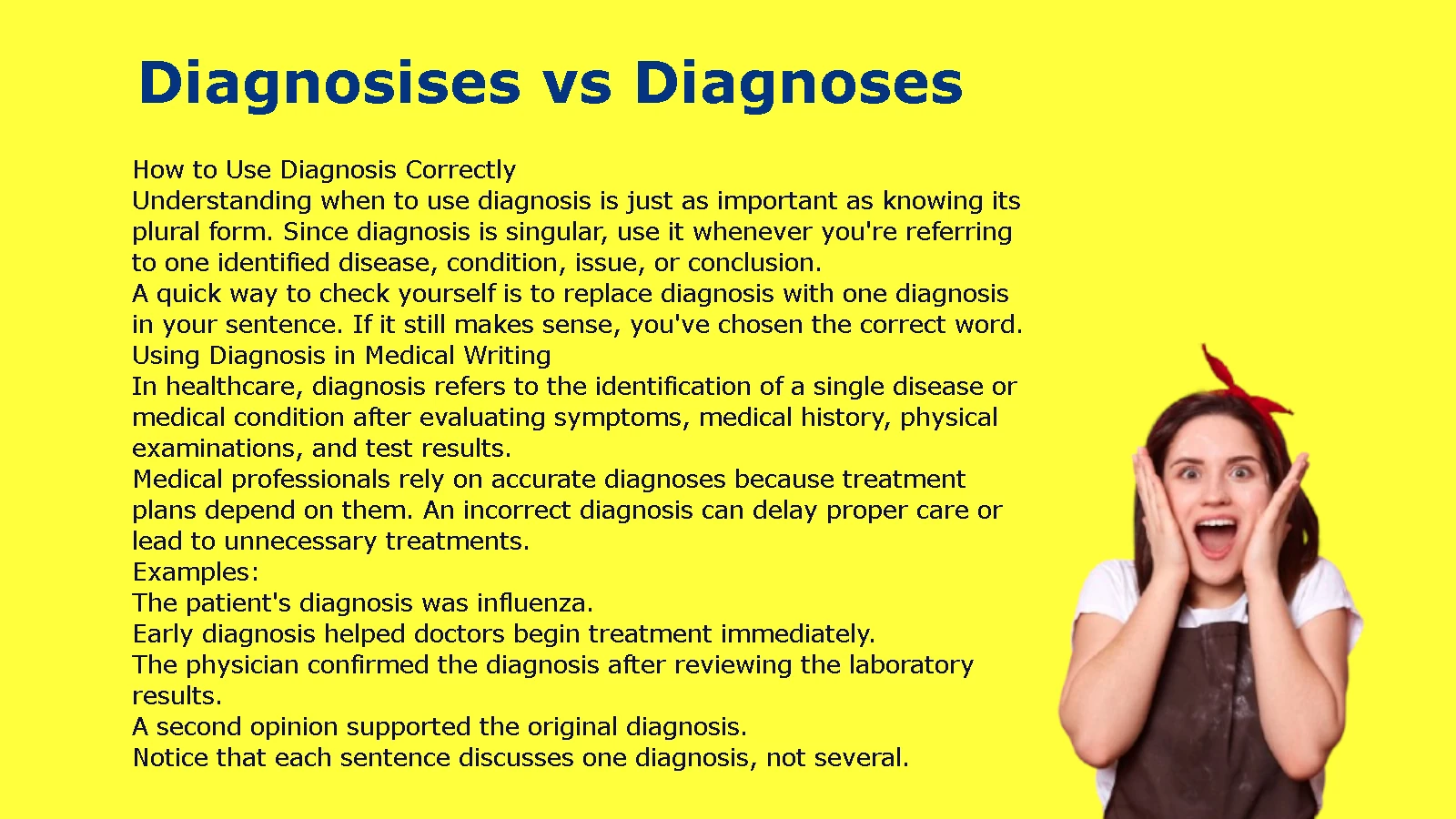
How to Use Diagnosis Correctly
Understanding when to use diagnosis is just as important as knowing its plural form. Since diagnosis is singular, use it whenever you’re referring to one identified disease, condition, issue, or conclusion.
A quick way to check yourself is to replace diagnosis with one diagnosis in your sentence. If it still makes sense, you’ve chosen the correct word.
Using Diagnosis in Medical Writing
In healthcare, diagnosis refers to the identification of a single disease or medical condition after evaluating symptoms, medical history, physical examinations, and test results.
Medical professionals rely on accurate diagnoses because treatment plans depend on them. An incorrect diagnosis can delay proper care or lead to unnecessary treatments.
Examples:
- The patient’s diagnosis was influenza.
- Early diagnosis helped doctors begin treatment immediately.
- The physician confirmed the diagnosis after reviewing the laboratory results.
- A second opinion supported the original diagnosis.
Notice that each sentence discusses one diagnosis, not several.
Using Diagnosis in Everyday Conversation
You don’t have to work in healthcare to use the word correctly.
People often use diagnosis whenever someone identifies the source of a problem.
Examples:
- The mechanic’s diagnosis saved us from an expensive repair.
- The technician completed a full system diagnosis.
- The electrician’s diagnosis revealed faulty wiring.
- The consultant’s diagnosis explained why sales had declined.
Although these examples aren’t medical, the meaning stays the same: someone carefully examined the evidence before identifying the cause.
Using Diagnosis in Academic Writing
Students frequently use diagnosis in essays, research papers, nursing assignments, and healthcare reports.
In formal writing, accuracy matters because diagnosis has a precise meaning.
Examples:
- The study evaluated the accuracy of each diagnosis.
- Researchers compared the initial diagnosis with the final laboratory findings.
- The paper discusses methods that improve diagnostic accuracy.
Academic writing also distinguishes between diagnosis (the conclusion) and diagnostic (an adjective).
Compare these examples:
| Correct | Why It Works |
| Diagnostic test | Diagnostic describes the test. |
| Diagnosis confirmed | Diagnosis is the identified condition. |
Using Diagnosis in Business and Problem-Solving
Many industries borrow medical terminology because the process is similar: gather evidence, identify the problem, then solve it.
Examples include:
- The company’s diagnosis identified supply chain delays.
- The project manager completed a diagnosis of the workflow.
- Our team’s diagnosis uncovered communication gaps.
This figurative use has become common in management, engineering, education, and technology.
How to Use Diagnoses Correctly
Whenever you’re talking about two or more diagnoses, use diagnoses.
The plural doesn’t change the meaning of the word. It simply indicates that multiple identified conditions or conclusions exist.
Referring to Multiple Patients
Healthcare professionals often discuss several patients during meetings or hospital rounds.
Examples:
- The doctors reviewed yesterday’s diagnoses.
- Several diagnoses required additional testing.
- The hospital recorded hundreds of new diagnoses this month.
- The specialist compared multiple diagnoses before reaching a conclusion.
Comparing Different Medical Conditions
Doctors sometimes evaluate several possible explanations before deciding which one best fits the patient’s symptoms.
Examples:
- The physician considered several possible diagnoses.
- Autoimmune disorders often require careful comparison of different diagnoses.
- Similar symptoms can lead to very different diagnoses.
This process is commonly called differential diagnosis, where clinicians compare multiple possible conditions before identifying the correct one.
Research Papers and Healthcare Reports
Medical literature frequently uses the plural because researchers analyze groups of patients rather than individuals.
Examples:
- The report summarized over 500 confirmed diagnoses.
- Researchers reviewed historical diagnoses from five hospitals.
- Electronic health records contained thousands of documented diagnoses.
Large healthcare databases may contain millions of diagnoses collected over many years.
General Non-Medical Examples
The plural also works outside healthcare.
Examples:
- The engineers reached different diagnoses after inspecting the machine.
- Multiple diagnoses explained the software failures.
- The consultants presented several diagnoses for the company’s declining profits.
Again, the idea remains consistent: identify several underlying causes.
Example Sentences
Seeing correct usage in context makes grammar easier to remember.
Correct Examples Using Diagnosis
- The doctor’s diagnosis explained the patient’s symptoms.
- An early diagnosis improved the chances of recovery.
- The mechanic’s diagnosis identified a damaged fuel pump.
- Her diagnosis came after several weeks of testing.
- The specialist confirmed the original diagnosis.
Correct Examples Using Diagnoses
- The medical team reviewed dozens of diagnoses.
- Different diagnoses often require different treatments.
- Researchers compared patient diagnoses from multiple clinics.
- The report listed several confirmed diagnoses.
- Accurate diagnoses improve patient outcomes.
Incorrect Examples and Corrections
| Incorrect Sentence | Correct Sentence |
| Several diagnosises were confirmed. | Several diagnoses were confirmed. |
| The doctor reviewed many diagnosises. | The doctor reviewed many diagnoses. |
| Three diagnosis were recorded. | Three diagnoses were recorded. |
| The patient’s diagnoses was accurate. | The patient’s diagnosis was accurate. |
Notice that some errors involve choosing the wrong singular or plural form rather than simply misspelling the word.
Diagnosis vs Diagnoses Side by Side
The differences become much clearer when you compare the two forms directly.
| Feature | Diagnosis | Diagnoses |
| Meaning | One identified condition or problem | More than one identified condition or problem |
| Number | Singular | Plural |
| Grammar | Singular noun | Plural noun |
| Pronunciation | die-ug-NOH-sis | die-ug-noh-SEEZ |
| Common Usage | One patient or one conclusion | Multiple patients or multiple conclusions |
| Example | The diagnosis was correct. | The diagnoses were reviewed. |
A simple memory trick is to match the verb:
- Diagnosis is
- Diagnoses are
If you’re unsure which form belongs in your sentence, check the verb. It often reveals whether you need the singular or plural noun.
Other Words That Follow the Same Plural Pattern
Diagnosis isn’t unique.
Many English nouns ending in -sis form their plural by changing -sis to -ses.
Here are some of the most common examples.
| Singular | Plural | Meaning |
| Analysis | Analyses | Detailed examination |
| Basis | Bases | Foundation or underlying support |
| Crisis | Crises | Difficult or dangerous situations |
| Thesis | Theses | Academic research paper or proposition |
| Hypothesis | Hypotheses | Proposed explanation |
| Parenthesis | Parentheses | Punctuation marks ( ) |
| Synopsis | Synopses | Brief summaries |
| Oasis | Oases | Fertile areas in deserts |
| Ellipsis | Ellipses | Three-dot punctuation mark (…) |
Once you recognize this pattern, you’ll avoid several common grammar mistakes at once.
Examples of These Plurals
- The editor reviewed several analyses before publishing the report.
- Universities archived hundreds of doctoral theses.
- The organization responded to multiple financial crises.
- Scientists tested numerous hypotheses.
- The author added extra parentheses for clarity.
- The publisher released brief synopses of each chapter.
These words all share the same grammatical pattern because of their Greek origins.
Why Words Ending in -sis Change to -ses
At first glance, the rule looks unusual.
However, it follows a consistent historical pattern.
English has borrowed thousands of words from Ancient Greek over many centuries. Rather than replacing every plural with a regular English ending, many words retained their original plural forms.
That explains why diagnosis becomes diagnoses instead of diagnosises.
A Brief History
Ancient Greek used different grammatical endings than modern English.
When scholars translated scientific, philosophical, and medical texts into English, many Greek nouns kept their traditional plurals.
That’s why English still includes forms such as:
- analysis → analyses
- hypothesis → hypotheses
- diagnosis → diagnoses
Medical vocabulary especially preserves these historical spellings because medicine has long relied on Greek terminology.
Why the Rule Still Exists
Some grammar rules disappear over time.
This one hasn’t.
Modern dictionaries, universities, scientific journals, hospitals, publishers, and style guides continue to use these traditional plurals.
Changing them would create unnecessary confusion across academic and professional writing.
An Easy Memory Trick
Instead of memorizing every word individually, remember one simple pattern.
Words ending in -sis
↓
Replace -sis with -ses
Examples:
Diagnosis → Diagnoses
Analysis → Analyses
Crisis → Crises
Thesis → Theses
Thinking of the ending as a replacement rather than an addition makes the rule much easier to remember.
Common Grammar Mistakes Related to Diagnosis
Even experienced writers occasionally confuse diagnosis and diagnoses.
Fortunately, most mistakes fall into a few predictable categories.
Using the Singular Instead of the Plural
Incorrect:
The doctors reviewed several diagnosis.
Correct:
The doctors reviewed several diagnoses.
Because “several” refers to more than one item, the noun must also be plural.
Writing Diagnosises
This is by far the most common spelling mistake.
Incorrect:
The report contained multiple diagnosises.
Correct:
The report contained multiple diagnoses.
Remember that diagnosises isn’t accepted in standard English.
Matching the Wrong Verb
Subject-verb agreement matters.
Correct:
- The diagnosis is complete.
- The diagnoses are complete.
Incorrect:
- The diagnosis are complete.
- The diagnoses is complete.
The noun and verb should always agree in number.
Confusing Pronunciation With Spelling
Some people spell words exactly as they hear them.
Because diagnoses sounds different from diagnosis, writers sometimes invent spellings like:
- diagnosises
- diagnosiz
- diagnosis
The safest approach is to remember the written rule rather than relying on pronunciation.
Confusing Diagnosis With Similar Words
These related words have different grammatical roles.
| Word | Part of Speech | Meaning |
| Diagnosis | Noun | Identification of a condition |
| Diagnoses | Plural noun | Multiple identified conditions |
| Diagnose | Verb | To identify a condition |
| Diagnosed | Verb (past tense) | Identified in the past |
| Diagnosing | Verb (present participle) | Currently identifying |
| Diagnostic | Adjective | Related to diagnosis |
Examples:
- The doctor diagnosed pneumonia.
- The laboratory performed diagnostic testing.
- The physician confirmed the diagnosis.
- Several diagnoses appeared in the report.
Pronunciation Guide: Diagnosis vs. Diagnoses
Many people spell diagnoses incorrectly because the pronunciation changes along with the spelling. Once you hear both words side by side, the difference becomes much easier to remember.
| Word | IPA Pronunciation | Simple Pronunciation |
| Diagnosis | /ˌdaɪ.əɡˈnoʊ.sɪs/ | die-ug-NOH-sis |
| Diagnoses | /ˌdaɪ.əɡ.noʊˈsiːz/ | die-ug-noh-SEEZ |
Notice that the stress shifts in the plural form. The singular emphasizes NOH, while the plural ends with a stronger SEEZ sound.
Pronunciation examples
Read these aloud to hear the difference.
Singular
- The diagnosis came after several blood tests.
- Her diagnosis explained the persistent symptoms.
- The physician confirmed the diagnosis during the appointment.
Plural
- The doctors reviewed several diagnoses.
- Different diagnoses require different treatment plans.
- The specialists compared multiple diagnoses before making a decision.
Saying both forms aloud a few times helps reinforce both the pronunciation and the spelling.
Common Phrases That Use Diagnosis or Diagnoses
Certain expressions appear frequently in medical, academic, and professional writing. Learning them can help you choose the correct form naturally.
Common phrases with Diagnosis
- Early diagnosis
- Accurate diagnosis
- Medical diagnosis
- Clinical diagnosis
- Final diagnosis
- Initial diagnosis
- Working diagnosis
- Correct diagnosis
- Differential diagnosis
- Prompt diagnosis
Common phrases with Diagnoses
- Multiple diagnoses
- Confirmed diagnoses
- Medical diagnoses
- Competing diagnoses
- Patient diagnoses
- Previous diagnoses
- Different diagnoses
- Reported diagnoses
- Clinical diagnoses
- Rare diagnoses
These combinations appear regularly in hospitals, research papers, textbooks, and healthcare news.
Real-World Examples
The distinction between diagnosis and diagnoses becomes even clearer when you see how professionals use them.
Example: Hospital Patient Record
Imagine a patient arrives at an emergency department with chest pain.
The physician conducts several tests, including:
- A physical examination
- Blood tests
- An electrocardiogram (ECG)
- Medical history review
- Chest imaging
After evaluating all the evidence, the physician reaches one diagnosis.
The medical record may state:
Final diagnosis: Acute pericarditis.
Because only one conclusion appears, the singular form is correct.
Example: Medical Research Study
Now imagine researchers analyze 5,000 hospital records.
Each patient may have one or more medical conditions.
The study might report:
- Respiratory diagnoses
- Cardiovascular diagnoses
- Neurological diagnoses
- Infectious disease diagnoses
Since the researchers discuss many identified conditions, diagnoses is the correct choice.
Example: Automotive Repair Shop
The word also works outside medicine.
A repair shop examines several vehicles experiencing engine problems.
Each mechanic reaches a different conclusion.
Their report may include:
- Battery failure diagnosis
- Fuel injector diagnosis
- Transmission diagnosis
When discussing all of those conclusions together, the report refers to multiple diagnoses.
Quick Memory Tricks
Grammar rules become much easier when you attach them to simple patterns.
Trick 1: Replace, Don’t Add
Instead of adding -es, replace the ending.
Diagnosis
Remove: sis
Add: ses
Diagnoses
Trick 2: Think of Similar Words
If you already know these words, you already know the rule.
| Singular | Plural |
| Analysis | Analyses |
| Crisis | Crises |
| Thesis | Theses |
| Hypothesis | Hypotheses |
| Diagnosis | Diagnoses |
They’re all built the same way.
Trick 3: Match the Verb
A quick grammar check often reveals the correct form.
- Diagnosis is correct.
- Diagnoses are correct.
If your sentence uses are, you’ll almost always need diagnoses.
Trick 4: Count the Number
Ask yourself one question:
Am I talking about one identified condition or several?
If the answer is:
- One → Diagnosis
- More than one → Diagnoses
This simple habit eliminates most mistakes.
Frequently Asked Questions About Diagnosises vs Diagnoses
Is diagnosises ever a correct word?
No. Diagnosises is not considered correct in standard English.
Major dictionaries, medical references, university style guides, and grammar authorities recognize diagnoses as the only accepted plural of diagnosis.
What is the plural of diagnosis?
The plural is diagnoses.
Examples
- One diagnosis
- Two diagnoses
- Several diagnoses
Why doesn’t diagnosis become diagnosises?
Because diagnosis comes from Greek rather than native English.
Instead of adding -es, words ending in -sis typically replace -sis with -ses.
The same rule applies to:
- analysis → analyses
- crisis → crises
- thesis → theses
Is diagnoses singular or plural?
Diagnoses is always plural.
If you’re referring to only one identified condition, use diagnosis.
How do you pronounce diagnoses?
The standard pronunciation is:
die-ug-noh-SEEZ
The ending sounds different from the singular form, which contributes to the spelling confusion.
Can diagnoses refer to non-medical situations?
Yes.
Although the word most commonly appears in healthcare, it also describes identifying problems in many other fields.
Examples include:
- Business consulting
- Information technology
- Engineering
- Automotive repair
- Education
- Organizational management
Whenever several conclusions identify several underlying problems, diagnoses is appropriate.
Is diagnosis a noun or a verb?
Diagnosis is a noun.
The corresponding verb is diagnose.
Compare these examples:
- The doctor diagnosed pneumonia.
- The diagnosis was pneumonia.
- The doctors reviewed multiple diagnoses.
What words follow the same plural rule?
Several common English words use this pattern.
Examples include:
- Analysis → Analyses
- Basis → Bases
- Crisis → Crises
- Thesis → Theses
- Parenthesis → Parentheses
- Hypothesis → Hypotheses
- Synopsis → Synopses
- Ellipsis → Ellipses
Recognizing this family of words makes the grammar rule much easier to remember.
Why do so many people write diagnosises?
Most English nouns simply add -s or -es to become plural.
Because that pattern is so common, many writers naturally apply it to diagnosis. While the mistake is understandable, standard English keeps the traditional Greek plural: diagnoses.
Key Takeaways: Diagnosises vs Diagnoses
Understanding the difference between diagnosises vs diagnoses doesn’t require memorizing dozens of grammar rules. You only need to remember one consistent pattern.
Here’s a quick recap:
- Diagnosis is the singular form.
- Diagnoses is the plural form.
- Diagnosises is not a correct English word.
- Words ending in -sis usually change to -ses in the plural.
- This pattern comes from the words’ Greek origins.
- The rule also applies to analysis, crisis, thesis, hypothesis, parenthesis, and several other English nouns.
- Diagnosis is and diagnoses are provide a quick grammar check.
- The word isn’t limited to medicine. It also appears in engineering, technology, business, education, and many other fields where identifying the cause of a problem matters.
Whether you’re writing a research paper, editing a healthcare document, preparing business reports, or simply improving your grammar, using diagnoses instead of diagnosises shows accuracy and attention to detail. Once you recognize the -sis → -ses pattern, you’ll find it much easier to spell and use these words correctly in every context.