Have you ever seen the word willful spelled as “wilful” and wondered which version is correct? While Willful vs Wilful may look like a simple spelling difference, the answer depends largely on where English is being used and the spelling conventions of that variety of English.
Willful and wilful have the same meaning. Both describe someone who acts intentionally, deliberately, or stubbornly, often despite knowing that their actions are wrong or against the rules. The main difference is that willful is the standard spelling in American English, while wilful is more common in British English and other varieties that follow British spelling conventions.
Examples:
- His willful refusal to follow the rules caused problems.
- The court found that his actions were wilful and deliberate.
The confusion is understandable. People often search for willful vs wilful, willful or wilful, is wilful correct, or willful meaning because both spellings appear in dictionaries, books, legal documents, and everyday writing. And here’s the kicker: neither spelling is inherently wrong. The better choice depends on the English variety and audience you’re writing for.
In this guide, you’ll learn the complete difference between Willful vs Wilful, including their meanings, spelling, pronunciation, usage, examples, and regional differences. You’ll also discover when to use willful or wilful and how these words are used in American and British English.
Willful vs Wilful: Quick Answer
The simplest way to remember willful vs wilful is this:
Willful = American English
Wilful = British English
For example, an American writer might say:
The employee showed willful disregard for the safety rules.
A British writer could write:
The employee showed wilful disregard for the safety rules.
The meaning remains essentially the same. The extra l in willful marks the common American spelling.
Merriam Webster lists willful with wilful as a variant and defines the word as either stubbornly self willed or deliberately done.
Willful vs Wilful at a Glance
| Feature | Willful | Wilful |
| Part of speech | Adjective | Adjective |
| US English | Preferred | Variant |
| British English | Less usual | Preferred |
| Meaning | Same | Same |
| Pronunciation | Essentially the same | Essentially the same |
| Deliberate action | Yes | Yes |
| Stubborn behavior | Yes | Yes |
| Legal usage | Common | Common in British contexts |
| Related adverb | willfully | wilfully |
| Related noun | willfulness | wilfulness |
The important point is consistency. If an article follows American English, use willful, willfully, and willfulness. If it follows British English, use wilful, wilfully, and wilfulness.
What Does Willful Mean?
Willful has two closely related meanings.
First, it can describe something that someone does deliberately or intentionally. In this sense, the person knows what they are doing rather than acting by accident.
For example:
The manager was accused of willful neglect.
Here, willful suggests that the neglect was deliberate rather than accidental.
Second, willful can describe someone who is stubbornly determined to have their own way. This meaning often applies to people whose behavior ignores advice, authority, or reasonable expectations.
For example:
The willful child refused to follow the instructions.
The child isn’t merely independent. The word suggests a degree of stubbornness or defiance.
Oxford gives both meanings. It describes willful as a bad or harmful action done deliberately while also defining it as being determined to do what you want without caring about what others want.
Willful Meaning: Deliberate or Intentional
The first meaning focuses on choice and intention.
If someone knowingly chooses to do something, the action may be described as willful, especially when the action causes harm or violates an expectation.
Consider these examples:
- willful damage
- willful misconduct
- willful neglect
- willful disobedience
- willful disregard
In each phrase, the word suggests that the behavior wasn’t simply an accident.
For instance:
The investigation found evidence of willful damage to the property.
The phrase implies that someone intentionally damaged the property.
That distinction matters. Compare:
The window broke accidentally.
with:
The window was damaged willfully.
The first sentence describes an unintended event. The second suggests deliberate action.
Willful Meaning: Stubborn or Self Willed
The second meaning focuses on personality and behavior.
A willful person tends to insist on doing things their own way. The person may ignore instructions or reject advice even when they understand the consequences.
For example:
Her willful attitude made it difficult for the team to reach an agreement.
Here, willful doesn’t necessarily mean that she committed a specific intentional act of harm. Instead, it highlights her determination to have things her way.
Merriam Webster defines this sense as being “obstinately and often perversely self-willed.”
The word can therefore overlap with terms such as:
- stubborn
- headstrong
- defiant
- obstinate
- self willed
- unruly
- rebellious
However, these words aren’t perfect substitutes in every sentence.
What Does Wilful Mean?
Wilful has the same core meanings as willful. The main difference is spelling.
British English commonly uses wilful where American English uses willful.
For example:
The company was accused of wilful misconduct.
An American writer would normally write:
The company was accused of willful misconduct.
Cambridge describes wilful as the UK spelling of willful. Oxford likewise labels wilful as especially British English and gives willful as the usual North American form.
Wilful Meaning in British English
British English uses wilful for both major senses.
It can describe an action that someone performs intentionally:
The report described the damage as wilful.
It can also describe someone who stubbornly insists on doing what they want:
He was a wilful child who rarely accepted advice.
Cambridge’s definition covers both intentional behavior and a person determined to do exactly what they want even when they know it may be wrong.
So don’t assume that wilful has a special British meaning that willful lacks. The regional spelling changes, not the basic concept.
Willful vs Wilful: Spelling Difference
The difference becomes obvious when you place the words side by side:
willful
wilful
American English keeps the additional l before ful. British English traditionally uses the shorter form wilful.
This pattern also appears in related words:
| American English | British English |
| willful | wilful |
| willfully | wilfully |
| willfulness | wilfulness |
The distinction isn’t about pronunciation. It is mainly a matter of regional spelling convention.
Merriam Webster recognizes wilful as a variant of willful and lists willfully and willfulness as related forms.
Why Does the Spelling Look Different?
The word comes from will + ful, with will referring to desire, intention, or determination. Oxford traces the word to Middle English and gives its word origin as the noun will plus the suffix -ful.
English spelling developed differently across regions over time. American English adopted a number of spelling preferences that differ from British conventions. Words such as color/colour, favor/favour, and behavior/behaviour are familiar examples.
Willful/wilful follows a similar regional pattern, although its spelling history has its own details.
The practical lesson is much simpler than the history:
Use the spelling that matches your English variety.
Is Willful or Wilful Correct?
Both are correct.
The correct choice depends on the variety of English you are writing.
Use willful when writing standard American English. Use wilful when following standard British English conventions.
Cambridge explicitly labels willful as the US spelling of wilful and labels wilful as the UK spelling of willful.
Use Willful in American English
Choose willful for:
- US business writing
- American academic writing
- US news writing
- American websites
- US legal writing
- General American English
Examples:
- willful misconduct
- willful neglect
- willful disregard
- willful violation
- willful disobedience
Use Wilful in British English
Choose wilful for:
- UK business writing
- British publications
- British academic writing
- UK focused websites
- British legal writing
- General British English
Examples:
- wilful misconduct
- wilful neglect
- wilful disregard
- wilful violation
- wilful disobedience
The safest approach is to follow the style guide or regional convention that governs your document.
Willful vs Wilful in American and British English
The difference becomes easier to understand when you look at actual sentence pairs.
| American English | British English |
| His willful disregard caused problems. | His wilful disregard caused problems. |
| The company admitted willful misconduct. | The company admitted wilful misconduct. |
| She was accused of willful neglect. | She was accused of wilful neglect. |
| The act was willful, not accidental. | The act was wilful, not accidental. |
| He willfully ignored the warning. | He wilfully ignored the warning. |
Nothing fundamental changes when you switch between the two versions.
The spelling simply follows the regional form of English.
Is Willful Used Outside the United States?
Yes. English doesn’t always respect neat national borders.
Dictionaries can list regional variants even when a particular spelling is more strongly associated with one variety. Merriam Webster, for example, lists wilful as a variant of willful. Collins likewise identifies willful as the American form and wilful as the British form.
That means a writer may encounter either spelling outside its strongest regional association.
However, when the goal is polished regional English, consistency matters more than pretending one spelling never appears elsewhere.
Willful vs Wilful Pronunciation
The spelling difference usually doesn’t create a meaningful pronunciation difference.
Both words are pronounced approximately like:
WILL ful
Cambridge gives essentially the same pronunciation for the US and UK forms.
You can think of the pronunciation as two parts:
- will
- ful
The extra l in the American spelling doesn’t mean you should add a new syllable.
Pronunciation in a Sentence
Try these aloud:
That was a willful decision.
That was a wilful decision.
The words sound essentially the same in normal speech.
That’s one reason the spelling question often appears in writing rather than conversation. When someone says the word aloud, you generally can’t tell which spelling they would put on the page.
Willful vs Wilful Examples in Sentences
Seeing the words in context makes the distinction much easier.
Willful Examples
Willful can describe deliberate behavior:
The court considered the violation willful rather than accidental.
Here, willful emphasizes intention.
The company faced criticism for its willful disregard of safety standards.
The company allegedly ignored safety concerns deliberately.
The report found evidence of willful damage to public property.
The damage wasn’t treated as an accident.
It can also describe stubborn behavior:
The willful student refused to follow the teacher’s instructions.
Her willful refusal to compromise delayed the negotiations.
In both cases, the word suggests determination to have one’s own way.
Wilful Examples
British English can express the same ideas with wilful:
The court found evidence of wilful neglect.
The report criticized the council for wilful disregard of the problem.
The damage appeared to be wilful rather than accidental.
He was a wilful child who disliked being told what to do.
Her wilful refusal to cooperate created unnecessary delays.
Notice the pattern. The meaning stays intact while the spelling changes.
Willful vs Wilful in Legal Writing
Legal writing makes this distinction especially useful because willful appears frequently in phrases involving deliberate conduct.
Merriam Webster’s legal definition describes willful as something that is not accidental and is done deliberately or knowingly, often with conscious violation or disregard of a law, duty, or another person’s rights.
Examples include:
- willful injury
- willful misconduct
- willful violation
- willful disregard
- willful neglect
British legal writing can use the corresponding wilful forms.
Why Intent Matters in Legal Contexts
Consider two situations.
Situation A: A person accidentally damages another person’s property.
Situation B: A person deliberately damages the property after being warned not to.
The second situation may be described as willful or wilful depending on the jurisdiction and writing convention.
That’s an important distinction because willful often signals intent rather than accident.
However, legal writers should be careful here. The exact meaning of willful can depend on the particular law, regulation, contract, or jurisdiction. A dictionary definition gives the general meaning, but it doesn’t automatically establish the legal test used in every case.
A Simple Legal Example
The employee’s conduct was described as willful misconduct.
In American English, this spelling is natural.
A British English document might use:
The employee’s conduct was described as wilful misconduct.
The spelling follows the regional convention, while the underlying idea remains deliberate or seriously improper conduct.
Willful vs Wilful: Common Phrases
These words often appear in predictable combinations.
| American spelling | British spelling | General idea |
| willful misconduct | wilful misconduct | Deliberate improper conduct |
| willful neglect | wilful neglect | Deliberate failure to provide proper care or attention |
| willful disregard | wilful disregard | Deliberately ignoring something important |
| willful damage | wilful damage | Intentional damage |
| willful disobedience | wilful disobedience | Deliberate refusal to obey |
| willful violation | wilful violation | Deliberate breach of a rule or law |
| willfully ignored | wilfully ignored | Ignored deliberately |
| willfulness | wilfulness | The quality of being willful |
Oxford specifically gives willful damage as an example and also uses wilful damage in its British English entry.
Willful Disregard vs Wilful Disregard
This is one of the most common combinations.
American:
The driver showed willful disregard for public safety.
British:
The driver showed wilful disregard for public safety.
The phrase means that the person deliberately ignored something they should have taken seriously.
Cambridge gives examples involving willful disregard and wilful disregard, including disregard of facts or personal health.
Willfully vs Wilfully
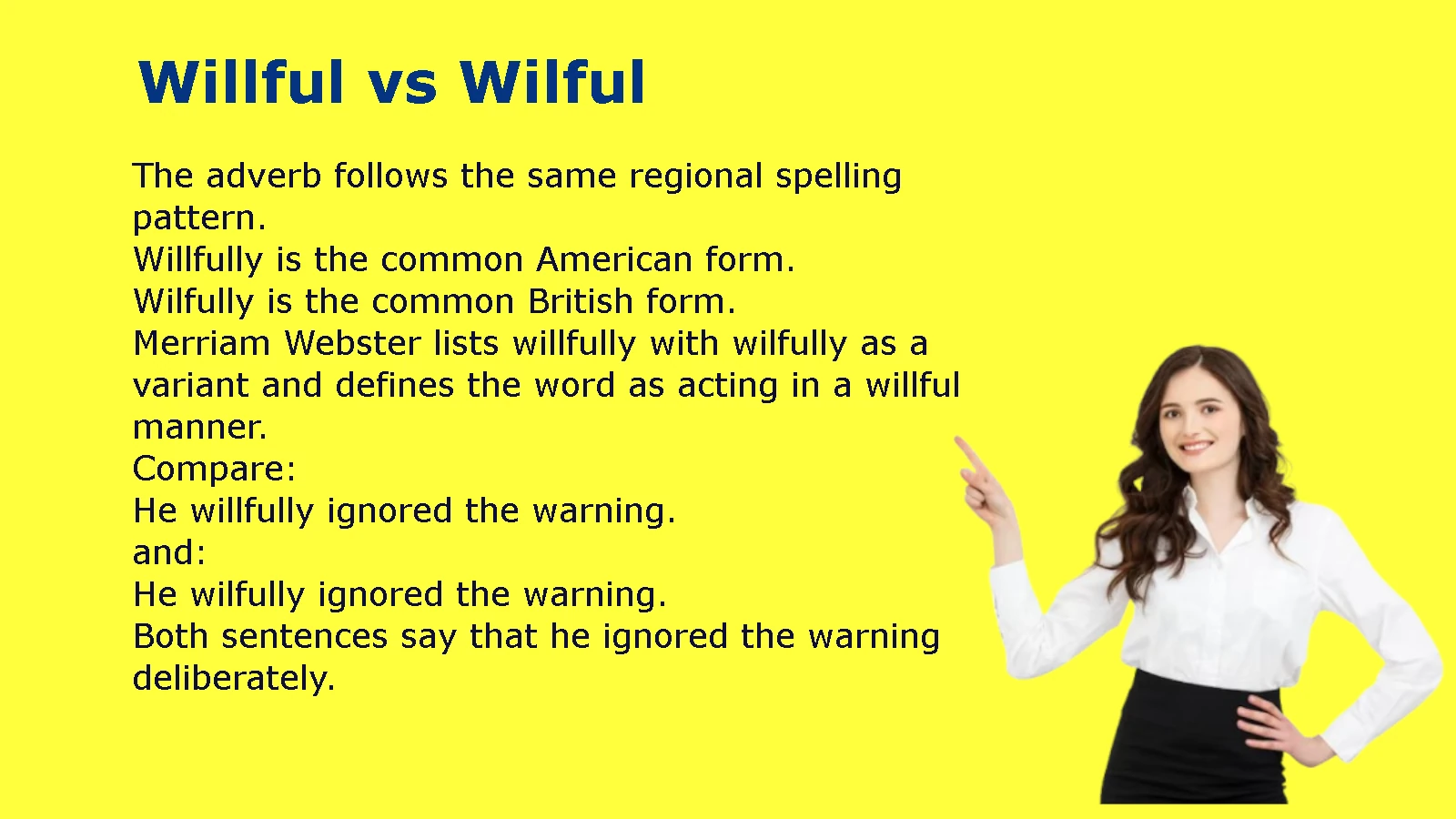
The adverb follows the same regional spelling pattern.
Willfully is the common American form.
Wilfully is the common British form.
Merriam Webster lists willfully with wilfully as a variant and defines the word as acting in a willful manner.
Compare:
He willfully ignored the warning.
and:
He wilfully ignored the warning.
Both sentences say that he ignored the warning deliberately.
Willfully Examples
- She willfully ignored the instructions.
- He willfully refused to cooperate.
- The company willfully violated the agreement.
- They willfully overlooked the obvious risks.
Wilfully Examples
- She wilfully ignored the instructions.
- He wilfully refused to cooperate.
- The company wilfully violated the agreement.
- They wilfully overlooked the obvious risks.
The only change is the spelling.
Willfulness vs Wilfulness
The noun forms follow the same pattern:
- willfulness — American English
- wilfulness — British English
The word refers to the quality or state of being willful. Merriam Webster lists willfulness with wilfulness as a variant.
For example:
The manager’s willfulness made the dispute harder to resolve.
A British English writer might use:
The manager’s wilfulness made the dispute harder to resolve.
Again, the meaning remains the same.
The Complete Word Family
| US English | British English |
| willful | wilful |
| willfully | wilfully |
| willfulness | wilfulness |
Learning the entire group is useful because it prevents a common problem: changing the main adjective while accidentally keeping the other forms in the wrong regional style.
Willed can describe something that someone intentionally chose or brought about through conscious effort.
Compare:
He made a willful decision to ignore the rules.
The word suggests deliberate choice and possibly defiance.
Now consider:
The athlete’s recovery was largely willed through determination and discipline.
Here, willed emphasizes conscious effort or determination.
So while both words connect to the idea of will, they perform different jobs in a sentence.
Willful vs Stubborn: Are They the Same?
Not quite.
Stubborn usually means unwilling to change your mind, behavior, or position. Willful can describe that same resistance, but it can carry an additional sense of deliberate or defiant behavior.
Consider:
She was stubborn about changing her plans.
This tells you she resisted changing her mind.
Now:
She was willful about following her own plans.
This can suggest a stronger determination to do exactly what she wants, perhaps despite advice or rules.
Merriam Webster’s synonym discussion places willful alongside words such as headstrong, recalcitrant, and intractable, while distinguishing their shades of meaning.
Willful and Stubborn in Context
| Word | Main emphasis |
| willful | Deliberate behavior or determined self direction |
| stubborn | Refusal to change |
| headstrong | Strongly self directed, often without enough regard for advice |
| defiant | Open resistance to authority |
| obstinate | Firm and unreasonable refusal to change |
This distinction matters when choosing the most precise word.
Case Study: Choosing the Right Spelling
Imagine an American company preparing a compliance report.
The report contains this sentence:
The investigation found willful disregard of the company’s safety procedures.
That spelling fits American English.
Now imagine the same report is rewritten for a British publication:
The investigation found wilful disregard of the company’s safety procedures.
The underlying statement hasn’t changed. The regional spelling has.
This illustrates the practical rule better than any memorization trick:
The audience determines the spelling.
If your publication uses US English, stick with willful. If it uses British English, use wilful.
How to Remember Willful vs Wilful
Here’s the easiest memory trick:
US → willful
UK → wilful
Think of the American spelling as the version that keeps the complete will before ful:
will + ful = willful
The British spelling drops one l:
wil + ful = wilful
You don’t need to memorize a complicated rule. Just remember the regional pair.
A Quick Memory Test
Ask yourself:
Am I writing in American English?
If yes:
willful
Am I writing in British English?
If yes:
wilful
Then apply the same pattern to the related forms:
willfully → wilfully
willfulness → wilfulness
Which Spelling Should You Use?
The best spelling depends on your audience, publication, employer, school, or style guide.
Use Willful When Writing for a US Audience
Choose willful in:
- American English articles
- US business documents
- American academic papers
- US websites
- American legal documents
- General US communication
For example:
The company denied any willful violation of the policy.
Use Wilful When Writing for a British Audience
Choose wilful in:
- British English articles
- UK publications
- British business documents
- British academic writing
- UK focused websites
- British legal writing
For example:
The company denied any wilful violation of the policy.
What If Your Audience Is International?
When writing for an international audience, the most important thing is consistency.
If the website uses American English throughout, use willful. If it uses British English throughout, use wilful.
Don’t switch between the forms simply because you encountered one spelling in another source.
For example, an American English article should generally avoid this inconsistent pattern:
The company showed willful disregard, but later described its wilful actions as accidental.
If there is no reason to preserve a quotation or source’s original spelling, use one regional convention consistently:
The company showed willful disregard, but later described its willful actions as accidental.
Consistency makes your writing look deliberate and polished.
Common Mistakes With Willful and Wilful
A few mistakes appear repeatedly when writers encounter these two forms.
Mistake: Treating Them as Different Words
Some writers assume willful and wilful have different definitions.
They don’t have different core meanings simply because they use different spellings.
Correction: Treat them as regional spelling variants.
Mistake: Calling Wilful Incorrect
It isn’t incorrect.
Wilful is a standard British English spelling. Cambridge and Oxford both recognize it as the British form.
Mistake: Calling Willful Incorrect
That isn’t correct either.
Willful is the standard American spelling and is also recognized by dictionaries as a variant of wilful.
Mistake: Mixing Regional Forms
Using willful in one paragraph and wilful in the next can make your writing look inconsistent.
Unless you’re quoting a source or discussing spelling differences, choose one form and stick with it.
Mistake: Assuming Willful Always Means Stubborn
The word has another important meaning: deliberate or intentional.
For example:
The company engaged in willful misconduct.
Here, the focus is on deliberate conduct, not simply a stubborn personality.
Facts About Willful and Wilful
Here are the key facts worth remembering:
- Willful is the common American English spelling.
- Wilful is especially associated with British English.
- Both forms function as adjectives.
- Both can mean deliberate or intentional.
- Both can describe someone who is stubbornly self willed.
- The spelling difference doesn’t normally change pronunciation.
- Willfully is the American form.
- Wilfully is the British form.
- Willfulness and wilfulness are corresponding noun forms.
- The word dates back to Middle English. Merriam Webster gives the first known use of willful as the 13th century.
- Oxford traces the word to will + -ful.
- The word frequently appears in formal and legal contexts, especially when describing deliberate conduct.
Frequently Asked Questions About Willful vs Wilful
Is willful American or British?
Willful is the standard American English spelling. British English generally uses wilful. Cambridge and Oxford both identify the regional distinction.
Is wilful British or American?
Wilful is especially associated with British English. American English generally prefers willful.
Do willful and wilful mean the same thing?
Yes. Both can mean deliberate or intentional, and both can describe someone who is stubbornly determined to do what they want.
Is willful spelled with one L or two?
In standard American English, the spelling is willful, with two l’s in the first part of the word. British English commonly uses wilful, with one l before ful.
Is willfully or wilfully correct?
Both are correct regional forms.
Willfully is the common American spelling.
Wilfully is the common British spelling. Merriam Webster lists them as variants.
Is willfulness or wilfulness correct?
Both are recognized.
Willfulness is the common American form, while wilfulness is the British form. Merriam Webster lists wilfulness as a variant of willfulness.
Which spelling should I use in American English?
Use willful.
For example:
The employee showed willful disregard for the company’s policy.
Which spelling should I use in British English?
Use wilful.
For example:
The employee showed wilful disregard for the company’s policy.
Does willful mean stubborn?
It can.
When willful describes a person, it can mean stubbornly determined to have their own way. However, it can also describe an action that was done deliberately.
Does willful mean intentional?
Yes. One of its main meanings is done deliberately or intentionally, especially when the action is bad or harmful.
Is willful a negative word?
Often, yes.
The word frequently carries a disapproving tone, particularly when it describes deliberate wrongdoing, neglect, disregard, or stubborn behavior. Oxford and Cambridge both mark the relevant definitions as disapproving.
However, the exact tone depends on context.
Willful vs Wilful: Final Verdict
The difference between willful vs wilful is much simpler than it first appears.
Willful is the standard American English spelling.
Wilful is the standard British English spelling.
Both words have the same basic meanings. They can describe something done deliberately or intentionally, or someone who is stubbornly determined to do what they want.
| If you’re writing in… | Use… |
| American English | willful |
| British English | wilful |
The same regional pattern continues through the word family:
- willful → wilful
- willfully → wilfully
- willfulness → wilfulness
So when you’re deciding between willful and wilful, don’t ask which one is universally correct. Ask which variety of English you’re using.
For US English, choose willful. For British English, choose wilful. Once that simple distinction is clear, the spelling choice becomes a piece of cake.