Have you ever written “dreamed” or “dreamt” and wondered which one is correct? While Dreamed vs Dreamt can seem confusing, both forms are correct past tense and past participle forms of the verb dream. The main difference is how they are used and where they are more common.
Dreamed and dreamt both mean experienced dreams while sleeping or imagined or hoped for something. However, dreamed is more common in American English, while dreamt is more common in British English and other varieties of English.
Examples:
- I dreamed about traveling around the world.
- I dreamt about traveling around the world.
The confusion is understandable. People often search for dreamed vs dreamt, is dreamed or dreamt correct, dreamed or dreamt in American English, and what is the difference between dreamed and dreamt because the two words have the same basic meaning but differ in frequency and regional preference.
In this guide, you’ll learn the complete difference between dreamed and dreamt, including their meaning, pronunciation, grammar, usage, examples in sentences, and which form is preferred in American and British English. You’ll also discover whether dreamed or dreamt is better for formal writing and how to choose the right form with confidence.
Dreamed vs Dreamt: Quick Answer
Dreamed and dreamt have the same basic meaning and perform the same grammatical functions.
| Word | Grammatical role | Meaning | Typical usage |
| Dreamed | Past tense and past participle | Past form of dream | Standard and especially common in US English |
| Dreamt | Past tense and past participle | Past form of dream | Common in British English and also valid elsewhere |
For example:
- I dreamed about my old school.
- I dreamt about my old school.
Both sentences mean the same thing.
The important distinction is that dreamed is the regular form, formed with -ed, while dreamt is an irregular form. Both have been used in English for centuries. Merriam Webster notes that both forms date back to at least the 14th century.
If you’re writing for a general US English audience, dreamed is usually the best choice.
What Does “Dreamed” Mean?
Dreamed is the regular past tense and past participle of dream. It can describe something you experienced while sleeping or something you imagined, hoped for, or considered possible while awake.
Merriam Webster defines dream as having thoughts, images, or emotions while sleeping. The verb can also mean imagining something or thinking about a desired possibility.
Dreamed as the Past Tense of Dream
Use dreamed when you’re describing a completed event in the past.
For example:
- I dreamed about flying last night.
- She dreamed that she was walking through a forest.
- We dreamed about our old house.
- He dreamed of becoming a professional musician.
- They dreamed about winning the championship.
In each sentence, the action happened in the past.
You don’t need a helping verb with the simple past:
I dreamed about you last night.
That’s complete.
Dreamed as a Past Participle
Dreamed can also work as a past participle. In that role, it typically appears with have, has, or had.
Examples include:
- I have dreamed about that place before.
- She has dreamed of becoming a doctor since childhood.
- They had dreamed of opening a restaurant for years.
- He has never dreamed of living abroad.
The meaning doesn’t change simply because the grammar changes. The tense tells you when the experience or thought relates to the present or another point in the past.
What Does “Dreamt” Mean?
Dreamt is the irregular past tense and past participle form of dream.
It has the same basic meaning as dreamed.
For example:
- I dreamt about my childhood home.
- She dreamt of becoming an artist.
- We dreamt about the trip for months.
- He had dreamt of that moment for years.
Cambridge and Merriam Webster both recognize dreamt as a legitimate form of dream.
Dreamt as the Past Tense
Use dreamt to describe a completed past experience:
I dreamt about the ocean last night.
You could replace dreamt with dreamed without changing the meaning:
I dreamed about the ocean last night.
Both work.
Dreamt as a Past Participle
You can also use dreamt with have, has, or had:
- I have dreamt about that place before.
- She has dreamt of becoming a writer since she was young.
- They had dreamt of that opportunity for years.
Again, the meaning remains essentially the same as with dreamed.
Dreamed vs Dreamt in American English
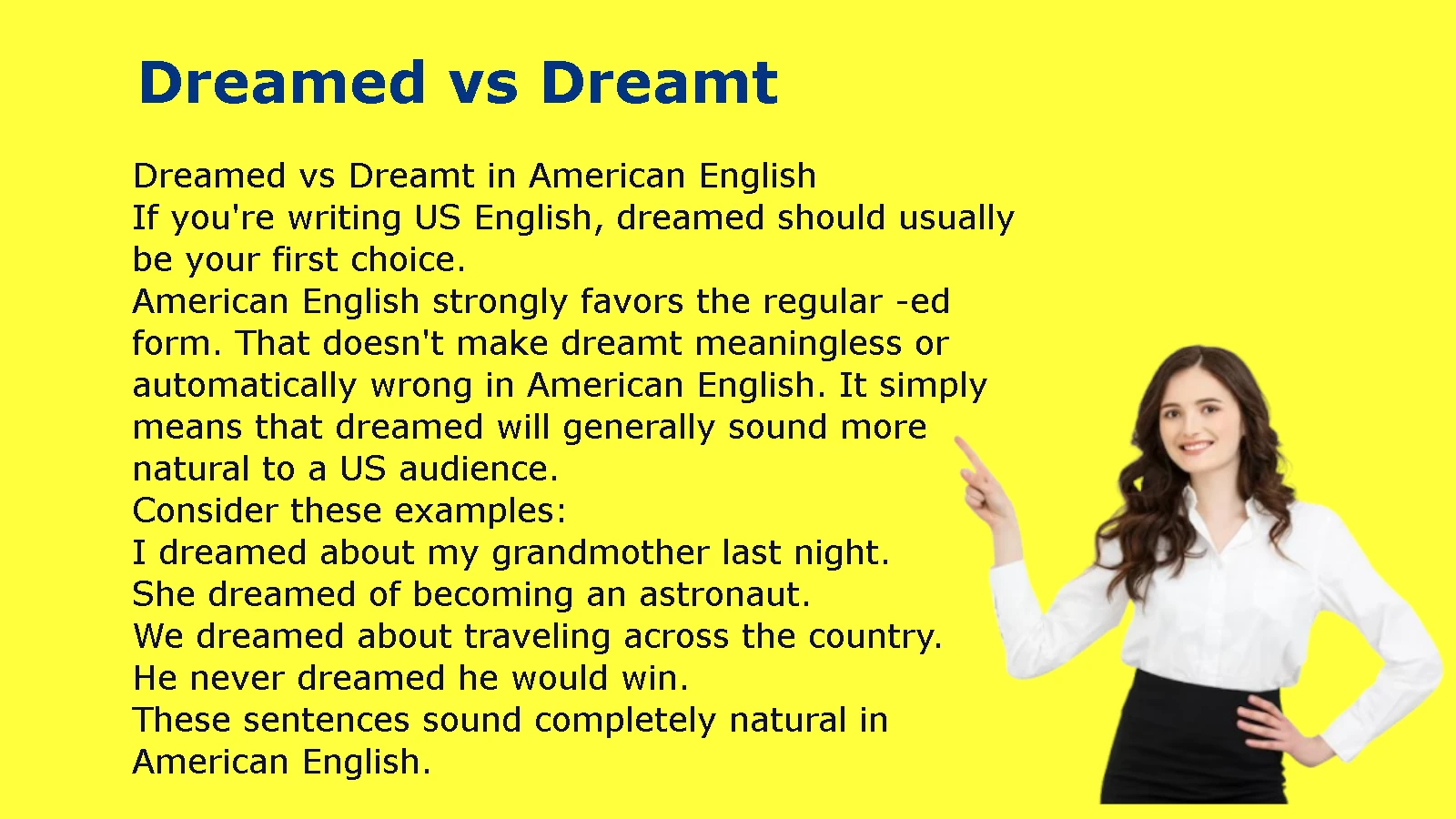
If you’re writing US English, dreamed should usually be your first choice.
American English strongly favors the regular -ed form. That doesn’t make dreamt meaningless or automatically wrong in American English. It simply means that dreamed will generally sound more natural to a US audience.
Consider these examples:
- I dreamed about my grandmother last night.
- She dreamed of becoming an astronaut.
- We dreamed about traveling across the country.
- He never dreamed he would win.
These sentences sound completely natural in American English.
Is Dreamt Wrong in American English?
No.
It’s better to say that dreamt is less common in US English rather than claiming that Americans cannot use it.
Dictionaries recognize dreamt as a valid form. Merriam Webster lists dreamed and dreamt together as the past forms of dream.
So this sentence isn’t grammatically broken:
I dreamt about the beach last night.
However, if your goal is to follow conventional US English, I dreamed about the beach last night is the more natural default.
Dreamed vs Dreamt in British English
British English gives you more flexibility.
Both dreamed and dreamt are used in British English. Although dreamt has a strong British association, it would be misleading to say that British speakers always use dreamt. Current usage includes both forms.
For example, a British English speaker could naturally write:
I dreamed about the house last night.
Or:
I dreamt about the house last night.
Neither sentence creates a grammatical problem.
This makes dreamed vs dreamt different from some spelling differences where one form is strongly tied to one variety of English. Here, the two forms overlap considerably.
Are “Dreamed” and “Dreamt” Both Correct?
Yes.
This is the most important fact to remember.
Both forms function as:
- the simple past of dream
- the past participle of dream
Merriam Webster explicitly describes dreamed and dreamt as acceptable past tense forms. Its dictionary also lists both forms under the verb dream.
So these are all correct:
- I dreamed about it.
- I dreamt about it.
- I have dreamed about it before.
- I have dreamt about it before.
- She had dreamed of success.
- She had dreamt of success.
The question isn’t really “Which one is grammatically correct?”
The better question is:
“Which one fits my variety of English and writing style?”
Dreamed vs Dreamt: Meaning and Grammar
Neither form has a special meaning that the other lacks.
You can use both to describe sleeping dreams.
Experiencing a Dream While Sleeping
Examples:
- I dreamed about a giant dog.
- I dreamt about a giant dog.
Both mean that the speaker experienced a dream involving a giant dog.
You can also use dream that:
- She dreamed that she could fly.
- She dreamt that she could fly.
The same applies to dream about:
- He dreamed about his childhood.
- He dreamt about his childhood.
Imagining or Hoping for Something
Dream also refers to ambitions and wishes.
For example:
- She dreamed of becoming a surgeon.
- She dreamt of becoming a surgeon.
Both mean that becoming a surgeon was her ambition.
You can also say:
- He dreamed of owning a small farm.
- He dreamt of owning a small farm.
The choice between dreamed and dreamt doesn’t change the ambition itself.
Dreamed vs Dreamt in Different Verb Tenses
Understanding the basic verb pattern makes this distinction much easier.
| Tense | Example |
| Present | I dream about the future. |
| Simple past | I dreamed/dreamt about the future. |
| Present perfect | I have dreamed/dreamt about it before. |
| Past perfect | I had dreamed/dreamt about that moment. |
| Present continuous | I am dreaming about my future. |
Notice something important: dreamed and dreamt don’t represent different tenses.
Both can serve as the simple past.
Both can also serve as the past participle.
The difference lies in form and usage, not tense.
Dreamed vs Dreamt in Common Expressions
The verb dream appears in several common constructions. Both past forms can usually work in these expressions.
Dreamed or Dreamt Of
Use dream of when you mean to hope for, imagine, or strongly desire something.
Examples:
- She dreamed of becoming a writer.
- She dreamt of becoming a writer.
- He dreamed of owning his own company.
- He dreamt of owning his own company.
- They had dreamed of traveling the world.
- They had dreamt of traveling the world.
This construction often appears when talking about ambitions.
Dreamed or Dreamt About
Use dream about when you’re referring to the subject or content of a dream.
Examples:
- I dreamed about my old school.
- I dreamt about my old school.
- She dreamed about winning the race.
- She dreamt about winning the race.
In everyday speech, dream about is especially common when describing something that appeared in a sleep dream.
Dreamed or Dreamt Up
There’s another useful expression: dream up.
It means to invent, imagine, or come up with an idea, often an unusual one.
For example:
- They dreamed up a clever solution.
- They dreamt up a clever solution.
- She dreamed up an elaborate plan.
- She dreamt up an elaborate plan.
Both forms are correct in this phrasal verb.
The meaning here has nothing to do with sleeping.
The engineers dreamed up a new way to solve the problem.
Here, dreamed up means invented or imagined.
Dreamed vs Dreamt Examples in Sentences
Seeing the two forms side by side makes the difference much clearer.
Talking About Sleep
- I dreamed about my childhood home last night.
- I dreamt about my childhood home last night.
About an Ambition
- She dreamed of becoming a pilot.
- She dreamt of becoming a pilot.
Unexpected Experience
- He never dreamed that he would meet his favorite actor.
- He never dreamt that he would meet his favorite actor.
Long Term Goal
- They had dreamed of opening a bakery.
- They had dreamt of opening a bakery.
About an Idea
- Someone dreamed up this strange invention.
- Someone dreamt up this strange invention.
Talking About a Past Hope
- I dreamed of visiting Japan when I was a child.
- I dreamt of visiting Japan when I was a child.
The meaning remains the same in each pair.
When Should You Use “Dreamed”?
Choose dreamed when you want the safest option for US English.
It’s especially useful when you’re writing:
- American English articles
- Academic assignments
- Business documents
- Professional emails
- General web content
- Educational material
- News or informational writing
- Content for an international audience that follows US English conventions
For example:
She dreamed of becoming a scientist from an early age.
This sounds natural, straightforward, and familiar to American readers.
Why “Dreamed” Works Well in US English
English has a strong tendency to turn older irregular forms into regular -ed forms. Merriam Webster explains that dreamed follows the regular verb pattern while dreamt preserves an irregular form.
You can see the same broad pattern in other verbs that have competing forms.
For practical writing, however, there’s no need to memorize the history. Just remember:
US English → dreamed is the usual default.
When Should You Use “Dreamt”?
Use dreamt when it fits the variety or style of English you’re writing.
It can make sense when:
- You’re writing in British English.
- Your audience commonly uses British English.
- You’re following an established regional style.
- You’re writing dialogue for a character whose speech naturally uses the form.
- You’re maintaining consistency with surrounding text.
For example:
I dreamt of seeing the northern lights as a child.
That sentence is perfectly grammatical.
However, don’t assume that dreamt automatically sounds more elegant, poetic, or formal. Writers sometimes associate the shorter form with literary language, but that isn’t a grammatical rule.
Dreamed vs Dreamt: Which Is More Common?
Dreamed is more common overall.
Current language guidance and dictionary evidence support the idea that dreamed has become the dominant form, while dreamt remains in active use. LanguageTool notes that dreamed is the more common variant in both British and American English, although dreamt has a stronger association with British English.
Merriam Webster also describes the historical movement toward dreamed while noting that both forms remain in use.
This matters because a common oversimplification says:
Dreamed = American English
Dreamt = British English
That’s useful as a quick learner’s rule, but it isn’t completely accurate.
A better explanation is:
Dreamed is the dominant general form, especially in US English, while dreamt remains a well established alternative with particularly strong use in British English.
That distinction gives you a more accurate picture of real English usage.
Why Are There Two Past Tenses of “Dream”?
The answer comes from the way English verbs have changed over time.
English contains both regular and irregular verbs. Regular verbs typically form the past tense by adding -ed:
- walk → walked
- talk → talked
- work → worked
- dream → dreamed
Irregular verbs don’t always follow that pattern:
- sing → sang
- write → wrote
- take → took
- dream → dreamt
But dream is unusual because both patterns survived.
Merriam Webster reports that both dreamed and dreamt have existed as past forms since the 14th century.
A Brief Historical Look
The verb dream has a long history in English. Merriam Webster traces the noun to the 13th century and the verb to the 14th century. Its deeper history connects the modern word with Old English and Old Norse forms.
Literature also shows that writers have used both forms for centuries.
Merriam Webster points out that Shakespeare used dreamt in Romeo and Juliet but also used dreamed elsewhere. Later writers likewise varied between the two forms.
So neither form represents a modern invention.
They’re both part of the long story of English.
Dreamed vs Dreamt in Formal and Informal Writing
Neither form is inherently grammatically more formal.
The better choice depends on your audience.
| Writing situation | Best practical choice |
| US academic writing | Dreamed |
| US business writing | Dreamed |
| US website content | Dreamed |
| General American English | Dreamed |
| British English | Dreamed or dreamt |
| British casual writing | Dreamed or dreamt |
| Literary writing | Either, depending on style |
| Character dialogue | Match the character’s natural variety |
For a US English article, dreamed gives you the most natural default.
For British English, you have more freedom.
Dreamed vs Dreamt: Common Mistakes
A few misconceptions cause most of the confusion.
Mistake: Thinking Dreamt Is Incorrect
It’s not.
Dreamt is a recognized past tense and past participle of dream. Major dictionaries list it as a valid form.
Mistake: Thinking Dreamed Is Incorrect
It isn’t.
Dreamed is also completely correct. In fact, it’s the standard choice for many US English contexts.
Mistake: Assuming Dreamt Is Always British
That’s too simple.
British English uses dreamt frequently, but British speakers also use dreamed. Current usage doesn’t support treating the two forms as an absolute regional divide.
Mistake: Thinking They Have Different Meanings
They don’t normally have different meanings.
Compare:
She dreamed of becoming a teacher.
and
She dreamt of becoming a teacher.
The meaning is the same.
Mistake: Assuming Dreamt Is More Formal
There’s no grammatical rule that makes dreamt more formal.
A writer may choose it for stylistic or regional reasons, but the word itself doesn’t automatically create a formal tone.
Dreamed vs Dreamt: A Practical Case Study
Imagine an American writer preparing a business article about career goals.
The writer has two possible sentences:
Many employees dreamed of starting their own businesses.
or:
Many employees dreamt of starting their own businesses.
Both are grammatically valid.
However, because the article follows US English conventions, dreamed will generally feel more natural to the intended audience.
Now imagine the same sentence in a British publication:
Many employees dreamt of starting their own businesses.
That version fits naturally as well.
The lesson isn’t that one sentence is right and the other is wrong. The lesson is that regional consistency matters more than choosing a supposedly “correct” form.
Case Study: A Global Website
Suppose a website publishes content for readers in the United States, Canada, India, the Philippines, and other English speaking markets.
The editor has two choices:
- Switch between dreamed and dreamt depending on the paragraph.
- Choose one form and use it consistently.
The second approach usually creates cleaner editorial style.
If the website follows US English, dreamed makes a strong default because it is familiar and widely accepted.
Dreamed vs Dreamt vs Dream
These three forms aren’t interchangeable.
| Form | Function | Example |
| Dream | Base/present form | I dream about the future. |
| Dreamed | Past and past participle | I dreamed about it last night. |
| Dreamt | Past and past participle | I dreamt about it last night. |
| Dreaming | Present participle/gerund | I am dreaming about the trip. |
The key point is that dreamed and dreamt occupy the same past tense and past participle positions.
For example:
Present:
I dream about becoming a writer.
Past:
I dreamed about becoming a writer.
or:
I dreamt about becoming a writer.
Present perfect:
I have dreamed about becoming a writer.
or:
I have dreamt about becoming a writer.
The verb changes according to tense, but the two past forms remain alternatives.
Dreamed or Dreamt: Which One Should You Use?
If you’re still unsure, use this simple decision guide.
Writing in US English?
Choose dreamed.
I dreamed about the trip last night.
Writing in British English?
Either dreamed or dreamt can work.
I dreamt about the trip last night.
Following a Style Guide?
Follow the style guide’s preferred usage.
Consistency matters more than personal preference.
Writing Dialogue?
Think about the character.
If the character naturally speaks British English, dreamt may fit. If the character speaks American English, dreamed will usually sound more natural.
Writing for a Mixed International Audience?
If the content follows US English conventions, dreamed is a clear and safe choice.
Dreamed vs Dreamt: Quick Facts
Here are the key facts worth remembering:
- Dreamed and dreamt are both correct.
- Both function as the past tense of dream.
- Both can function as the past participle.
- Dreamed follows the regular -ed pattern.
- Dreamt is an irregular form.
- Dreamed is generally the safer choice in US English.
- Dreamt is strongly associated with British English.
- British English uses both dreamed and dreamt.
- The two forms generally have the same meaning.
- Both forms have a long history in English dating back centuries.
- Dreamed up and dreamt up are both valid forms of the phrasal verb dream up.
Frequently Asked Questions About Dreamed vs Dreamt
Is “Dreamt” a Correct Word?
Yes. Dreamt is a correct English word and a recognized past tense and past participle of dream.
Is “Dreamed” Correct?
Yes. Dreamed is also correct. It’s the regular -ed form and the preferred default in US English.
Is Dreamt British or American?
Dreamt is used in both British and American English, but it has a much stronger association with British English. American English generally favors dreamed.
Which Is Better in American English: Dreamed or Dreamt?
Dreamed is generally the better choice for standard US English writing.
For example:
I dreamed about it last night.
Can You Use Dreamt in American English?
Yes. Dreamt is a valid English form, although Americans generally encounter and use dreamed more often.
Do Dreamed and Dreamt Have the Same Meaning?
Yes. They normally have the same meaning.
She dreamed of becoming a doctor.
and
She dreamt of becoming a doctor.
Both express the same idea.
Is “Dreamt Up” Correct?
Yes.
Both are correct:
- dreamed up
- dreamt up
They mean invented, imagined, or came up with an idea or plan.
Is “Dreamed” a Regular Verb Form?
Yes. Dreamed follows the regular -ed pattern.
Dream → dreamed
Is “Dreamt” an Irregular Verb Form?
Yes. Dreamt is the irregular alternative.
Dream → dreamt
The unusual part is that English retains both forms rather than requiring only one.
Final Verdict: Dreamed vs Dreamt
So, dreamed vs dreamt isn’t really a battle between a correct word and an incorrect one. It’s a choice between two accepted forms of the same verb.
Dreamed is the regular past tense and past participle and makes the best default for US English. Dreamt is the irregular alternative and remains widely recognized, with particularly strong use in British English. British English, however, also uses dreamed, so the distinction isn’t absolute.
The simplest rule is:
Writing in US English? Use “dreamed.” Writing in British English? “Dreamed” and “dreamt” are both correct.
Dreamed vs Dreamt at a Glance
| Question | Answer |
| Are both forms correct? | Yes |
| Is dreamed the past tense of dream? | Yes |
| Is dreamt the past tense of dream? | Yes |
| Can both act as past participles? | Yes |
| Which form is preferred in US English? | Dreamed |
| Can British English use dreamed? | Yes |
| Can British English use dreamt? | Yes |
| Do the forms normally have different meanings? | No |
| Is dreamt automatically more formal? | No |
| Is dreamed up correct? | Yes |
| Is dreamt up correct? | Yes |
When in doubt, don’t lose sleep over it. Dreamed is the safest choice for US English, while dreamt remains a perfectly legitimate form. The real key is to understand your audience and keep your usage consistent.