Existence is the correct spelling and means the state of being real, present, or alive, while existance is a common misspelling and is not accepted in standard English. Understanding the correct form helps you write more accurately.When comparing existence vs. existance, always use existence because it is the only correct spelling.
The confusion usually happens because of word endings, pronunciation, and the way similar words are spelled. And here’s the kicker: using the wrong spelling can make your emails, essays, or professional content appear less accurate.
In this guide, you’ll learn the difference between Existence vs Existance, discover the correct spelling of existence, understand the meaning of existence, and see why existance is considered an incorrect spelling. You’ll also find existence examples, pronunciation tips, and simple ways to remember the correct form.
By the end, you’ll know exactly when to use existence and how to avoid this common English spelling error in your writing.
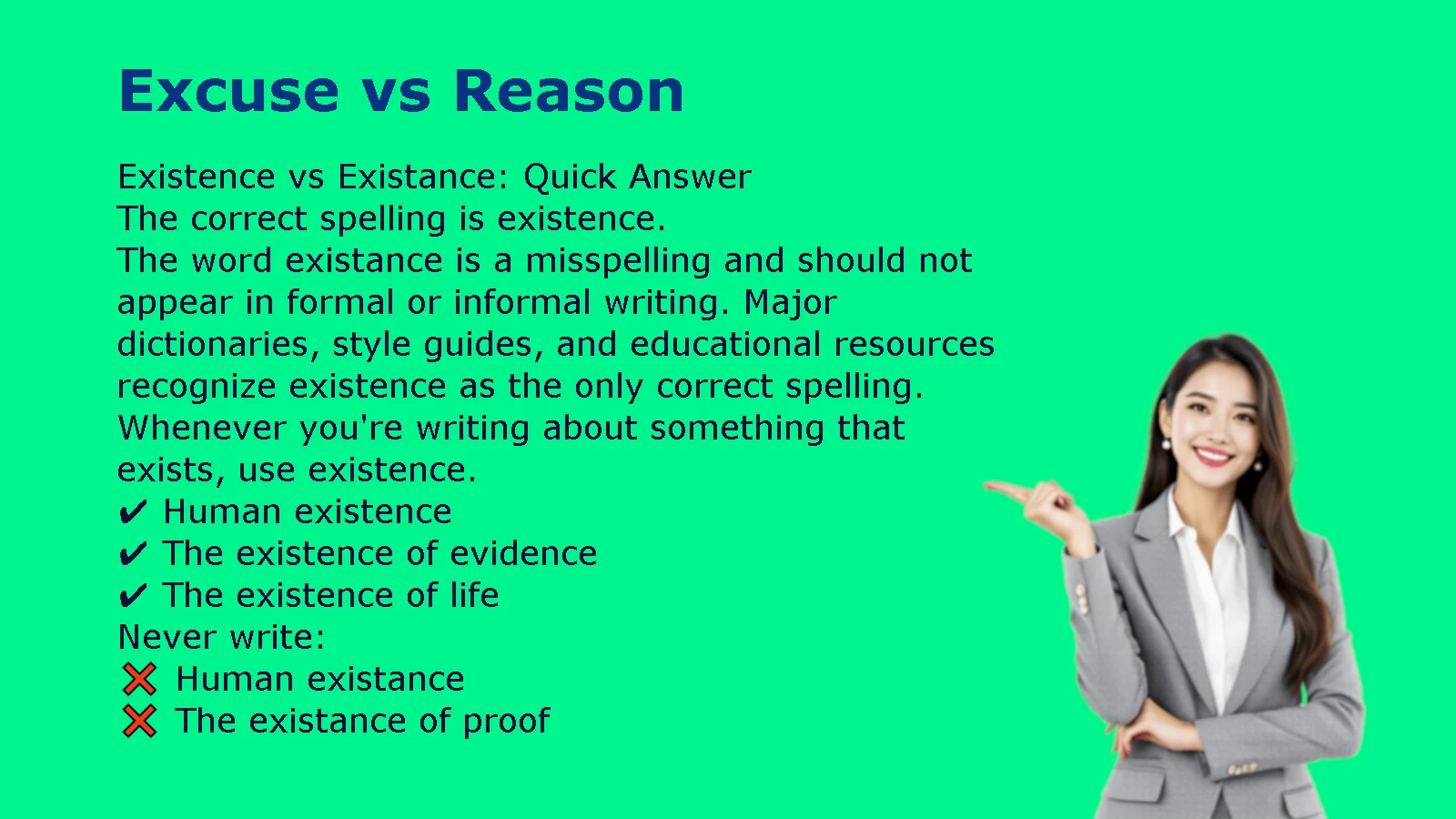
Existence vs Existance: Quick Answer
The correct spelling is existence.
The word existance is a misspelling and should not appear in formal or informal writing. Major dictionaries, style guides, and educational resources recognize existence as the only correct spelling.
| Word | Correct? | Meaning |
| Existence | ✅ Yes | The state of being real or continuing to be |
| Existance | ❌ No | Incorrect spelling of existence |
The simple rule
Whenever you’re writing about something that exists, use existence.
✔ Human existence
✔ The existence of evidence
✔ The existence of life
Never write:
❌ Human existance
❌ The existance of proof
What Does “Existence” Mean?
Existence refers to the state of being real, living, present, or continuing to exist. The word can describe people, animals, objects, ideas, organizations, planets, emotions, or even abstract concepts.
In simple terms:
Existence means that something is real or has being.
People use this word every day in conversations, academic writing, science, philosophy, religion, law, and business.
For example:
- The scientists found evidence supporting the existence of water beneath the planet’s surface.
- Nobody questioned the company’s legal existence after the merger.
- Many philosophers debate the existence of free will.
- The museum preserves artifacts that tell the story of ancient human existence.
Although the meaning stays consistent, the context changes depending on the subject.
Definition of Existence
Most dictionaries define existence in similar ways.
Existence (noun)
The condition or fact of being real, living, or continuing to be.
The word doesn’t always refer to physical objects. It can also describe ideas or conditions.
Examples include:
- the existence of gravity
- the existence of hope
- the existence of laws
- the existence of microorganisms
- the existence of traditions
In every case, the word tells us that something is present or real.
Pronunciation of Existence
Many spelling mistakes happen because people write words exactly as they hear them.
Pronunciation (IPA):
/ɪɡˈzɪs.təns/
A simple pronunciation guide is:
ig-ZIS-tuhns
Notice something interesting.
The ending sounds like “tuhns,” not clearly “-ence” or “-ance.” That’s one reason many people mistakenly type existance.
English pronunciation often hides spelling patterns. As a result, relying only on pronunciation can lead to errors.
Part of Speech
Existence is a noun.
That means it names a condition or state rather than describing an action.
Word family
| Word | Part of Speech | Example |
| exist | Verb | Dinosaurs no longer exist. |
| existence | Noun | Their existence changed history. |
| existing | Adjective | Existing laws remain effective. |
| existent | Adjective | Several risks are already existent. (Less common) |
Understanding the word family makes spelling easier because existence grows naturally from the verb exist.
Why Do People Spell It “Existance”?
If existence is the only correct spelling, why do so many people write existance?
The answer lies in how English works. Several factors contribute to this common mistake.
The Ending Sounds Similar
When spoken aloud, existence doesn’t strongly emphasize the letters -ence.
Most people hear something close to:
ig-ZIS-tuhns
Because of this pronunciation, writers often guess the ending.
Some choose:
- existence ✅
- existance ❌
The sound alone doesn’t reveal the correct spelling.
English Has Many “-ance” Words
English contains hundreds of nouns ending in -ance.
Examples include:
- importance
- performance
- appearance
- acceptance
- assistance
Since people see these endings regularly, they sometimes assume existance follows the same pattern.
It doesn’t.
Instead, existence belongs to another group of words ending in -ence.
Fast Typing Causes Errors
Modern communication encourages speed.
People write emails, messages, reports, and social media posts quickly. As a result, spelling mistakes become more common.
For example:
- typing too quickly
- skipping proofreading
- relying on muscle memory
- autocorrect failing to notice the mistake
Since existance closely resembles the correct word, many readers overlook the typo.
Memory Mix-Ups
English spelling isn’t perfectly predictable.
Some words ending with similar sounds use -ance, while others use -ence.
Examples:
- attendance
- assistance
- confidence
- independence
- patience
Without repeated exposure, it’s easy to confuse these endings.
Influence From Other Languages
Some languages follow different spelling conventions for similar words.
People learning English as a second language may naturally apply spelling rules from their native language.
For instance, Romance languages often use endings that don’t exactly match English spellings.
That’s another reason existance appears online even though dictionaries reject it.
Why “Existence” Ends with -ence
One of the best ways to remember the correct spelling is to understand why it ends with -ence.
Although English contains many exceptions, several useful spelling patterns can help.
The Word Comes From Latin
The history of a word often explains its spelling.
Existence ultimately comes from the Latin verb existere, meaning:
- to appear
- to emerge
- to stand forth
- to exist
As the word evolved through French and Middle English, its spelling settled into the modern English form:
existence
This historical development explains why dictionaries preserve the -ence ending.
The Verb Helps You Remember
Start with the verb:
exist
Now add the noun ending:
exist + ence = existence
Notice that the base word remains unchanged.
This simple connection makes spelling easier than trying to memorize the whole word separately.
Many Related Nouns Also End in -ence
English includes numerous nouns with the same ending.
Here are some examples.
| Correct Word | Meaning |
| confidence | Belief in yourself or others |
| difference | A distinction between things |
| evidence | Information that proves something |
| reference | Something mentioned for support |
| independence | Freedom from outside control |
| patience | The ability to wait calmly |
| silence | The absence of sound |
| presence | The state of being present |
Seeing these words together helps your brain recognize the pattern.
Compare “-ence” and “-ance”
Many learners confuse these endings because both appear frequently.
Here’s a useful comparison.
| Words Ending in -ence | Words Ending in -ance |
| existence | importance |
| confidence | performance |
| evidence | acceptance |
| difference | appearance |
| reference | assistance |
| independence | attendance |
There’s no universal rule that works every time.
Instead, learning common word families makes spelling much easier than guessing.
A Practical Spelling Pattern
Here’s a useful habit.
When you’re unsure, ask yourself:
Does the word come from “exist”?
If the answer is yes, write:
existence
Never replace -ence with -ance.
This habit quickly becomes automatic with regular reading and writing.
Think of Similar Everyday Words
Sometimes comparison creates stronger memory than memorization.
Notice these familiar words:
- exist → existence
- differ → difference
- refer → reference
- prefer → preference
- occur → occurrence (different ending)
- persist → persistence (different suffix)
Although English isn’t perfectly consistent, recognizing these relationships improves spelling accuracy over time.
A Real-World Example
Imagine you’re preparing an important job application.
You write:
“The company’s existance has continued for over twenty years.”
Even if your qualifications are excellent, that single misspelling may distract the hiring manager.
Now compare it with the corrected version.
“The company’s existence has continued for over twenty years.”
The second sentence looks polished, professional, and trustworthy.
Small spelling choices often leave a lasting impression.
Quick Fact: Studies on reading and proofreading consistently show that familiar spelling mistakes can reduce perceived credibility, especially in academic, business, and professional writing. While one typo won’t define your work, consistently using correct spelling helps readers focus on your message instead of your mistakes.
Existence vs Existance: Side-by-Side Comparison
If you’re still unsure which spelling to use, this comparison makes the difference clear at a glance.
| Feature | Existence | Existance |
| Correct English spelling | ✅ Yes | ❌ No |
| Found in dictionaries | ✅ Yes | ❌ No |
| Accepted in academic writing | ✅ Yes | ❌ No |
| Appropriate for business writing | ✅ Yes | ❌ No |
| Used in books and newspapers | ✅ Yes | ❌ No |
| Safe to use in exams | ✅ Yes | ❌ No |
The takeaway couldn’t be simpler: existence is always correct. If you write existance, spell-check software may flag it. Even if it doesn’t, careful readers will likely notice the mistake.
How to Use “Existence” Correctly
Knowing the correct spelling is only half the battle. You also need to know how to use existence naturally in different situations.
Because it’s a noun, existence usually follows articles like the, an, or its. It often appears after adjectives and before prepositional phrases.
For example:
- The existence of intelligent life remains an open question.
- Her peaceful existence changed overnight.
- Scientists continue to study the existence of dark matter.
Let’s look at how the word works in everyday contexts.
Using “Existence” in Everyday Conversations
Most people use existence when talking about something that is real or continues to exist.
Examples include:
- I didn’t know the cave’s existence until last week.
- Their friendship has shaped my entire existence.
- The park’s existence makes this neighborhood more attractive.
- Nobody questioned the existence of the old bridge.
Notice that the word fits naturally into everyday speech without sounding overly formal.
Using “Existence” in Academic Writing
Schools, colleges, and research papers frequently use existence because it expresses certainty or discusses evidence.
Examples:
- Researchers examined the existence of ancient civilizations.
- The study explored the existence of genetic variations.
- Historians debate the existence of several lost kingdoms.
- The paper presents evidence supporting the existence of microbial life beneath Antarctic ice.
Academic writing values precision. Using the correct spelling shows attention to detail.
Using “Existence” in Business Writing
Professional documents often discuss organizations, contracts, laws, or legal entities.
Examples:
- The company’s legal existence began in 2010.
- The audit confirmed the existence of all reported assets.
- Investors verified the existence of signed agreements.
- The contract recognizes the continued existence of both parties.
One spelling mistake in a proposal or report can reduce credibility. Always proofread before sending important documents.
Using “Existence” in Science
Scientists regularly use existence when discussing theories, discoveries, and observations.
Examples include:
- Astronomers continue searching for evidence of extraterrestrial existence.
- The experiment confirmed the existence of a previously unknown chemical reaction.
- Biologists study the existence of microorganisms in extreme environments.
- Climate researchers investigate the existence of long-term weather patterns.
Scientific writing depends on precise language. Correct spelling supports clear communication.
Using “Existence” in Philosophy
Few words appear more often in philosophy than existence.
Philosophers ask questions such as:
- What gives something existence?
- Does consciousness exist independently of the body?
- Is existence itself meaningful?
- Can ideas exist without physical form?
These discussions have shaped philosophy for centuries. Even today, the concept of existence remains central to debates about reality, identity, and knowledge.
Examples of “Existence” in Sentences
Reading examples is one of the fastest ways to remember correct usage.
Everyday Examples
- The old lighthouse has stood as proof of the town’s existence for generations.
- We didn’t discover the hidden waterfall’s existence until summer.
- Her cheerful attitude transformed everyone’s daily existence.
- The photograph proves the cabin’s existence decades ago.
- Few people knew about the island’s existence.
School Examples
- Students discussed the existence of dinosaurs before humans.
- The teacher explained the existence of different ecosystems.
- Evidence supported the existence of early farming communities.
- The history lesson explored the existence of ancient trade routes.
- The science fair project examined the existence of bacteria in pond water.
Workplace Examples
- The audit verified the existence of inventory.
- Management confirmed the existence of additional funding.
- The report questioned the existence of duplicate records.
- Legal documents proved the organization’s continued existence.
- The investigation established the existence of security weaknesses.
Science Examples
- Researchers discovered evidence supporting the existence of underground oceans.
- The telescope may reveal the existence of distant planets.
- Scientists continue investigating the existence of dark energy.
- Fossils demonstrate the existence of extinct species.
- Laboratory tests confirmed the existence of rare compounds.
Creative Writing Examples
- Hope became the reason for his existence.
- The castle whispered stories of another existence.
- Their quiet existence unfolded beside the sea.
- Every sunrise reminded her of life’s fragile existence.
- The novel explores the meaning of human existence.
Incorrect Examples Using “Existance”
Learning from mistakes makes the correct spelling easier to remember.
| Incorrect Sentence | Correct Sentence |
| The existance of the building surprised everyone. | The existence of the building surprised everyone. |
| Scientists studied the existance of black holes. | Scientists studied the existence of black holes. |
| Nobody doubted her existance. | Nobody doubted her existence. |
| The report confirmed the existance of errors. | The report confirmed the existence of errors. |
| We discussed the existance of life on Mars. | We discussed the existence of life on Mars. |
Every correction follows the same rule: replace existance with existence.
Common Phrases That Use “Existence”
Some expressions appear so often that they become fixed phrases. Learning them helps you sound more natural in both speech and writing.
The Existence of Life
Often used in science and astronomy.
Example:
Scientists continue searching for evidence of the existence of life beyond Earth.
Human Existence
Refers to humanity’s life, survival, or condition.
Example:
Technology has changed nearly every aspect of human existence.
Continued Existence
Describes something that remains in operation or continues over time.
Example:
The museum’s continued existence depends on community support.
Peaceful Existence
Often used when discussing harmony between people or nations.
Example:
Different cultures can enjoy a peaceful existence together.
Legal Existence
A common legal and business phrase.
Example:
The corporation gained legal existence after registration.
Proof of Existence
Used in science, law, and philosophy.
Example:
The fossil provides proof of existence for the extinct animal.
Existence of Evidence
Common in legal writing.
Example:
The court examined the existence of evidence before making its decision.
Existence Itself
Frequently appears in philosophy and literature.
Example:
The novel questions existence itself through its main character’s journey.
Words Commonly Confused with “Existence”
English contains many words that people misspell for similar reasons. Most involve confusing -ence and -ance endings.
| Correct Word | Common Misspelling |
| existence | existance |
| difference | differance |
| reference | referance |
| occurrence | occurence |
| conscience | concience |
| maintenance | maintainance |
| independence | independance |
| persistence | persistance |
Each mistake follows a familiar pattern. The pronunciation doesn’t clearly reveal the spelling, so writers often guess.
Building familiarity with these words reduces spelling errors over time.
Memory Tricks to Remember the Correct Spelling
Simple tricks often work better than memorizing complicated rules.
Connect It to the Verb “Exist”
This is the easiest method.
Start with:
exist
Then add:
-ence
You immediately get:
existence
If you remember the verb, the noun becomes much easier to spell.
Remember the “-ence” Family
Group similar words together.
- confidence
- difference
- evidence
- reference
- presence
- existence
Your brain remembers patterns more effectively than isolated words.
Read More High-Quality Writing
Books, newspapers, magazines, and trusted websites repeatedly expose you to correct spelling.
The more often you see existence, the more natural it becomes.
Reading acts like passive spelling practice.
Use the “Dictionary Test”
Whenever a spelling feels uncertain, pause for a moment.
Ask yourself:
“Have I ever seen existance in a dictionary or published book?”
The answer is almost certainly no.
Professional writers consistently use existence.
Create a Visual Memory
Imagine writing the word like this:
exist + ence
Instead of memorizing nine letters, you’re only remembering a familiar verb plus its ending.
That mental shortcut makes recall much faster.
Proofread Backward
Professional editors often review documents from the end toward the beginning. This unusual technique forces your brain to focus on individual words instead of the overall meaning.
When you slow down, mistakes like existance become much easier to spot.
A Real-World Case Study: One Letter That Changed a First Impression
A university student submitted a scholarship essay discussing the existence of equal educational opportunities. The essay was thoughtful and well organized. Unfortunately, the student repeatedly wrote existance instead of existence.
The reviewers understood the intended meaning. However, the repeated spelling error distracted them and weakened the essay’s polished appearance.
The student corrected the mistake before submitting future applications. That small change improved the professionalism of the writing without changing a single idea.
Lesson: A single letter rarely changes your message. Still, consistent spelling helps readers focus on your ideas instead of your mistakes.
“Good writing isn’t only about great ideas. It’s also about presenting those ideas with clarity and accuracy.”
Existence in British vs American English
One common question people ask is whether existence changes between British English and American English.
The answer is simple:
The spelling is exactly the same in both varieties of English.
Unlike some words that have different spellings, such as:
- colour (British English) vs color (American English)
- organise (British English) vs organize (American English)
- centre (British English) vs center (American English)
The word existence remains unchanged.
| English Variety | Correct Spelling | Example |
| American English | existence | The evidence proves the existence of the species. |
| British English | existence | Scientists confirmed the existence of the species. |
The meaning also stays the same.
Whether you’re writing a college essay in the United States, a business report in the United Kingdom, or an article for an international audience, existence is the correct choice.
Does Pronunciation Change in British and American English?
The pronunciation may sound slightly different because accents influence speech. However, the difference is minor.
American English pronunciation
Existence
ig-ZIS-tuhns
British English pronunciation
Existence
ig-ZIS-tuhns
The main difference comes from regional accents, not the spelling or meaning.
This is another reason why relying only on pronunciation can cause mistakes. Many English words sound similar but have different spellings.
Is “Existance” Ever Correct?
No.
Existance is not considered a correct English word.
You may occasionally see it online, but that does not make it acceptable. The word usually appears because of:
- typing mistakes
- spelling confusion
- autocorrect errors
- rushed writing
- mistakes by English learners
For example:
❌ The existance of the universe is mysterious.
✅ The existence of the universe is mysterious.
The incorrect spelling does not create a new meaning. It is simply an error.
Why Does “Existance” Appear Online?
Even though existance is wrong, search engines may still show results containing it.
This happens because the internet contains billions of pages created by people with different levels of writing ability.
Common sources of misspellings include:
- social media posts
- user comments
- unedited blogs
- discussion forums
- automatically generated content
- old websites
Search engines recognize that users make mistakes, so they often show results for misspelled searches.
For example, someone searching:
“existance meaning”
will usually receive results explaining existence.
This does not mean existance is accepted. It simply means search engines understand common spelling errors.
Existence in Dictionaries
Trusted dictionaries list existence as the correct noun form of exist.
A dictionary check is one of the fastest ways to confirm spelling.
| Dictionary | Existence Listed? | Existance Listed? |
| Merriam-Webster | ✅ Yes | ❌ No |
| Oxford English Dictionary | ✅ Yes | ❌ No |
| Cambridge Dictionary | ✅ Yes | ❌ No |
| Collins Dictionary | ✅ Yes | ❌ No |
Major dictionaries agree on this spelling.
If you ever hesitate between existence vs existance, checking a reliable dictionary will always point you toward existence.
Common Questions About Existence vs Existance
Is It Existence or Existance?
The correct spelling is existence.
Existance is a common spelling mistake and should not be used in writing.
Example:
✅ The existence of ancient civilizations fascinates historians.
❌ The existance of ancient civilizations fascinates historians.
Why Is Existance Wrong?
Existance is wrong because English formed the noun from the verb exist with the ending -ence, not -ance.
The correct formation is:
exist + ence = existence
Not:
exist + ance = existance
Is Existance in the Dictionary?
No. Standard English dictionaries do not recognize existance as a correct word.
You may find it in search results or informal online writing, but it appears as a misspelling rather than an accepted term.
What Is the Meaning of Existence?
Existence means the state of being real, present, alive, or continuing.
Examples:
- The existence of life on another planet remains unknown.
- Human existence has changed dramatically through technology.
- The company’s existence depends on customer support.
Is Existence a Noun?
Yes.
Existence is a noun because it names a state or condition.
Examples:
- The existence of the problem became obvious.
- Scientists confirmed the existence of the element.
The related verb is exist.
Example:
- Many species exist in the rainforest.
How Do You Spell Existence Correctly?
Remember this simple pattern:
EXIST + ENCE = EXISTENCE
The word keeps the base form exist and adds the noun ending -ence.
A quick memory sentence:
“Things that exist have existence.”
How Do You Pronounce Existence?
The common pronunciation is:
ig-ZIS-tuhns
IPA:
/ɪɡˈzɪs.təns/
The final sound can make the spelling confusing, but remember that pronunciation does not change the spelling.
Can I Use Existance in Formal Writing?
No.
Avoid existance in:
- essays
- resumes
- reports
- emails
- academic papers
- professional documents
Always use existence instead.
What Are Some Synonyms for Existence?
Depending on the context, you can replace existence with several related words.
| Synonym | Meaning |
| Being | The state of existing |
| Presence | Something being there |
| Reality | The condition of being real |
| Life | Living existence |
| Survival | Continuing to exist |
| Continuation | Remaining over time |
| Occurrence | Something happening or appearing |
However, these words do not always work as direct replacements.
For example:
“The existence of the company”
could become:
“The continued operation of the company.”
But:
“The reality of the company”
may not express the same idea.
Key Takeaways: Existence vs Existance
Before you finish, remember these important points:
- ✅ Existence is the correct spelling.
- ❌ Existance is a spelling mistake.
- Existence is a noun that means the state of being real or present.
- The word comes from exist + ence.
- Both British and American English use the same spelling.
- Pronunciation makes the spelling confusing because the ending sounds similar to -ance.
- Professional, academic, and formal writing should always use existence.
- Similar words like difference, confidence, and reference can help you remember the -ence pattern.
A simple rule solves the entire confusion:
If something can exist, it has existence.
Final Thoughts on Existence vs Existance
The difference between existence vs existance comes down to one small letter, but that single letter separates correct English from a common mistake.
English spelling can sometimes feel unpredictable. Words with similar sounds often follow different patterns, and endings like -ence and -ance create confusion for many writers.
Still, some mistakes become easy to avoid once you understand the pattern.
The correct word is always:
✅ Existence
Use it when you talk about something being real, present, alive, or continuing.
Avoid:
❌ Existance
The next time you need to write this word, remember the simple connection:
Exist → Existence
That small spelling habit will help your writing look more accurate, professional, and polished.