A reason explains why something happened or why a decision was made, while an excuse is often used to justify or avoid responsibility for an action. Knowing the difference helps you communicate more clearly and accurately. When comparing excuse vs reason, choose the word that best matches your intended meaning and context.
The confusion comes from the fact that both explain why something happened. However, a reason usually provides a genuine explanation, while an excuse is often seen as an attempt to justify or avoid responsibility. But here’s the good news: once you understand the difference, knowing which word to use becomes much easier.
In this guide, you’ll learn the difference between Excuse vs. reason, explore excuse meaning, reason meaning, excuse vs reason examples, when to use excuse, and when to use reason. You’ll also discover excuse and reason in a sentence, common word confusion, and simple tips to help you choose the right word with confidence.
By the end, you’ll clearly understand Excuse vs. reason and know exactly when to use each term in everyday conversations, professional writing, and academic communication.
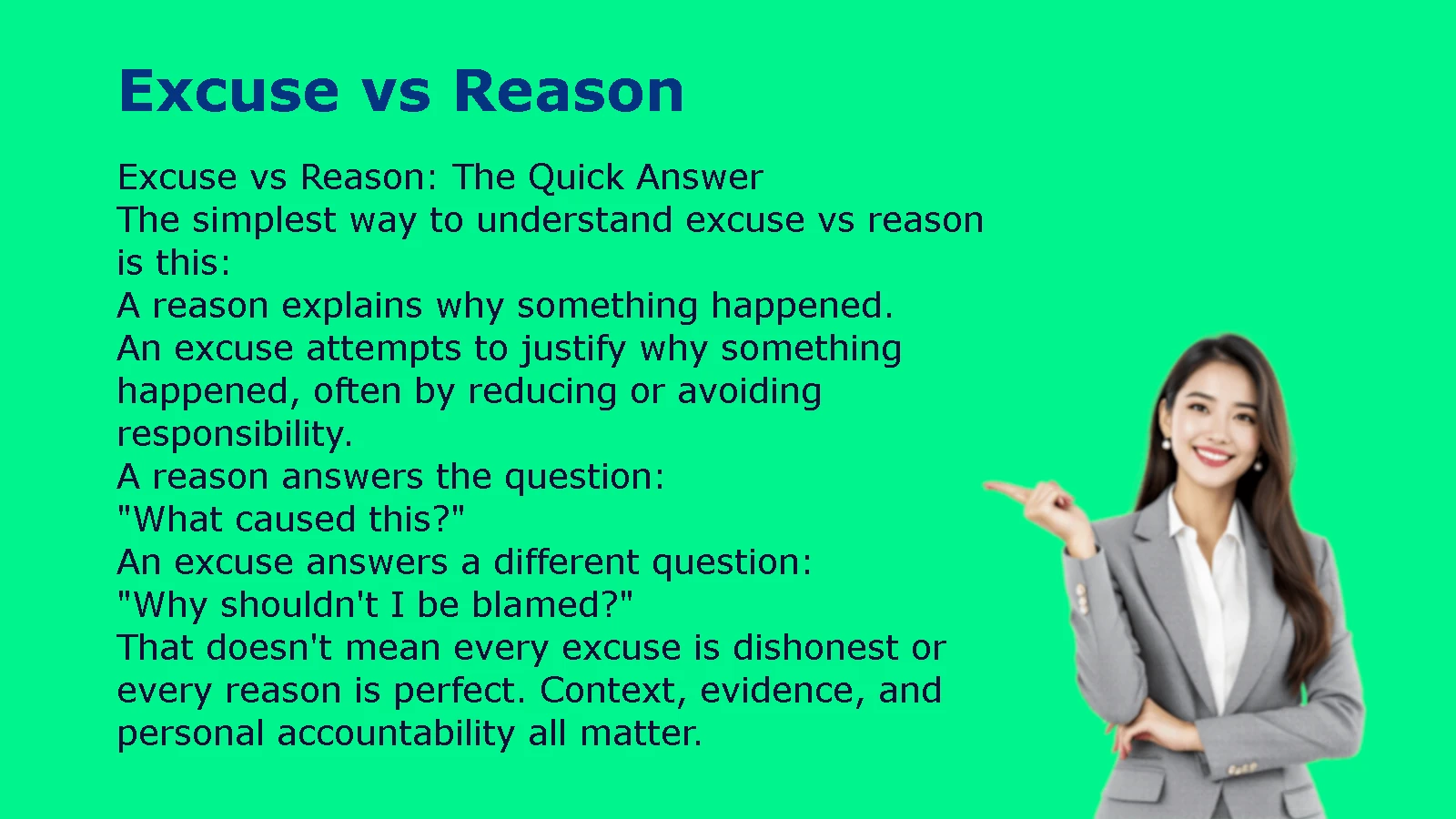
Excuse vs Reason: The Quick Answer
The simplest way to understand excuse vs reason is this:
- A reason explains why something happened.
- An excuse attempts to justify why something happened, often by reducing or avoiding responsibility.
A reason answers the question:
“What caused this?”
An excuse answers a different question:
“Why shouldn’t I be blamed?”
That doesn’t mean every excuse is dishonest or every reason is perfect. Context, evidence, and personal accountability all matter.
Quick Comparison
| Feature | Excuse | Reason |
| Primary purpose | Reduce blame | Explain what happened |
| Accountability | Often avoids responsibility | Usually accepts responsibility |
| Evidence | May lack proof | Often supported by facts |
| Focus | Self-protection | Understanding the situation |
| Tone | Defensive | Honest and informative |
| Trust impact | Can reduce credibility | Often builds credibility |
| Outcome | May end discussion | Encourages problem-solving |
Quick takeaway: A reason explains an event. An excuse explains away responsibility.
What Is an Excuse?
An excuse is an explanation offered to defend, justify, or lessen responsibility for a mistake, failure, or unwanted outcome. Sometimes an excuse contains truthful information. However, it often shifts attention away from personal accountability.
Think of an excuse as placing a shield between yourself and the consequences of your actions.
For example:
“I couldn’t finish the project because everyone kept interrupting me.”
Interruptions may have happened. Even so, the statement avoids discussing time management or possible solutions.
Now compare it with:
“I underestimated how long the project would take. Frequent interruptions made it harder, and I’ll block focus time next week.”
The second response includes a reason while accepting responsibility.
Characteristics of an Excuse
Although every situation is different, excuses often share several common traits.
Avoids Responsibility
Many excuses focus more on outside circumstances than personal choices.
Examples include:
- “The instructions weren’t clear.”
- “Nobody reminded me.”
- “Everyone else was late.”
External factors may have contributed to the problem. Still, they don’t completely remove responsibility.
Shifts the Blame
Instead of explaining what happened objectively, excuses often point toward another person or situation.
Examples:
- Blaming coworkers
- Blaming traffic every day
- Blaming technology without preparing backups
Focuses on Justification
An excuse often tries to convince others that the mistake wasn’t entirely the person’s fault.
Instead of solving the issue, the conversation becomes centered on defending actions.
Rarely Includes a Solution
One easy way to recognize an excuse is to ask:
“What happens next?”
If the explanation ends without discussing improvement, it may be leaning toward an excuse.
Everyday Examples of Excuses
At Work
“I missed the deadline because my inbox was too full.”
At School
“I forgot my homework because I was watching television.”
In Relationships
“I forgot your birthday because I’ve been busy.”
For Personal Goals
“I can’t exercise because I never have enough time.”
Each example may contain some truth. However, each also avoids discussing choices that could have changed the outcome.
Why Excuses Sometimes Feel Convincing
Human beings naturally want to protect their self-image.
Psychologists describe this tendency through the concept of self-serving bias. People often credit themselves for success while attributing failures to outside circumstances.
For example:
- Passing an exam becomes proof of intelligence.
- Failing an exam becomes the teacher’s fault.
This mental shortcut helps preserve confidence. Unfortunately, it can also encourage excuse-making if left unchecked.
Quote
“An excuse explains away responsibility. A reason explains reality.”
What Is a Reason?
A reason is a factual explanation describing why something happened. Unlike an excuse, a reason doesn’t automatically remove responsibility.
Good reasons help others understand events.
They answer questions honestly without hiding behind them.
For example:
“The meeting started late because the previous presentation ran over schedule.”
This statement simply explains what occurred.
Now consider:
“The meeting started late because I didn’t prepare.”
That statement also gives a reason. Better yet, it openly accepts responsibility.
Characteristics of a Genuine Reason
Several qualities separate genuine reasons from excuses.
Based on Facts
A reason is usually supported by evidence or observable circumstances.
Examples include:
- Medical emergencies
- Severe weather
- Transportation accidents
- Family emergencies
- Technical system failures
These events genuinely interfere with normal plans.
Accepts Responsibility When Appropriate
Reasons don’t pretend mistakes never happened.
Instead, they acknowledge reality.
Example:
“I became sick yesterday, so I couldn’t attend the meeting. I should have notified everyone sooner.”
Notice how responsibility remains part of the explanation.
Helps Solve Problems
Reasons provide information people can use.
Imagine a software engineer saying:
“The server failed because storage reached capacity.”
Now the team knows where to investigate.
Contrast that with:
“The server just stopped working.”
The second statement offers little value.
Builds Trust
People generally trust explanations that include:
- Facts
- Accountability
- Transparency
- Solutions
These elements strengthen credibility over time.
Everyday Examples of Reasons
Health
“I had a migraine that required medical treatment.”
Transportation
“The highway was closed after a major accident.”
Work
“Our supplier delayed the shipment by two days.”
Family
“I needed to take my child to the emergency room.”
These situations explain events rather than excuse them.
Why Honest Reasons Matter
Clear communication prevents misunderstandings.
Imagine two employees arriving thirty minutes late.
Employee A says:
“Traffic was terrible.”
Employee B says:
“A highway accident closed two lanes. I should have checked alternate routes earlier, and I’ll leave earlier tomorrow.”
Both mention traffic.
Only one demonstrates accountability.
Managers usually appreciate honesty paired with ownership because it builds confidence that the same mistake won’t happen again.
Excuse vs Reason: Key Differences Explained
People often use these words interchangeably. In reality, they describe different communication styles.
The biggest distinction isn’t the event itself.
It’s how responsibility is handled.
Comparison Table
| Aspect | Excuse | Reason |
| Purpose | Avoid criticism | Explain circumstances |
| Responsibility | Minimized | Accepted when appropriate |
| Honesty | May be selective | Seeks complete context |
| Evidence | Sometimes weak | Usually supported |
| Focus | Defending actions | Understanding events |
| Problem-solving | Rare | Common |
| Trust | May decrease trust | Often increases trust |
| Long-term effect | Repeated patterns damage credibility | Encourages learning and growth |
Intent Matters
Imagine two students who submit assignments late.
Student One says:
“My laptop is terrible.”
Student Two says:
“My laptop crashed last night. I borrowed another computer this morning, finished the assignment, and submitted it as soon as possible.”
The technical problem is identical.
The responses are completely different.
One avoids ownership.
The other explains the facts while demonstrating effort.
Accountability Changes Everything
A reason and accountability often work together.
For example:
“I underestimated the workload. That caused the delay, and I’ve already adjusted next week’s schedule.”
The speaker doesn’t hide the mistake.
Instead, they explain it and show improvement.
That’s why leaders, teachers, and employers often respond positively to honest reasons.
Evidence Strengthens Reasons
The strongest reasons can usually be verified.
Examples include:
- Medical documentation
- Flight cancellations
- Police reports
- Email records
- Calendar conflicts
- Weather alerts
Evidence isn’t always necessary, though it increases credibility when questions arise.
How to Tell if Something Is an Excuse or a Reason
Sometimes the difference feels obvious.
Other times, it’s surprisingly difficult.
A useful approach is to ask a few simple questions before judging the explanation.
Ask These Questions
Does the person acknowledge responsibility?
People giving genuine reasons usually recognize their role in the situation.
Is the explanation supported by facts?
Can the event reasonably be verified?
If not, the explanation deserves closer examination.
Could the problem have been prevented?
Sometimes circumstances truly fall outside someone’s control.
Other times, better planning would have avoided the issue.
Does the explanation include a solution?
Responsible people usually discuss what they’ll do differently next time.
That signals growth rather than avoidance.
Does the same explanation happen repeatedly?
Patterns matter.
Missing one deadline because of a family emergency is understandable.
Missing every deadline because of a different emergency each week raises legitimate questions.
A Simple Decision Framework
Did something genuinely prevent the action?
│
┌───────┴────────┐
│ │
No Yes
│ │
Likely an excuse │
▼
Is the explanation factual?
│ │
No Yes
│ │
Probably an excuse ▼
Does the person accept responsibility?
│ │
No Yes
│ │
Likely an excuse Likely a genuine reason
This framework isn’t perfect because human situations are rarely black and white. Still, it offers a practical way to evaluate explanations fairly instead of jumping to conclusions.
Mini Case Study
Scenario: Emma misses an important client meeting.
Response A: “Nobody reminded me about it.”
Response B: “I entered the meeting on the wrong date in my calendar. That’s my mistake. I’ve already corrected it and added a second reminder.”
Both statements explain what happened. However, the second response combines a reason with accountability, making it more trustworthy and professional.
Excuse vs Reason in Everyday Situations
The difference between an excuse and a reason becomes much clearer when you look at real-life situations. The words people choose often influence how others respond. A thoughtful explanation can build trust. A weak excuse can damage credibility in seconds.
Let’s explore some common scenarios.
Excuse vs Reason at Work
The workplace is where accountability matters most. Managers don’t expect perfection. They expect honesty, communication, and a willingness to solve problems.
Imagine two employees who miss the same deadline.
Employee A says:
“I had too much work, so I couldn’t finish.”
Employee B says:
“I underestimated the time this project would take. I also received two urgent client requests that delayed my progress. I’ve already adjusted my schedule and will send progress updates earlier next time.”
The second response doesn’t deny the problem. Instead, it explains what happened and shows a plan to prevent it from happening again.
Common Workplace Examples
| Situation | Excuse | Reason |
| Arriving late | “Traffic was awful.” | “A major accident closed the freeway. I left home on time, though I’ll use an alternate route if it happens again.” |
| Missing a deadline | “I was too busy.” | “The client’s requirements changed midway through the project. I should have communicated the revised timeline sooner.” |
| Forgetting a meeting | “Nobody reminded me.” | “I entered the wrong date in my calendar. I’ve added automatic reminders to avoid repeating the mistake.” |
| Making an error | “The software is confusing.” | “I misunderstood one setting in the software. I’ve reviewed the process and corrected the issue.” |
Professional tip: Employers usually appreciate honesty more than perfection. Owning a mistake often earns more respect than trying to explain it away.
Excuse vs Reason at School
Students face similar situations every day.
Teachers understand that unexpected events happen. What they often dislike is a pattern of vague explanations that avoid responsibility.
Consider these responses.
Excuse:
“My printer broke.”
Reason:
“My printer stopped working last night. I emailed you the assignment before the deadline and brought a printed copy today.”
Notice the difference.
The second student anticipated the problem and found another solution.
School Examples
- Missing class because of a medical appointment
- Turning in homework late after a family emergency
- Missing a group project meeting because of illness
- Requesting an extension after a verified technical issue
In each case, honesty and communication matter just as much as the explanation itself.
Excuse vs Reason in Relationships
Relationships thrive on trust.
People rarely become upset because of a single mistake. Instead, repeated excuses often make them question someone’s reliability.
Imagine forgetting your anniversary.
Excuse:
“I’ve just been really busy.”
Reason:
“I completely forgot the date, and I’m sorry. That’s on me. I’d like to make it up to you this weekend.”
The second response accepts responsibility instead of minimizing the other person’s feelings.
Common Relationship Situations
| Situation | Excuse | Reason |
| Forgetting a birthday | “I’ve had a lot on my mind.” | “I forgot the date, and I should have set a reminder.” |
| Canceling plans | “Something came up.” | “My daughter became sick this afternoon, so I had to stay home.” |
| Not replying to messages | “I was busy.” | “I spent the day in back-to-back meetings and couldn’t check my phone until evening.” |
A sincere explanation often strengthens relationships because it combines honesty with accountability.
Excuse vs Reason in Parenting
Parents constantly teach children the difference between explaining behavior and avoiding responsibility.
Imagine a child breaking a vase.
Child One says:
“My brother distracted me.”
Child Two says:
“I was running inside the house even though I knew I shouldn’t have been.”
Both statements may contain truth.
Only one accepts responsibility.
Parents often use these moments to teach an important life lesson:
A reason explains what happened. It doesn’t erase responsibility.
Why People Make Excuses
People rarely wake up intending to make excuses.
Most excuses develop naturally because the brain wants to reduce discomfort. Admitting mistakes can feel embarrassing. Defending ourselves often feels easier.
Understanding the psychology behind excuses helps us recognize them without becoming overly judgmental.
Fear of Failure
Nobody enjoys failing.
When people worry that failure will define them, they may invent explanations that protect their confidence.
Instead of saying,
“I didn’t prepare enough.”
they might say,
“The test was unfair.”
Protecting self-esteem feels safer than admitting poor preparation.
Fear of Judgment
Many excuses arise because people worry about how others will see them.
Questions like these often trigger defensive responses:
- Will people think I’m lazy?
- Will I lose credibility?
- Will I disappoint my family?
- Will my manager lose trust in me?
Rather than facing those fears directly, some people create explanations that soften criticism.
Protecting Self-Image
Most people like believing they are competent, responsible, and dependable.
Psychologists often refer to this as self-serving bias. It describes our tendency to credit ourselves for successes while blaming outside factors for failures.
For example:
- “I succeeded because I worked hard.”
- “I failed because the circumstances were unfair.”
This thinking happens more often than many people realize.
Avoiding Consequences
Sometimes excuses serve one purpose.
They reduce punishment.
A student may hope for extra time.
An employee may hope to avoid criticism.
A child may hope to escape discipline.
The explanation becomes less about truth and more about avoiding consequences.
Habit and Learned Behavior
Some people grow up in environments where excuses become routine.
If children regularly see adults avoiding responsibility, they may learn to respond the same way.
The good news is that habits can change.
Learning to accept responsibility often improves confidence because people spend less energy defending mistakes and more energy solving them.
Quote
“Excuses protect your comfort today. Responsibility protects your future.”
When a Reason Can Sound Like an Excuse
Not every honest explanation is received as a genuine reason.
Sometimes a perfectly valid reason sounds like an excuse because of poor communication, missing context, or repeated patterns.
Let’s look at why that happens.
Poor Timing
Imagine explaining a mistake immediately after someone experiences its consequences.
Even a truthful explanation may sound defensive because emotions are still high.
Waiting until emotions settle often leads to a more productive conversation.
Missing Context
Suppose someone says:
“I couldn’t attend the meeting.”
That statement raises questions.
Now add context.
“I couldn’t attend because my daughter was admitted to the emergency room.”
The explanation suddenly feels much more reasonable.
Context helps people understand circumstances without assuming the worst.
Lack of Evidence
Sometimes people simply cannot verify what happened.
For example:
- “My internet stopped working.”
- “My phone died.”
- “I never received the email.”
These situations may be completely true.
However, repeated use without supporting details may gradually reduce credibility.
Emotional Delivery
Tone matters.
Compare these responses.
Response One
“It’s not my fault. Everyone keeps blaming me.”
Response Two
“Here’s what happened. I understand the impact, and I’d like to explain the situation.”
The facts may be identical.
The delivery completely changes how people interpret the explanation.
Repeated Explanations
A valid reason loses credibility if it becomes a recurring pattern.
For example:
- Car trouble once is believable.
- Car trouble every Monday raises questions.
Patterns influence trust more than isolated events.
Can an Excuse Also Be a Reason?
This question creates a surprising amount of debate.
The answer is yes—sometimes.
A single statement can contain both a legitimate reason and an excuse.
The difference often depends on intent, context, and accountability.
Consider this example.
“I missed the deadline because my son became seriously ill.”
That is a genuine reason.
Now imagine the same person continues:
“There’s nothing I could have done differently.”
If they had opportunities to communicate, request help, or update the deadline, that second statement begins shifting toward an excuse.
The Overlap
Think of it like this.
- A reason explains why something happened.
- An excuse explains why someone shouldn’t be blamed.
Sometimes those ideas overlap.
For example:
A snowstorm closes every road leading to work.
The weather is clearly the reason for your absence.
If your employer criticizes you despite the road closures, mentioning the storm also functions as an excuse because it reduces responsibility.
The key isn’t the event.
The key is whether responsibility still exists.
Examples of Excuse vs Reason
The following examples make the distinction easier to recognize.
| Situation | Excuse | Reason |
| Being late | “Traffic is always terrible.” | “A highway accident closed two lanes unexpectedly.” |
| Missing work | “I just wasn’t feeling it.” | “My doctor diagnosed me with the flu this morning.” |
| Forgetting homework | “My dog ate it.” | “I accidentally left it at home, and I’ll bring it first thing tomorrow.” |
| Canceling dinner | “Something came up.” | “My father was taken to the hospital unexpectedly.” |
| Missing a deadline | “Everyone kept interrupting me.” | “The project requirements changed, and I failed to communicate the revised timeline.” |
| Skipping exercise | “I’m too busy.” | “I’ve been recovering from knee surgery and following my doctor’s restrictions.” |
| Not saving money | “Everything is too expensive.” | “Unexpected medical bills forced me to use my emergency savings.” |
| Forgetting a meeting | “Nobody reminded me.” | “I entered the wrong date in my calendar and corrected it immediately.” |
Notice a pattern.
Reasons provide facts.
Excuses often stop at justification.
Excuse vs Reason in Professional Communication
Professional communication isn’t about avoiding mistakes.
It’s about responding to mistakes responsibly.
Strong professionals know that transparency builds long-term trust.
What Managers Usually Look For
Most supervisors ask themselves four questions after hearing an explanation.
- What actually happened?
- Did the employee accept responsibility?
- Can the issue be fixed?
- Is this likely to happen again?
A clear answer to those questions usually earns more respect than a lengthy defense.
How to Explain Problems Professionally
A simple structure works well in almost every workplace.
State the facts.
Describe exactly what happened.
Accept your role.
Own the parts you could control.
Explain the impact.
Show that you understand how the issue affected others.
Offer a solution.
Explain how you’ll prevent the problem in the future.
For example:
“I misunderstood the client’s deadline. That’s my mistake. I’ve already updated our project tracker and added milestone reminders to prevent another delay.”
That response demonstrates professionalism because it balances honesty with accountability.
Better Alternatives That Sound Responsible
Instead of saying:
- “It’s not my fault.”
Try saying:
- “Here’s what happened, and here’s how I’m fixing it.”
Instead of saying:
- “Nobody told me.”
Try saying:
- “I misunderstood the instructions. I’ll confirm the details next time.”
Instead of saying:
- “I was too busy.”
Try saying:
- “I underestimated the workload and should have communicated sooner.”
These small wording changes shift the conversation from blame to solutions.
How to Give a Reason Without Sounding Like You’re Making Excuses
Many people worry that explaining themselves will automatically sound defensive.
Fortunately, there’s a simple approach that keeps your explanation honest, respectful, and credible.
State the Facts First
Avoid dramatic language.
Share only the information needed to explain the situation.
Accept Responsibility
Even if outside circumstances contributed to the problem, acknowledge your role whenever appropriate.
Keep It Brief
Long explanations often sound less convincing.
A concise explanation usually feels more authentic.
Offer a Solution
People remember solutions more than problems.
Explain what you’ll do differently moving forward.
Follow Through
Words matter.
Actions matter more.
Consistently improving after mistakes builds trust faster than any explanation ever could.
Before-and-After Example
Less Effective
“I couldn’t finish because everyone kept interrupting me.”
More Effective
“Frequent interruptions slowed my progress, and I should have communicated that earlier. I’ve blocked dedicated focus time for tomorrow so I can finish the remaining work.”
The second response explains the situation without avoiding responsibility. It also shows initiative, making it far more likely to earn understanding and respect.
Case Study: Turning an Excuse Into a Reason
Situation: James, a sales representative, missed an important client presentation after arriving late to the office.
His first response: “Traffic made me late.”
His manager pointed out that heavy traffic was common during morning rush hour.
James reflected on the situation and responded differently:
“Traffic was heavier than expected, but I should have allowed extra travel time. I’ll leave 20 minutes earlier for future client meetings and check live traffic before I head out.”
The second response didn’t change what happened. It changed how James handled it. By combining a valid reason with accountability and a clear solution, he rebuilt trust and demonstrated professional growth.
Common Phrases That Sound Like Excuses
The words you choose can shape how people interpret your message. Some phrases aren’t automatically excuses, yet people often perceive them that way because they sound vague, defensive, or repetitive.
Replacing them with clear, accountable language can make a significant difference.
| Common Phrase | Better Alternative |
| “I was too busy.” | “I didn’t manage my time well, and I’ll plan better next time.” |
| “I forgot.” | “I forgot, and I should have set a reminder.” |
| “It’s not my fault.” | “Here’s what happened, and here’s what I’m doing to fix it.” |
| “Nobody told me.” | “I misunderstood the instructions, so I’ll confirm the details next time.” |
| “I didn’t have time.” | “I underestimated how long it would take.” |
| “Everyone else was doing it.” | “I made the wrong decision, and I accept responsibility.” |
| “I was going to do it.” | “I didn’t complete it, and I’ll finish it by the agreed deadline.” |
| “That’s just how I am.” | “I recognize this habit, and I’m working to improve it.” |
Notice the pattern. The stronger alternatives acknowledge reality without avoiding accountability.
Common Myths About Excuses and Reasons
Many misconceptions blur the line between an excuse and a reason. Let’s separate fact from fiction.
Myth: Every Explanation Is an Excuse
Reality: An explanation simply provides information. It only becomes an excuse when it shifts blame or avoids responsibility.
Myth: Reasons Remove Responsibility
Reality: A genuine reason explains what happened. It doesn’t erase accountability.
For example:
“The storm delayed my flight.”
That’s a reason.
If you also failed to notify the people expecting you, you’re still responsible for the lack of communication.
Myth: Excuses Are Always Lies
Reality: Many excuses contain truthful details.
The issue isn’t always dishonesty.
The issue is using truthful details to avoid responsibility.
Myth: Honest People Never Make Excuses
Reality: Everyone makes excuses from time to time.
Stress, embarrassment, fear, and pride can influence anyone.
The important part is recognizing the habit and replacing it with honest communication.
Myth: Intent Doesn’t Matter
Reality: Intent plays a major role.
Two people can describe the exact same event.
One may genuinely want to explain the situation.
The other may simply want to avoid blame.
Context and accountability reveal the difference.
Excuse vs Reason vs Explanation
Many people use these three words interchangeably.
They aren’t the same.
Understanding the differences improves both communication and critical thinking.
| Term | Meaning | Primary Purpose | Responsibility |
| Excuse | A statement that attempts to lessen blame or justify behavior | Reduce responsibility | Often minimized |
| Reason | A factual cause explaining why something happened | Provide context | Usually acknowledged |
| Explanation | A broader description that clarifies a situation | Increase understanding | May or may not involve responsibility |
An Easy Way to Remember
Think of it like this:
- An explanation tells the story.
- A reason explains the cause.
- An excuse tries to soften the consequences.
Here’s a simple example.
Explanation
“The meeting started late because the previous presentation ran over.”
Reason
“The earlier meeting exceeded its scheduled time.”
Excuse
“It wasn’t my fault that I arrived late because everyone else delayed the schedule.”
The same event can include all three depending on how it’s communicated.
Synonyms of Excuse and Reason
Choosing the right synonym depends on the context.
Synonyms for Excuse
- Justification
- Rationalization
- Defense
- Pretext
- Alibi (used mainly in legal contexts)
- Plea
- Cover story (informal)
- Explanation (depending on context)
Synonyms for Reason
- Cause
- Basis
- Ground
- Motive
- Purpose
- Factor
- Explanation
- Rationale
- Justification (in certain contexts)
Tip: Some words overlap in meaning. Always consider the context before using them interchangeably.
Common Mistakes People Make
Even excellent communicators occasionally confuse excuses with reasons.
Recognizing these mistakes helps you communicate more effectively.
Assuming Every Explanation Is Defensive
Some people dismiss every explanation by saying,
“You’re just making excuses.”
That reaction can shut down honest conversations.
Instead, evaluate the facts before reaching a conclusion.
Ignoring Context
Context changes everything.
Imagine someone arriving late because a bridge collapsed.
Without context, it looks irresponsible.
With context, it becomes understandable.
Good communication includes enough detail for others to understand the situation.
Confusing Circumstances With Choices
Not every obstacle removes responsibility.
For example:
- Heavy traffic is outside your control.
- Leaving home too late is within your control.
Separating circumstances from choices leads to fairer judgments.
Forgetting That Accountability Builds Trust
People often spend so much time defending themselves that they forget the simplest approach.
Admit the mistake.
Explain the reason.
Offer a solution.
That combination almost always earns more respect than a lengthy defense.
Believing One Good Reason Erases Every Problem
A genuine reason explains an event.
It doesn’t automatically erase its consequences.
For example, a delayed shipment may have been unavoidable because of severe weather.
Customers may still experience inconvenience.
Acknowledging both facts demonstrates professionalism and empathy.
Key Takeaways
Before wrapping up, here’s a quick summary of the most important lessons.
The Difference at a Glance
| Question | Excuse | Reason |
| What does it do? | Reduces blame | Explains the cause |
| Does it accept responsibility? | Often no | Usually yes |
| Is it fact-based? | Sometimes | Usually |
| Does it build trust? | Rarely | Often |
| Does it encourage solutions? | Not usually | Yes |
Remember These Principles
- A reason explains.
- An excuse defends.
- Accountability strengthens credibility.
- Facts matter more than lengthy justifications.
- Solutions speak louder than explanations.
These principles apply at work, in school, with family, and in everyday conversations.
Real-World Case Study: The Same Situation, Two Different Outcomes
A marketing agency assigned two project managers to deliver client proposals on Friday morning.
Both experienced a major internet outage Thursday evening.
Manager One
Friday morning, she said:
“The internet went down. There wasn’t anything I could do.”
She didn’t notify the client, contact her team, or look for another connection.
The client lost confidence.
Manager Two
She called the client immediately after the outage began.
She drove to a nearby coworking space with reliable Wi-Fi.
The proposal arrived only one hour late.
Her message read:
“A regional internet outage interrupted my work last night. I found another connection this morning and completed the proposal as quickly as possible. Thank you for your patience.”
Both managers faced the same problem.
Only one demonstrated accountability.
The difference wasn’t the obstacle.
It was the response.
Quote
“Character isn’t revealed by the absence of mistakes. It’s revealed by how people respond to them.”
Frequently Asked Questions
What is the main difference between an excuse and a reason?
A reason explains why something happened using facts and context. An excuse often tries to reduce or avoid responsibility for the outcome. While both may describe the same event, the key difference lies in accountability.
Is every excuse a lie?
No.
Many excuses contain truthful information. The problem is that they may highlight only part of the story while ignoring personal responsibility.
Can a reason include personal responsibility?
Absolutely.
In fact, the strongest reasons often acknowledge responsibility while explaining the circumstances.
For example:
“I underestimated the workload. That’s why I missed the deadline, and I’ve adjusted my schedule for future projects.”
Can the same statement be both an excuse and a reason?
Yes.
A factual explanation can become an excuse if it’s used solely to avoid accountability.
Context, intent, and follow-up actions determine how people interpret it.
How do employers distinguish excuses from reasons?
Most employers look for three things:
- Honest communication
- Personal accountability
- A clear plan to prevent the issue from happening again
Employees who accept responsibility generally earn more trust than those who repeatedly defend their actions.
Why do people say, “Stop making excuses”?
People usually say this when they believe someone is avoiding responsibility instead of addressing the real issue.
The phrase encourages accountability, though it can sometimes dismiss legitimate reasons if used too quickly.
Is explaining yourself always making excuses?
No.
Providing context is a normal part of healthy communication.
An explanation becomes an excuse only when it focuses more on avoiding blame than solving the problem.
How can I give a reason without sounding defensive?
Keep your explanation simple.
State the facts.
Accept responsibility where appropriate.
Offer a solution or next step.
This approach sounds honest, confident, and professional.
Final Thoughts on Excuse vs Reason
Understanding excuse vs reason goes beyond improving vocabulary. It strengthens communication, builds trust, and encourages personal growth.
A reason helps people understand why something happened. It relies on facts, context, and honesty. An excuse, on the other hand, often shifts attention away from responsibility or minimizes the consequences of an action.
The distinction isn’t always black and white. Real life is full of unexpected challenges, and genuine reasons sometimes sound like excuses when they lack context or accountability. That’s why the most effective communicators don’t stop at explaining what happened. They also acknowledge their role, discuss what they’ve learned, and focus on moving forward.
The next time you need to explain a mistake, ask yourself a simple question:
Am I trying to explain the situation or avoid responsibility?
That single question can transform the way you communicate, strengthen your relationships, and help others see you as someone who values honesty, accountability, and continuous improvement.