Adapt and adopt are often confused because they sound similar, but they have different meanings. Adapt means to change something to fit a new situation or purpose, while adopt means to accept, choose, or begin using something. For example, you can adapt to a new environment, but you can adopt a new habit or approach.
The confusion is understandable because people often search for adapt vs adopt, adapt meaning, adopt meaning, or wonder which word to use in a sentence. The easiest way to remember the difference is that adapt involves making a change, while adopt involves accepting or choosing something.
| Question | Answer |
|---|---|
| What is the difference between adapt and adopt? | Adapt means to adjust or modify, while adopt means to accept, choose, or start using something. |
| What does adapt mean? | Adapt means to change or adjust to suit a new situation or purpose. |
| What does adopt mean? | Adopt means to accept, choose, or begin using something. |
| Is it adapt or adopt a new habit? | Adopt a new habit is correct. |
| Is it adapt or adopt to a new situation? | Adapt to a new situation is correct. |
| :::writing::: |
Adapt vs Adopt: Quick Difference
| Word | Meaning | Main idea | Example |
| Adapt | To change something so it fits a new situation or purpose | Modification | We adapted the lesson for younger students. |
| Adopt | To choose, accept, or begin using something | Choice or acceptance | The school adopted a new teaching method. |
The easiest rule is simple:
Adapt = change it to fit.
Adopt = choose or take it on.
This distinction works across everyday conversation, business writing, education, technology, and formal English.
Cambridge defines adapt as changing something or changing yourself to suit different conditions or uses. Merriam Webster similarly describes it as making something fit, often through modification.
By contrast, adopt means accepting or beginning to use something. It can also mean legally taking a child into your family or taking an animal as a pet.
What Does Adapt Mean?
Adapt means to change something so that it becomes suitable for a new purpose, condition, environment, audience, or situation.
It can also describe a person or living thing adjusting to new circumstances.
For example:
- The teacher adapted the lesson for beginners.
- The company adapted its product for international customers.
- She quickly adapted to her new job.
- The plants adapted to the dry climate.
In each case, there is an adjustment involved.
The thing being adapted may change directly, or a person may change their behavior in response to new circumstances. Cambridge recognizes both uses: changing something to suit different conditions and changing your ideas or behavior to suit a new situation.
Adapt as a Transitive Verb
When adapt takes a direct object, it means to modify something.
For example:
The designer adapted the website for mobile users.
The website already existed. The designer changed it so it would work better for mobile users.
Other examples include:
- The chef adapted the recipe for a vegan diet.
- The teacher adapted the activity for younger children.
- The engineer adapted the machine for underwater use.
- The author adapted the novel for television.
Here, adapt focuses on modification.
Adapt as an Intransitive Verb
You can also use adapt without a direct object when someone or something adjusts to circumstances.
The most common structure is:
adapt to + noun
Examples:
- She adapted to college life.
- The team adapted to the new system.
- Children often adapt to new environments quickly.
- The company must adapt to changing customer needs.
The subject changes its behavior, expectations, methods, or responses to deal with a new situation.
Merriam Webster gives the pattern adapt to a new environment, while Cambridge provides examples such as adapting to a new job or changing marketplace.
What Does Adopt Mean?
Adopt means to choose, accept, or begin using something as your own.
The word often appears with things such as:
- policies
- strategies
- methods
- approaches
- habits
- lifestyles
- attitudes
- ideas
- systems
- rules
- technologies
For example:
The company adopted a new strategy.
The company didn’t necessarily modify the strategy. It chose to use it.
That is the heart of the distinction.
Cambridge defines adopt in one of its main senses as accepting or beginning to use something. It also uses the verb for organizations that formally accept rules, motions, policies, and similar measures.
Adopt Can Mean “Start Using”
Consider these sentences:
- She adopted a healthier lifestyle.
- The school adopted a new curriculum.
- The company adopted a flexible work policy.
- The team adopted a different approach.
- The government adopted new regulations.
The common thread is choice.
Someone decides to take something on and use it.
Adopt Can Mean “Accept Formally”
In formal contexts, adopt can mean officially accept or approve something.
For example:
The board adopted the proposal.
This means the board formally accepted the proposal.
You might also see:
- The committee adopted the resolution.
- The council adopted the new policy.
- The organization adopted new safety standards.
- The legislature adopted the measure.
In these examples, adopt suggests a deliberate decision to accept something and put it into effect. Cambridge specifically notes this use for rules and formal decisions.
Adopt Can Mean Take Into a Family
Adopt also has a literal family related meaning.
For example:
The couple decided to adopt a child.
Here, adopt means to legally take another person’s child into the family and raise that child as one’s own.
The same general idea of taking something as one’s own connects this meaning with the broader use of adopt.
Adopt Can Also Refer to Animals
English speakers also use adopt when someone takes an animal into their home.
For example:
They adopted a dog from a local shelter.
Cambridge lists this as another established use of the verb.
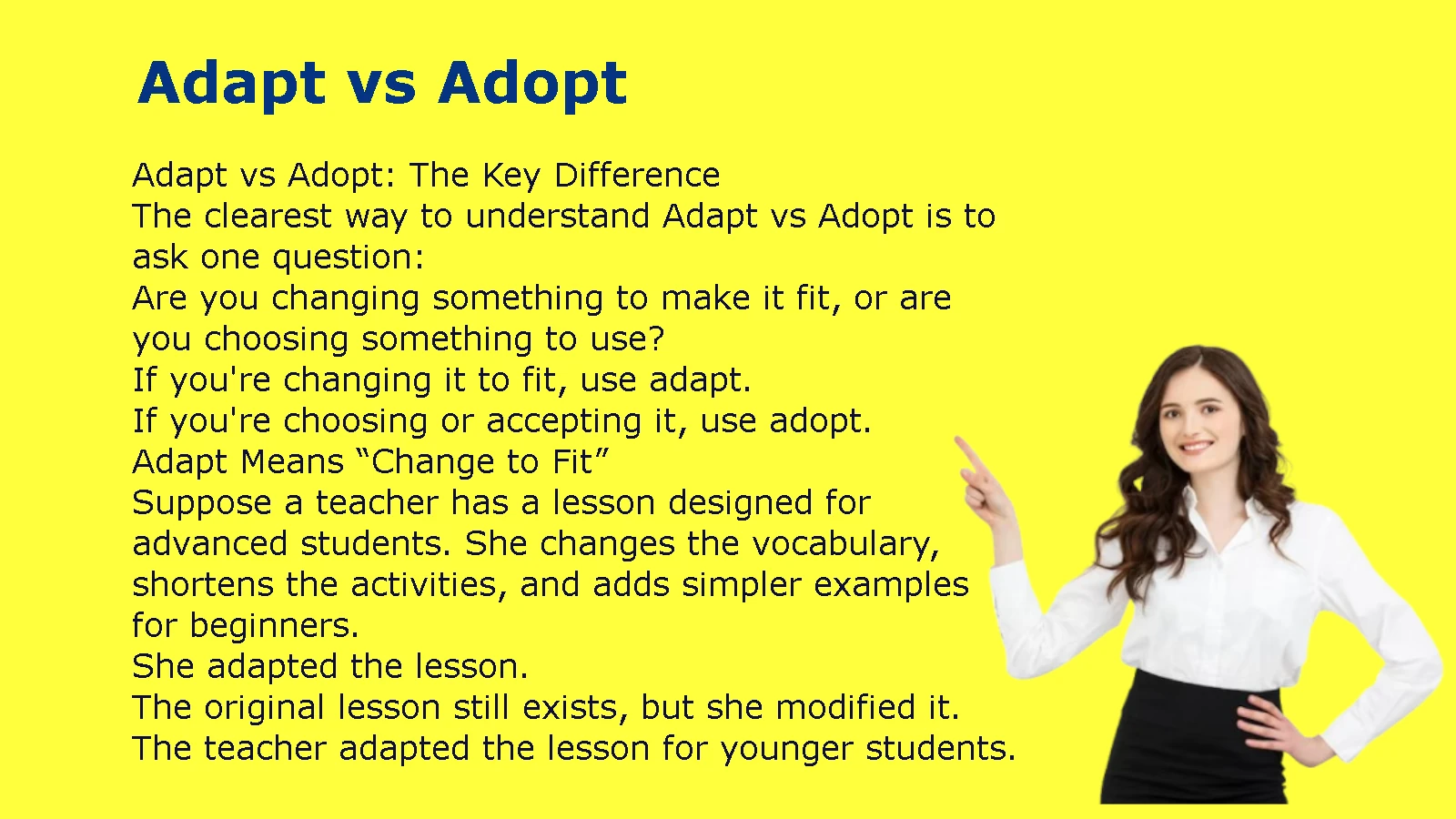
Adapt vs Adopt: The Key Difference
The clearest way to understand Adapt vs Adopt is to ask one question:
Are you changing something to make it fit, or are you choosing something to use?
If you’re changing it to fit, use adapt.
If you’re choosing or accepting it, use adopt.
Adapt Means “Change to Fit”
Suppose a teacher has a lesson designed for advanced students. She changes the vocabulary, shortens the activities, and adds simpler examples for beginners.
She adapted the lesson.
The original lesson still exists, but she modified it.
The teacher adapted the lesson for younger students.
The focus is on change.
Adopt Means “Choose or Take Up”
Now imagine a school decides to use a completely new teaching system.
The school adopts the system.
The focus isn’t necessarily on changing the system. The school has decided to accept and use it.
The school adopted a new teaching method.
The focus is on choice.
Adapt vs Adopt Examples Side by Side
| Adapt | Adopt |
| She adapted the recipe for children. | She adopted a healthier diet. |
| The teacher adapted the lesson for beginners. | The school adopted a new curriculum. |
| The team adapted its strategy to changing conditions. | The team adopted a new strategy. |
| He adapted to his new workplace. | He adopted a new work routine. |
| The author adapted the novel for film. | The company adopted a new policy. |
| The product was adapted for local customers. | The business adopted a new marketing approach. |
Notice an important detail: adapt and adopt can sometimes appear with the same nouns.
For example, both verbs can work with strategy:
- The company adapted its strategy to changing market conditions.
- The company adopted a new strategy.
These sentences aren’t interchangeable.
In the first sentence, the company changed an existing strategy.
In the second, it chose a strategy to use.
That’s why context matters.
Adapt to vs. Adopt
One of the most common mistakes involves confusing adapt to with adopt.
The two expressions sound similar, but their grammar and meanings differ.
Adapt to Means “Adjust to”
Use adapt to when someone or something adjusts to a situation.
Examples:
- She adapted to her new job.
- He adapted to the colder climate.
- The company adapted to changing customer expectations.
- The children adapted to their new school.
- The software adapted to the new operating environment.
The structure is:
adapt to + situation, condition, environment, or activity
You can also use a gerund after to:
She adapted to working from home.
Here, to is a preposition rather than the infinitive marker.
Adopt Means “Choose or Begin Using”
Use adopt when someone chooses or accepts something.
Examples:
- She adopted a healthier routine.
- He adopted a new approach.
- The company adopted remote work.
- The school adopted new safety rules.
- The team adopted a different strategy.
There is no need for to between adopt and its object.
Compare the Two
The employee adapted to remote work.
This means the employee adjusted to working remotely.
The employee adopted a remote work schedule.
This means the employee chose or began using that schedule.
Both sentences can describe the same broad situation, but they focus on different actions.
Adapt vs Adopt in Business
Business writing frequently uses both words because companies constantly respond to change and introduce new practices.
Use Adapt for Adjusting
Use adapt when a company modifies an existing product, service, process, or strategy.
Examples:
- The company adapted its product for international markets.
- The team adapted its strategy after customer feedback.
- The retailer adapted its website for mobile shoppers.
- The manufacturer adapted the design to reduce production costs.
The company already had something. It changed that thing to make it more suitable.
Use Adopt for Choosing
Use adopt when a company begins using a new system, policy, method, or strategy.
Examples:
- The company adopted a four day workweek.
- The team adopted a new project management system.
- The business adopted stricter security policies.
- The organization adopted a customer first approach.
Cambridge’s Business English Dictionary specifically gives adopt an approach/strategy/policy and similar patterns.
A Business Case Study
Imagine a retail company launches an online store.
At first, the website works only for desktop computers. After reviewing customer behavior, the company changes the layout so the site works better on phones.
The company adapts the website.
Later, management decides to introduce a new customer service system developed by another company.
The business adopts the system.
The distinction looks like this:
Existing website → modified for mobile → adapted
New system → chosen and put into use → adopted
That simple sequence captures the difference between the two verbs.
Adapt vs Adopt in Education
Education provides another useful contrast.
A teacher might have a standard lesson plan but discover that students need more visual examples.
The teacher adapts the lesson.
However, if the school decides to start using a new curriculum, it adopts the curriculum.
Compare:
The teacher adapted the lesson for students with different learning needs.
The school adopted a new curriculum.
The first sentence describes modification.
The second describes selection and acceptance.
Other examples include:
- Teachers adapt activities for different age groups.
- Students adapt to new classroom environments.
- Schools adopt new textbooks.
- Districts adopt new academic standards.
- Teachers adopt new instructional methods.
Adapt vs Adopt in Technology
Technology changes quickly, which makes these verbs especially useful.
A company might adopt a new software platform.
Once it begins using the platform, employees may adapt their workflows to it.
For example:
The company adopted a cloud based project management system.
Then:
Employees adapted to the new system.
The company made the decision to use the system. The employees adjusted to it.
A development team could also adapt existing software for a different device or audience.
For example:
The developer adapted the application for tablets.
The application already existed. The developer modified it.
Adapt vs Adopt in Writing and Entertainment
The word adapt has a particularly important role in books, movies, television, and theater.
When someone changes a work from one format into another, adapt is normally the appropriate verb.
For example:
- The director adapted the novel for film.
- The studio adapted the comic book for television.
- The author adapted the short story for the stage.
Merriam Webster and Cambridge both give this sense of adapt, including adapting a novel or other work for another format.
The original work serves as the source. The new version changes it to suit another medium or audience.
That’s adaptation.
By contrast, adopt can describe choosing a style, attitude, name, or viewpoint.
Adapt vs Adopt in Everyday Life
The distinction becomes easier when you see how naturally these words fit ordinary situations.
Moving to a New City
When you move to a new city, you may need to adapt to unfamiliar traffic patterns, weather, schedules, and social habits.
You adjust to the environment.
At the same time, you might adopt a new daily routine.
You choose to make that routine part of your life.
Changing Your Diet
Suppose you already have a favorite recipe but need to change it because you can’t eat one ingredient.
You adapt the recipe.
If you decide to follow a vegetarian diet, you adopt a vegetarian lifestyle.
Starting a New Job
A new job may require you to adapt to a different workplace culture.
You might also adopt new habits, such as keeping a digital task list or following a new meeting schedule.
These examples show why the two words can appear close together while still performing different jobs.
Common Mistakes With Adapt and Adopt
Similar spelling makes these words easy to mix up. Fortunately, the most common mistakes follow a few predictable patterns.
Mistake: “Adopt to a New Environment”
Incorrect:
She adopted to her new environment.
Correct:
She adapted to her new environment.
Why?
Because the person is adjusting to the environment. She isn’t choosing the environment as something to take on.
The correct pattern is:
adapt to + situation
Mistake: “Adapt a New Policy”
This sentence can be correct in a different context, but it often isn’t what the writer means.
If you mean that an organization chooses a policy, use adopt:
The company adopted a new policy.
If you mean that the organization changed an existing policy, adapt can work:
The company adapted its policy to meet new regulations.
The difference is subtle but important.
Mistake: “Adopt the Novel for Film”
Incorrect when you mean changing the novel into a screenplay:
The director adopted the novel for film.
Correct:
The director adapted the novel for film.
The director modifies the original work to fit a new medium.
Mistake: Treating Adapt and Adopt as Synonyms
Although both words can involve change, they’re not interchangeable.
Compare:
The company adapted its strategy to the new market.
This means the strategy changed.
The company adopted a new strategy.
This means the company chose a new strategy.
Replacing one word with the other can change the sentence’s meaning completely.
Adapt vs Adopt: Common Word Combinations
Learning common word combinations can make the distinction much easier.
Common Combinations With Adapt
- adapt to change
- adapt to a situation
- adapt to a new environment
- adapt to new conditions
- adapt to a new job
- adapt a plan
- adapt a strategy
- adapt a lesson
- adapt a recipe
- adapt a book for film
- adapt a product for a new market
- adapt something to a particular purpose
Common Combinations With Adopt
- adopt a policy
- adopt a strategy
- adopt an approach
- adopt a method
- adopt a habit
- adopt a lifestyle
- adopt a routine
- adopt an idea
- adopt a rule
- adopt a system
- adopt a technology
- adopt a name
- adopt a child
- adopt a pet
These combinations aren’t rigid rules, but they reveal the usual semantic difference between the two verbs.
Adapt vs Adopt: Word Forms
Knowing related forms can help you recognize the same distinction in longer sentences.
Forms of Adapt
| Form | Example |
| adapt | We need to adapt. |
| adapts | The system adapts automatically. |
| adapted | She adapted quickly. |
| adapting | They are adapting to change. |
| adaptation | The adaptation took several months. |
| adaptable | She is highly adaptable. |
| adaptability | Adaptability is useful in a changing workplace. |
The noun adaptation refers to the process or result of adapting.
For example:
The film is an adaptation of a popular novel.
Merriam Webster traces adapt through French and Latin roots connected with the idea of being fit or suitable.
Forms of Adopt
| Form | Example |
| adopt | They plan to adopt the proposal. |
| adopts | The company adopts new practices quickly. |
| adopted | The board adopted the policy. |
| adopting | The business is adopting new technology. |
| adoption | Technology adoption has increased. |
| adoptive | She visited her adoptive parents. |
| adopter | Early adopters often try new technology first. |
The noun adoption can refer to the act of choosing or accepting something, as well as the legal process of taking a child into a family.
Merriam Webster traces adopt through Latin adoptare, connected with choosing or deciding.
A Simple Memory Trick for Adapt vs Adopt
Two tiny associations can make these words much easier to remember.
Adapt = Adjust
Think of adapt as being connected with apt, which means suitable or fitting.
When you adapt something, you make it fit.
Adapt = adjust to fit.
Adopt = Opt
Think of adopt as containing opt, as in opt for.
When you adopt something, you choose to take it on.
Adopt = choose or accept.
This isn’t a full explanation of the words’ historical development, but it’s a useful memory aid for everyday writing.
Can Adapt and Adopt Ever Mean the Same Thing?
Generally, no.
They overlap because both words can appear when something changes. However, the underlying action differs.
Adapt focuses on adjustment or modification.
Adopt focuses on selection, acceptance, or taking something on.
Consider this example:
The company adapted its existing policy to meet new regulations.
The policy changed.
Now compare:
The company adopted a new policy to meet new regulations.
The company chose and accepted a different policy.
Both sentences make sense. They simply describe different actions.
Adapt vs Adopt: Quick Comparison Chart
| Question | Adapt | Adopt |
| Does it mean “change to fit”? | Yes | No |
| Does it mean “adjust to a situation”? | Yes | No |
| Does it mean “choose or accept”? | No | Yes |
| Can it describe a new policy? | Yes, if modified | Yes, if accepted |
| Can it describe a new strategy? | Yes, if modified | Yes, if chosen |
| Can it describe a lifestyle? | Sometimes, depending on context | Yes |
| Can it describe adjusting to a workplace? | Yes | No |
| Can it describe legally taking a child into a family? | No | Yes |
| Can it describe changing a book into a movie? | Yes | No |
| Can it describe taking an animal home? | No | Yes |
Adapt vs Adopt: Which Word Should You Use?
When you’re unsure, look at what happens in the sentence.
Ask yourself:
Did someone change something to make it suitable?
If yes, choose adapt.
We adapted the plan to fit the new deadline.
Or ask:
Did someone choose, accept, or begin using something?
If yes, choose adopt.
We adopted a new plan.
A third question helps with situations involving people:
Did someone adjust to a new situation?
If so, use adapt to.
She adapted to her new role.
This three question test covers most everyday uses:
- Change to fit? → Adapt
- Choose or accept? → Adopt
- Adjust to a situation? → Adapt to
Frequently Asked Questions About Adapt vs Adopt
Is it “adapt to” or “adopt to”?
The correct phrase is usually adapt to when you mean “adjust to.”
For example:
She adapted to her new surroundings.
Adopt to isn’t the standard construction for this meaning. Adopt normally takes a direct object:
She adopted a new routine.
Is it “adapt a new approach” or “adopt a new approach”?
Both can be correct, but they mean different things.
Adopt a new approach means choose or begin using a new approach.
The company adopted a new approach to customer service.
Adapt an approach means modify an approach so it fits a particular situation.
The company adapted its approach to meet local customer needs.
Is it “adapt a policy” or “adopt a policy”?
Both are possible.
Use adopt a policy when an organization chooses or formally accepts it.
The board adopted a new policy.
Use adapt a policy when the organization modifies an existing policy.
The company adapted its policy to comply with the new regulations.
Is it “adapt a book” or “adopt a book”?
Use adapt a book when you mean changing the book into another form, such as a movie, television series, or stage production.
The studio adapted the book for television.
Adopt a book can have a different meaning in a particular context, such as selecting a book for classroom use, but it doesn’t mean turning the book into another format.
What is the difference between “adapt to” and “adopt”?
Adapt to means adjust to something.
Adopt means choose, accept, or begin using something.
Compare:
The employees adapted to the new software.
They adjusted to it.
The company adopted the new software.
The company chose to use it.
Is “adapt” a synonym for “change”?
Sometimes, but adapt is more specific.
Change is broad. Something can change for many reasons.
Adapt usually suggests change in response to a condition, purpose, need, or environment.
For example:
The company changed its logo.
This tells us that the logo became different.
The company adapted its logo for a younger audience.
This tells us why and for what purpose the change happened.
Is “adopt” a synonym for “accept”?
Often, but not always.
When you adopt an idea or policy, you accept or choose it for use.
However, adopt has other meanings, including legally taking a child into a family and taking an animal as a pet.
Final Thoughts on Adapt vs Adopt
The difference between Adapt vs Adopt becomes much easier once you focus on the action rather than the spelling.
Adapt means to change or adjust something so it fits a new situation, purpose, or condition. It can also mean adjusting yourself to new circumstances.
Adopt means to choose, accept, or begin using something. It can also describe legally taking a child into a family or taking an animal as a pet.
Keep these three rules in mind:
- Adapt = adjust or modify.
- Adapt to = adjust to a situation.
- Adopt = choose, accept, or take on.
The difference becomes especially clear in paired examples:
The team adapted its strategy to the changing market.
The strategy was modified.
The team adopted a new strategy.
The team chose a new strategy.
When you’re stuck, ask one simple question: Am I changing something to make it fit, or am I choosing something to use?
If you’re changing it, adapt is usually the word you need. If you’re choosing or accepting it, adopt is the better choice.